
BIM technology has emerged as a groundbreaking innovation in recent years. While it has seen widespread adoption internationally, in China’s construction sector, its use remains mostly confined to major design institutes and a handful of engineering consulting firms. What are the key application features of BIM technology, and what does its future hold? Let’s explore.
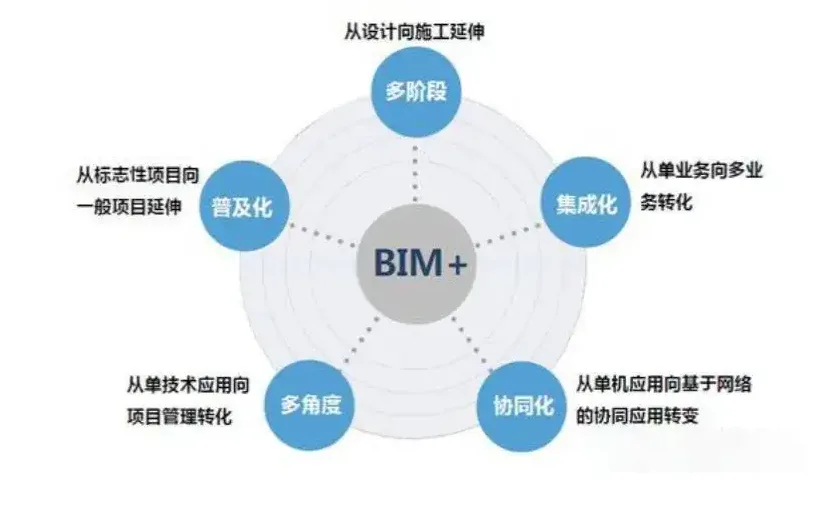
1. Key Application Characteristics of BIM Technology
1. BIM offers a visual approach by representing traditional linear components as three-dimensional physical models, providing a more intuitive understanding.
2. Beyond simulating designed building models, BIM can also simulate scenarios that cannot be physically tested in reality. During the design phase, BIM enables simulation experiments for various design elements requiring analysis.
3. The entire design, construction, and operation process is a continuous cycle of optimization. Although optimization is not inherently tied to BIM, the technology facilitates more effective improvements. Optimization depends on three critical factors: information, complexity, and time.
4. BIM supports collaborative workflows, maintaining automated processing capabilities along with ensuring information relevance and consistency throughout the project lifecycle.
5. It serves as a platform for information exchange, delivering a clear, repeatable, verifiable, and maintainable information environment that supports the entire building lifecycle.
2. The Advantages of the BIM Industry
According to the national 2016-2020 plan, China has committed to vigorously promoting the development of building information management. Currently, large-scale engineering projects require the use of building information models. Implementing BIM helps save substantial amounts of money, materials, and rework time.
As demand for BIM grows, it naturally drives industry development and increases the need for skilled BIM professionals.
At present, BIM certification is divided into three levels: BIM Modeler, BIM Senior Modeler, and BIM Application Designer, ranked from entry-level to advanced. Certificates issued by the Ministry of Human Resources and Social Security carry significant authority and industry credibility. Additionally, the Ministry of Industry and Information Technology organizes exams, though there is not yet a unified national BIM certification. Both certifications are valued and verifiable.
BIM technology is gaining immense popularity. Entering this field offers promising career prospects and attractive compensation. With BIM just beginning to be widely promoted, the demand for talent is high, and remuneration for senior experts is substantial.
















Must log in before commenting!
Sign Up