
BIM (Building Information Modeling) technology is an advanced information system encompassing geometry, spatial relationships, geographic information systems, and detailed properties and quantities of various building components, including supplier information. Among its key aspects, BIM modeling technology plays a crucial role. So, how are BIM models established? The following provides a detailed explanation.

1. BIM Building Modeling Standards
Precast and prefabricated building components can be incorporated into BIM models as individual objects.
Building components must be created using the appropriate tools. If existing tools are insufficient, alternative tools may be used, provided the component’s “type” is properly defined.
Components smaller than the modeling requirements do not need to be modeled in 3D; instead, 2D drawings should be used to supplement explanations.
Detailed 2D drawings serve as an important complement to the BIM model.
Building components should be modeled separately for each floor.
Required parameters include type, material ID, and size, with the “type” parameter serving as the basis for quantity extraction.
If multiple tools are available to create a component, the final model must clearly define the component’s “type”.
For example, if both “version” and “beam” tools can be used to build a “road,” the “type” parameter for the completed “road” should be set as “road”. Structural components must be modeled according to dimensions provided by structural engineers.
2. BIM Structural Modeling Standards
Contractors and subcontractors must collaborate to adjust the detailed structural model to match the construction model based on assembly methods. When necessary, the structural model should be enhanced with manufacturing drawings.
The structural consultant develops both a structural analysis model and a structural BIM model based on actual component locations and dimensions, which will generate the structural files.
Precast and prefabricated structural components can also be designed using specialized tools, then integrated into the structural BIM model after completion.
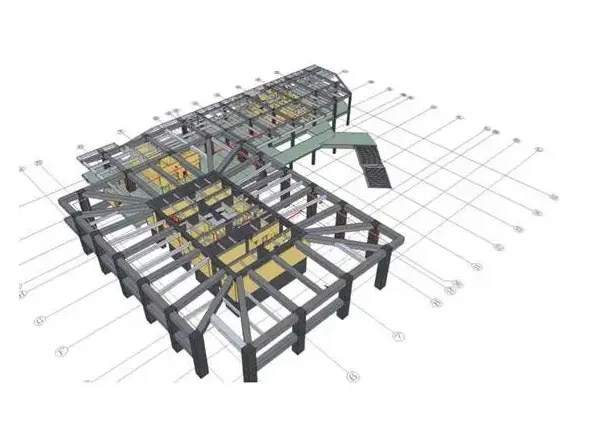
The structural BIM model includes all load-bearing elements made of concrete, wood, and steel, as well as non-load-bearing concrete structures. Core components include walls, slabs, beams, and lattice frames, which must be modeled using the appropriate tools (e.g., walls, slabs). If suitable tools are unavailable, alternative tools may be used, but the component’s “type” must be clearly defined.
The structural model can be divided into stages aligned with structural approval processes. During detailed design, steel bars and joints can be modeled using specialized tools.
Components smaller than the modeling threshold, such as those under 10 centimeters, do not require 3D modeling and can be represented with 2D drawings.
2D graphics are useful for load planning. When BIM modeling software is limited, 2D drawings can be used to detail columns, including their shape and cross-section.
Structural components should be organized by floor level. Parameter requirements include type, material, ID code, and size, with the “type” parameter used for quantity extraction.
When multiple tools can create a component, the component’s “type” must be clearly defined. For example, after assembling a roof truss from individual beams, the frames should be grouped and assigned the “type” of Truss.
3. BIM Mechanical and Electrical (MEP) Modeling Standards
Special attention should be given when modeling parts that require it.
Any changes made by the construction contractor must be clearly indicated and approved by the engineering consultant.
Objects not available in BIM modeling tools can be represented by box shapes, but must be labeled appropriately with names and parameters.
The elevation of each system component should be clearly marked, referencing the completed floor level or other reference planes.
If necessary, models of fasteners and hanging parts can be created.
Attribute data standards require users to complete the “Completed Model Attribute Data Standard Fields” to classify each COBie worksheet and display domain names along with related management data required for construction permits.
Becoming a proficient BIM modeler requires dedication and continuous learning. While obtaining certification may seem straightforward, increasing the value of that certification is challenging. It is important not only to ensure the certificate is officially recognized but also to enhance personal skills. BIM modeling involves many details and demands extensive study and practice. Persistence is key when pursuing a career in BIM modeling.
Source: Author: BIM Website Source: BIM Website
















Must log in before commenting!
Sign Up