
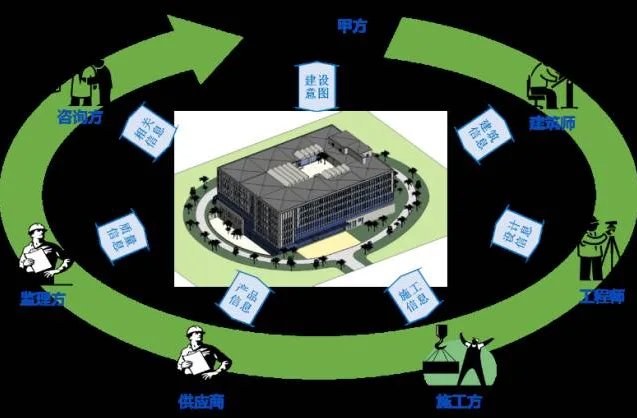
BIM technology primarily aims to enable all stakeholders involved in a construction project—including government regulatory bodies, owners, designers, construction teams, supervisors, cost managers, operations personnel, and project users—to manage information and models throughout the entire project lifecycle, from initial concept to final demolition.
The Essence of BIM Technology
BIM technology manifests through models, with information as its core, writing as its foundation, and software as its tool. At its heart, BIM transforms collaboration among all project participants by centering cooperation around information models.
Overview of BIM Technology
What BIM Technology Can Achieve
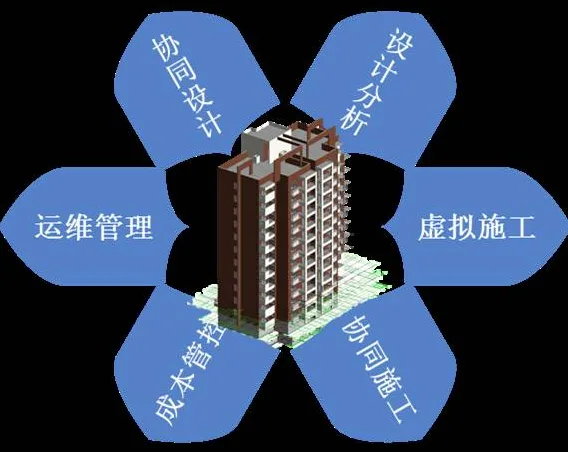
There is extensive information available on this topic, so we will highlight the main aspects here:
- Operation and maintenance management
- Collaborative design
- Design analysis
- Virtual construction
- Collaborative construction
- Cost control
Frequently Asked Questions About BIM Technology
1. Is BIM just a 3D version of CAD?
In civil engineering, traditional CAD tools focus on constructing and designing geometric shapes, resulting in models made up of points, lines, and surfaces. In contrast, BIM emphasizes building object-oriented parametric models. It not only constructs 3D models representing physical engineering objects, but also allows users to easily manage geometric parameters (such as length, width, height) and their relationships (equalities, proportions, adjacency, tangency) through parametric modeling technology.
Beyond parametric geometry, BIM models prioritize establishing and managing object attribute information—such as model details, materials, and physical properties—to support diverse applications throughout the model’s lifecycle. Therefore, BIM tools cover a broad spectrum of functions required for creating, managing, and utilizing BIM models during every phase of an engineering project.
In summary, CAD is primarily about building models, while BIM is about creating comprehensive 3D information databases.
2. Is BIM a software?
Many people mistakenly believe BIM is merely software used for creating 3D images. Surprisingly, this misconception is widespread, as revealed by Silk Road Education’s surveys.
In reality, BIM is neither a single software nor a platform. It represents a new architectural mindset called “spatial digital informatization.” Though it may sound technical, this concept encompasses a vast and profound approach to design and construction.
Space refers to three-dimensionality or beyond—not just limited to 3D, but potentially extending to higher dimensions, such as immersive experiences enabled by BIM combined with VR technology.
Number represents big data, arguably the most advanced and smooth aspect of BIM’s development. Digitization converts all building-related information into computer-readable formats, storing, categorizing, identifying, and reflecting data. This means transforming drawings, models, quantities, and other details into numerical data. While CAD drawings are a form of informatization, BIM’s digital representation is far richer and more detailed.
Informatization means that every model has its own attributes. Although this sounds simple, it’s challenging to implement. It requires a large database capable of real-time updates, continuous additions, and deletions. This complexity has been a major hurdle for BIM development. Despite national efforts to standardize modeling, inconsistent and incomplete information has hindered full standardization. The advantage of informatization is that models can intelligently detect conflicts and issues within building components, significantly reducing construction delays and rework costs.
In architectural design, the cost of converting BIM models on the construction side is 20 times higher than converting them directly at the design stage using BIM technology. Reducing this intermediate cost is key to unlocking BIM’s full value across the entire industry chain.
Source: Author: Silk Road Education
















Must log in before commenting!
Sign Up