
Wedge: Rooted in the Transit-Oriented Development (TOD) concept, Suzhou High-Speed Rail New City serves as the gateway to the Beijing-Shanghai line. In September 2016, New City Holdings Group acquired 27 land plots within this area to blueprint an integrated industrial and urban development. The four adjacent plots introduced here—Plots 12, 16, 17, and 21—are part of this ambitious plan.
01 Suzhou High-Speed Rail New City “South Gate”
Plots 12, 16, 17, and 21 are situated at the southern end of the city’s north-south central axis, within the “Riverside Ecological Zone” of the “One Core, Three Zones, One Axis, and Three Corridors” plan for Suzhou High-Speed Rail New City. They border the Central Landscape Park to the north and the Beijing River Ecological Leisure Zone to the south, forming the “southern gateway” to the new city.
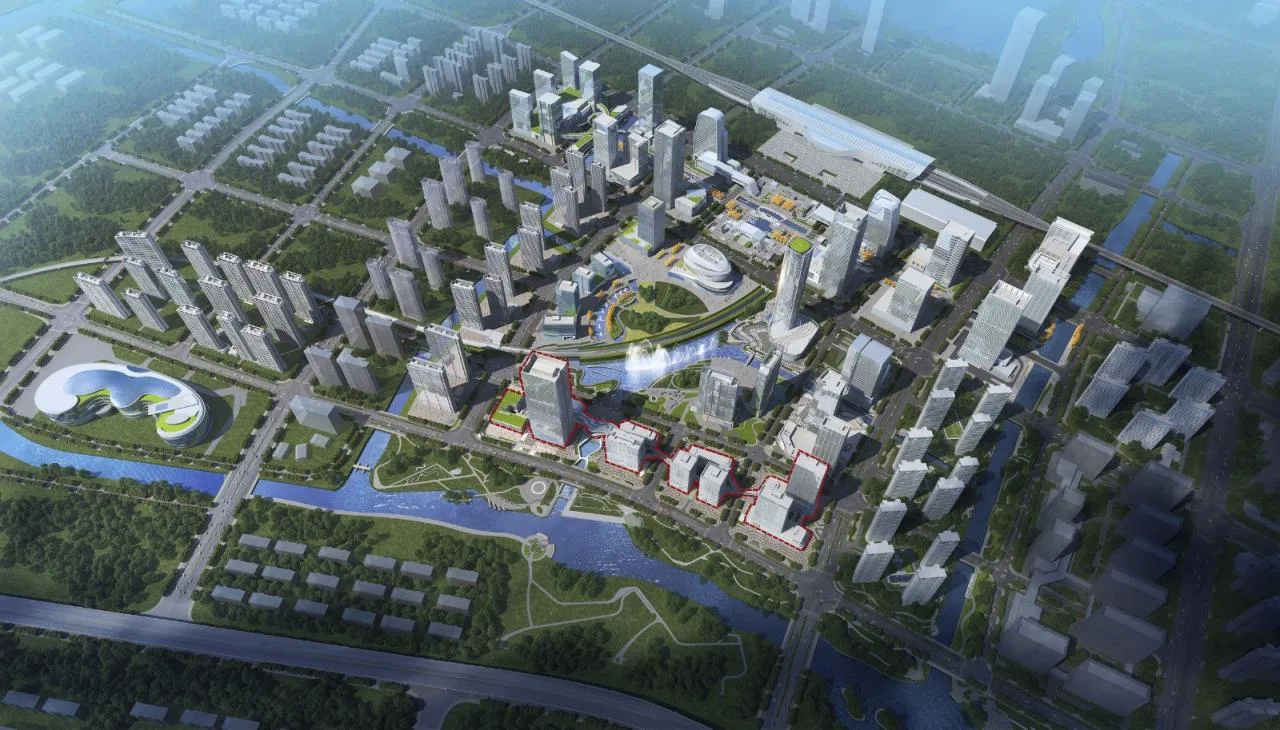
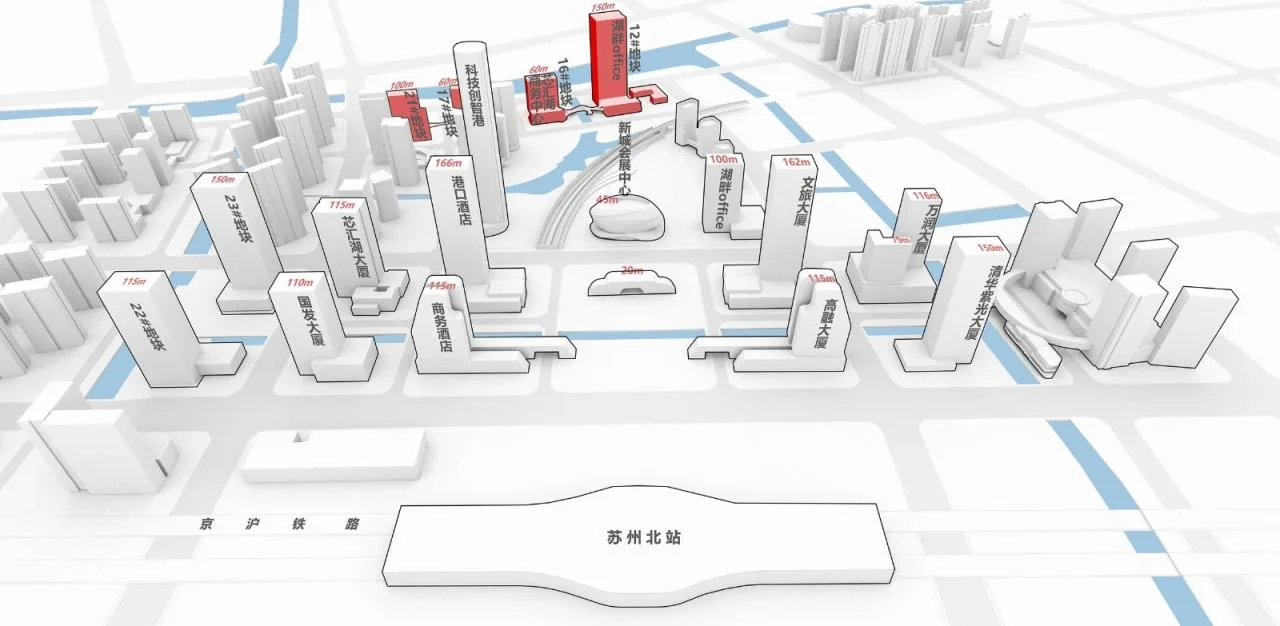
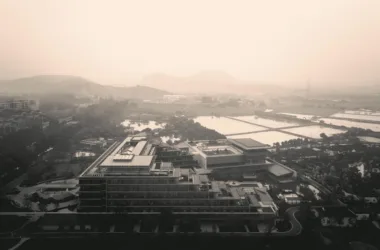
This project encompasses four plots covering a total land area of 45,000 square meters, with a total construction area of 280,000 square meters. Notably, Plot 12 features a 150-meter super high-rise building that serves as a key landmark within the urban skyline, overlooking both the central park of the high-speed rail new city and the riverside landscape.
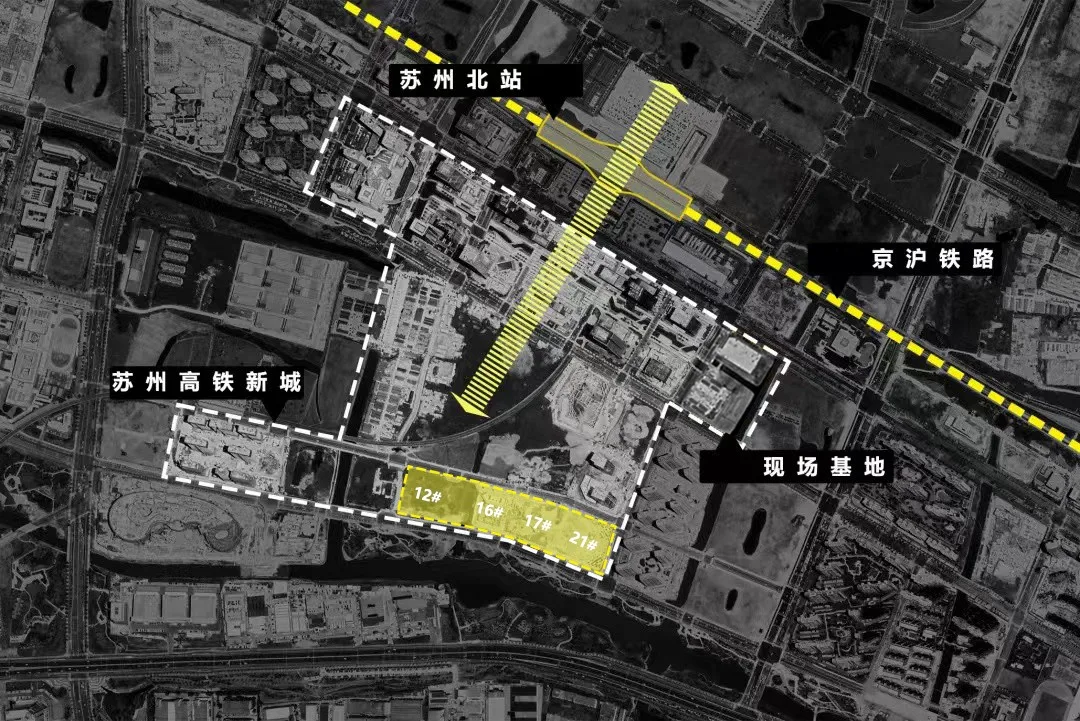
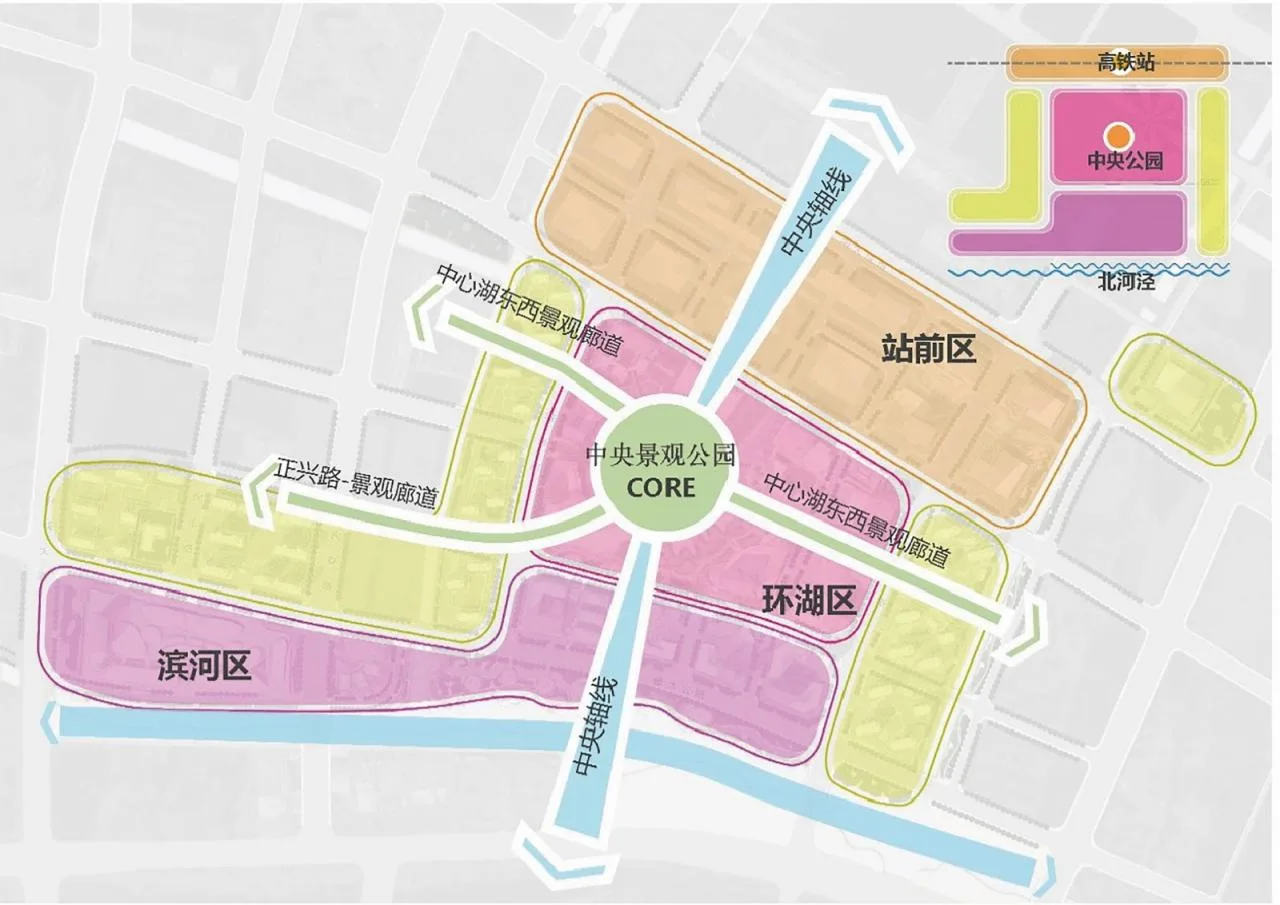
Location analysis
Designed as a regional benchmark for integrated industry and urban development, this block combines diverse commercial functions including Grade A offices, hotels, apartments, retail spaces, and kindergartens. It exemplifies the TOD model by integrating production, commerce, and residential areas within a railway city framework.
02 Urban Design Challenges and Solutions
The design team began with an in-depth study of the urban design guidelines for Suzhou North Station. The overall planning divides the land into four smaller blocks following a “small block” and “dense road network” approach. Urban design guidelines strictly regulate façade styles, tower numbers, and plot ratios to ensure a cohesive and rhythmic skyline upon project completion.
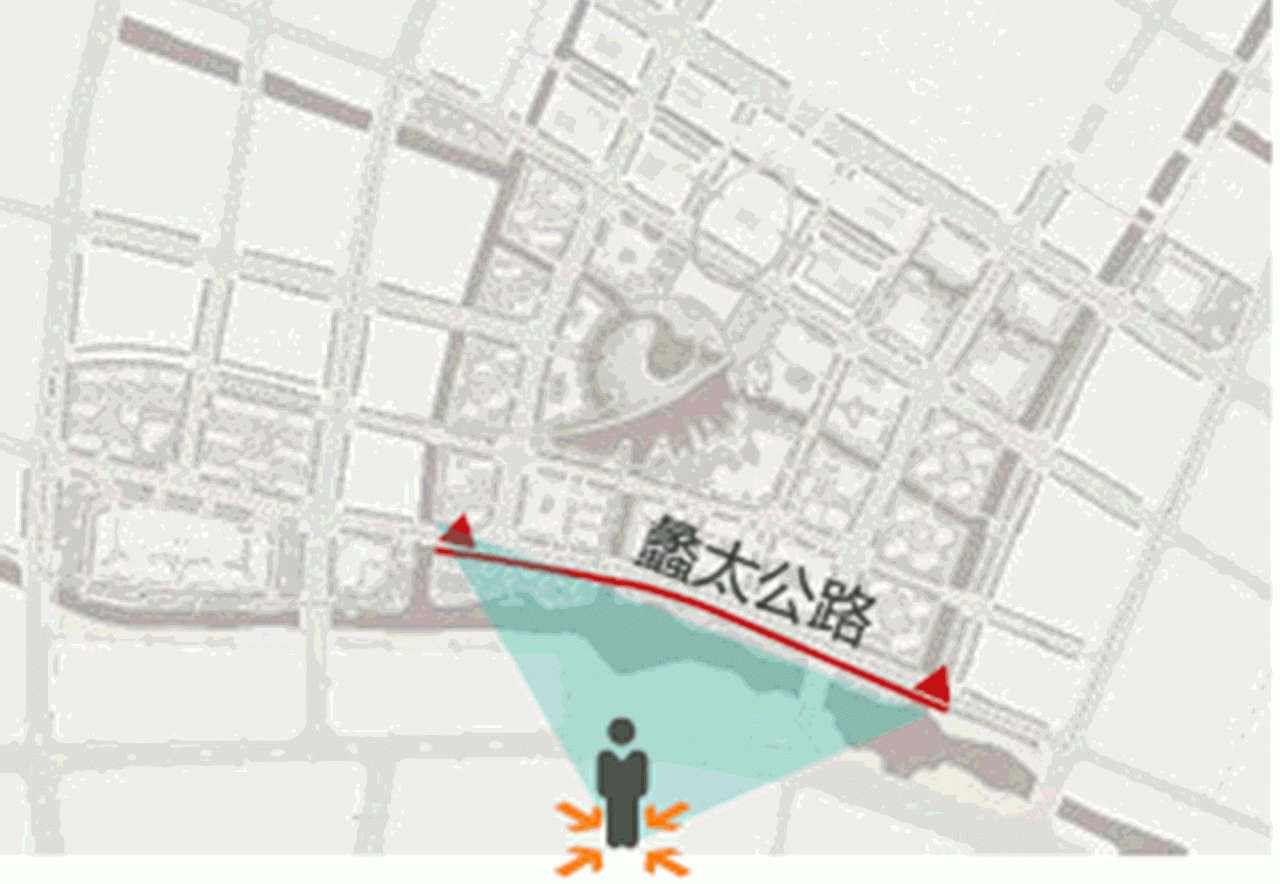
Urban Design Guidelines
The project owner envisions an open commercial district that operates 24/7 and caters to all age groups with diverse business experiences. It aims to foster a dynamic relationship with the 240,000 square meter Xiangcheng Wuyue Square located southwest of the site. This vision moves away from the conventional “main building + podium” model outlined in the original urban design guidelines. A key design challenge is to create a continuous commercial frontage across four fragmented plots, while shaping street and alley spaces that are both inviting and vibrant.
03 Unlocking Potential with ‘Blank Space’
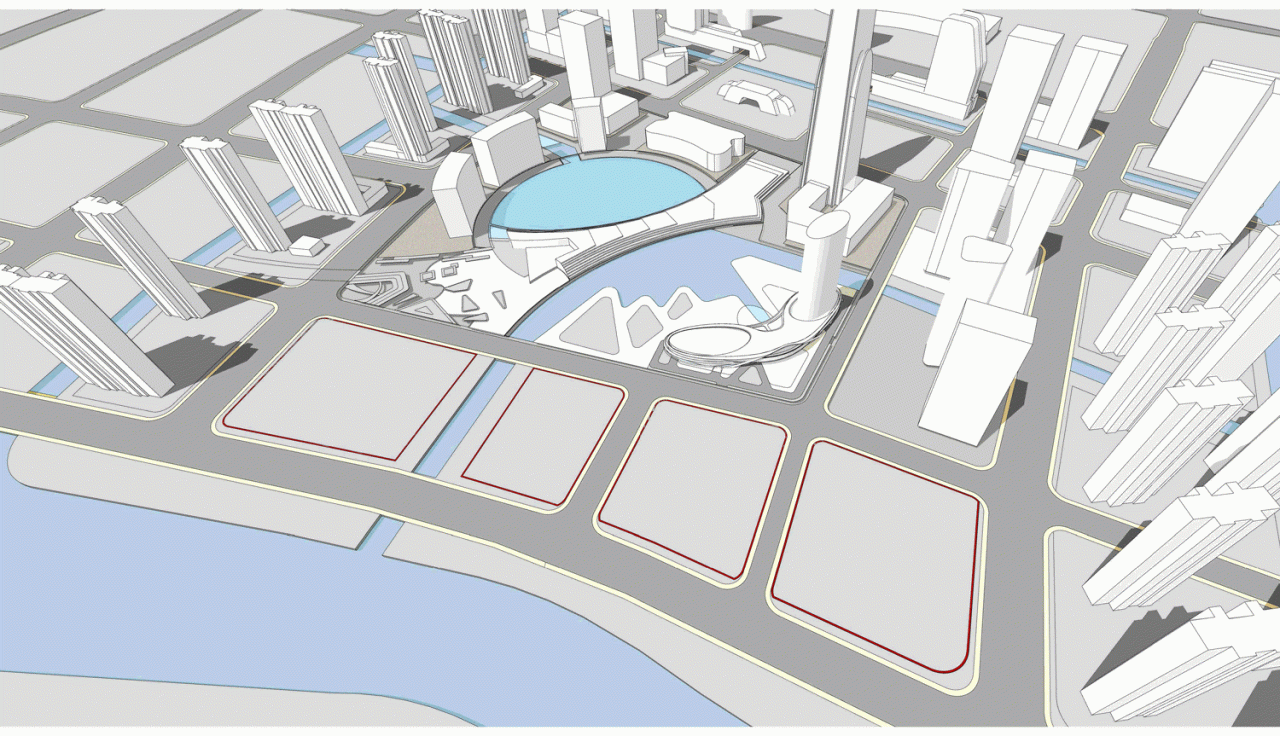
Block development process
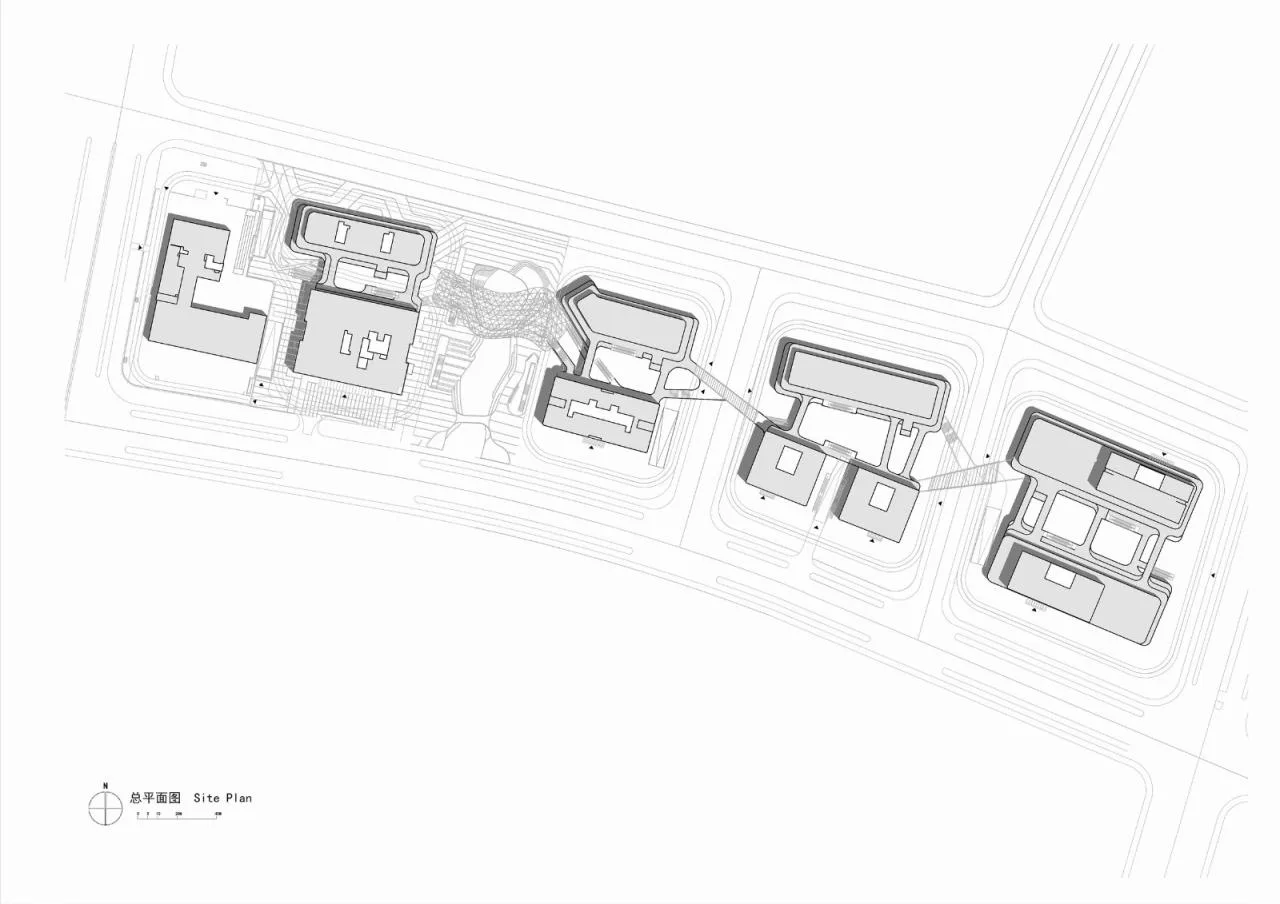
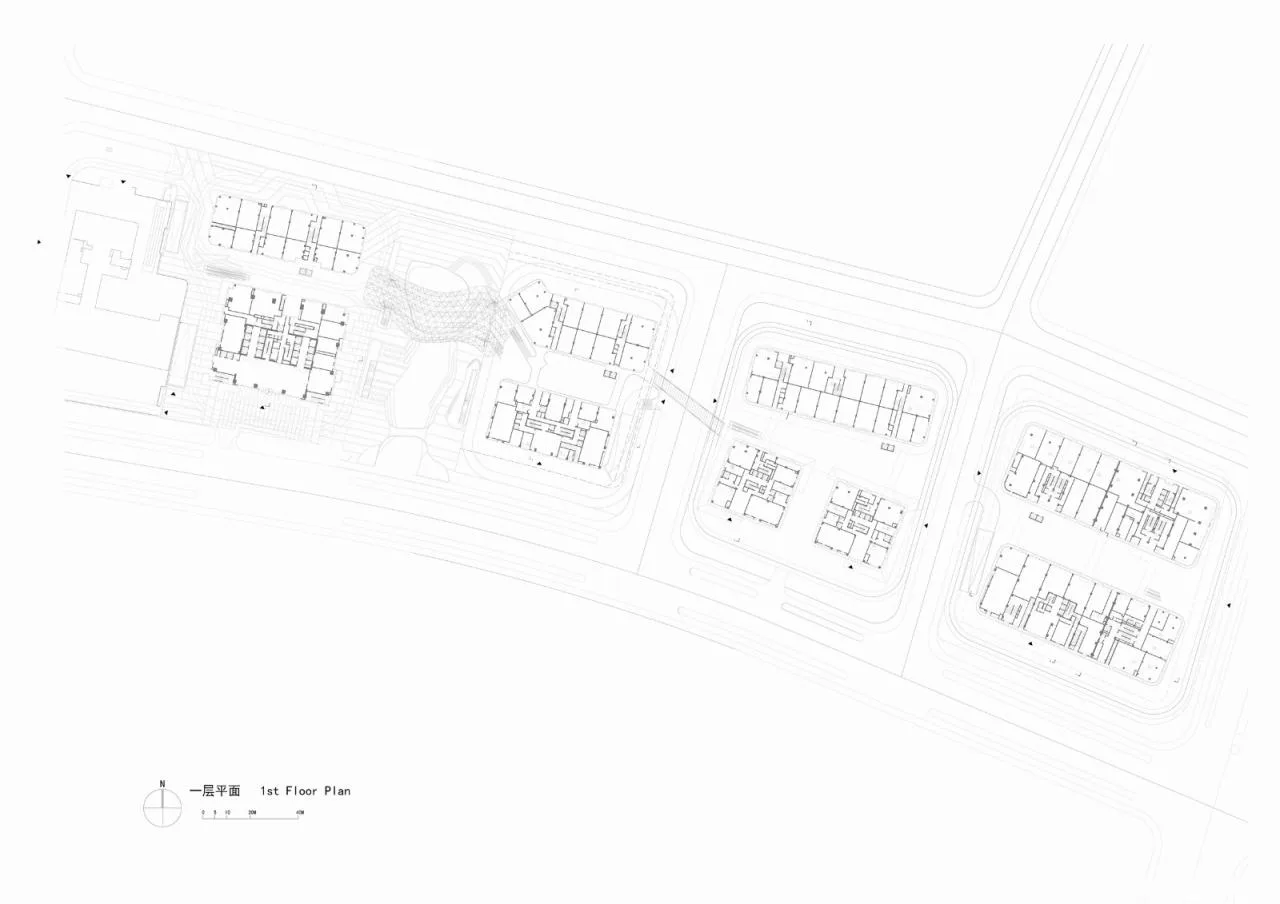
After careful consideration of factors such as commercial value, pedestrian flow, and circulation patterns, the team strategically positioned the tower and podium. The tower is located along the river on the south side. The commercial podium and main building are separated: a moderately deep commercial podium sits beneath the main tower, while most retail spaces are independently arranged along the northern road, facing the landscape core area. This approach maximizes commercial frontage and introduces a “blank space” within the urban fabric, akin to traditional Chinese calligraphy and painting techniques. This negative space opens up rich possibilities for commercial activity.
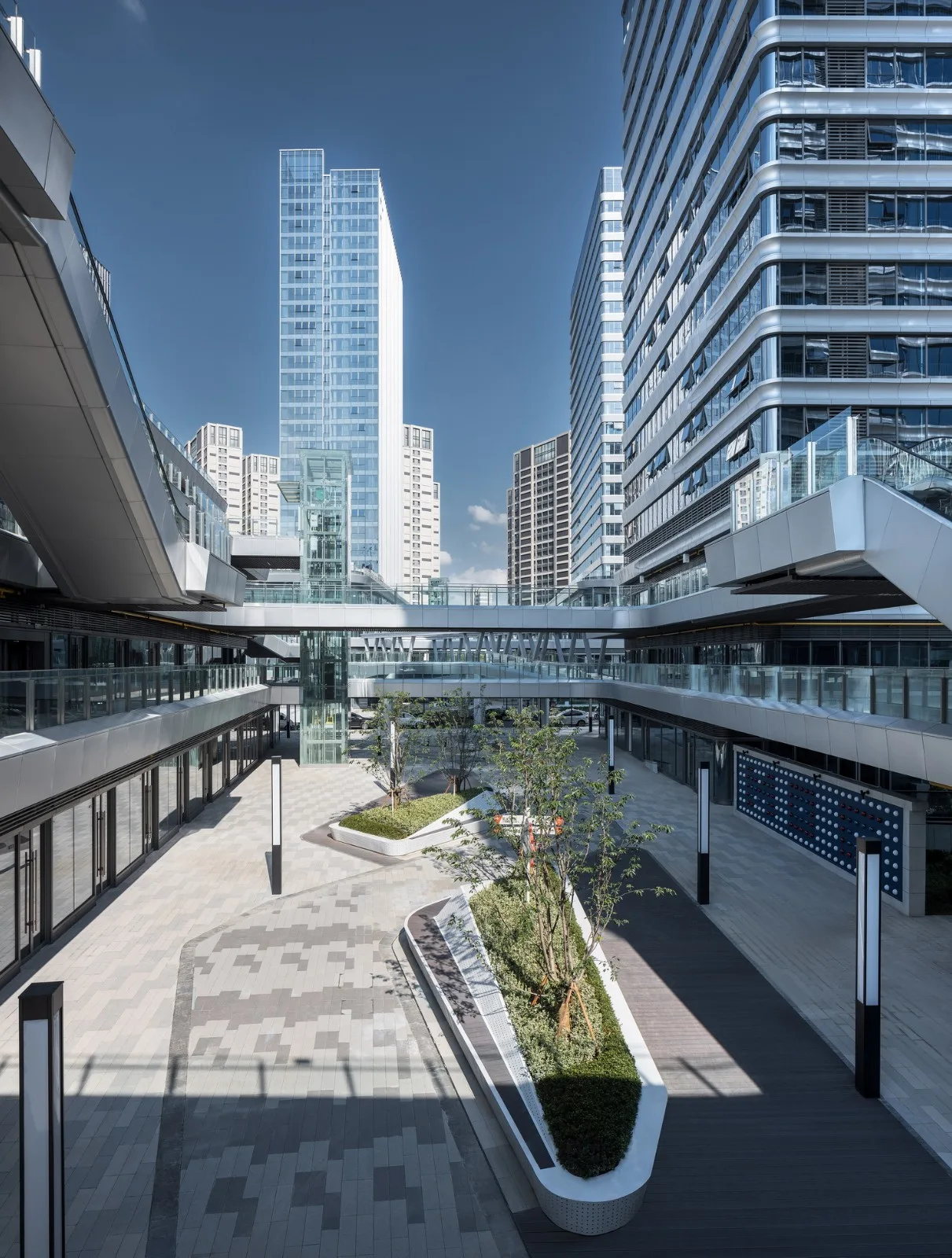
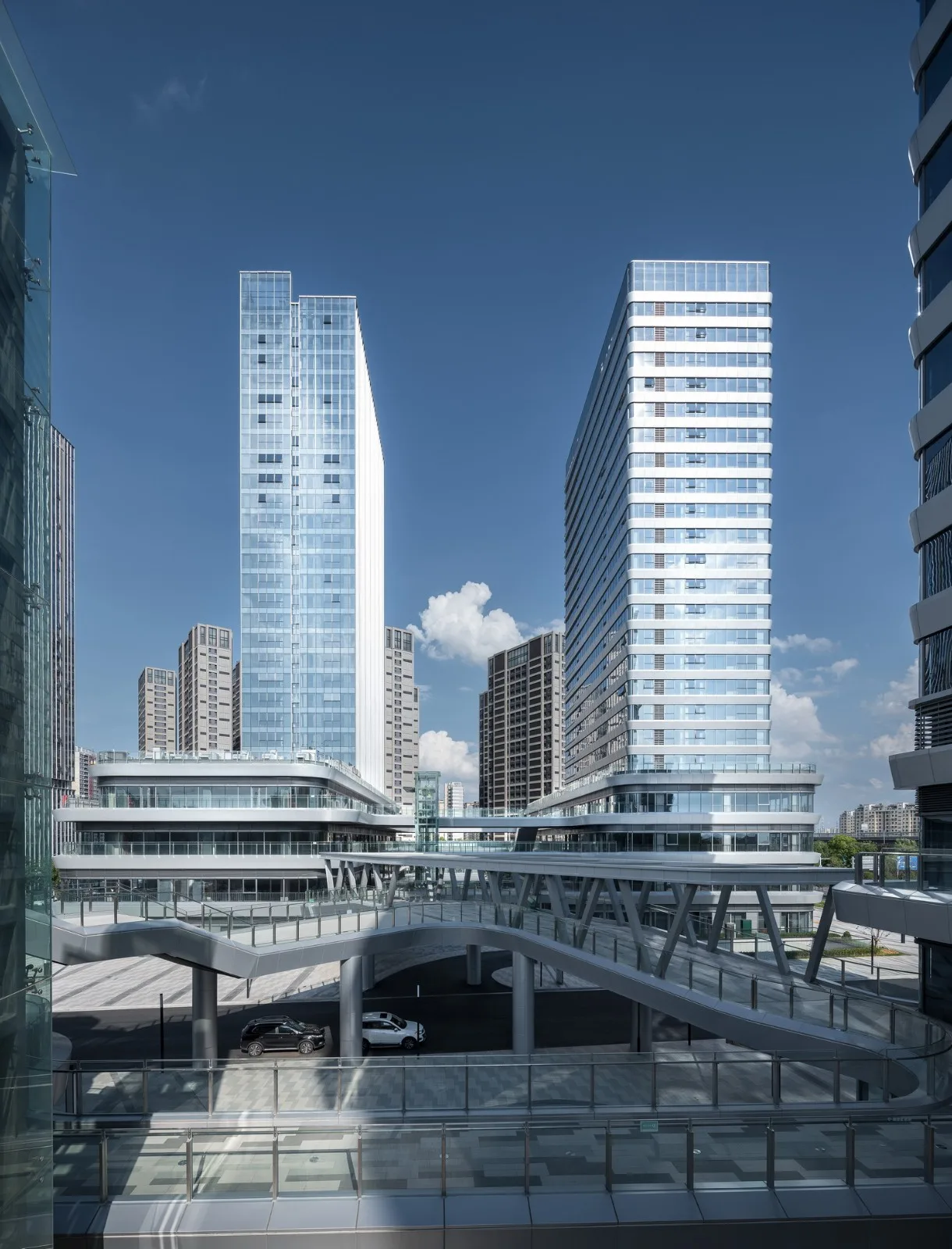
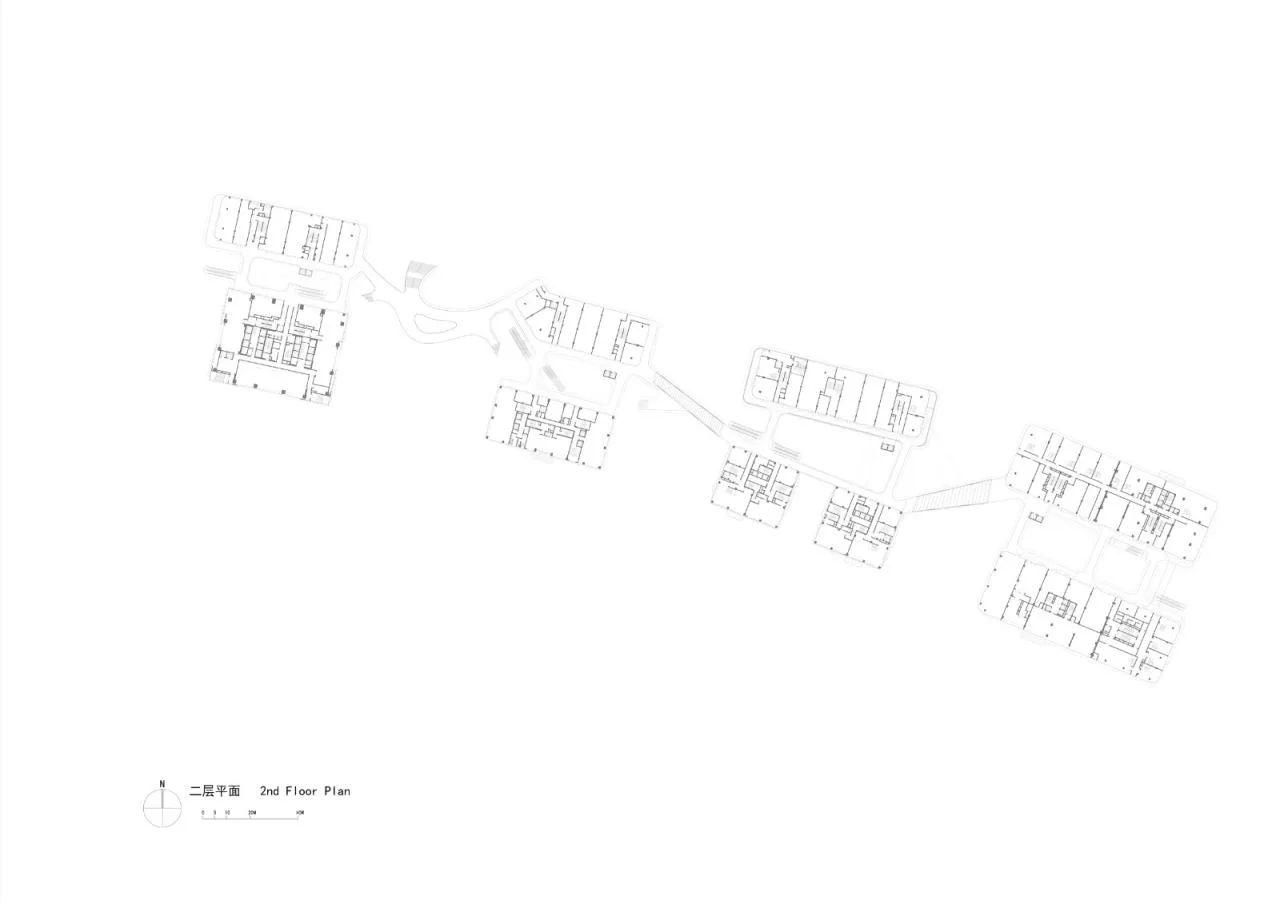
A continuous 500-meter commercial frontage is created between the four plots via setbacks, connecting corridors, and uniquely shaped overpasses. The block is divided into four themed areas aligned with their business focus: “Children’s Fun Park,” “Youth Society,” “Private Enjoyment Hub,” and “Family Photo.” These themes are linked by a musical rhythm narrative inspired by Suzhou’s Pingtan art form, using its four expressions—speaking, laughing, playing, and singing—to correspond with cultural, entertainment, dining, and lifestyle services within each plot.
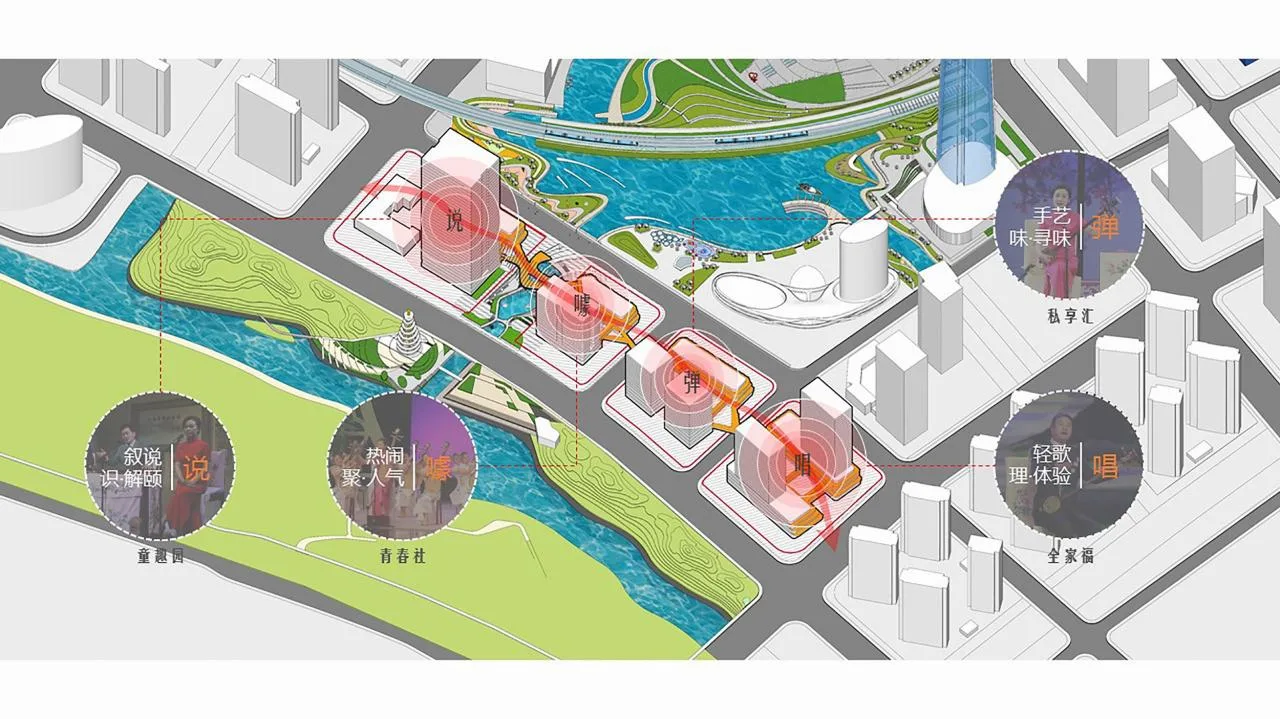
Business Theme Analysis
04 Canyon: Pedestrian Experience
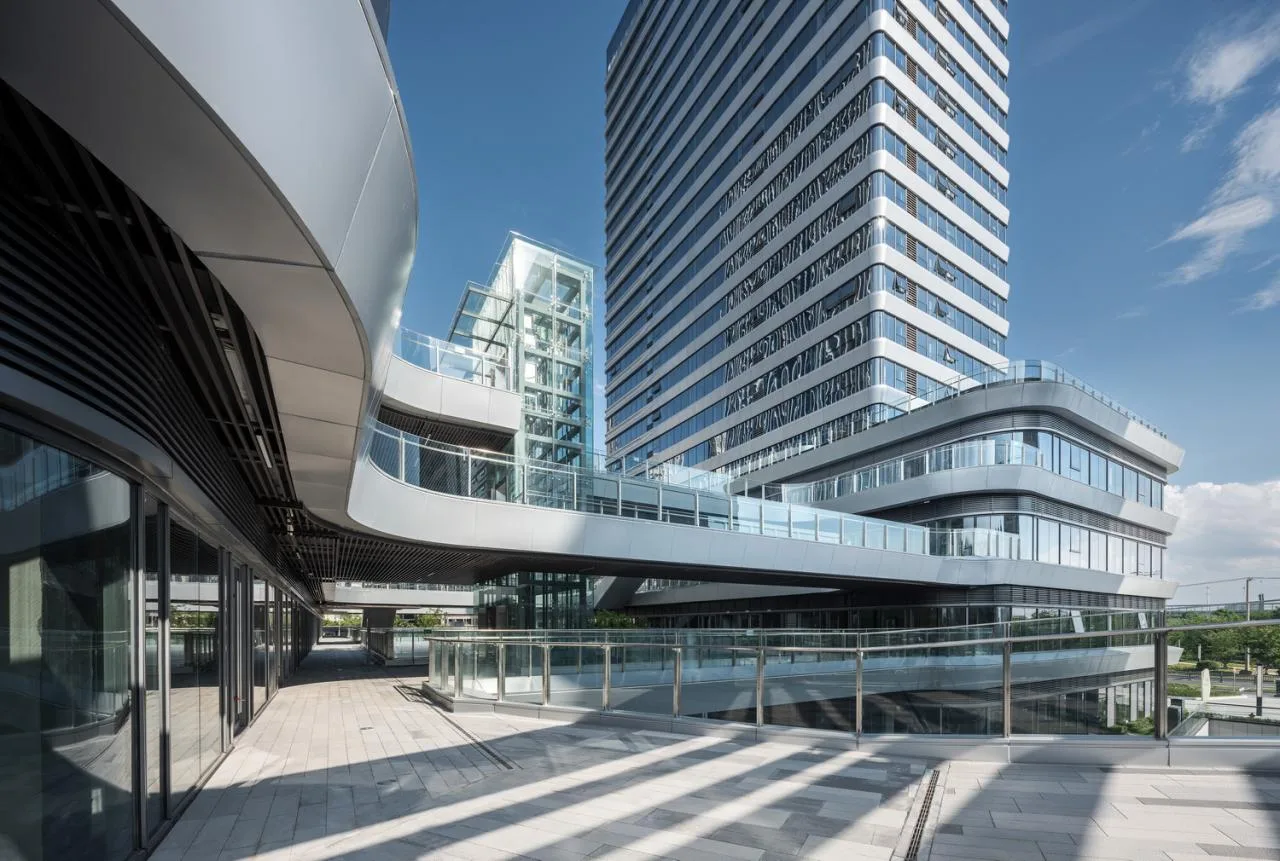
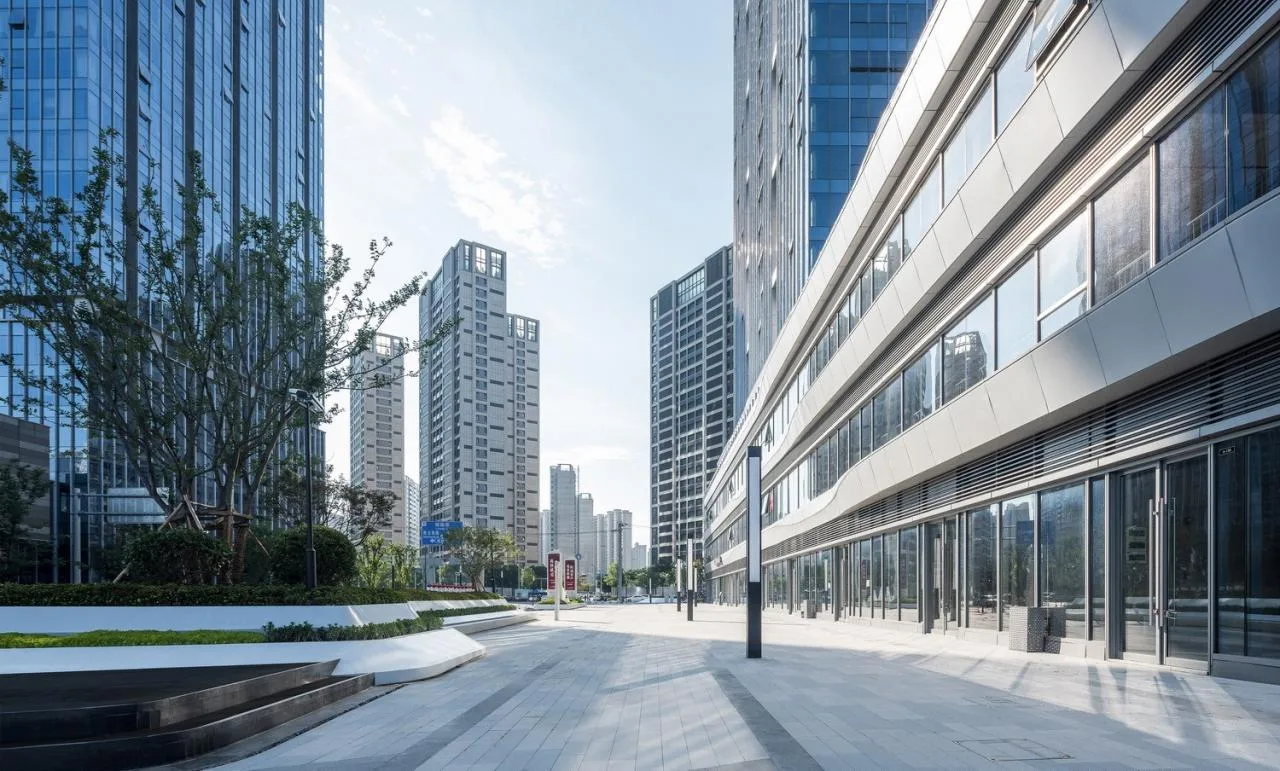
Due to the irregular shape of the plot, the commercial block forms varying angles between buildings on the north and south sides. This results in a naturally dynamic inner street with varying spatial relationships. As the commercial spaces gradually recede along this street, pedestrians experience a sensation of wandering through a canyon, seamlessly transitioning between moments of movement and pause, flow and rest.
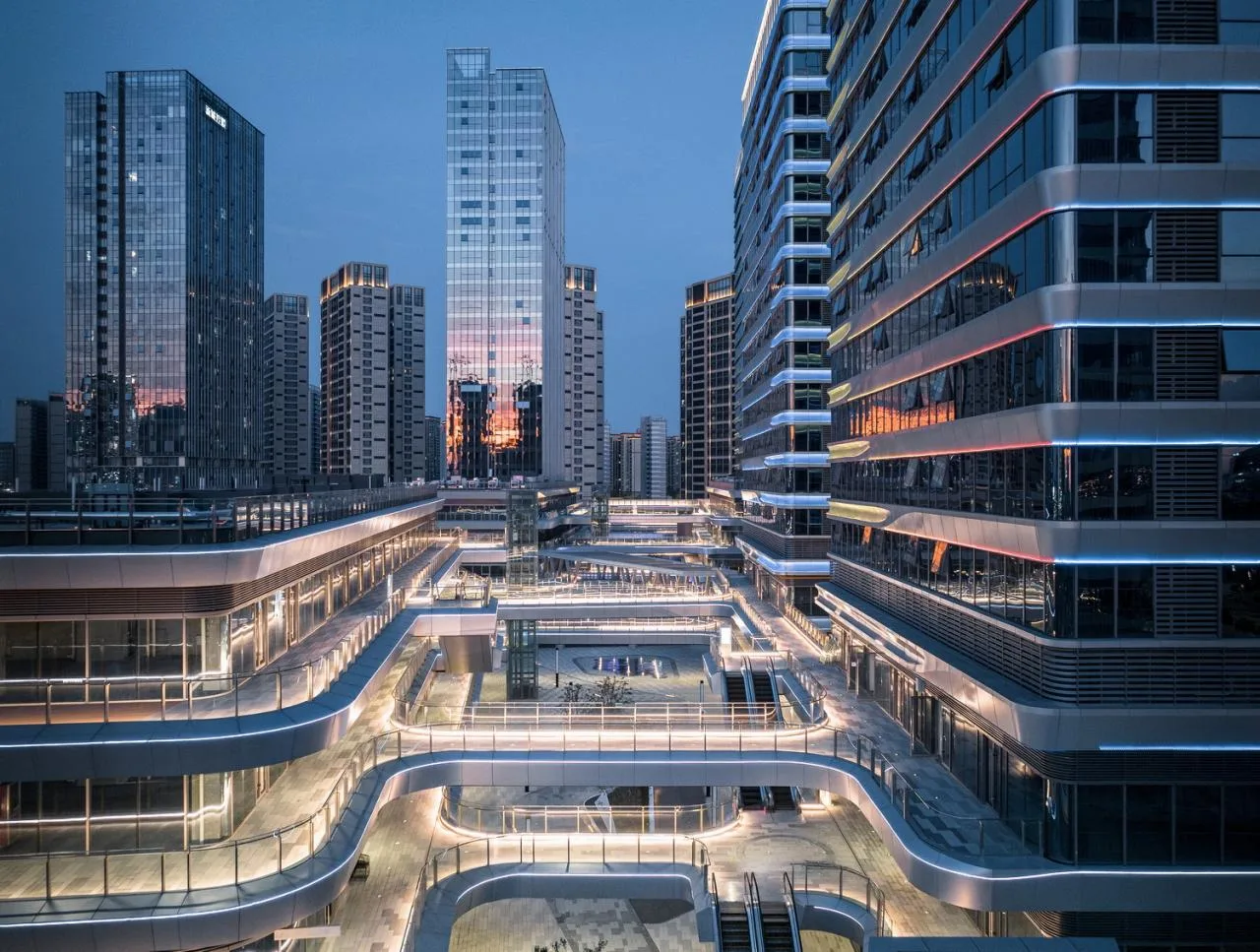
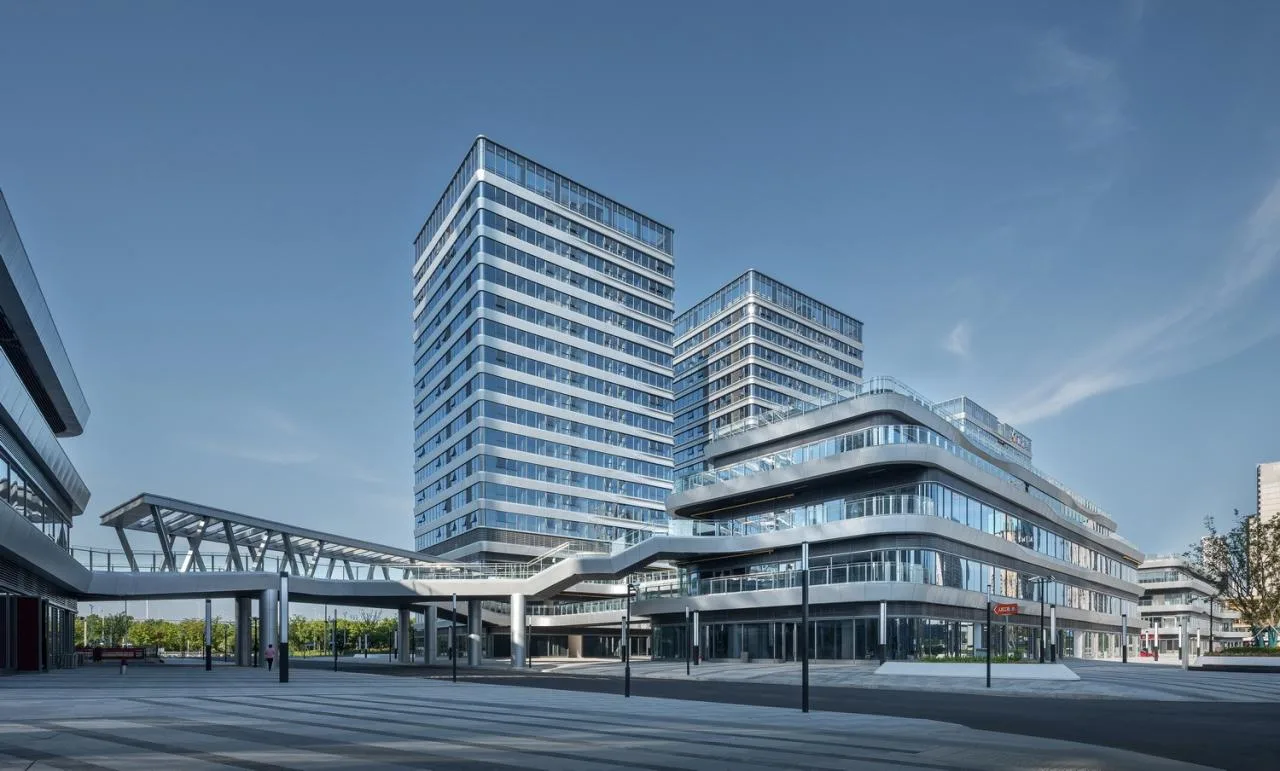
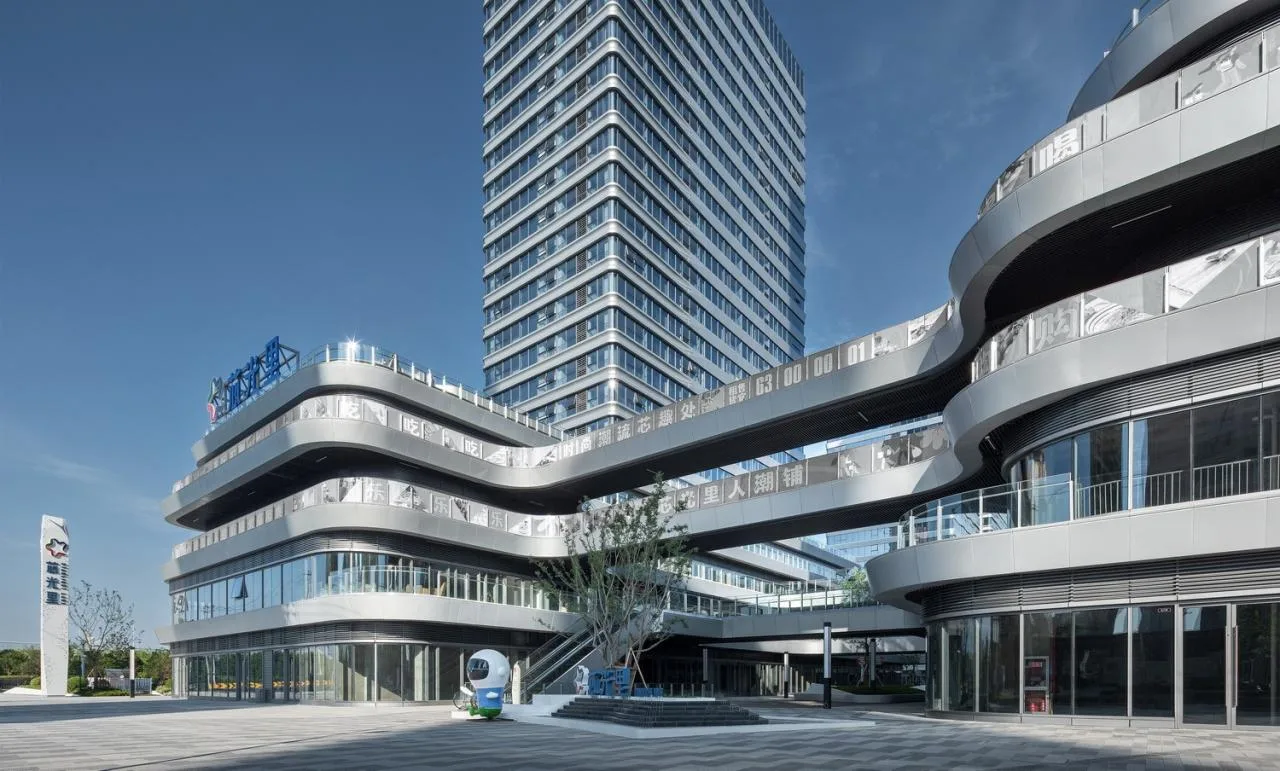
Corridors and bridges are central elements of Suzhou’s cultural identity. This project’s three-layer corridor system forms over ten uniquely shaped bridges connecting commercial streets and plots, which have become signature features. These pedestrian bridges link the four plots in diverse forms, acting as key nodes within the rhythmic progression of the block. They alternate between vibrant, grand gestures reminiscent of the portal square’s music, and gentle, melodious moments reflecting the ancient charm of Pingtan, evoking the city’s cultural spirit.
05 Vehicle System
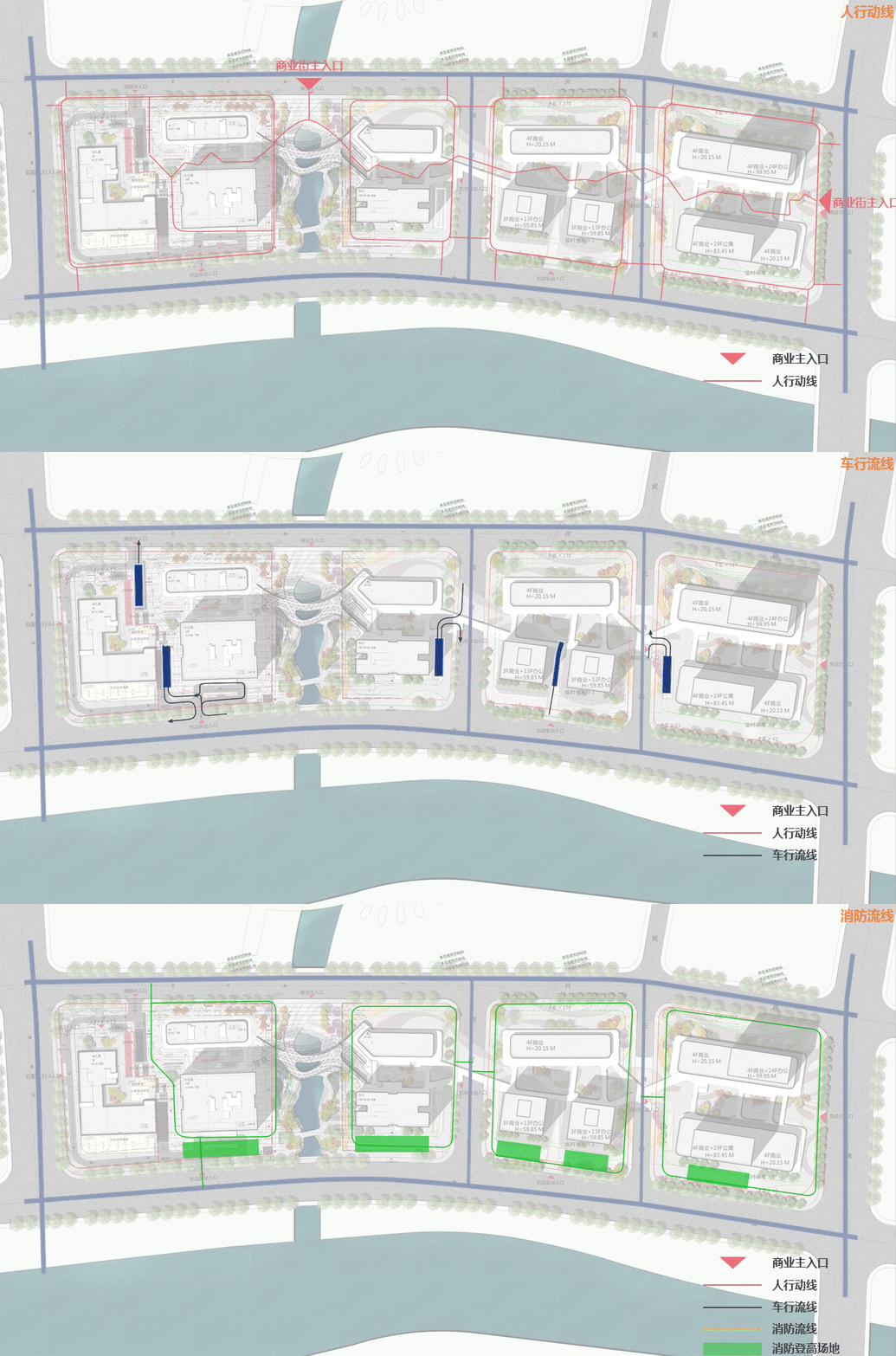
Traffic flow analysis
Surrounded by streets on all sides, the four plots benefit from convenient transportation access. Vehicle entrances and exits have been strategically placed on secondary roads to minimize interference with pedestrian and commercial zones. Additionally, ramps for cars, drop-off areas for offices, apartments, and hotels are positioned along the perimeter to maximize the safety and comfort of pedestrians within the inner commercial streets.
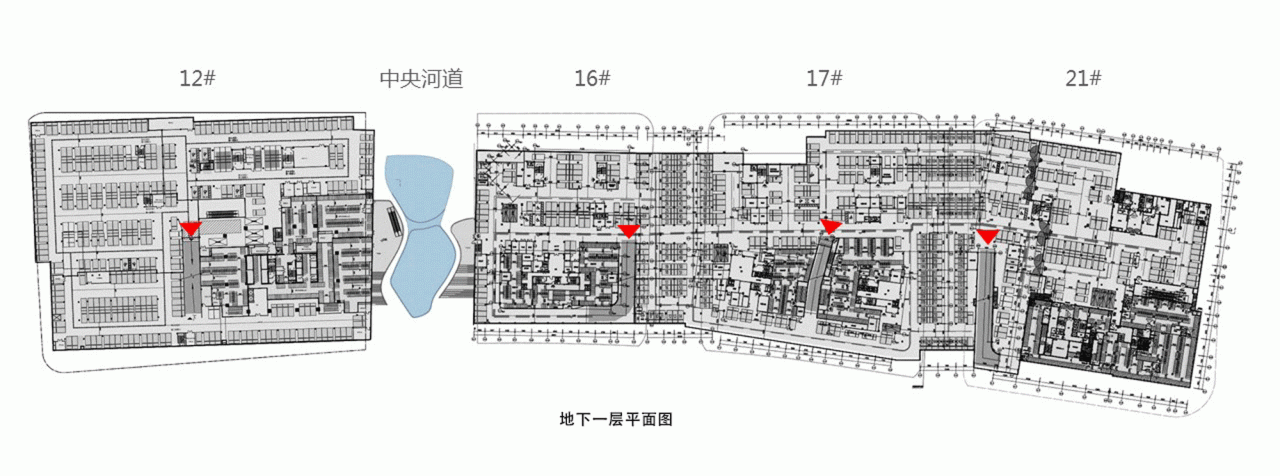
River and underground reservoir system
Designing the basement posed notable challenges. A river divides the four plots underground into east and west sections, connected by a unified reservoir on the second basement level that also links with other reservoirs in the high-speed rail new city. To maintain clear visibility and easy access between plots, an expressway and pedestrian walkway run through the middle of the block. Lower-level plazas flank the waterfront, providing entry points to the basement from the plaza areas.
06 Facade and Landscape Design
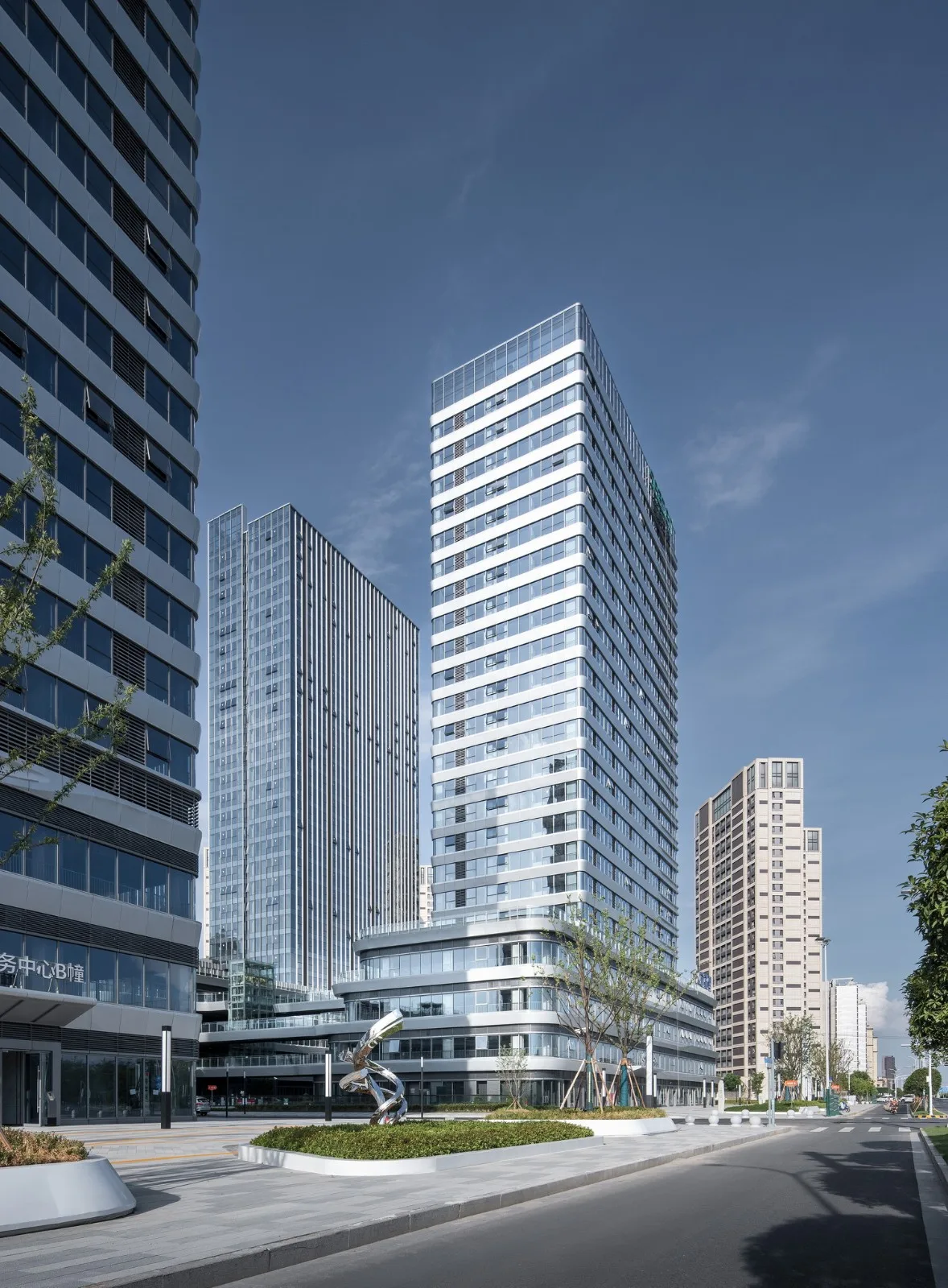
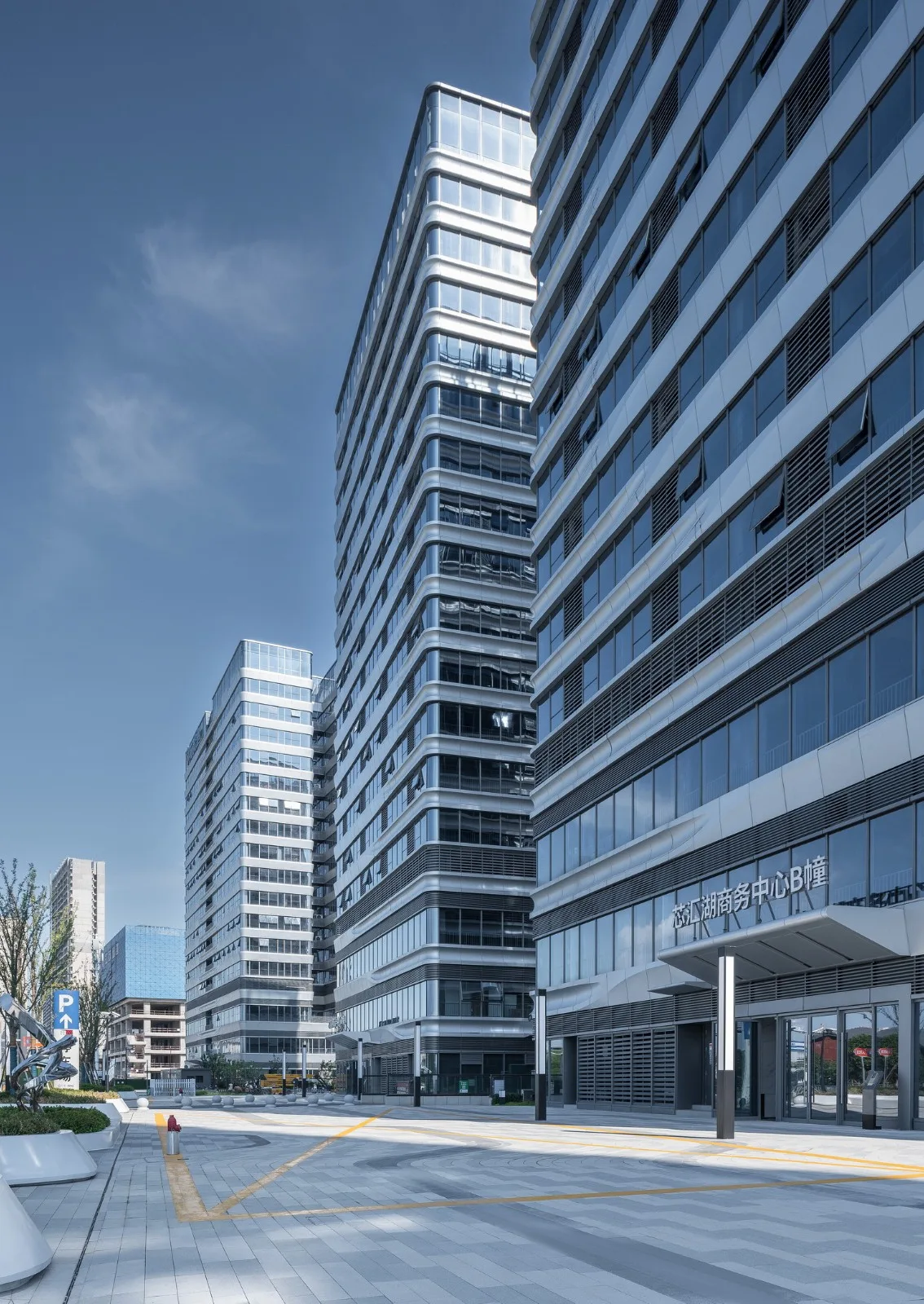
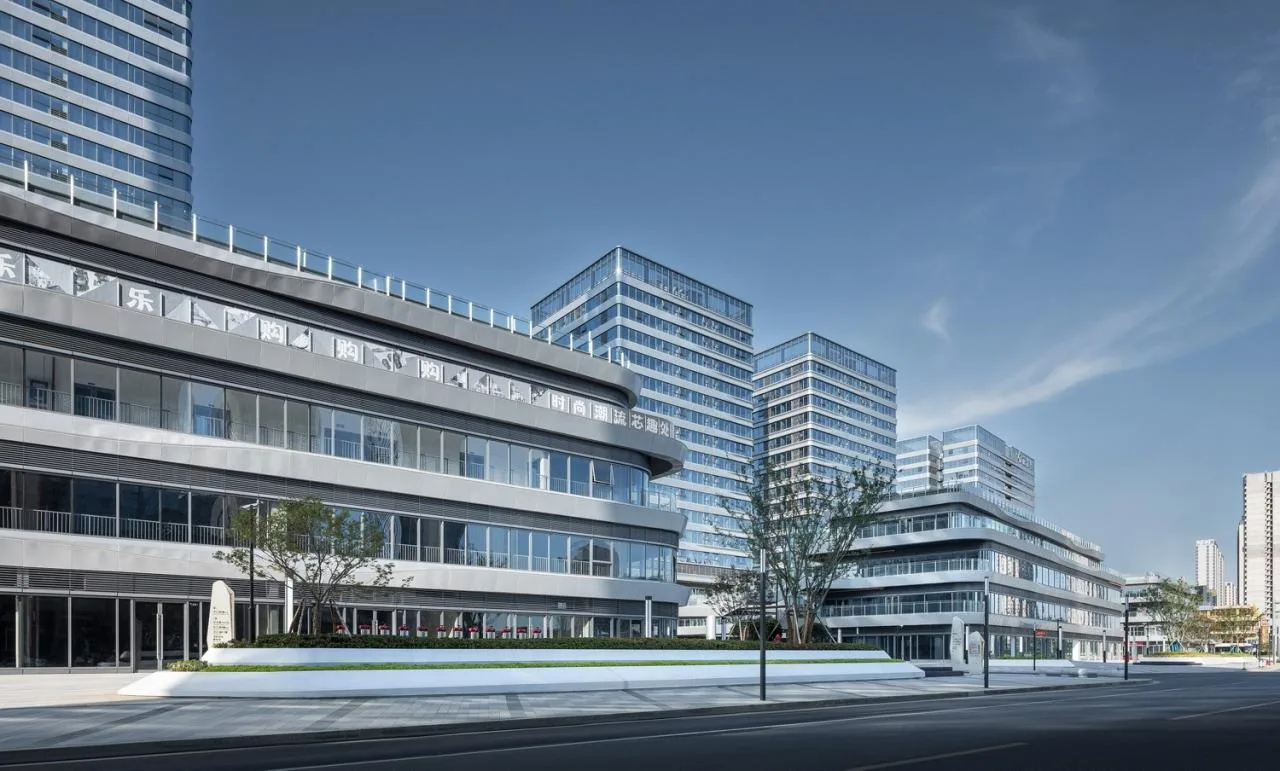
The project features a variety of individual buildings with diverse tower shapes and heights. To unify the urban image, the façade design categorizes surfaces into four types. The super high-rise and the northern building of Plot 21—the tallest points from east to west—feature vertical glass curtain walls. In contrast, the other towers and podiums utilize horizontal window wall systems.
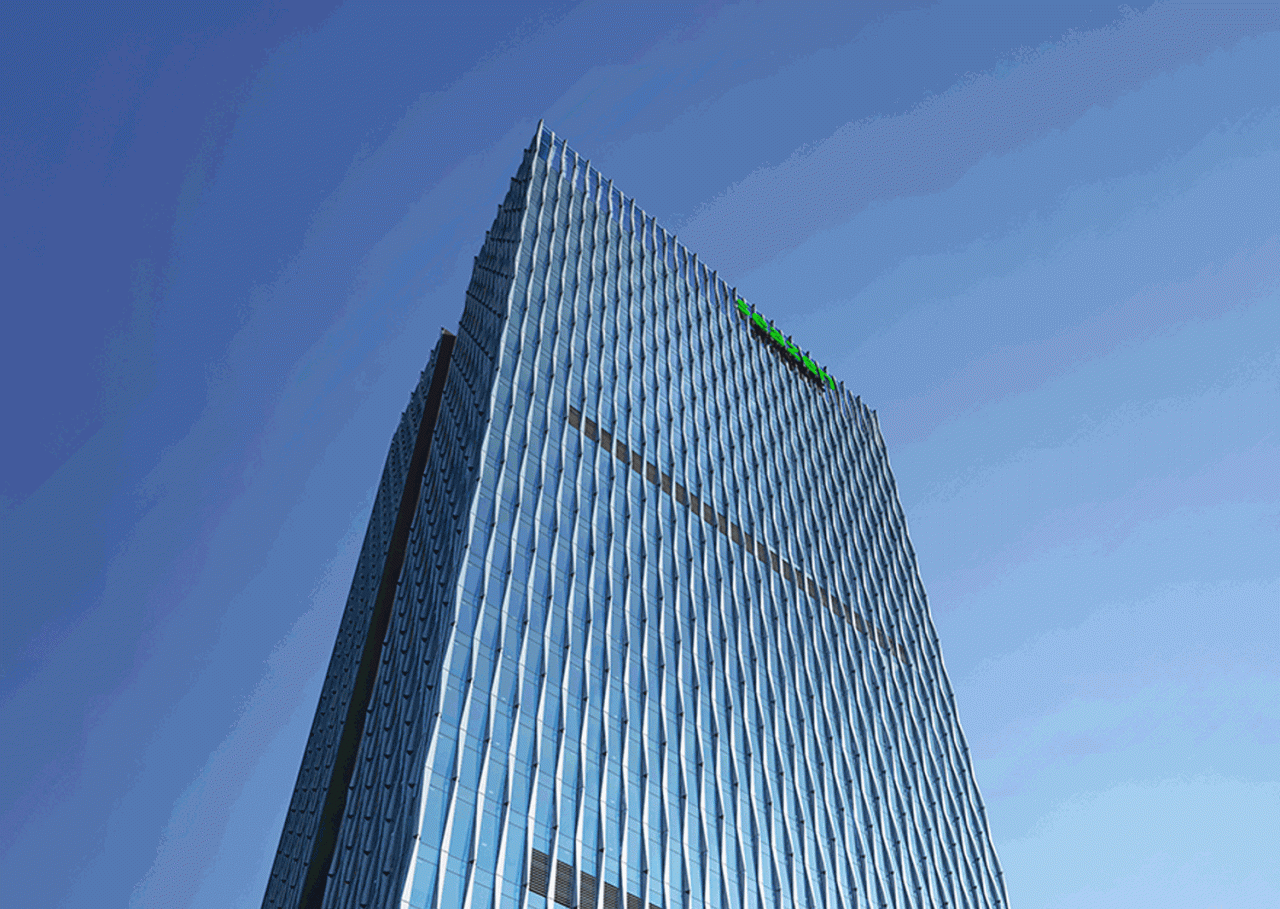
With water bodies bordering the north and south sides, the water theme is expressed in three distinct façade styles. Plot 12’s super high-rise employs a glass curtain wall combined with vertically folded aluminum panels concealing ventilation systems. These folded panels cascade in all directions, metaphorically representing “high mountains and flowing water.”
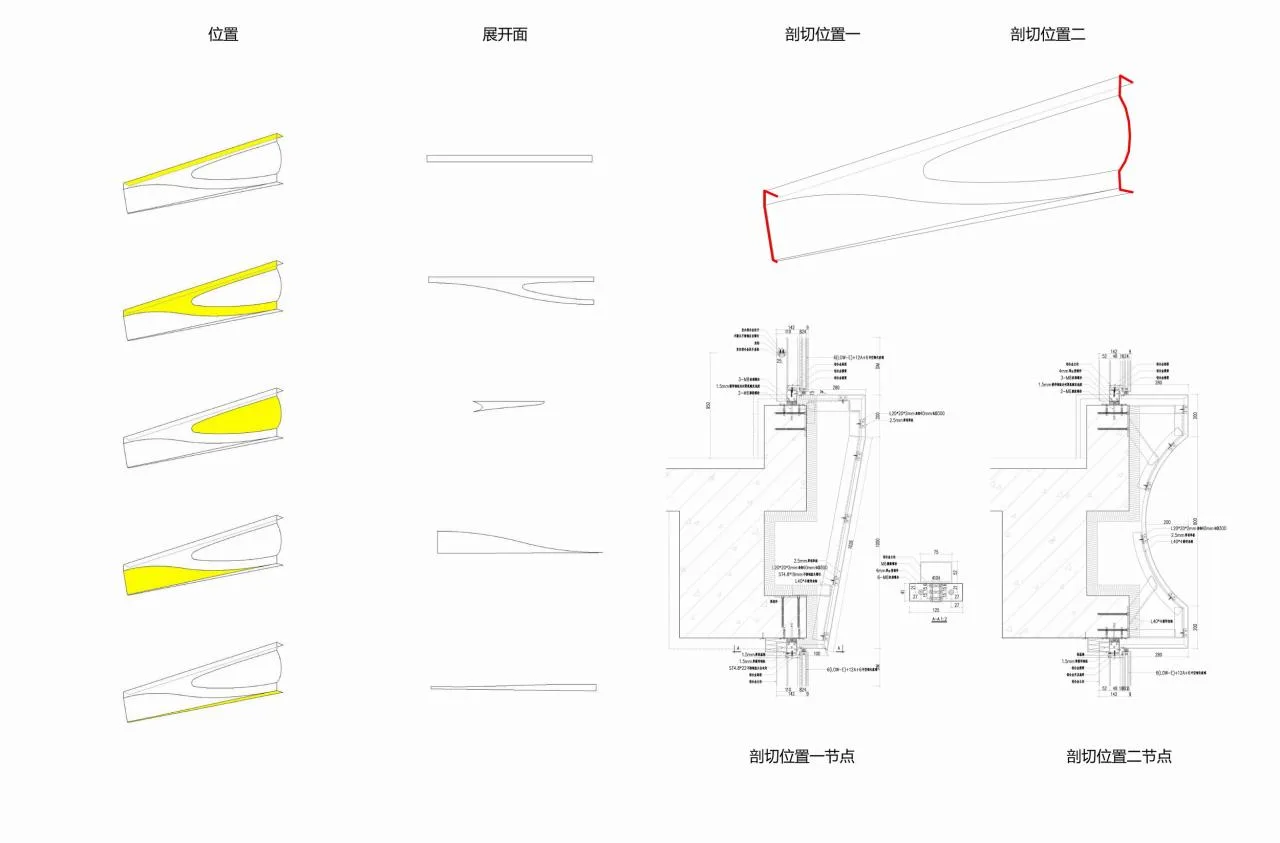
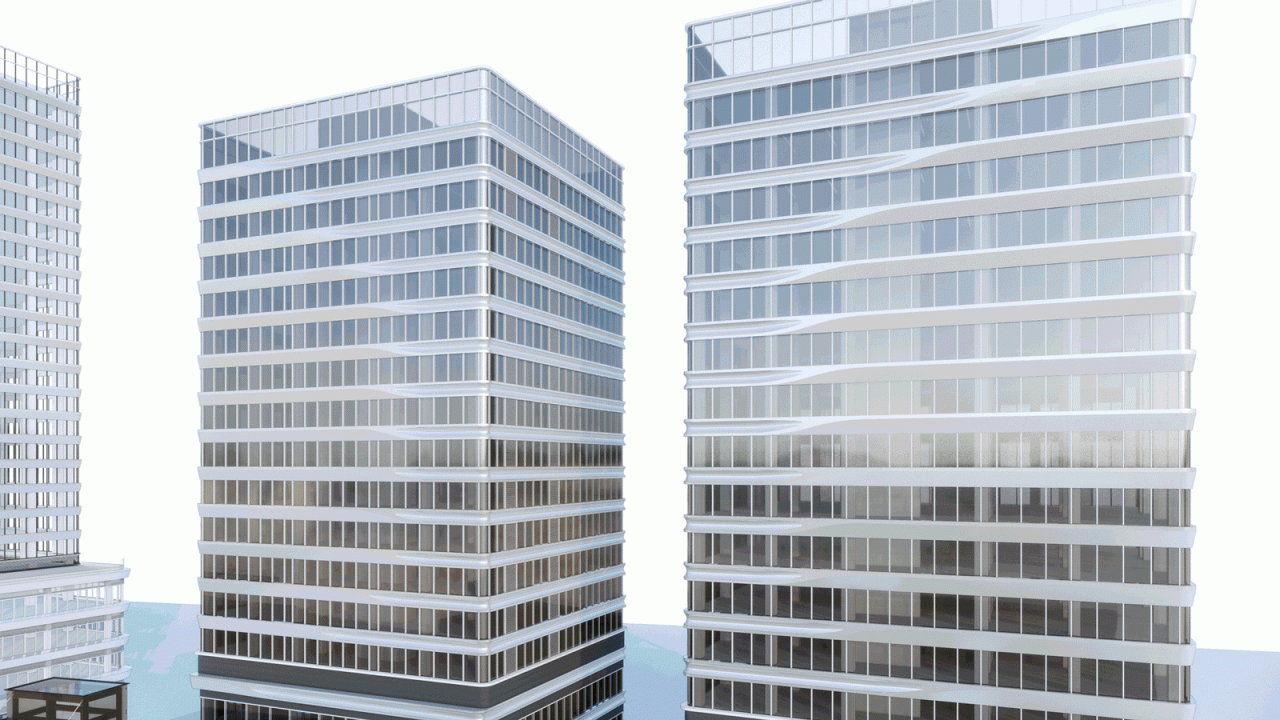
Analysis of Tower Lines
The commercial podium is articulated with convex, curved aluminum panels layered to simulate a gentle stream flowing over the ground. Other towers feature concave curved and twisting elements that create interlayer displacements where they meet standard sections, resembling slowly unfolding water ripples.
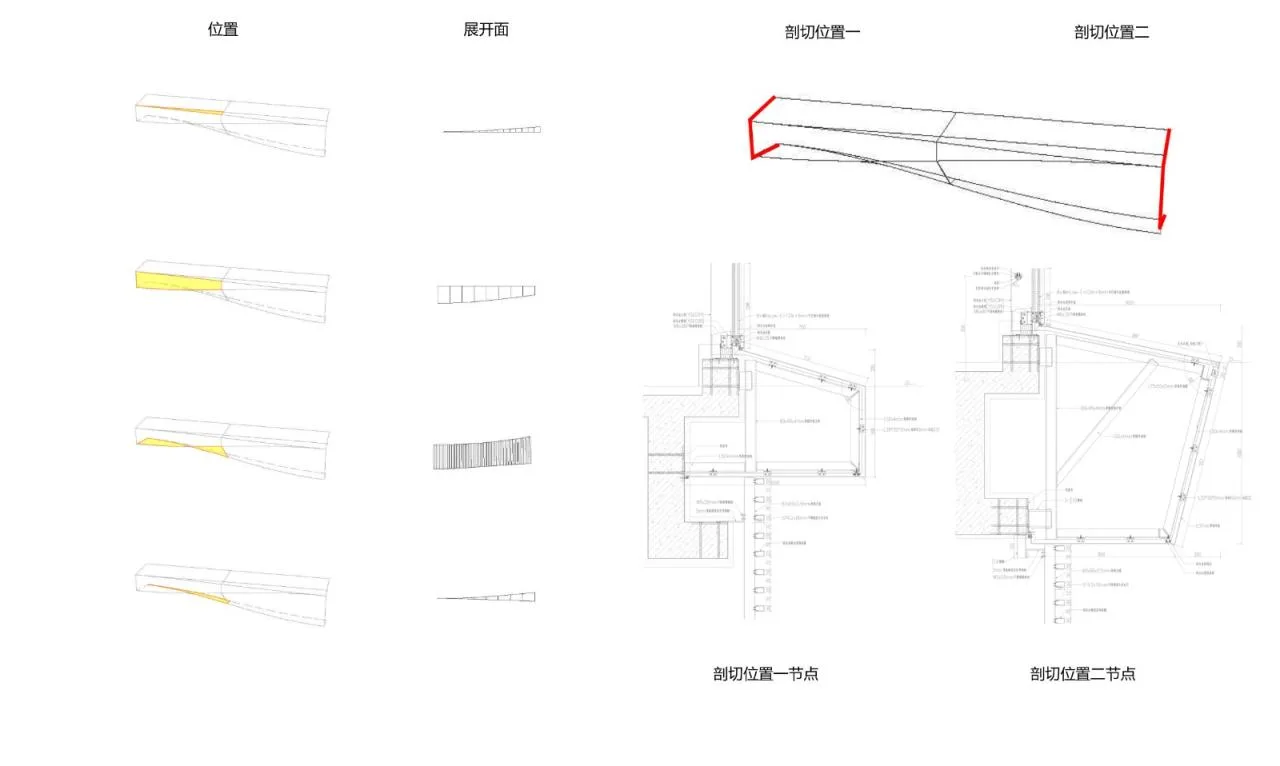
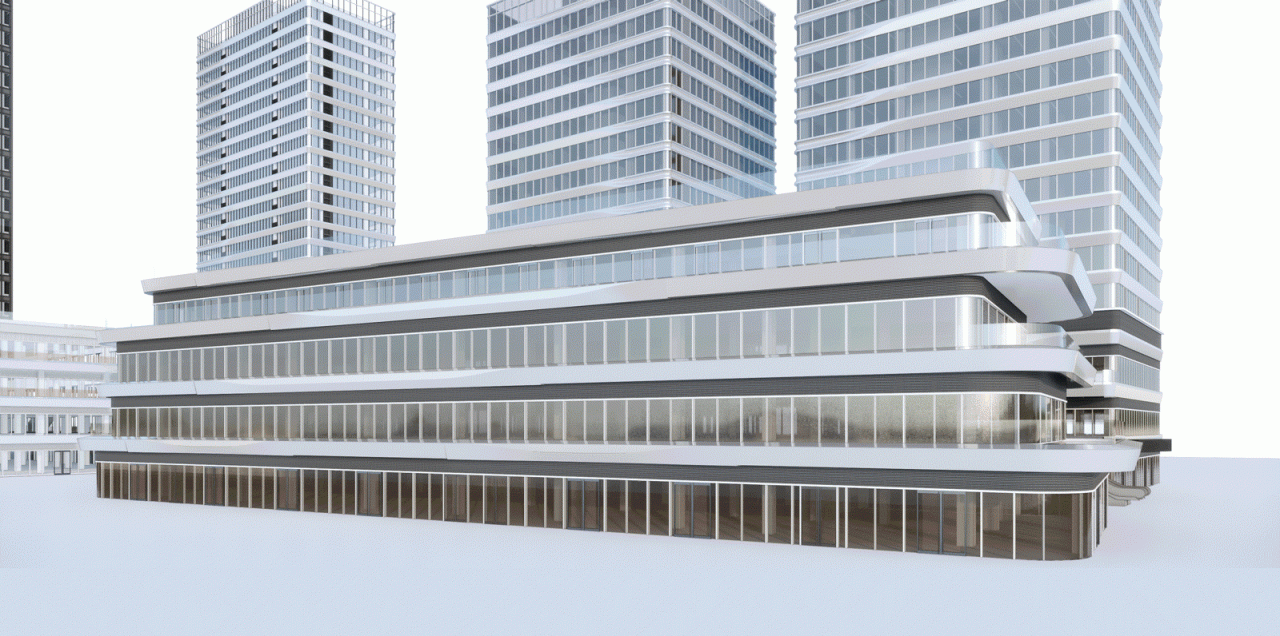
Analysis of Podium Lines
Controlling the aluminum panel lines on the podium was a complex task to achieve three-dimensional undulations while maintaining a degree of uniformity. Horizontal variations were modularized in segments of 8400mm. Layer displacement within these segments creates a flowing façade movement. The silk-like rippling lines soften the building’s appearance, balancing the rigidity of glass curtain walls and aluminum panels, while reflecting Suzhou’s refined and elegant spirit.
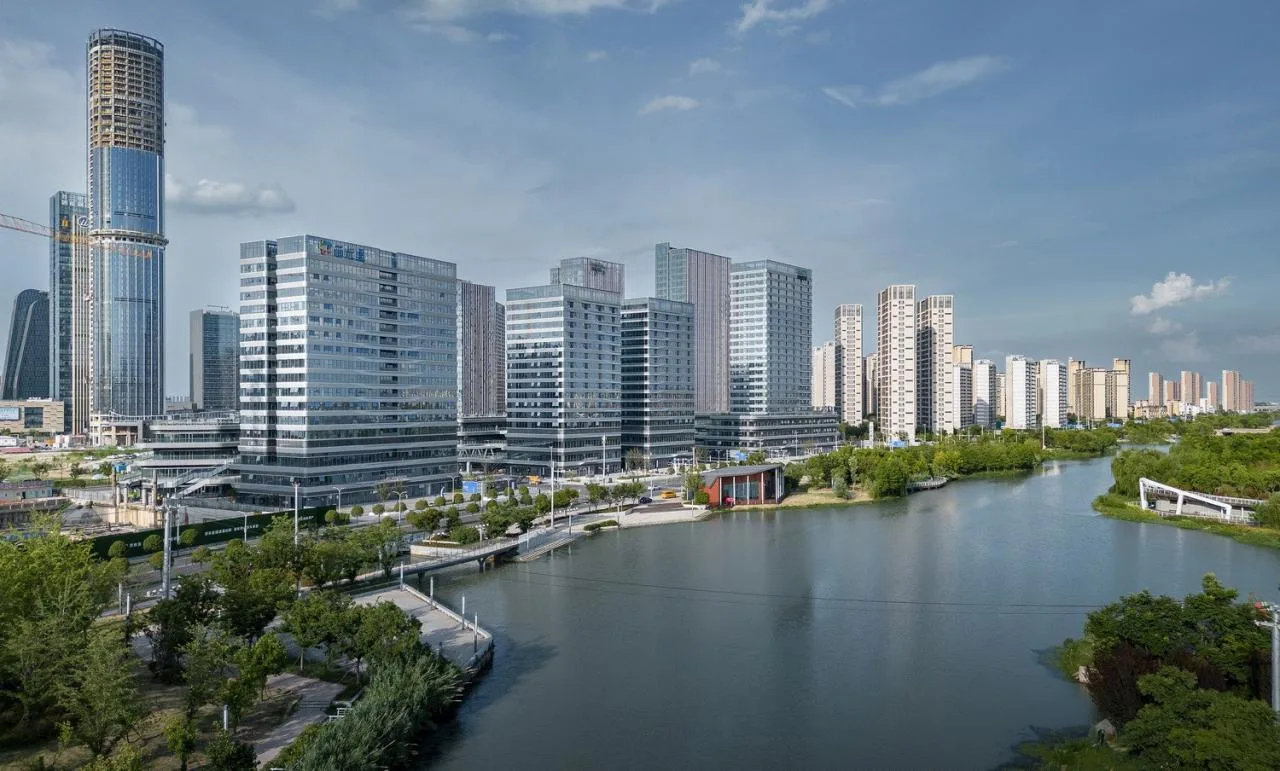
Conclusion: As one of the most complex land plots in Suzhou High-Speed Rail New City, this project has attracted significant attention from property owners and government authorities. By overcoming constraints and challenging conventional approaches, the design team successfully integrated four separate plots into a cohesive commercial hub. The result is a culturally rich and welcoming urban space that empowers the growth and identity of Suzhou High-Speed Rail New City.
Project Drawings
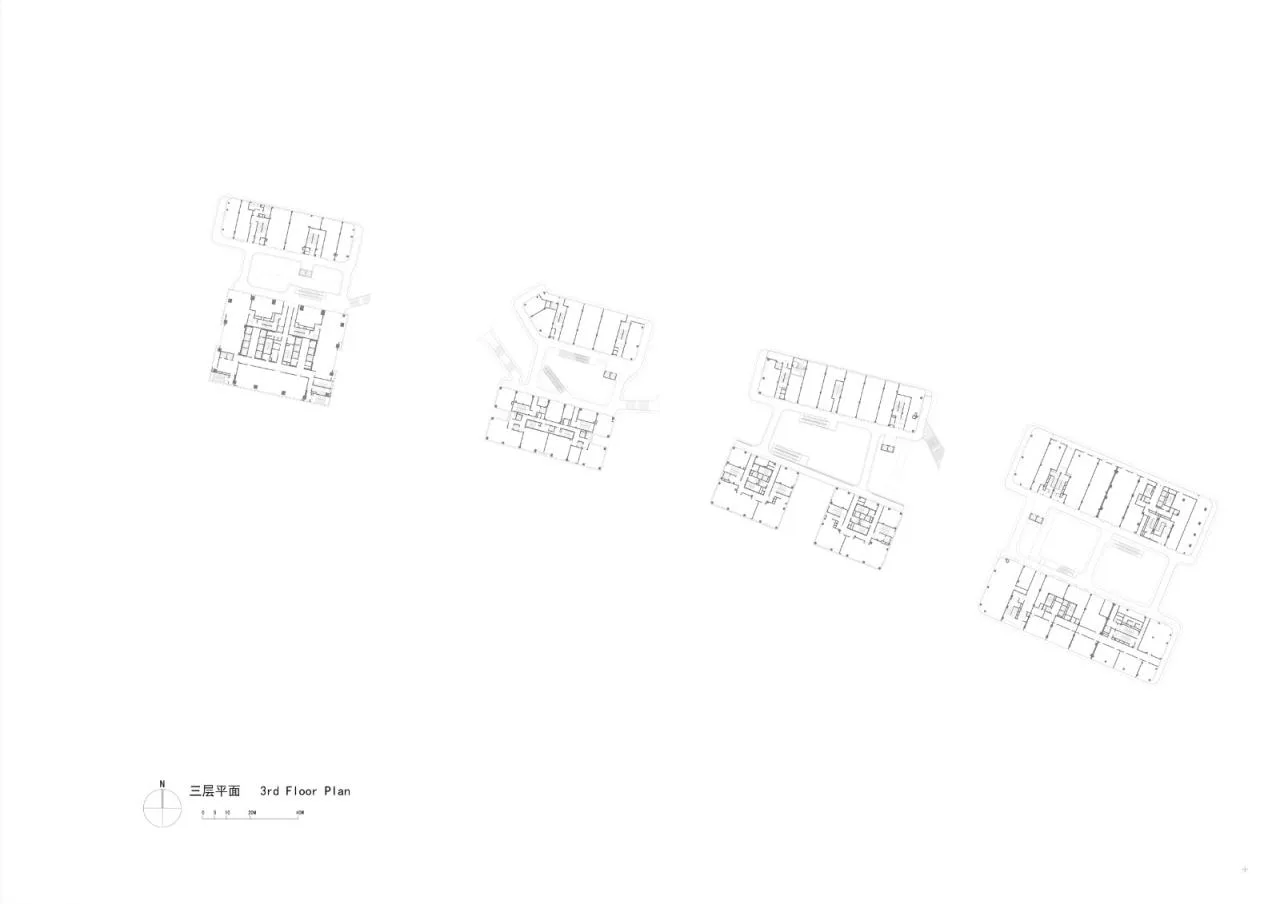
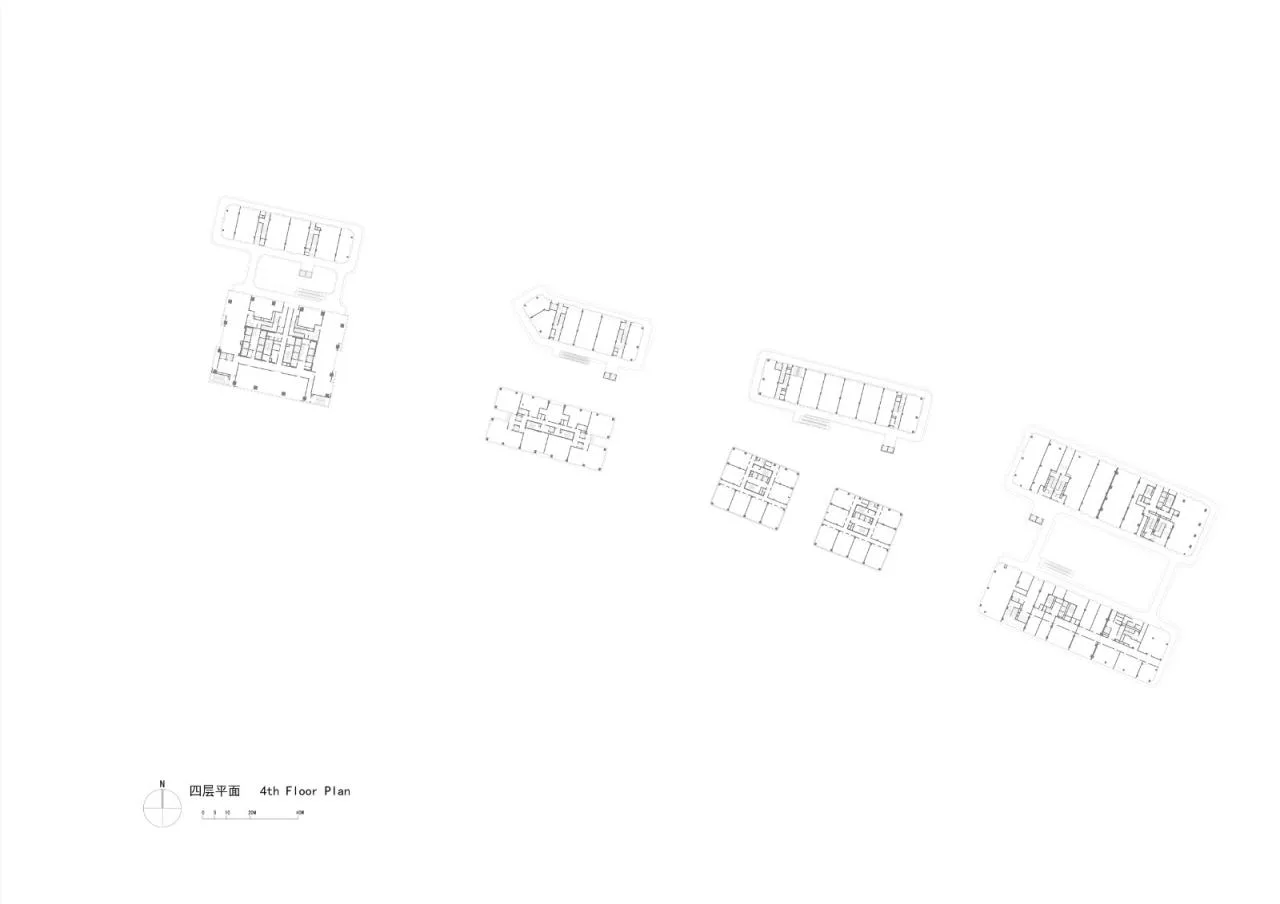
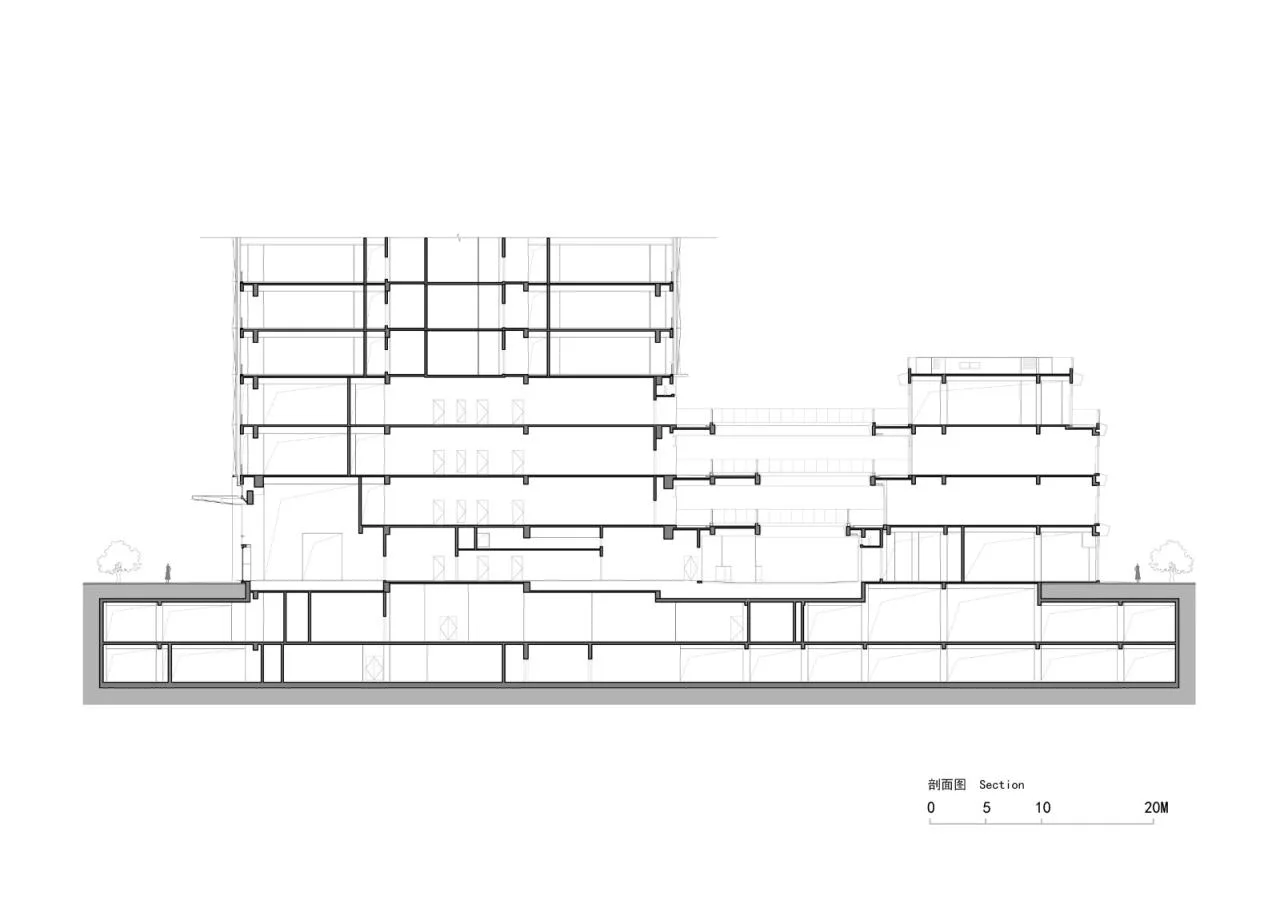
Project Information
Project Name: Design of Plots 12, 16, 17, and 21, Suzhou High-Speed Rail New City
Owner Company: New City Holdings Shanghai Suzhou City Company
Design Firm: GEN Jianhe Studio
Building Scale: 280,000 square meters
Design Team: Shen Ying, Fu Zhongkai, Pang Zhonghui, Zou Feng, Su Shuwen, Liu Yujing, Wang Peng, Qin Lu
Construction Drawing Team: Zhu Honghong, Ma Dan, Leng Zhuqing, Jiang Lu, Zhang Jianxin, Chen Bei, Mao Haibo, Mao Tongbin, Zhou Zhiwei, Li Yepeng
Landscape Design: Guangzhou Shanshui Bide Design Co., Ltd.
Curtain Wall Design: Zhejiang Zhongnan Construction Group Co., Ltd. Curtain Wall Design and Research Institute, Suzhou Kelida Decoration Co., Ltd., Shenzhen Xinshan Curtain Wall Technology Consulting Co., Ltd.
Architectural Photography: Architectural Vision












Must log in before commenting!
Sign Up