
Many believe that BIM technology has plateaued, but Tiemen Strobbe, product manager of BricsCAD, disagrees. He sees disruptive technologies continuing to drive the evolution of BIM software.
The construction sector—which includes real estate, infrastructure, and industrial buildings—is one of the largest industries worldwide. Fueled by population growth, ongoing urbanization, and increased infrastructure investment, the industry still shows strong growth potential.
Despite its size, the construction industry faces several challenging market characteristics:
- Project-based construction methods and customized projects with unique functions limit repeatability and standardization.
- A highly fragmented ecosystem relies on coordination among various professionals—owners, contractors, architects, and engineers—resulting in limited economies of scale.
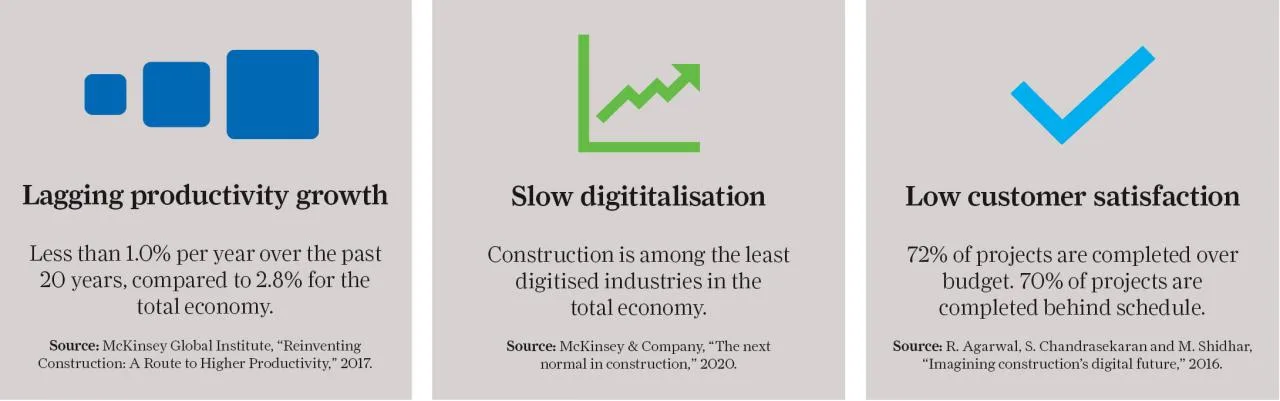
As detailed in McKinsey’s 2020 report, these factors have contributed to the construction industry’s historically poor performance, marked by slow productivity growth, limited innovation and digitization, and low customer satisfaction.
The Promise of BIM
Building Information Modeling (BIM) streamlines design, construction, and operations by leveraging shared digital representations of built assets, providing a reliable foundation for decision-making.
Although BIM applications have existed since the 1990s, global adoption has only reached 60% to 70% over 35 years. Nonetheless, there is high optimism that BIM will enhance the construction industry’s overall performance. Key disruptive trends expected to accelerate BIM adoption and industry digitization include off-site manufacturing, artificial intelligence, and increased collaboration.
1. Design for Manufacturing: From Project to Product
Modular construction offers a more standardized, comprehensive, and integrated building process. It entails producing standardized components off-site in factories, followed by on-site assembly. This approach can speed up construction by up to 50% and reduce costs by 20% in suitable environments.
While modular construction has existed for decades, it is gaining renewed interest due to shifts in customer perception and advancements in digital design, planning, and manufacturing technologies.
Countries such as the UK, US, and Japan have seen a surge in modular projects, and it is expected that modular buildings will soon become widespread globally.
As McKinsey noted in its 2019 report From Project to Product: “Modularity has had moments like this before, but there is reason to believe that its momentum is sustainable this time.”
This shift significantly impacts BIM usage during design. Designers must make decisions earlier, aligning projects with manufacturing processes and focusing on efficient production and assembly.
This approach is known as Design for Manufacturing and Assembly (DfMA). BIM tools bridge the gap between conceptual design and manufacturing, cutting design cycle time and costs. Automation and modular manufacturing libraries further accelerate the process.
2. Leveraging Artificial Intelligence for Design Automation
The concept of artificial intelligence (AI) in computer-aided design dates back to the 1970s. Architect and technologist Nicholas Negroponte envisioned collaborative human-machine interactions generating ideas unattainable by either alone.
Today, AI can enhance BIM by automating tasks, recognizing design intent, and completing repetitive work automatically.
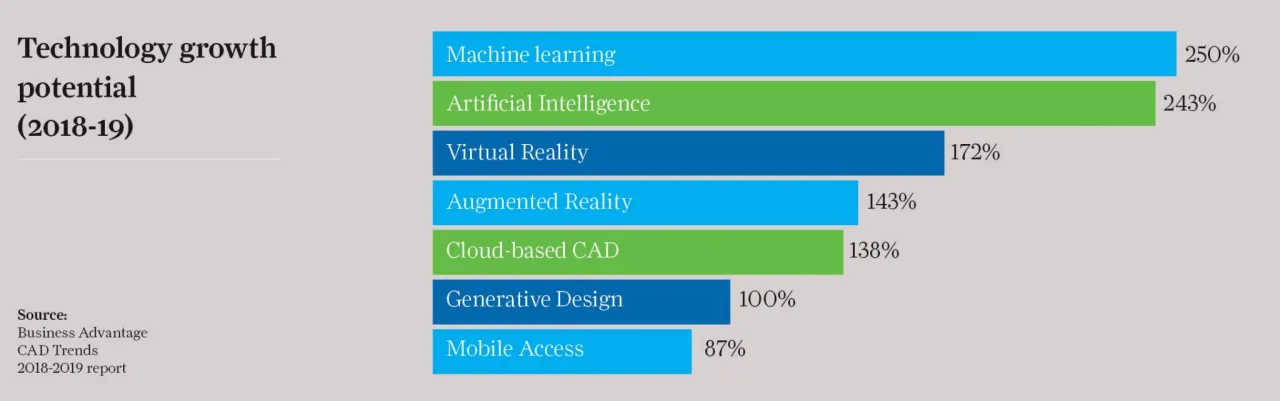
According to the 2018-2019 Business Advantage CAD Trends report, advances in big data, computing power, and cloud technology have made AI—a subset of machine learning—the most promising growth area in BIM.
AI tools assist designers but do not replace them; designers retain control to accept, reject, or modify AI-generated suggestions. Notable AI applications in BIM include:
- Automatic classification of BIM elements
- Auto-completion of connection details
- Maintaining data integrity for models and drawings
- Automatic annotation of construction drawings (labels, dimensions, etc.)
- Model and drawing cleanup
- Auxiliary planning
3. Cloud Collaboration
While many industries have shifted from desktop to cloud-based services, cloud adoption in CAD and BIM within the architecture, engineering, and construction (AEC) sector remains limited. Still, the future looks promising, especially for cloud-based BIM tools beyond desktop platforms.
The COVID-19 pandemic accelerated the industry’s acceptance of cloud technologies, with remote work driving increased use of cloud-based model collaboration and improving overall productivity.
Key aspects of BIM cloud collaboration include design collaboration, design review, and construction coordination. The 2018-2019 CAD Trends report by Business Advantage found that over half of CAD professionals use cloud-based files and models for exchange or collaboration, and half use the cloud for storage and review.
BIM collaboration tools help reduce design cycles and costs by enabling:
- Tracking design changes
- Avoiding conflicts and assigning ownership
- Fast, seamless communication during design
- Cross-team coordination
- Support for non-linear design workflows and multiple design iterations
- Facilitating last-minute design changes
A comparable example is found in software development, where teams collaborate on source code using version control systems to track changes and coordinate work.
If these collaboration tools become user-friendly for non-technical users and integrate well with project workflows and design change management, they are likely to gain traction in BIM environments.
Original link: Three trends for BIM tools – AEC Magazine
Translated and organized by BimAnt
















Must log in before commenting!
Sign Up