
Many people believe that BIM technology is not yet fully mature in China and therefore does not provide significant value. However, in reality, BIM, as a supportive design tool and information technology, holds substantial value throughout the planning, design, construction, and operation phases of engineering projects. Experience has shown that BIM’s greatest impact occurs during the design stage. Early adoption of BIM technology in this phase enables more refined designs through scheme demonstrations, performance simulations, visualizations, and collaborative workflows. This leads to improved design quality, better cost control, reduced risks, and an optimal balance between efficiency and benefits.
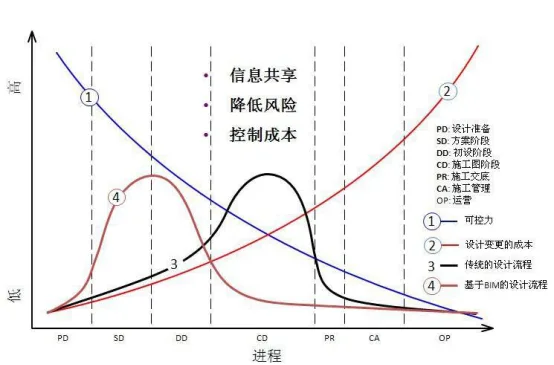
The chart above illustrates the BIM curve introduced by Patrick MacLeamy, CEO of the well-known American construction firm HOK. Curve ④ represents the design process when using BIM. Compared to curve ③, which depicts the traditional design workflow, the workload in the conceptual and preliminary design phases is higher with BIM. However, once the BIM model is established, the costs associated with later modifications and design changes are significantly reduced.
The owner-driven BIM application model maximizes the management advantages of BIM technology during the design phase. Creating a refined BIM management approach led by the project owner and involving all stakeholders best highlights BIM’s role and value. Therefore, when considering investment and overall project goals in real estate development, addressing issues related to construction drawings during the design stage through BIM systems is the most effective entry point for BIM adoption. Based on practical examples from large real estate projects such as the Shanghai Center Building and China Zun, the owner-driven BIM application mode can be categorized into three types: independent implementation, outsourcing to consulting firms, and design-oriented approaches.
















Must log in before commenting!
Sign Up