
Previously, the Leg Leg editor introduced the billing standards for BIM technology services in several provinces. Now, let’s turn our attention to Henan Province to explore how BIM fees are calculated there.

Scope of Application
1. The Building Information Modeling (BIM) technology service fee serves as a reference for preparing budget estimates for new housing construction and municipal infrastructure projects in Henan Province that utilize BIM technology and are primarily funded by state-owned investments. This fee is added to other construction costs.
2. Renovation and expansion projects, other types of projects, and those with alternative investment models may also refer to this billing standard.
Cost Calculation
The BIM technology service fee is calculated using the following formula:
BIM Technology Service Fee = Billing Basis × Unit Price (Rate) × Additional Adjustment Factor for Project Complexity
Billing Basis
1. The building area is calculated according to the “Code for Calculation of Building Area of Construction Projects” (GB/T50353).
2. The cost of construction and installation is based on the “Composition of Construction and Installation Engineering Cost Projects” (Jianbiao [2013] No. 44) issued by the Ministry of Housing and Urban-Rural Development and the Ministry of Finance.
Cost Base Price
1. Basic Cost of Civil Construction Engineering
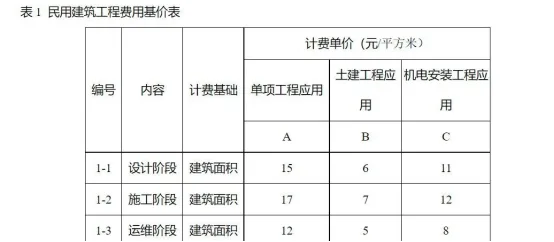
Notes: 1) The individual project applications listed refer to comprehensive services covering civil engineering, mechanical and electrical engineering, decoration, and other specialties. Secondary decoration and renovation projects can have their fees negotiated based on project depth and service content, referencing the civil engineering billing unit price.
2) BIM services involved in civil construction stages include but are not limited to model creation, virtual simulation walkthroughs, visual reviews, visual presentations, clash detection and 3D pipeline integration, clearance analysis and optimization, equipment and material statistics, construction process simulation, progress tracking, quality and safety management assistance, completion and handover, operation and maintenance model creation and planning, and engineering and facility data input.
3) For projects with identical units or standard floors, the billing basis (building area) should be negotiated based on actual project scope and service content.
2. Basic Cost of Industrial Construction Engineering
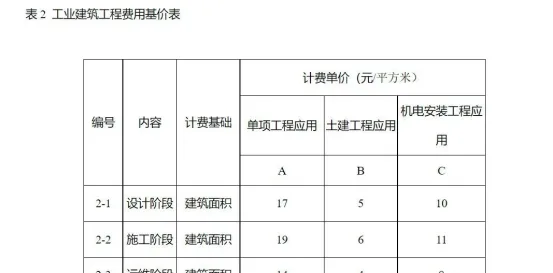
Notes: 1) The listed individual projects refer to comprehensive services including civil, mechanical, electrical, technological, and other specialties. Industrial projects without specialized processes are adjusted by coefficients between 0.5 and 0.8; complex industrial processes require adjustments between 1.1 and 1.5.
2) BIM services for industrial construction cover model creation (including processes), virtual simulation walkthroughs, visual reviews, visual presentations, clash detection and 3D pipeline integration, clearance analysis and optimization, equipment and material statistics, construction simulation, progress tracking, quality and safety management support, project completion and delivery, operation and maintenance model creation and planning, and engineering and facility data input.
3. Basic Cost of Municipal Engineering
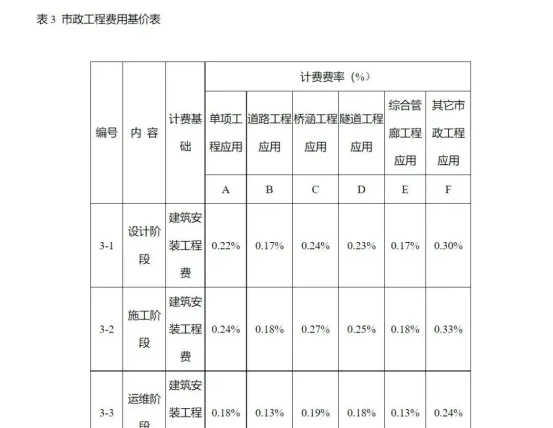
Notes: 1) The individual projects involve comprehensive services across multiple specialties such as roads, bridges, culverts, tunnels, and comprehensive pipe galleries. If a single specialty’s construction and installation cost exceeds 80% of the total project cost, the billing rate for that specialty applies.
2) Road engineering includes underground pipelines, transportation, lighting, landscaping, and related attachments. Bridge and culvert engineering encompasses structures, transportation, lighting, landscaping, and related facilities. Tunnel engineering covers construction, mechanical and electrical systems, pipelines, and transportation related to tunnels. Comprehensive pipe gallery projects include construction, mechanical and electrical systems, pipelines, and ancillary facilities. Other municipal projects include factories, stations, plazas, streetscapes, gardens, and parking lots.
3) BIM services for municipal engineering stages include model creation, site modeling and analysis, virtual walkthroughs, visual reviews, visual presentations, traffic simulation, pipeline relocation and road connectivity simulation, clash detection and 3D pipeline integration, material statistics, large equipment transportation path inspections, site layout, construction process simulation, progress tracking, quality and safety management support, completion and handover, operation and maintenance model creation and planning, and data input for engineering and facilities.
4. Basic Cost of Urban Rail Transit Engineering
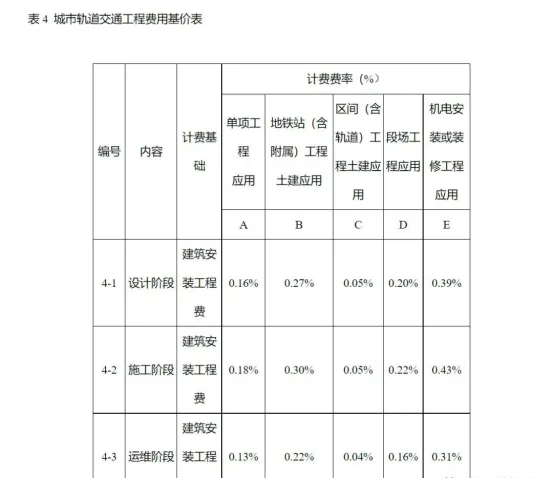
Notes: 1) The projects include comprehensive services for subway stations (with ancillary facilities), track sections, and yards. Segmental engineering services cover civil and mechanical-electrical work for vehicle depots and parking lots.
2) BIM services cover model creation, scheme comparison and simulation walkthroughs, visual reviews, visual presentations, site modeling and analysis, virtual walkthroughs, traffic evacuation and pipeline relocation simulation, 3D pipeline integration, material statistics, large equipment transport path inspections, engineering planning simulation, construction process simulation, progress management, quality and safety risk management, project completion and handover, operation and maintenance model creation and planning, and engineering and facility data input.
Additional Adjustment Factor for Project Complexity
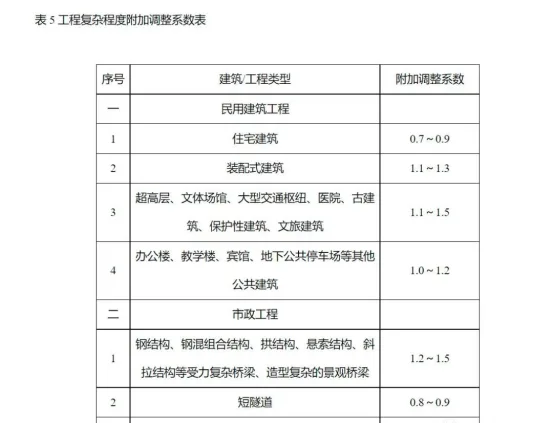
Notes: 1) If a project falls under multiple building or engineering categories, the overall adjustment factor is the product of the individual factors for each type.
2) Short tunnels are defined as tunnels with a length of 500 meters or less. Prefabricated buildings are assembled from prefabricated components on-site, with assembly rates meeting national standards outlined in the “Evaluation Standards for Prefabricated Buildings”.
Billing Instructions
1) These fees exclude BIM software development and related training costs, such as secondary BIM software development, BIM management platform, and BIM operation and maintenance platform development. Software development costs should be negotiated separately.
2) If the same provider delivers BIM services in two separate stages, the total fee is the sum of both stages’ fees multiplied by 0.9. For full lifecycle BIM services covering design, construction, and operation, the total fee is calculated by summing each stage’s cost and multiplying by a coefficient between 0.7 and 0.8. The exact rate should be agreed upon based on project scope and service requirements.
3) Additional costs arising from extensive design changes during project execution should be negotiated based on the actual increase in workload.
















Must log in before commenting!
Sign Up