
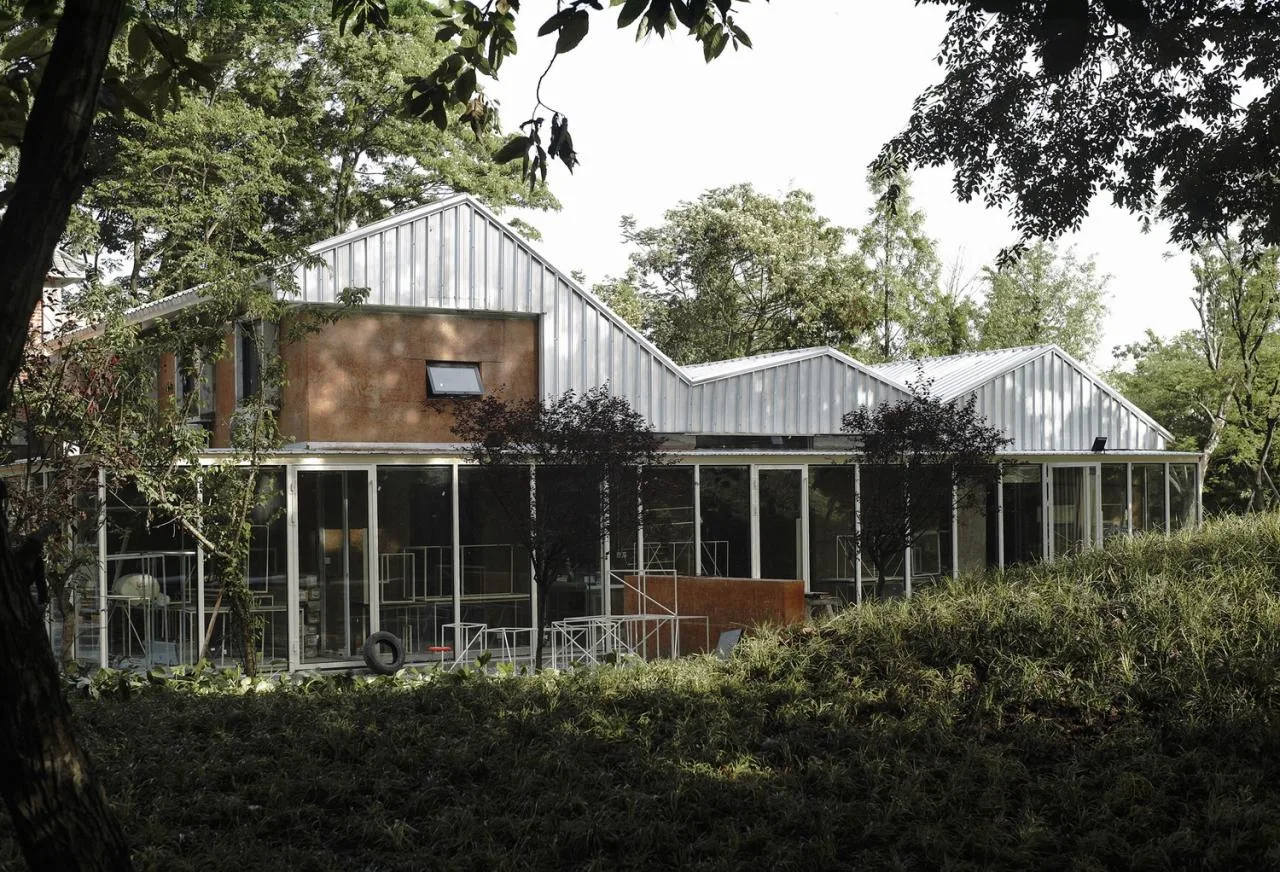
Architecture/Art Innovation Laboratory
The Architecture/Art Innovation Laboratory is a rural construction studio located in Qionglai, Chengdu. Established by a cooperative, it is a collaborative space developed and managed by architects, artists, university researchers, and local craftsmen. The term “Innovation Laboratory” reflects its commitment to experimentation across three key dimensions: construction methods, rural development, and social relationships.
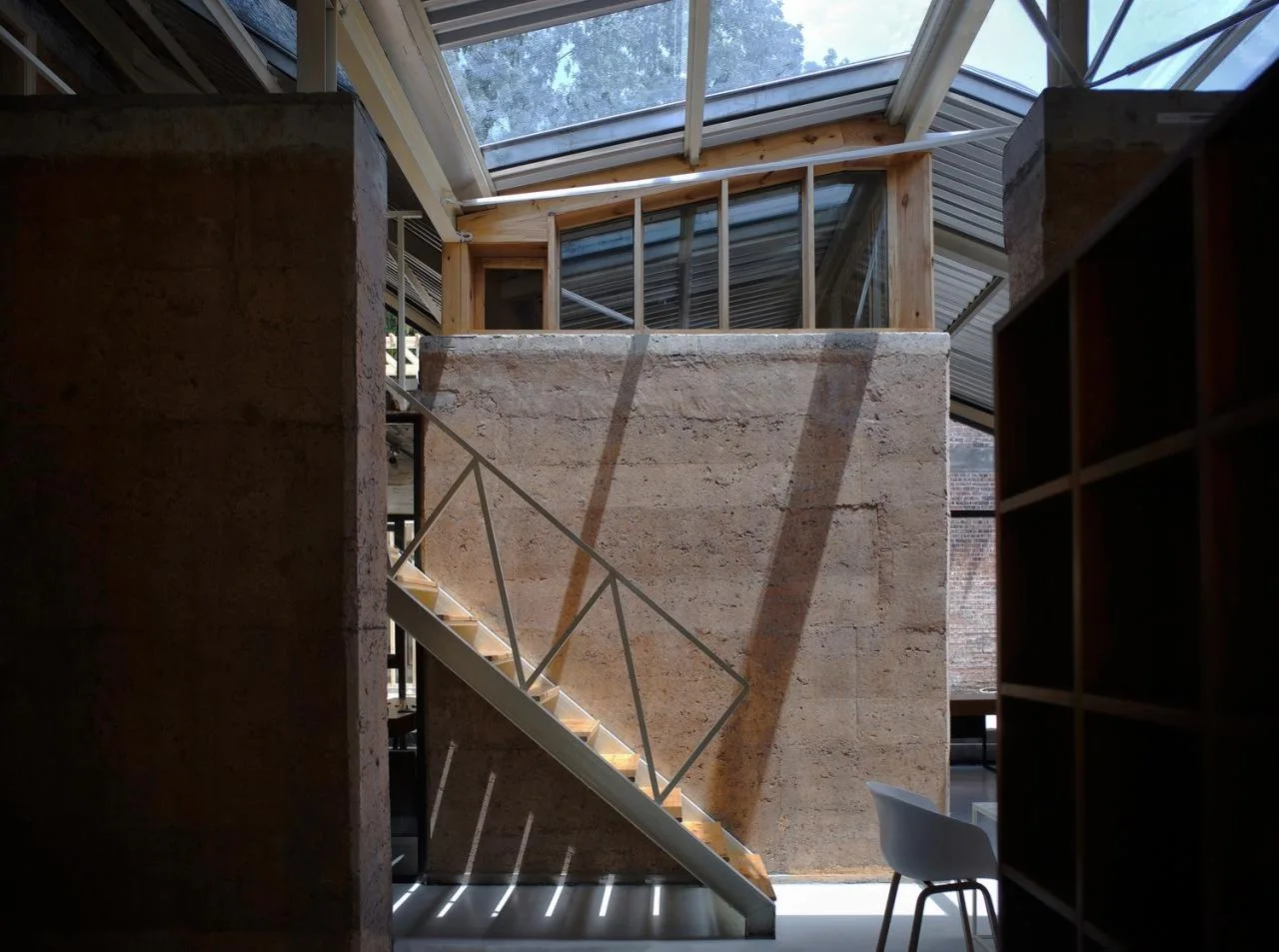
The original intention of the project © Cooperative Society
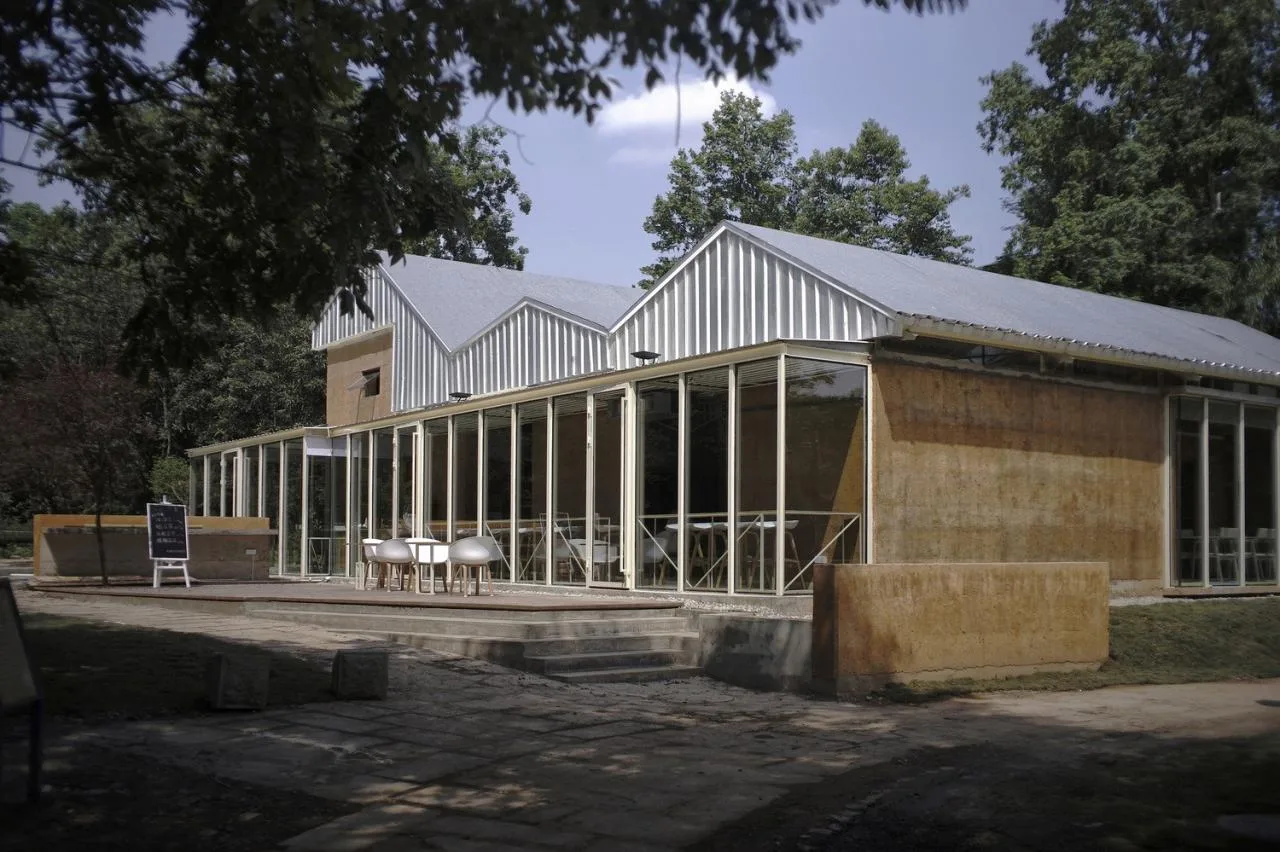
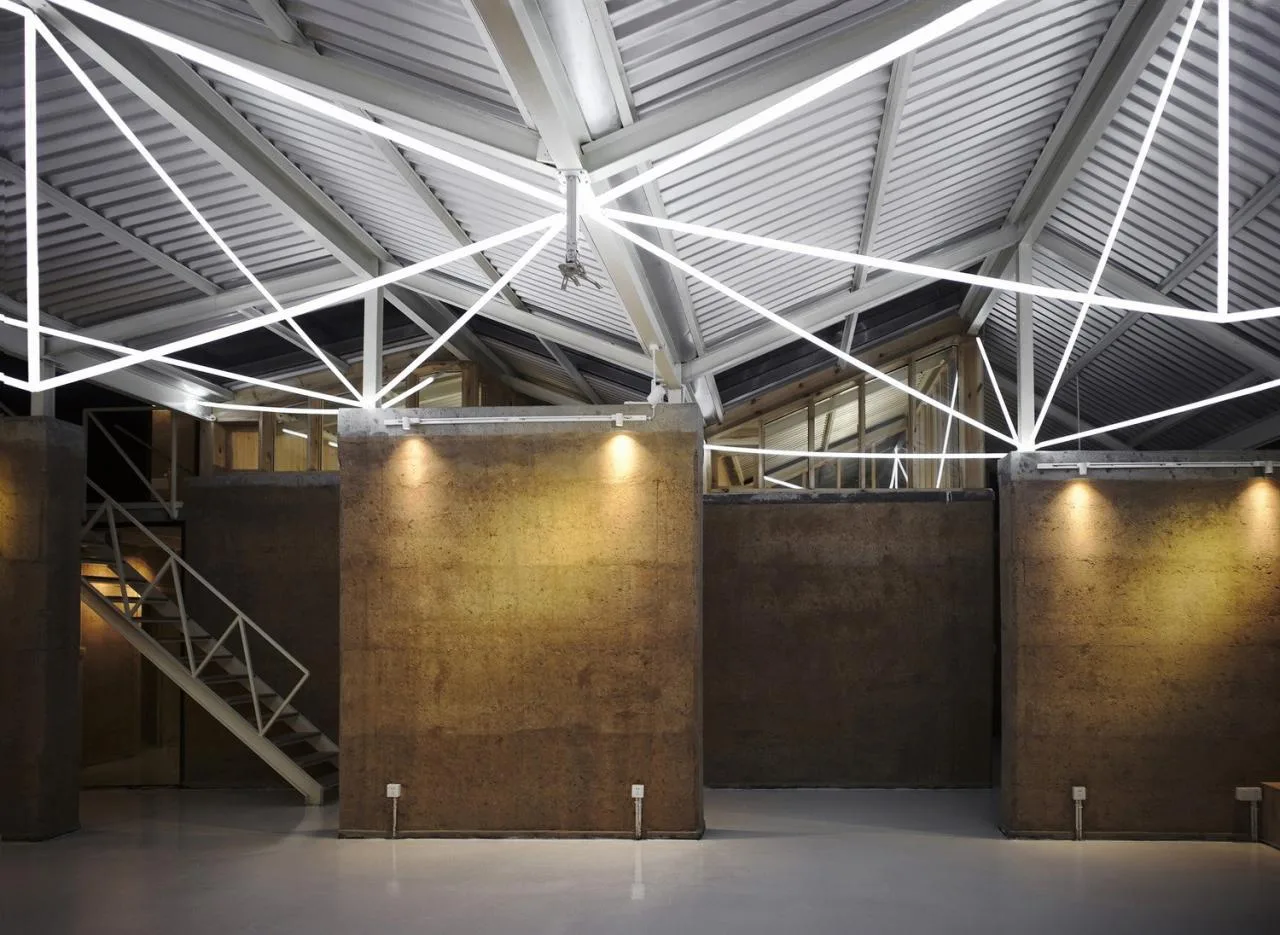
The goal was to create a modern experimental space using traditional materials. Rammed earth forms the structural base supporting the lightweight steel roof truss. These traditional materials are seamlessly integrated with modern aesthetics and technologies, including sound, lighting, electrical systems, and heating.
Monument from the Land
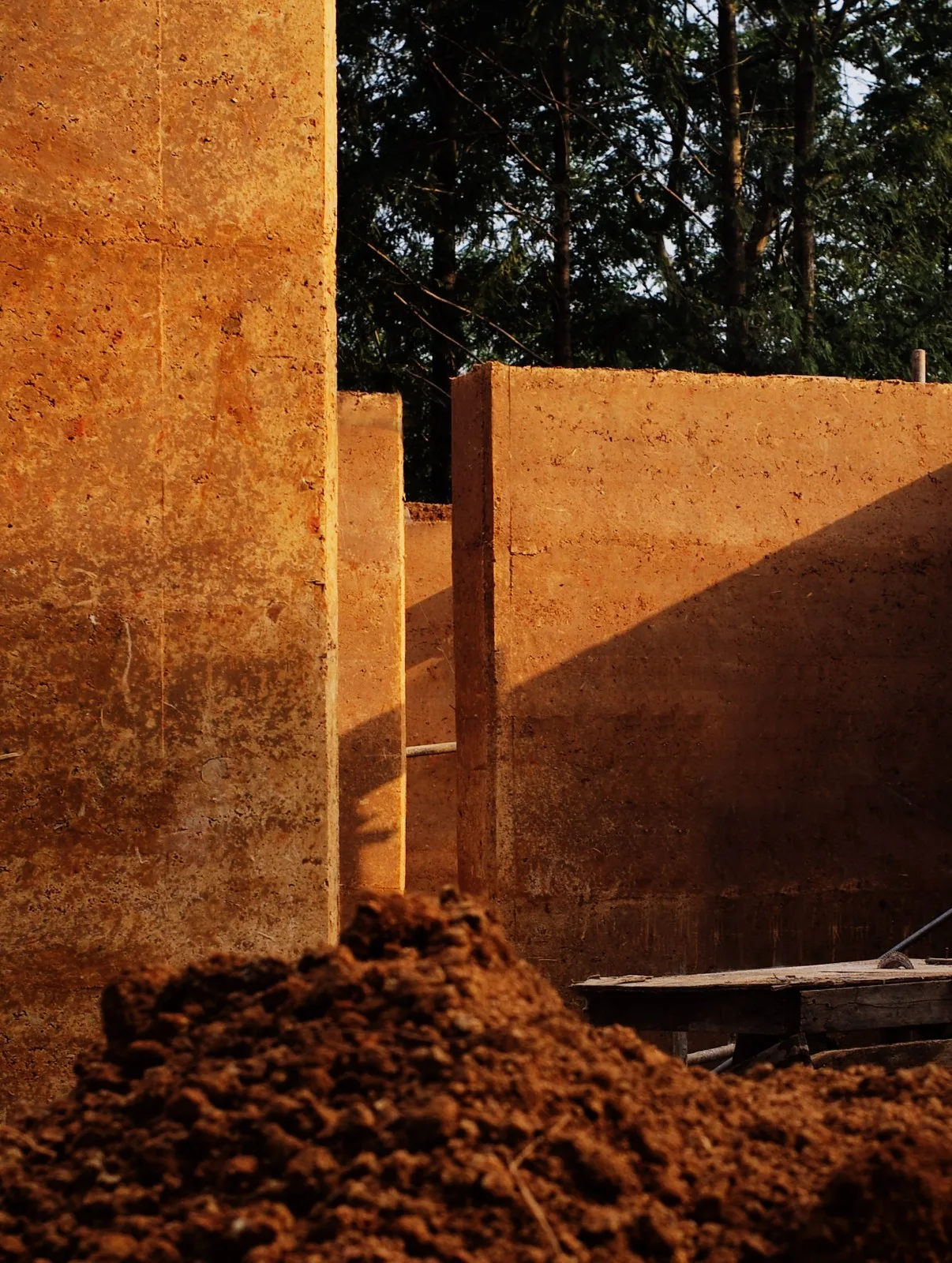
In the ruins park, rammed earth walls stand as monuments rising from the land. © Cooperative Society
“Historicism is rampant, claiming architecture can no longer transform society; however, I believe architecture needs social relationships as a material for self-renewal. While architectural professionalism roots itself in tradition, architecture should not exist solely to reflect its own problems or explore traditions.” — Vittorio Gregorio
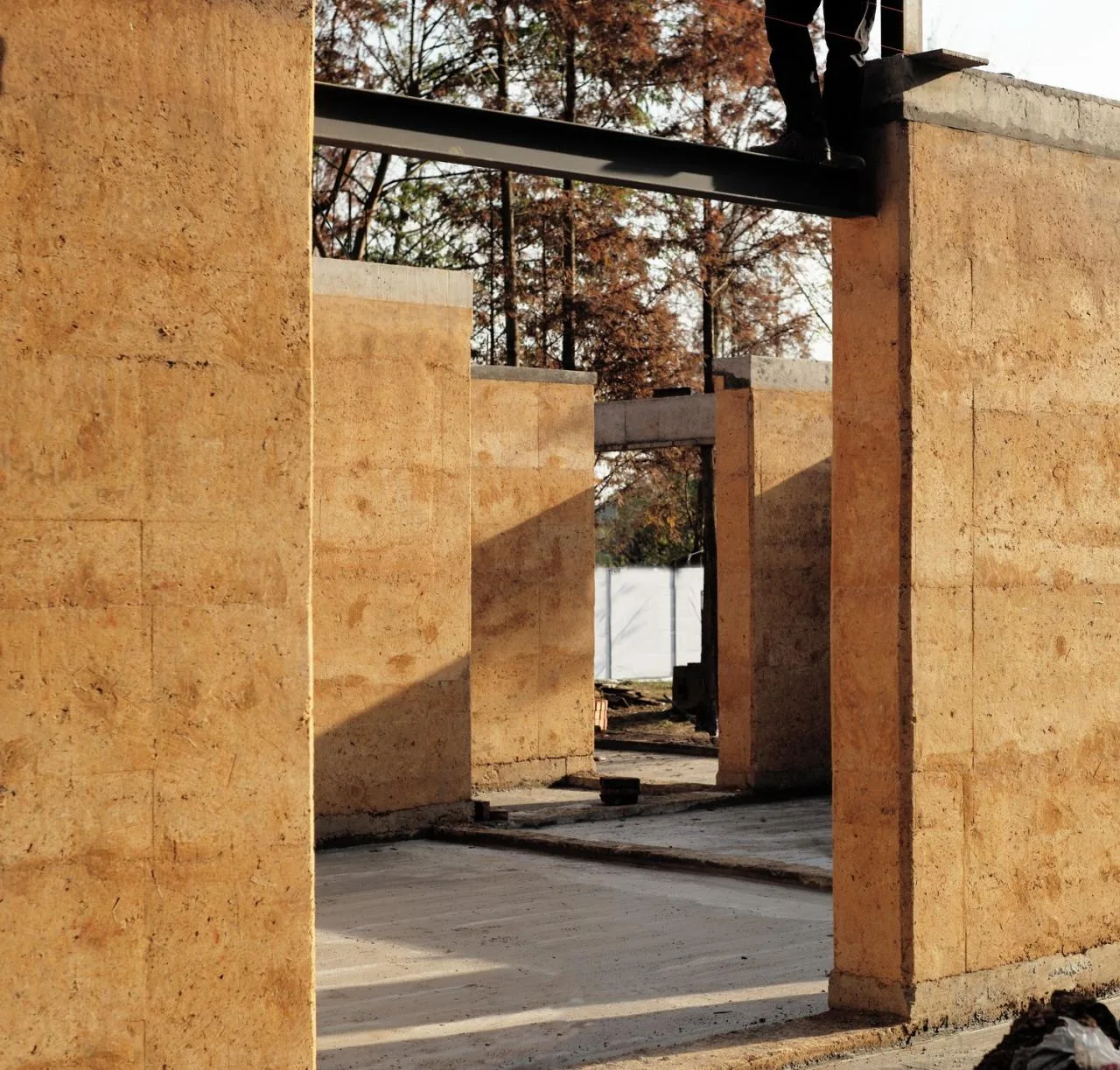
The local construction team building the steel frame for the rammed earth wall. © Cooperative Society
This space is built using traditional materials like rammed earth. The Chinese University of Hong Kong’s research team provided advanced technical support, enhancing the rammed earth’s structural capacity to meet seismic resistance standards of magnitude eight. This innovation allows rammed earth to serve as a genuine structural system, improving residential safety in rural regions.
The technology respects traditional manual labor, adapting to the social labor patterns of rural communities. It has been embraced and spread widely across rural China. The construction of this space also serves as a training ground for modern rammed earth craftsmanship. Local workers will carry these skills back to their villages, revitalizing rural construction with handmade expertise and injecting contemporary meaning into historic practices.
Once completed, the laboratory will host residencies for architects and artists, fostering a dialogue between contemporary knowledge and rural nature, and exploring innovative social interactions. This is the core purpose of the Architecture and Art Innovation Laboratory.
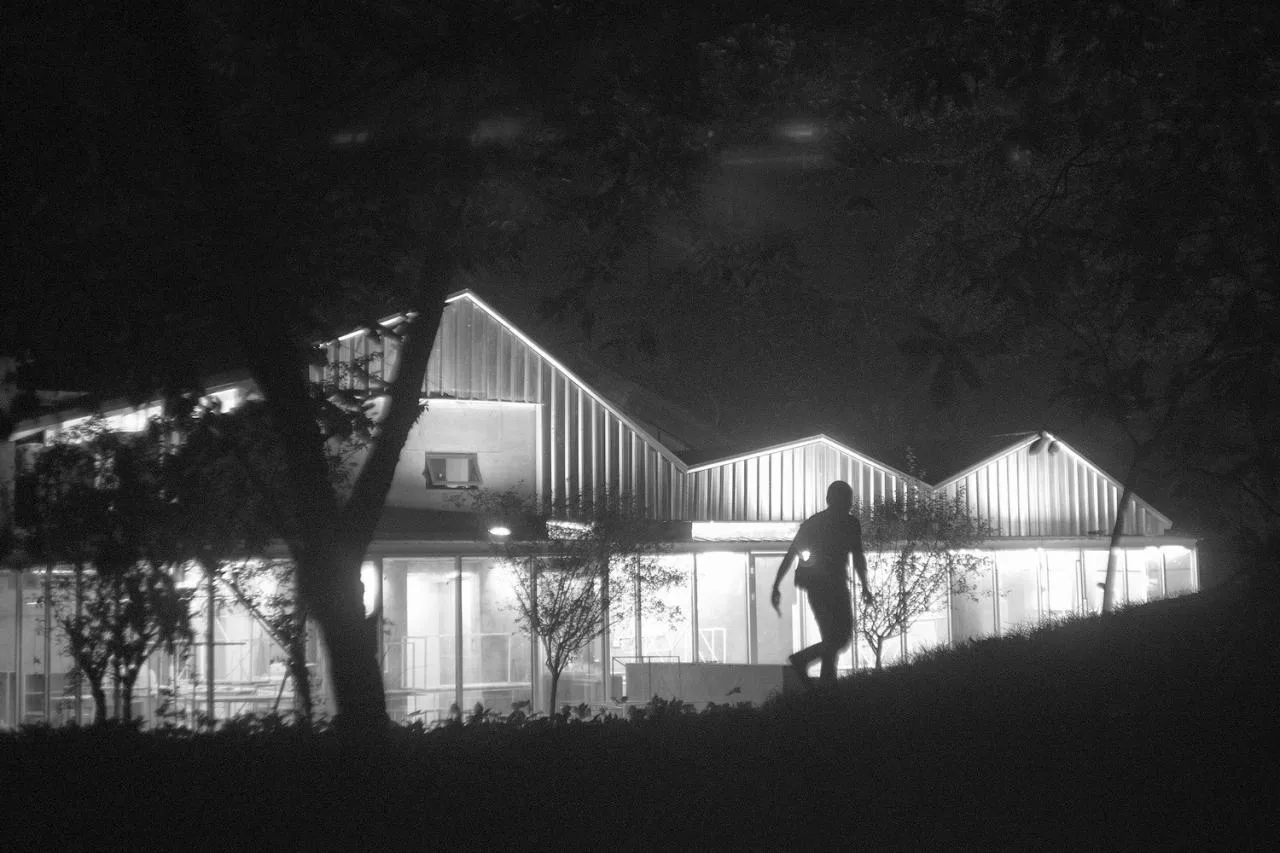
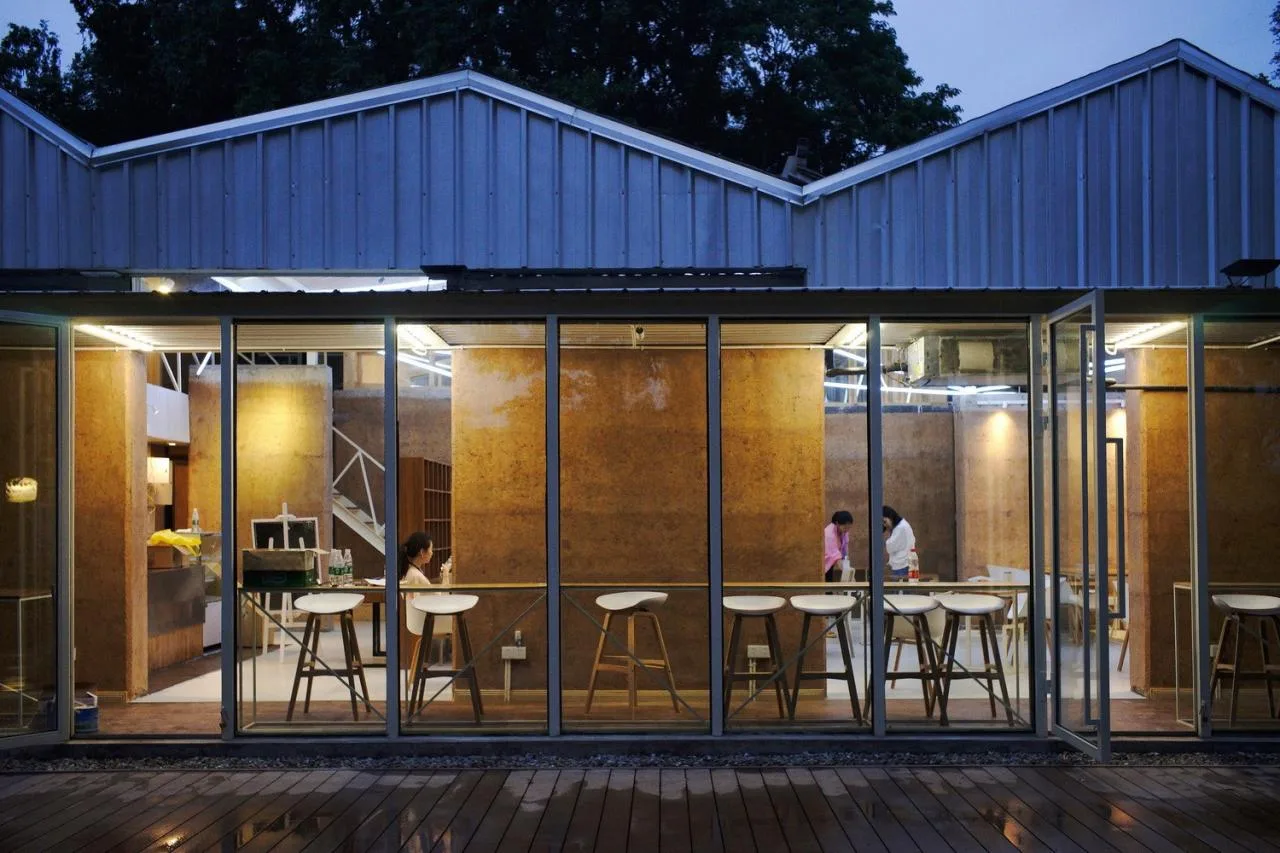
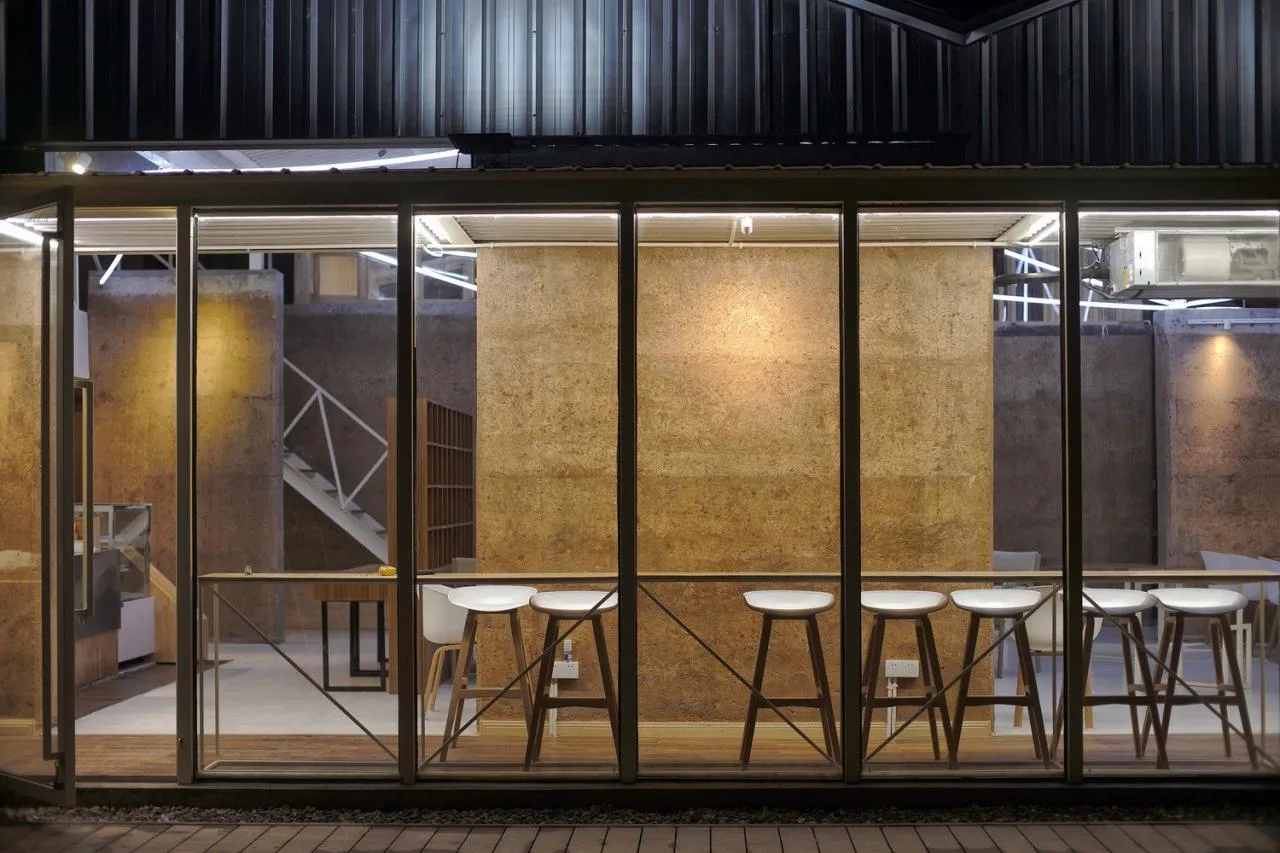
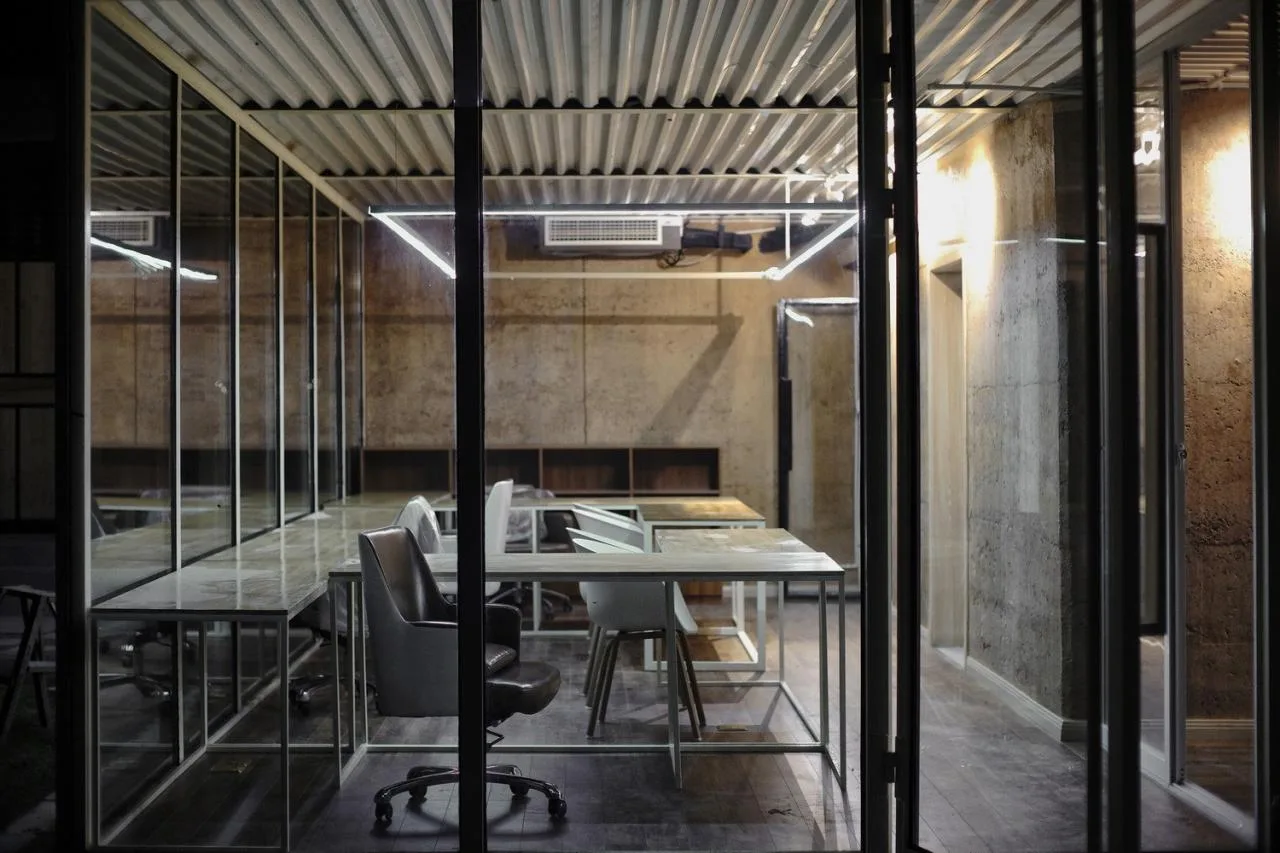
Architecture/Art Innovation Laboratory at Night © Cooperative Society
Architecture Story: Construction as Social Intervention
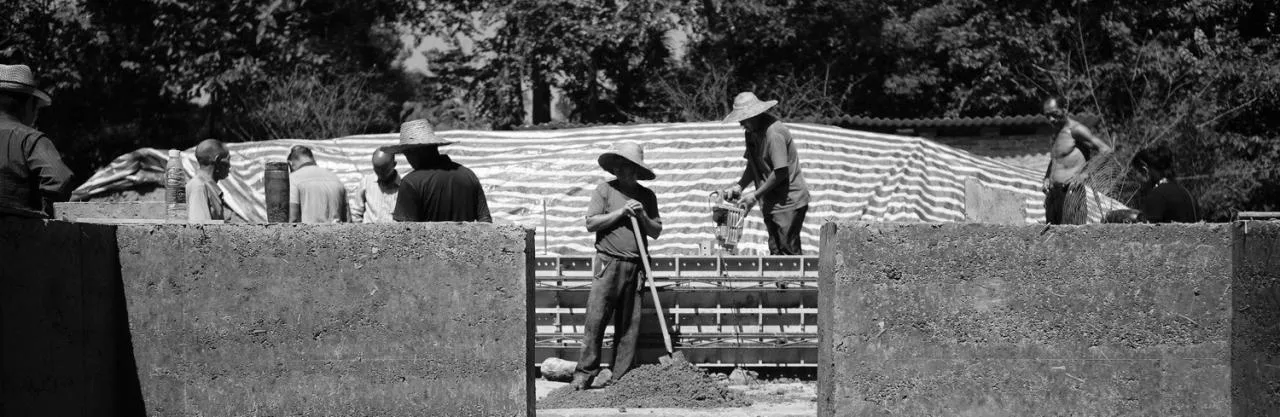
The local construction team piling rammed earth walls. © Cooperative Society
In 2017, I was invited to build a studio space for “Hezao Society” in a Tang and Song dynasty ruins park located in rural Chengdu. It was my first experience constructing a real house in the countryside, using a migrant workforce recruited locally. This project, named the “Architecture/Art Innovation Laboratory,” was conceived to explore several experiments during its preparation phase.
First, I intended to use rammed earth as the primary building material.
Second, I aimed to use rammed earth structurally—not just as a cladding or maintenance material.
Third, I planned to organize training for rammed earth workers within rural communities.
These experimental goals stemmed not from nostalgia or aesthetic preference but from a speculative idea: that rammed earth technology could influence and reshape rural social relations. I viewed this construction as an experiment in applying architectural knowledge to social structures and as an opportunity for social intervention in rural life. This social intervention is arguably more fundamental than simply building houses.
Fourth, the building had to accommodate modern amenities. Alongside the traditional rammed earth structure, we redesigned thermal features including hand-built structural-level broken bridge curtain walls and cost-effective integrated insulation and waterproof roofs.
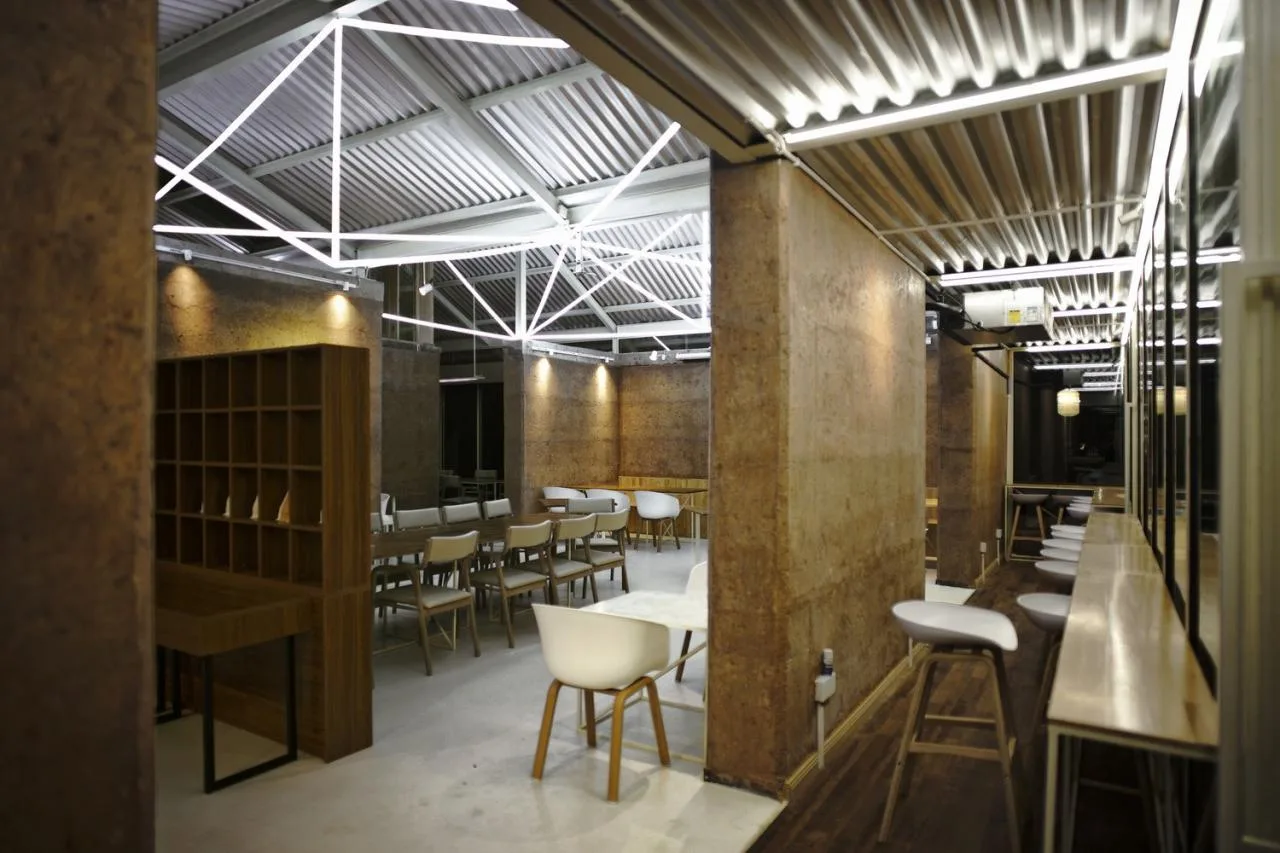
Fifth, disliking traditional lighting fixtures, we devised structural spatial devices to provide illumination instead.
The entire building was handcrafted by migrant workers.
— Xu Lang
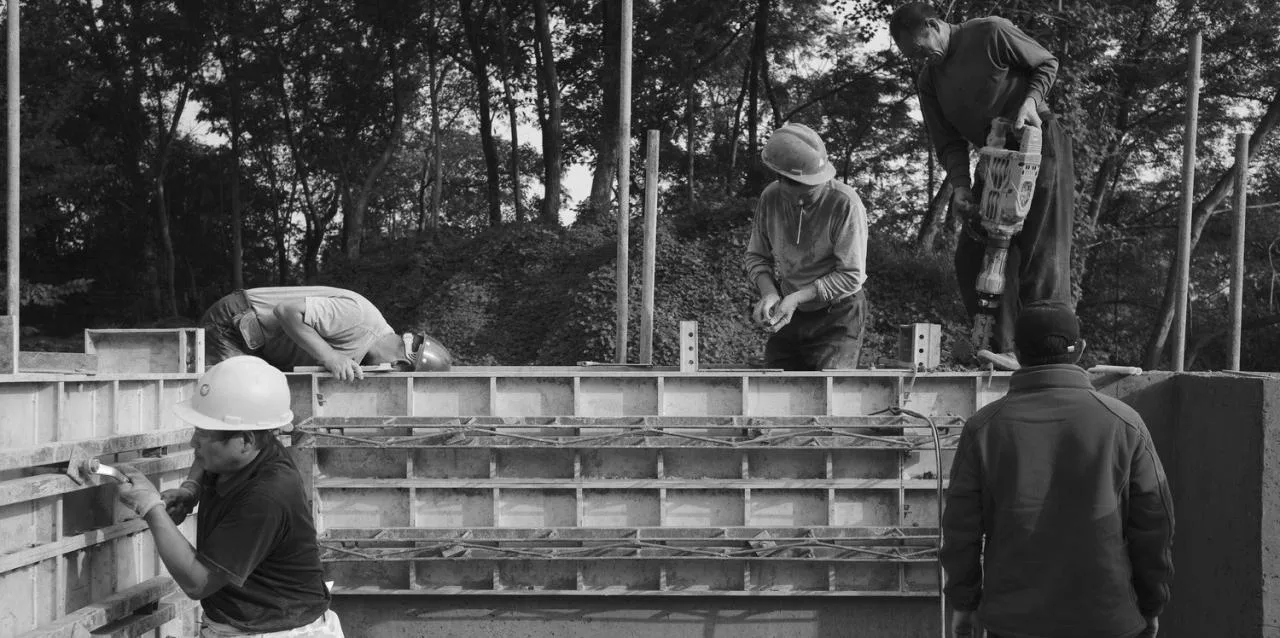
The local team erecting steel frames. © Cooperative Society
Design Focus: Seismic Frame Tube Plan
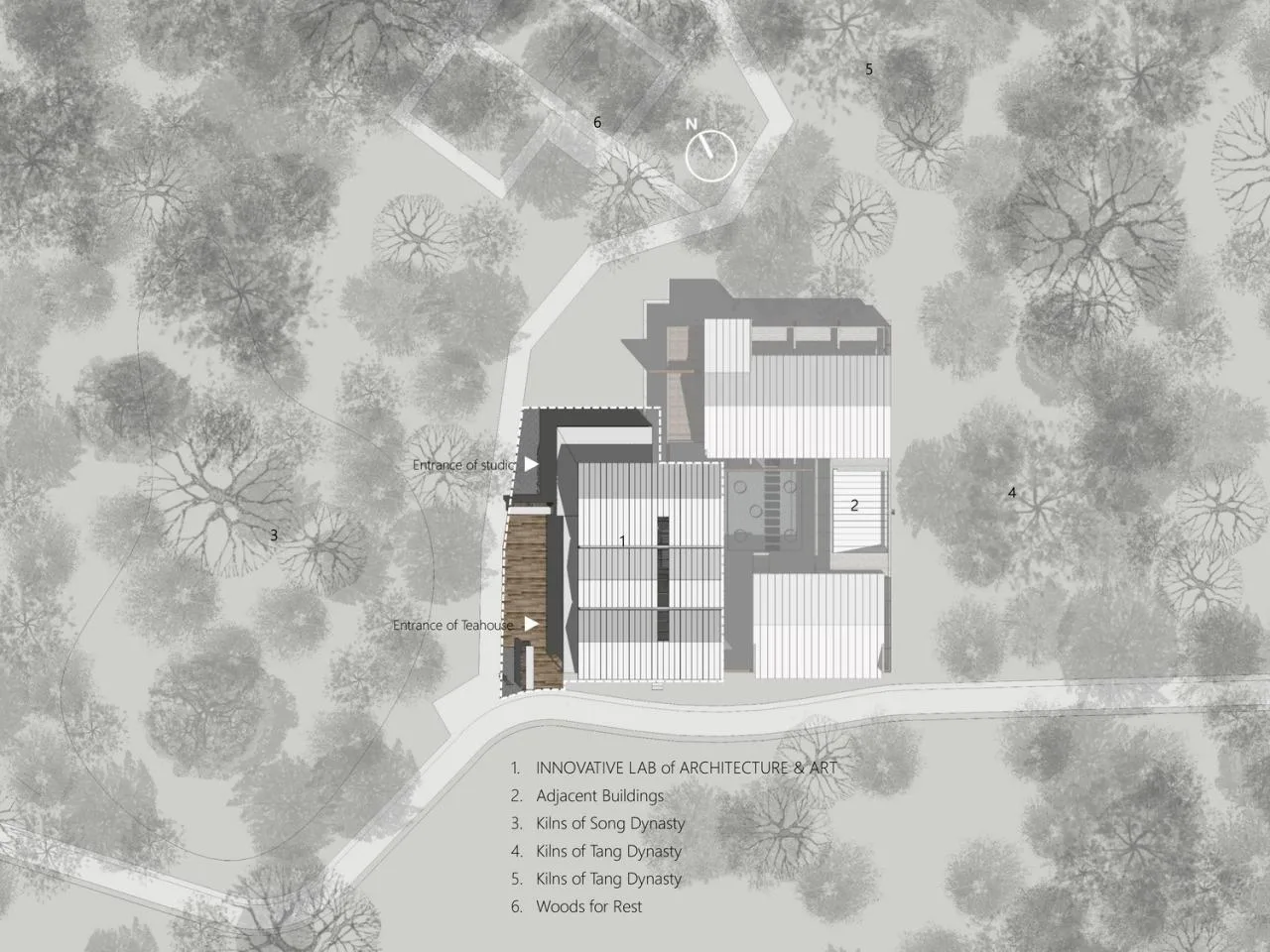
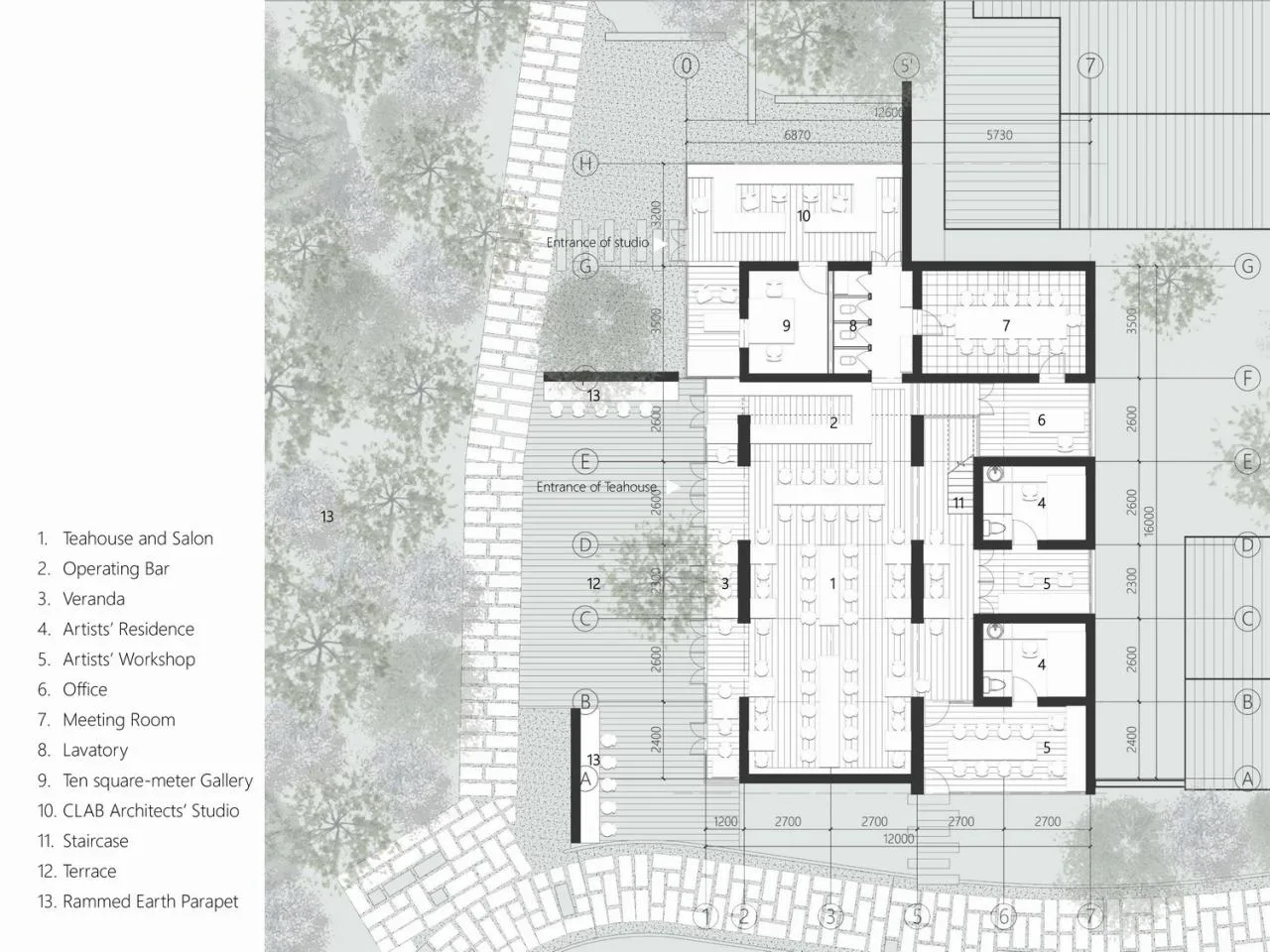
Plan view © Cooperative Society
The significance of handmade rammed earth in rural society is clear. Architectural knowledge introduces the principles of durability, practicality, and beauty to rural construction. Safety is especially critical where modern building codes and supervision are lacking.
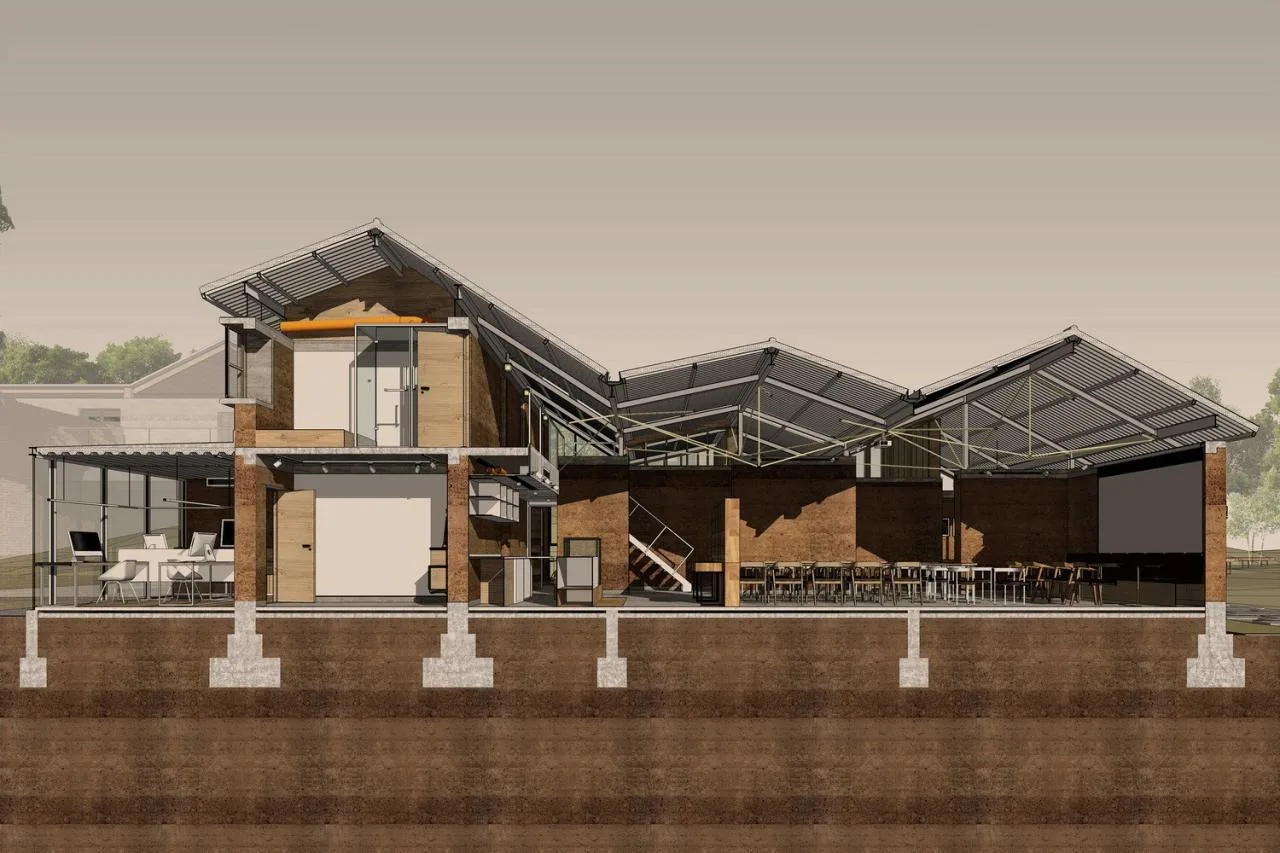
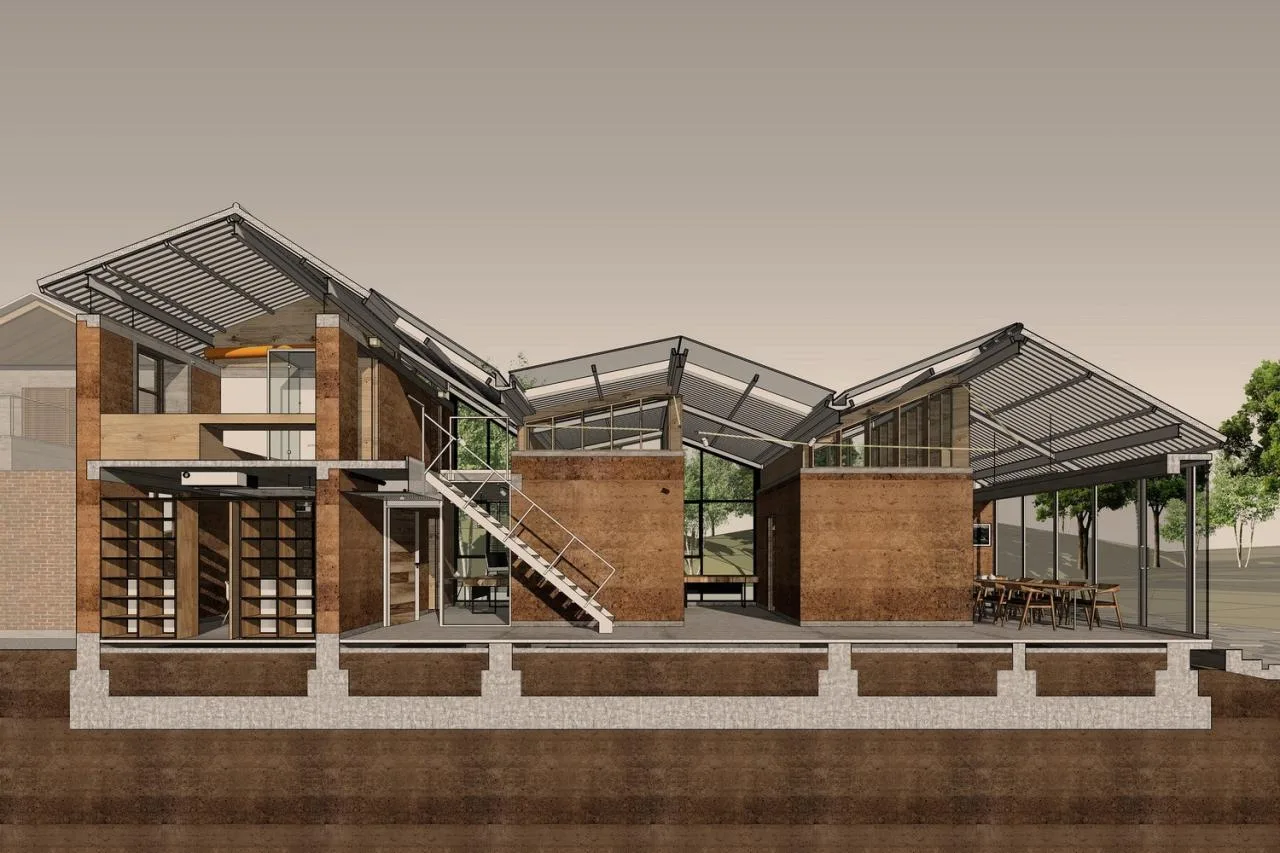
Section diagram © Cooperative Society
Beyond material improvements, the seismic and shear performance of rammed earth depends on the structural design. This building uses small frame tubes to resist horizontal forces from any direction. Between these frame tubes is a public space—a free plane. Walls in the larger space connect via steel roof frames, foundation beams, and shear frame tubes. This “frame tube shear resistance + free plane” structural prototype suits most rural public spaces.
Three Social Access Points of Rammed Earth:
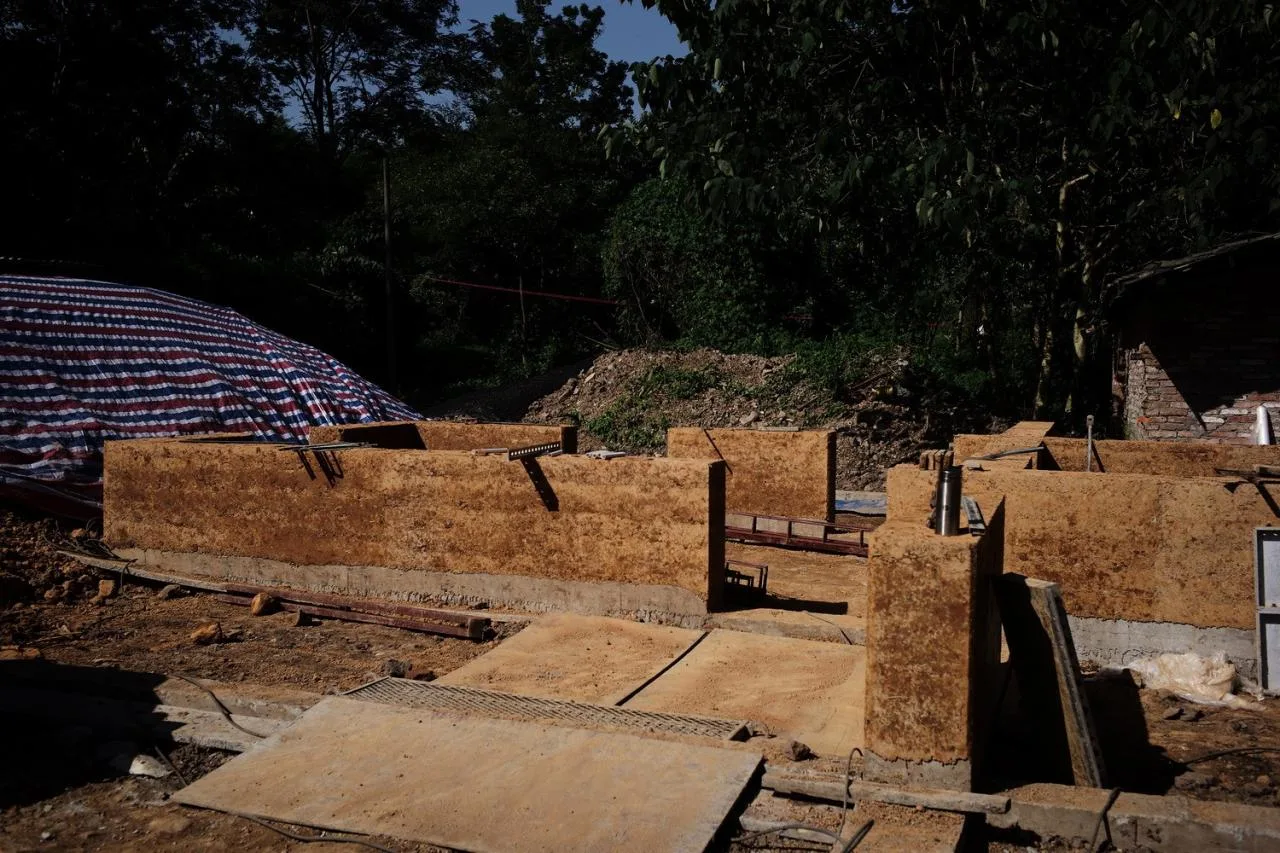
Compacting the wall base—the first generation of rammed earth. © Cooperative Society
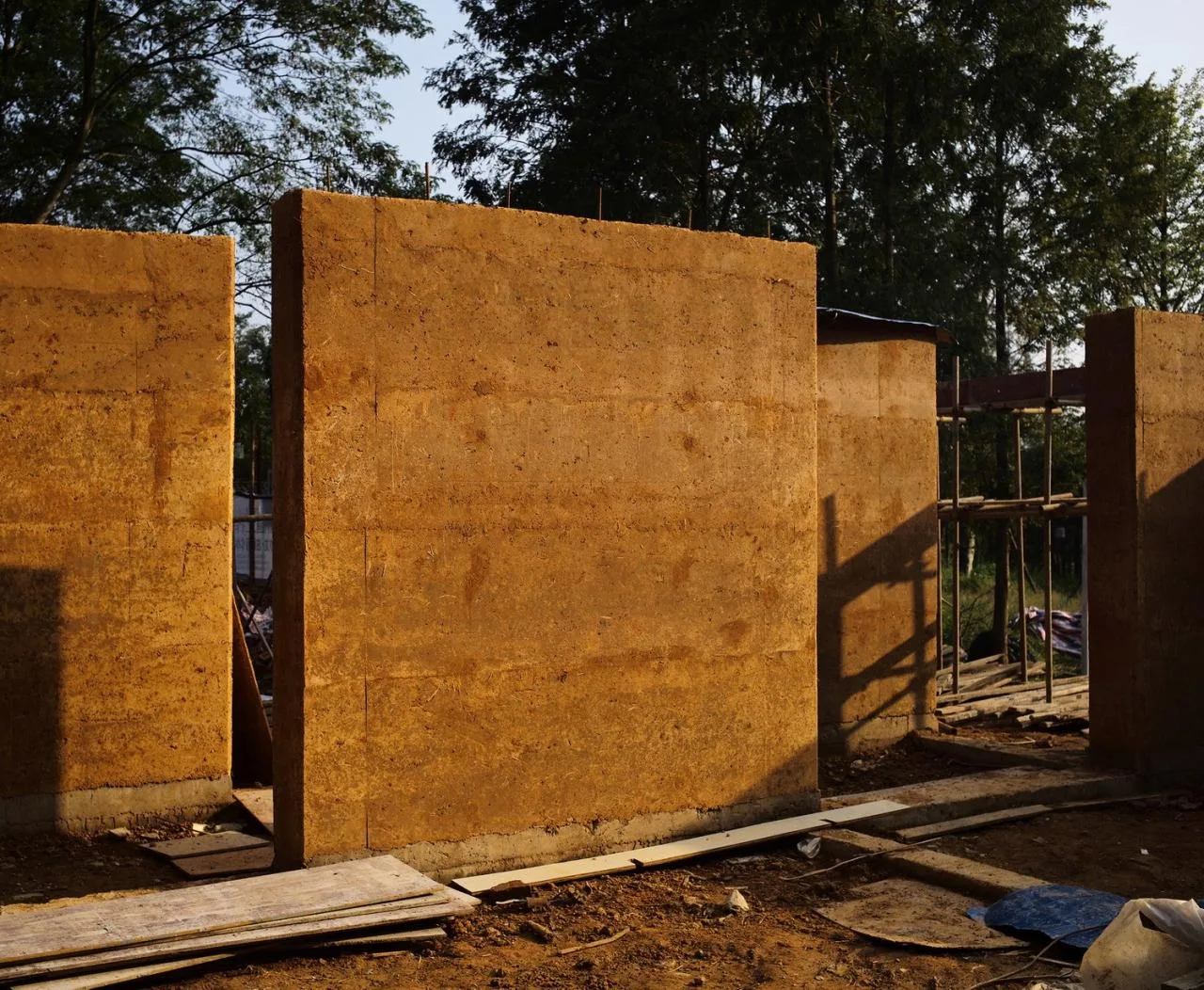
Rammed earth wall under construction. © Cooperative Society
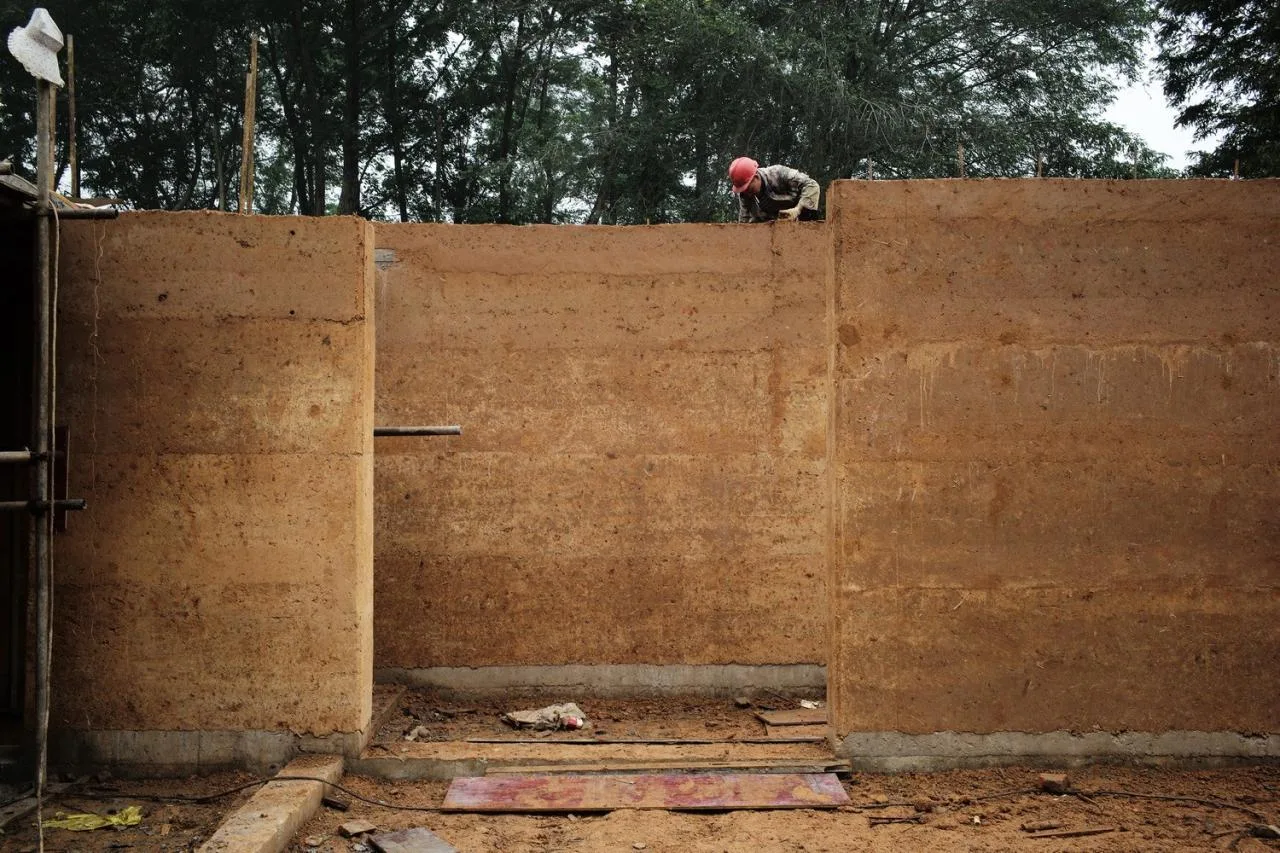
Rural construction workers checking the compactness of the rammed earth wall. © Cooperative Society
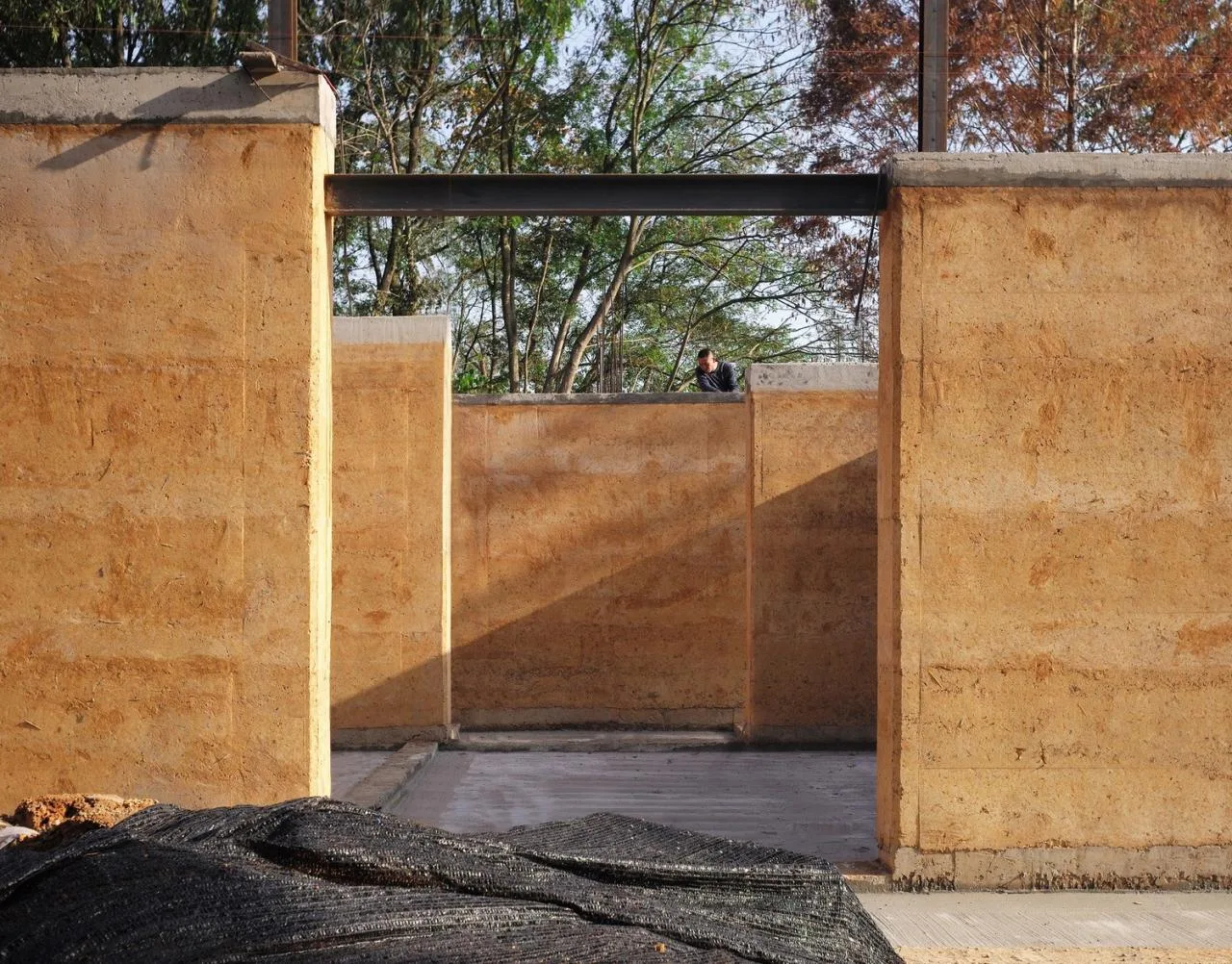
Completed rammed earth wall, ready for roof truss construction. © Cooperative Society
Key aspects:
- Cost-effective: The affordability of rammed earth materials facilitates spontaneous adoption in rural areas.
- Handmade: In pre-modern Chinese rural contexts lacking advanced construction technology, house building is a life skill rather than a specialized profession.
- Structural Use: Rammed earth must serve as a building’s structural system to effectively influence rural social structures. This project also functions as training for rural rammed earth craftsmen, who then bring their skills back to their communities and share knowledge.
Construction Process: Building a Home in the Countryside
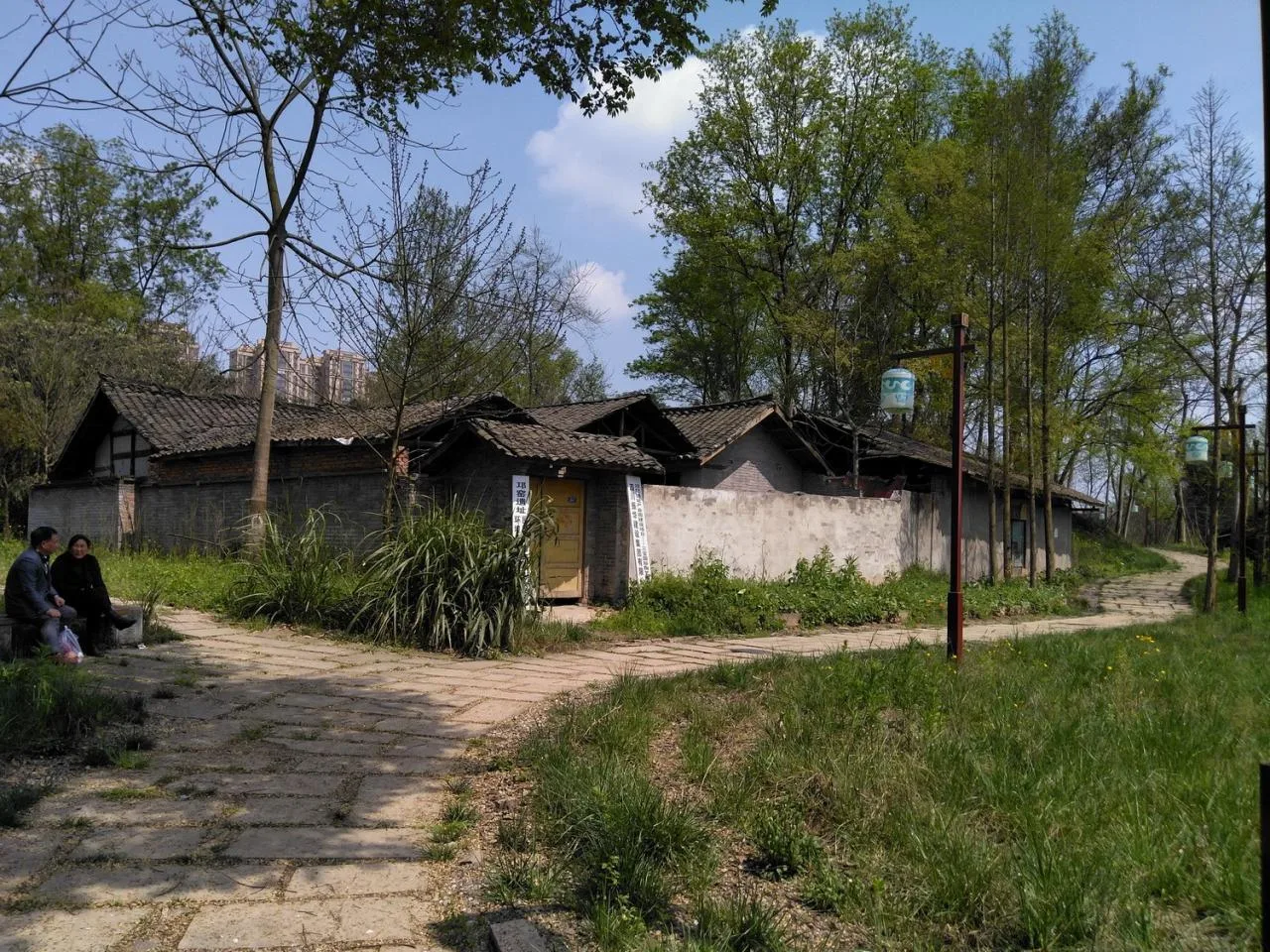
Demolishing a dangerous building on the original laboratory site. © Cooperative Society
Many involved in rural construction are familiar with the concept of “renovating old houses,” but often lack clarity between renovation and reconstruction, leading to uncertainty in decision-making. Here are some guidelines:
- Most rural houses feature brick and wood structures. Renovation often requires replacing main beams and columns, which entails dismantling roof trusses and demolishing the upper structure. If the foundation remains intact, rebuilding main columns and beams is considered reconstruction. Altering the layout constitutes complete reconstruction.
- If main beams and columns are sound and the building accommodates new functions, merely replacing doors and windows (maintenance system) can be a cost-saving renovation.
- If main columns require replacement, demolition is inevitable. It is advisable to redesign the floor plan to meet new functional needs. This approach was applied in the Architecture/Art Innovation Laboratory project, where decayed pillars and foundations were excavated and redesigned.
- The least recommended method is demolishing the entire structure and rebuilding on the original foundation and footprint, as it often leads to higher costs and functional mismatch.
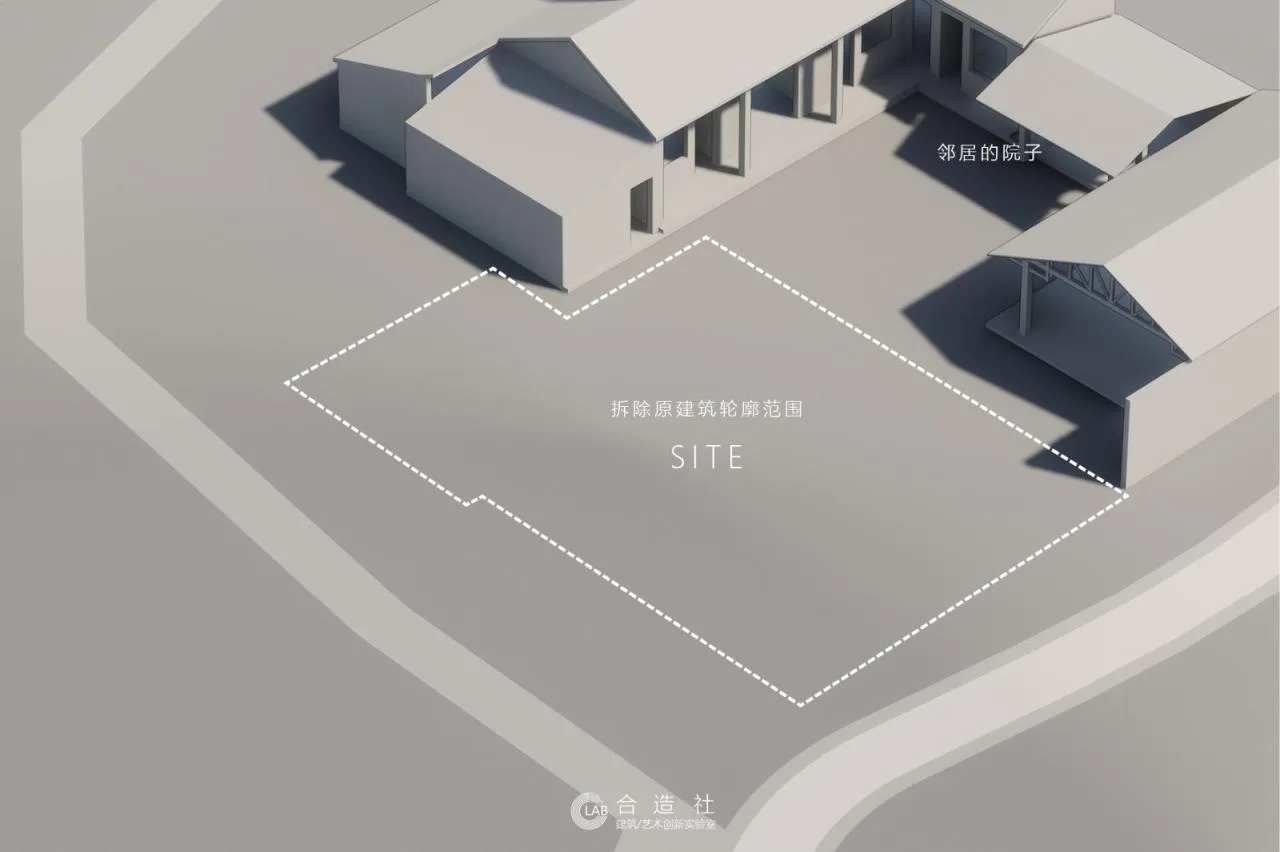
After demolition, building the foundation and site surroundings. © Cooperative Society
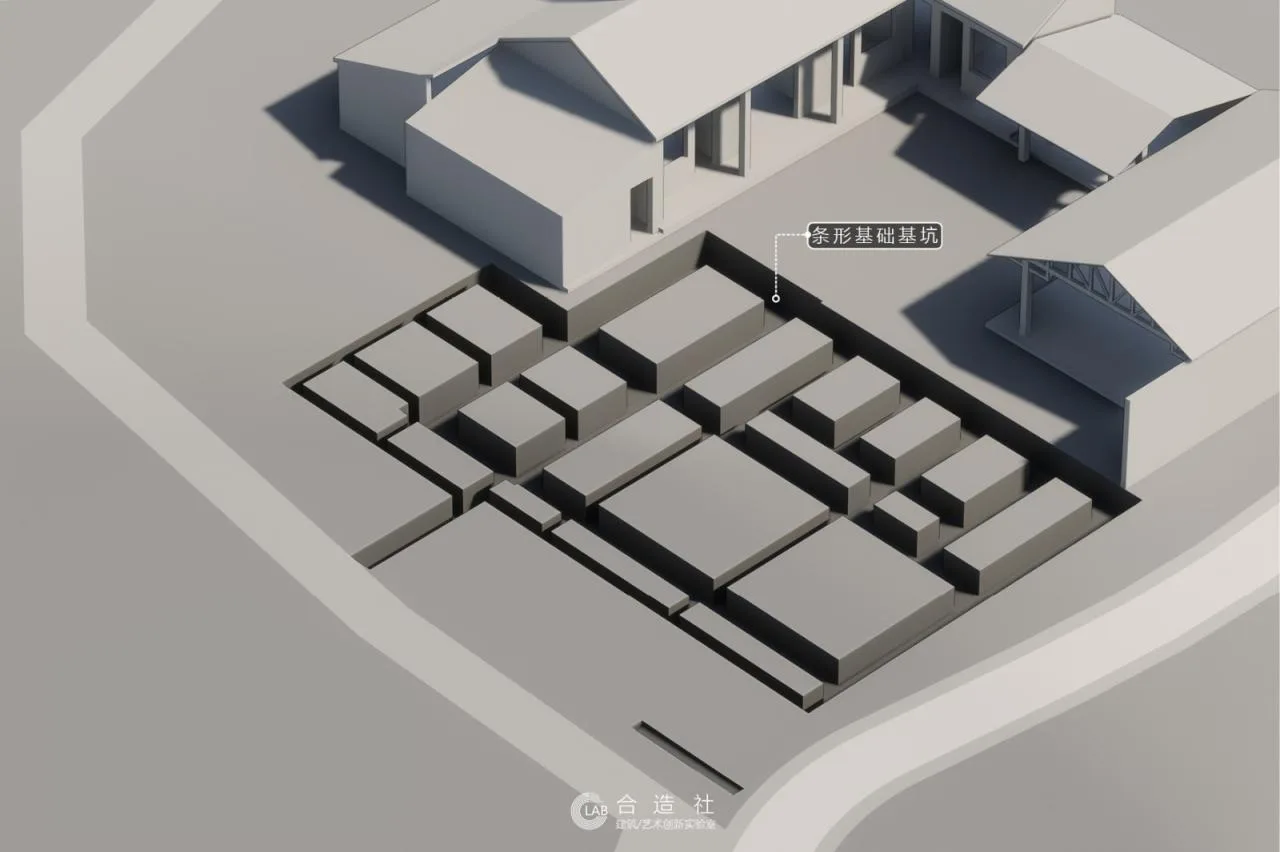
Excavation of the foundation pit. © Cooperative Society
The laboratory uses a strip foundation excavated to the bearing layer. However, as the site is within a protected cultural relic zone, the excavation was shallower. To compensate, a wide concrete strip foundation was cast at the base to reduce settlement and enhance structural stability.
Principles for foundation choice:
- Use independent foundations for column-bearing structures.
- Use strip foundations for wall-bearing structures.
In rural construction, shallow excavation is common, requiring wider foundations and a flexible concrete cushion layer.
Even in rural projects, detailed construction drawings are essential. Due to urgent foundation modifications and lack of structural recalculations, this project incurred an extra 20,000 yuan per foundation item—a costly lesson.
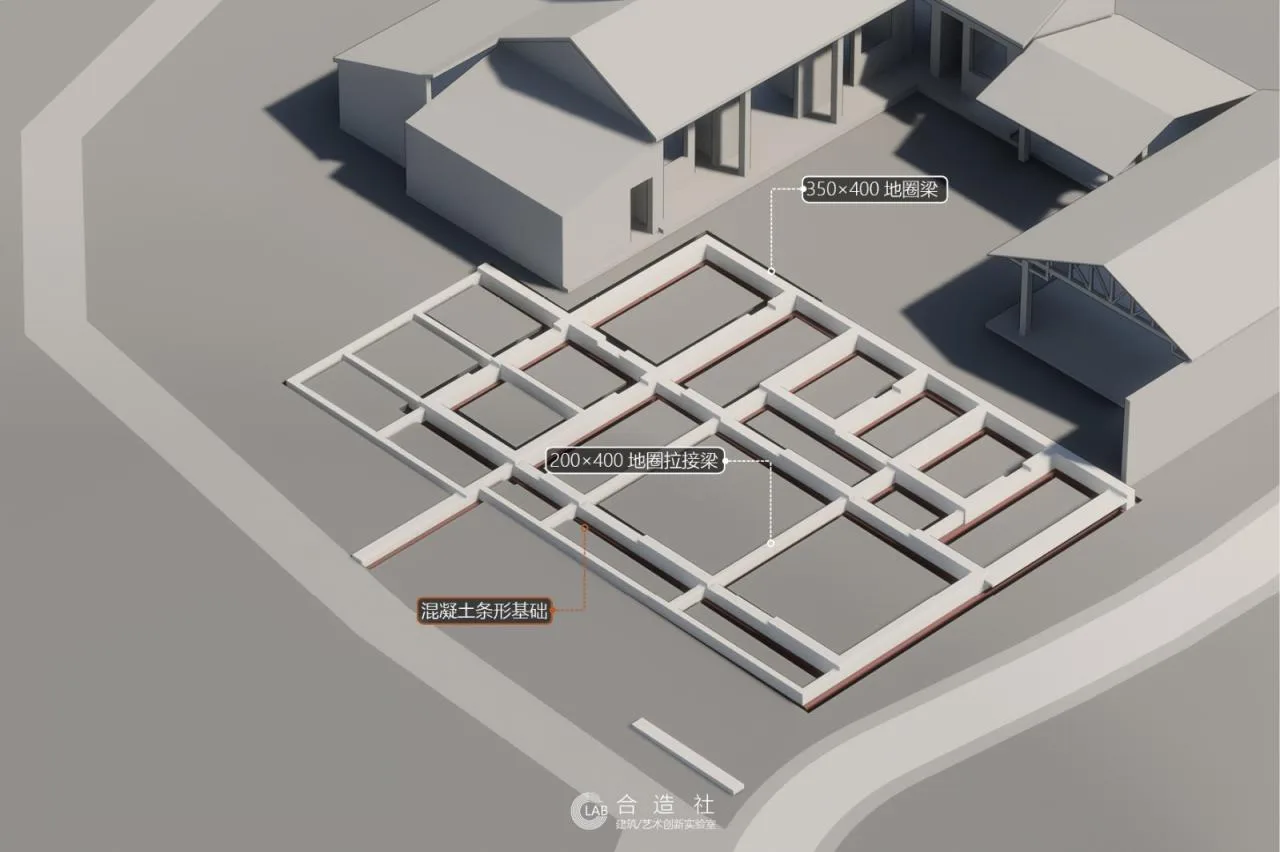
Foundation construction. © Cooperative Society
The laboratory’s main structure is a box-shaped rammed earth building supported by strip foundations. The reinforcement at the base slab consists of 18 mm diameter threaded steel bars, with eight longitudinal bars spaced 250 mm apart (later deemed overly dense through structural analysis).
Foundations must be present wherever walls exist. Strip foundations can be connected along axes or reinforced with tie beams to improve seismic resilience.
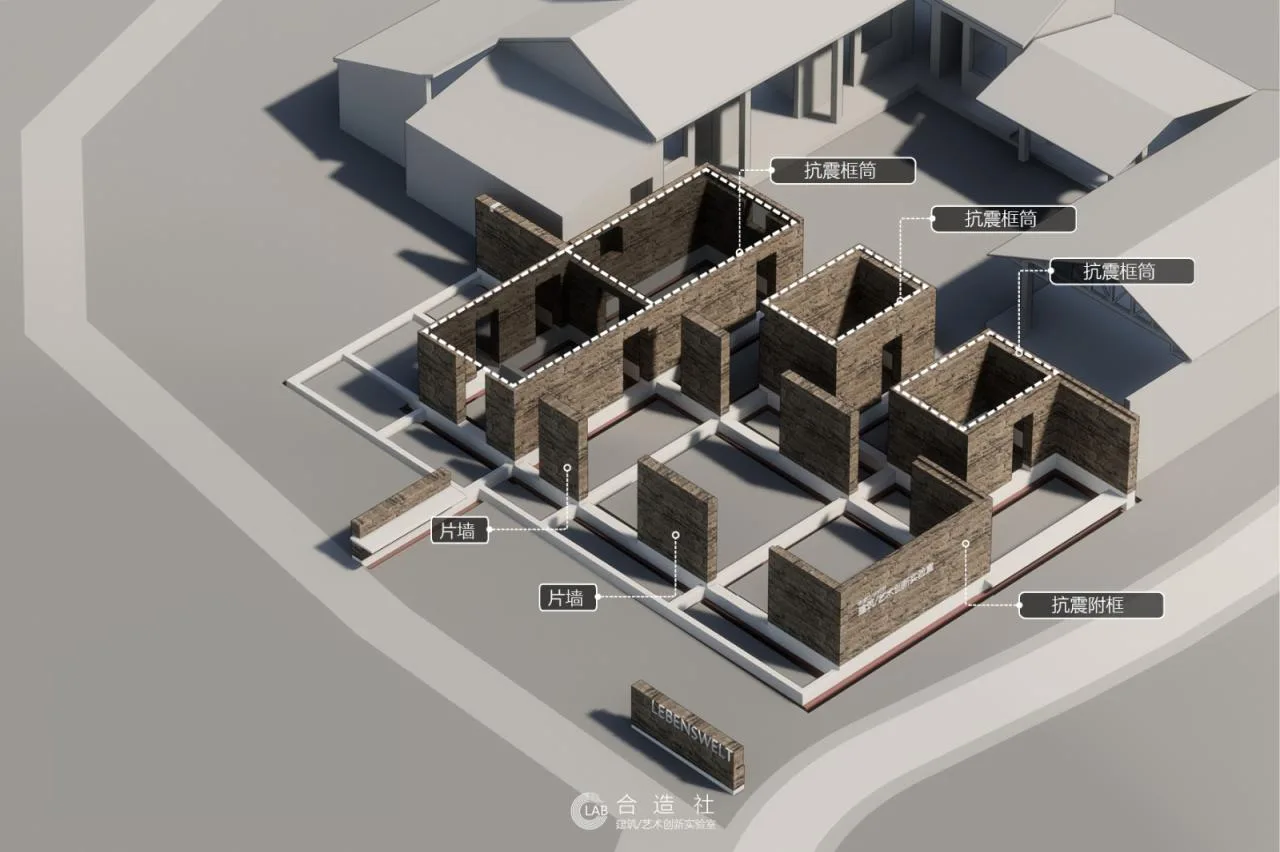
After pouring the ground ring beam, soil compaction for the first wall layer begins. © Cooperative Society
The concrete ring beam requires about five days of curing before soil compaction atop it can start.
The primary principle for seismic rammed earth walls is to create a frame tube structure. Large frame tubes include an internal wall to form two smaller frame tubes with a lower aspect ratio.
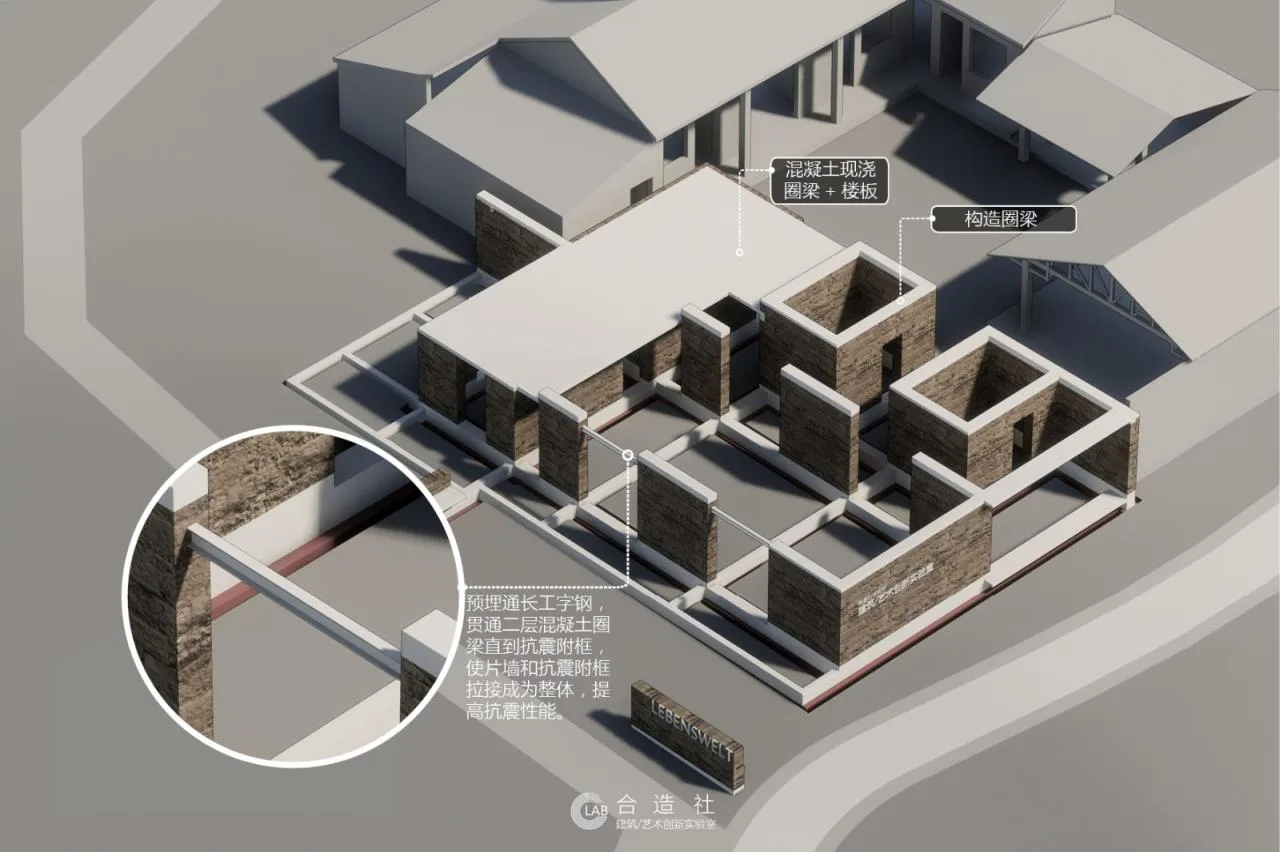
After compacting the first-floor walls, formwork was erected and ring beams and second-floor slabs poured. © Cooperative Society
Because the laboratory’s design includes a large public space, a frame tube structure could not be formed on one side. Instead, a wall was used. While vertical seismic performance of such walls is excellent, lateral seismic resistance is minimal. To address this, a full-length high-strength I-beam was embedded longitudinally within the wall. The I-beam is welded to embedded parts in concrete slabs, connecting slabs and seismic frame tubes into an integrated structural system, enhancing seismic resistance.
Key points:
- Concrete ring beams enhance horizontal seismic resistance and serve as load-bearing elements connecting rammed earth walls and steel roof structures. Steel is alkali resistant but not acid resistant; concrete is alkaline; rammed earth tends to be acidic. The design ensures seamless connections among materials.
- I-beams embedded in rammed earth receive high-strength anti-corrosion treatment. Pre-embedded positions must be centered and compacted on both sides to prevent displacement during compaction.
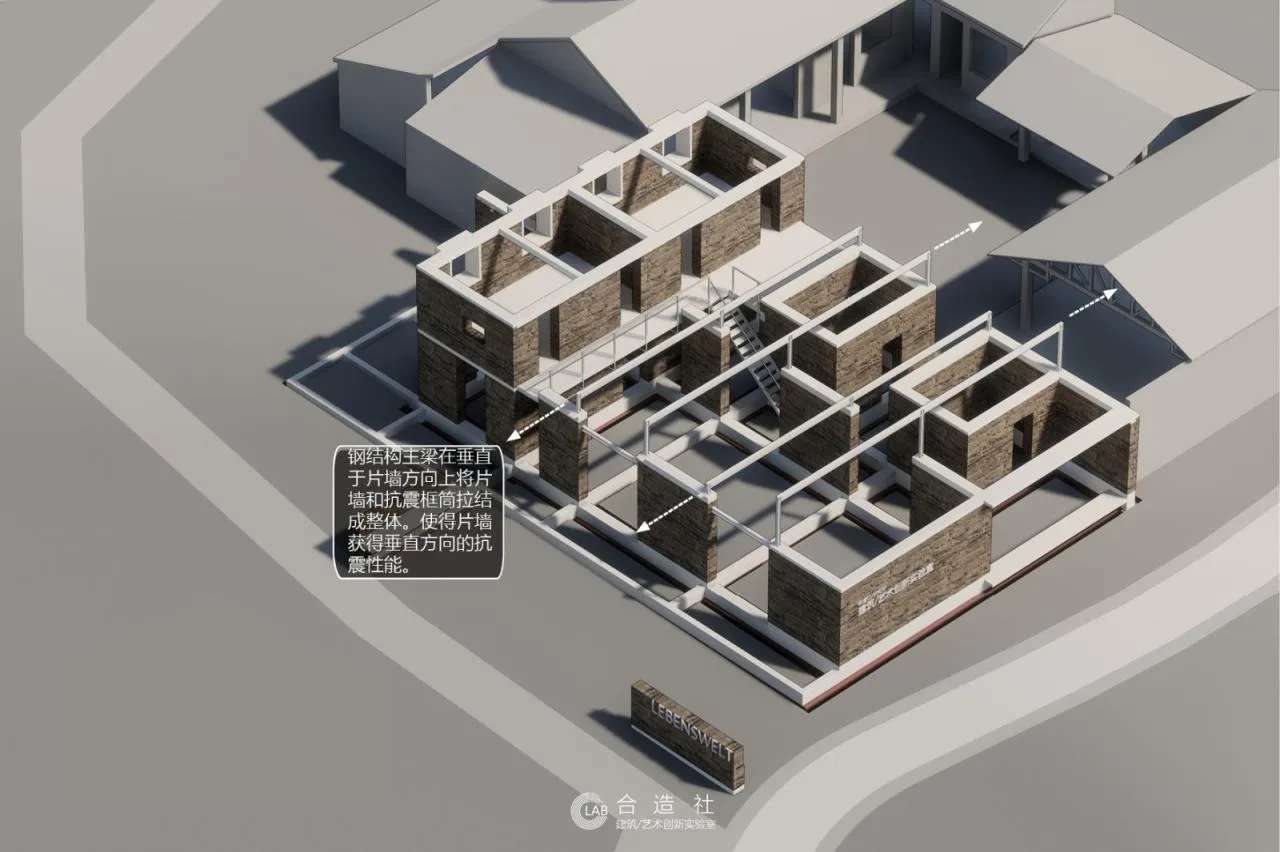
Compacting the second wall layer on the floor slab and constructing a steel staircase. © Cooperative Society
Steel columns and main beams rise above the ring beam. Four main beams connect the sheet wall and seismic frame tube vertically, giving the wall seismic resistance in both directions.
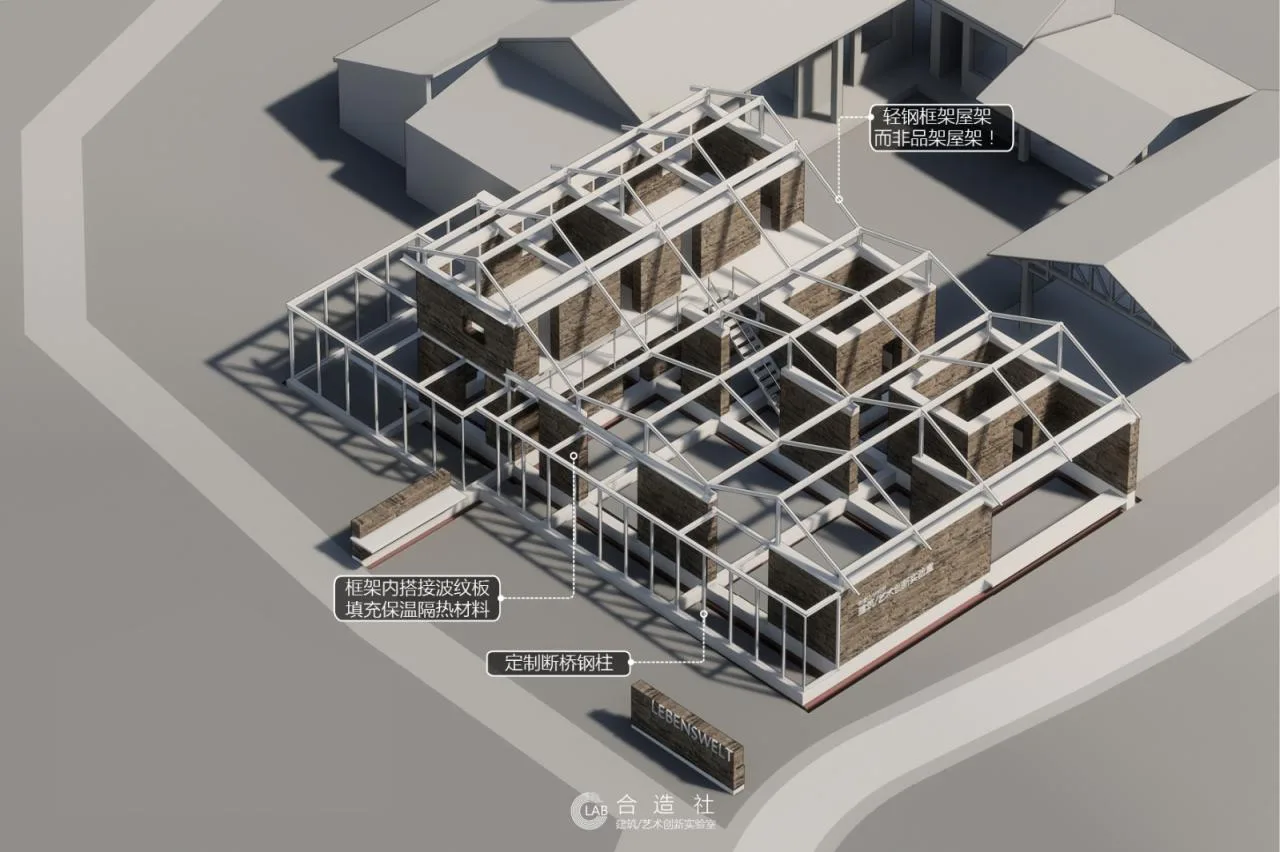
Overlapping light steel frame and edge gallery system. © Cooperative Society
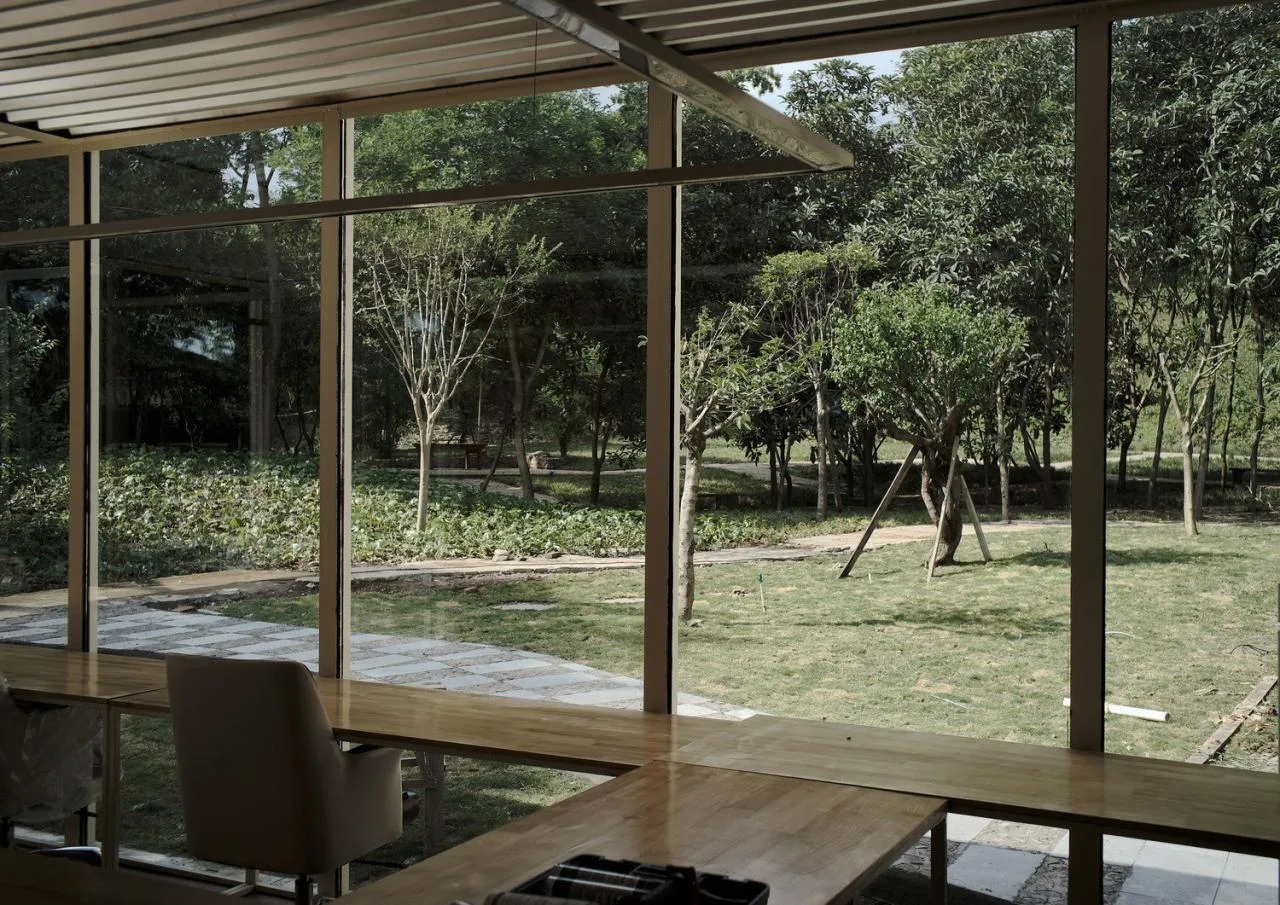
The side corridor utilizes specially developed broken bridge steel columns by the cooperative. These columns serve both as load-bearing elements and window frames. Hollow insulated glass is clamped directly between the broken bridge steel columns.
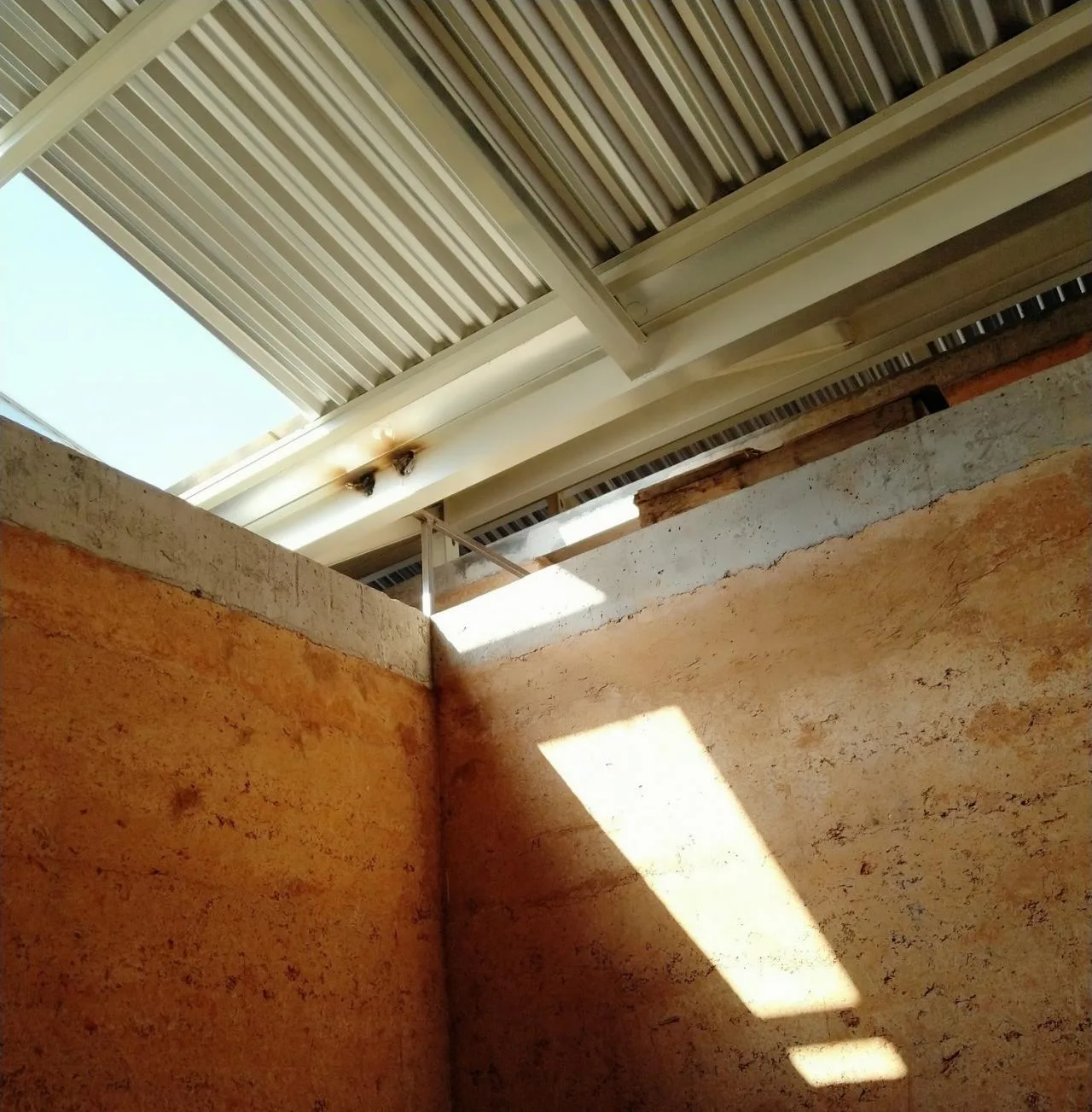
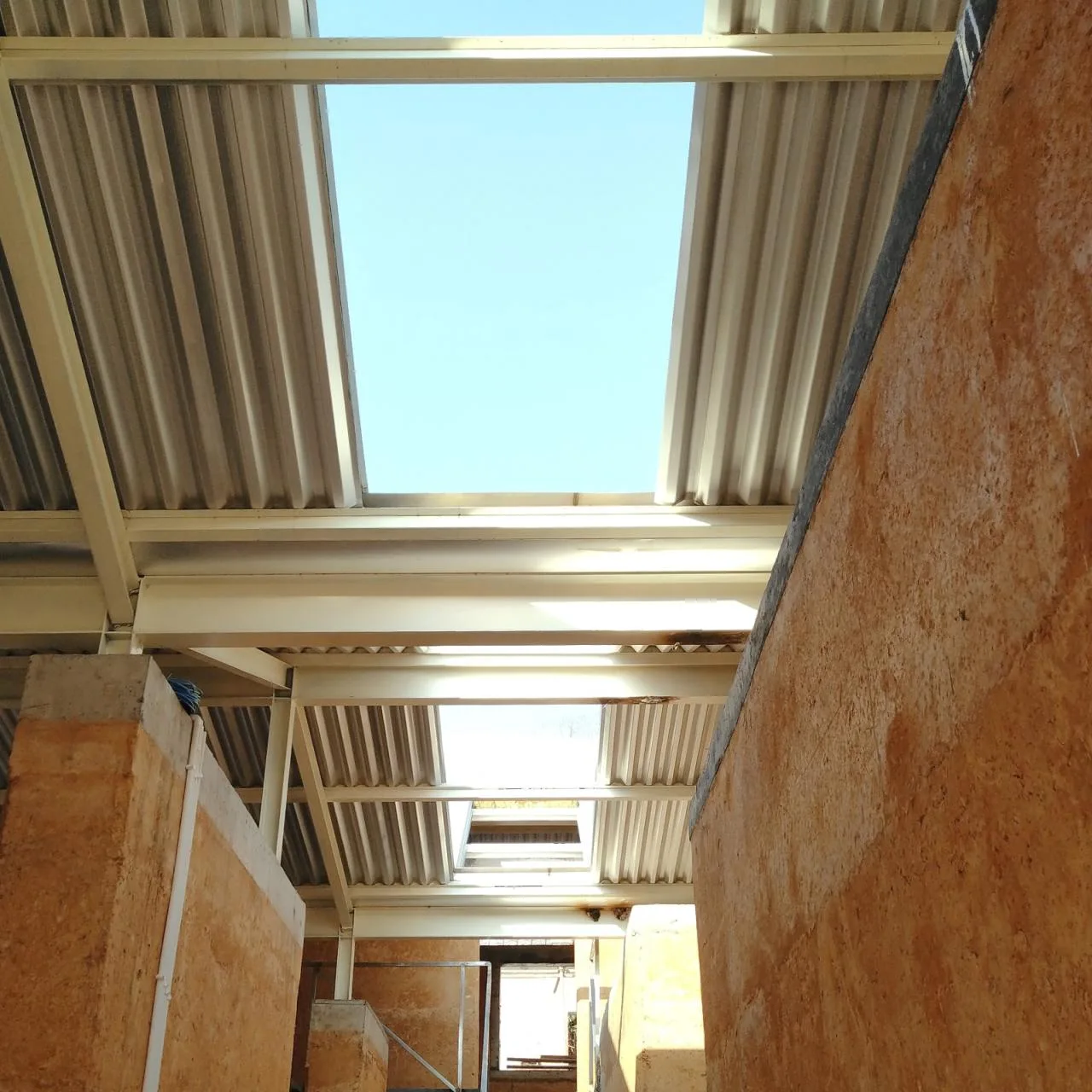
The side corridor roof structure features I-beams as beams, with corrugated plates attached to lower flanges, creating a pot-shaped space filled with insulation materials.
Light steel roof trusses generally come in frame or truss structures. Frame structures resist forces in multiple horizontal directions, while trusses resist forces primarily along one direction. The frame structure, though slightly more expensive, offers superior performance and was chosen for enhanced seismic resistance.
Metal components of the glass corridor must adopt broken bridge technology to avoid excessive air conditioning costs and prevent heat hazards.
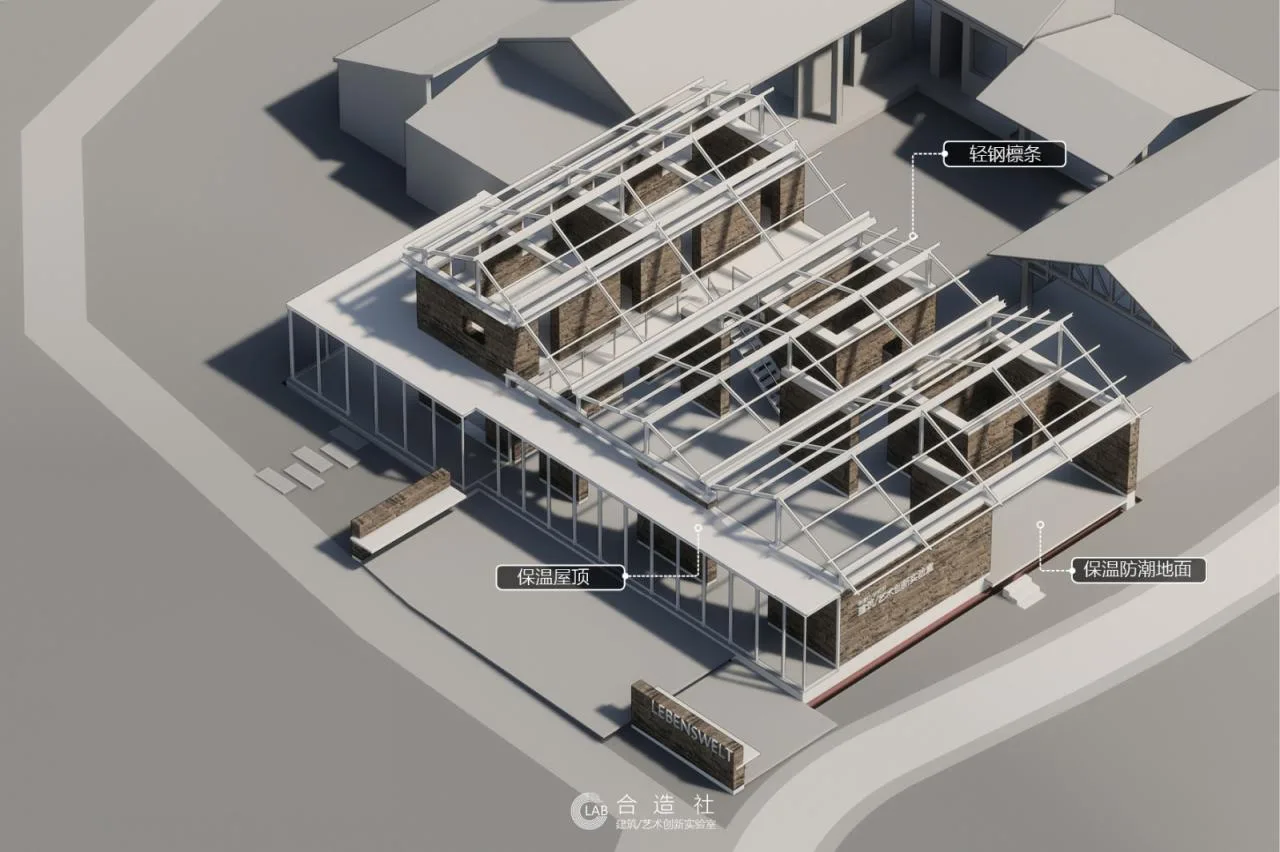
Installing the side corridor roof; purlins also serve as ground supports. © Cooperative Society
Once ground construction begins, completion is near. Rural humidity is higher than urban areas, so even without central air conditioning, a moisture-proof insulation layer on the ground is advisable. For buildings with central air conditioning or heating, the ground structure may comprise nearly ten layers, totaling around 180 millimeters in thickness.
Currently, few rural homestays have proper ground structures; many simply lay bluestone slabs over base layers, resulting in high indoor humidity and poor living comfort at night. For those avoiding central air conditioning and seeking cost savings, compacted concrete floors—used for thousands of years—are recommended. For modern craftsman floors, moisture-proof and insulated floors are strongly advised.
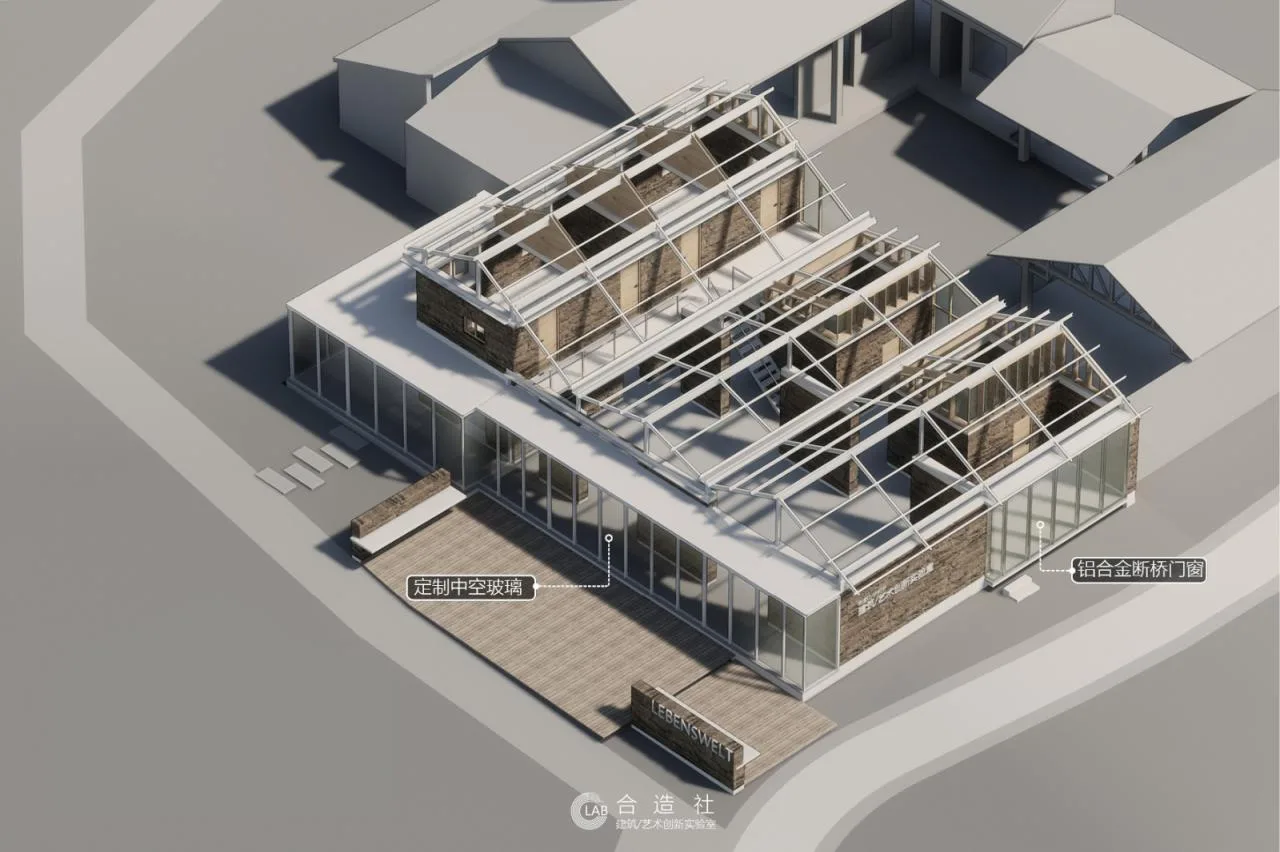
Sealing glass, doors, windows, constructing partitions, and performing maintenance. © Cooperative Society
For buildings with large glazed surfaces or wide openings, airtight insulated glass doors and windows are vital when using central air conditioning. Energy costs vary significantly: approximately 600 yuan per 100 square meters monthly for buildings with sealed, broken bridge insulated glass versus about 1500 yuan for those without.
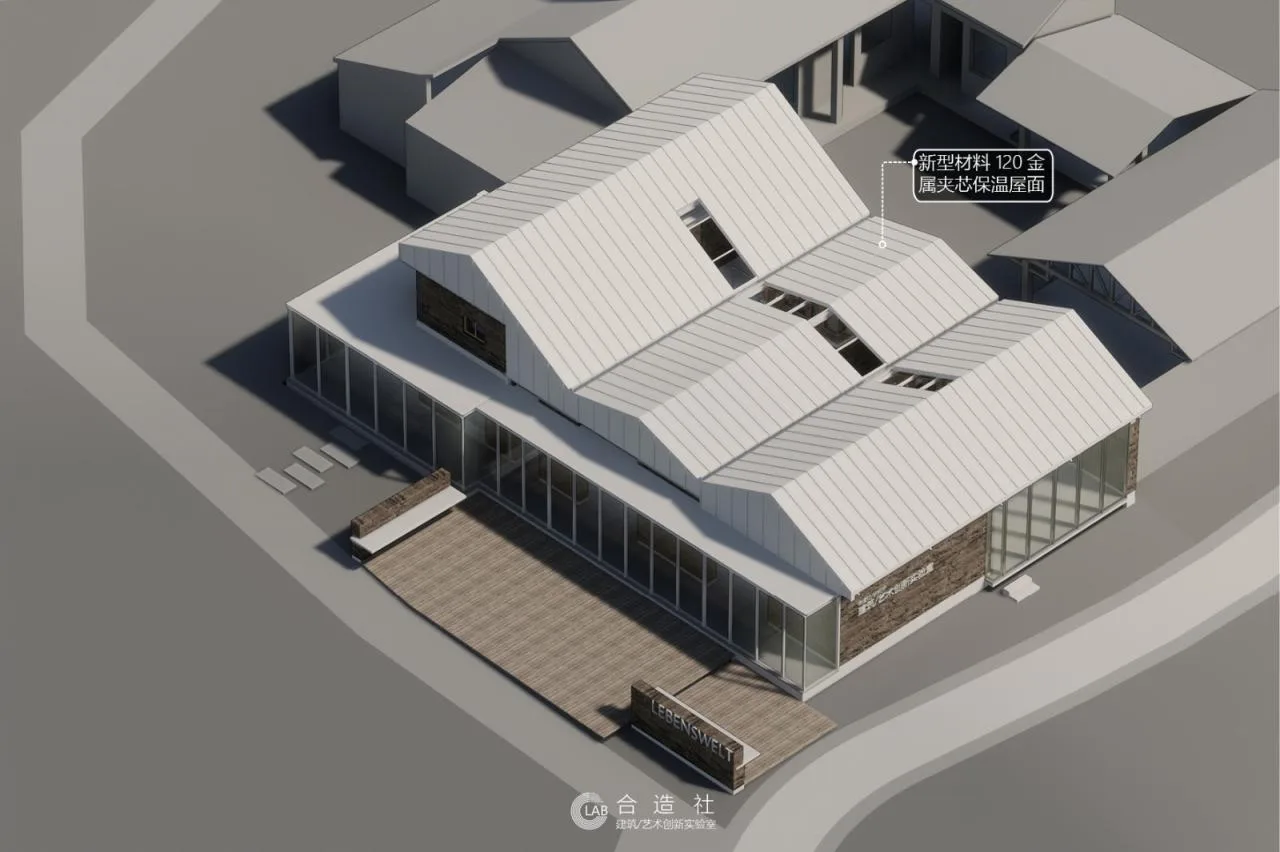
Installing 120mm thick aluminum-magnesium-manganese insulated sandwich roofing. © Cooperative Society
Additional Insights: Building Your Own Rural Home
Cost considerations: The belief that rural houses are inherently cheap is a misconception. The actual cost depends on multiple factors:
- Many villagers build homes at low individual costs due to material prices and a social structure where neighbors assist in construction.
- Costs vary based on required equipment and functionality, such as whether central air conditioning is installed. Higher function demands increase costs for equipment, installation, and necessary structural adaptations.
- For example, ground construction with air conditioning involves multiple layers and comprehensive insulation, increasing expenses by three to four times compared to simpler construction without air conditioning.
Saving costs: Rural construction practices have evolved positively, with more people recognizing design value and willing to pay for it. However, a common misunderstanding is starting construction based solely on design proposals without detailed construction drawings, aiming to save costs.
Construction drawings are critical—not only for aesthetics but more importantly for ensuring reliability, cost efficiency, and safety. In the Architecture/Art Innovation Laboratory, last-minute foundation changes without proper structural recalculations led to a 20,000 yuan increase in costs.
Quality construction drawings coordinate structure, utilities, and equipment, shorten construction time, reduce expenses, and ensure safety. Given that rural projects often do not require official approval of drawings, these documents become the main safeguard for building safety.
We witnessed a seven-meter-high, single-story brick house built without structural ring beams, using 6mm diameter round steel bars for corner columns and iron wire as stirrups—an alarming situation highlighting the need for proper design and supervision.
Architectural Keywords
Heritage Park
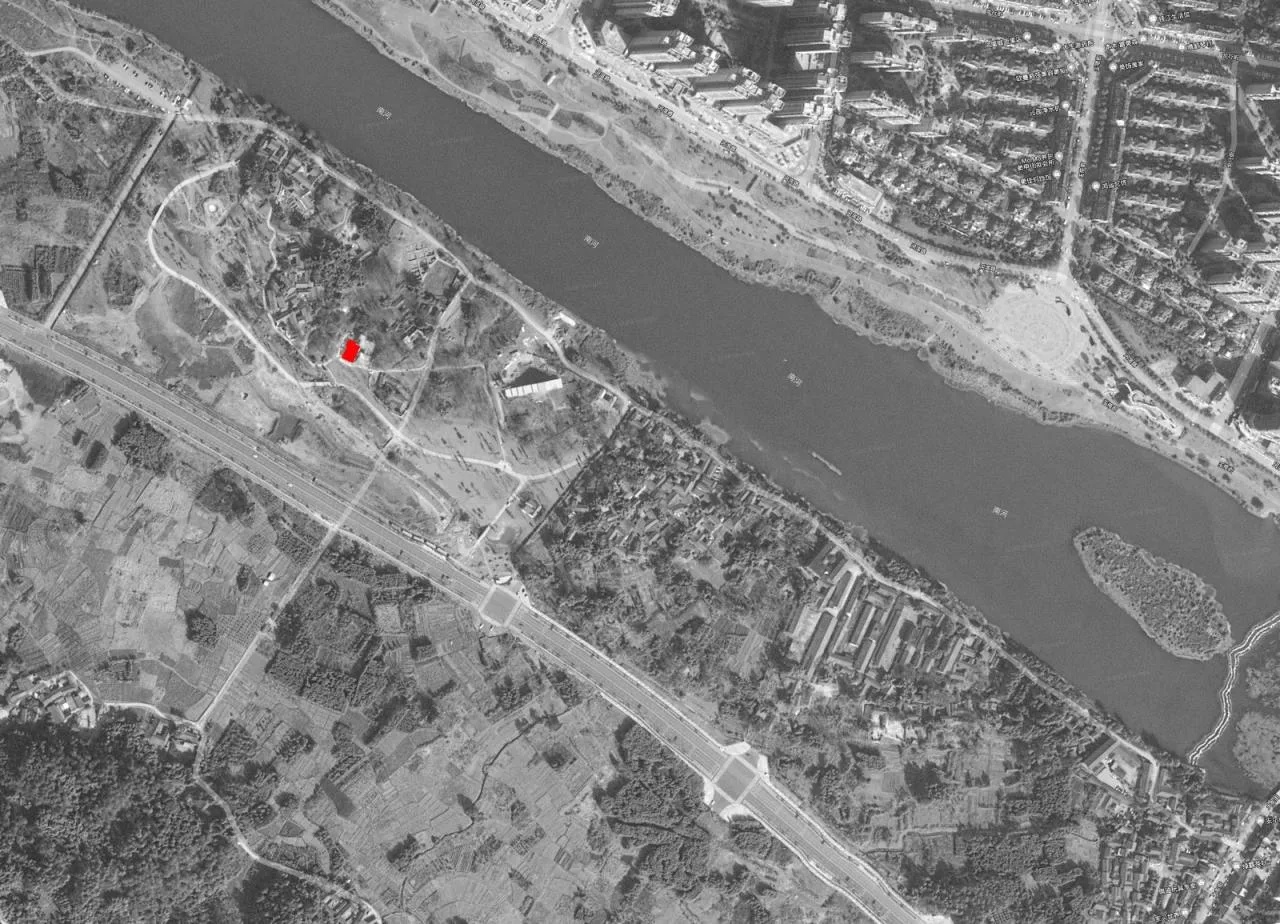
Site Park © Cooperative Society
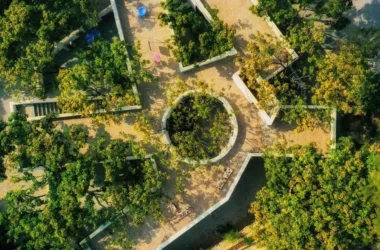
The Architecture/Art Innovation Laboratory is situated within the nationally protected Qiongyao Site Park. This area has hosted skilled pottery craftsmen since the Han Dynasty through to the late Qing Dynasty, leaving behind fourteen kiln mounds covered by towering trees. Ceramic fragments still occasionally surface, bearing witness to millennia of craftsmanship and labor.
Qiong Kiln, a folk kiln site, historically intertwined pottery making with agricultural practices, shaping a unique landscape where kiln mounds are interspersed among the forests and farmlands of western Sichuan—a trinity of production, life, and social structure reflected in spatial topography. The laboratory occupies one of over ten Linpan courtyards in this region.
This project draws deeply from history while infusing contemporary meaning.
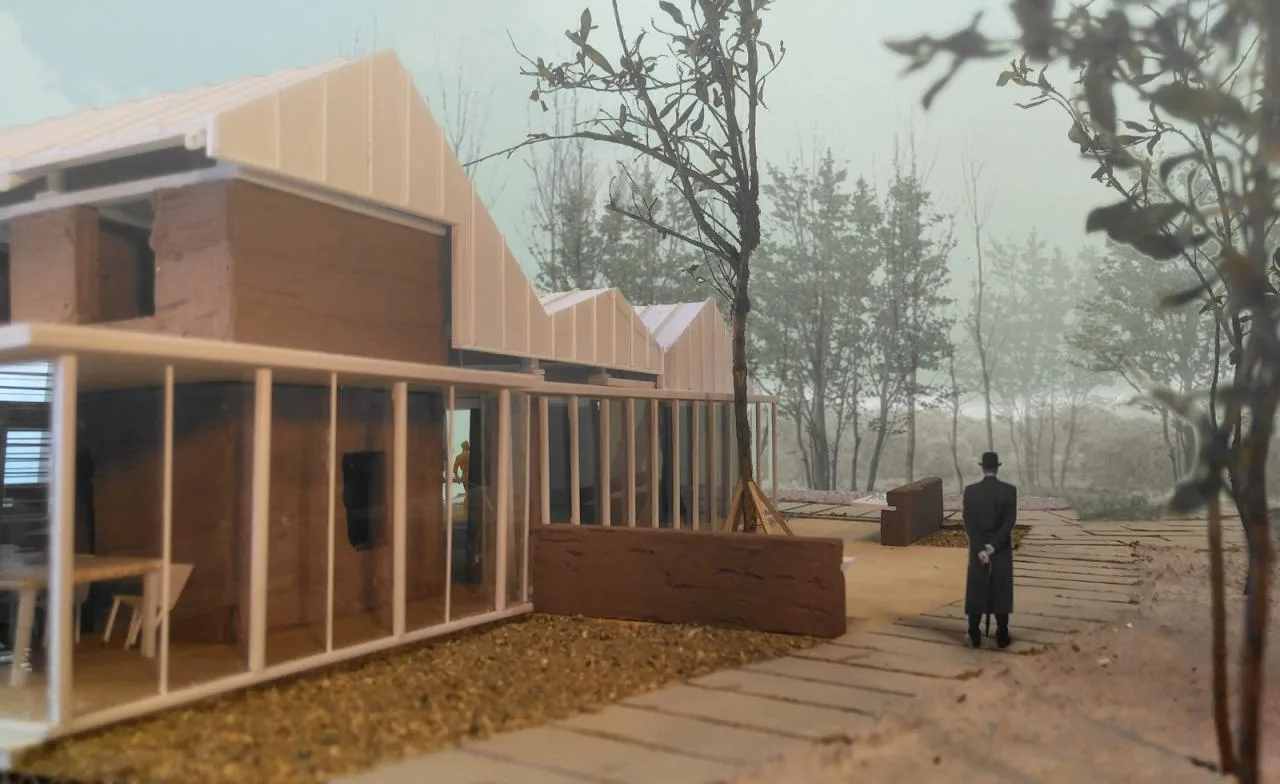
Model design envisioning architecture within the site. © Cooperative Society
Rammed Earth: Carrier of Social Relations
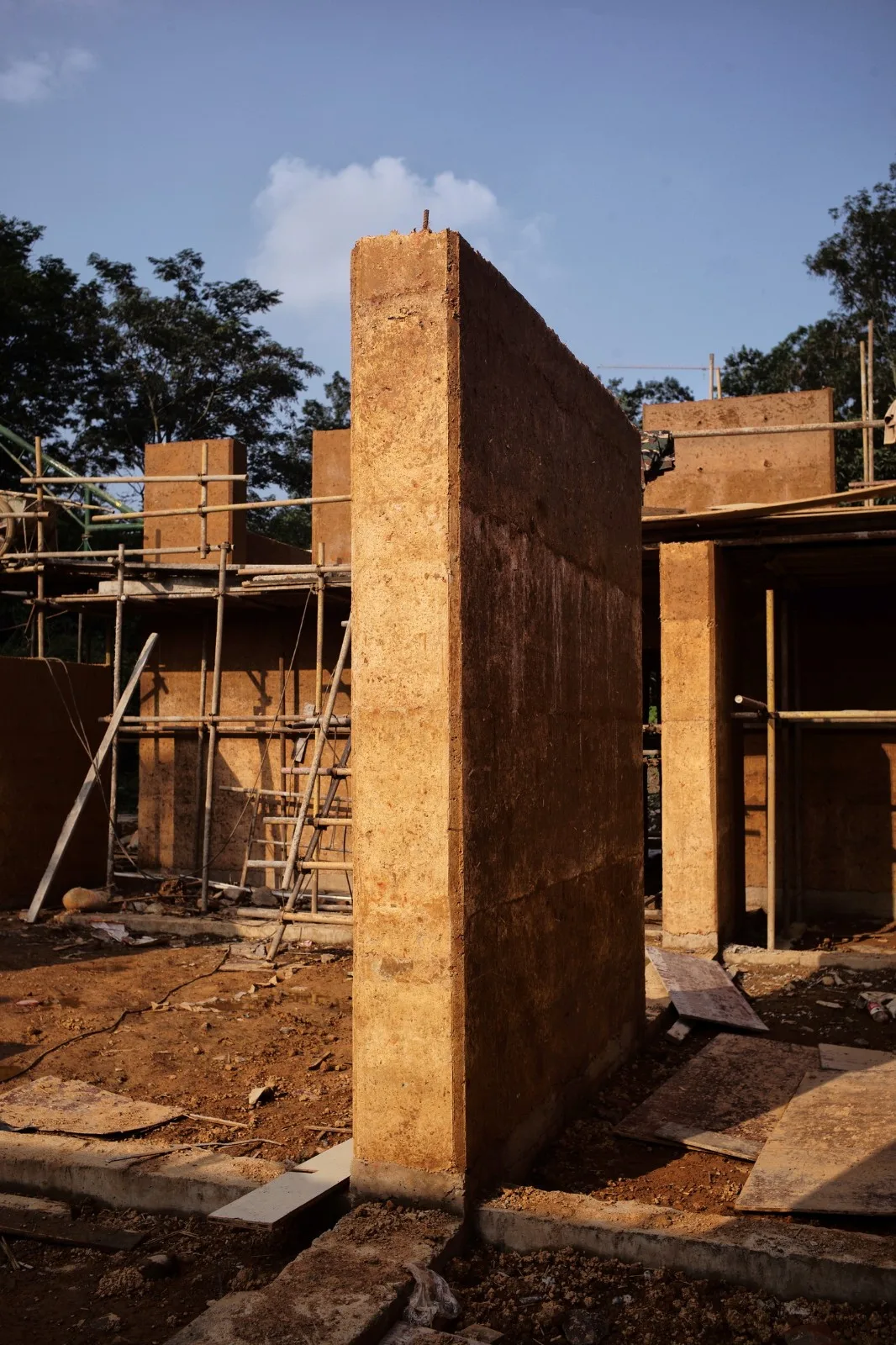
Compacted earth wall. © Cooperative Society
The Architecture/Art Innovation Laboratory revives the age-old but now dormant rammed earth technique, imbuing it with modern relevance through construction experiments. This includes:
- Suitability for seismic zones with resistance up to magnitude eight.
- Use as a true structural system, not mere decoration.
- Biodegradability, allowing the material to return to the earth rather than becoming waste.
- Manual construction methods that align with the pre-modern rural labor context, ensuring continuity rather than detachment from rural life.
Thus, the project’s significance extends beyond technology to encompass social relations of this era.
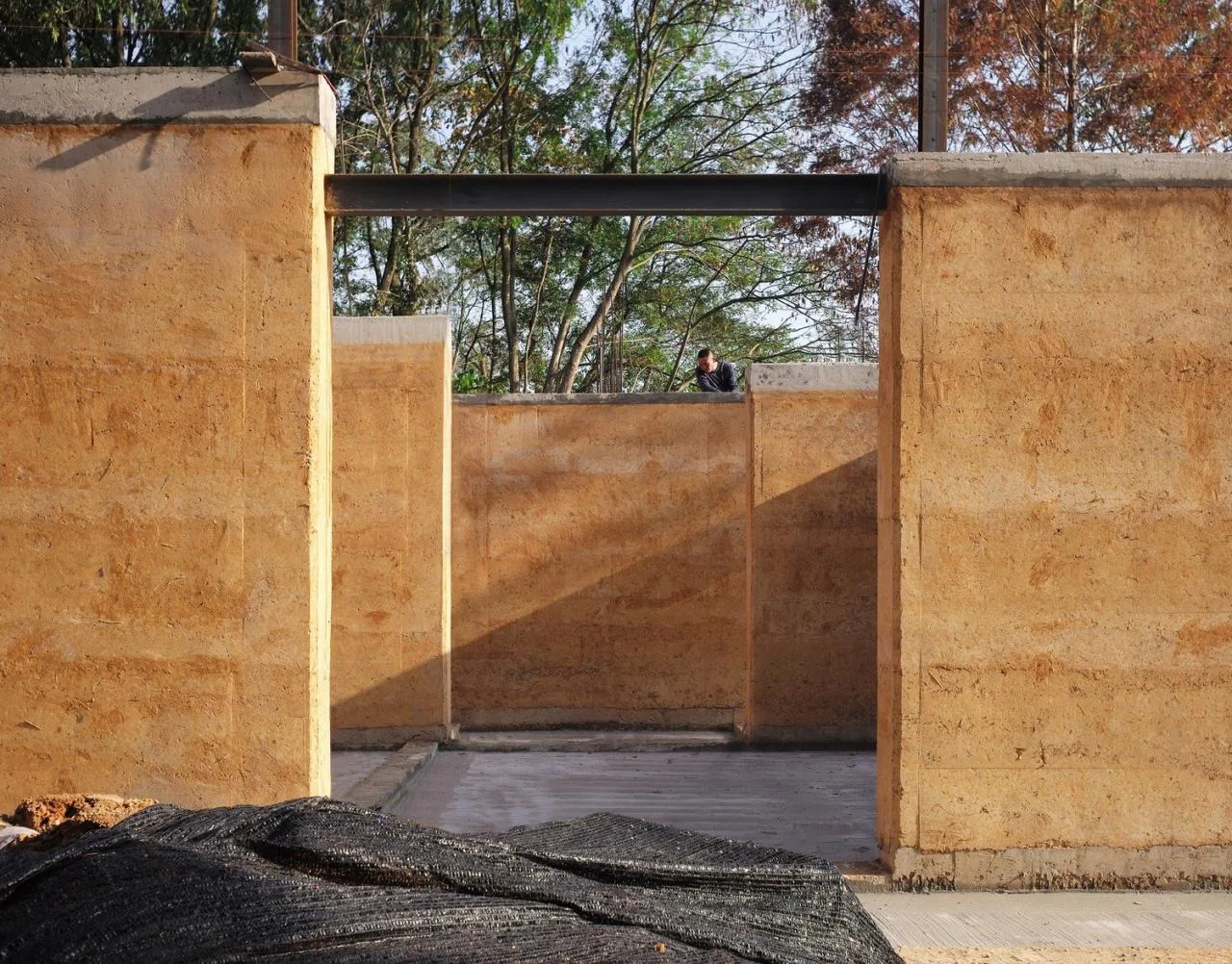
Compacted earth wall. © Cooperative Society
Pre-modern Rural Meets Modern Design: Structural-level Broken Bridge Curtain Wall & Integrated Waterproof and Thermal Roof
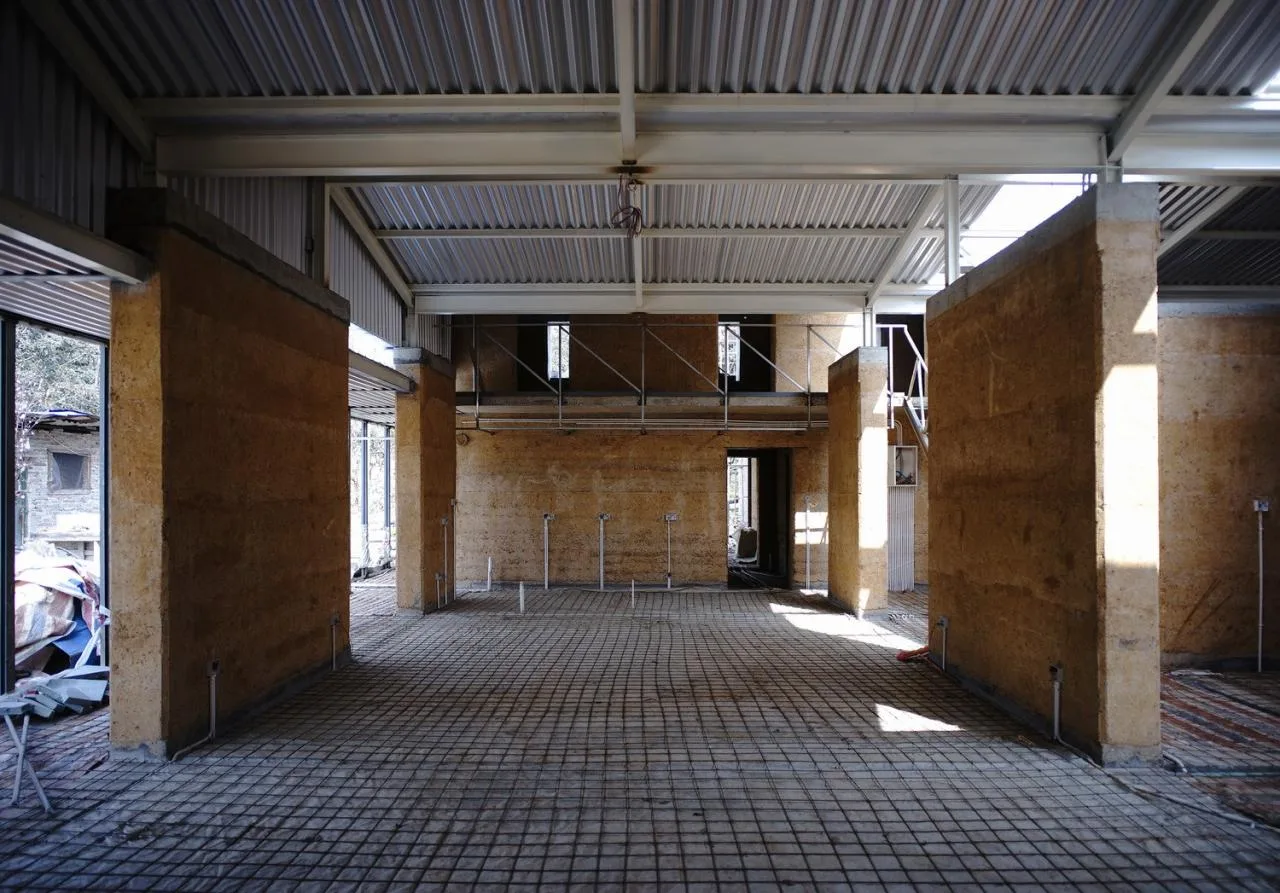
Laboratory public space under construction © Cooperative Society
The building features central air conditioning and a hot water circulation system, integrating modern comforts. The building’s maintenance systems were designed accordingly.
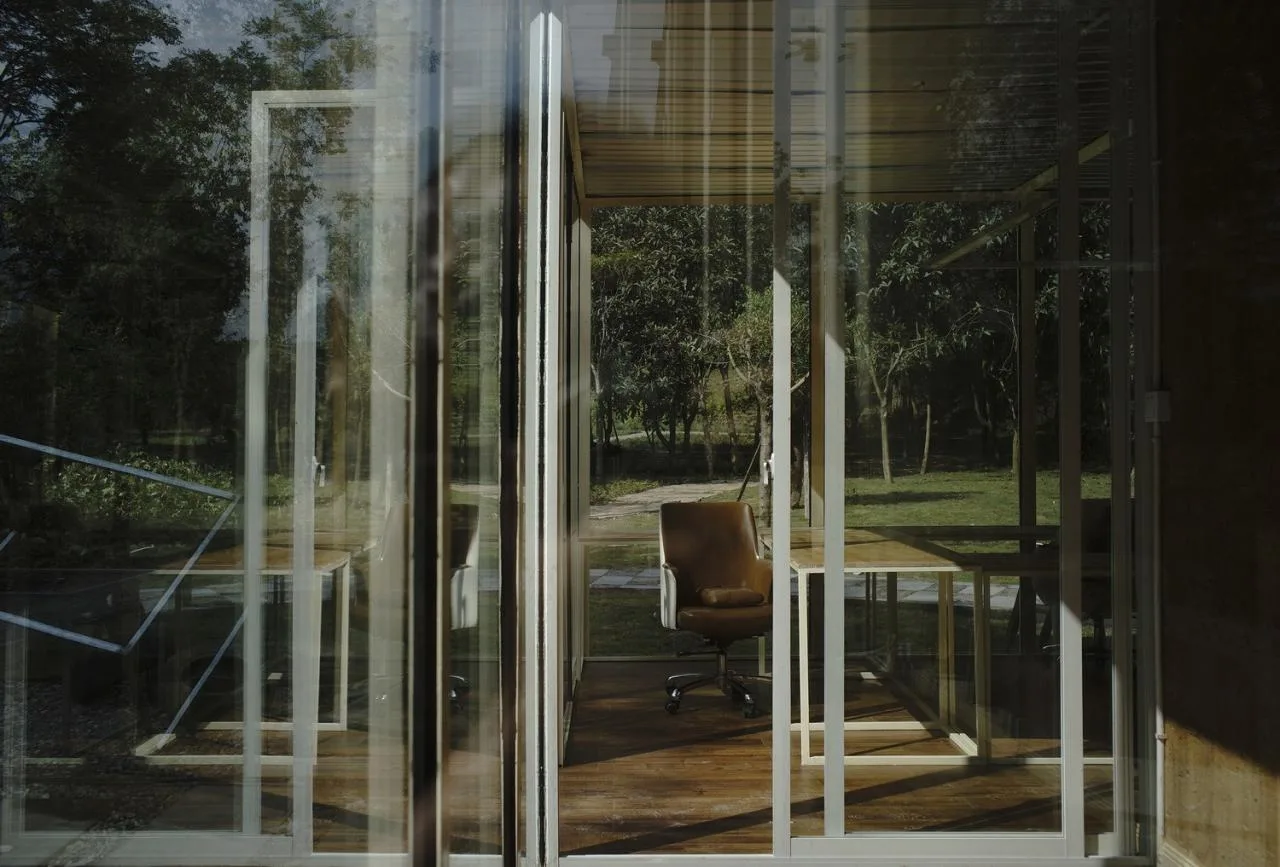
The curtain wall is a steel frame with structural-level broken bridge technology: each steel column consists of two sections with insulating material between them. Hollow glass is installed within the broken bridge steel slots, creating a fully sealed indoor-outdoor separation. The steel sections are slimmed down for manual welding and positioning, producing a facade with visually balanced widths.
The integrated roof combines nano board profiles with rock wool insulation and waterproof layers, factory-assembled and installed on structural purlins. This roof costs one-third of comparable commercial products with similar thermal performance.
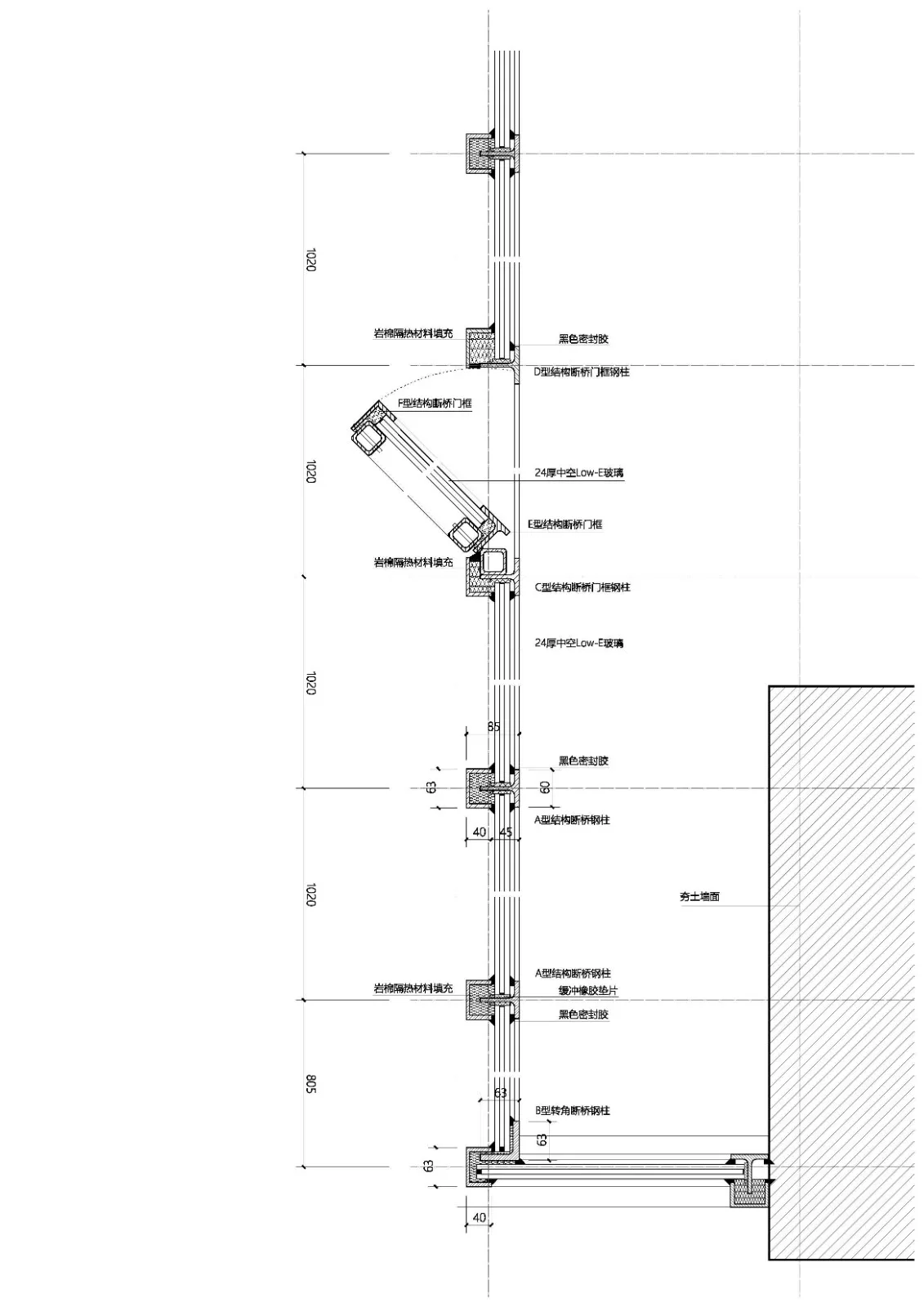
Structural-level broken bridge © Cooperative Society
Lighting as Structure
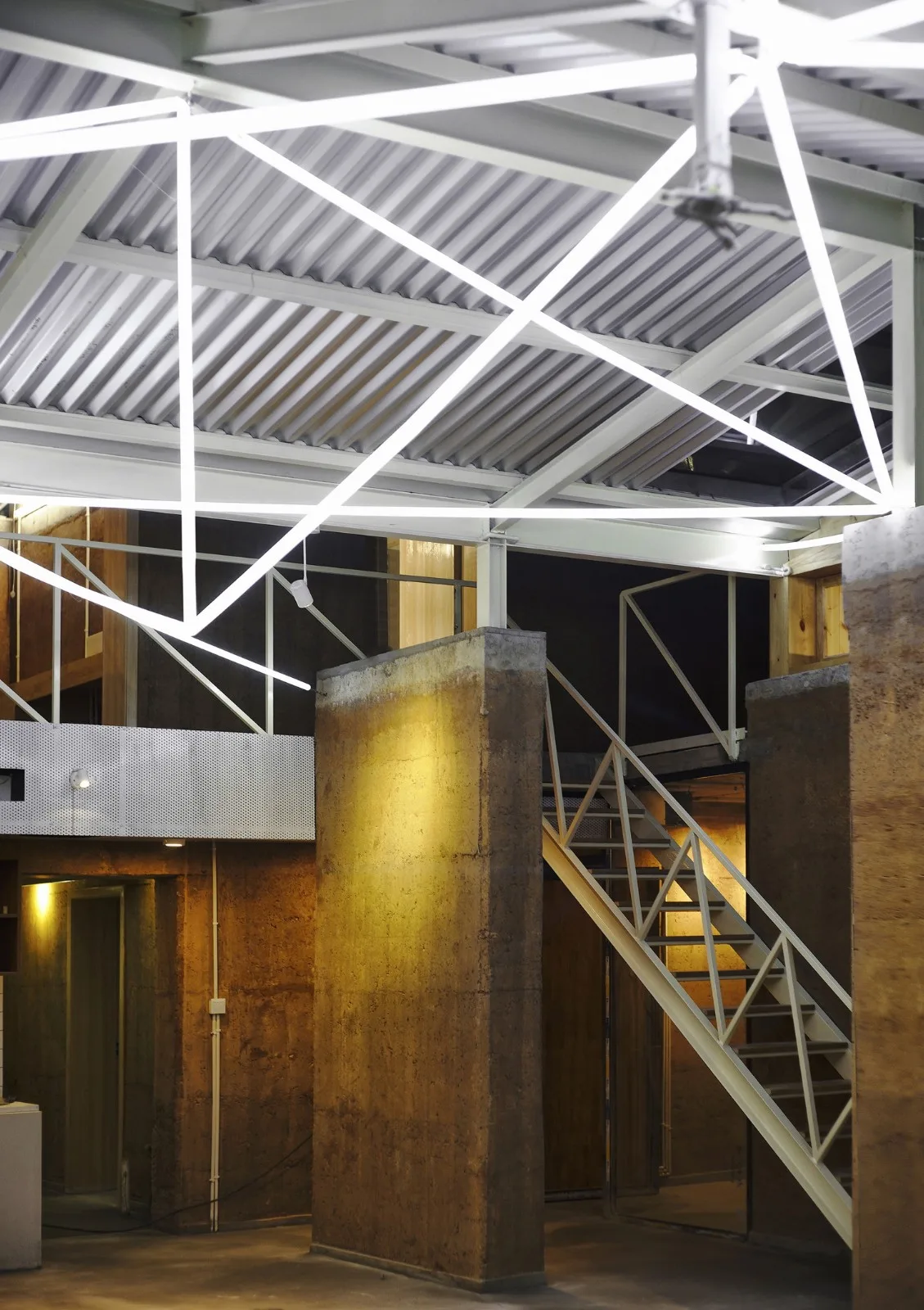
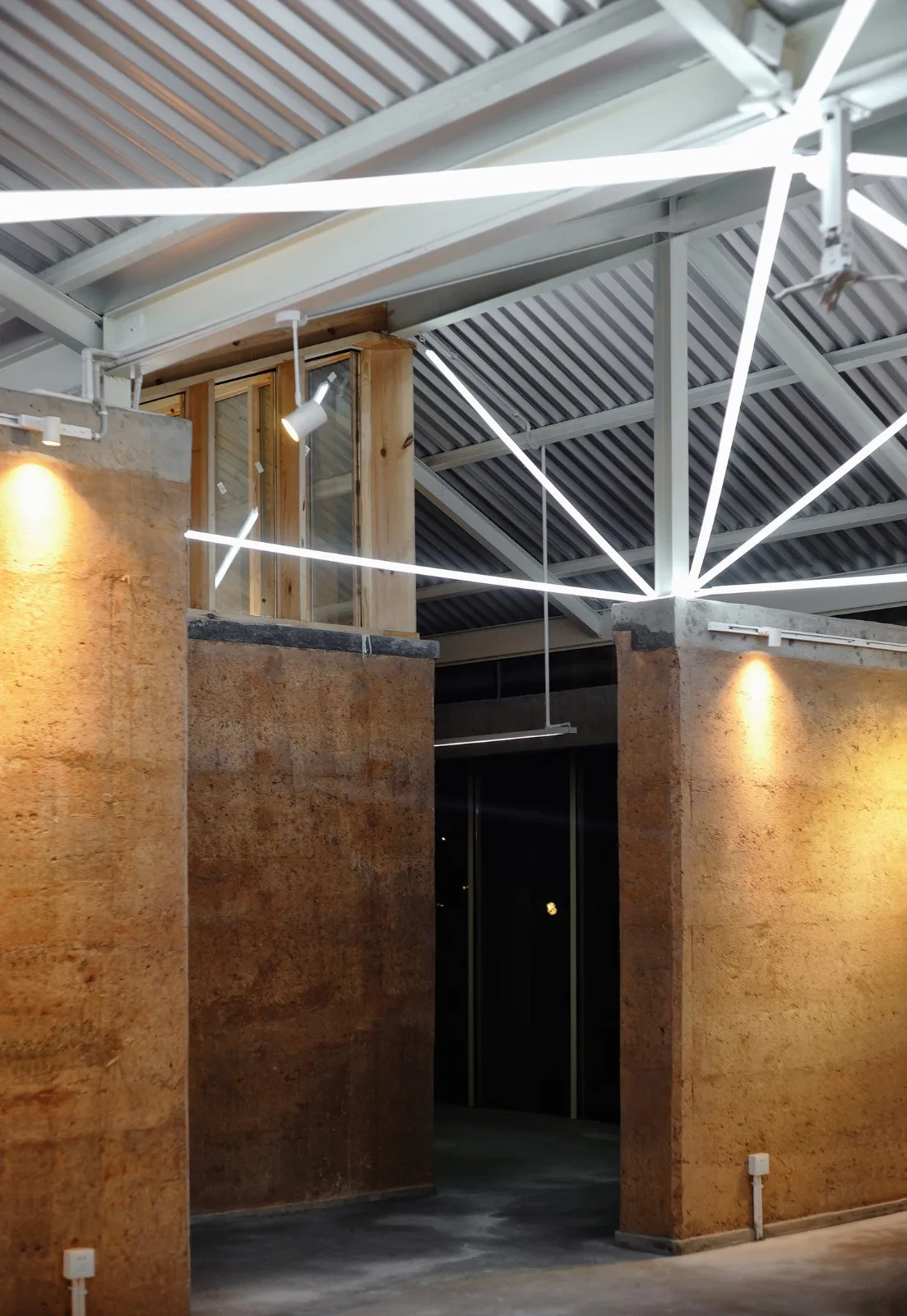
Lighting devices © Cooperative Society
The building’s clear and unique construction logic made it challenging to find suitable locations for lighting fixtures after completion. Instead, a structural spatial device for lighting was created using tension and compression members, onto which semi-transparent acrylic tubes and linear light sources were installed. This design divides space into three dimensions through light.
Artist Li Honghong contributed to the design, construction, and technical support for this installation.
Experimental Space Operation
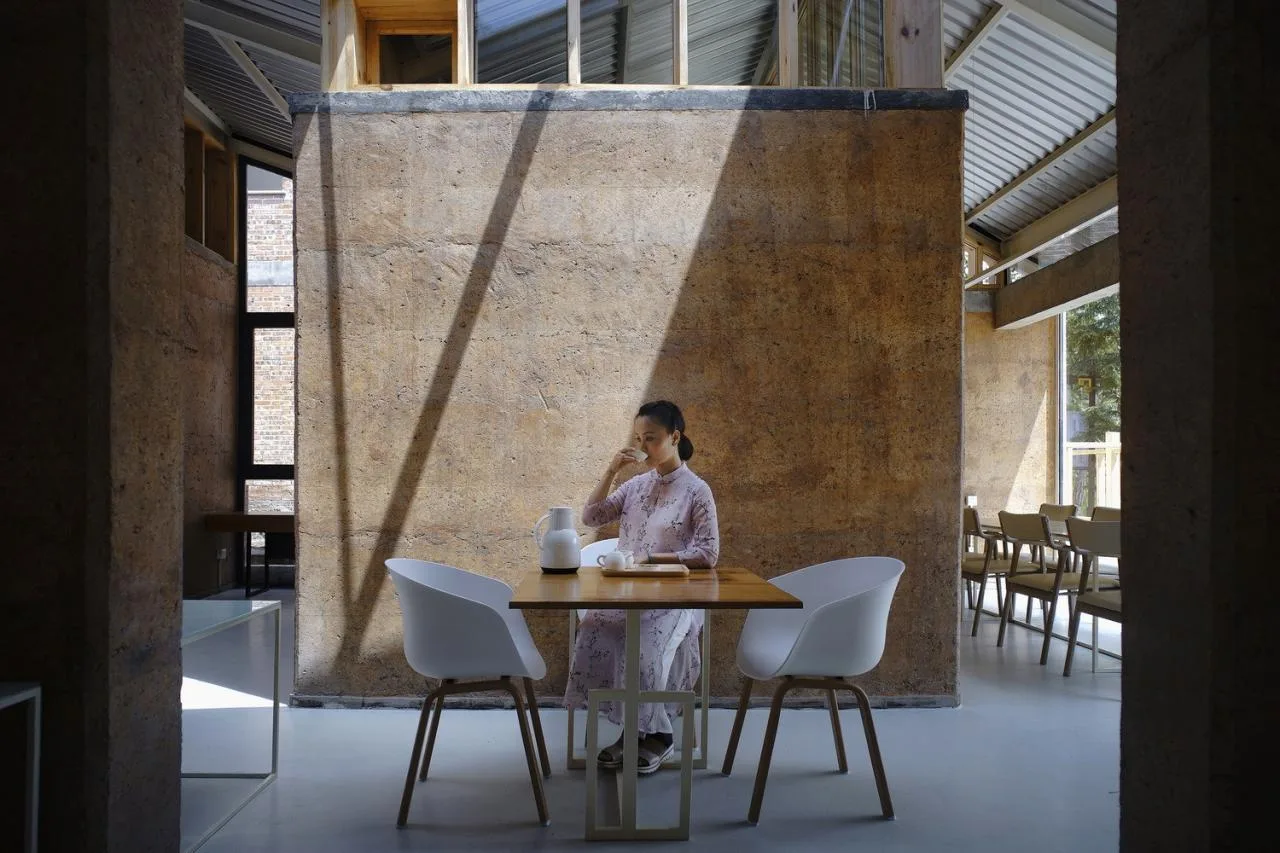
The building comprises a conceptual tea room for public events, residential spaces for architects and artists, and a studio. The space is made up of several rammed earth cylindrical or semi-cylindrical forms. The cylinder interiors offer private residential areas, while the spaces between or outside the cylinders are fluid public zones.
The work of resident artists and architects enriches the public experience, reflecting the heritage park’s millennia of craftsmanship, intelligence, labor, and creativity. The conceptual tea room seeks to pioneer new agricultural practices rooted in rural life, operated collaboratively by the cooperative and agricultural entrepreneurs, aiming to reimagine traditional Chinese tea culture.
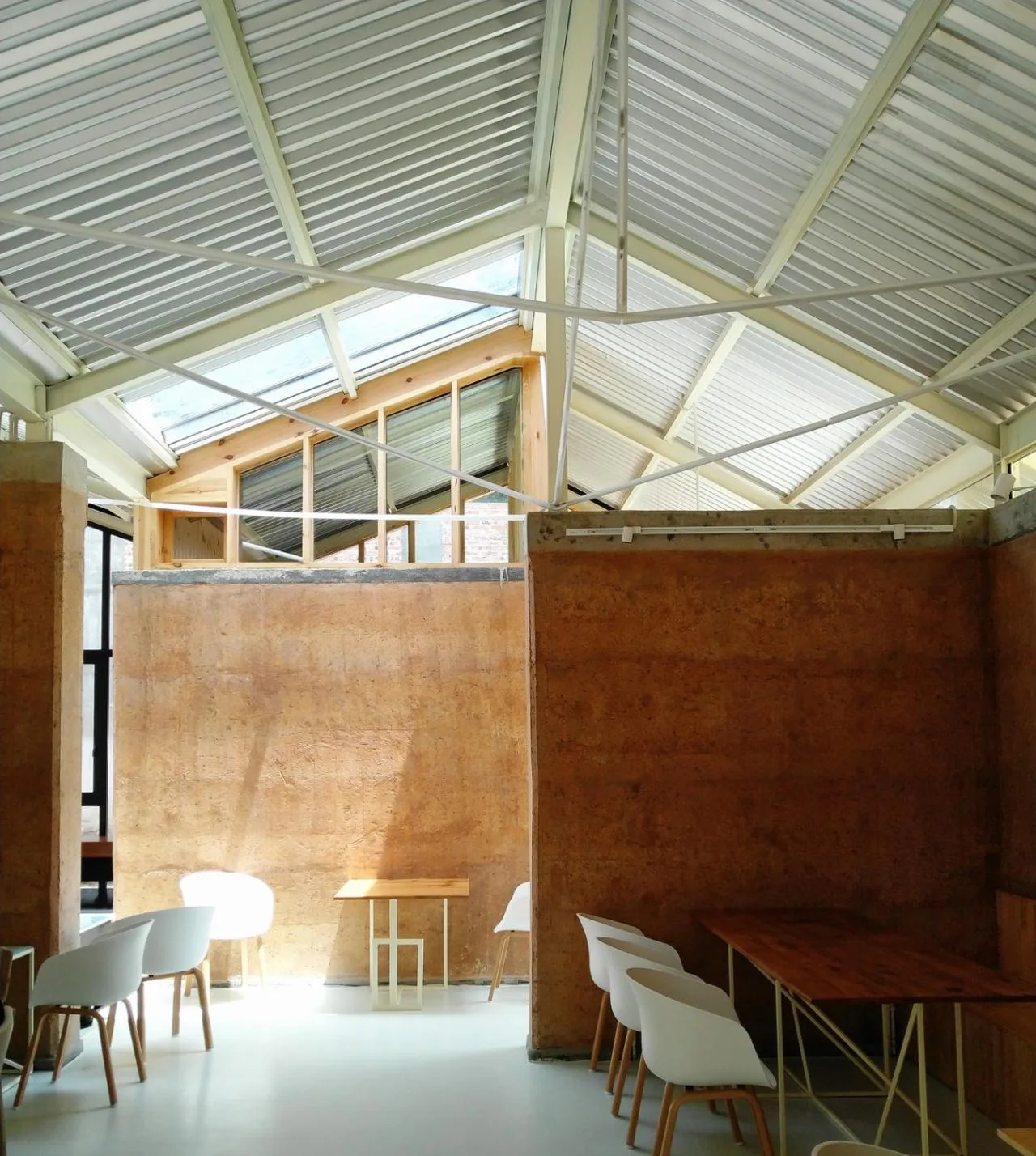
Residence space © Cooperative Society
New Site
©CLAB
Two low rammed earth walls were constructed outside the building, topped with concrete tabletops at mid-height to protect against rain erosion. One side of the walls faces natural sunlight and rain, allowing gradual degradation and return to the earth over several decades, thus forming a modern site.
The park’s towering trees and artifacts embody a continuum from history into the future.
Architectural Images
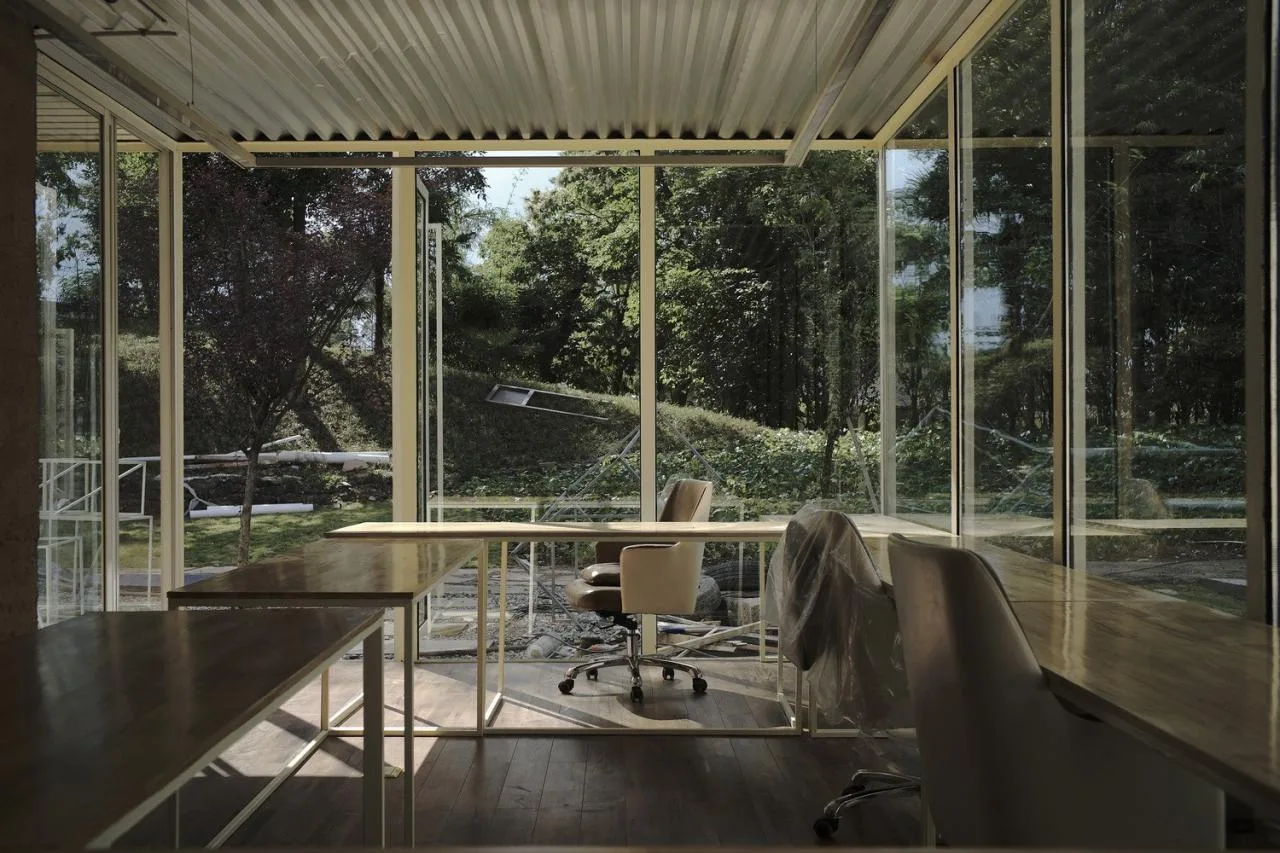
Cooperative Qionglai Studio and the kiln across from it © Cooperative Society
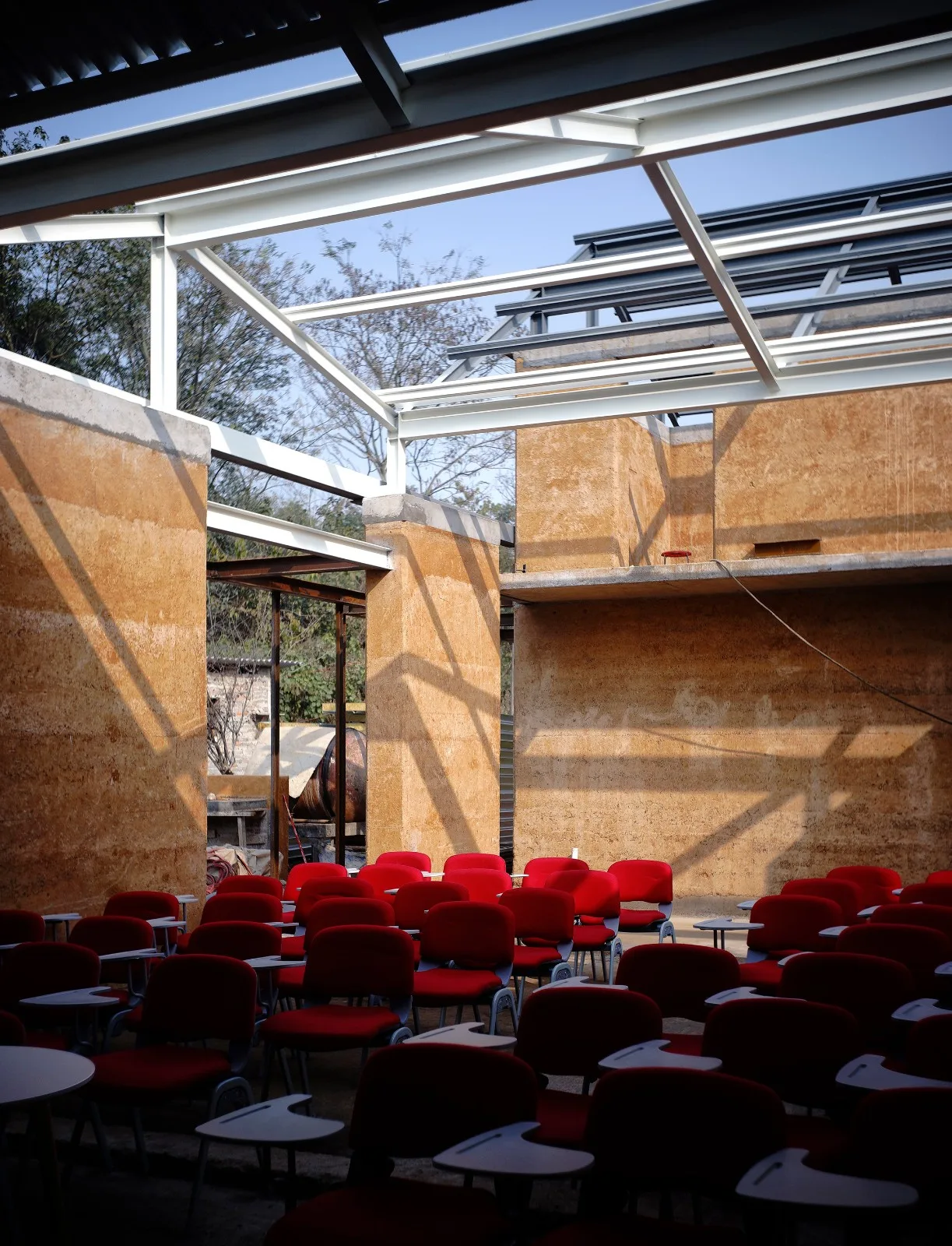
During construction, architect Xie Yingjun shared insights on rural construction at the site. © Cooperative Society
Roof
Project Information
Project Name: Architecture/Art Innovation Laboratory
Architectural Design: HeZaoShe Architectural Design Firm
Design Period: April 2017 – September 2017
Construction Start: May 2018
Building Area: 305 square meters
Location: Qionglai, Chengdu, China, Qiongyao Site Park
Lead Architect: Xu Lang
Design Team: Xu Lang, Chen Dongxu, Wang He (Co Creation Society)
Compaction Technology: Wan Chai / Chi Xin’an (The Chinese University of Hong Kong)
Structural Calculations: Ran Jintao
Model Making: Wu Hao, Yang Jingchao
Installation Artist: Li Honghong
Construction Manager: Xu Gang
Investors: Hezao Society + Wuyou Tea Room
Photography Copyright: Co Creation Society
Project Type: Rural Architecture
Materials: Rammed earth, steel, concrete














Must log in before commenting!
Sign Up