
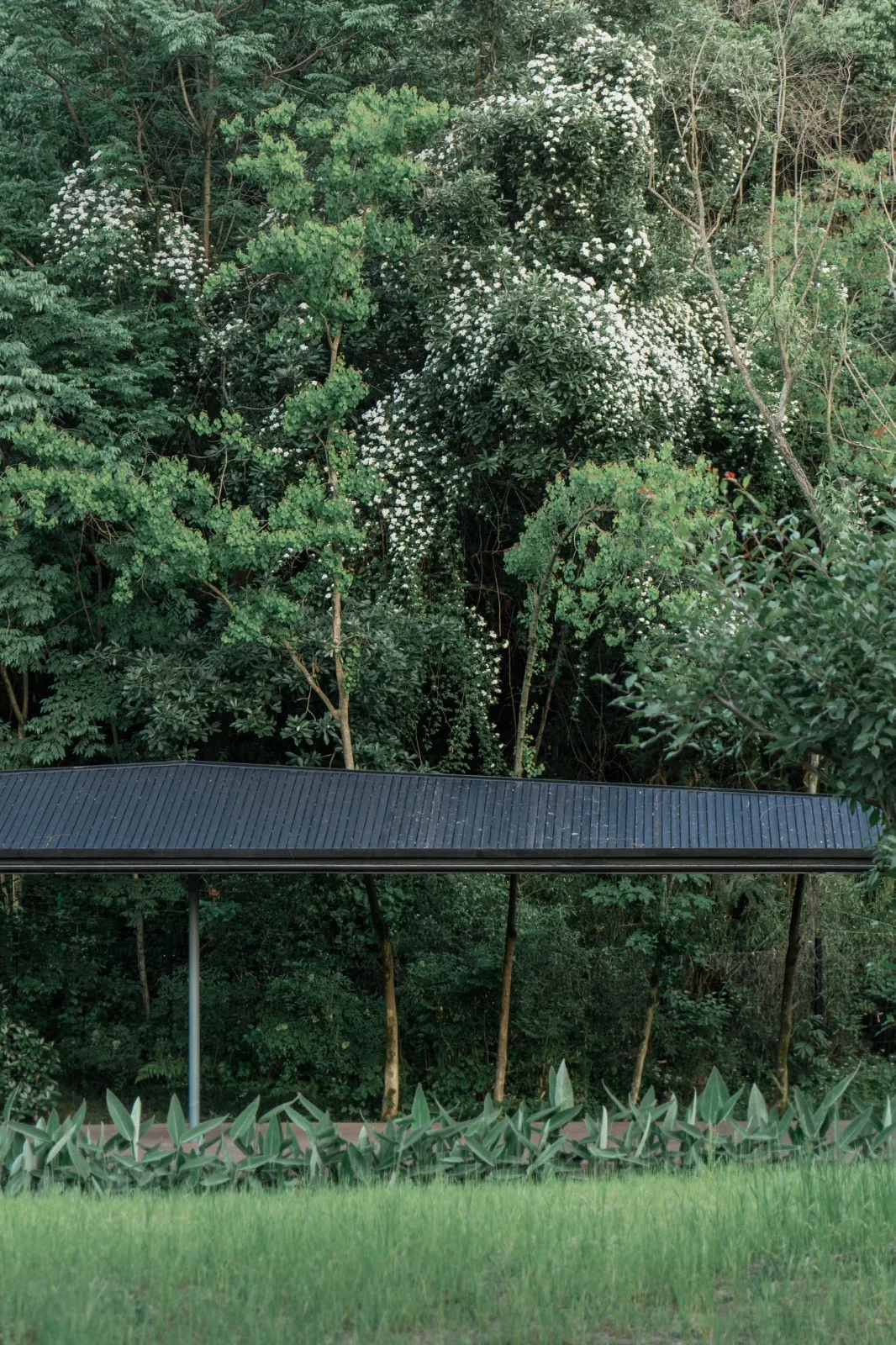
“Nature is full of the image of time, where nature lingers and time slides rapidly.” — Hölderlin’s Vision
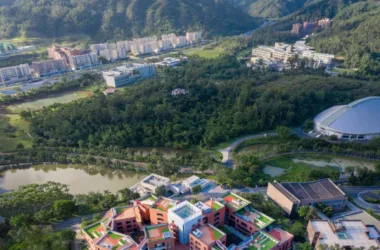
The Zhejiang Conservatory of Music, home to the “Flying Eaves on the Stream,” is China’s 10th independent professional music education institution. A decade ago, during a design competition, lead architect Zhu Peidong challenged the conventional enclosed campus model surrounded by walls. He envisioned an “open music and art park” as a spatial prototype, aiming to move beyond traditional campus scales and boundaries by integrating “flowing landscapes and hidden mountain music residences.” This innovative approach sought to create a freer, more open model for arts education campuses.
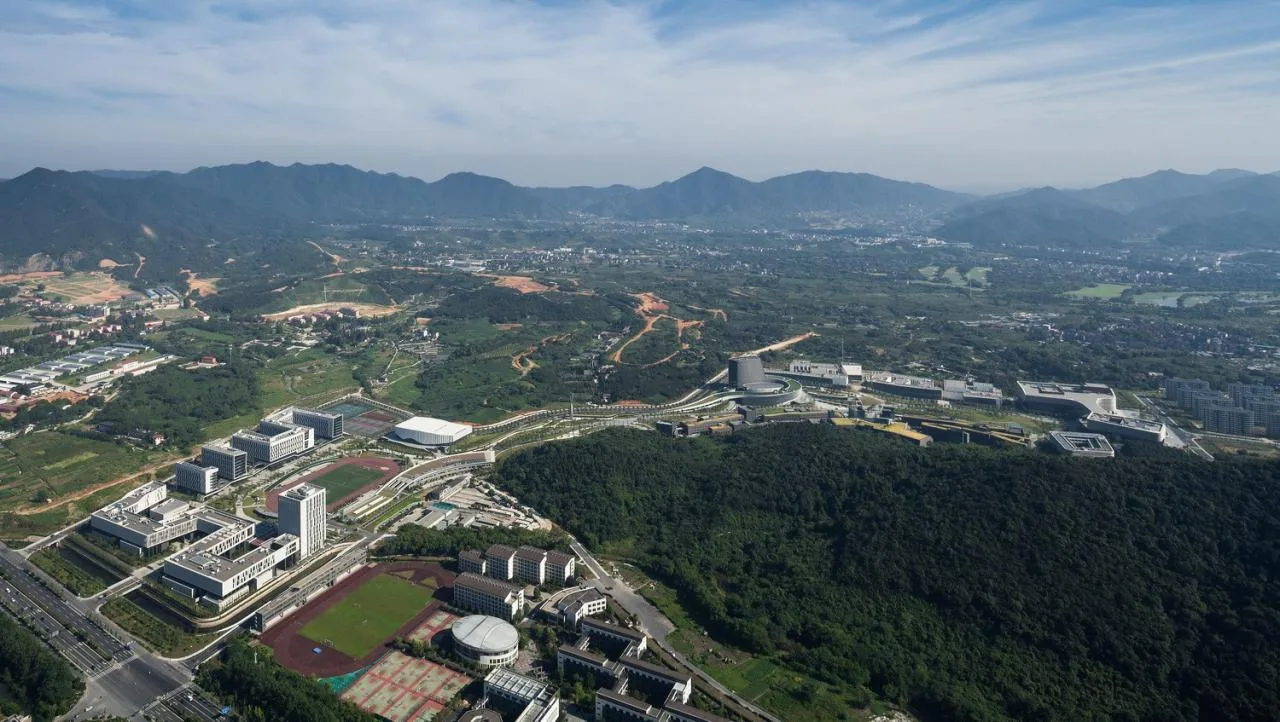
The spatial prototype inspired by the concept of an “Open Music and Art Park”
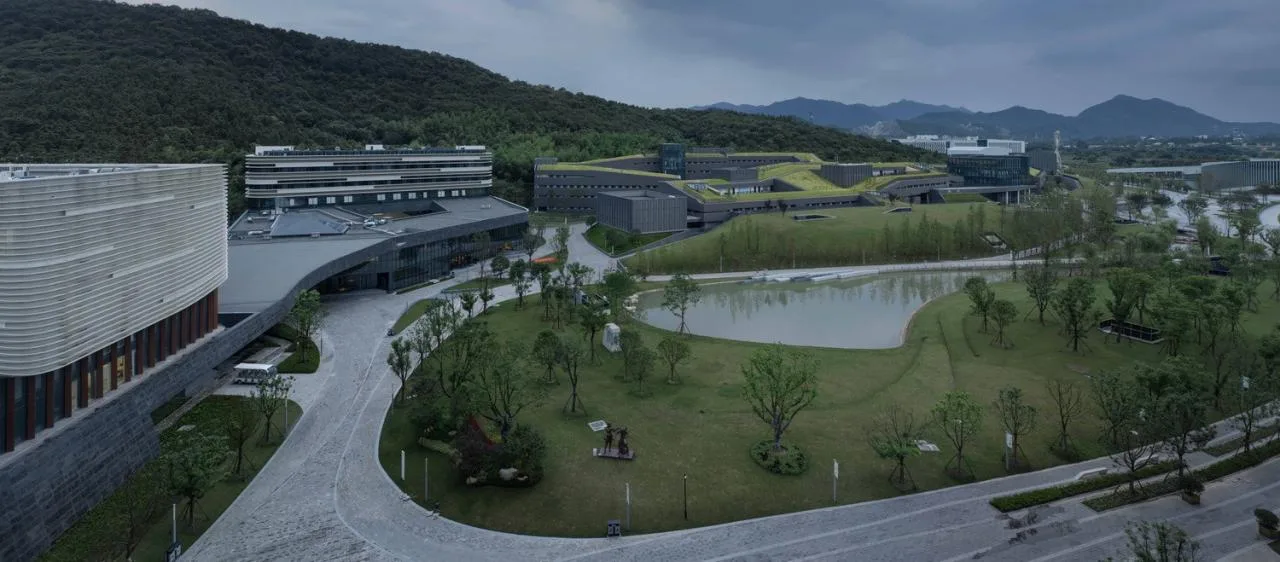
△ Flowing Landscape & Hidden Mountain Residences
Since the campus completion in 2015, with ongoing integration of facilities and improvements in management, the university administration has pursued designation as a 4A-level cultural tourism site. This provided an opportunity to extend the original design philosophy through subtle campus updates, evolving the campus identity from an “open campus” concept to a “public scenic spot” recognized socially and ecologically.
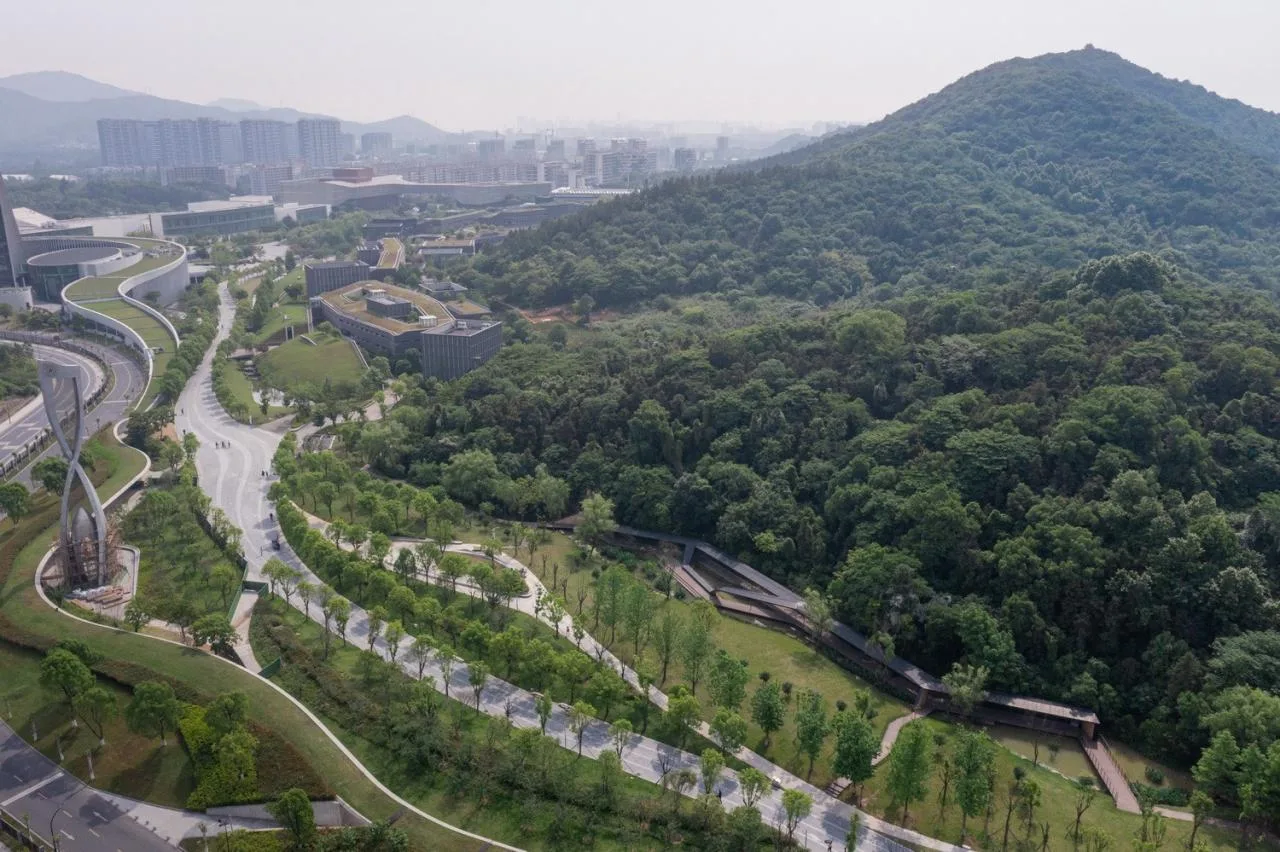
01 Linear Integration: Connecting North and South
The campus layout aligns with the terrain, forming two distinct clusters: the northern group of buildings nestled in mountainous natural landscapes, and the southern cluster composed of formal ceremonial spaces with defined boundaries. Between them lies an intentionally preserved open area, linked by gently curving walkways, meandering mountain canals, and natural settings that seamlessly connect the two zones.
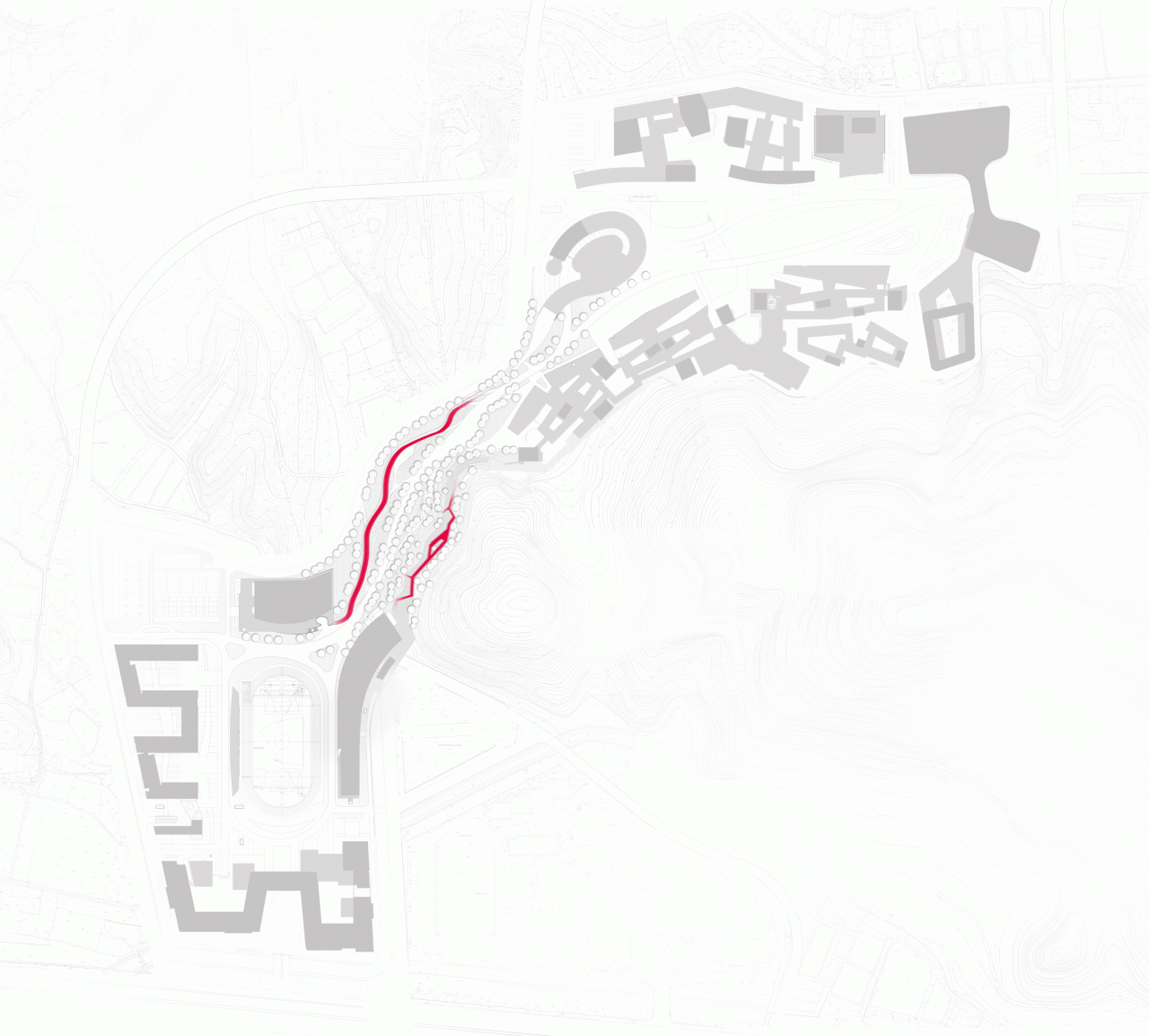
Parallel double corridors create a connection between the northern and southern parts of the campus.
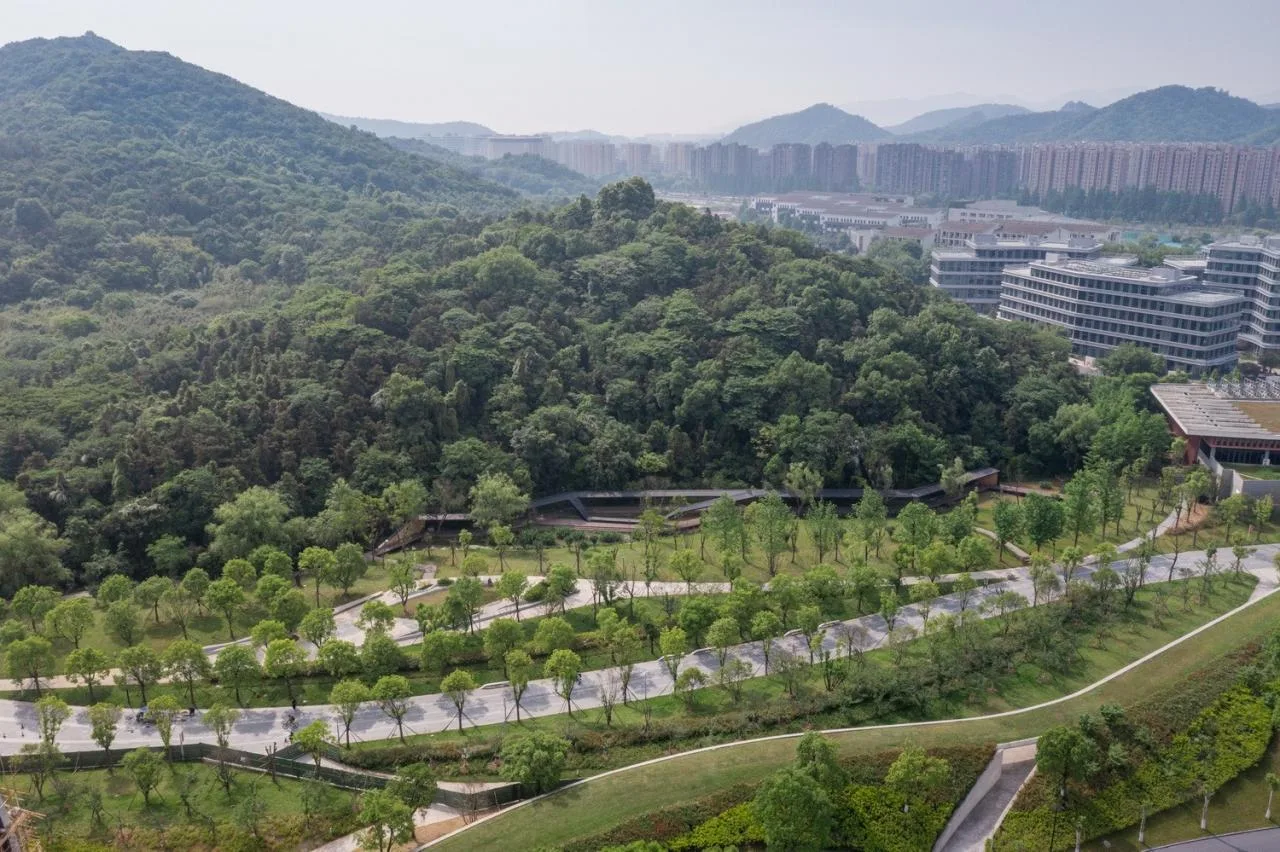
To enhance the campus’s 4A scenic spot designation, upgrading the central public area became a priority to activate existing spaces and strengthen their public function.
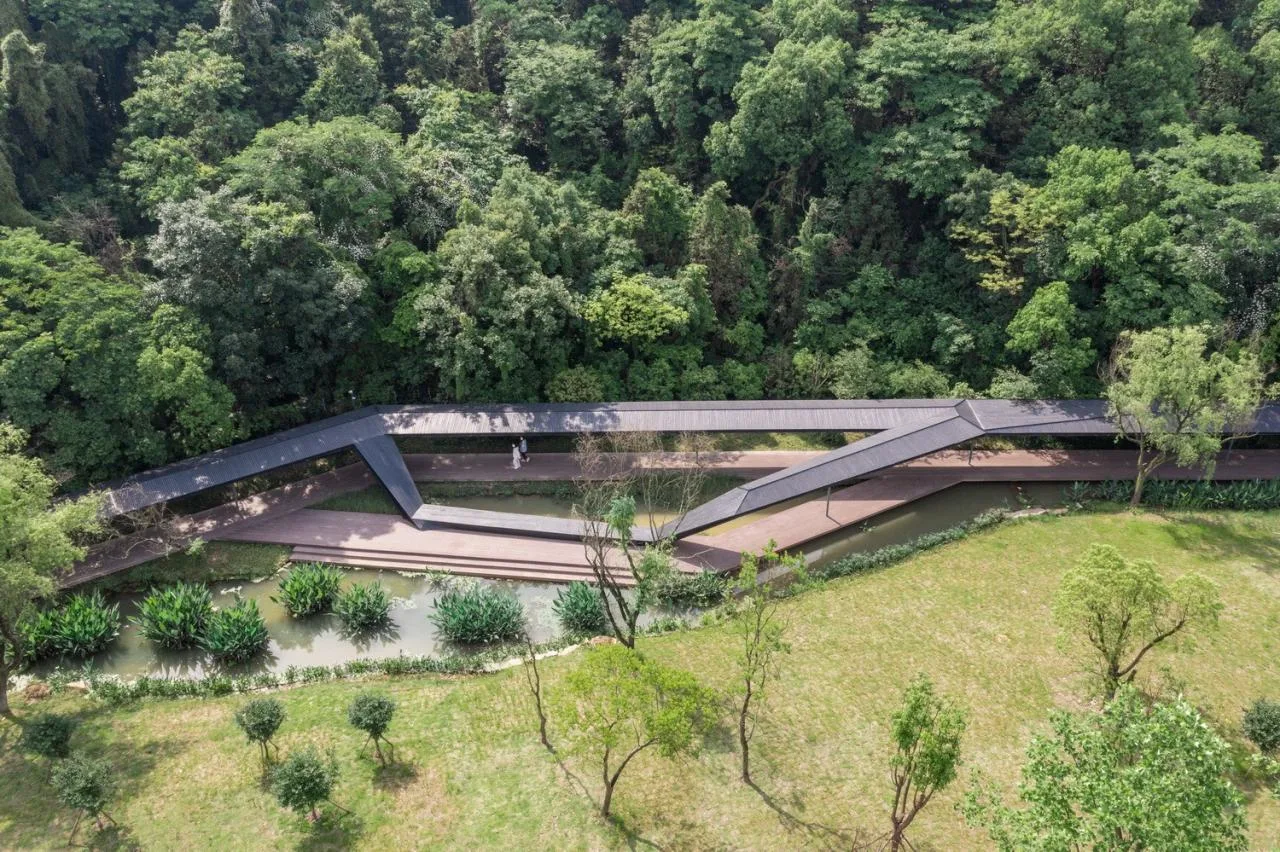
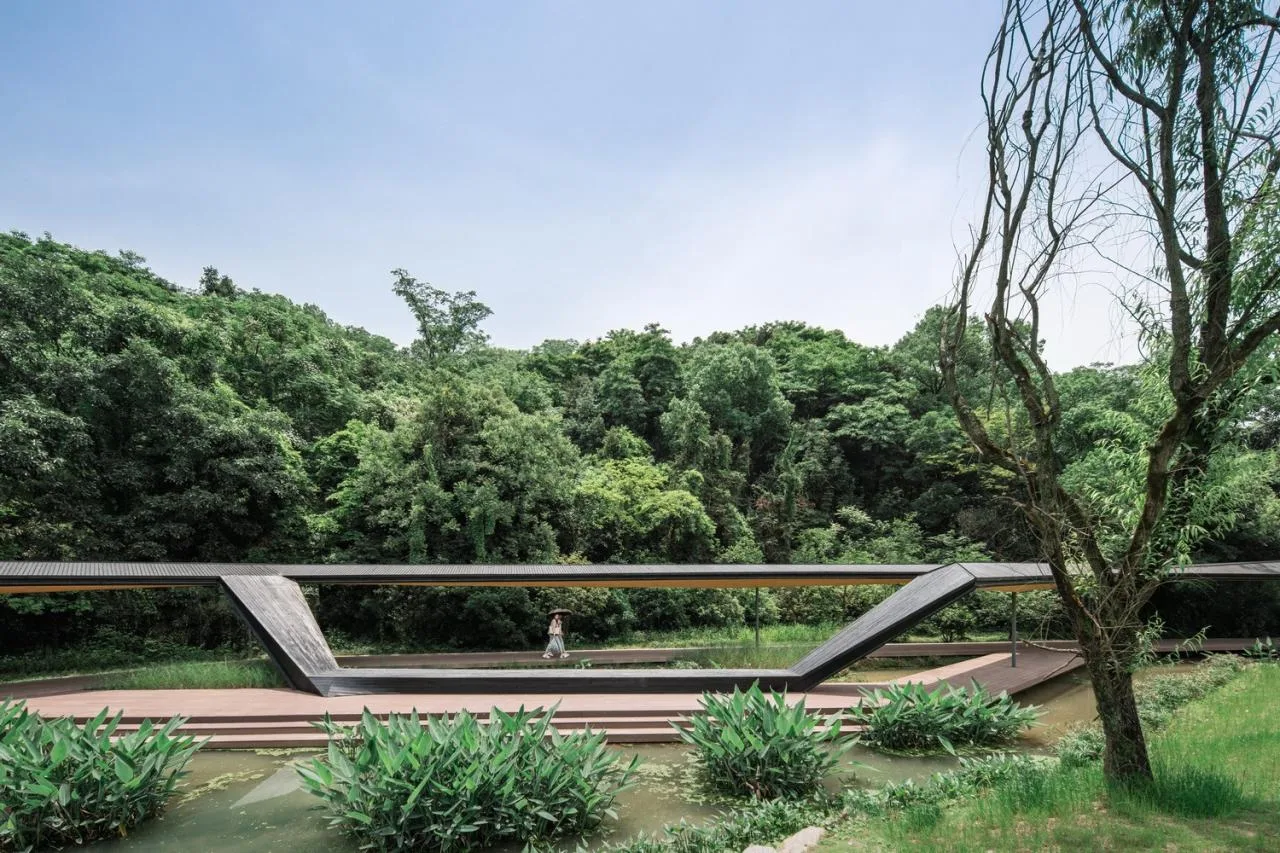
Revisiting our initial design goals and addressing new campus development needs, we selected a rain garden site along the mountain canal in the campus center. Preserving the original ecological space with minimal intervention, we introduced a linear pedestrian walkway integrated into the landscape.
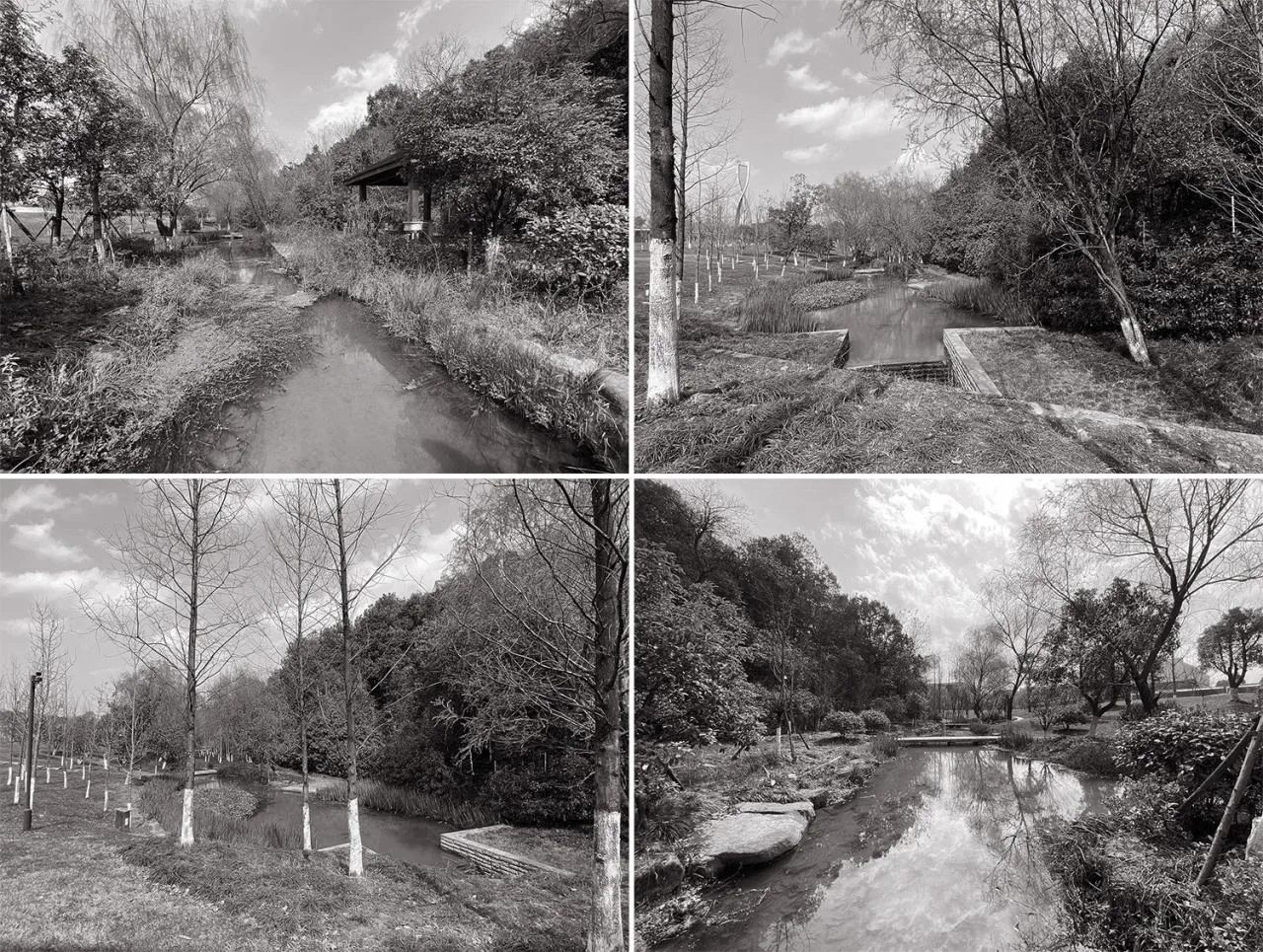
△ Original site condition
Drawing inspiration from the scattered perspective technique of traditional Chinese painting, we translated classical garden elements—such as stacked structures, corridors, eaves, and bridges—into layered focal points and spatial experiences within a folding corridor. This design encourages visitors to engage with diverse perspectives and movements, activating underused campus spaces and enriching public circulation.
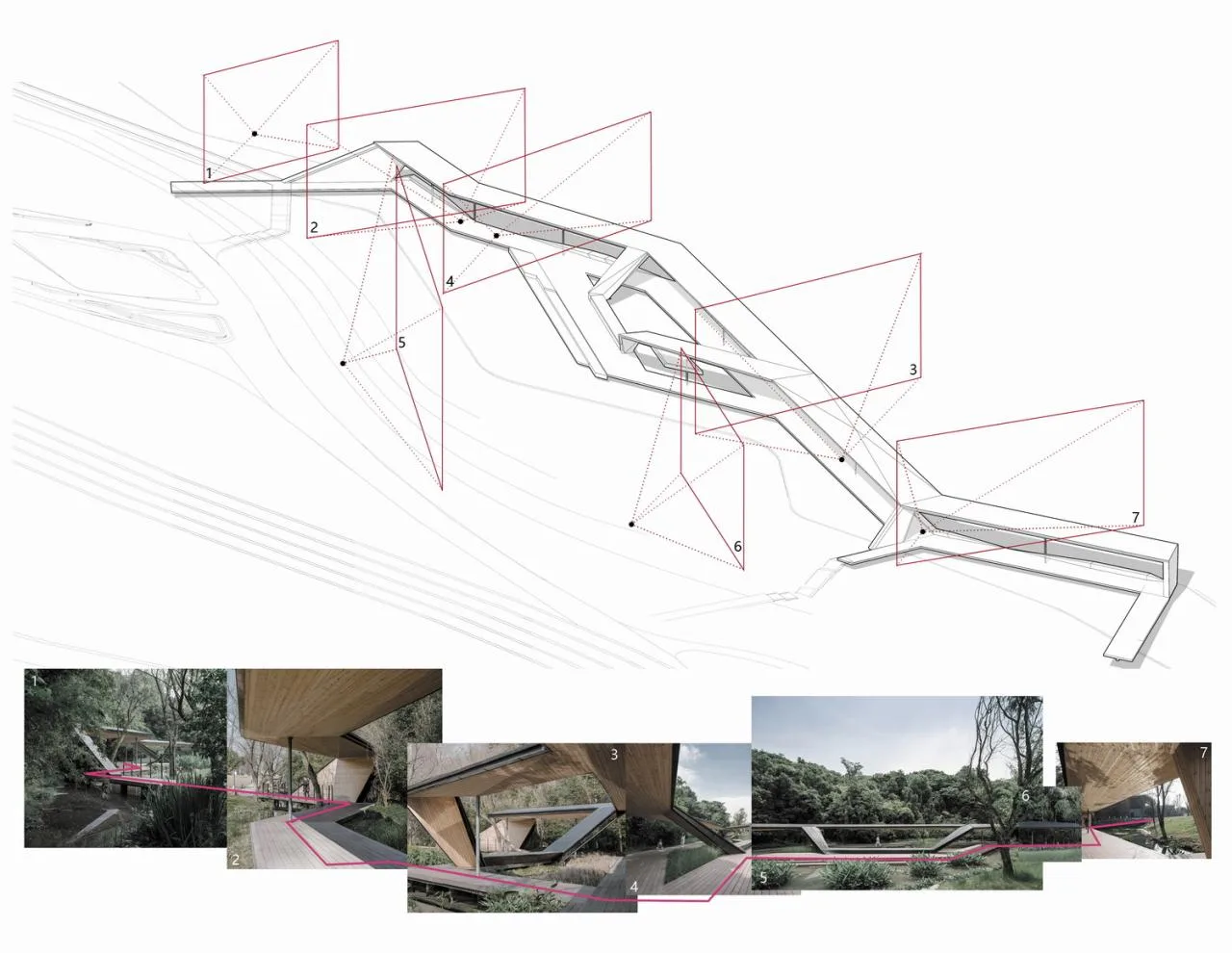
△ Scattered perspective analysis
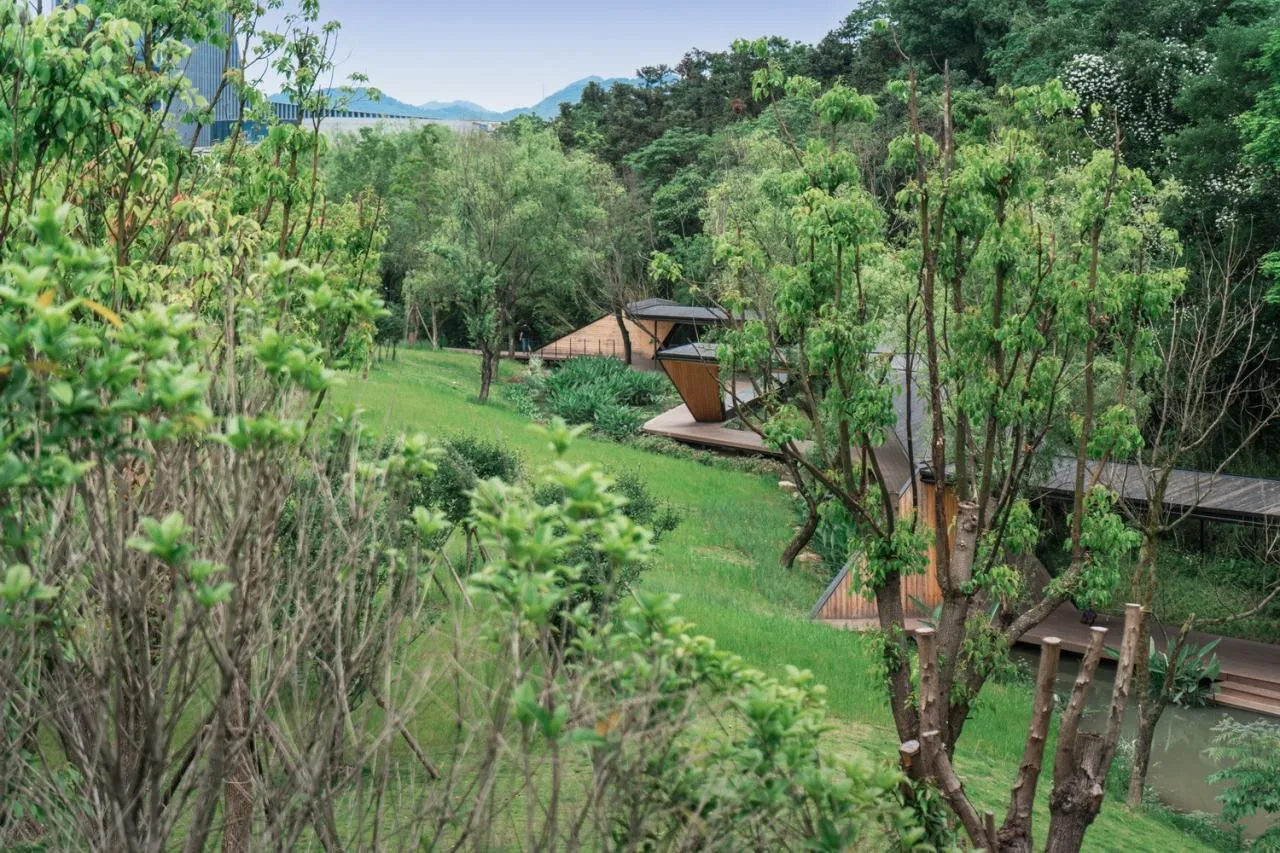
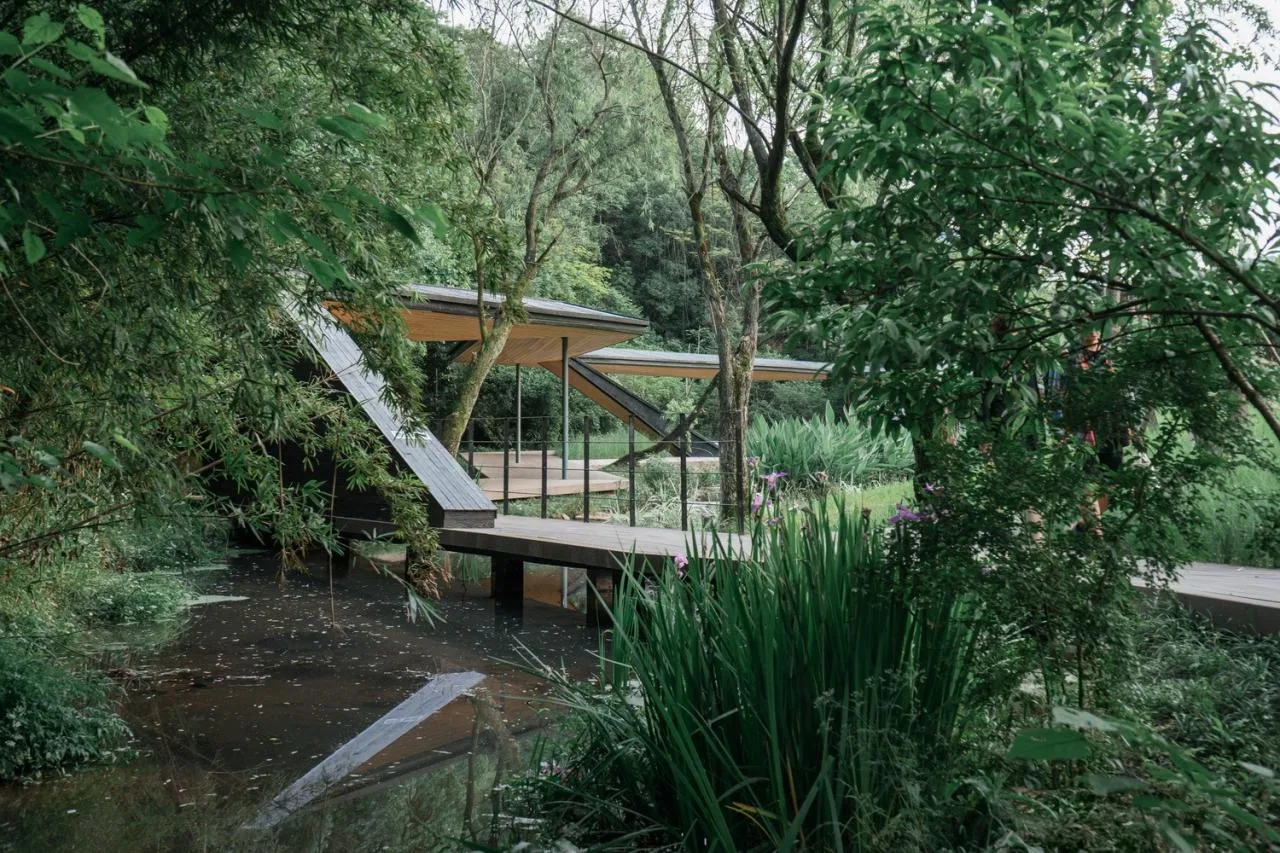
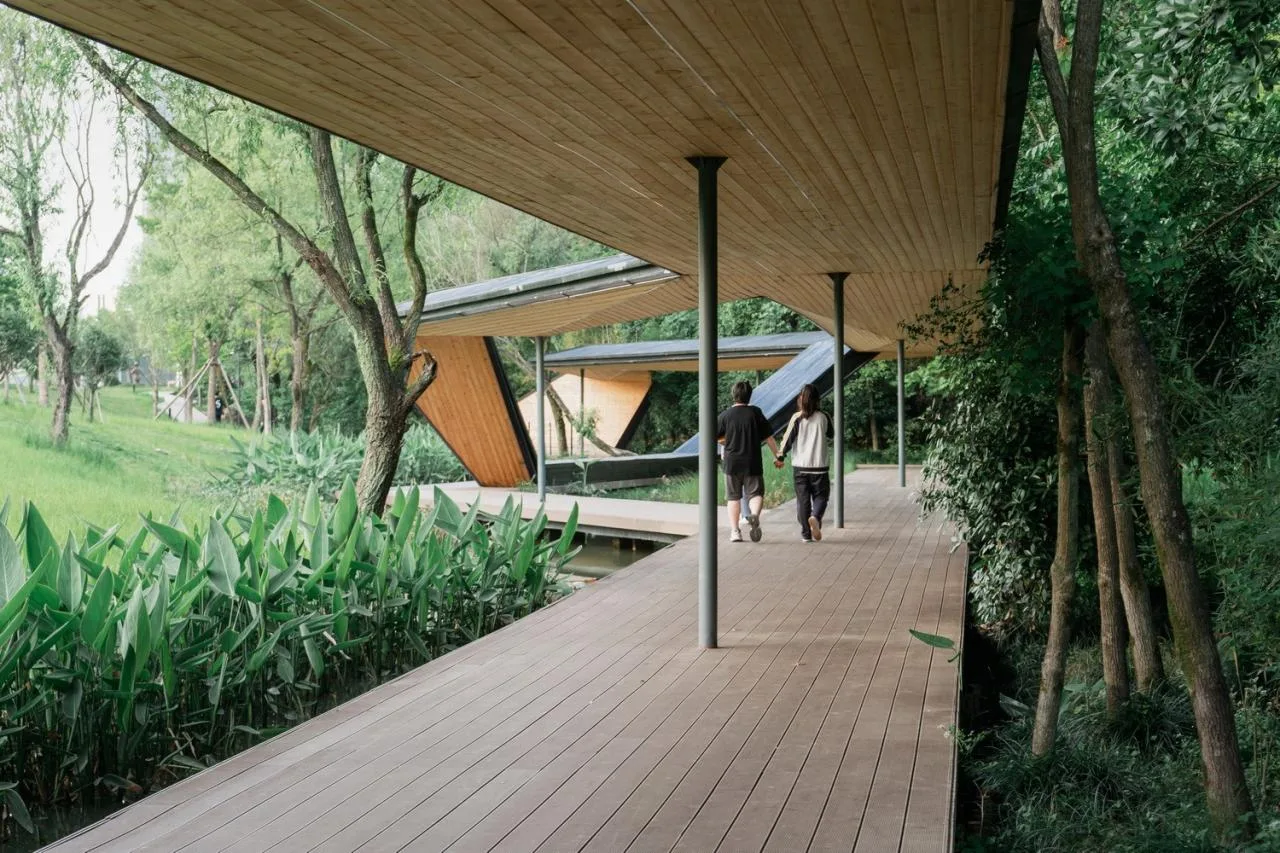
On the northern side of the eaves, a wooden boardwalk gently floats above the ground, guiding visitors through music department buildings that blend into the mountains and echo with lingering sounds. On the southern end, the path concludes with a cantilevered steel bridge and platform overlooking the lively campus cafeteria, completing a natural walking route at the foot of Wangjiang Mountain. This offers teachers, students, and visitors a unique north-south journey through forest and stream.
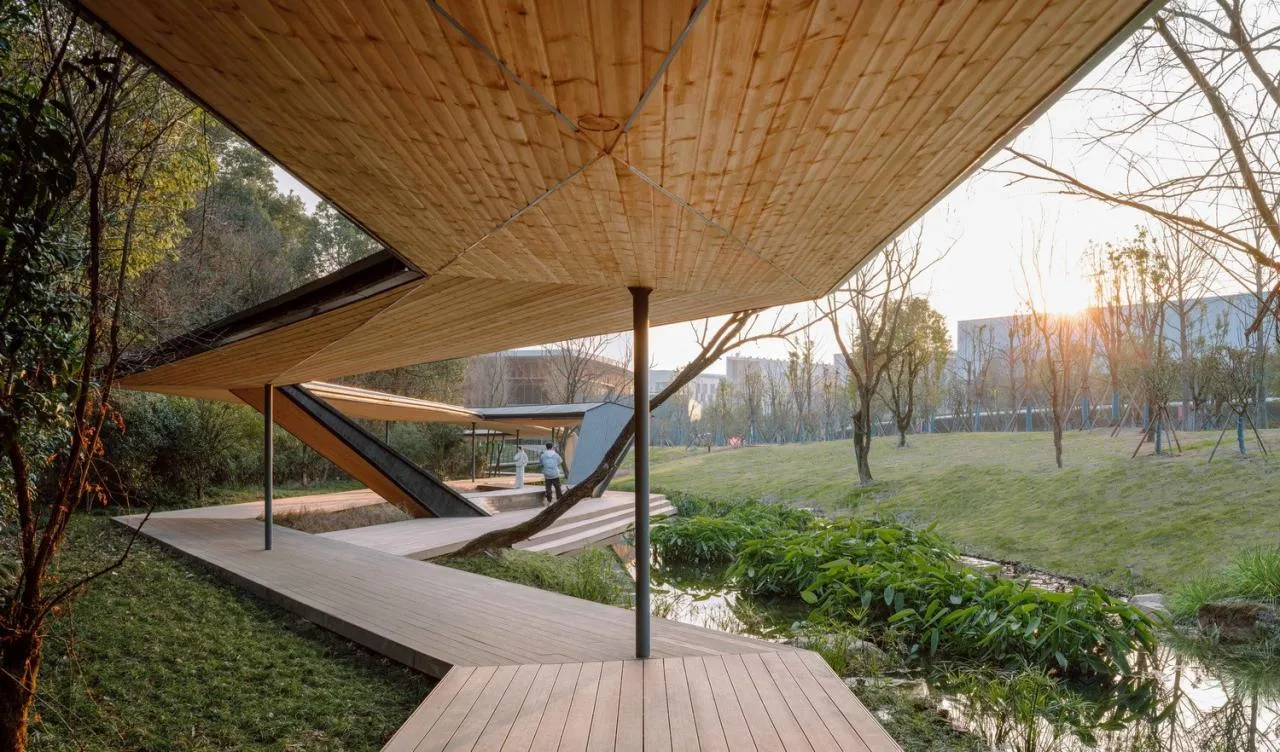
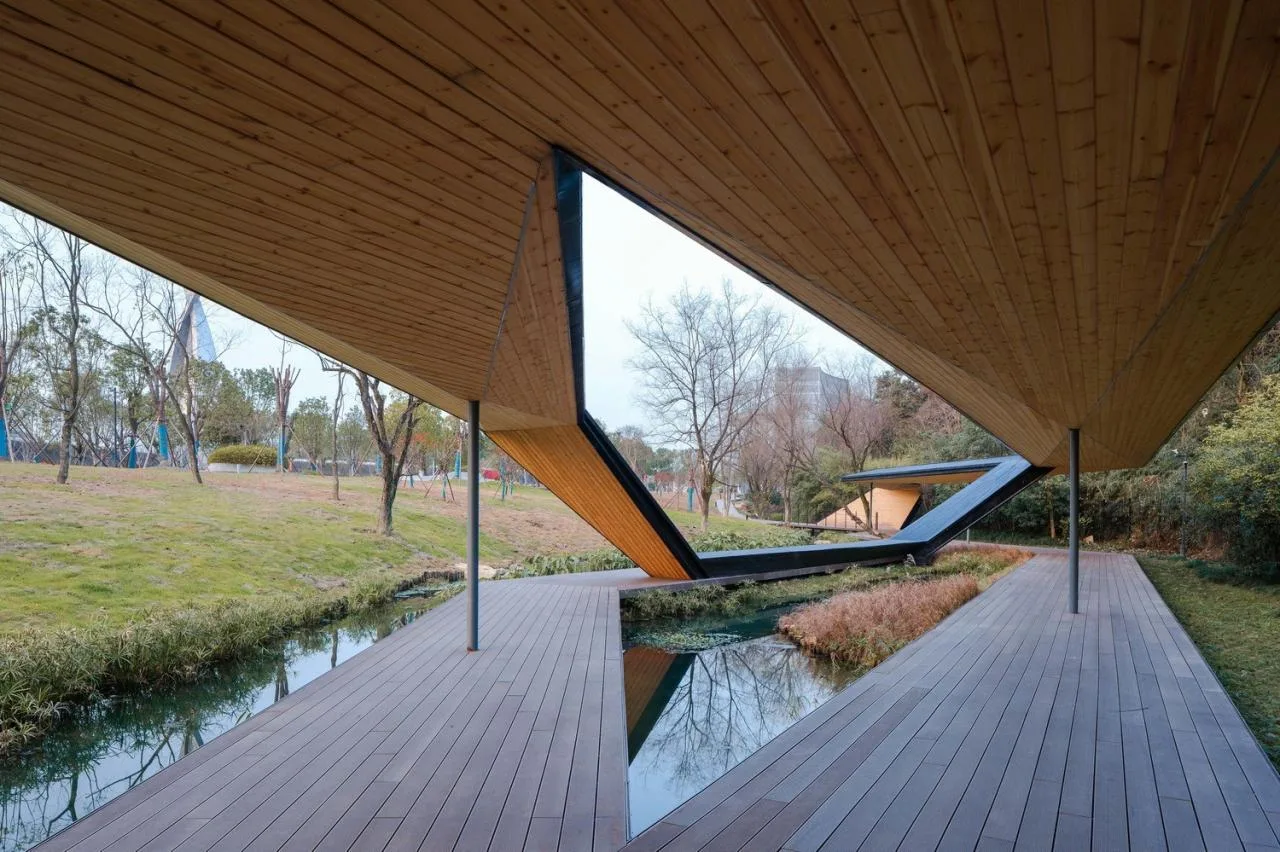
△ A new walking experience connecting the northern and southern campus areas
02 Parallel Corridors: An East-West Dialogue
At the campus’s central boundary, the newly constructed “Creek Flying Eaves” runs parallel to the long-standing “Sound Valley Cloud Corridor,” both harmonizing with the central natural mountain scenery. Together, they form a public space that encourages diverse daily activities.
Ten years ago, the “Sound Valley Cloud Corridor” was designed with soft, flowing curves and natural landscaping, featuring plain concrete volumes subtly textured with wood grain. It laid the groundwork for the current campus renewal.
Now, the newly introduced steel and wood folding corridor “Xi Shang Fei Yan” on the east and the concrete connecting corridor “Yin Gu Yun Lang” on the west form a dialogue across a decade. One is light and airy, the other solid and grounded; one folded, one curved; soft meets rigid. They connect the campus’s north and south in distinct ways, bridging the natural slopes and mountain backdrop.
Between these corridors, linear geometric landscaping flows like music notes, guiding movement across the campus.
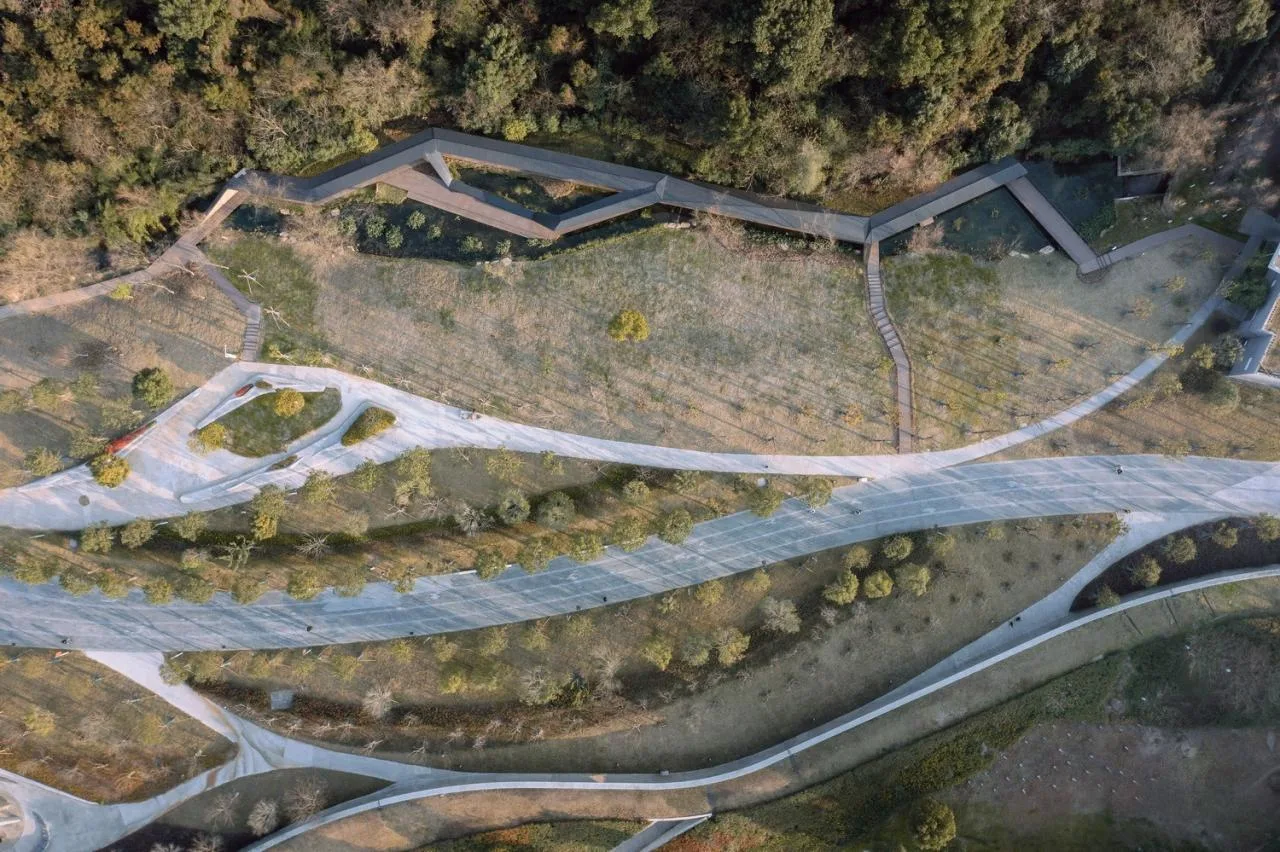
△ The “Flying Eaves on the Stream” and “Sound Valley Cloud Corridor” engage in a decade-spanning east-west dialogue.
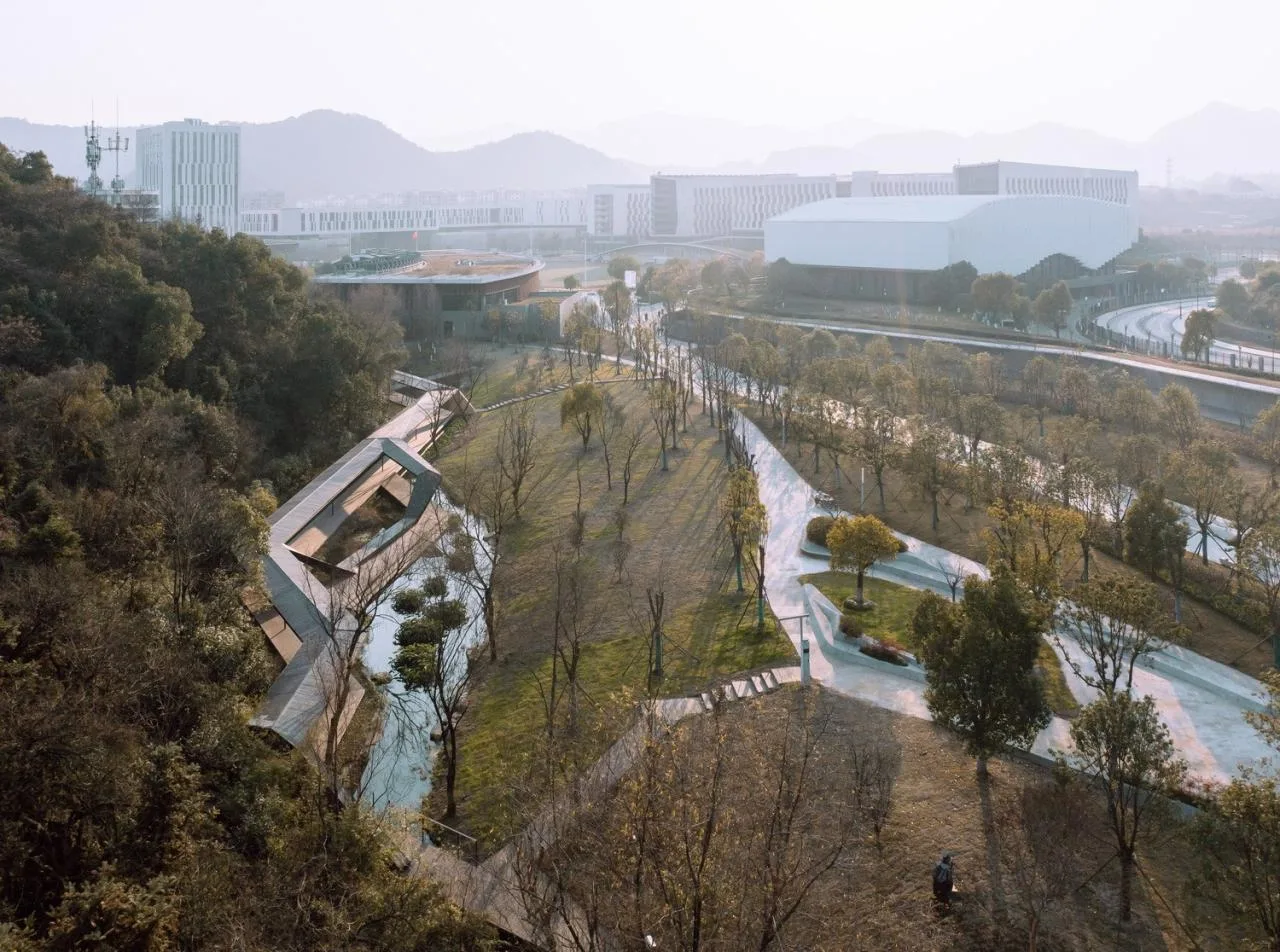
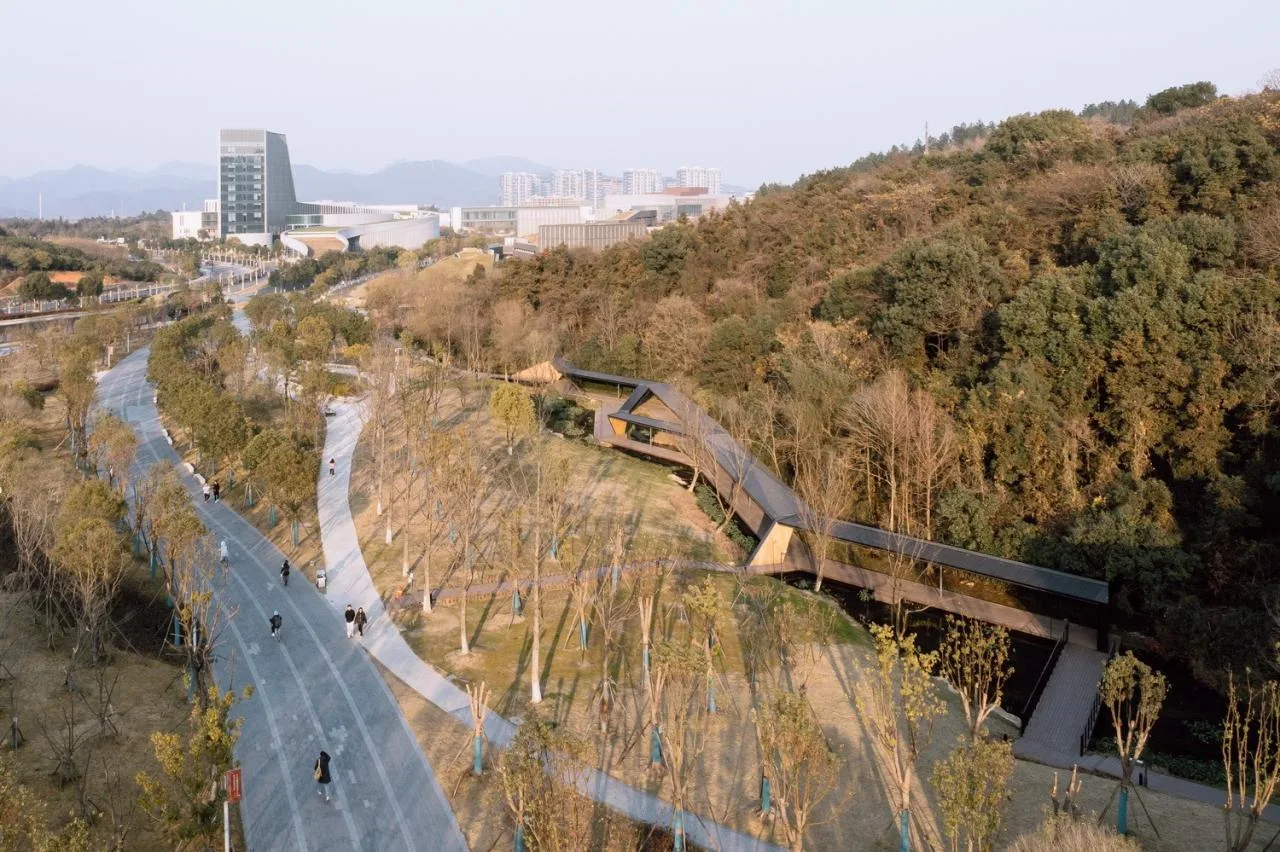
△ North-south perspective of the “Flying Eaves on the Stream”
2.1 Topological Relationships
Crossing rivers and forests, offering leisurely, winding walks
The “Sound Valley Cloud Corridor” serves as a sound barrier with a semi-open plain concrete structure, while the “Flying Eaves on the Stream” invites the mountain into the garden via a fully transparent steel and wood folding corridor. The concrete corridor’s dynamic curves contrast with the sturdy, winding form of the steel-wood corridor. These two materials interpret flowing pathways in harmony with their terrain.
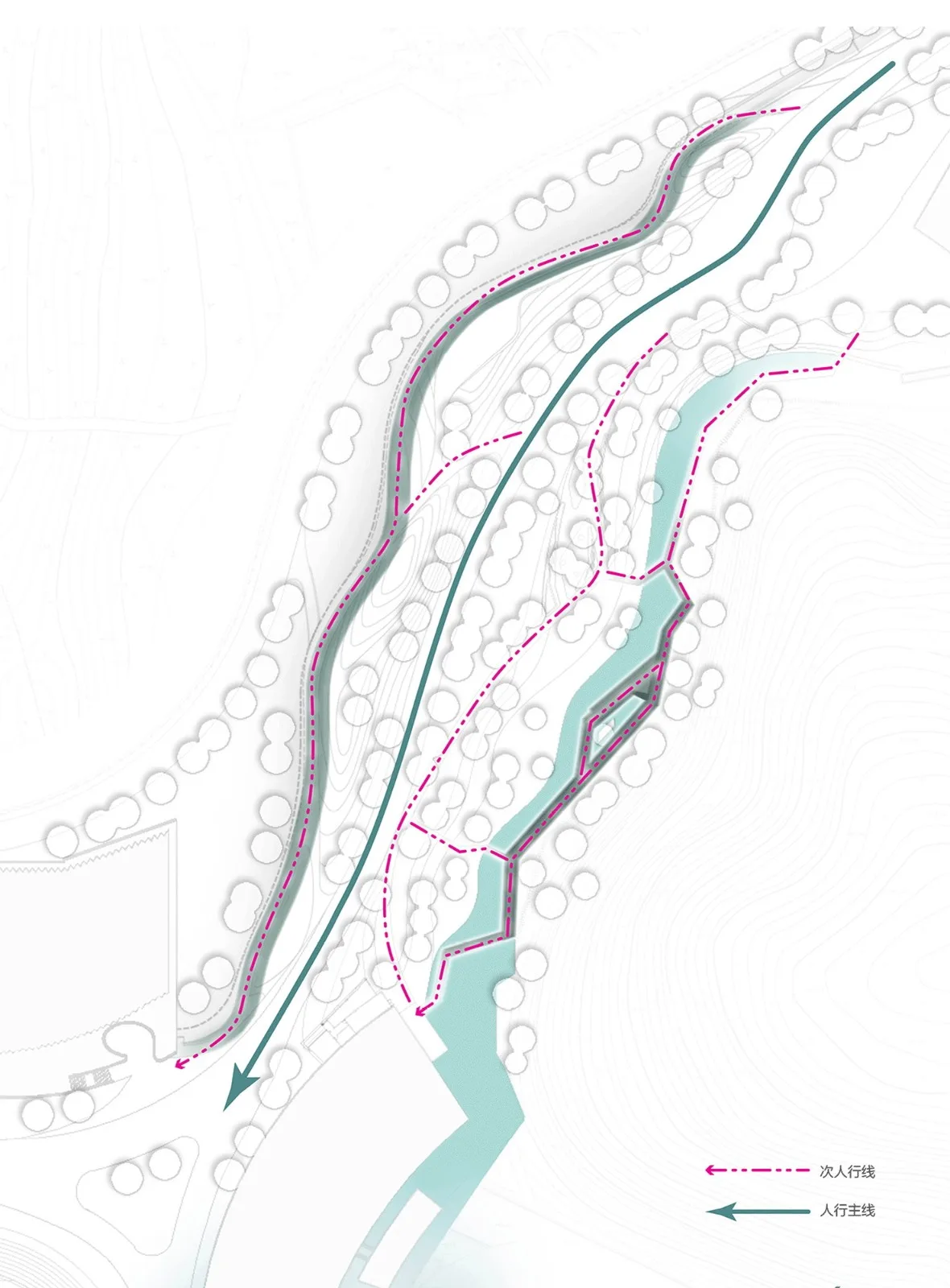
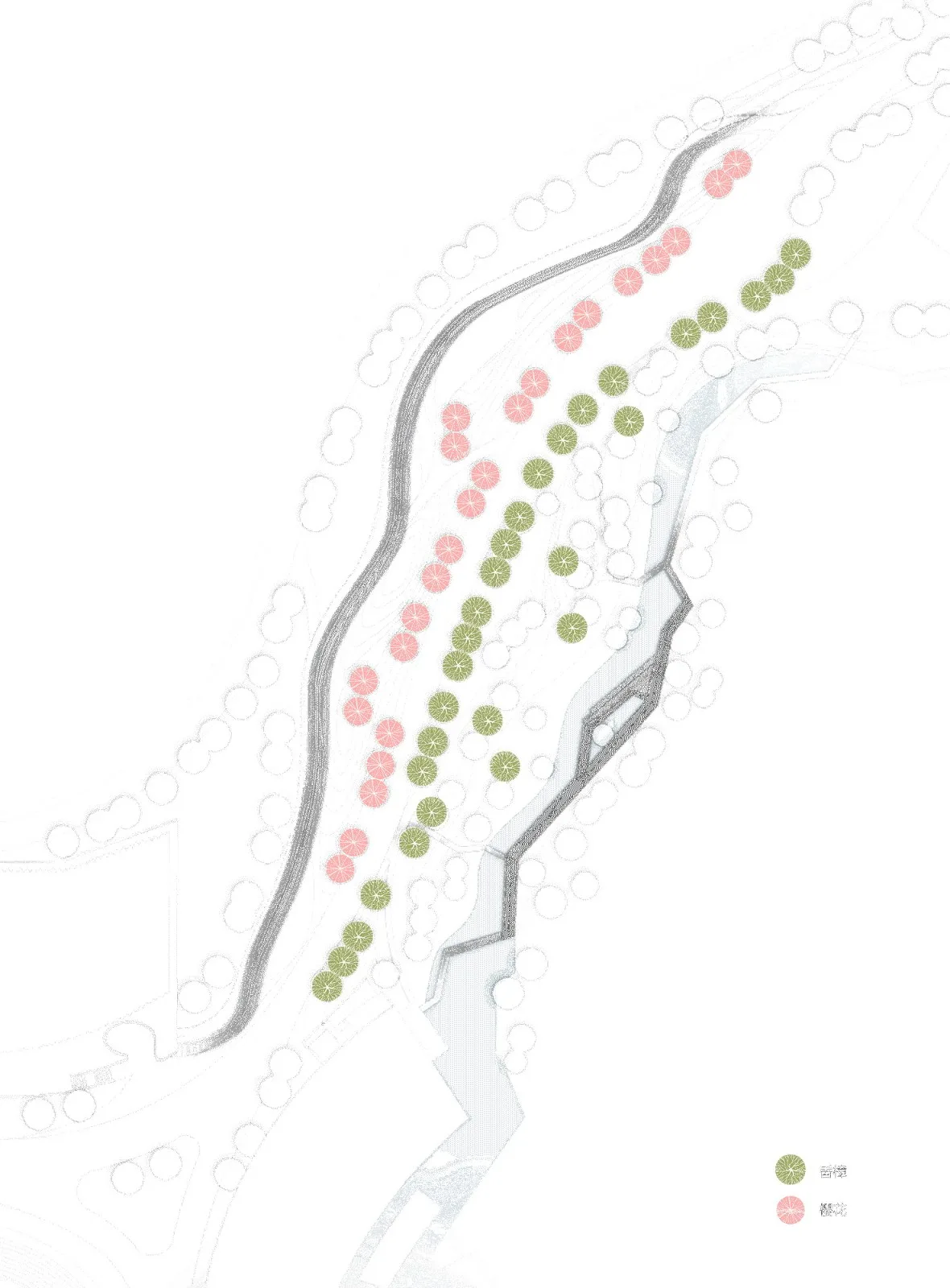
△ Flow Line and Vegetation Analysis
The “Sound Valley Cloud Corridor” site features a height difference of 1 to 4 meters on each side, with campus and city lanes on the outer edge. The continuously suspended semi-arched corridor replaces a rigid retaining wall, eliminating traffic noise and creating a poetic space for viewing mountains and rivers, while sheltering from wind and rain. Its soil-covered roof blends into the landscape, softening the campus’s eastern edge.
The micro-update retains the original spatial design, refreshing landscaping by planting 33 early cherry blossom trees to create a blooming cherry blossom forest.

△ Cross-sectional view of the double corridors
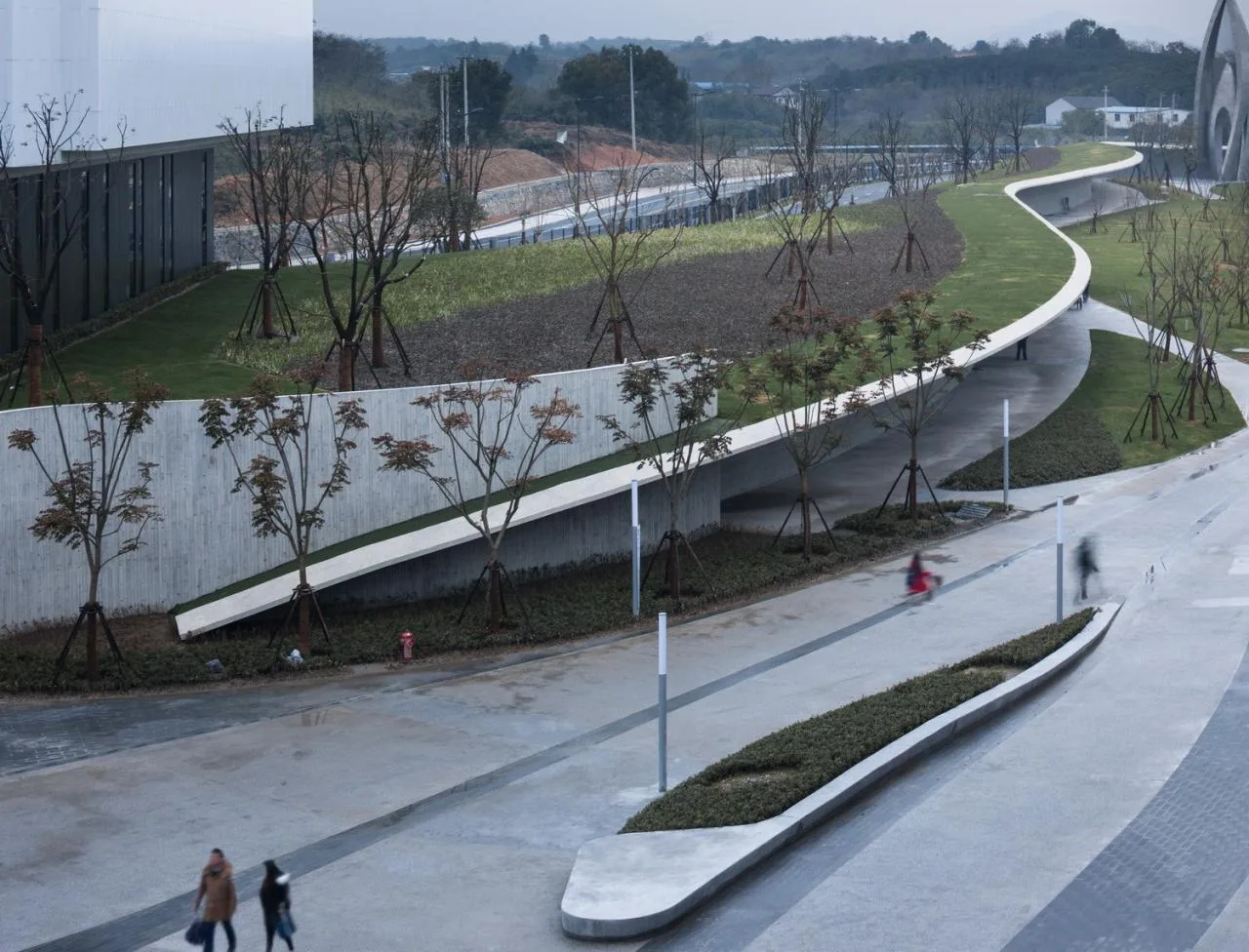
△ The “Sound Valley Cloud Corridor” softens the campus’s eastern boundary
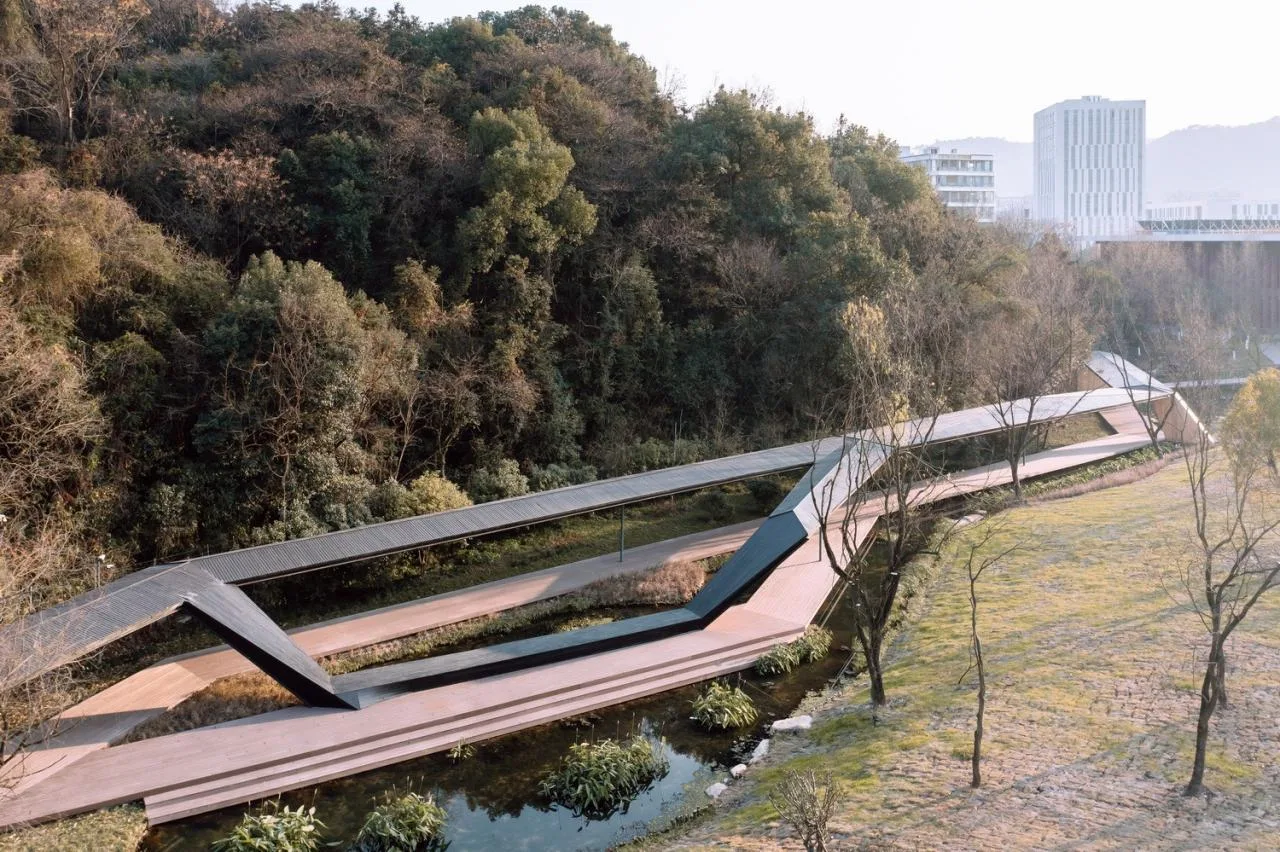
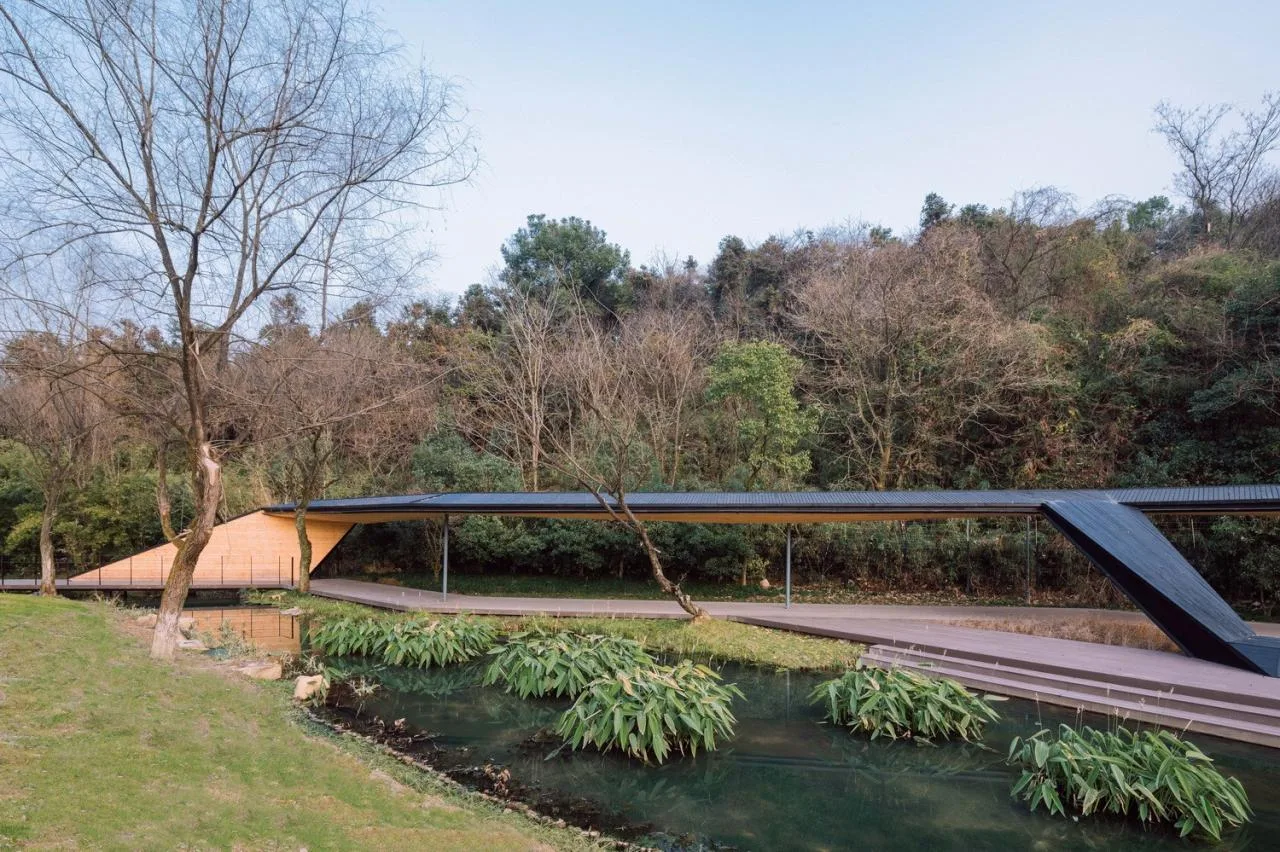
Looking westward along the “Sound Valley Cloud Corridor,” the mountain scenery unfolds. The “Flying Eaves on the Stream” winds closely along the mountain edge, crossing the stream. The layered composition of stacks, corridors, eaves, and bridges integrates various spatial fragments—leaning on the mountain, flowing water, facing the stream, and winding pathways—creating a rich and varied spatial experience.
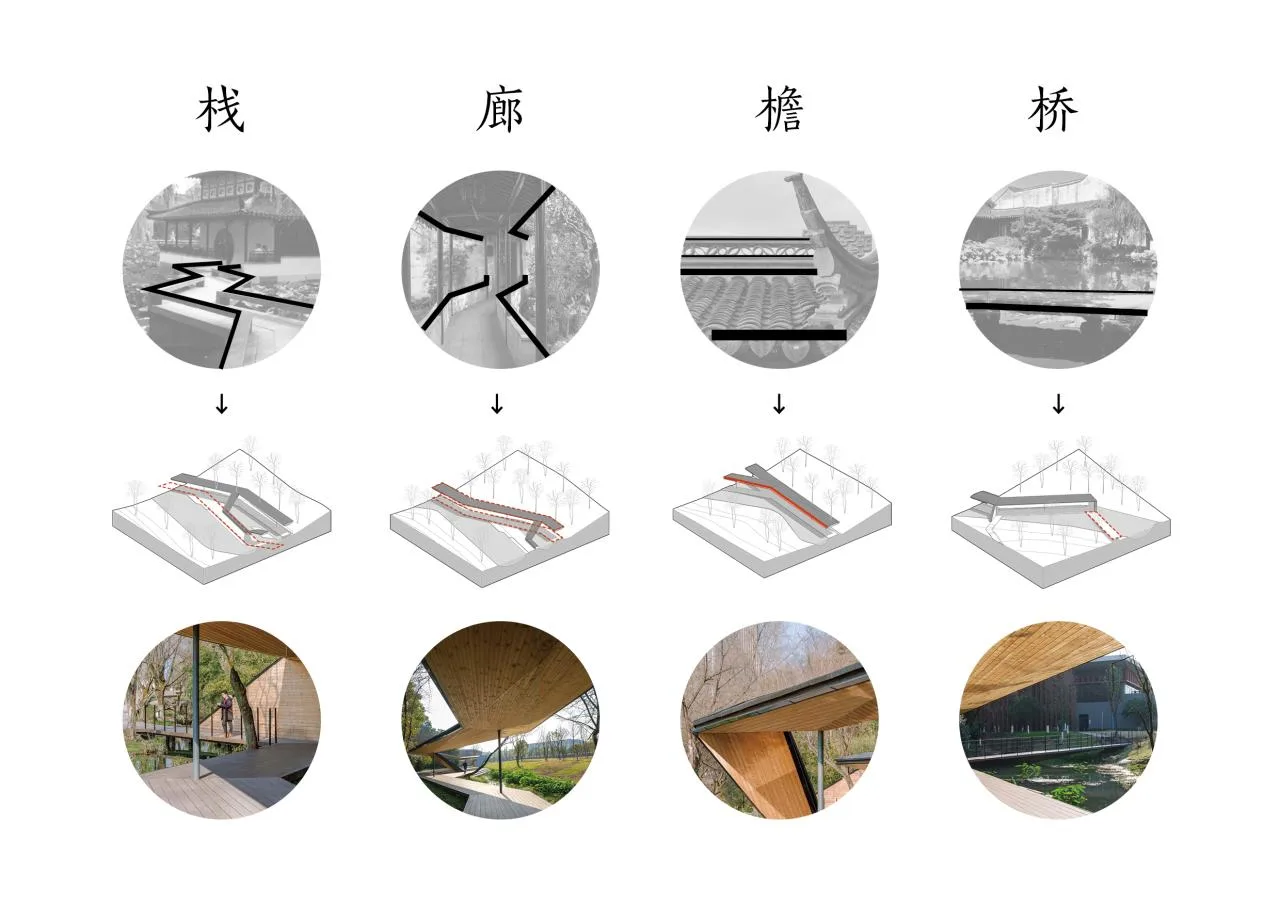
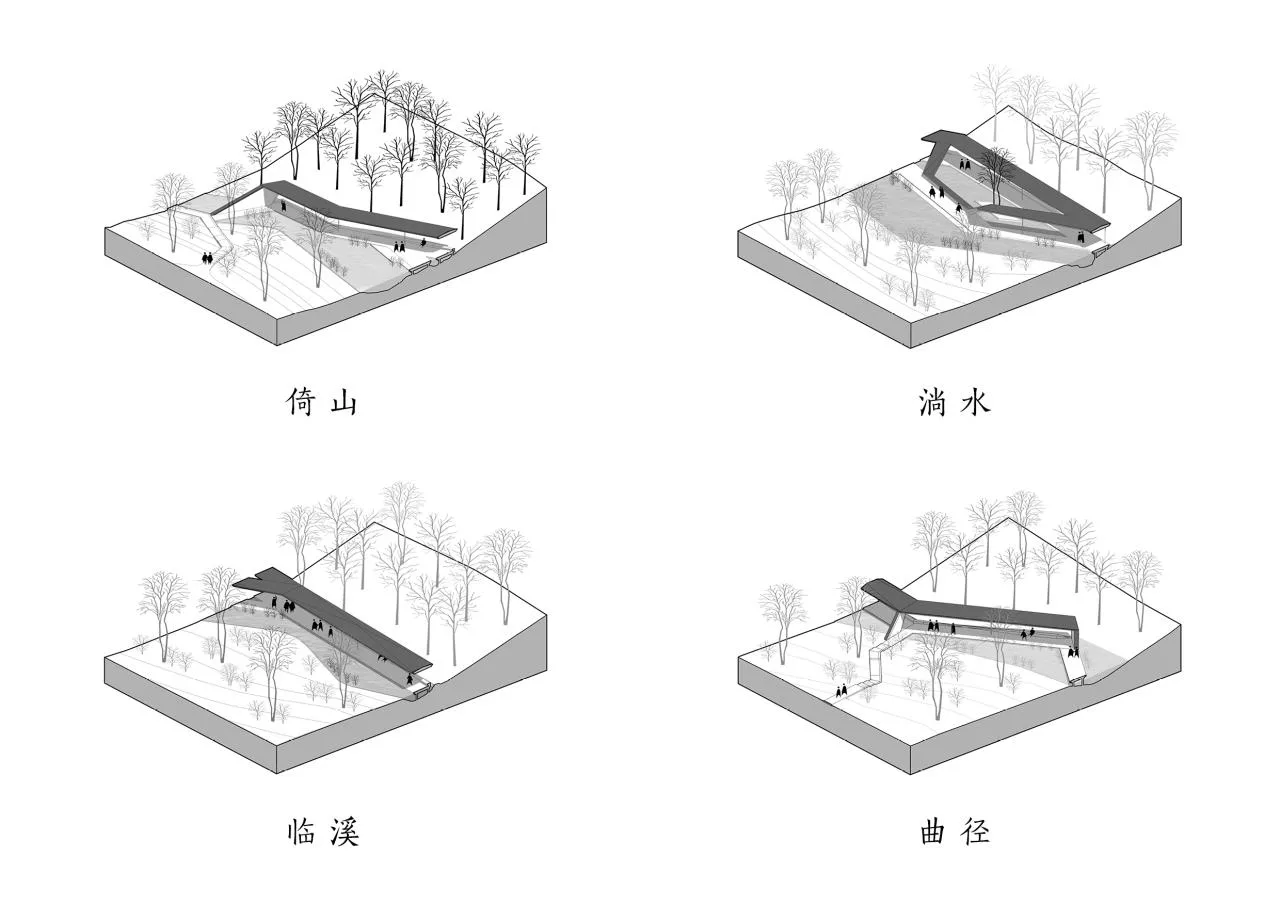
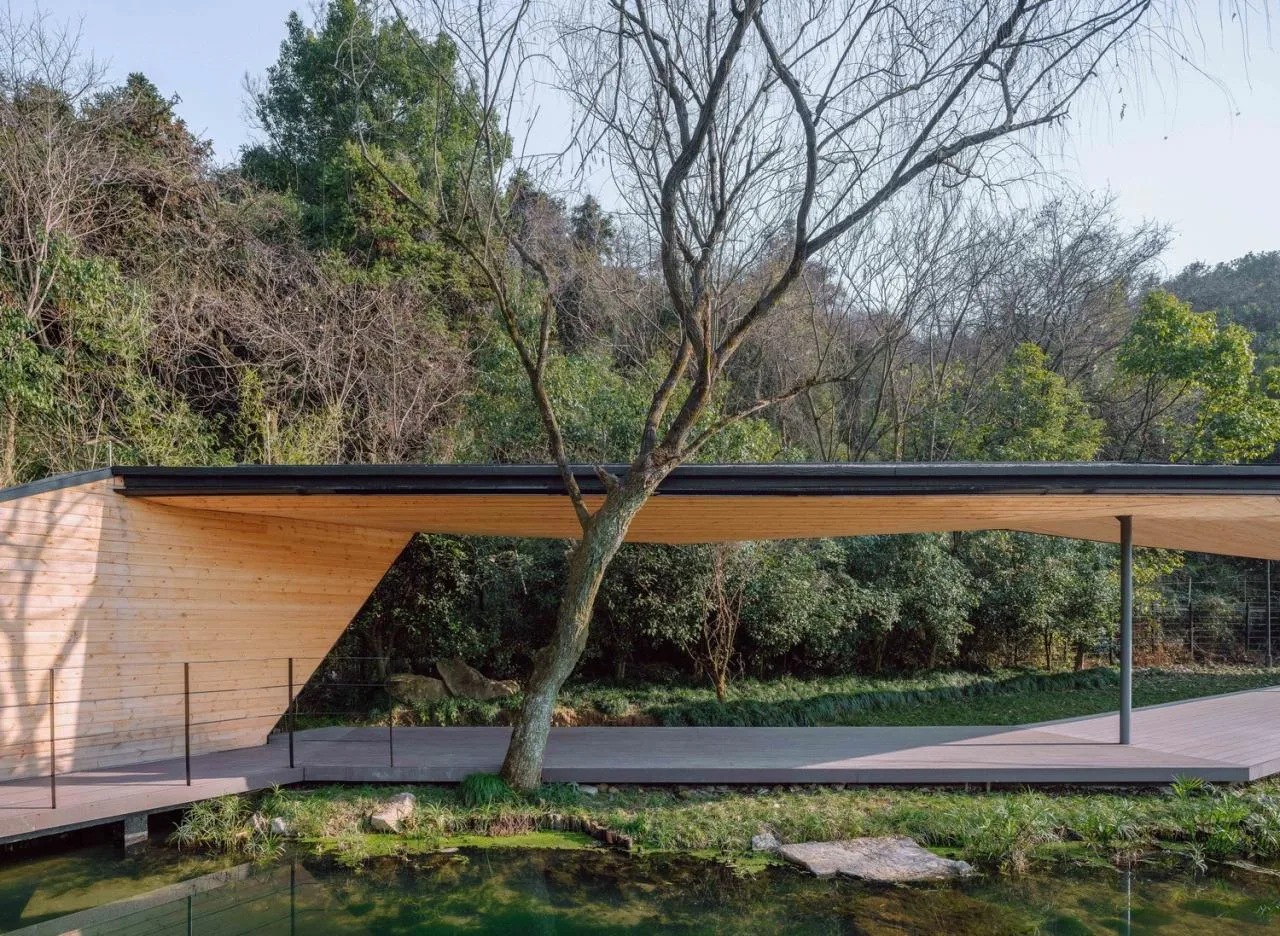
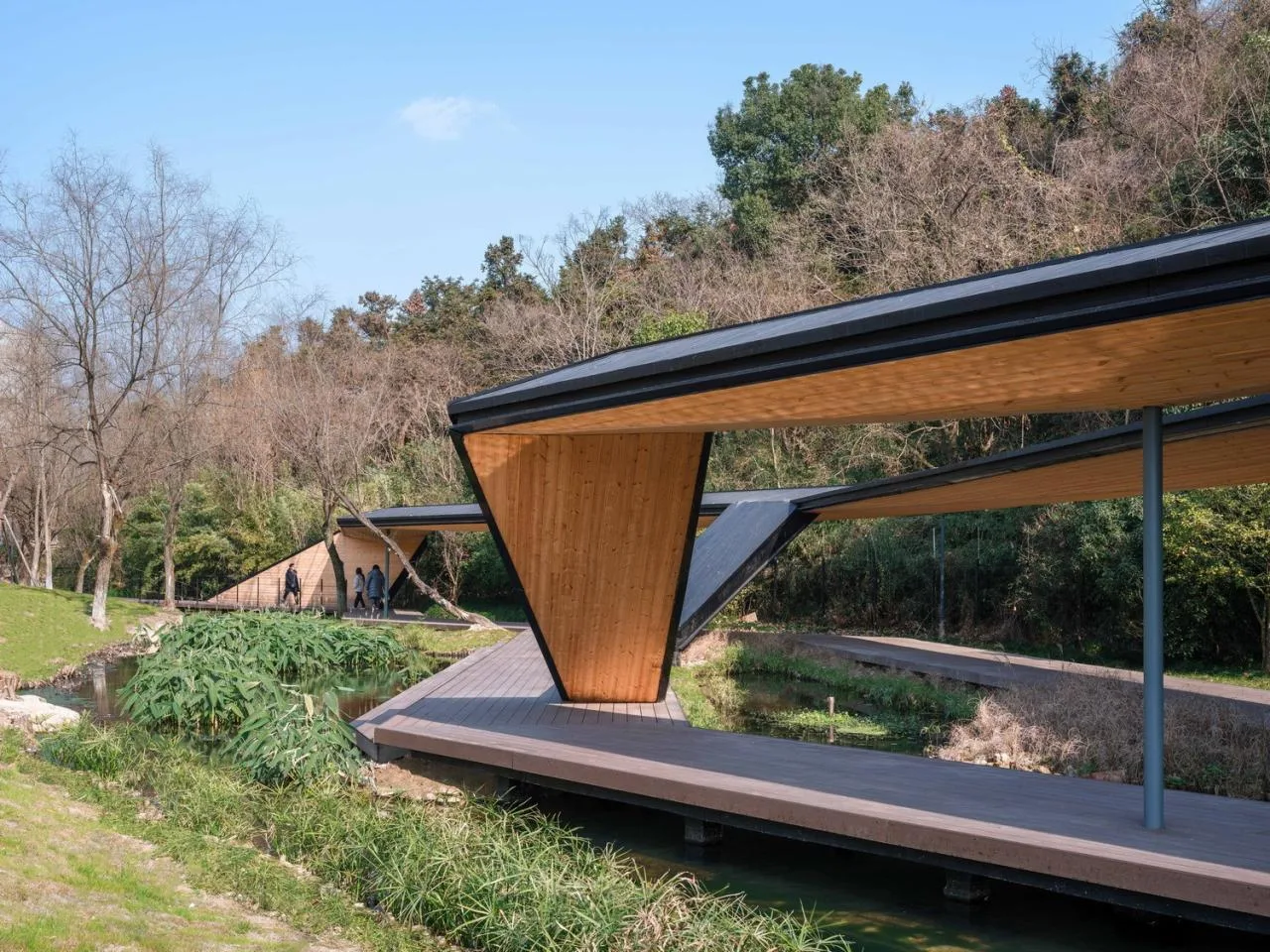
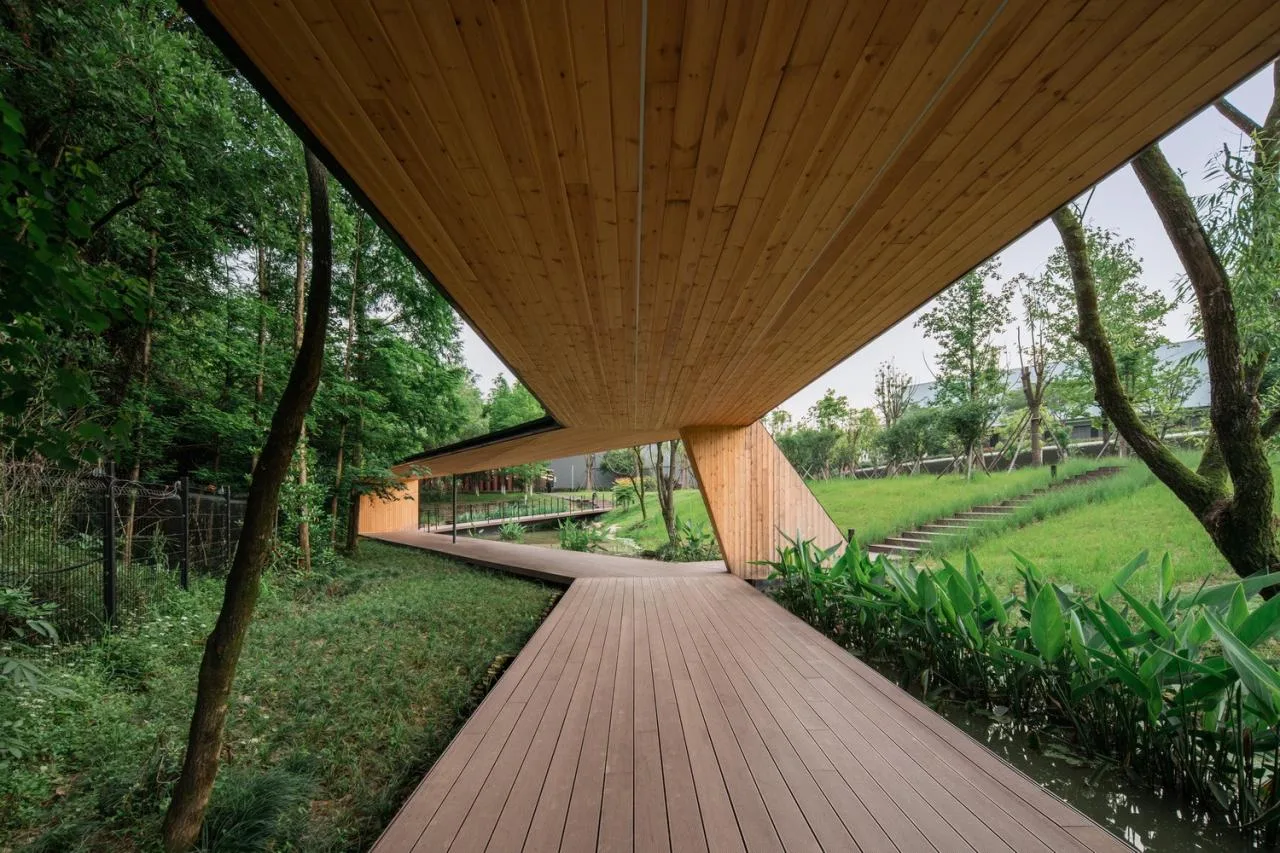
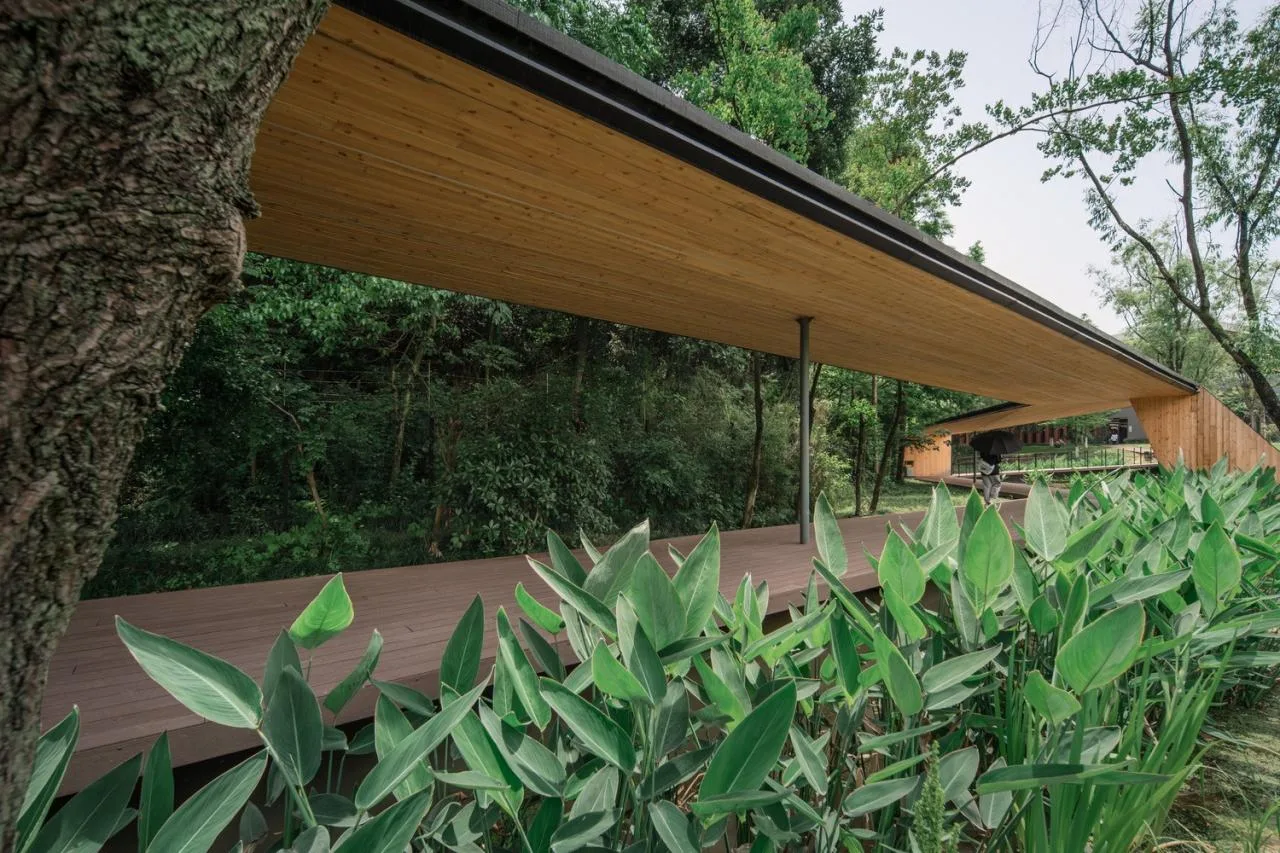
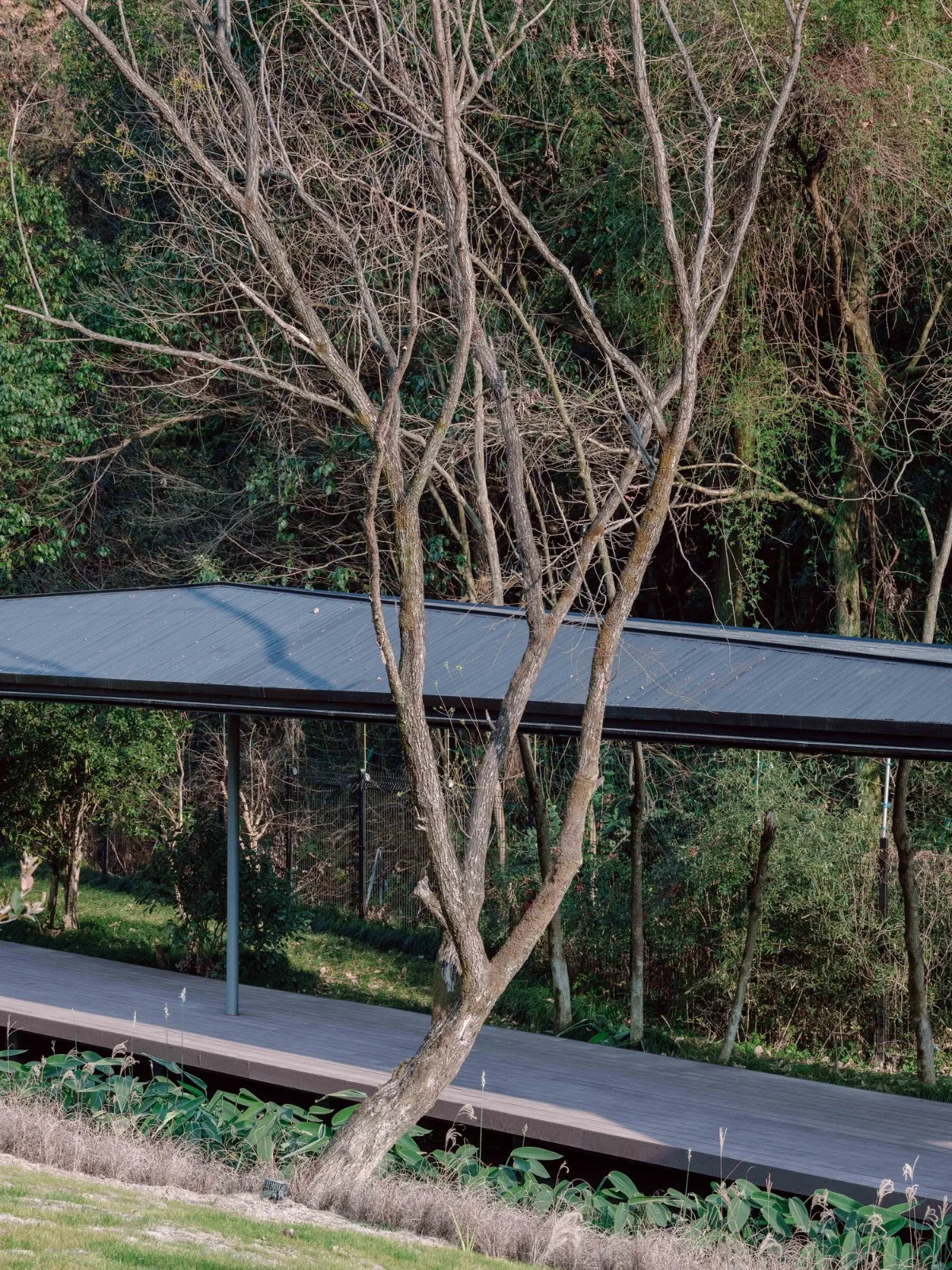
Stack: To protect the original site environment, the pathway crosses the stream via a low-profile overhead structure that closely follows the water surface, bending to avoid native trees and align with the mountain slope.
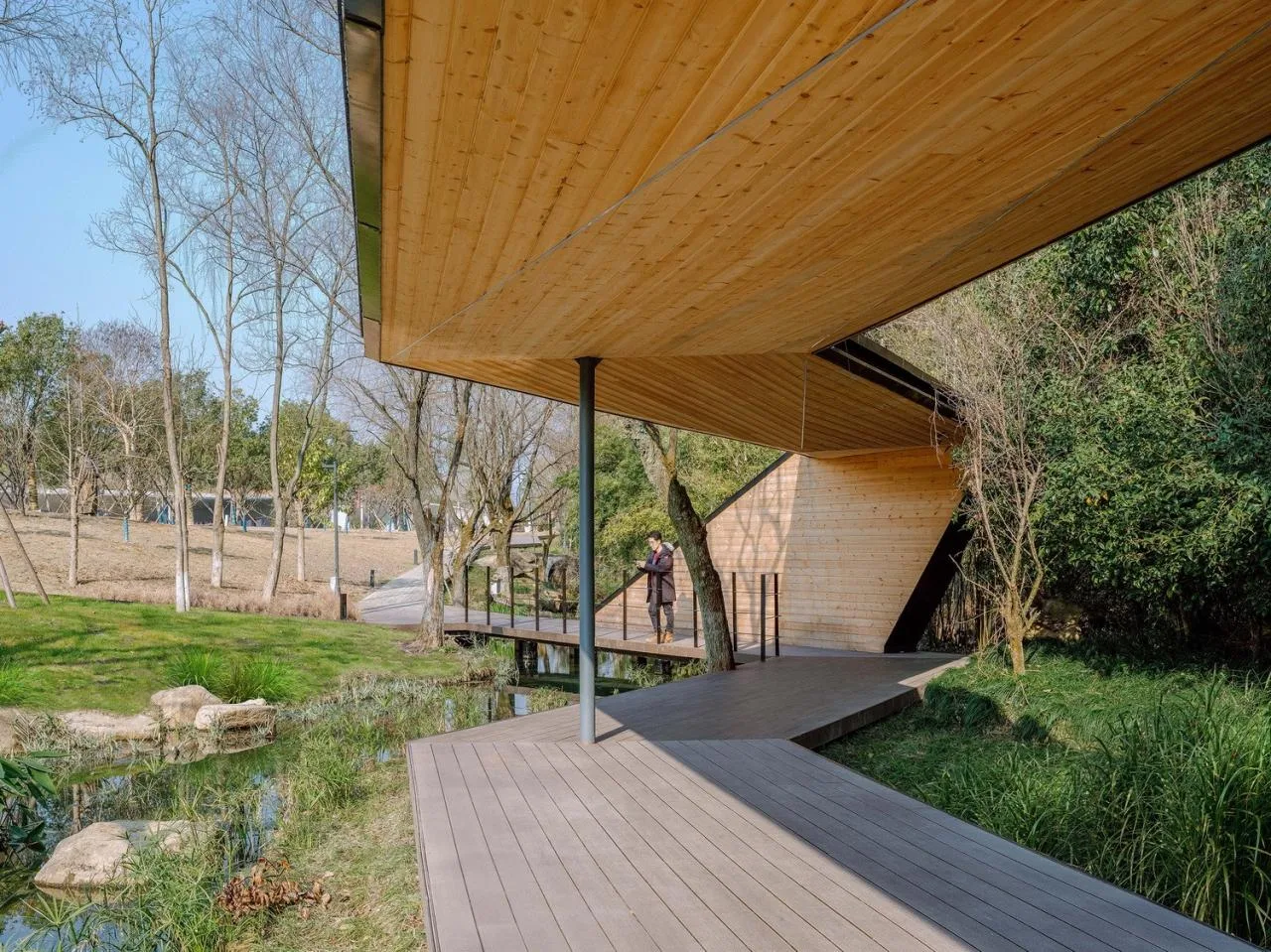
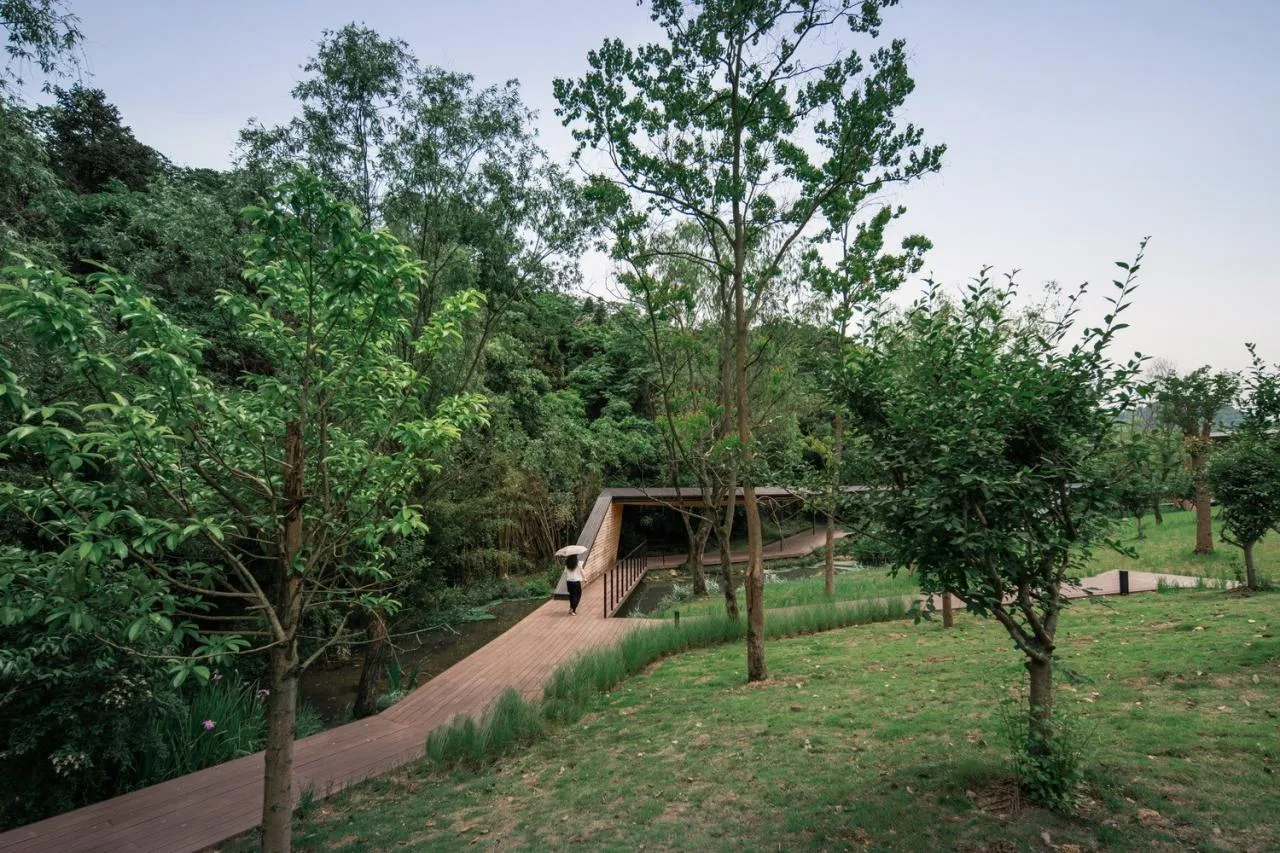
Corridor: The stack supports eaves pillars that curve with the mountain slope, extending the corridor over the stream’s middle section. Stepping down two or three steps allows pedestrians to sit by the water, blending seating, viewing, and strolling functions into a shared space that invites both movement and rest.
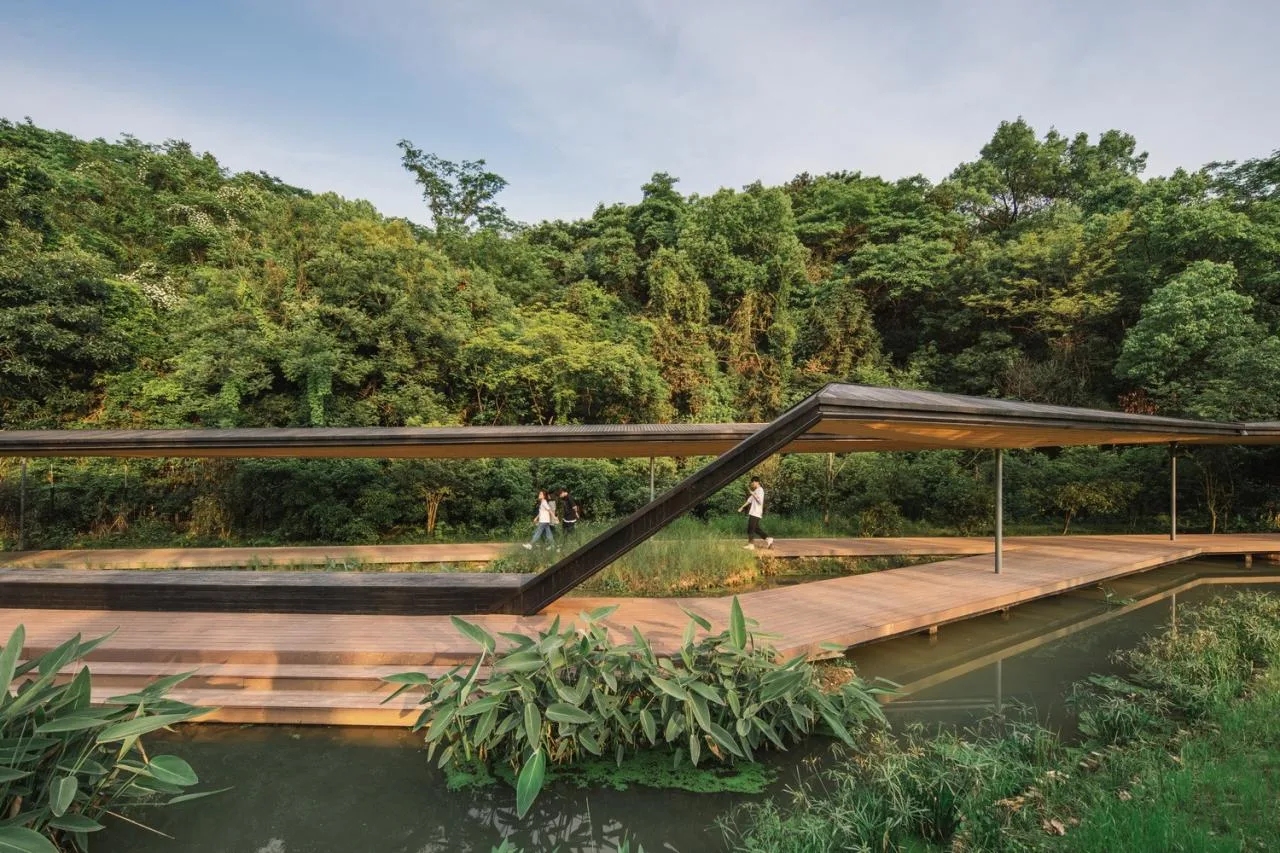
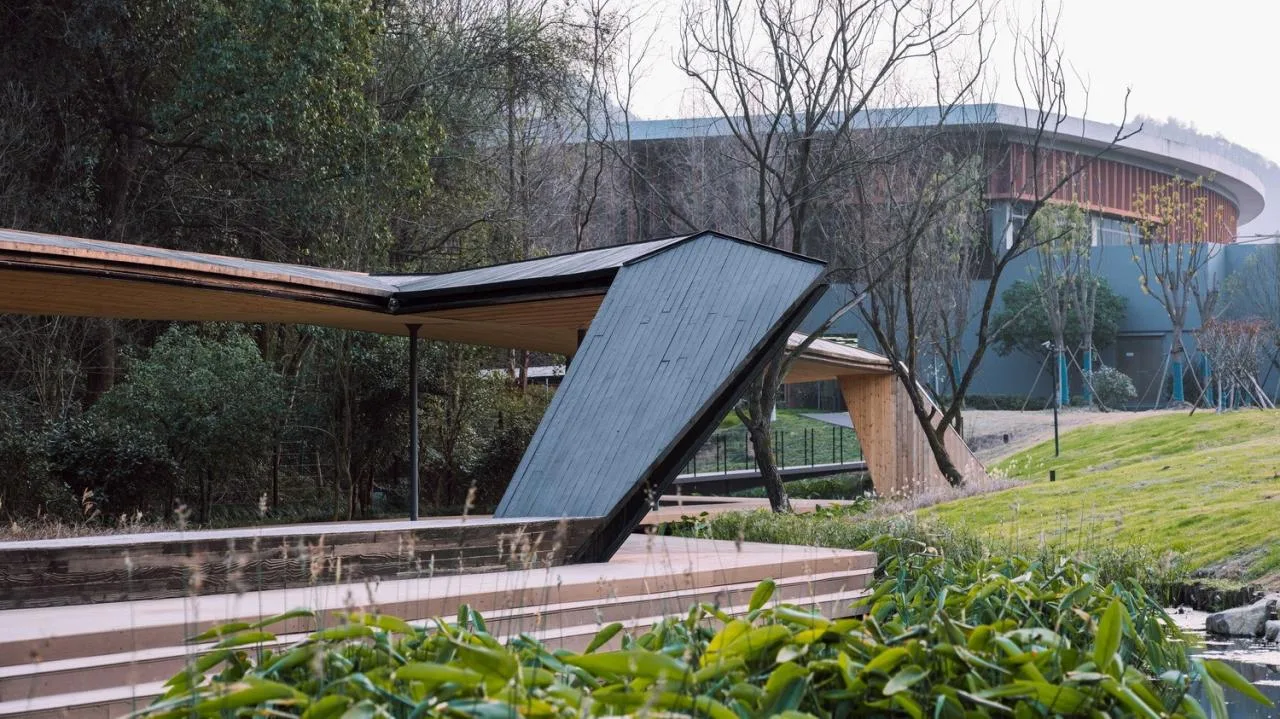
Stepping down two or three steps from the “corridor,” pedestrians can relax by sitting on the water’s edge.
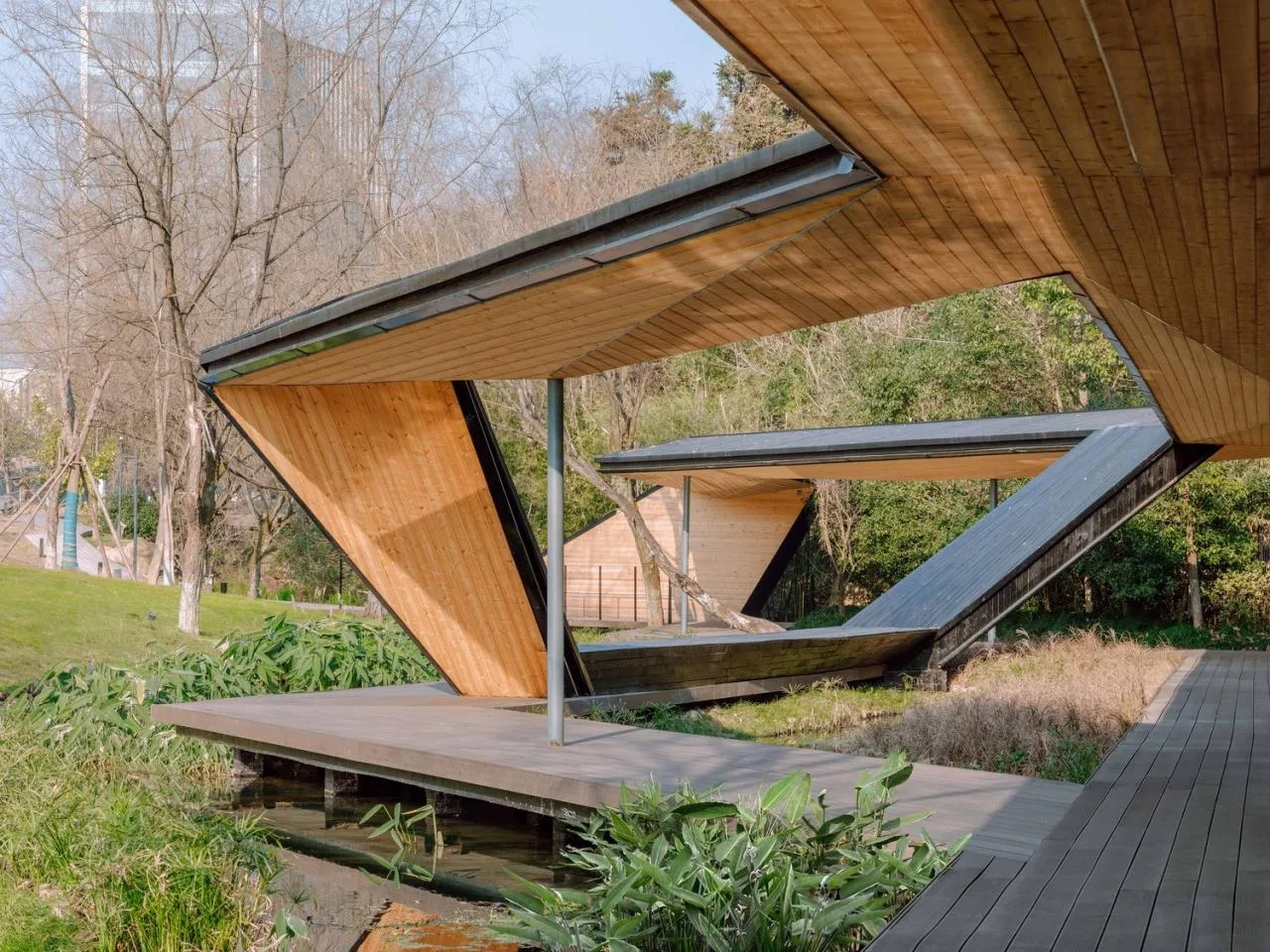
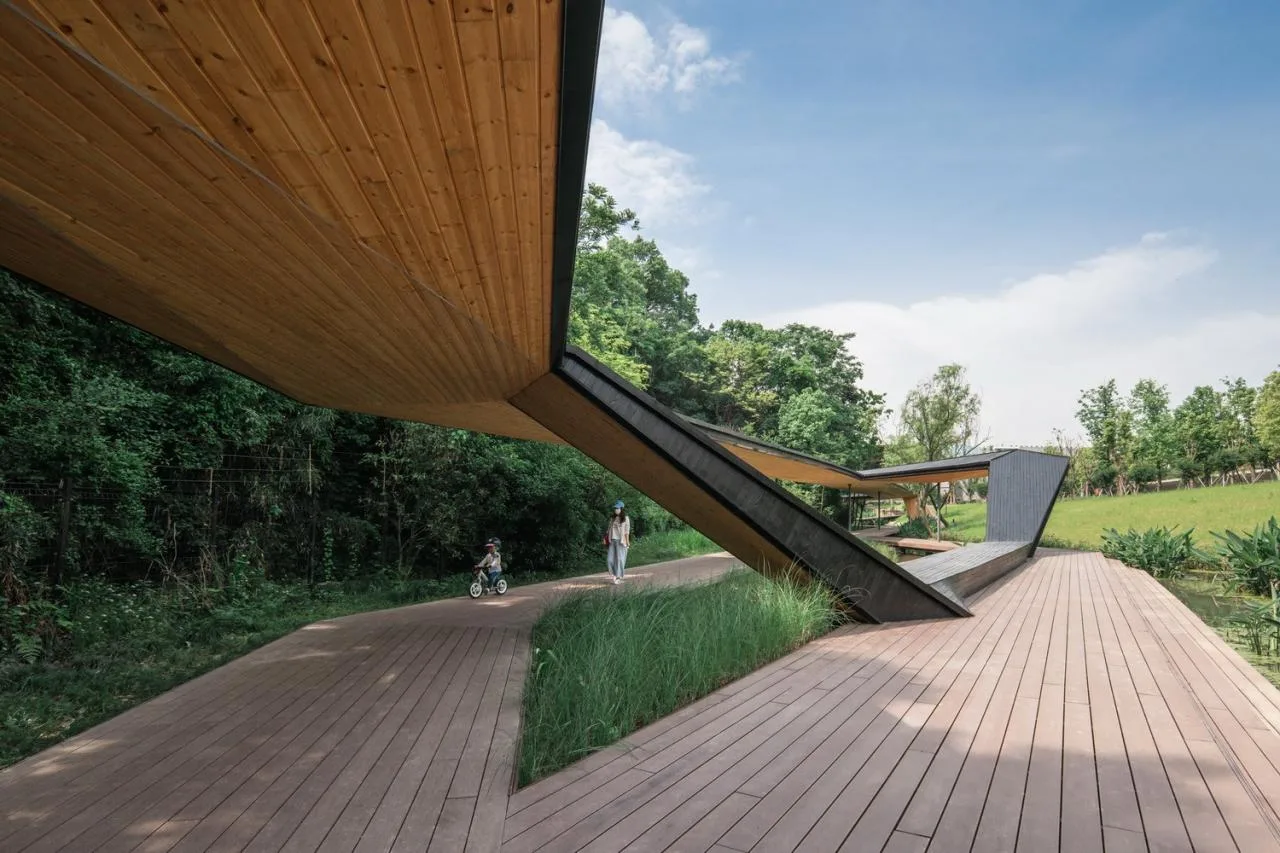
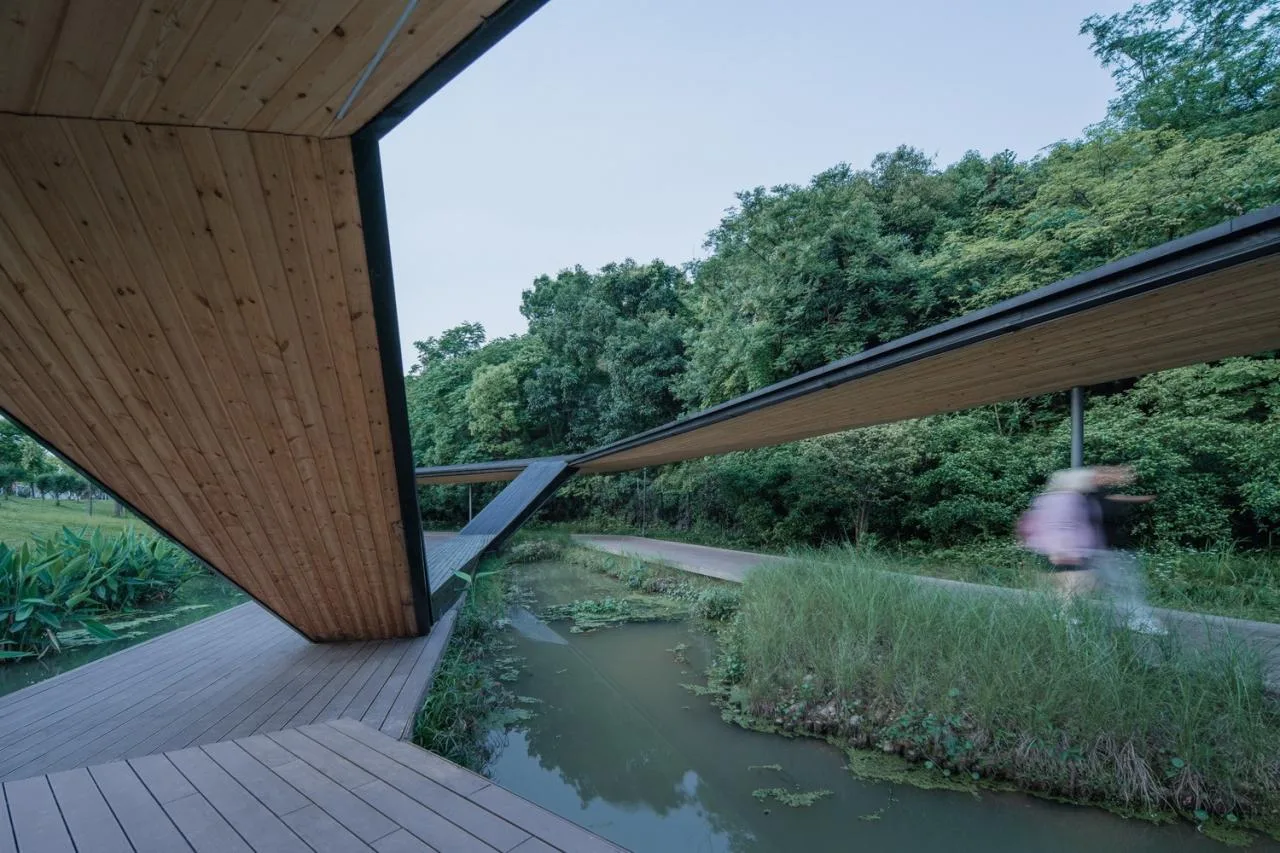
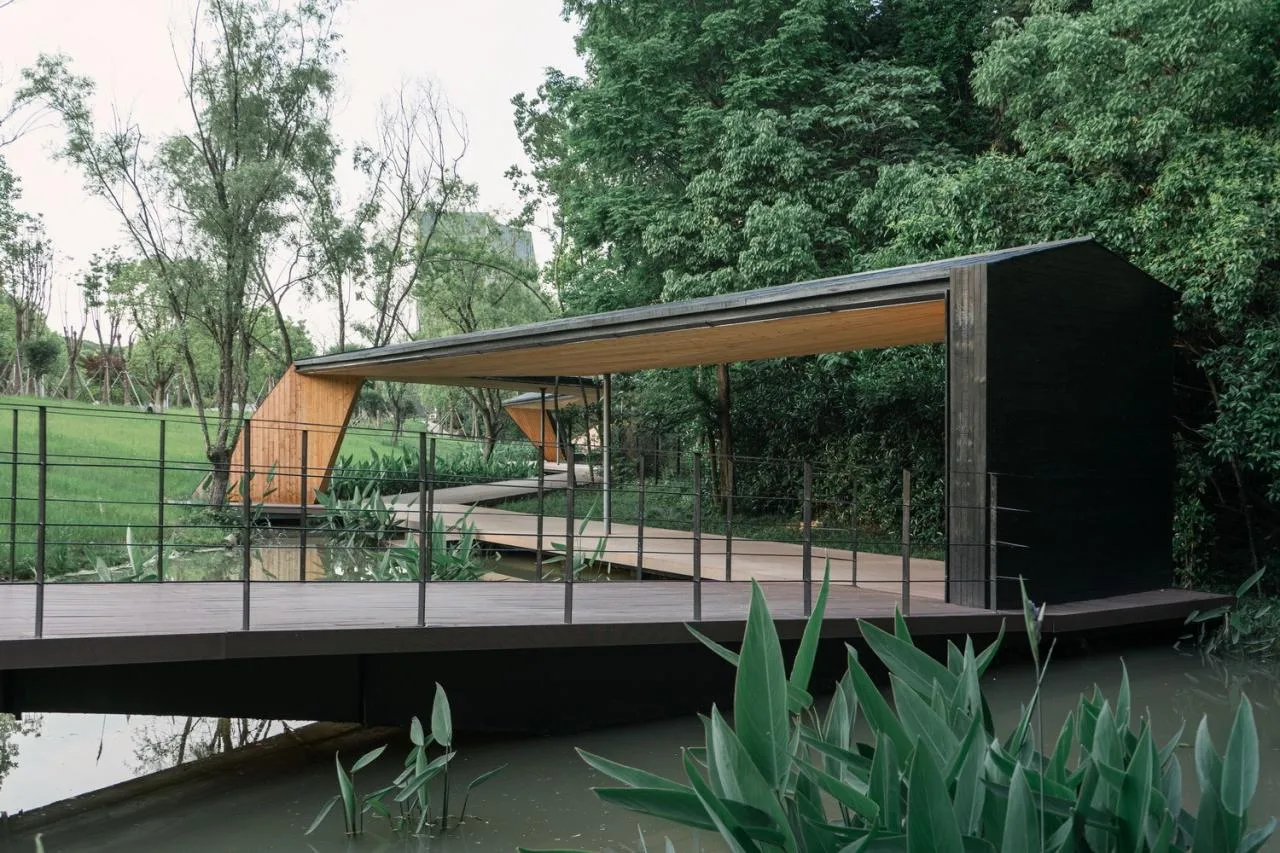
Eaves: Simplifying the ridges and slopes of traditional roofs, the eaves are designed with smooth transitions and a light, concealed presence. They twist and fold onto the boardwalk, forming casual seating and structural buttresses that mark the path’s beginning and end.
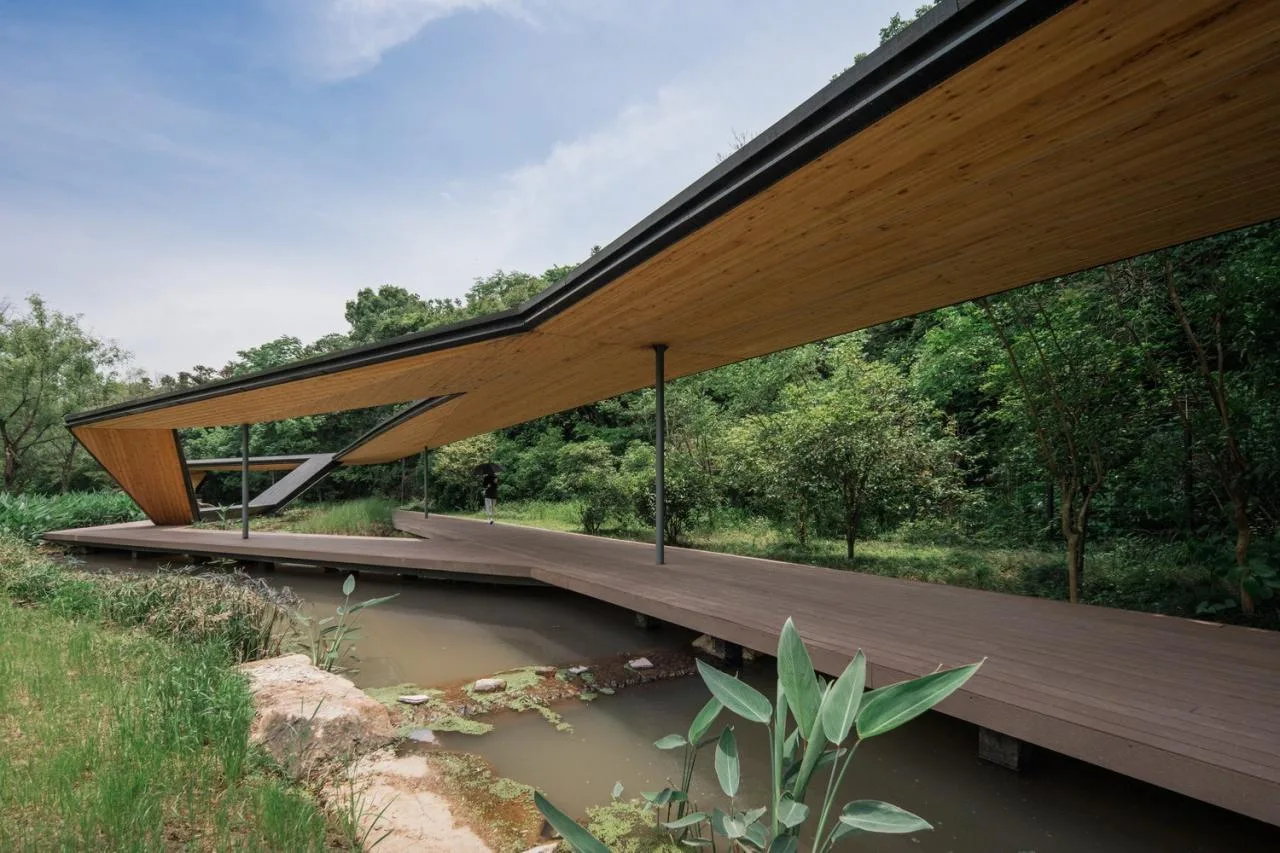
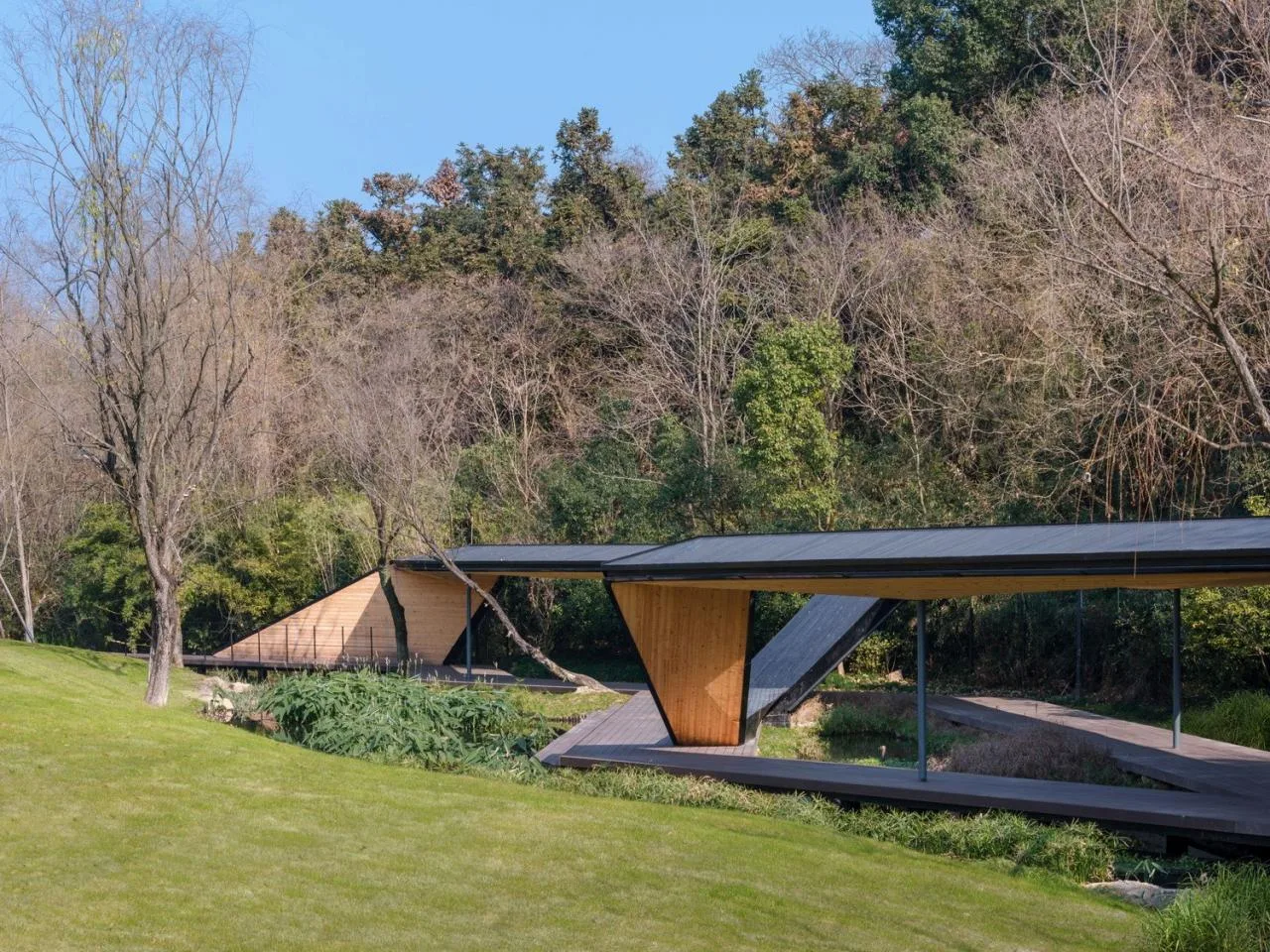
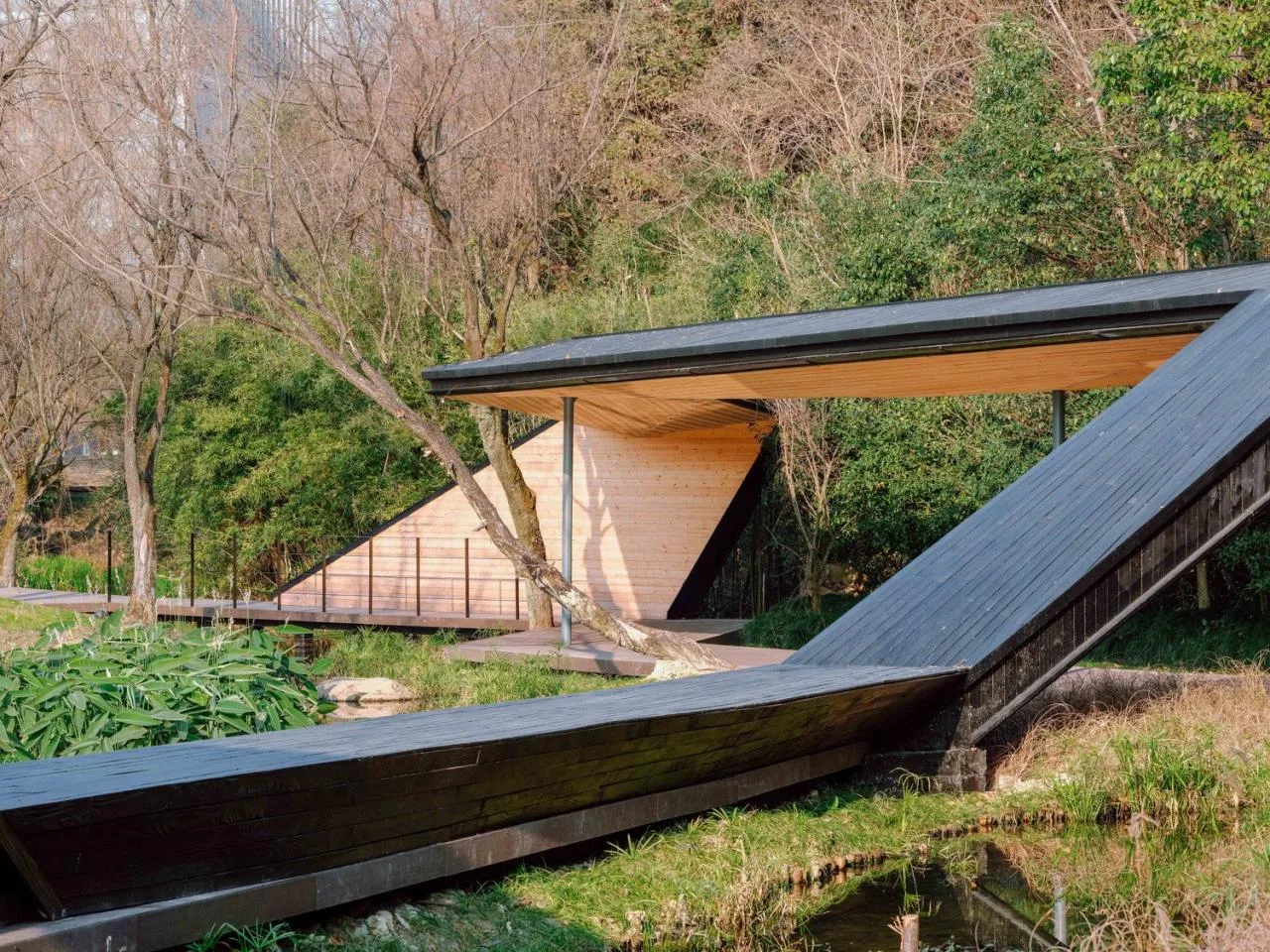
The twisted eaves form benches and supporting walls that define the walkway’s start and end points.
Bridge: In front of the campus cafeteria lies a small millet-shaped pond crossed by a slightly inclined steel bridge. This cantilevered structure is suspended on one side, providing easy access to the adjacent slope.
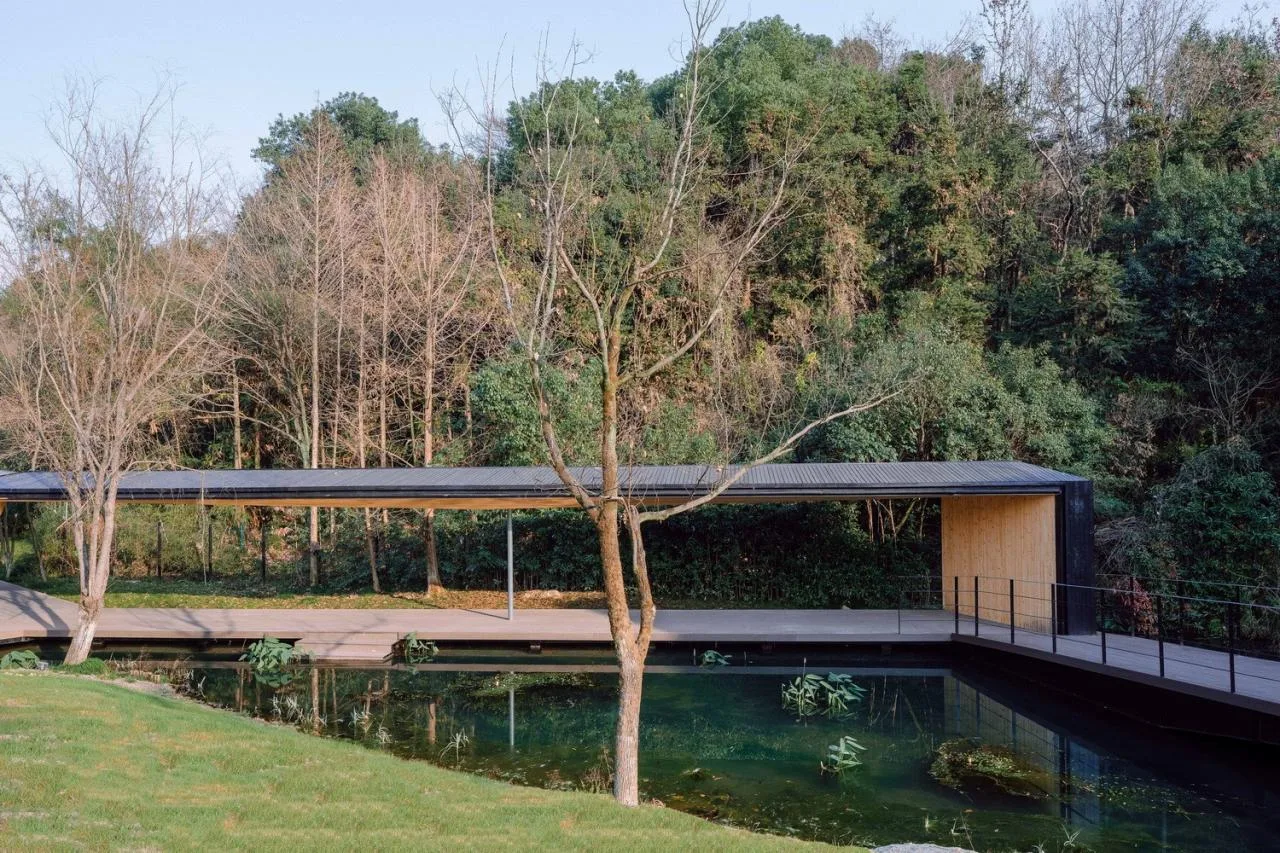
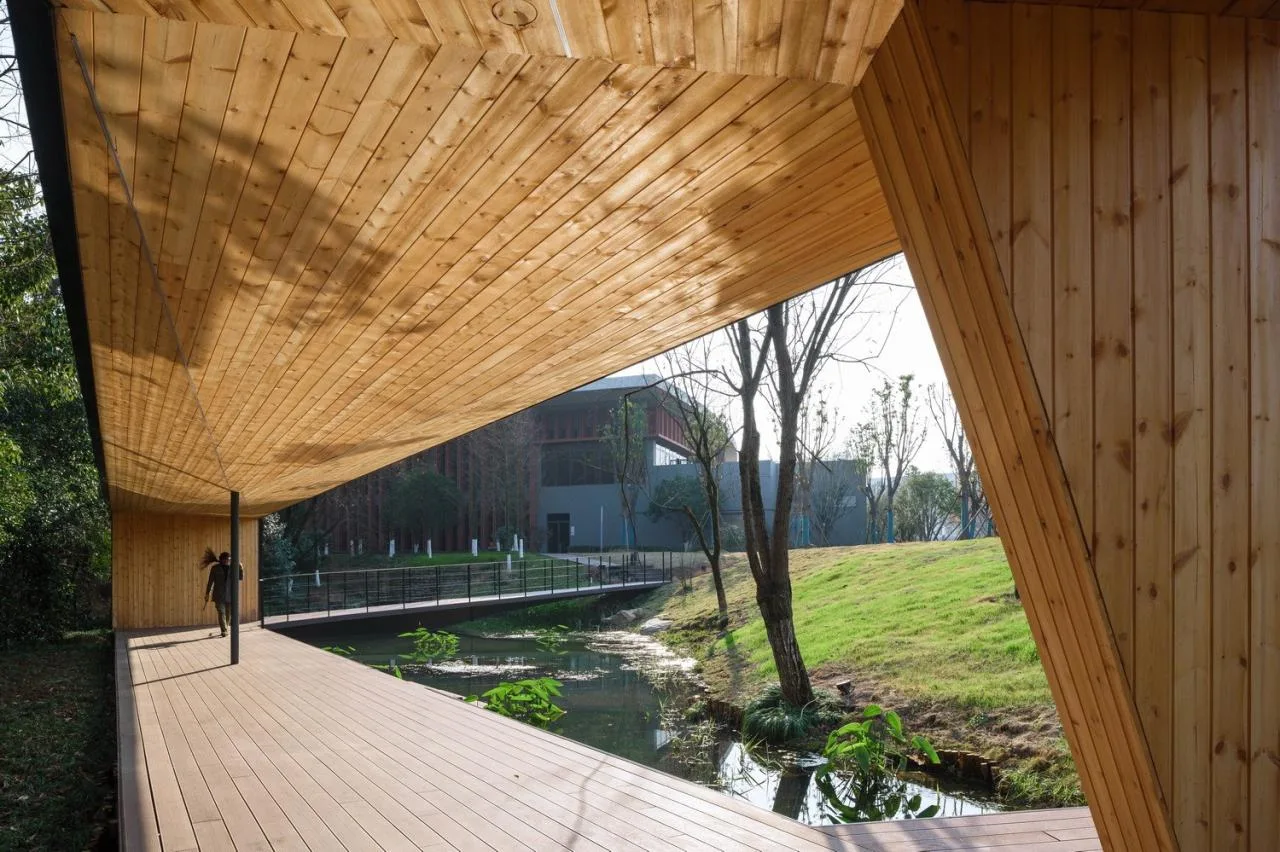
This steel bridge spans the pond in front of the cafeteria, facilitating easy slope access.
Contrasting the continuous curves of the “Sound Valley Cloud Corridor,” the “Flying Eaves on the Stream” employs defined lines at nodes and interprets classical garden elements to create a layered three-dimensional form. This builds a cohesive system where behaviors and scenes intertwine.
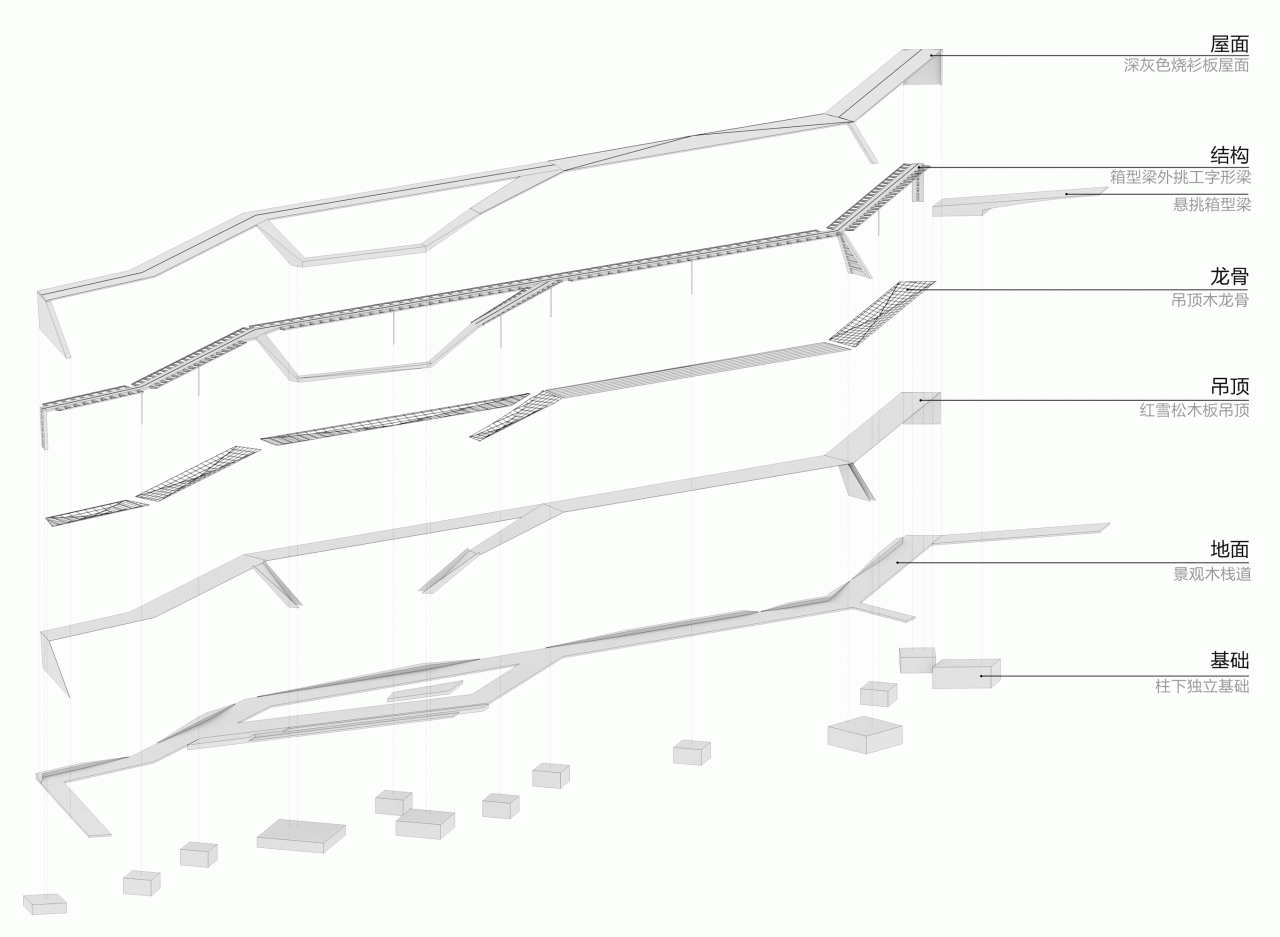
△ Material and structural analysis
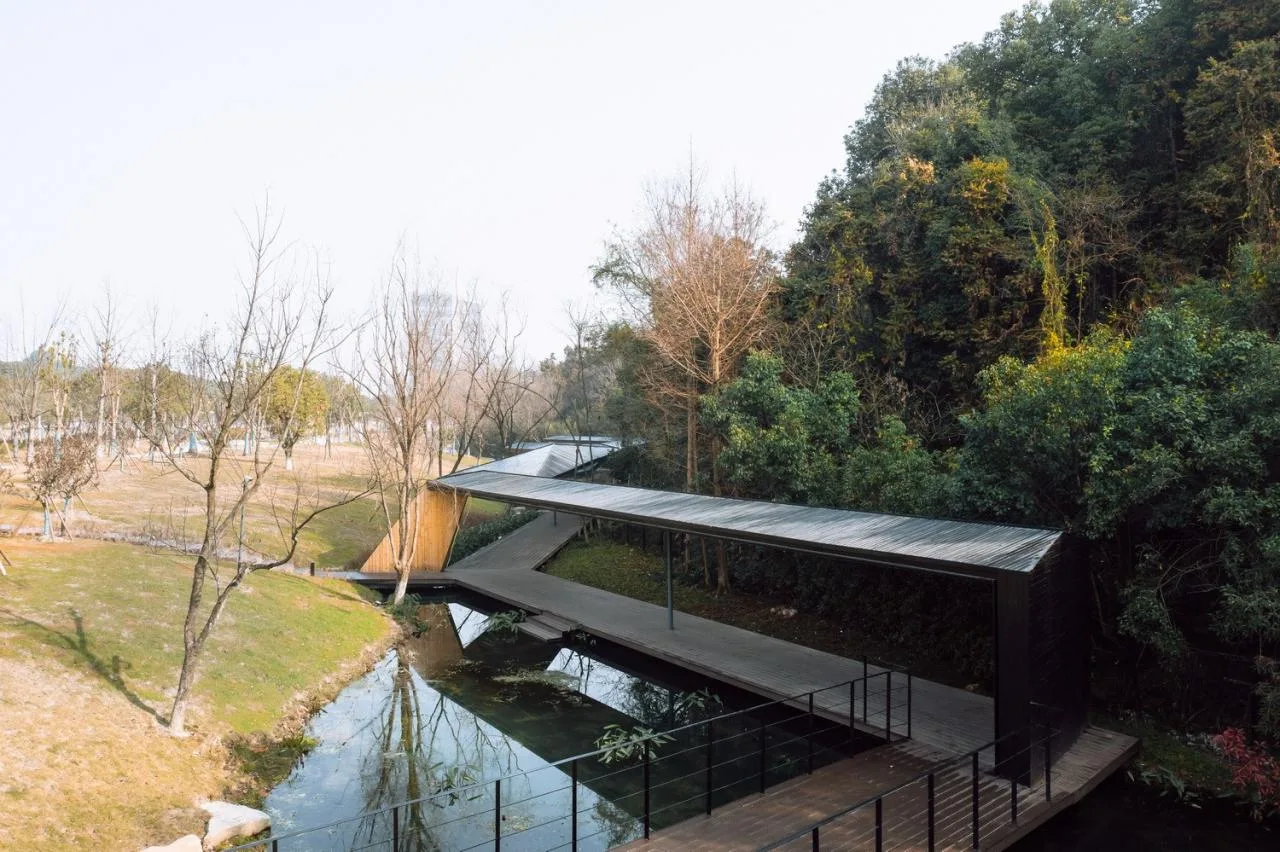
Establishing a cohesive system that unifies activity and environment
2.2 Structural Dialogue
Void and Solid, Hard and Soft
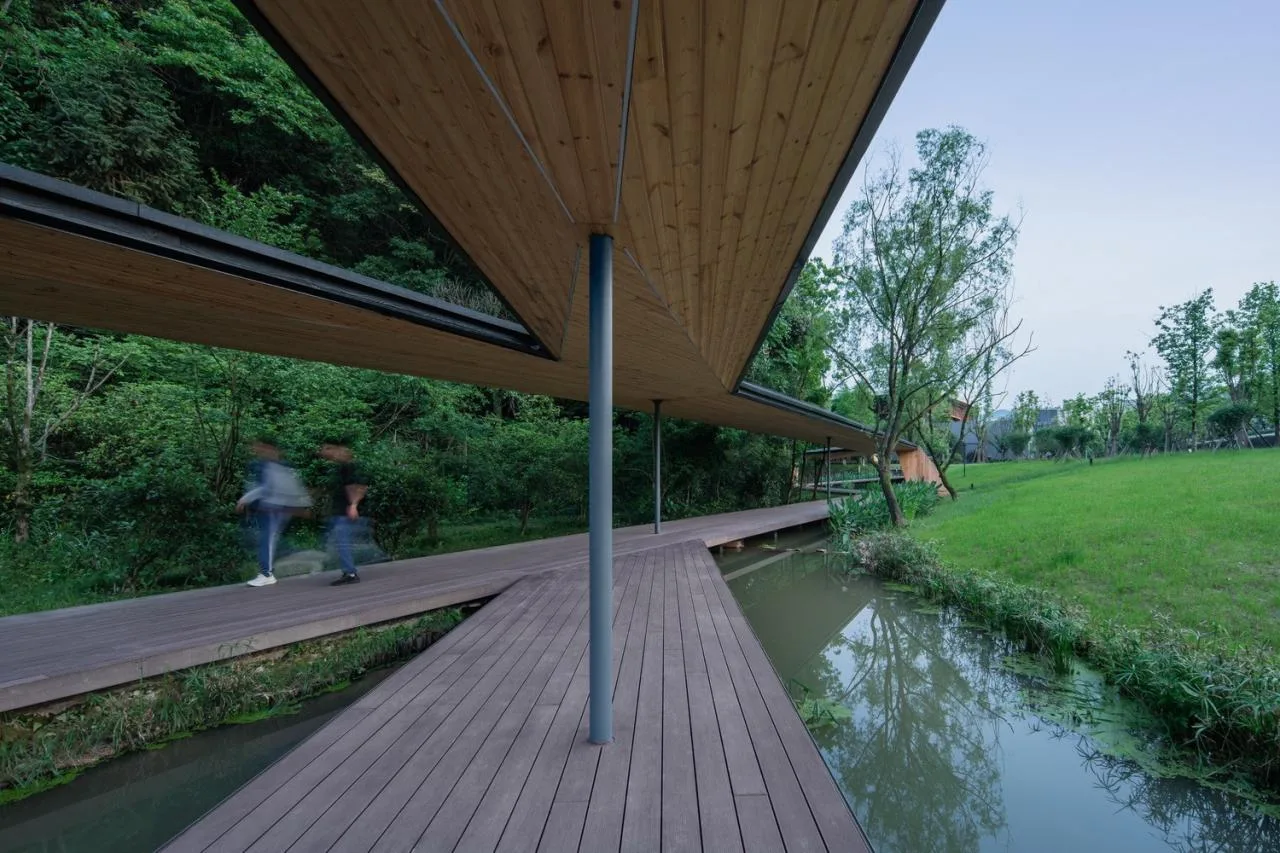
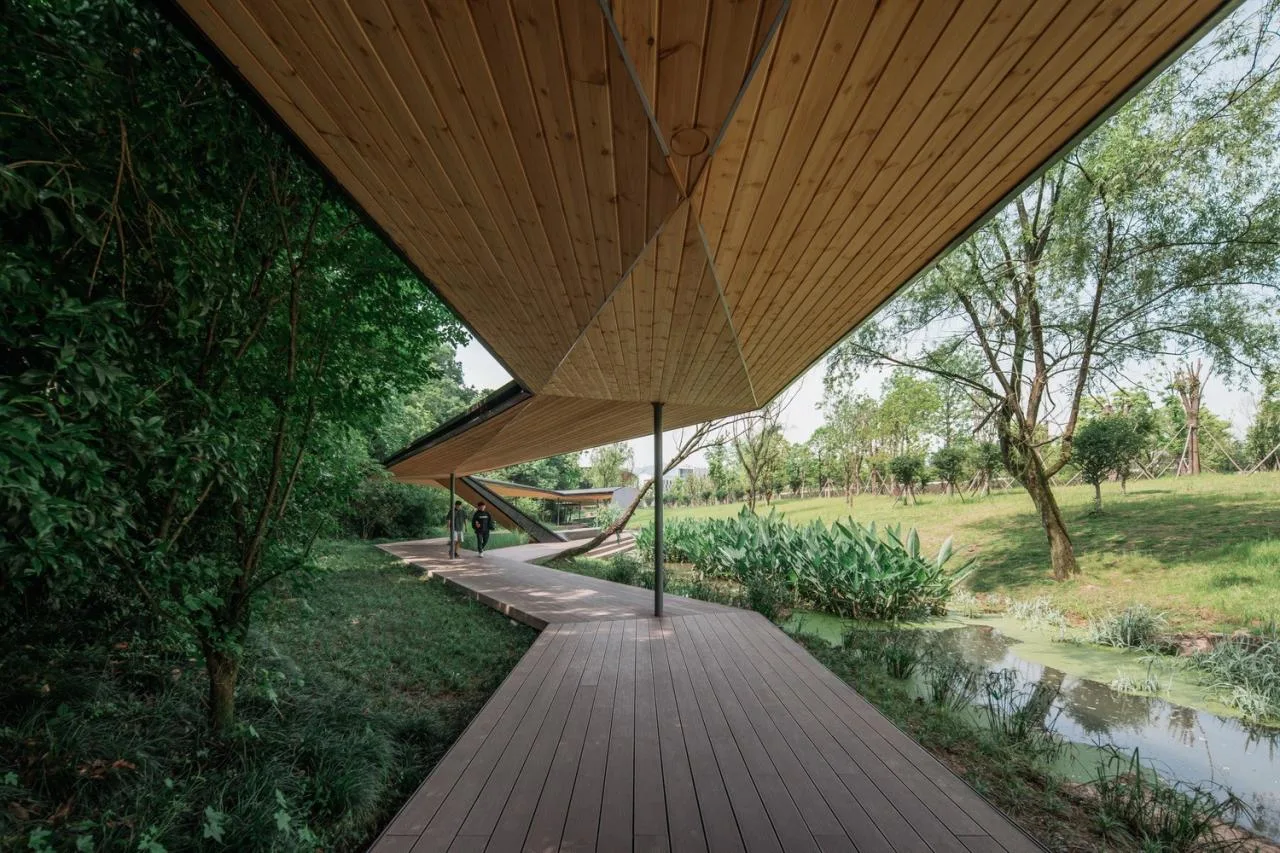
The “eaves” structure of the “Flying Eaves on the Stream” features a box beam overhanging I-beam design. The outer roof abstracts traditional double-sloped roofs with four corner cusps. Corresponding pyramidal forms are echoed in the suspended ceiling inside the eaves, converging all support points at the pyramid apex. This design allows the 113-meter-long eaves to be supported by only five slender steel columns, minimizing vertical structural elements.
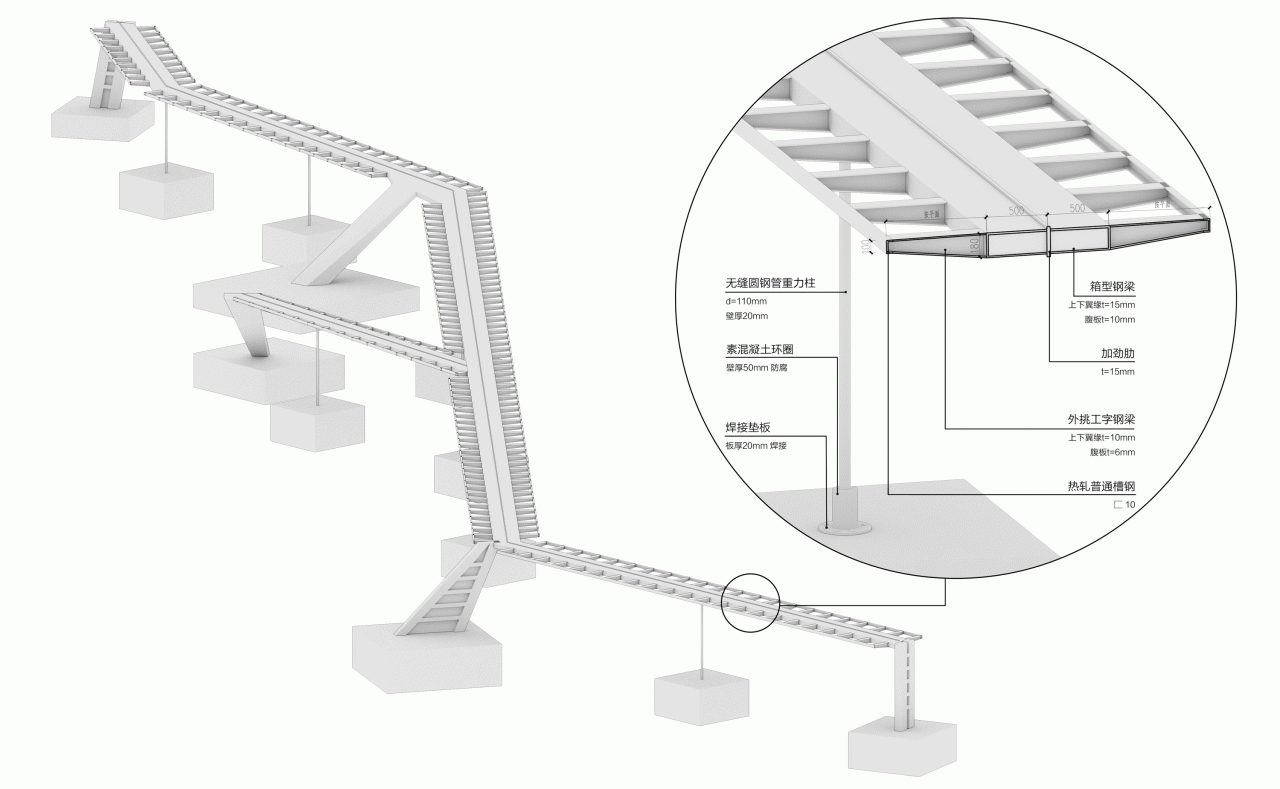
△ Structural analysis
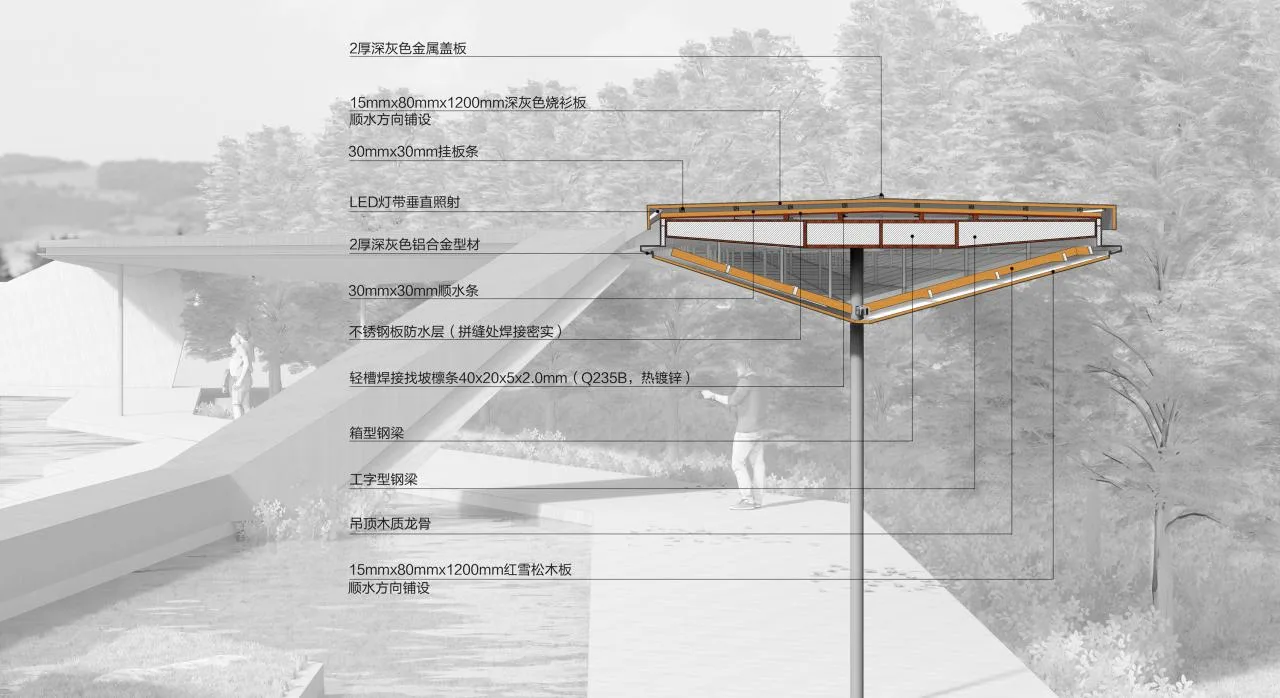
△ Construction nodes detail
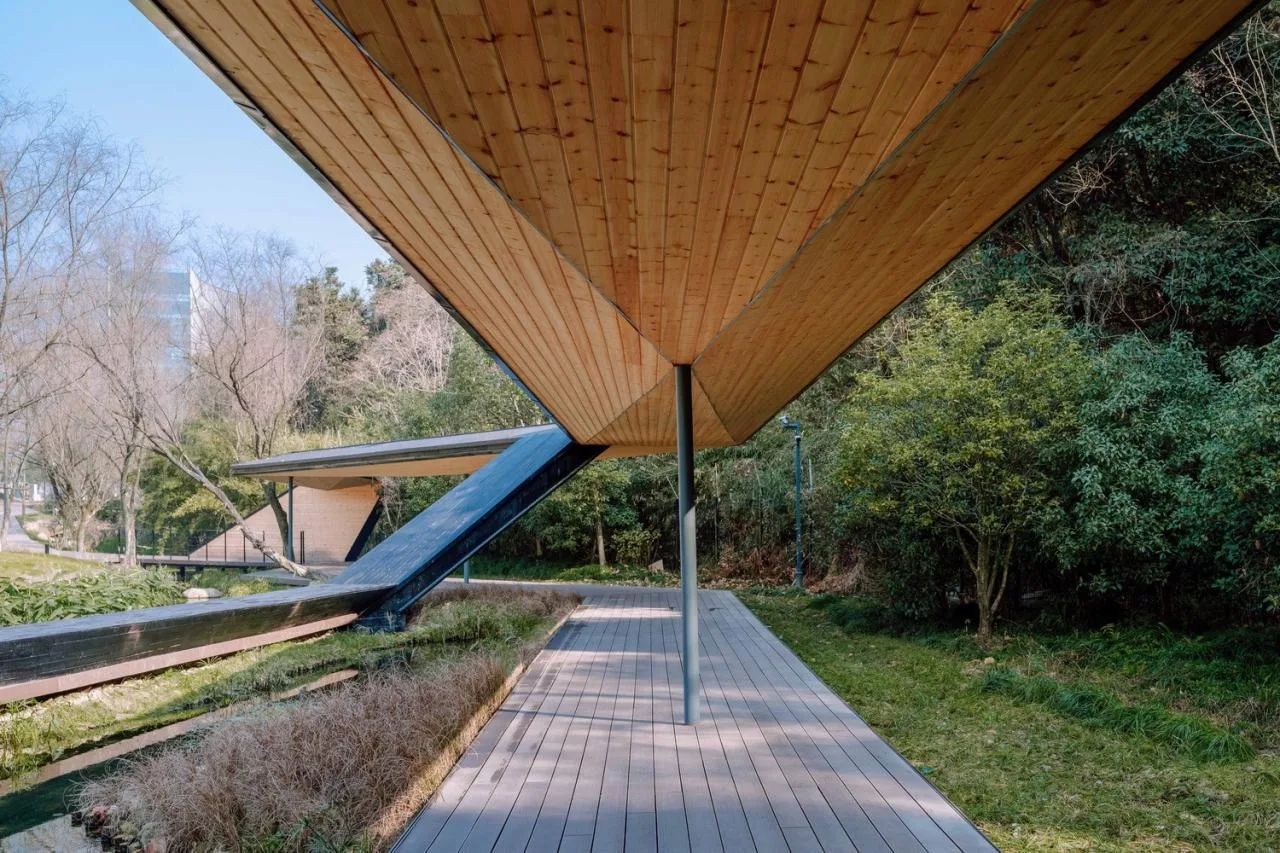
The suspended ceiling forms a four-sided pyramid with all supports converging at the apex.
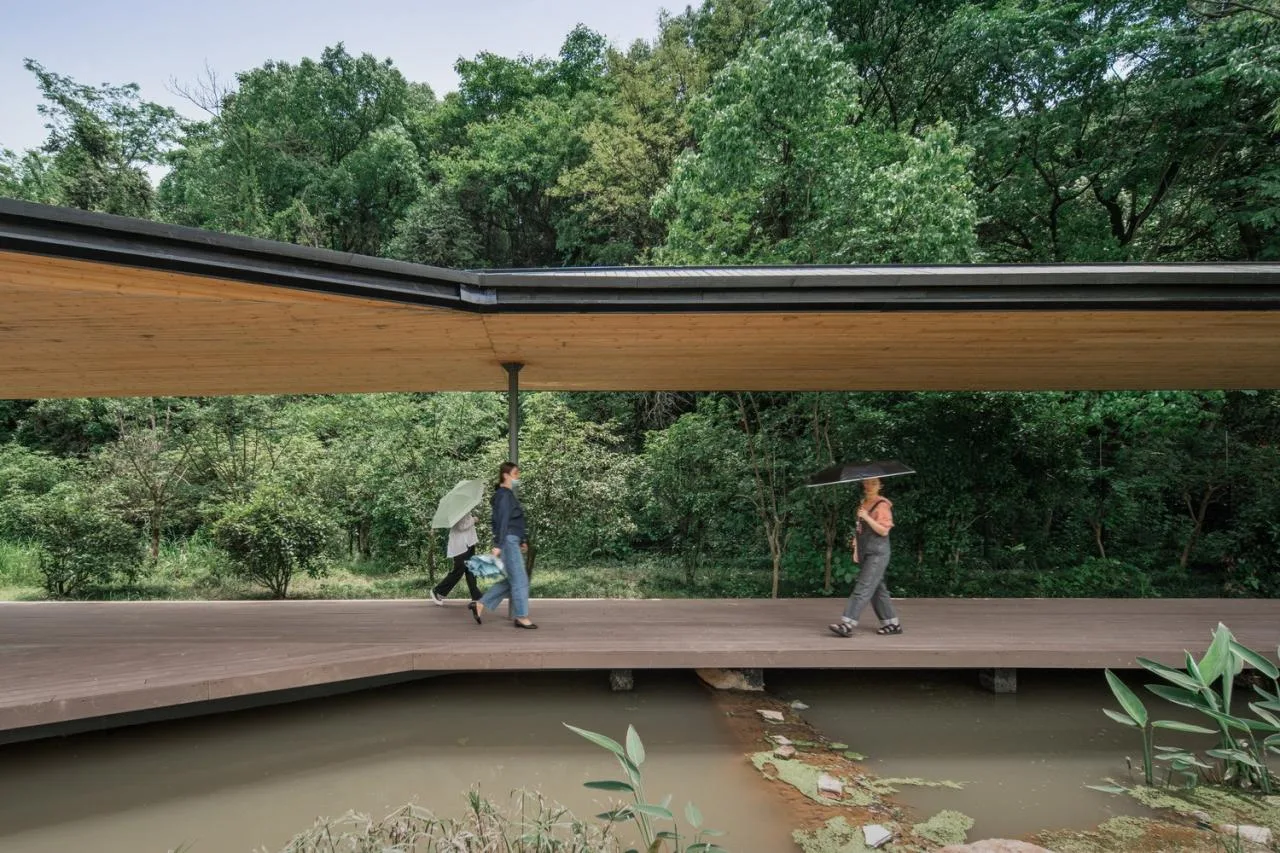
Viewed from the “Sound Valley Cloud Corridor” side, the steel columns of the “Flying Eaves on the Stream” seem to vanish, resembling tree branches. The horizontal “eaves” become a visual focal point, appearing to lightly float over the stream and seamlessly blending with the surrounding landscape.
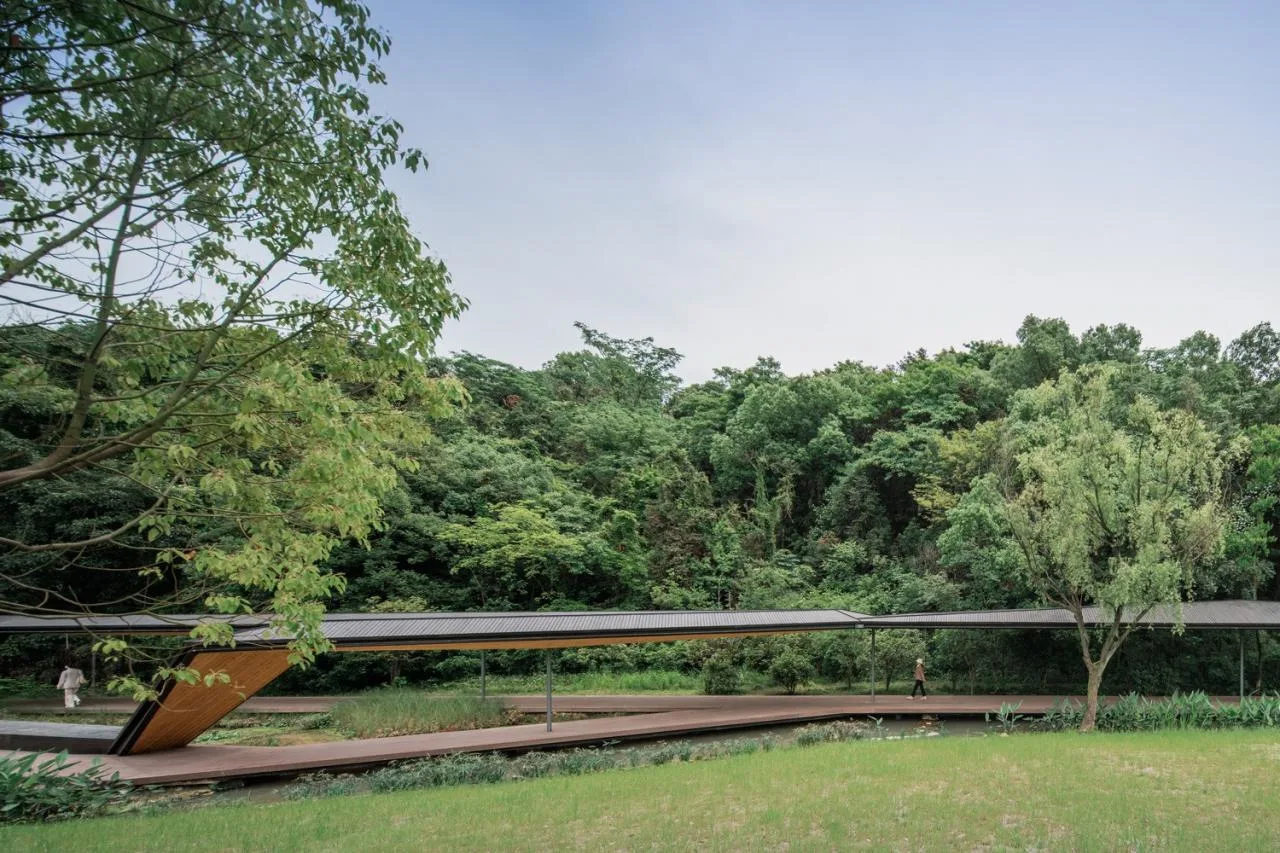
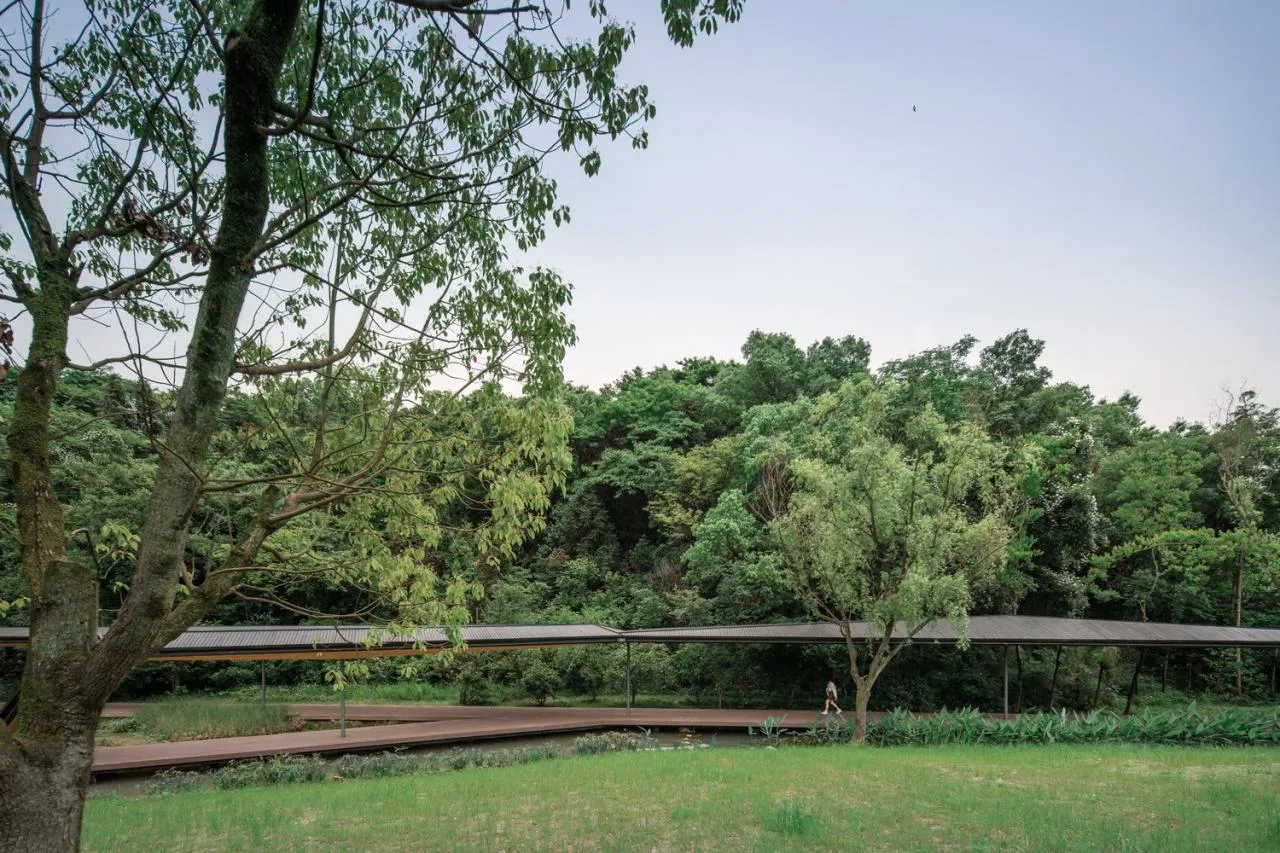
The “eaves” create a visual effect of lightness, as if floating over the stream and blending with the environment.
A wooden gap at the junction of the four-sided pine pyramid ceiling along the “stream eaves” is embedded with LED light strips. These enhance the geometric form and create a smooth, minimalist lighting effect.
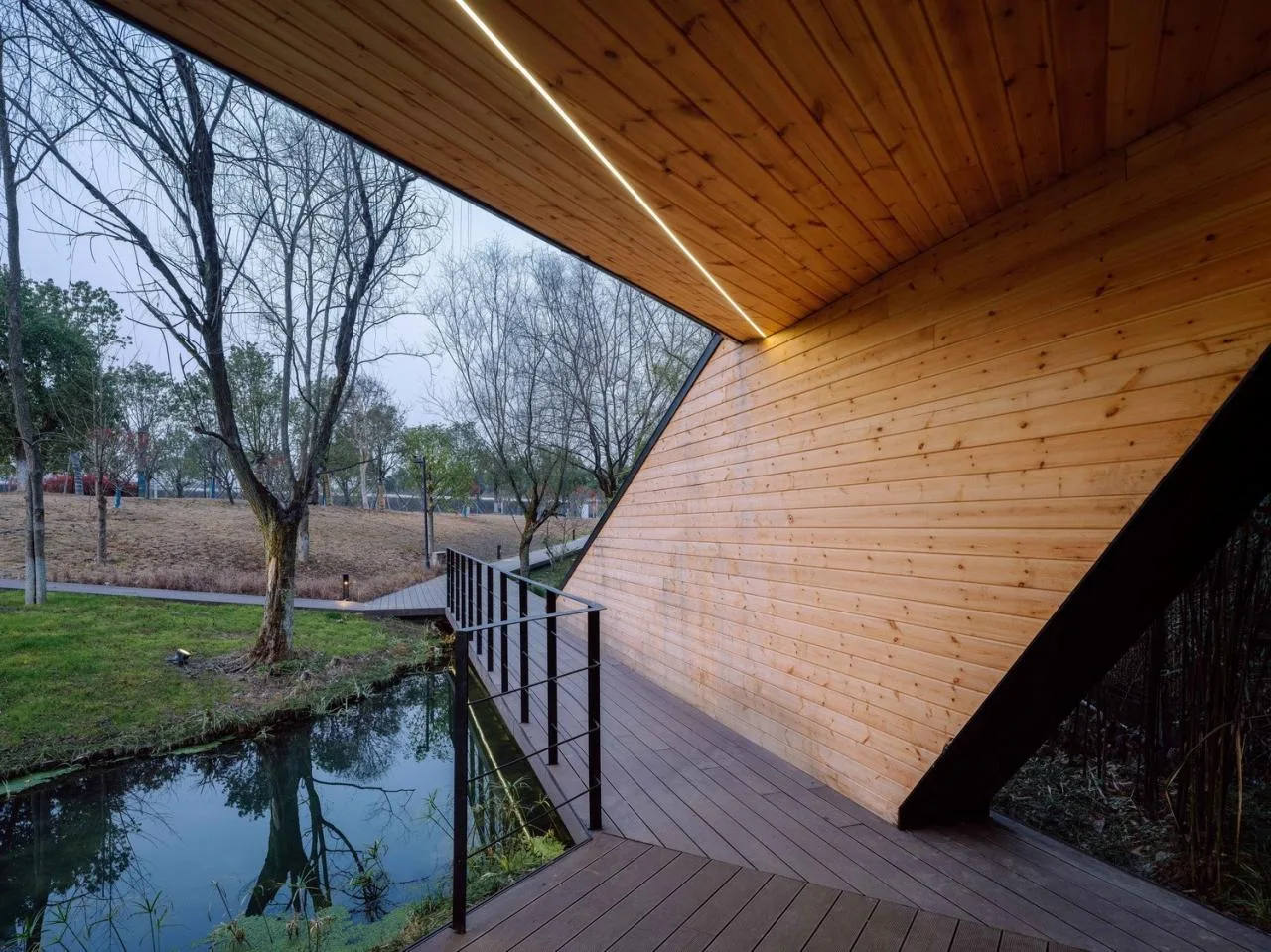
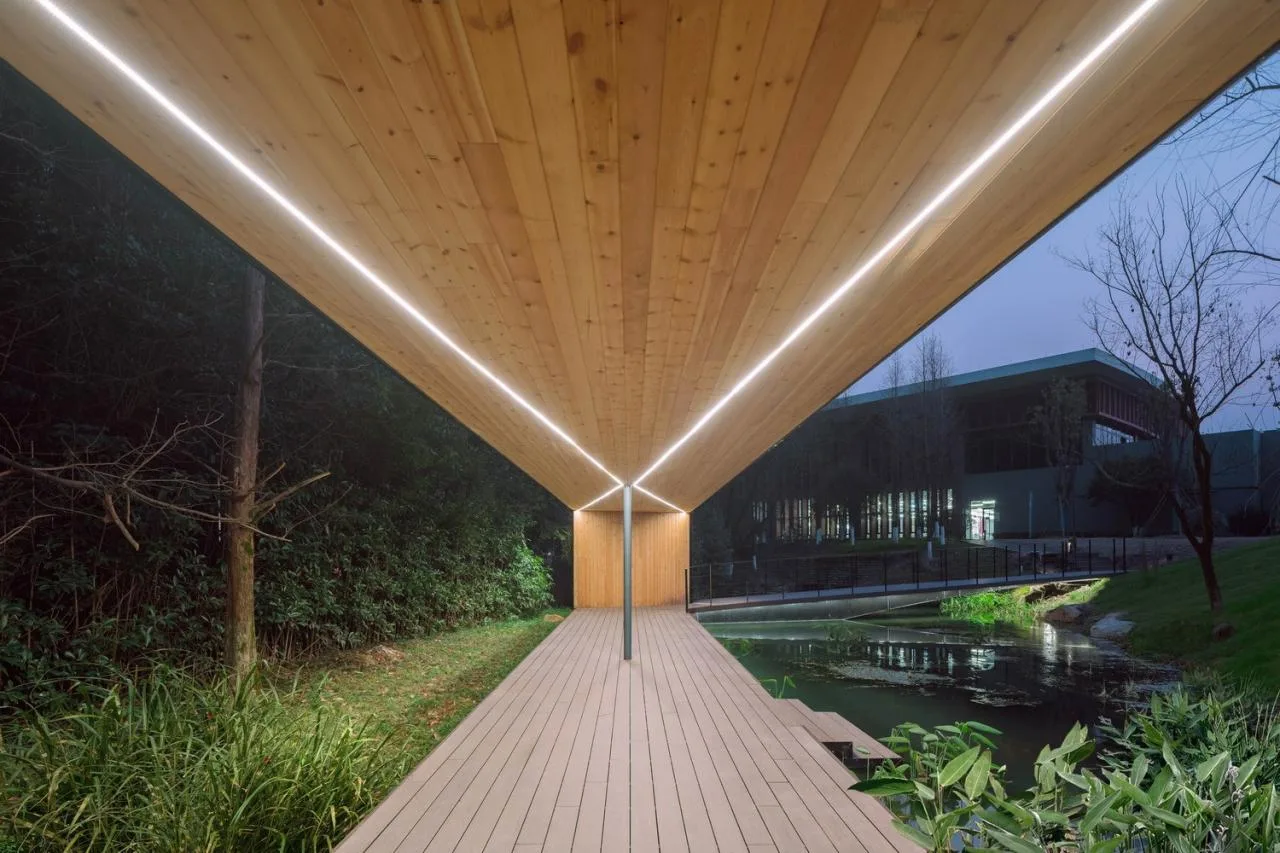
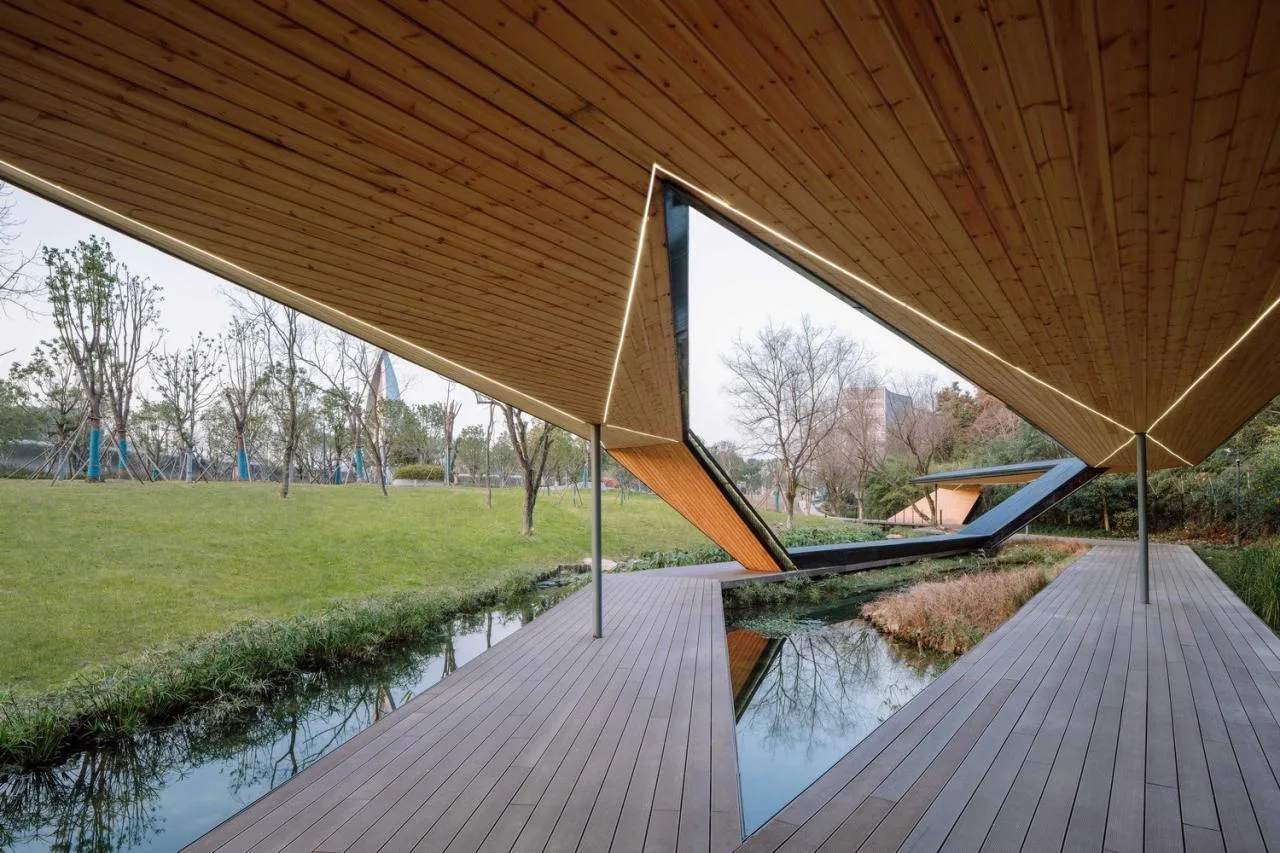
△ Embedded LED strips accentuate the geometry of the ceiling panels
At night, these lights illuminate the ceiling and pillars, resembling umbrella ribs that fade into the darkness. The illuminated roof edges trace the path for pedestrians.
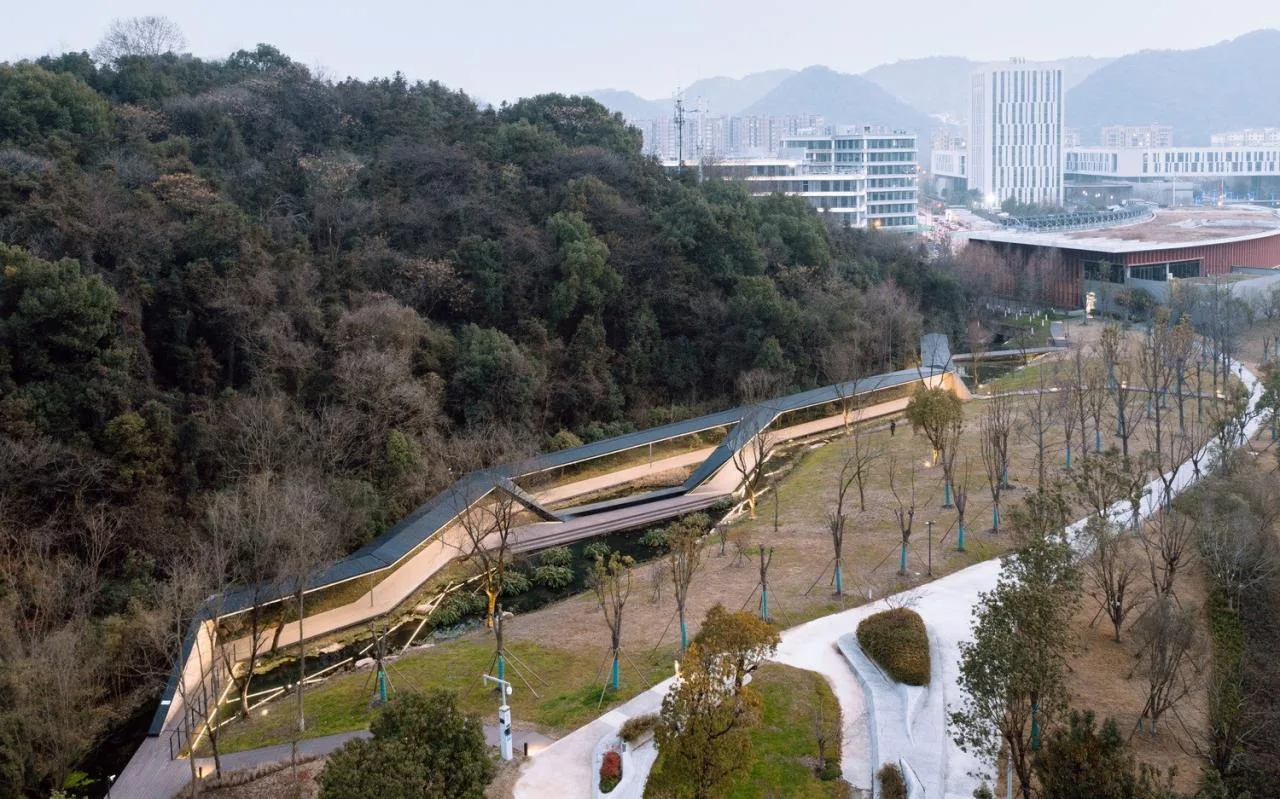
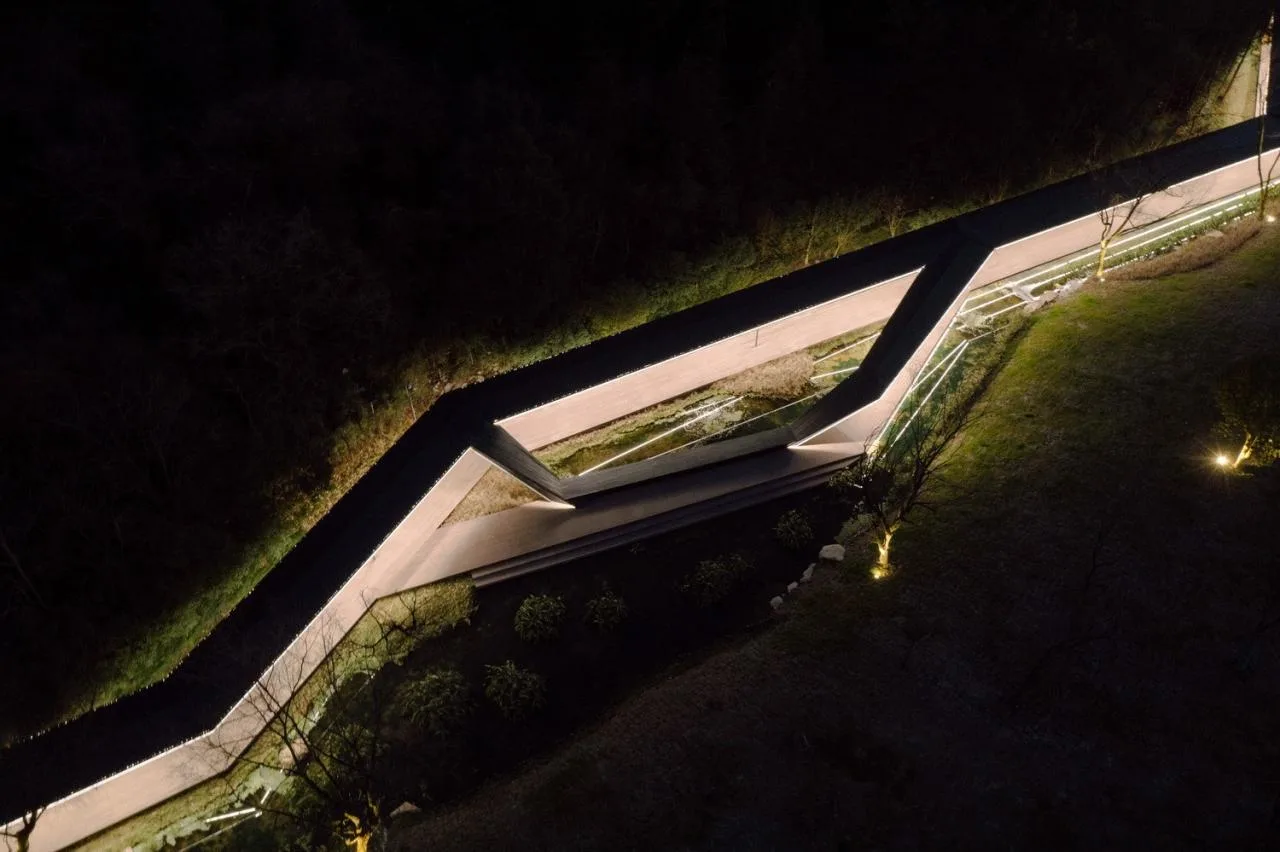
Unlike the permeable “Flying Eaves,” the “Sound Valley Cloud Corridor” functions as a screen for sound insulation and soil retention. It adapts to the uneven height differences on each side with irregular plain concrete segments featuring multiple curved control sections and 600 profiles optimized for acoustic gain. These are arranged every half meter to form a smooth, continuous single-arm cantilever structure.
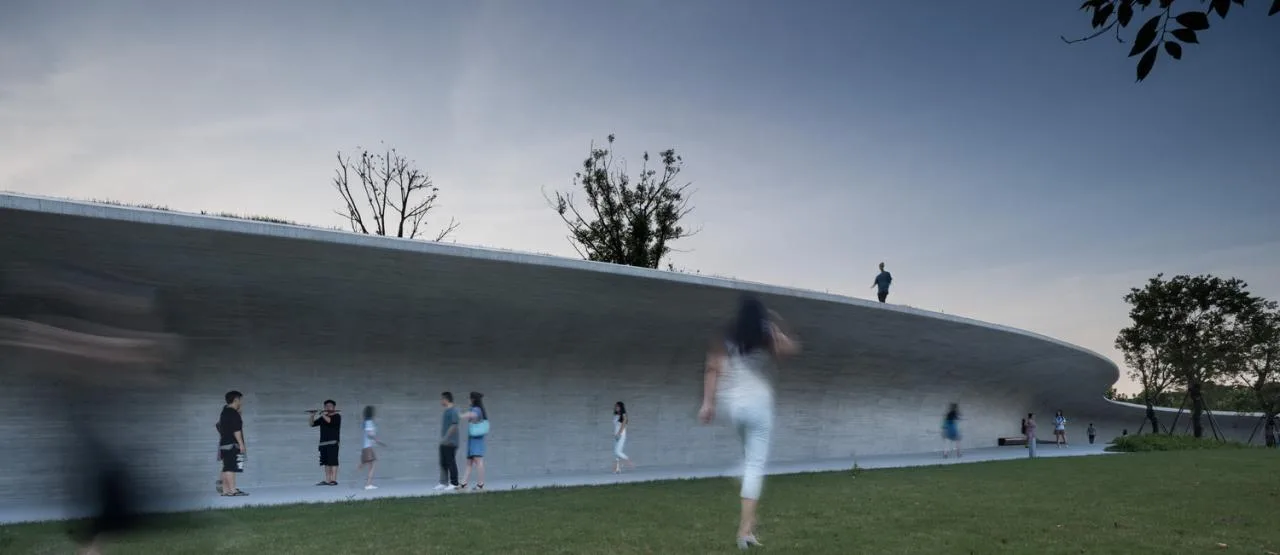
The “Sound Valley Cloud Corridor” serves as a soft, continuous single-arm cantilevered screen.
With campus operations well established, construction of the “Flying Eaves on the Stream” was scheduled during summer breaks to minimize disruption. The steel structures were prefabricated off-site in sections for precision, then transported and assembled on location, shortening construction time. The clearly defined nodes and segmented assembly give the eaves a rigid yet refined appearance, balancing the “Sound Valley Cloud Corridor’s” softness with structural firmness.
2.3 Material Palette
Warm and Cool Tones, Surface and Core
The “Sound Valley Cloud Corridor” features exposed plain concrete, creating a spatial tension, while the “Flying Eaves on the Stream” uses natural wood to harmonize with the mountain setting, offering a warm and inviting atmosphere.
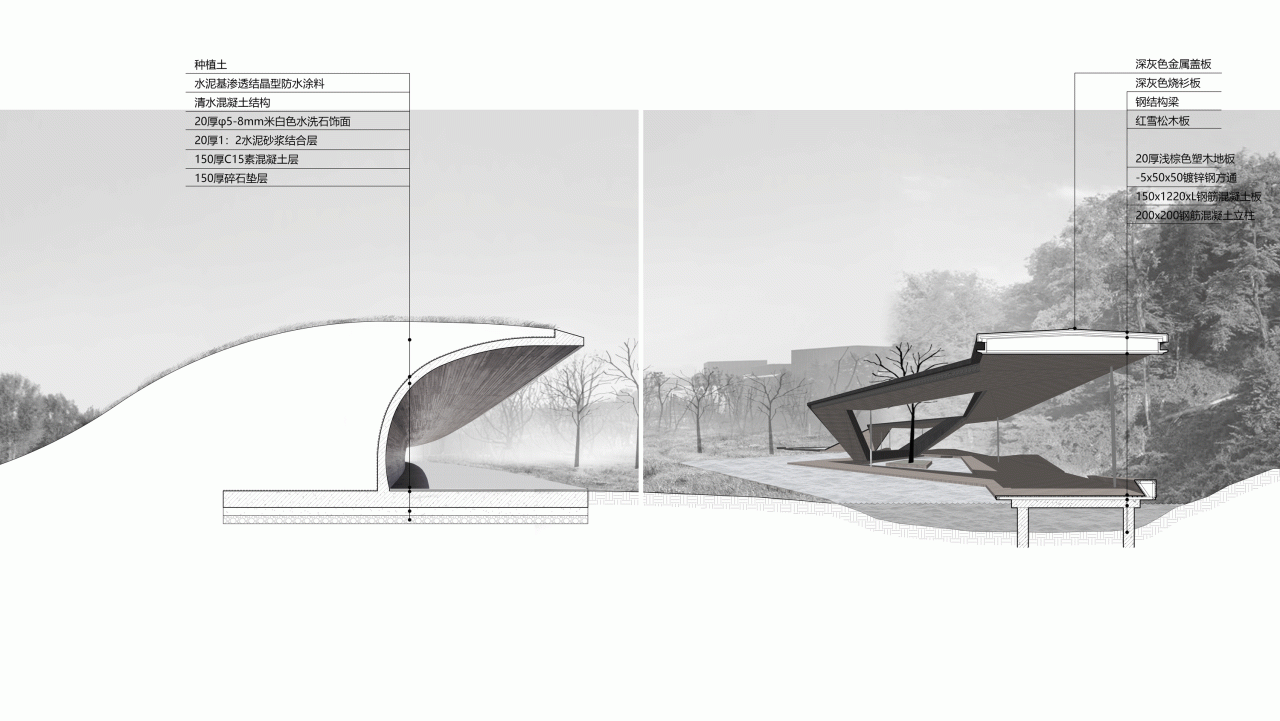
Material analysis comparing the Sound Valley Cloud Corridor with the Flying Eaves on the Stream
Inside the “Sound Valley Cloud Corridor,” wood textures subtly contrast its bold concrete exterior. The formwork supporting the complex curved concrete structure is constructed from 80mm cedar boards and bamboo plywood. After demolding, the wood grain imprint softens the large concrete surfaces, lending the corridor an approachable scale and protective warmth. This interior wood texture contrasts beautifully with the genuine wood grain of the steel-wood folding corridor, enriching the overall ambiance.
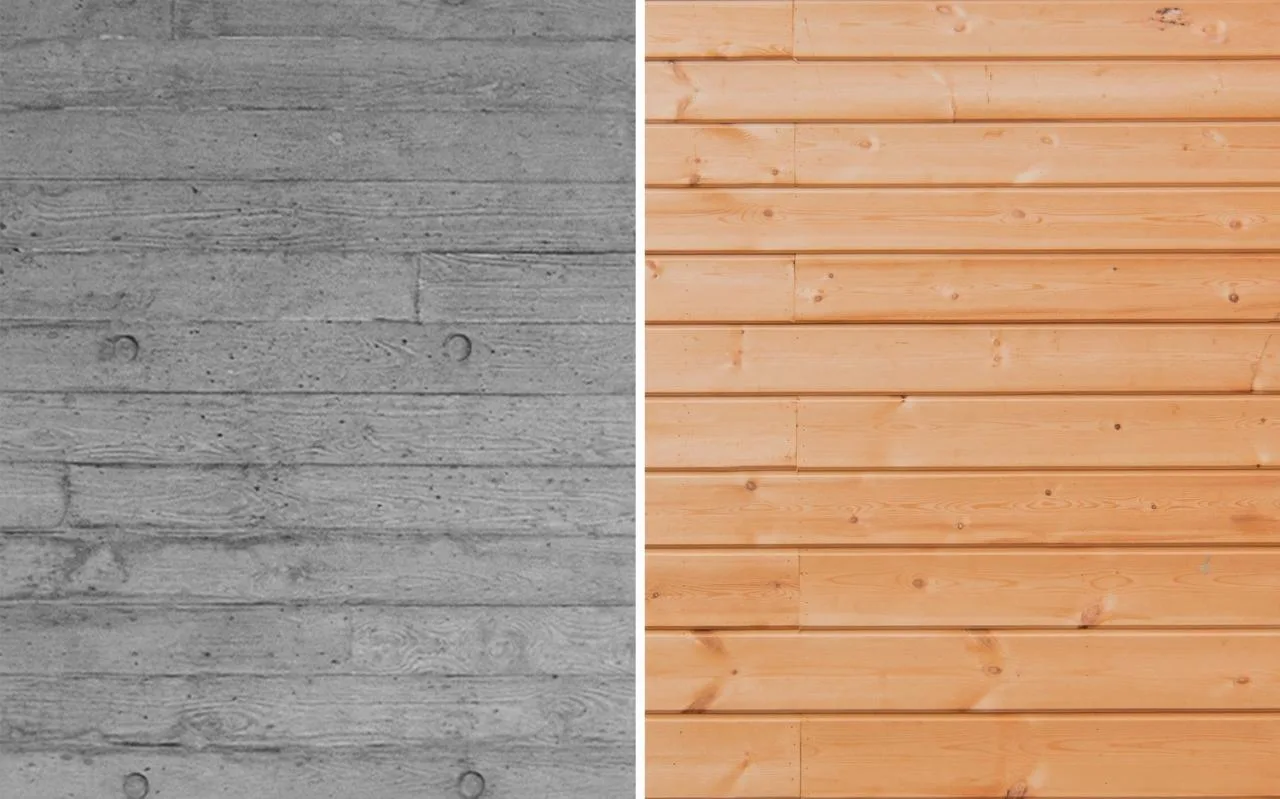
Wooden formwork for the concrete cloud corridor and pine wood panels for the folding corridor
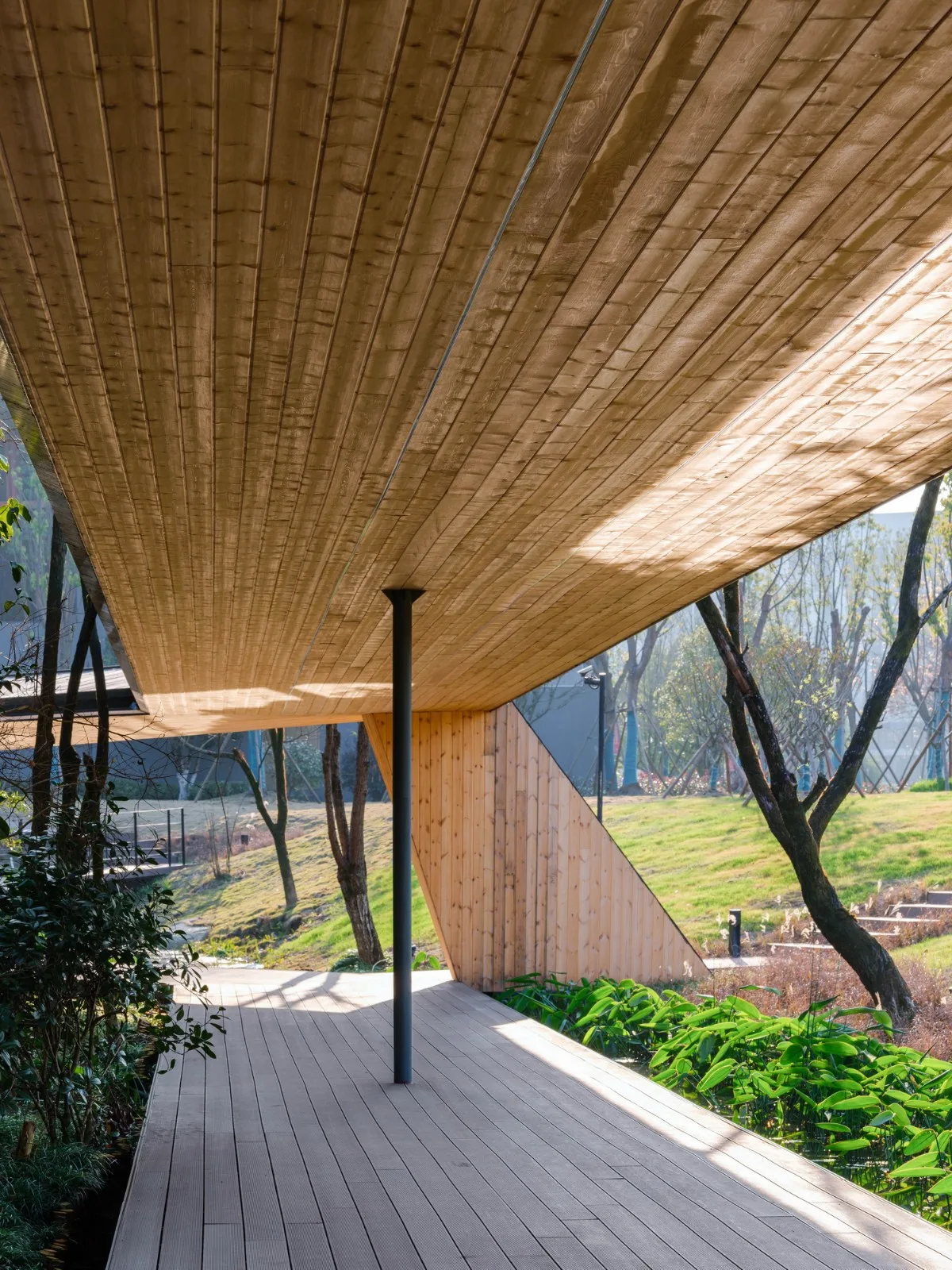
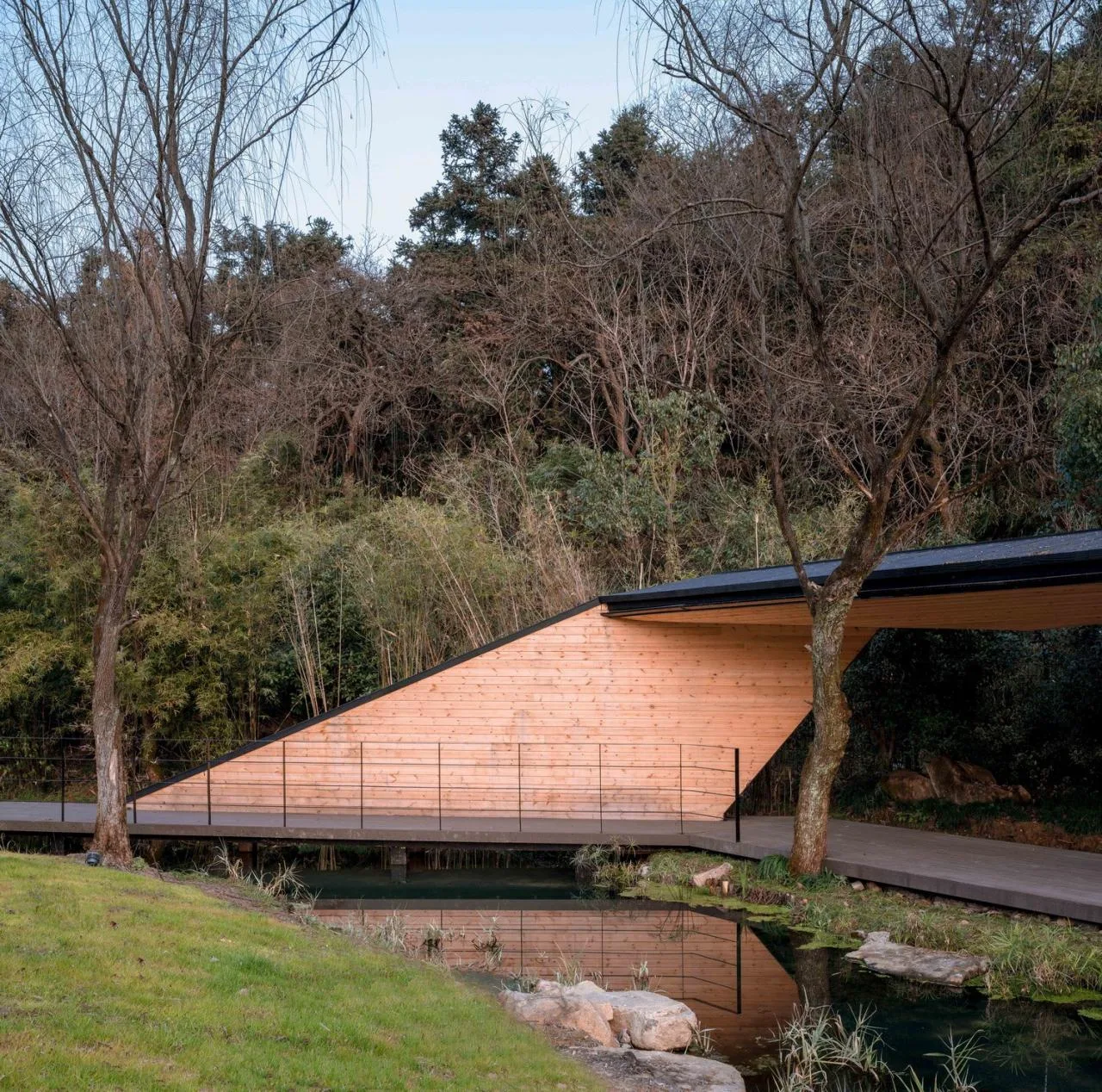
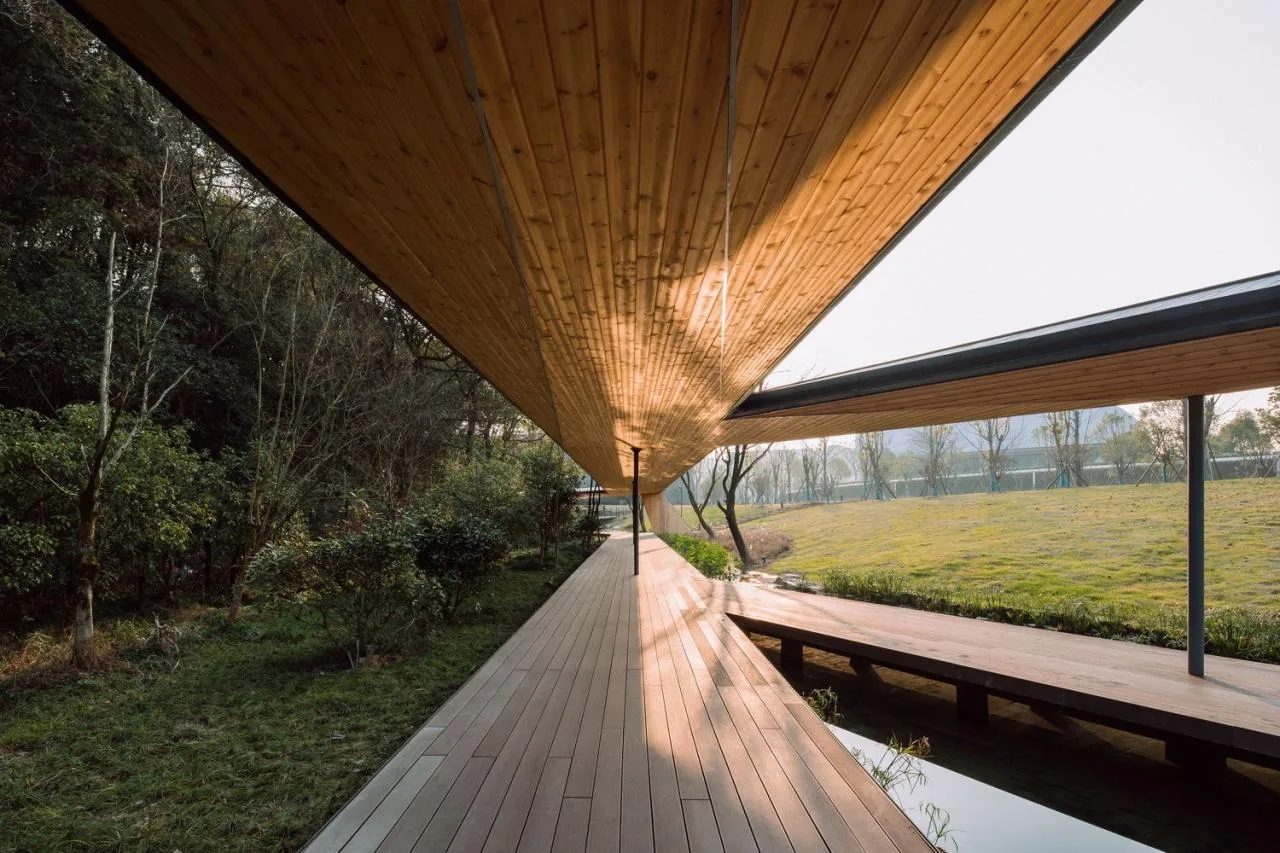
The “Flying Eaves on the Stream” utilizes wood creatively to express distinct forms: the roof and benches outside the eaves use dark, carbonized fir boards treated for corrosion resistance, blending the folding corridor with the mountain forest; meanwhile, the eaves ceiling and buttresses are crafted from natural red cedar, offering warm tones and inviting textures for pedestrian relaxation.
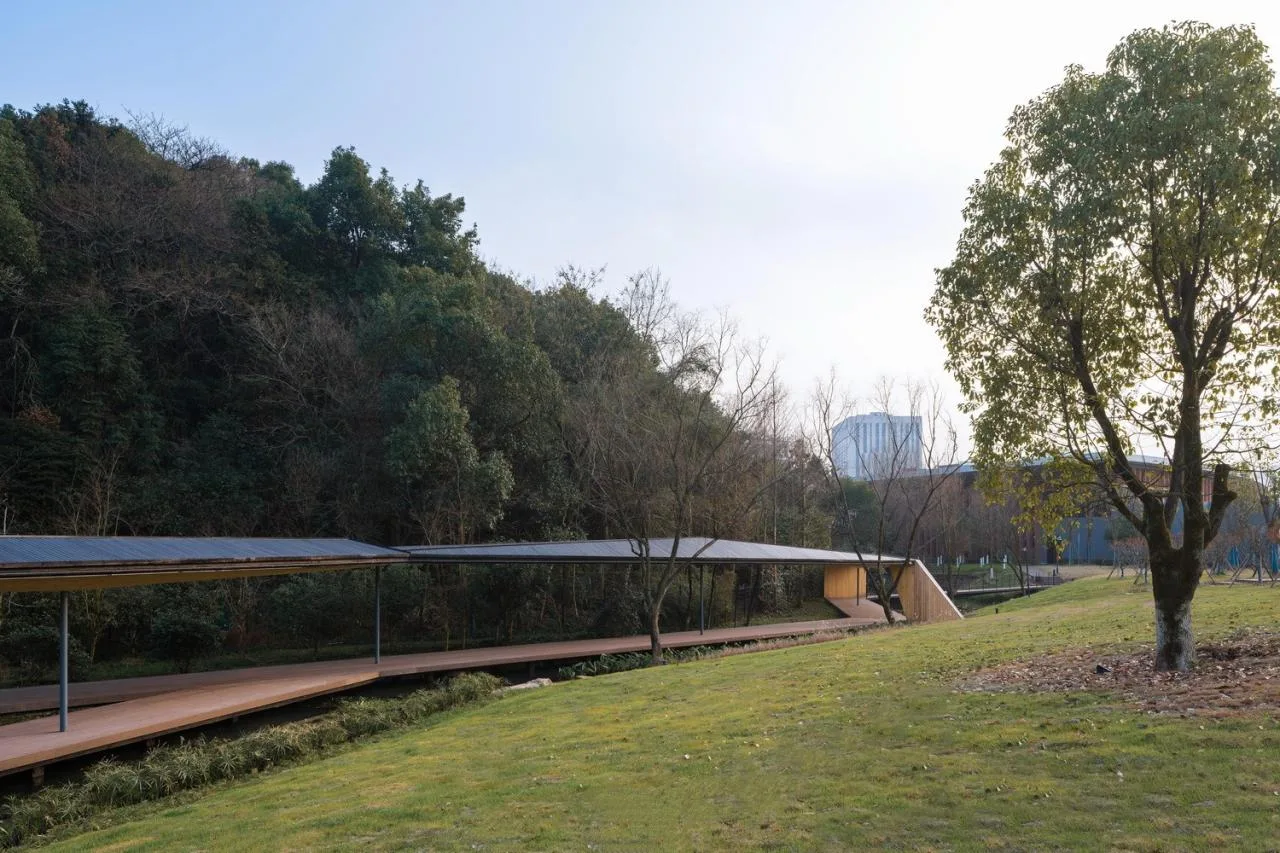
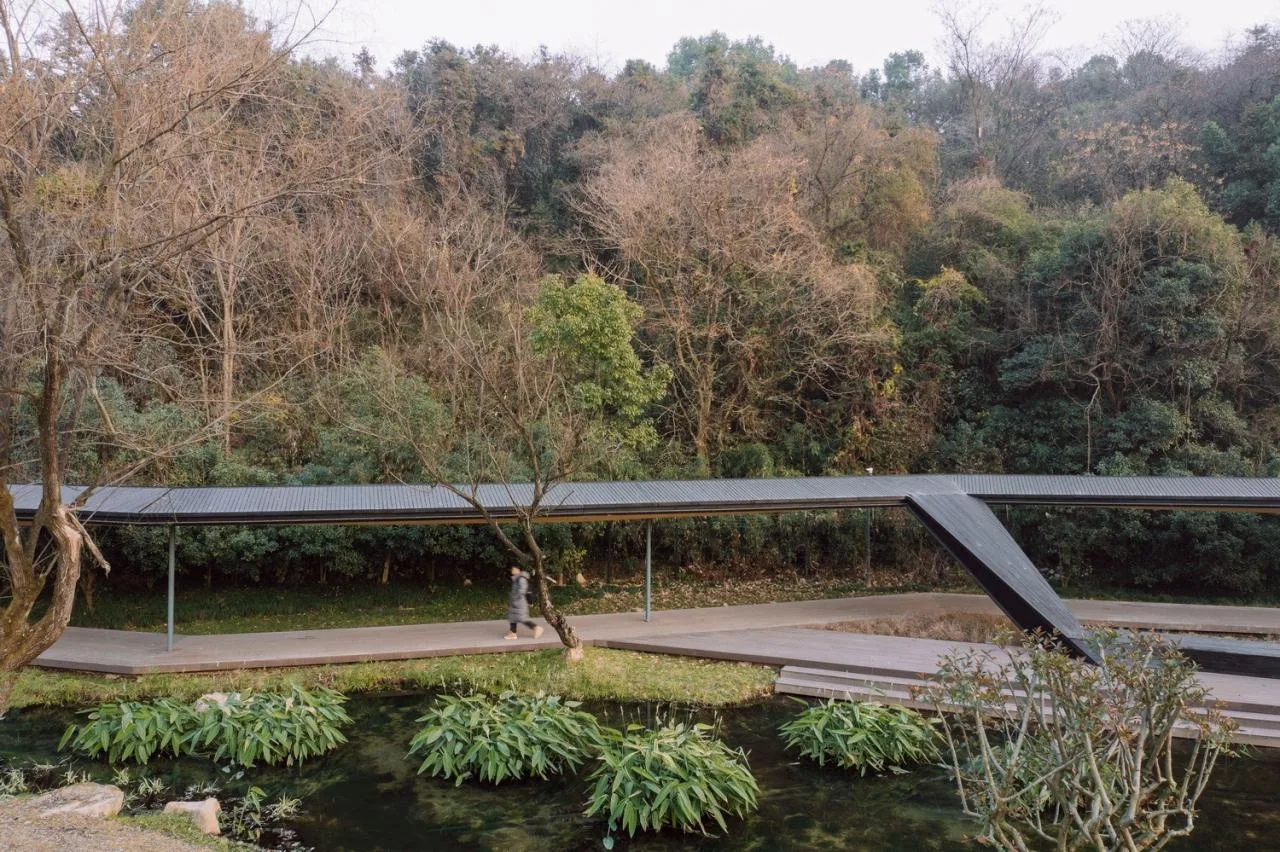
At sunset, the natural red cedar ceiling reflects the stream’s ripples and surrounding plants. The folding corridor transforms into a welcoming leisure space where visitors lean on railings to watch fish, sit on steps, and stroll peacefully. The “Flying Eaves on the Stream” extends a warm invitation to both campus members and the public to engage with artistic activities.
03 Ecology: Sponge Landscape Design
An important ecological node along the campus axis, the “Flying Eaves on the Stream” incorporates a rain garden concept. Preserving the existing water systems, mountain trees, and stream grasses, the design embraces minimal site intervention. This creates a sponge landscape that merges ecological sustainability with landscape artistry and encourages community engagement.
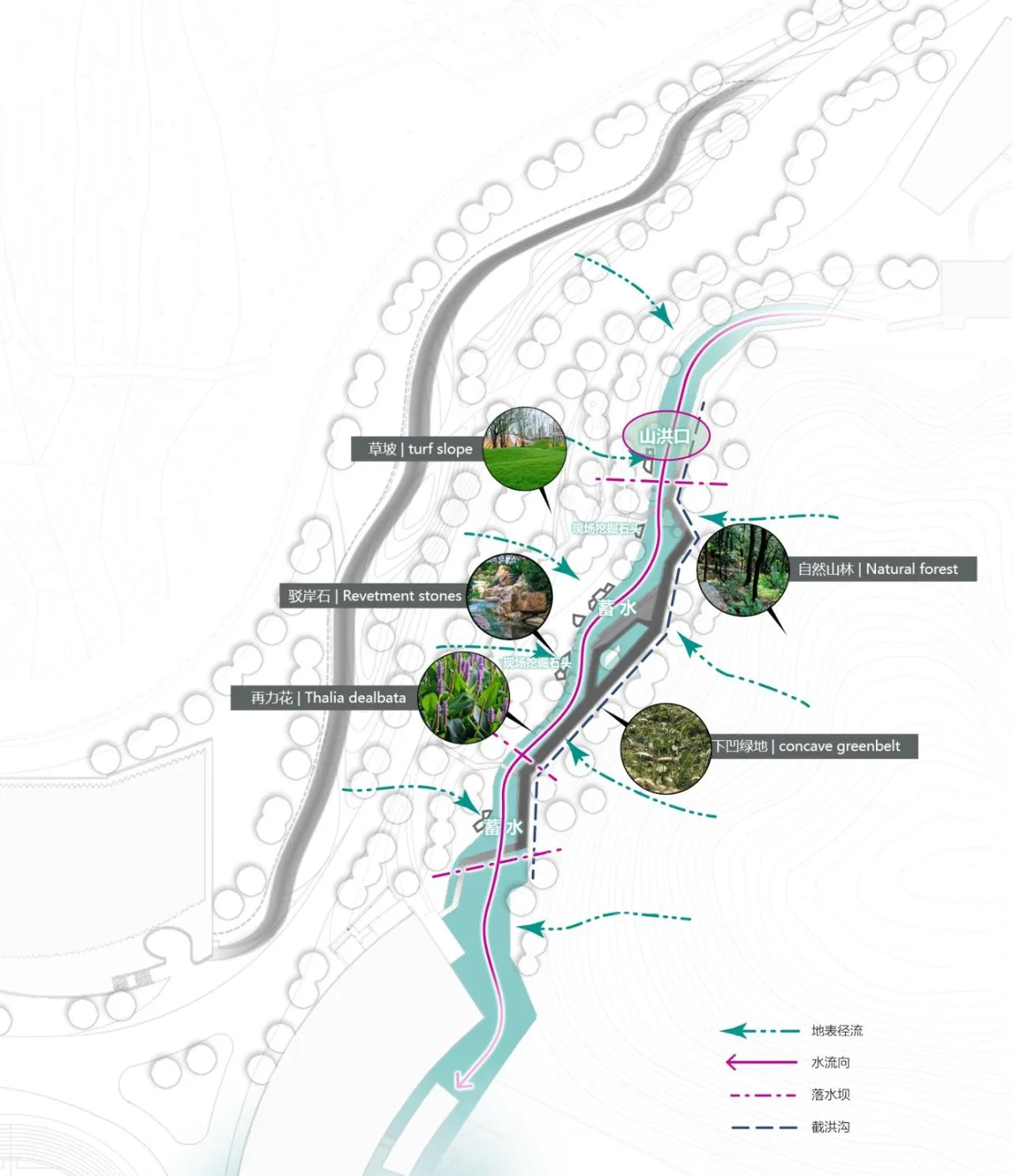
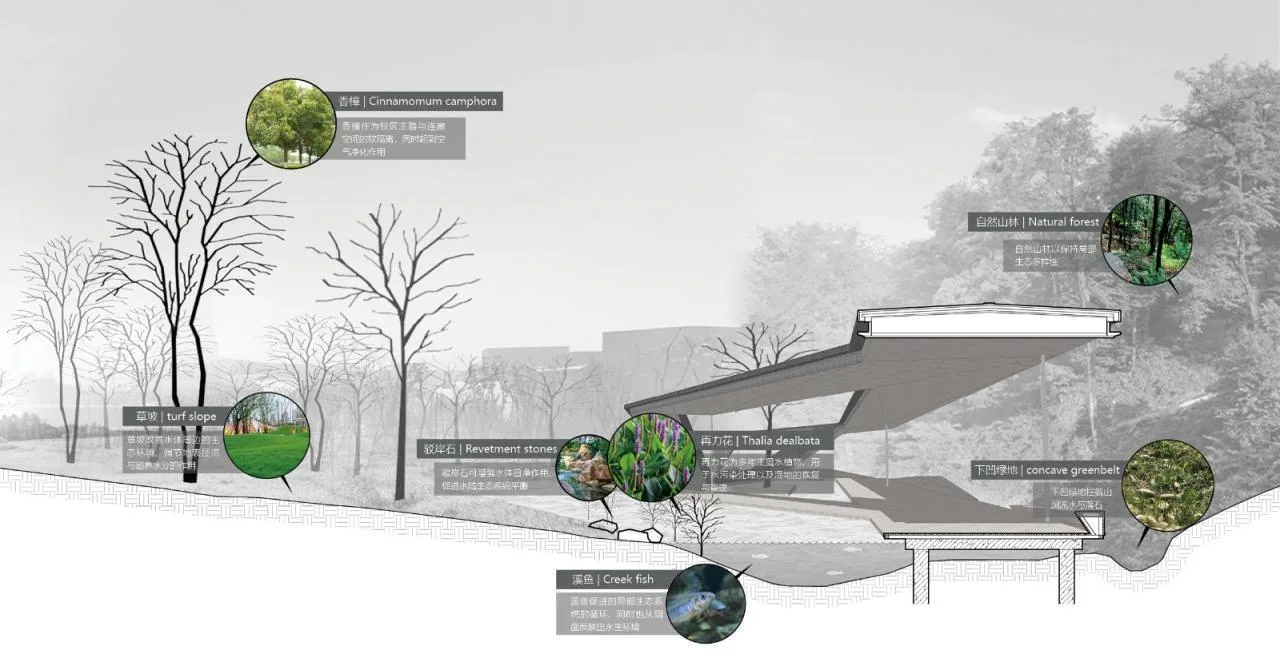
△ Surface runoff channels flowing into streams
The campus stream, roads, and “Sound Valley Cloud Corridor” transition naturally to a dry stream landscape belt through lawns, shrub buffers, and an elevated corridor bridge. Gentle slopes on either side of the folding corridor facilitate water inflow, supporting aquatic plants. Natural precipitation is purified by plants and sand, improving water quality, promoting soil infiltration, conserving groundwater, and sustaining the landscape.
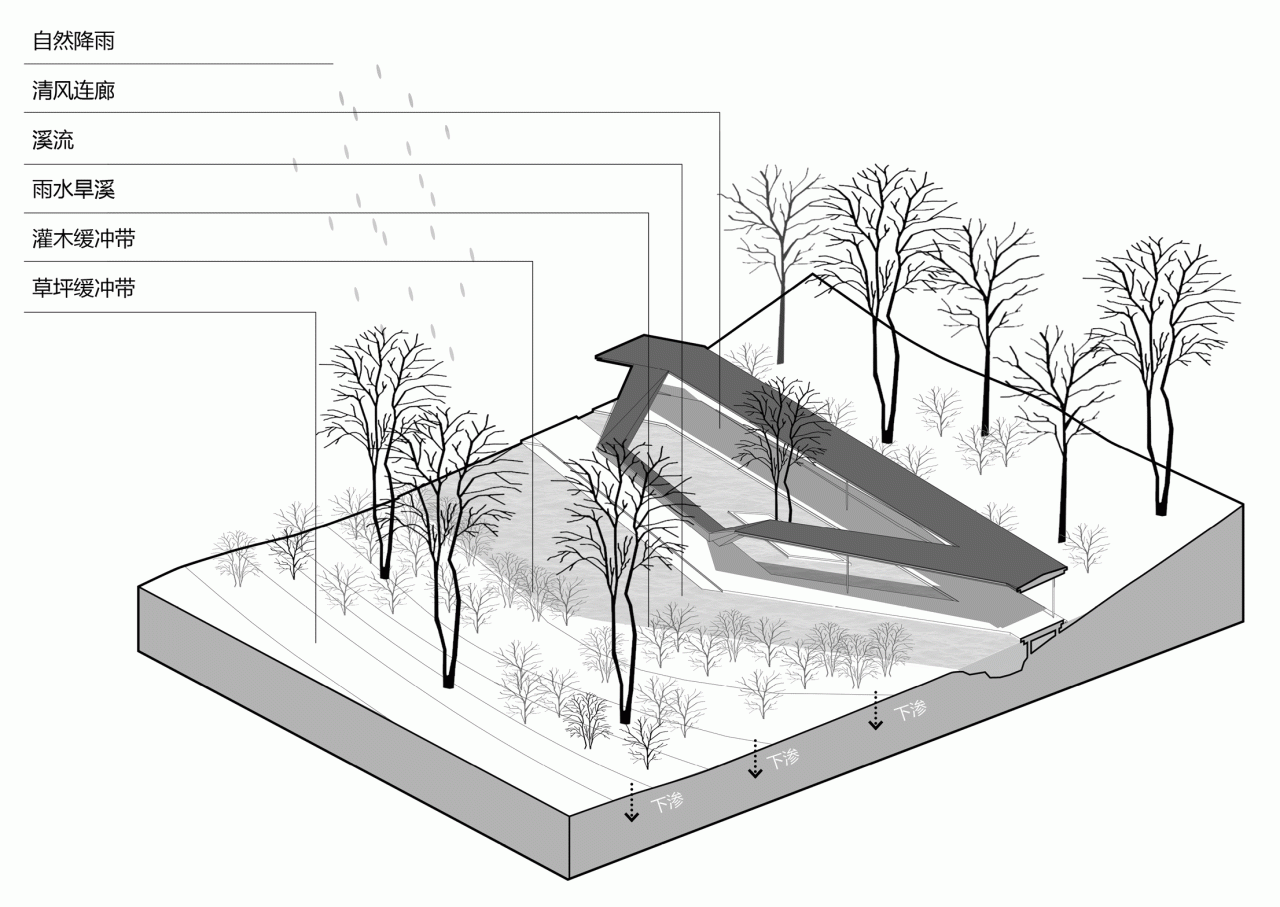
Sponge landscape system design analysis
04 Old Song, New Chapter: Sharing the Campus
The “Flying Eaves on the Stream” represent a new chapter of openness and freedom for the Zhejiang Conservatory of Music’s campus, which had previously reached a design plateau. Enhancing campus infrastructure, serving teachers and students, and integrating natural resources along with seasonal landscapes, this project benefits the public through innovative forms, structures, and materials. It engages in a meaningful east-west dialogue with the existing “Music Valley Cloud Corridor,” completing the linear rest space at the campus’s heart and connecting the northern and southern architectural clusters. The result is a public cultural and artistic space that is open, shared with the city, and harmoniously immersed in nature.
Over the years, the Zhejiang Conservatory of Music has hosted numerous national and provincial music and art events open to the public. On a larger scale, the “Flying Eaves on the Stream” enhance campus infrastructure and the ecological environment by creating a natural, rhythmic corridor that serves diverse public groups. On a smaller ecological scale, it functions as a self-contained resting place supporting biodiversity.
As Hölderlin wrote in The Long View, “Nature is full of the image of time, living and lingering in nature, and time slides rapidly. All of this comes from perfection; therefore, the light from high above shines on humanity, like the flowers blooming beside trees.”
Project Drawings
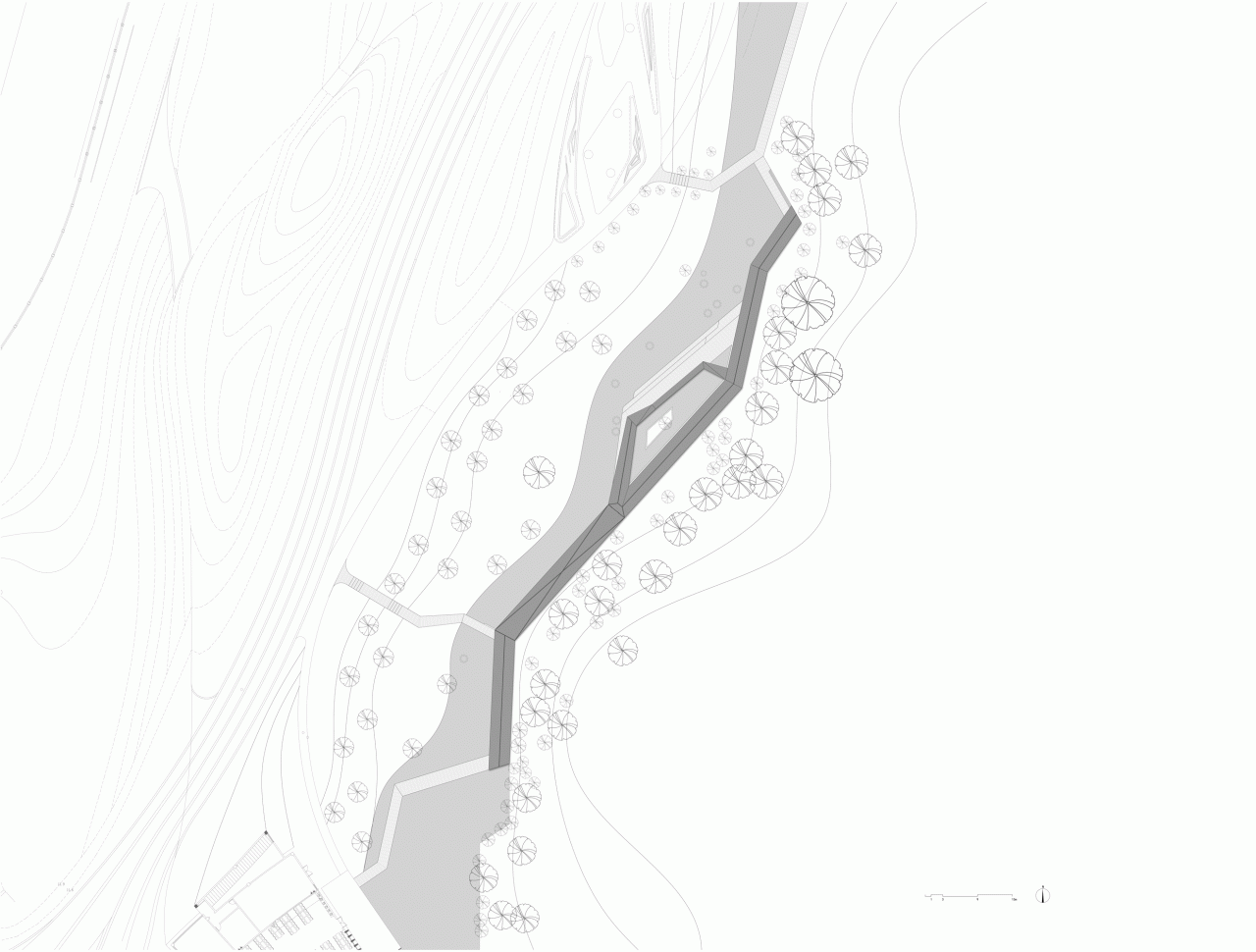
△ General layout plan
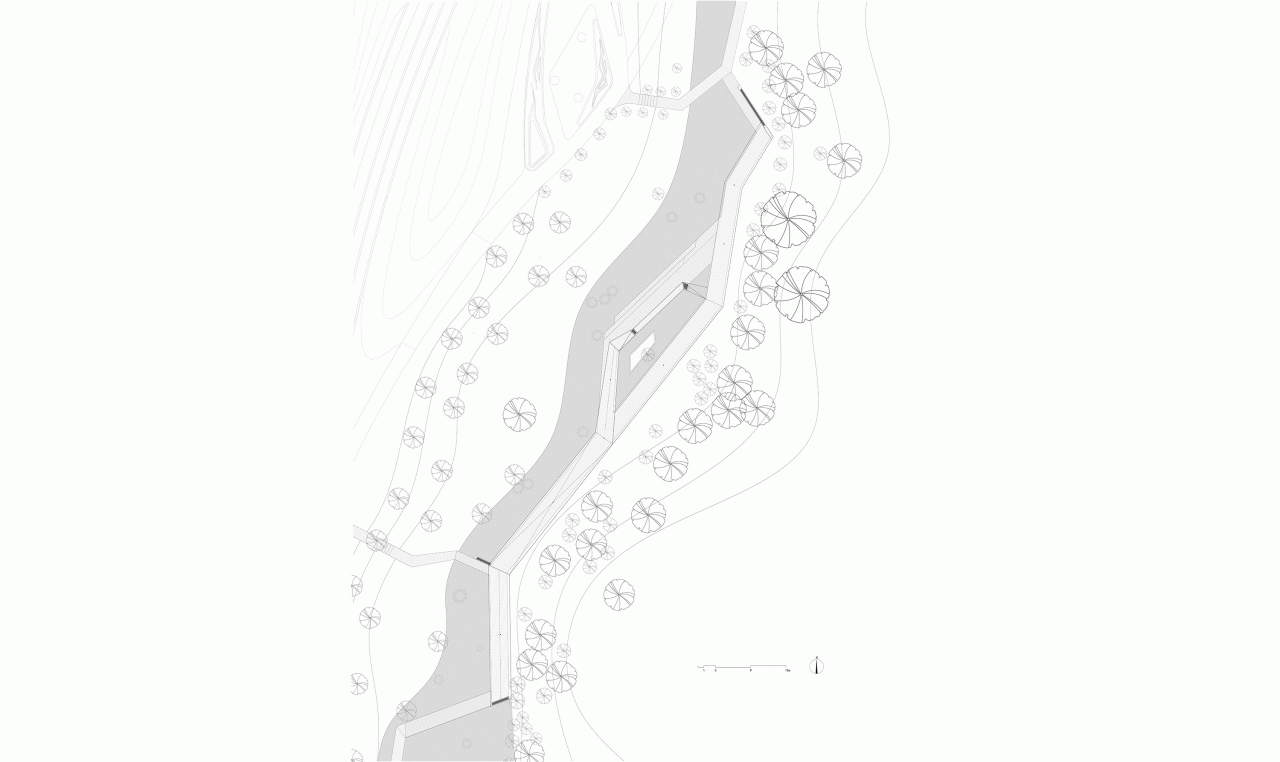
△ Ground floor plan
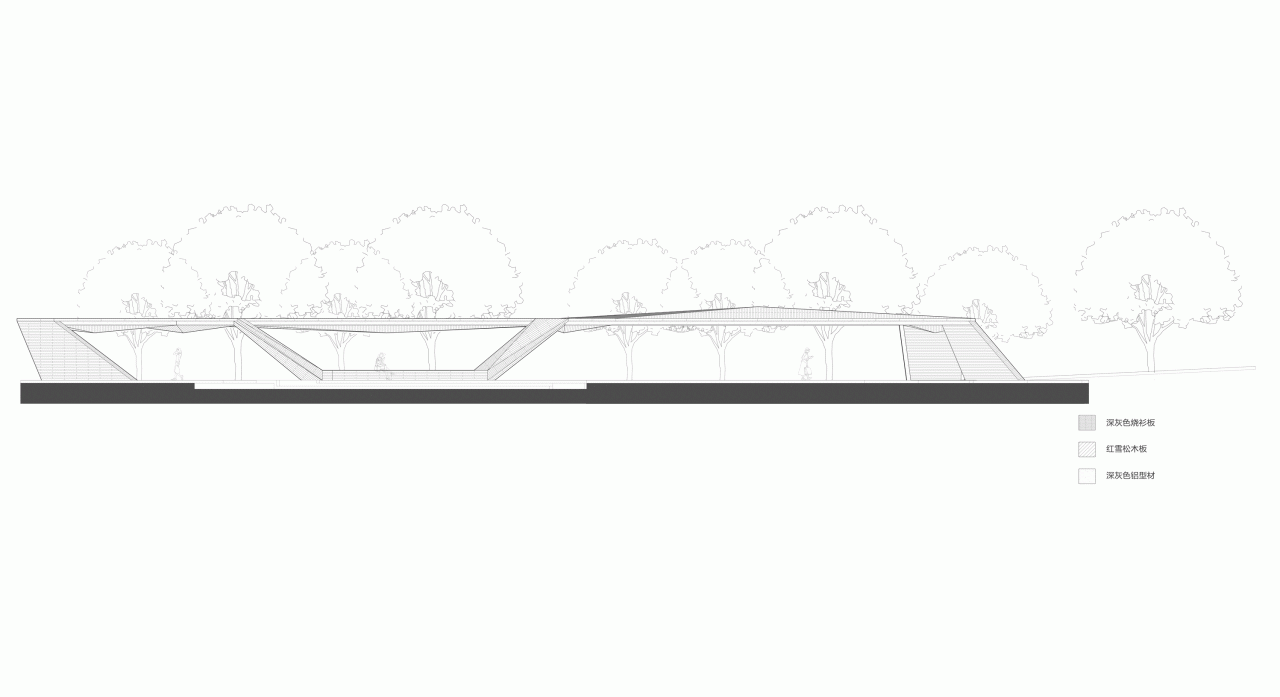
△ Elevation drawing
Project Information
Project Name: Zhejiang Conservatory of Music “Flying Eaves on the Stream”
Location: Hangzhou, Zhejiang
Design Firm: Line+Architectural Firm gad
Lead Architect / Project Creator: Zhu Peidong
Landscape Designer: Li Shangyang
Design Team: Sun Xiaoyu, Zhou Yang (Architecture); Jin Jianbo, Zhang Wenjie, Chi Xiaomei (Landscape)
Building Area: 409 square meters
Design Period: July 2020 – September 2020
Construction Period: April 2021 – September 2021
Client: Zhejiang Conservatory of Music
Structural Engineering: Zhejiang Greentown Architectural Design Co., Ltd
Structural Team: Li Baozhong, Gao Yi
Structure Type: Steel structure
Materials: Deep carbonized burnt cedar boards, anti-corrosion treated red cedar boards
Photography: Zhu Runzi line+, Yao Li















Must log in before commenting!
Sign Up