
(1) Hunan Province BIM Review System
At the beginning of 2019, the Department of Housing and Urban-Rural Development of Hunan Province led the nation in launching BIM review work for engineering construction projects. They completed the initial research and development of the BIM review system. In June 2020, this system was officially launched on the Hunan Province Construction Drawing Management Platform, implementing BIM review in phases and batches.
The development of the Hunan BIM review system has transformed construction drawing reviews from two-dimensional to three-dimensional. It helped establish an early ecosystem for BIM review, increased awareness, and played a crucial role in advancing and upgrading China’s construction drawing review business. The system holds significant promotion and application value.
Currently, the review system offers comprehensive professional auxiliary review functions, highlighted by the following features:
- A standard system based on BIM review technology, model delivery, and data standards that uniformly converts models from various mainstream BIM software into XDB format for review.
- A domain rule library developed using structured natural language, paired with an intelligent review engine.
- Diverse review tools including web and mobile browsing, 2D and 3D linkage, automatic and manual review, and annotation, all supporting intelligent BIM model review.
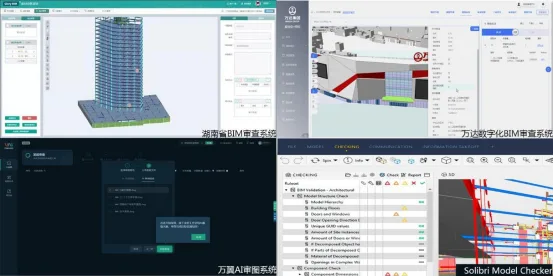
Figure 1: Existing BIM Review System
(2) Wanda Digital Intelligent Review System
Since 2015, Wanda has pursued a strategy for industrial digital upgrading and established a BIM product system with independent intellectual property rights. Their goal has been to promote BIM positive design to ensure design compliance, model legality, and data accuracy.
In 2019, Wanda officially launched the “Wanda Digital Intelligent Review System,” based on BIM positive design achievements. The system’s core development goals include automating review processes, standardizing review methods, and structuring review results. The main purpose is to enhance design review efficiency and ensure quality.
Compared to traditional manual review methods, Wanda’s digital intelligent review system offers numerous advantages:
- Improved efficiency in multi-party collaboration
- An intuitive control interface
- Fast and convenient rule matching
- A clear, efficient review workflow
- Comprehensive coverage of review issues
- Automatic generation of review results
(3) Wanyi AI Drawing Review System
The Wanyi AI Drawing Review System was jointly developed by the Shenzhen Housing and Construction Bureau and Wanyi Technology Co., Ltd. It is an intelligent drawing review platform with high accuracy in recognizing and reviewing design drawings, based on extensive analysis of real project data.
This system assists government agencies, real estate companies, design firms, and drawing review institutions in improving design quality. It boasts a high recognition rate, short review cycles, and comprehensive review content.
Although currently limited to supporting DWG format files, the Wanyi system provides valuable, replicable experience for reforming construction drawing review systems, carrying significant implications for the industry.
(4) Solibri Model Checker
Solibri Model Checker, a pioneer in model quality inspection, is Solibri’s core product. It primarily uses IFC standards for data exchange and supports various inspections and analyses, including:
- Integrity checks of building information models
- Collaborative verification of modeling quality
- Physical safety analysis
The software also features a rule engine built with Java, enabling users to create custom rules for model review tailored to their specific needs.
Other notable BIM review systems include Guanglian Da BIM Review Software, Hongye Technology BIM Review Software, and Luban BIM Software. As BIM review systems continue to develop, design document reviews have gradually shifted from 2D to 3D, becoming more automated and refined.
This evolution has helped reduce the workload of drawing reviews, ensured architectural design quality, advanced construction industry informatization, and extended BIM technology throughout the entire lifecycle of building design.
Article by Zhang Xiaoyan (Qingdao University of Technology)
For learning and communication purposes only. Copyright belongs to the original author. If any infringement occurs, please contact us for removal.
















Must log in before commenting!
Sign Up