
Autodesk offers comprehensive BIM solutions tailored for architectural design, construction, and various other industries. These solutions empower users with foresight throughout the entire project lifecycle, significantly enhancing work efficiency, minimizing project risks, and improving management practices. The main Autodesk products are illustrated in the image below.
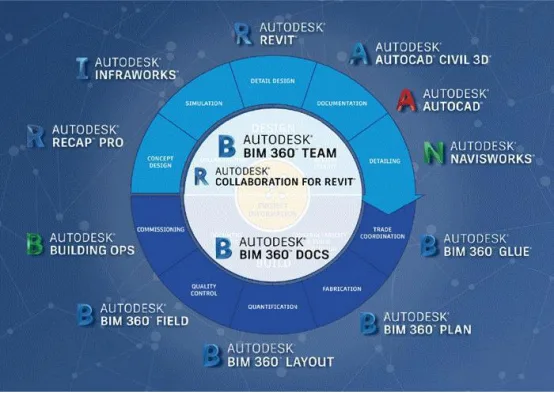
During the design phase of the engineering lifecycle, different Autodesk tools serve specific purposes: Infraworks supports preliminary scheme design, Revit assists with both preliminary and construction drawing design for building structures and other specialties, Civil3D is used for road construction drawings, Navisworks enables clash detection and coordination management, and the BIM360 series handles engineering data management.
Advantages of the Autodesk Platform
1) The model is dynamically linked with information, so any changes to data automatically update the model and vice versa, greatly reducing errors.
2) The platform offers powerful family creation tools, allowing users to customize various family types to meet their specific requirements.
3) Autodesk’s product suite covers multiple stages of the project lifecycle, enabling precise information transfer throughout.
4) It features a rich set of detailed design tools that can automatically generate component lists, with database completeness directly enhancing modeling accuracy.
5) The 3D visualization capabilities are robust, allowing timely detection of design errors through 3D inspections. Additionally, the automatic clash detection tool is invaluable for complex tasks like pipe layout.
Disadvantages of the Autodesk Platform
1) Revit’s design approach differs significantly from traditional 2D AutoCAD software, requiring designers to adapt and abandon long-standing drawing habits, which poses a challenge when promoting 3D design adoption.
2) As a foreign company, Autodesk adheres to the US-based IFC data standard, which differs from domestic standards, potentially leading to compatibility issues.
3) Compared to specialized 3D modeling software, Revit lacks advanced rendering functions and depends on external software for producing renderings.
4) The limited variety of built-in primitive families necessitates ongoing development and customization by users, increasing their workload.
5) Revit focuses primarily on construction drawings and quantity takeoffs, with simple early-stage modeling but less convenient operations when inputting detailed information in later stages.













Must log in before commenting!
Sign Up