
Autodesk, the American software company, continues to be highly favored across various industries in China. Thanks to its extensive user base and the user-friendly interface of its CAD software, Autodesk holds a significant market share in China, making the company well-known in the region.

Revit, a software in the BIM (Building Information Modeling) series, is tailored for professionals in architecture, structural engineering, and equipment design. Since the 2014 version, these three formerly separate software modules have been integrated into a single Revit platform. Autodesk’s AutoCAD software also enjoys widespread use in China’s engineering sector, maintaining a substantial share of the market. Revit’s intuitive interface and availability of a trial version for beginners contribute to its status as the most widely adopted BIM software today.
Introduction to Revit Conceptual Mass
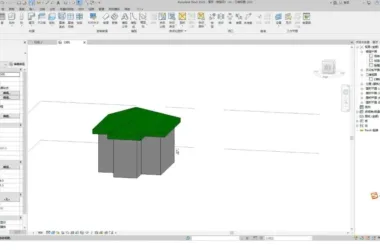
During the early design phase of construction projects, designers often develop and communicate their ideas through 2D sketches or 3D models. However, these methods can lack clarity and flexibility in conveying design intent. Revit’s conceptual mass tool offers a solution by providing designers with a dynamic platform to quickly and intuitively visualize complex structures. This tool supports flexible modifications and adjustments, enhancing the design process. The most commonly used type is the loadable mass family, which features the following advantages:
① Creating mass families is simpler compared to standard family components. This tool is primarily used for rapid development of 3D conceptual models and presentations;
② The creation process starts with establishing reference points, followed by building the model using the mass family editor, involving fewer parameters;
③ It addresses Revit’s limitations in modeling irregular surface components by integrating points, lines, and surfaces, enabling the generation of any complex component model.













Must log in before commenting!
Sign Up