
The owner serves as the primary entity in the project. When considering BIM application methods, a theoretical analysis based on traditional projects can be applied. This approach involves two main aspects: self-construction by the owner and consulting assistance, forming an owner-driven EPC project BIM technology management model. Both self-built and consulting-assisted models can be implemented throughout the entire project lifecycle. However, given the owner’s control role in the EPC general contracting model, daily management of EPC projects by the owner differs from traditional methods. Management begins with in-depth early-stage project research, followed by overall project control through contracts and other mechanisms. Practically, if the owner wishes to utilize BIM technology for EPC project information management, contracts must mandate that the general contractor apply BIM technology. This approach is defined as “owner-requested, general contractor-driven.” Below is a summary of the three BIM application management modes discussed.
1. Owner-Driven, Owner-Built Model
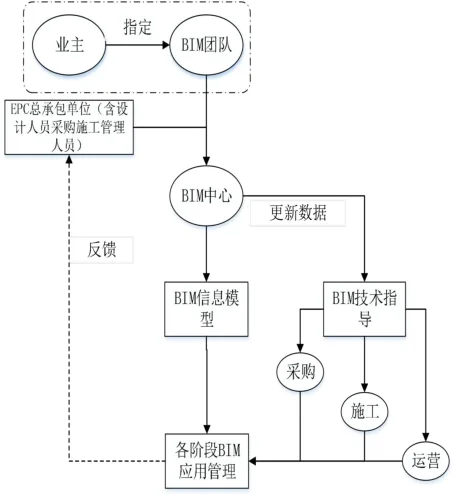
The owner-built model involves the establishment of a BIM center jointly operated by the owner’s dedicated BIM team and relevant personnel from the EPC general contractor, including design, procurement, and construction management staff. The BIM center acts as a hub for coordination, information output, and feedback. As illustrated in Figure 1, this self-built model follows a cyclic control process. Initially, a BIM information model is created through the BIM center and applied to various stages of project management. When issues arise during procurement, construction, or operation management, they are reported back to the BIM application center. After coordination and decision-making, the BIM information model is updated, and BIM technology guidance is promptly reapplied.
2. Owner-Driven, Consulting-Assisted Model
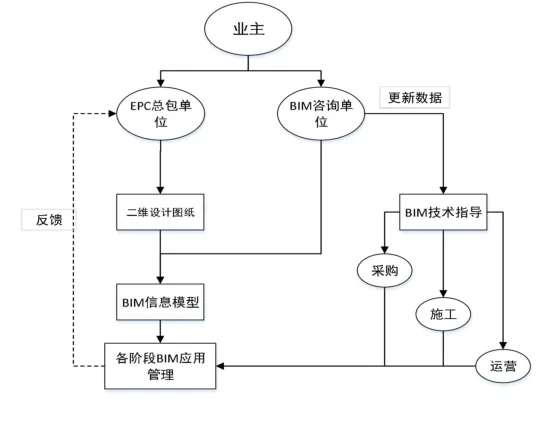
In the owner-driven, consulting-assisted model, the owner signs a contract with a BIM consulting firm to oversee BIM applications. Figure 2 depicts this consulting assistance model, which also follows a cyclic control approach. The EPC general contractor provides 2D design drawings, upon which the BIM consulting unit creates a 3D BIM information model. This model supports BIM applications throughout the project stages. When procurement, construction, or operation and maintenance issues occur, timely feedback is provided to the EPC general contractor. The 2D drawings and BIM information model are then updated accordingly, and BIM technology guidance is reapplied as needed.
3. Owner-Requested, EPC General Contractor-Driven Model
This model requires the EPC general contractor to lead BIM application efforts at the owner’s request. While similar to a general contractor-driven approach, it differs in that the owner’s management oversees the BIM application process. The general contractor typically drives internal project cycles but does not extend to operation and maintenance management, nor is it subject to owner control. Here, the general contractor’s BIM use must meet the owner’s specific requirements, including extending BIM application through operation and maintenance stages.
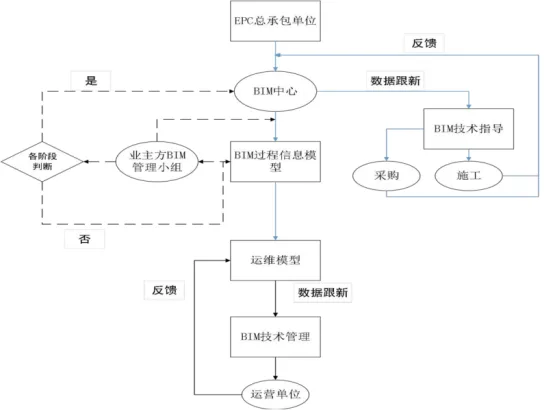
Figure 3 illustrates this model. The BIM center is staffed by personnel from the EPC general contractor, generating the BIM process information model. The owner’s BIM technology management team includes BIM specialists and owner representatives familiar with on-site conditions. In the flowchart, the blue solid arrows represent BIM application within the EPC general contractor, while black dashed arrows indicate owner control over BIM application. The black solid arrows show the flow into operation and maintenance management. Each phase involves cyclical management, with operation and maintenance beginning only after the completion of the first two phases. Through oversight by the owner’s BIM management team, BIM application by the EPC general contractor is controlled at every stage.
















Must log in before commenting!
Sign Up