
The Ningbo City Exhibition Center project, completed and inaugurated in May 2019, has garnered widespread acclaim across various sectors. It has since become one of Ningbo’s most iconic buildings. The integration of BIM technology during the renovation earned the Science and Technology Innovation Achievement Award in the building decoration industry. This project’s successful application of BIM technology has been validated and recognized, providing valuable experience for constructing irregular building curtain walls and guiding enterprise research and development in BIM technology. The project demonstrates a high degree of alignment between the digital renderings and the actual site, as illustrated below.
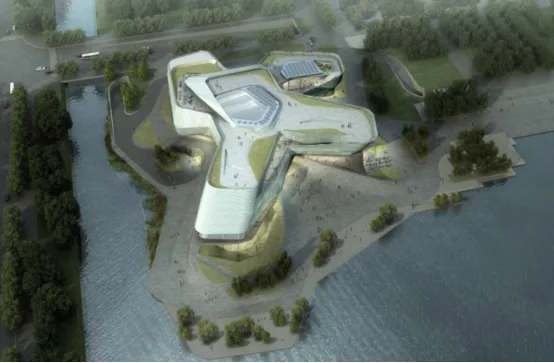
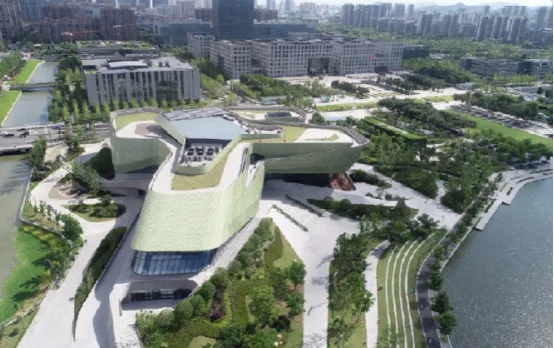
Figure 1: Comparison between the rendering and the actual scene of Ningbo City Exhibition Hall
The use of BIM technology in the curtain wall engineering of the Ningbo City Exhibition Center primarily addresses several practical challenges:
First, creating highly precise models for the irregular, double-layered curtain walls helps define the types and exact dimensions of the exterior facade panels. Detailed analysis and research of these models are essential to fully grasp the architect’s design intent and concepts, providing critical support for the curtain wall structural design. Without this, the design phase would be uncertain and inefficient. Additionally, relying solely on 2D drawings fails to convey comprehensive design information needed for construction guidance. It also limits the ability to accurately assess the relationships between the curtain wall, main structure, landscaping, equipment, and other disciplines. BIM’s 3D visualization enables early detection of potential issues during project execution.
The project involves a wide variety of components, including thousands of structural skeleton specifications and numerous twisted sections. Tens of thousands of panels—most unique in shape—are used, along with countless auxiliary materials that require detailed processing and information management. Managing, designing, and storing these material processing drawings is a complex task. Without BIM technology, this enormous workload would result in significantly higher costs for the construction company and could jeopardize timely project completion.
The double-layered curtain wall facade features varying inward and outward inclinations, as well as diverse left and right angles. Because the contour angles and directions constantly change, positioning each curtain wall part involves irregular and three-dimensional spatial coordination. High precision is critical for controlling accuracy, making the construction process highly challenging. BIM technology is indispensable for achieving the fine management required.
When modules need to be replaced or modified during construction, operation, or maintenance, BIM models enable quick extraction of relevant data by material code. This significantly improves efficiency in operation and maintenance management. Increasing research focuses on applying BIM technology in the operational phase—for example, space management for indoor layout planning and spatial positioning of fire protection, lighting, and other systems. BIM allows for fast and intuitive searching and locating, facilitating maintenance and renovation tasks.
More advanced BIM applications involve secondary software development. Currently, BIM use remains tied to traditional design methods, with some functions not fully suited to building construction needs. Certain specialized technical applications are missing, limiting full digital integration. Only through secondary development and applied research in BIM systems can error rates be reduced, project timelines shortened, efficiency boosted, and overall BIM effectiveness enhanced.
Text: Yi Yingying
For learning and communication purposes only. If any infringement occurs, please contact us for removal.
















Must log in before commenting!
Sign Up