
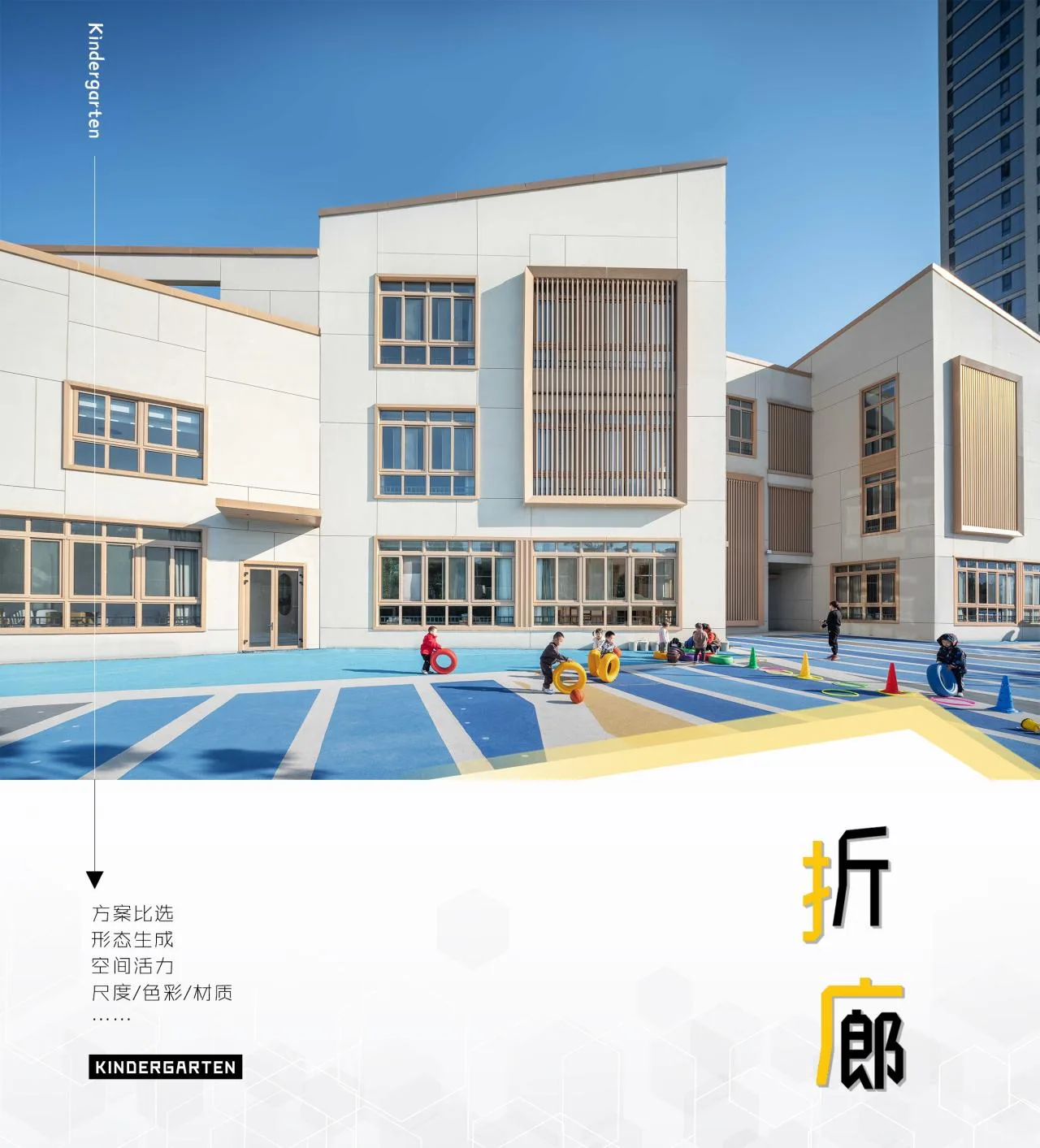
1. Forming an Enclosed ‘Mini City’
Wenzhou City, known for its pioneering economic spirit and motto of “daring to be the first,” serves as the setting for this project, located in the Longwan District. The kindergarten site features a relatively simple base design, but we aimed to introduce local innovation, creating an ideal urban space for children within environmental and regulatory constraints. Through thoughtful design of spatial layouts, exterior facades, and color schemes, the kindergarten seeks to positively influence its surroundings and enhance the city’s overall appearance.
The site is shaped roughly as a narrow trapezoid. To the south and west, it adjoins urban public green spaces, while to the east, residential areas border the site. Due to interference caused by the community entrance on the northern side, the design places a parking lot there, concentrating the kindergarten buildings on the southern portion of the plot.
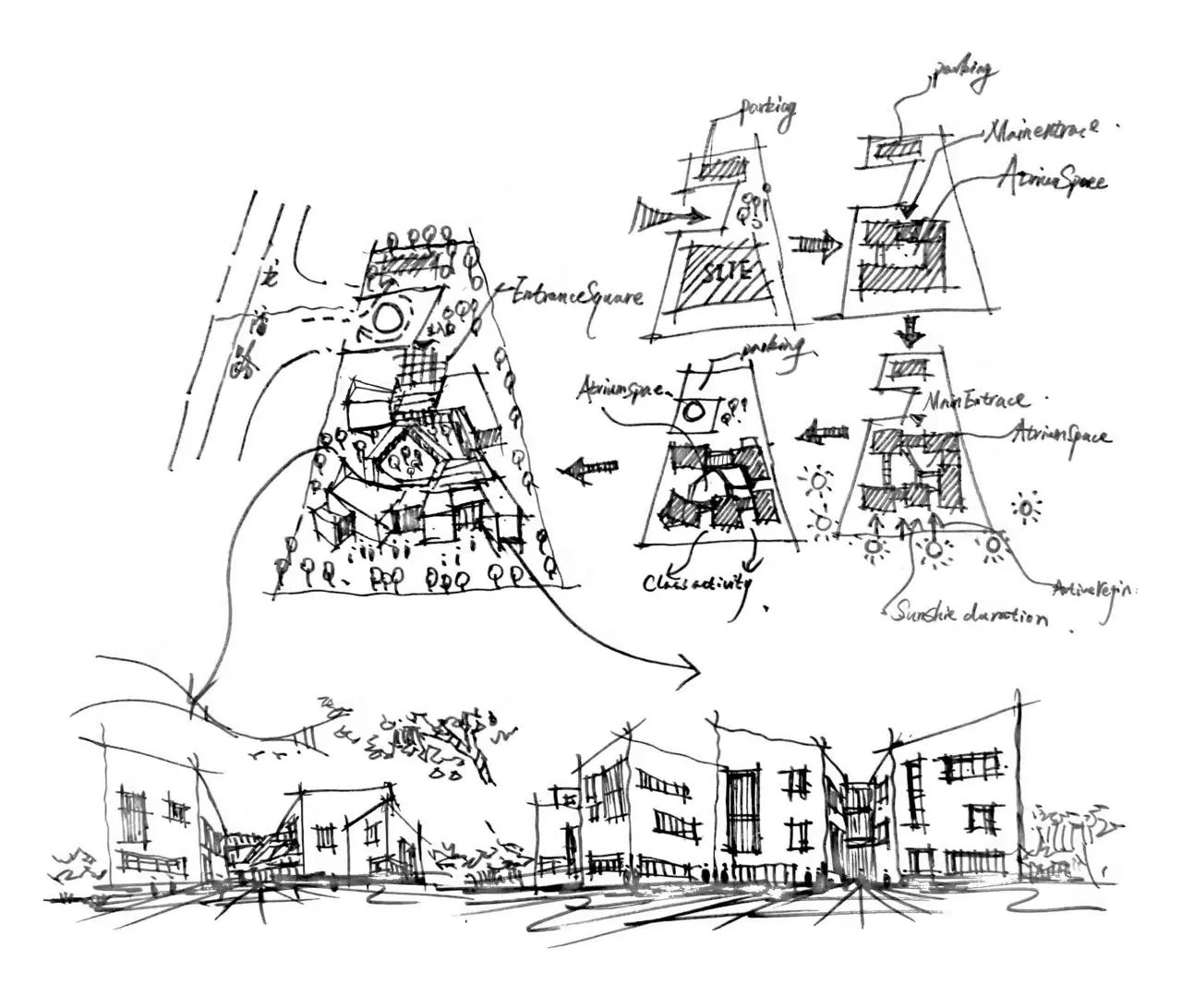
⊙ Concept Drawing
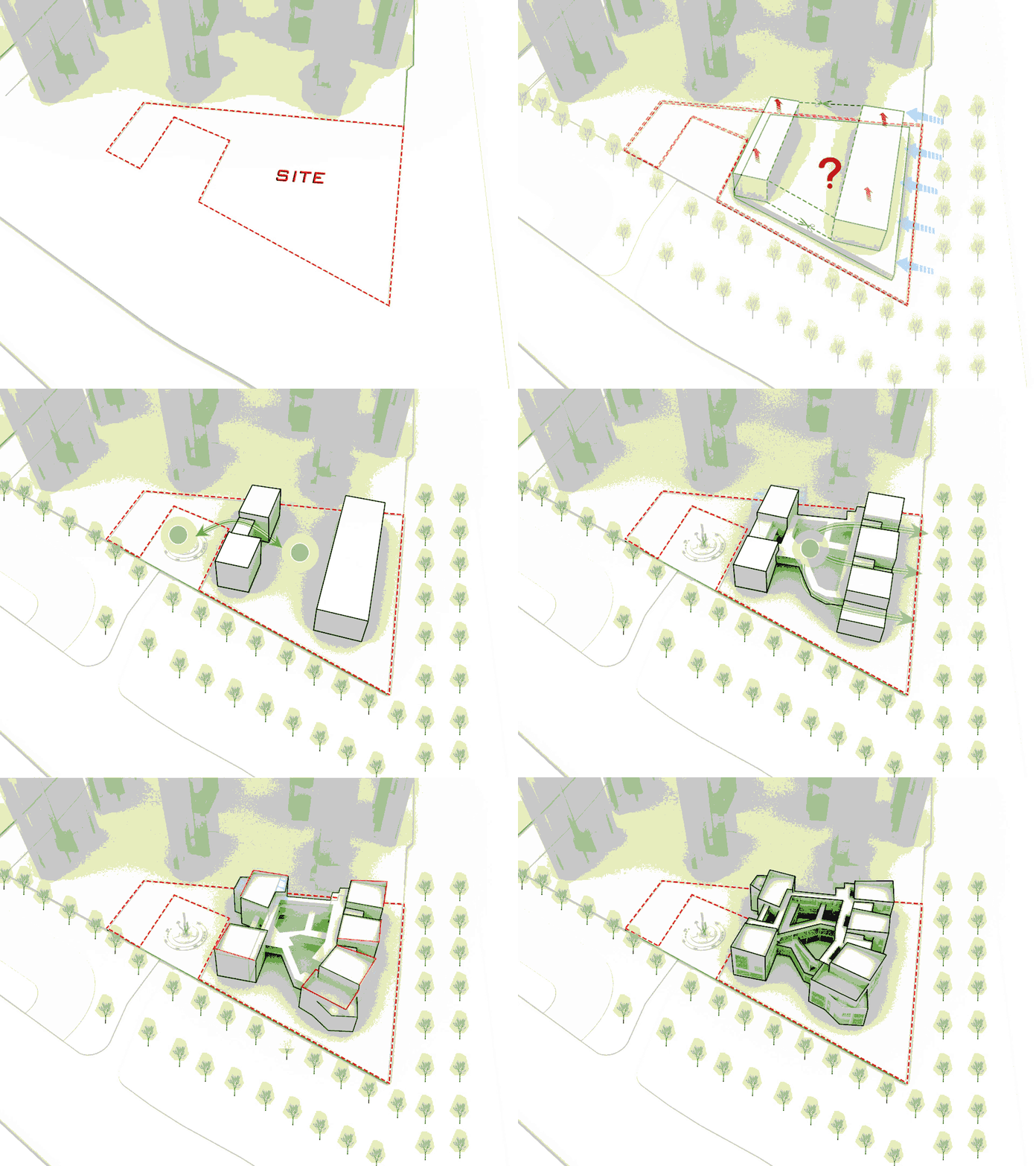
⊙ Form Generation
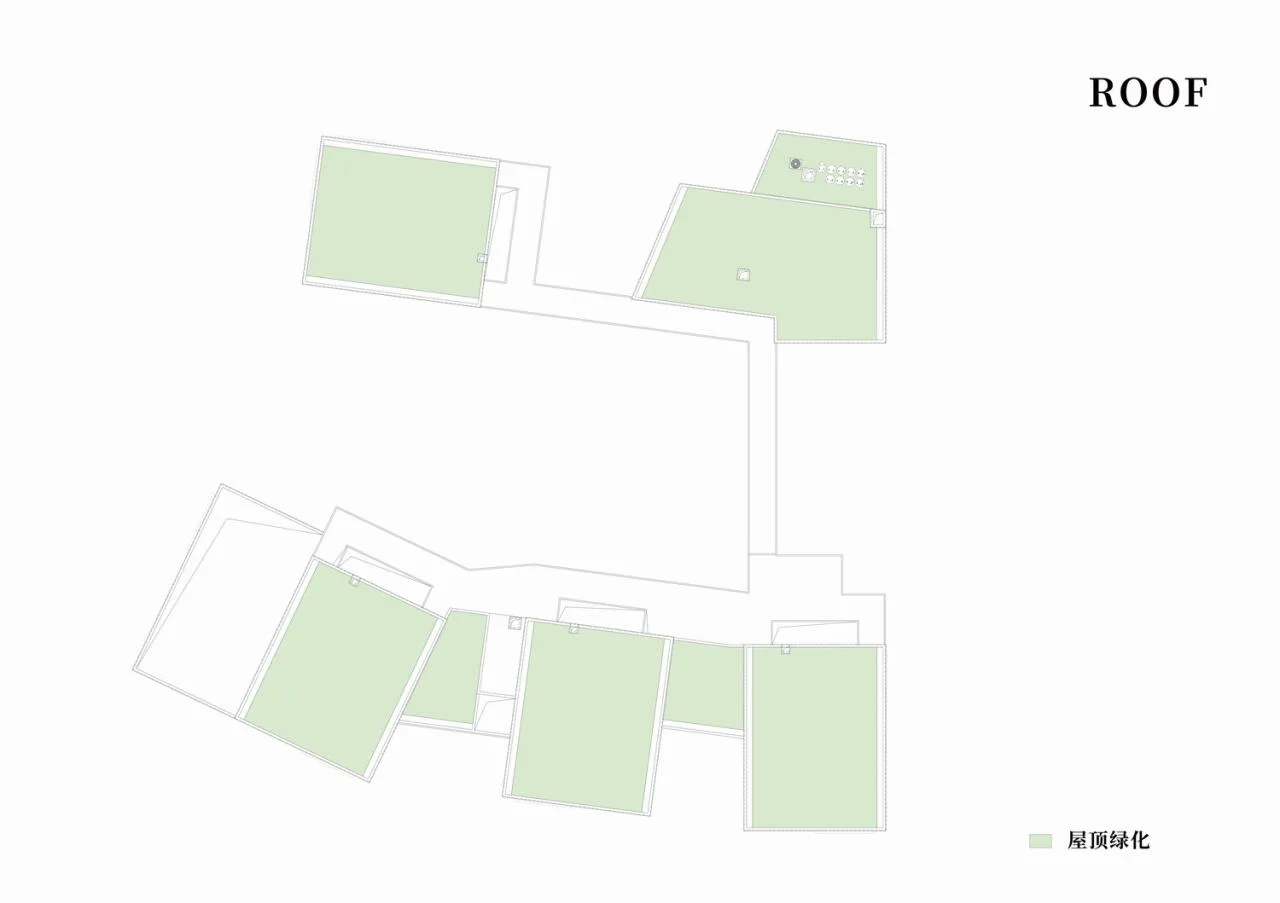
The building consists of front and rear rows linked by a corridor, creating an I-shaped floor plan. This corridor runs alongside a taller building, forming a unified courtyard at the center. It connects two central landscaped areas and the greenery along the street, establishing a horizontal landscape axis aligned with the functional zones. Extending from this corridor, the design divides the large space into smaller parts, rotating and shifting some blocks to achieve the final architectural form.
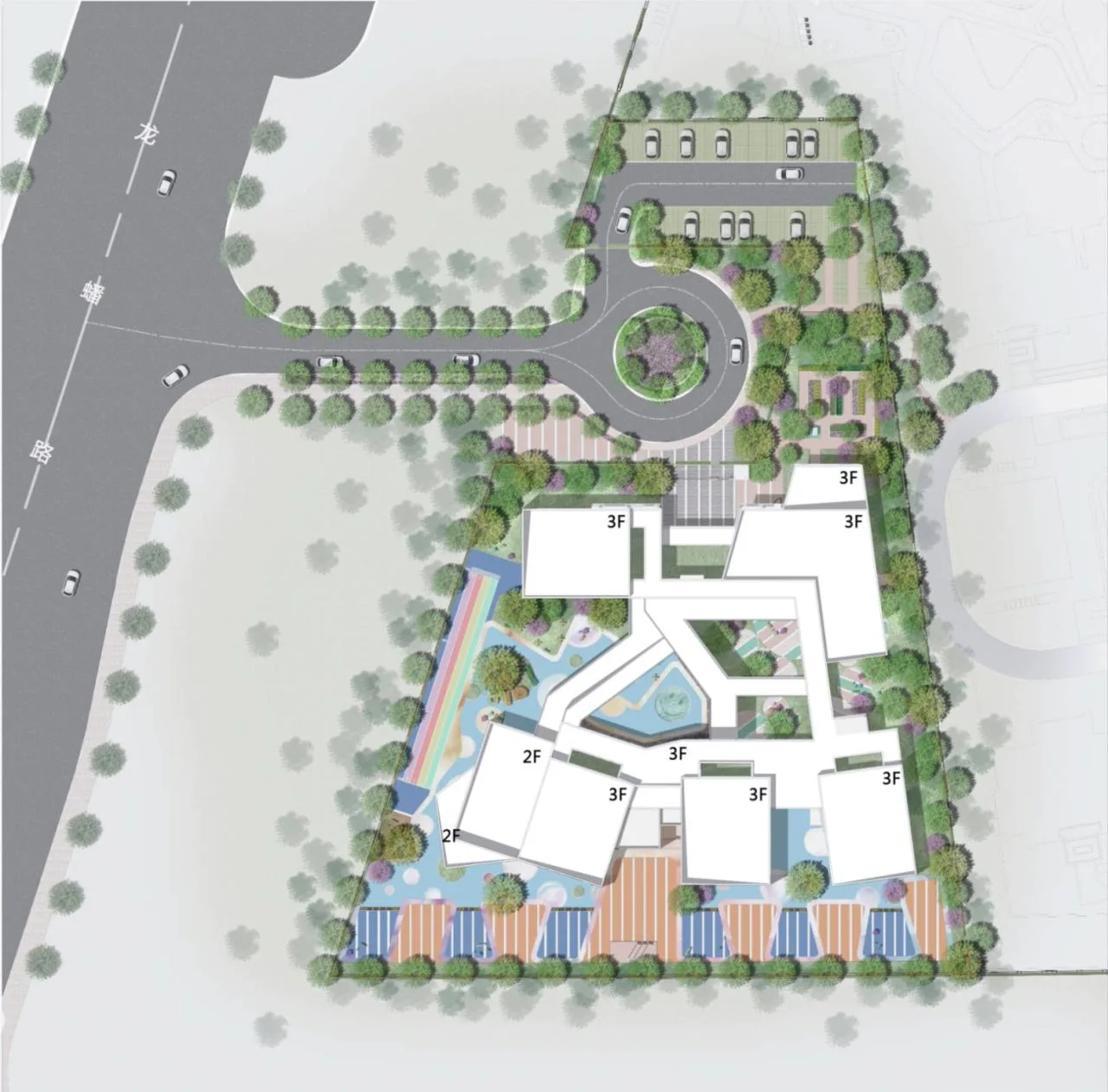
⊙ General Layout Plan
During the design process, alternative solutions were explored, focusing on encouraging children’s connection to nature and creating fun, diverse spaces from various perspectives. For example, the “Breaking Ground” concept fully occupies the site from north to south, with layered elevations creating ubiquitous curves inside and outside. Other approaches experimented with removing corridors or adding central blocks.
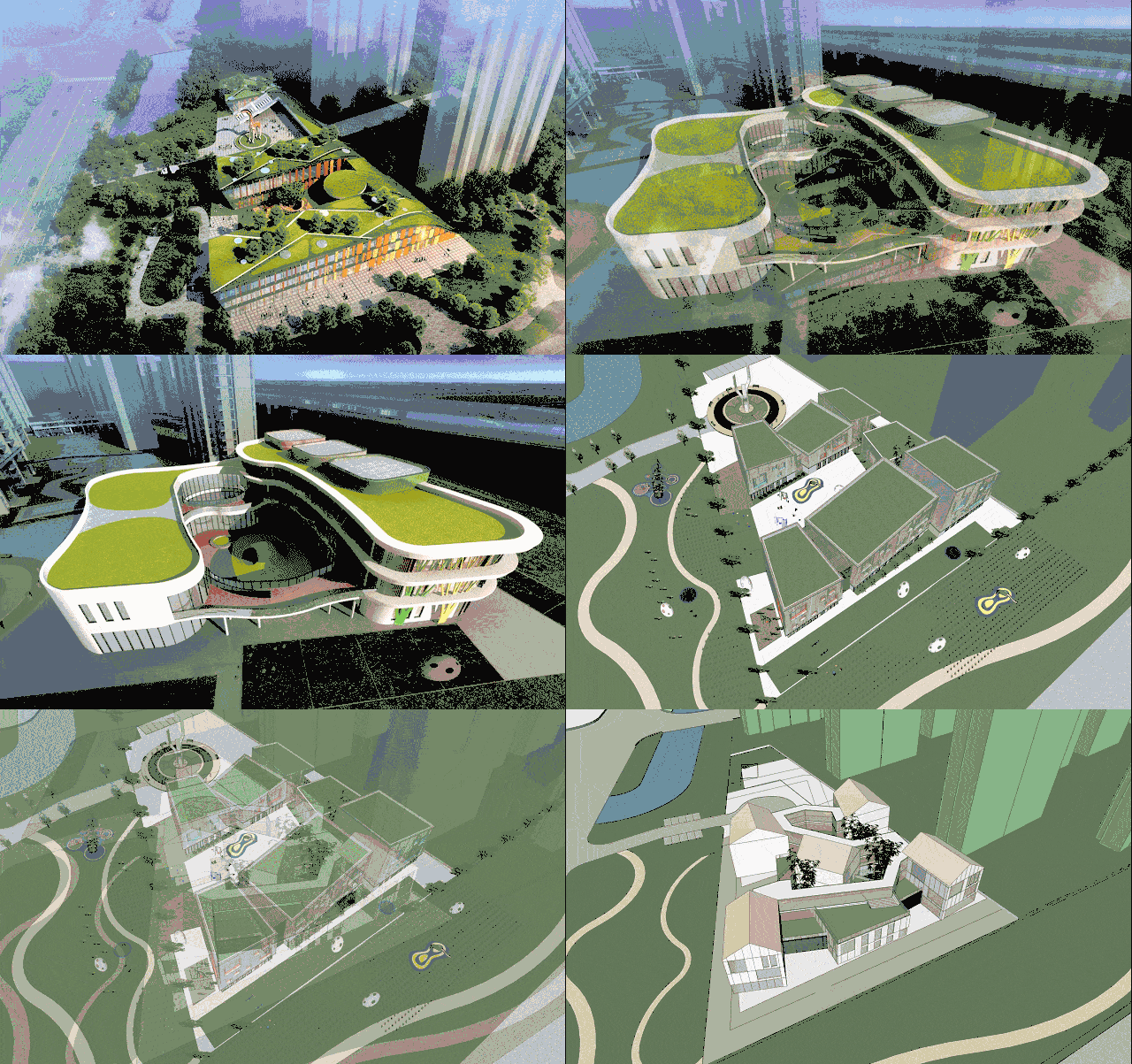
⊙ Scheme Comparison and Selection
—— Garden Tour ——
Ultimately, the “Corridor Waist Manhui” design was selected — an amusement park concept that cuts off the northern side for parking, resulting in a more integrated and user-friendly kindergarten building. With the activity area already established on-site, the design aims to reconstruct the central semi-enclosed space through the corridor, enriching the spatial experience architecturally.
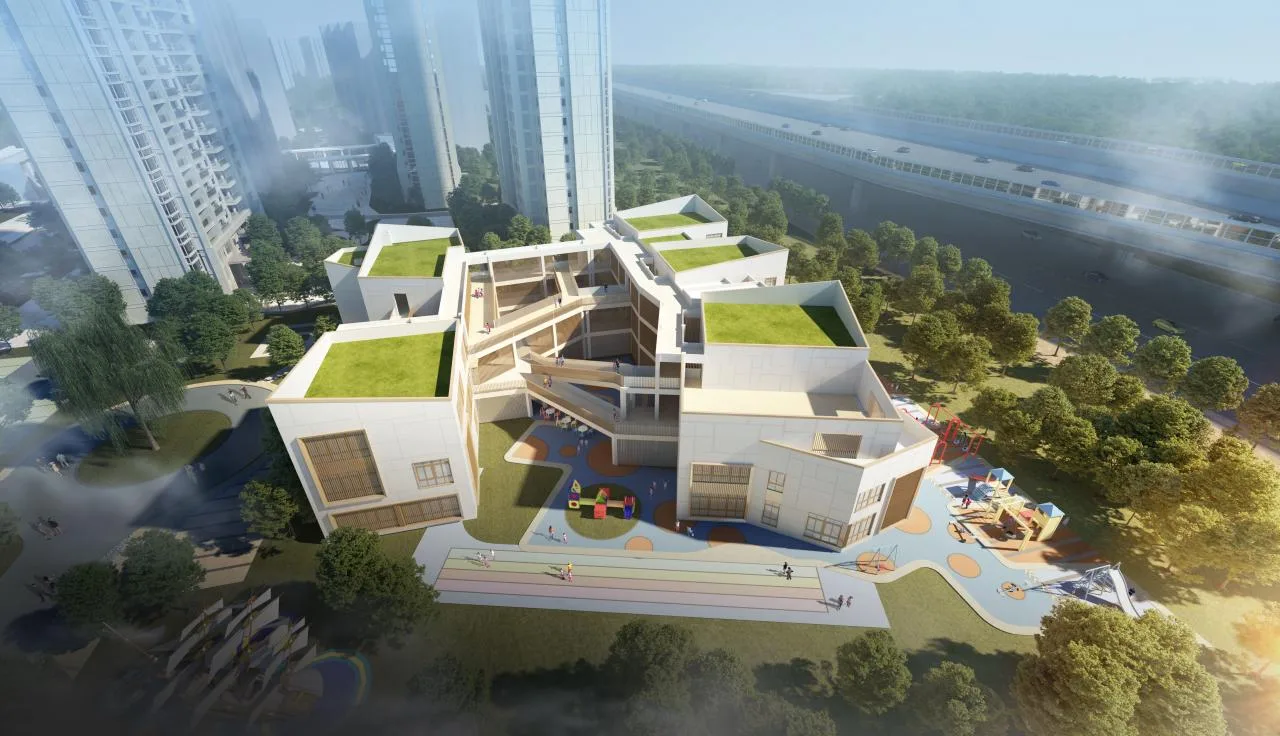
⊙ Aerial Rendering
2. Folding Corridor Creates a Vital Core
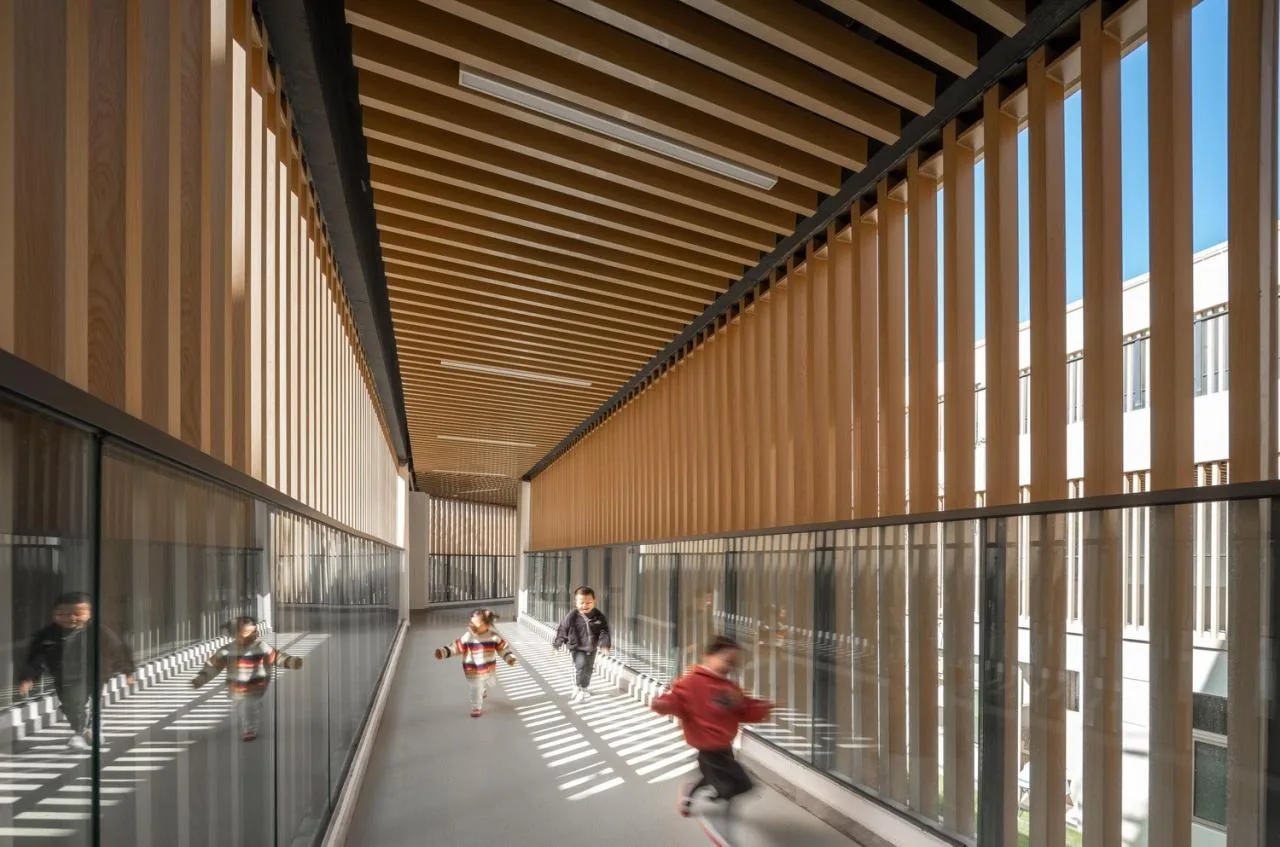
The corridor acts as the connective thread between buildings and often guides visitors through scenic views. Serving as an extension between indoor and outdoor spaces, it links building blocks and, inspired by classical Chinese garden organization, forms a vibrant spatial core with a winding path at the heart of the structure.
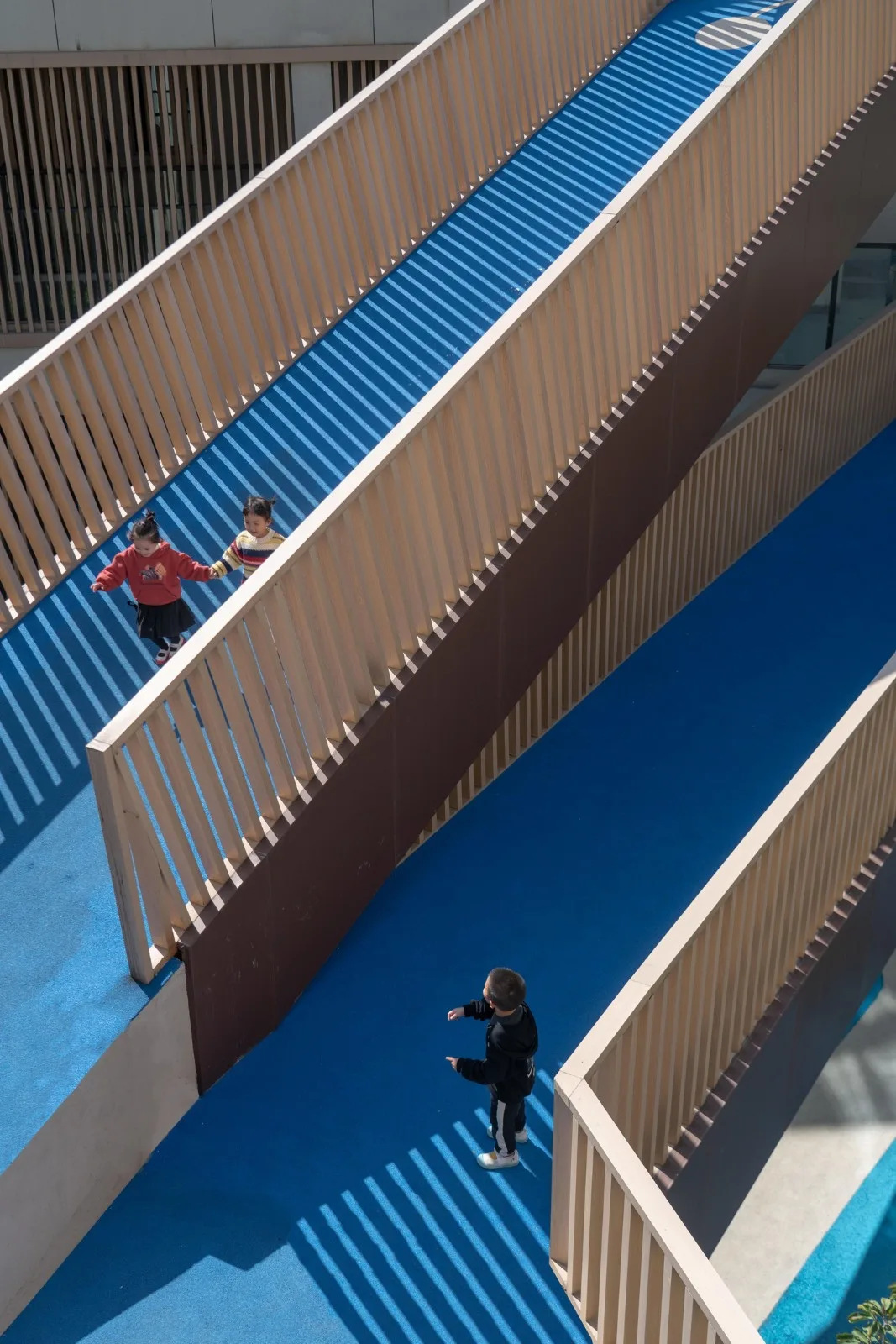
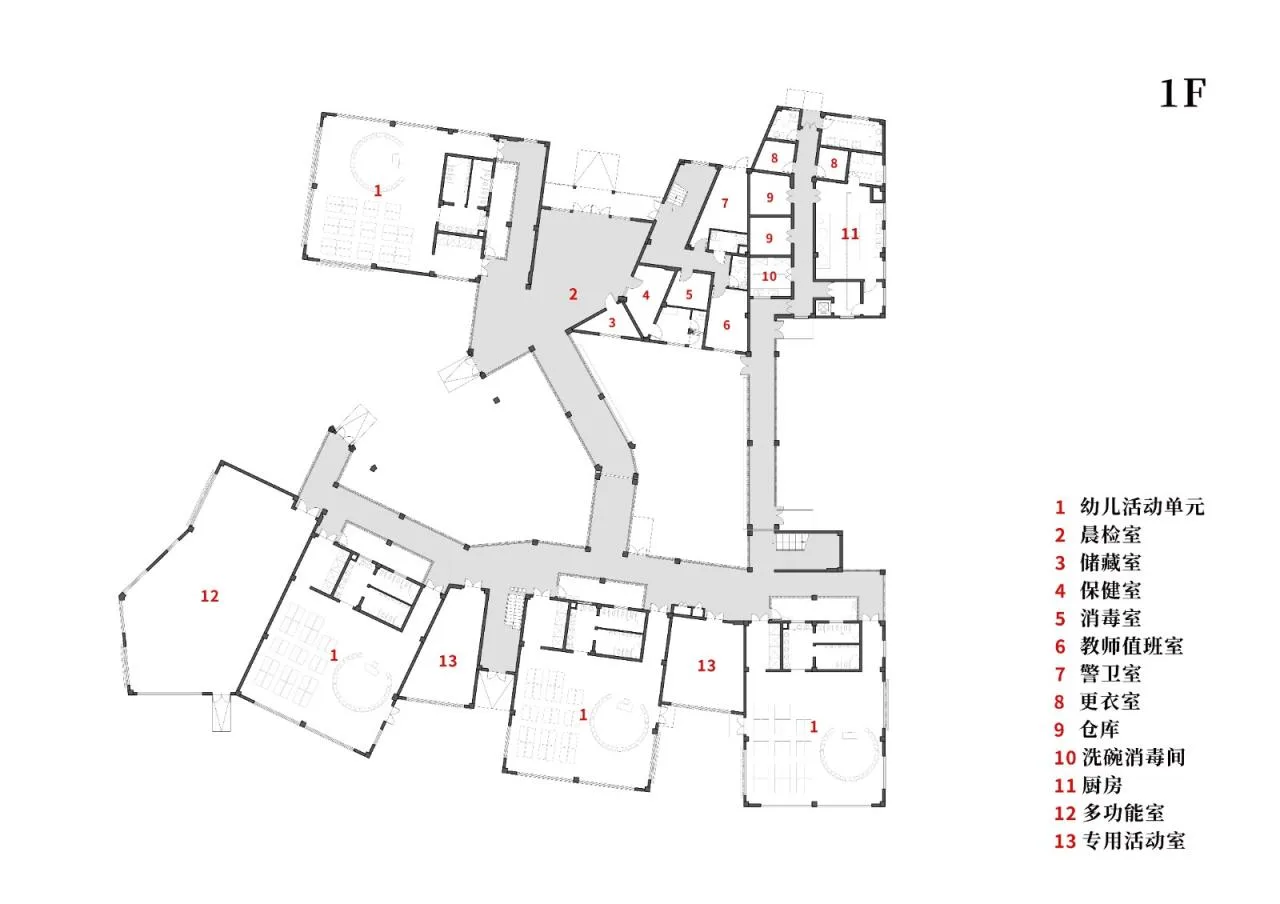
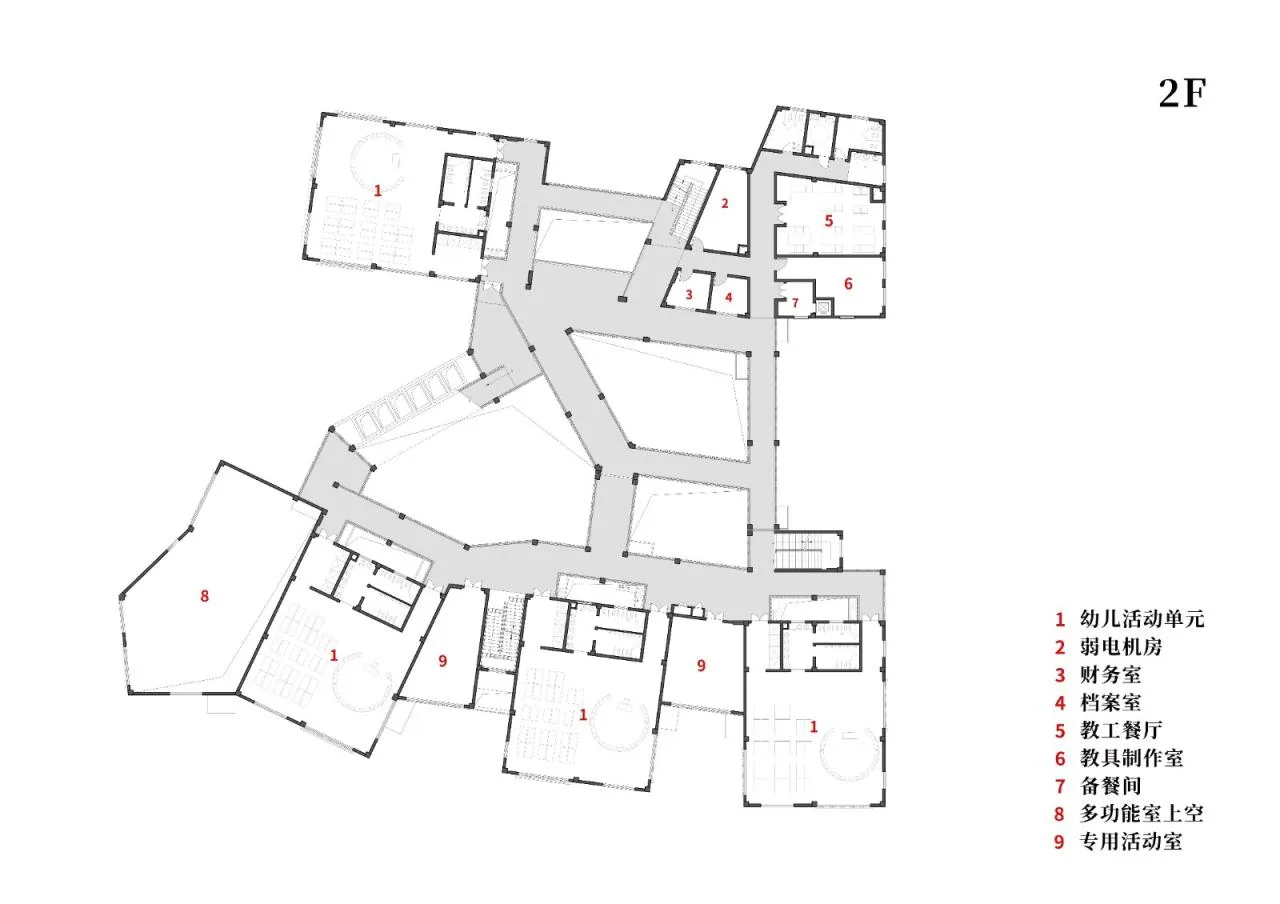
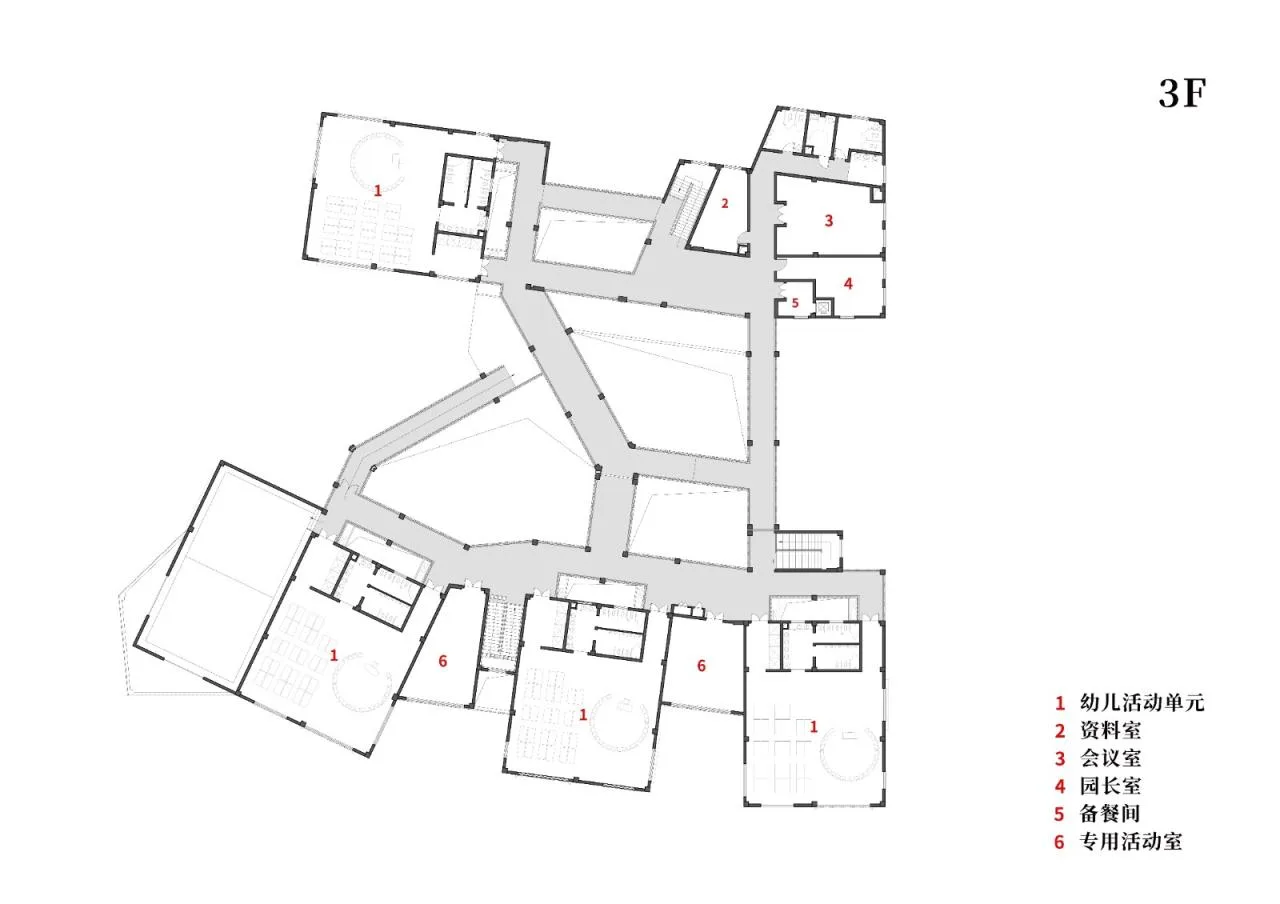
The total length of the three-story corridor is approximately 370 meters. It includes three primary north-south corridors: two connecting the entrance hall and traffic core, and one linking to office and logistics buildings. These interconnected corridors weave through the building, functioning both as aerial passages and playful mazes for children. A sloping corridor slide on the west side of the third floor leads directly to the second floor opposite, adding excitement to the journey.
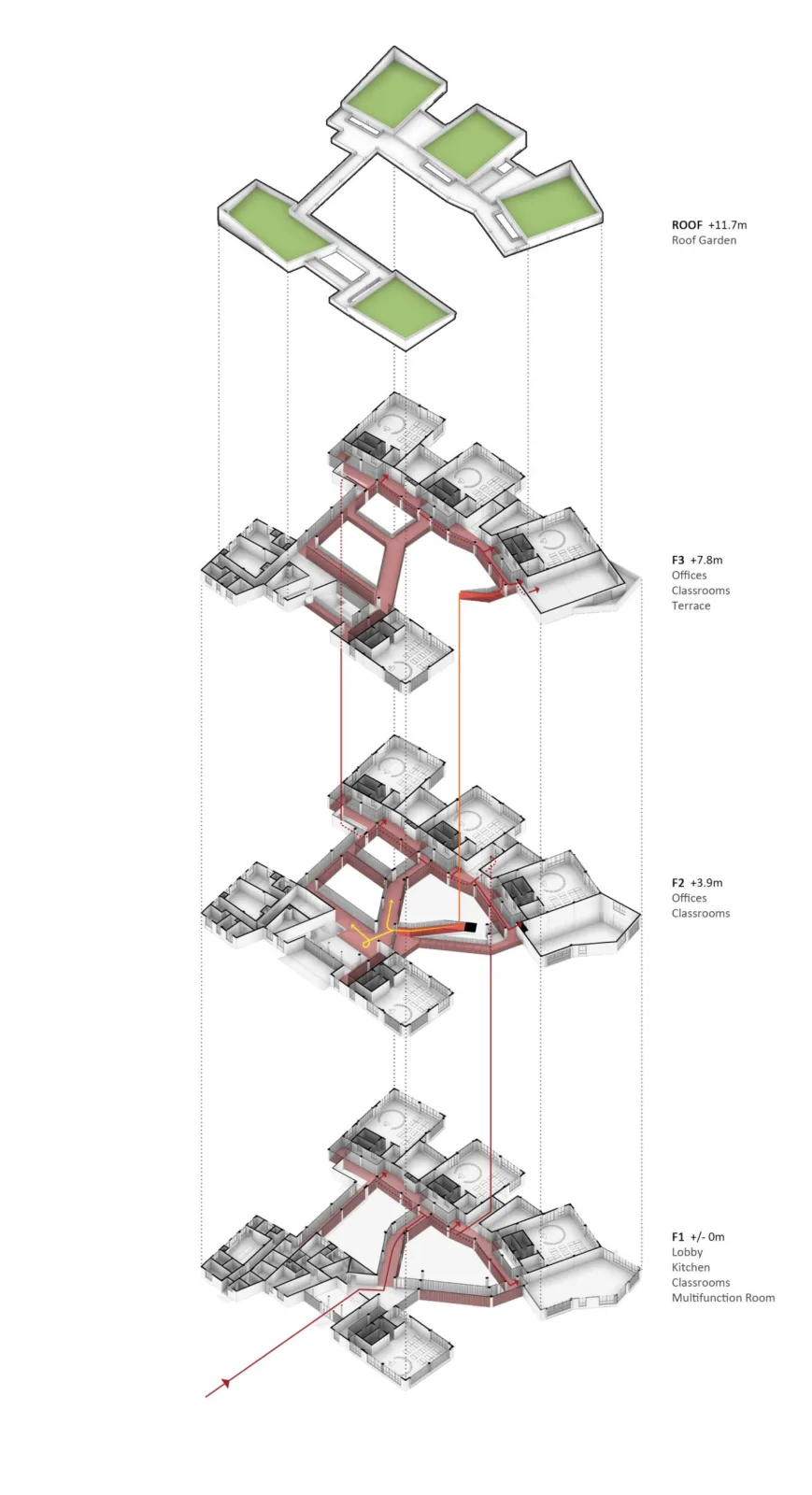
⊙ Exploded Axonometric Diagram
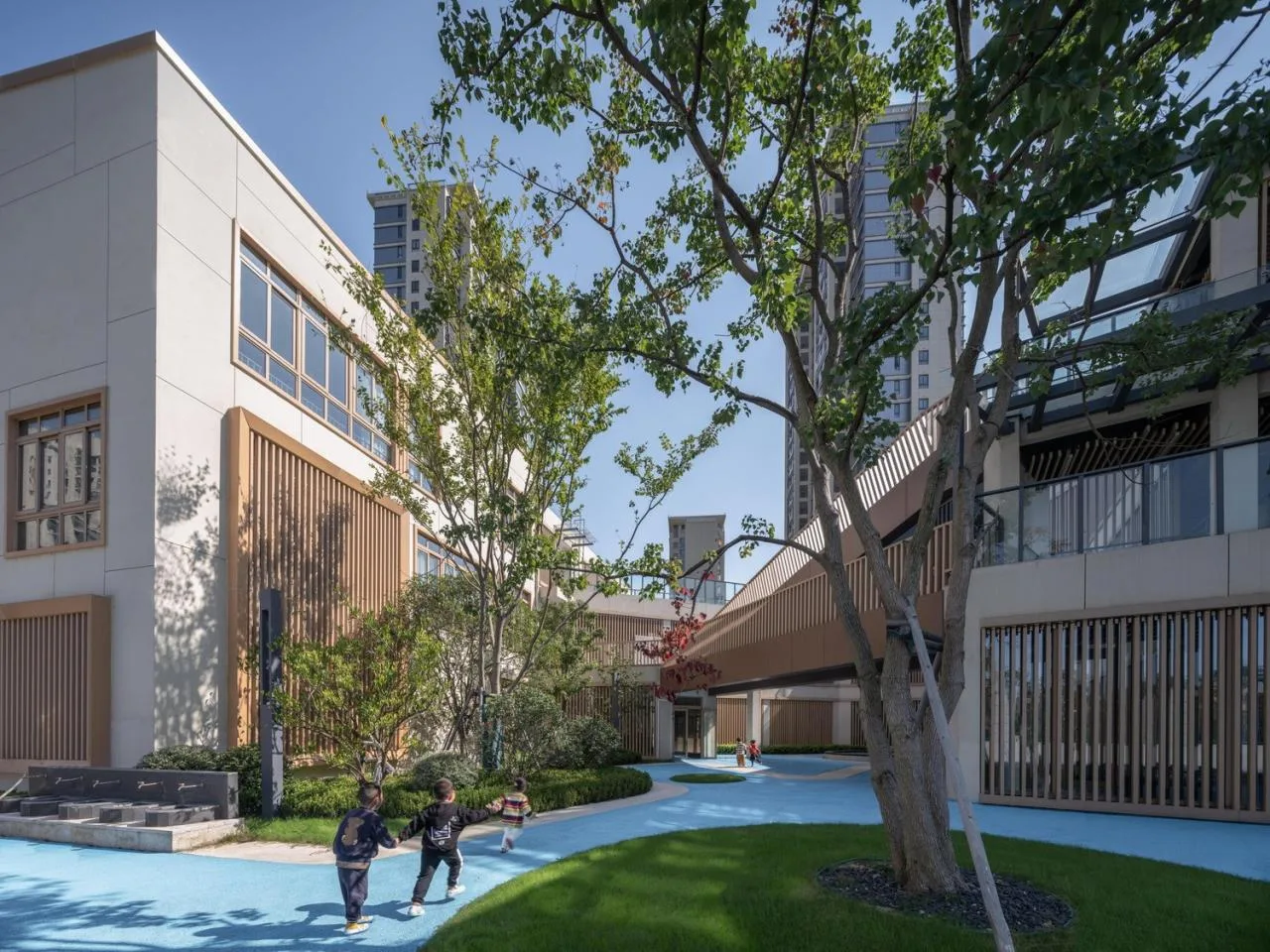
When adults and children play hide and seek, children often hide in obvious spots due to their shorter height and limited field of view. This difference means children experience space differently from adults, who perceive broader scales.
The corridor breaks the large central outdoor space into smaller courtyards adorned with greenery. This reduces the overwhelming scale, making the spaces feel more suited to children. These small courtyards are versatile, supplementing existing activity areas and offering ambiguous spaces for children to explore and define with their imagination.
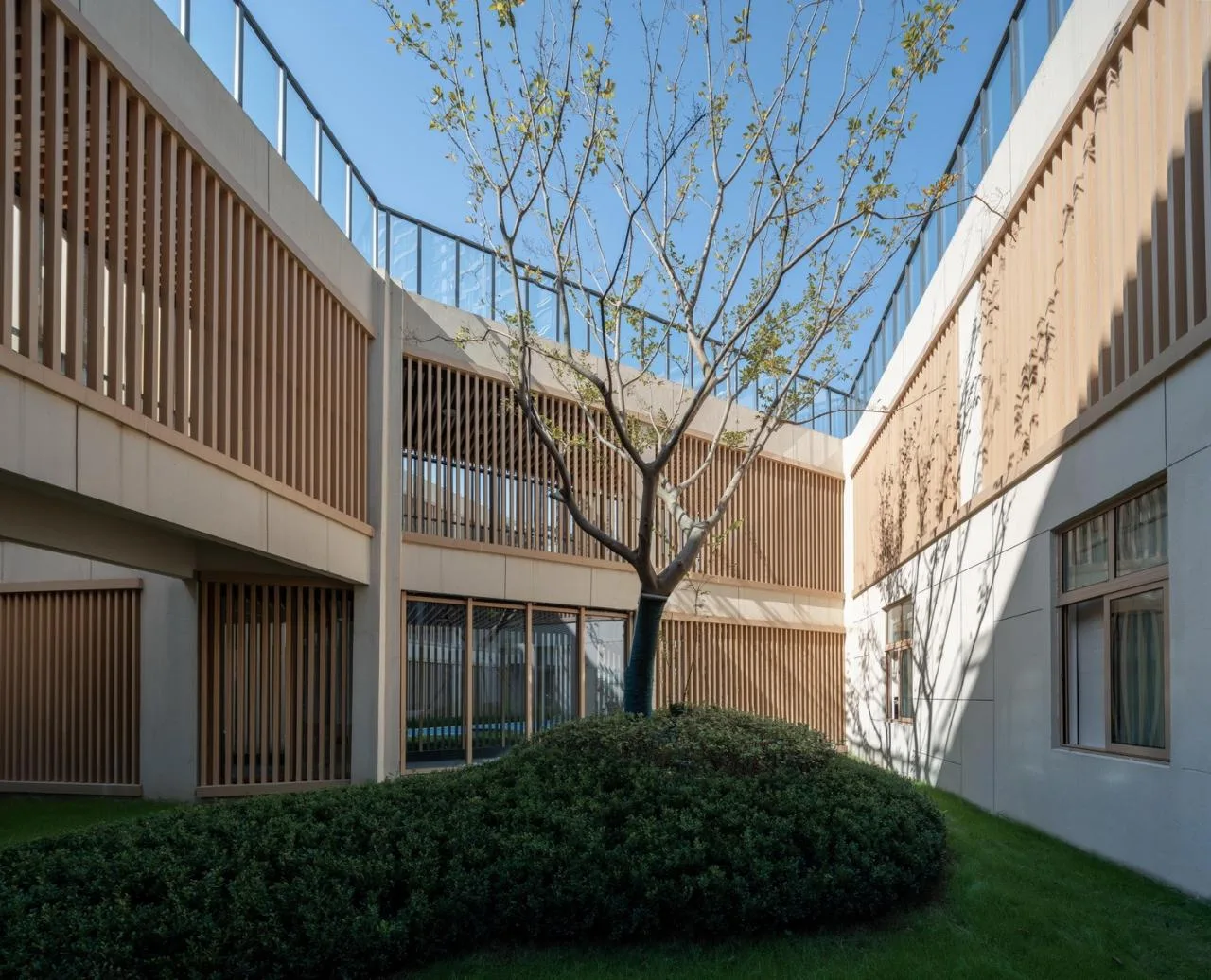
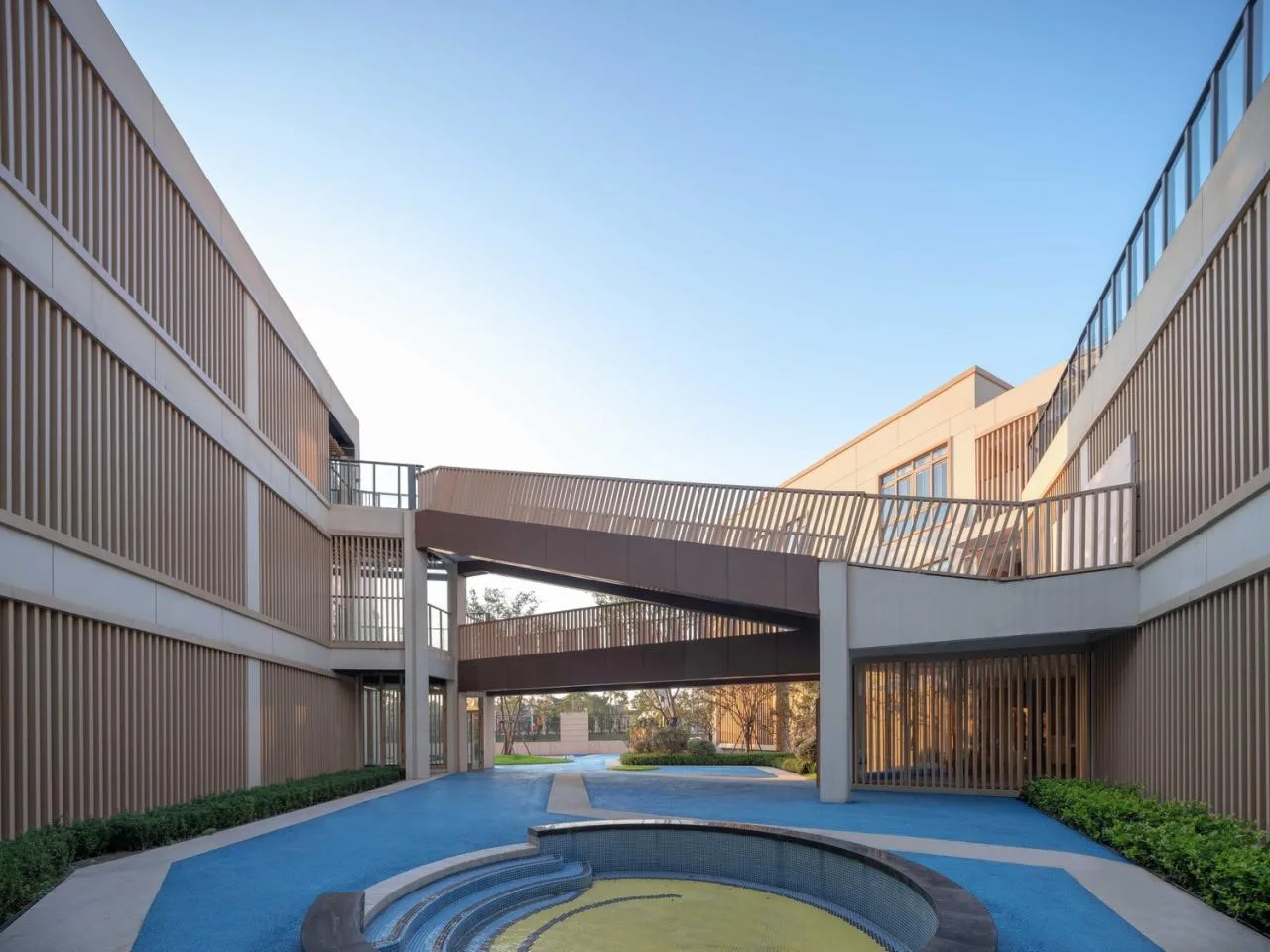
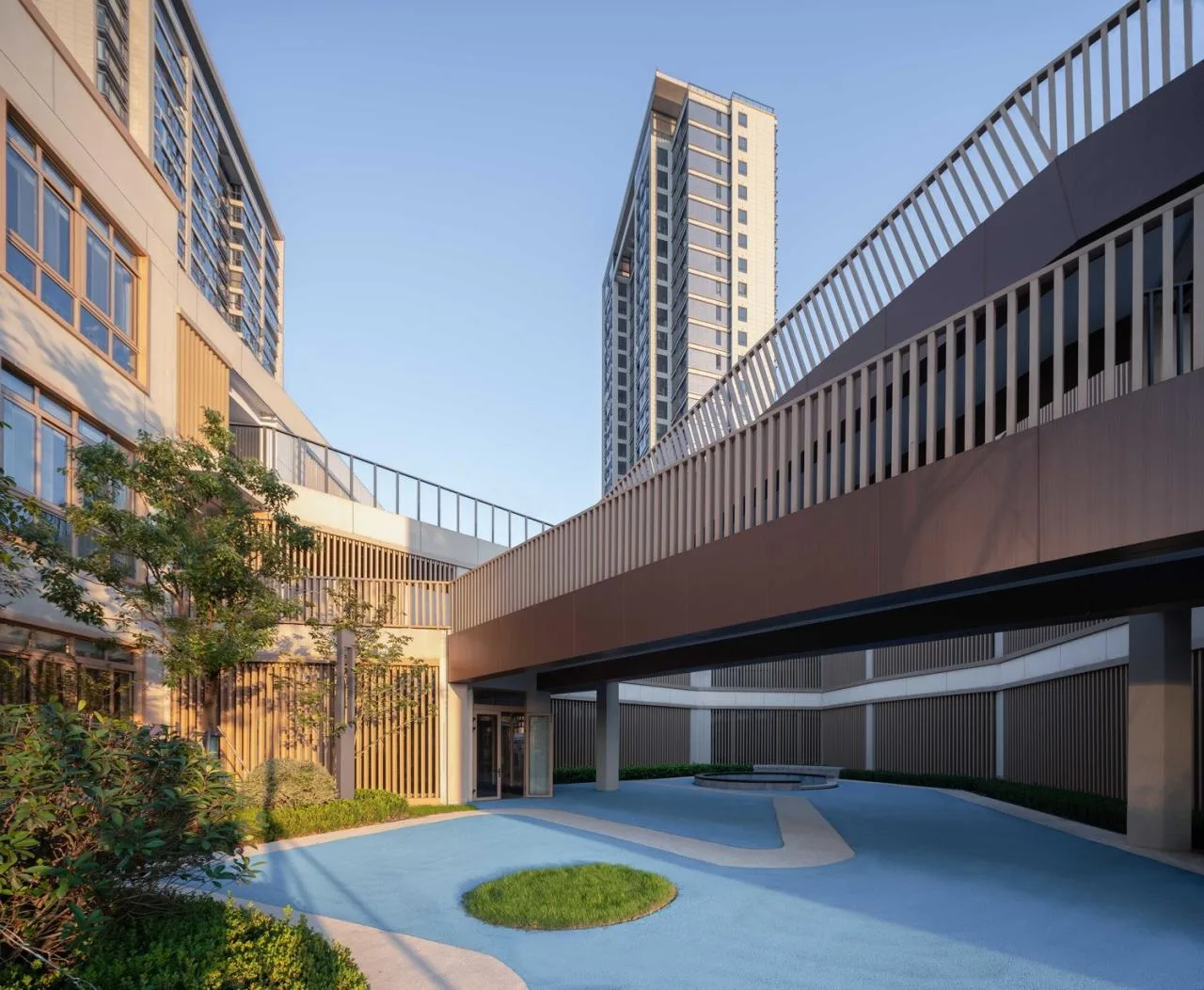
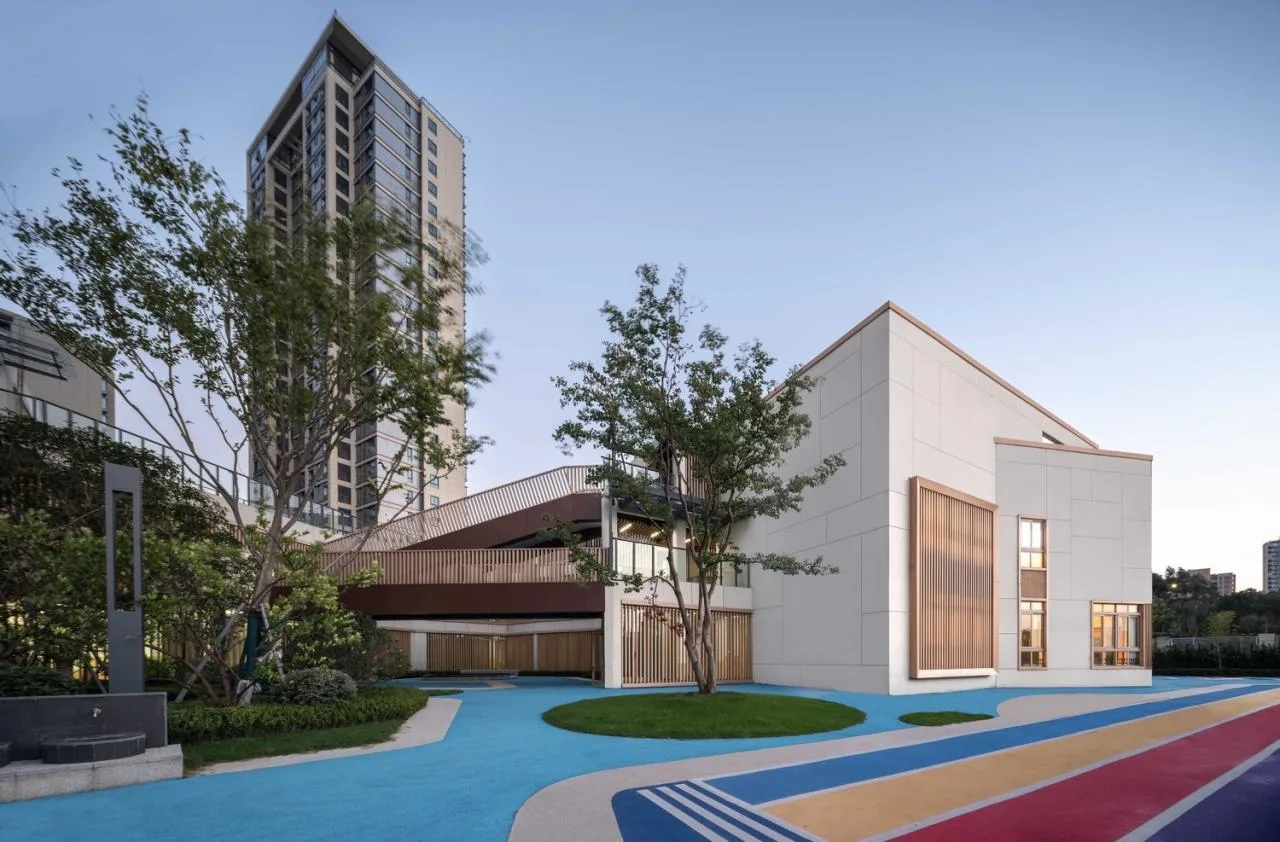
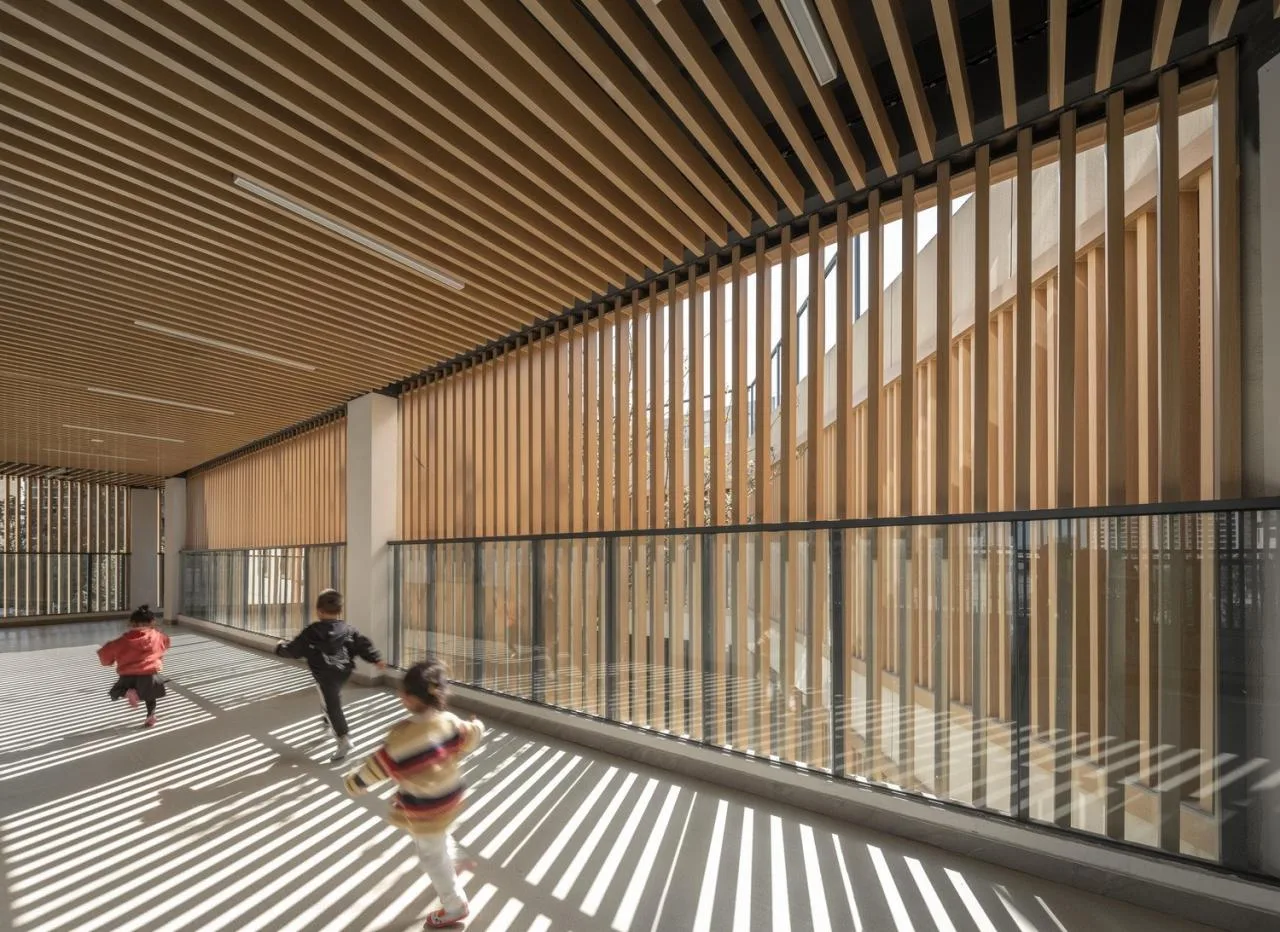
The corridor bridging the north and south blocks acts as a transition and boundary between interior and exterior spaces, reflecting contrasting characteristics. Some sections are enclosed with grilles and protected by glass railings, while others use dense wooden railings resembling a forest. These varying corridor types offer children diverse spatial experiences, enriching their daily journeys.
3. Visual Perception and Stylistic Composition
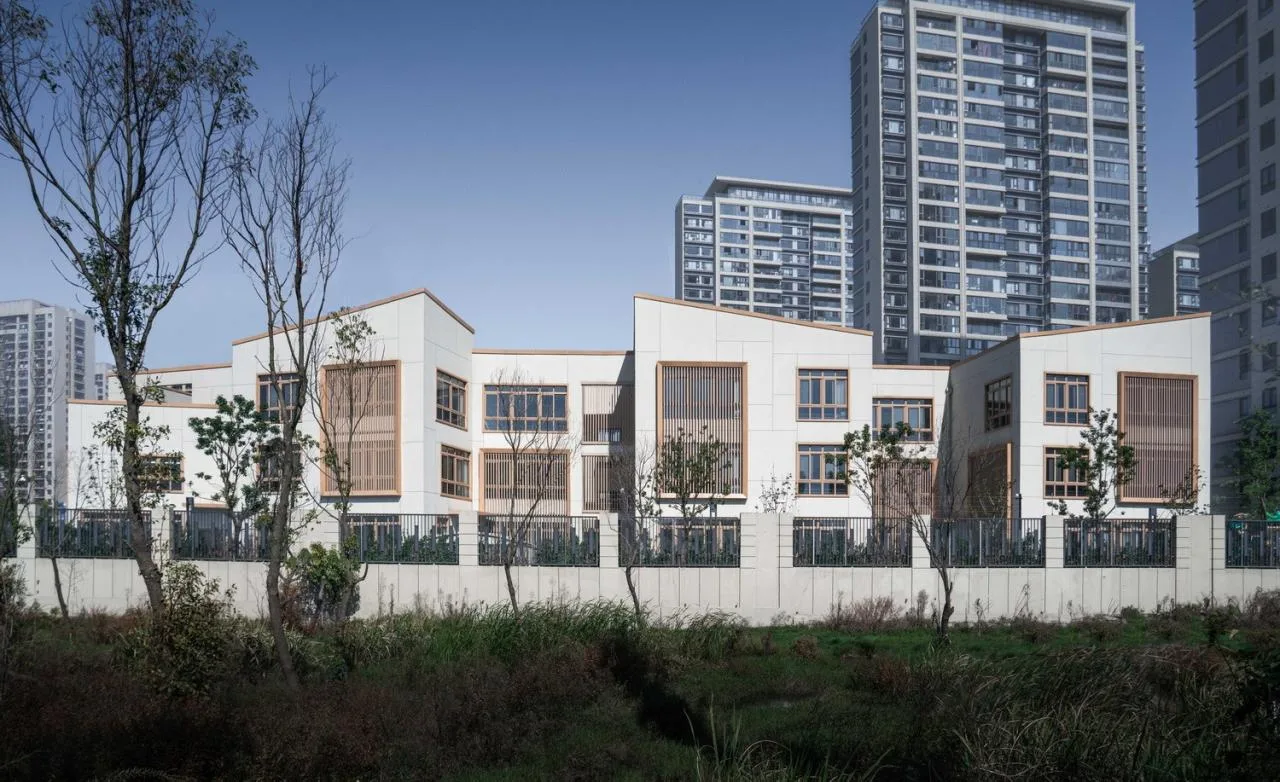
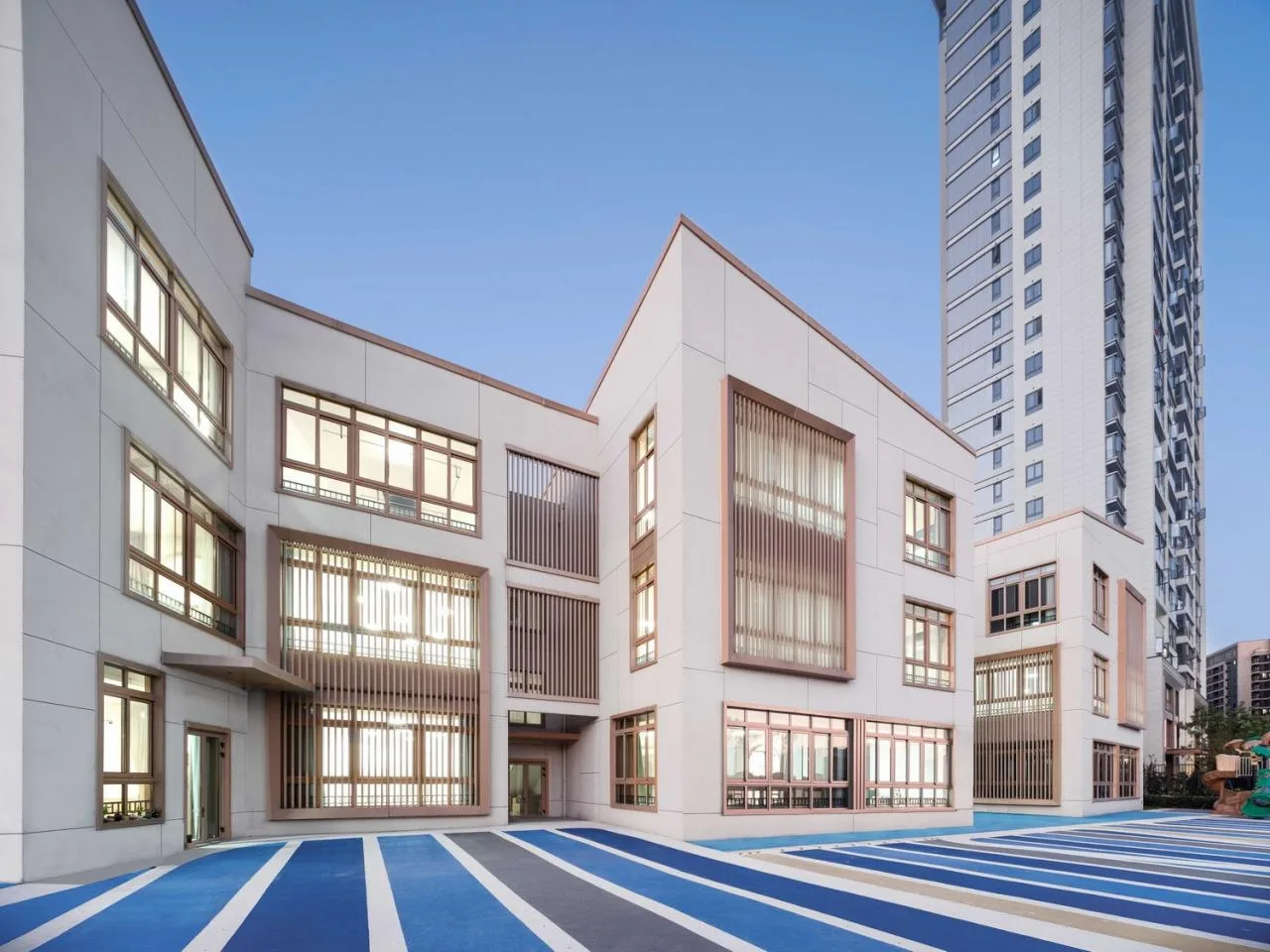
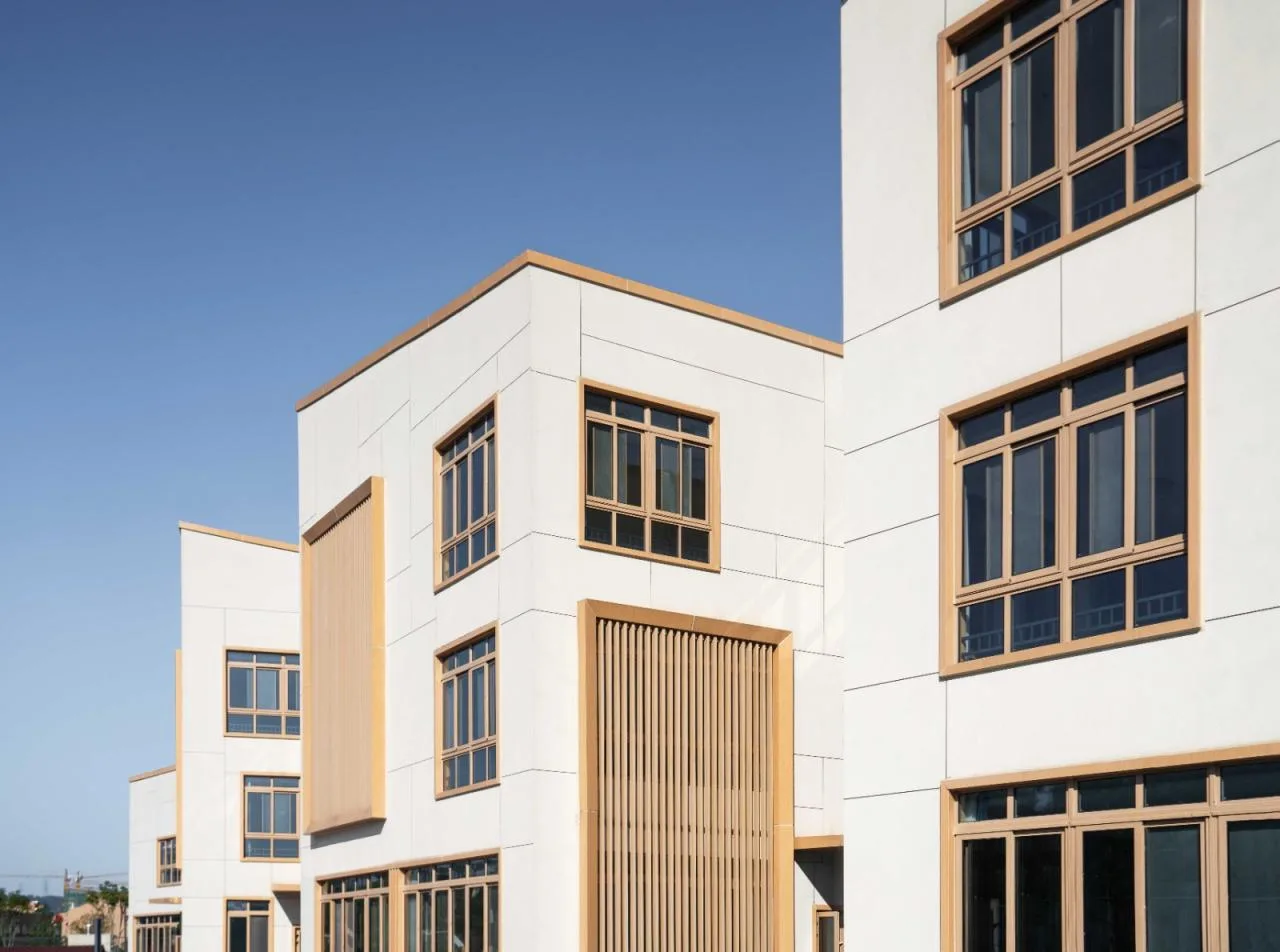
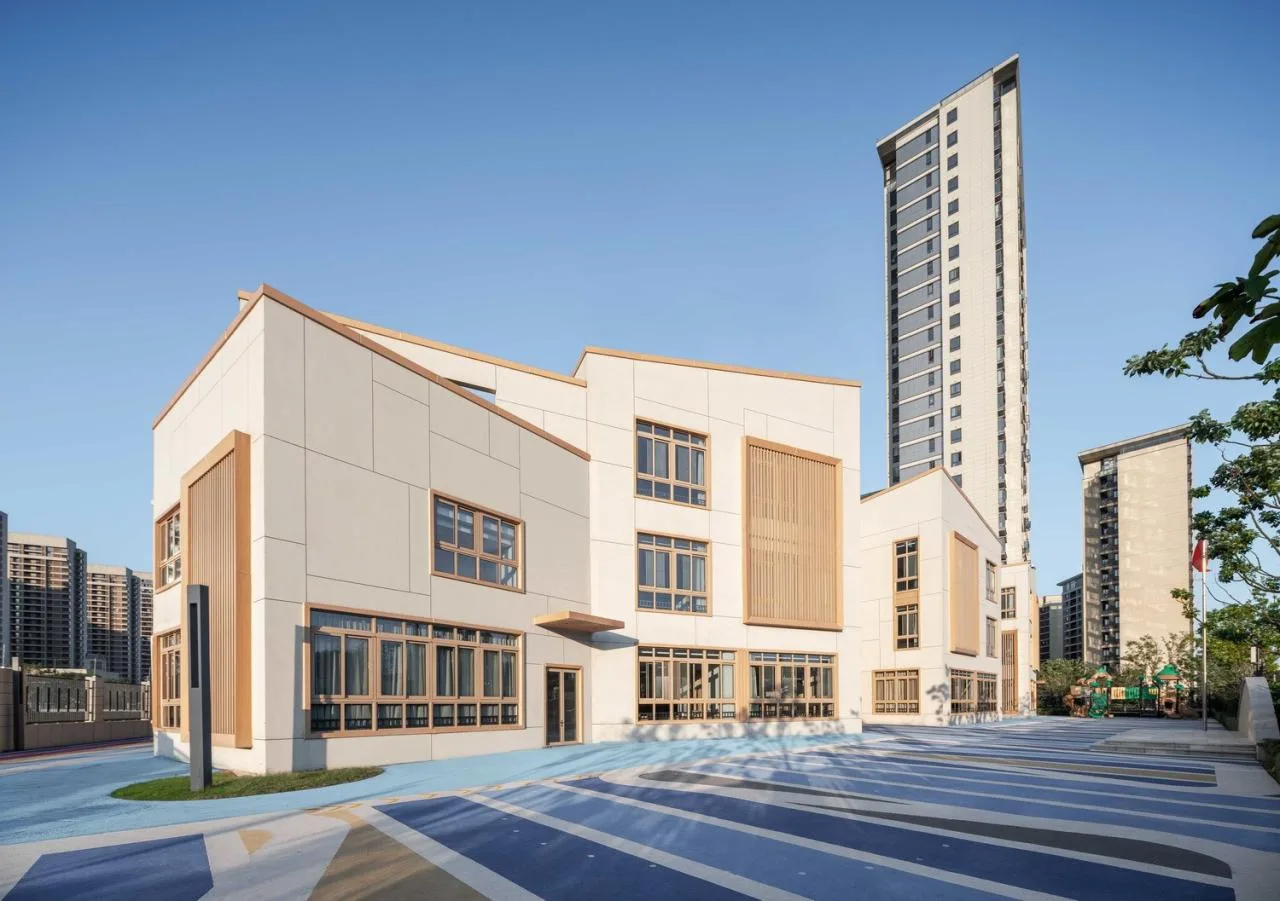
The building’s exterior features a simple, natural, and lively aesthetic, with expansive white real stone paint and imitation wood grain grilles. The design draws inspiration from the strip elements in Piet Mondrian’s “Composition of Red, Yellow, and Blue,” extending their proportional forms into the facade.
Human visual perception involves the brain’s secondary processing of visual information into complex experiences. To communicate design concepts effectively, visual elements must be accessible and meaningful to users. In designing this preschool, the goal was to respect children’s worldviews—not to create Disney-style colorful buildings from an adult perspective, but to offer an environment fostering children’s aesthetics and cultural literacy through simple, classic, elegant, and warm color schemes.
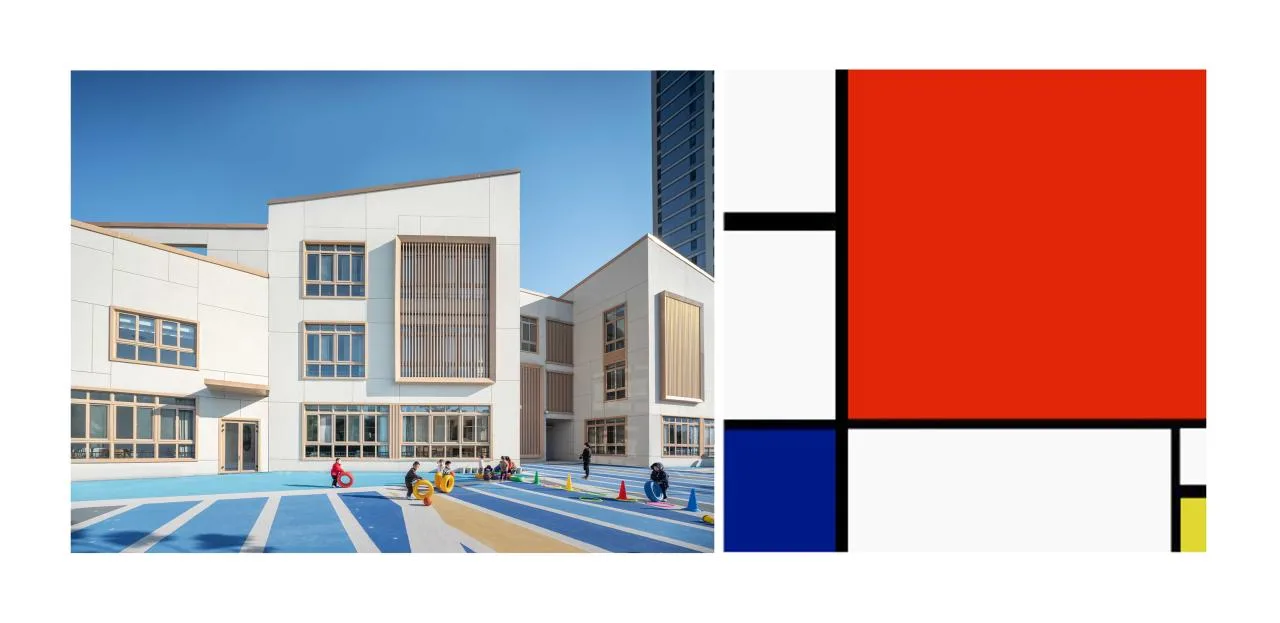
⊙ Real Scene | Mondrian’s “Composition of Red, Yellow, and Blue”
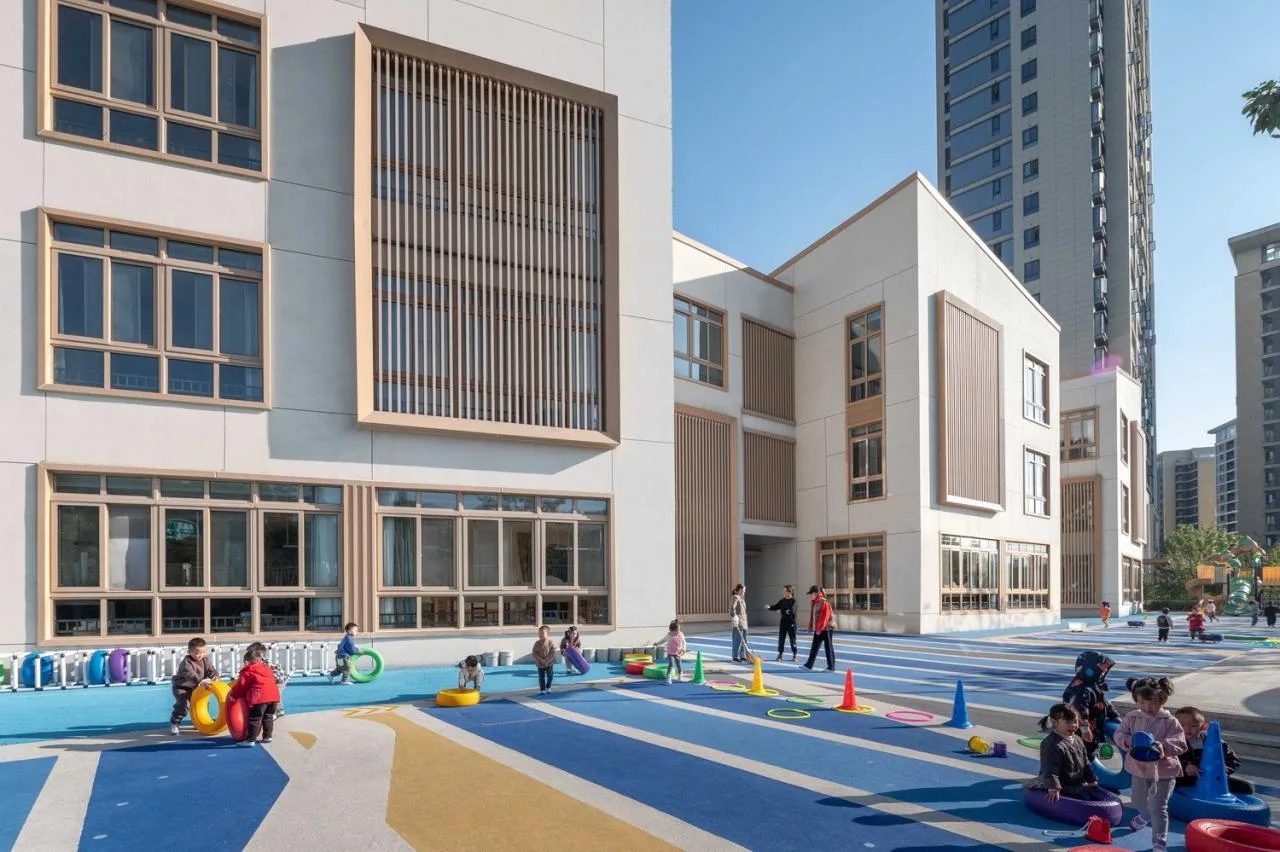
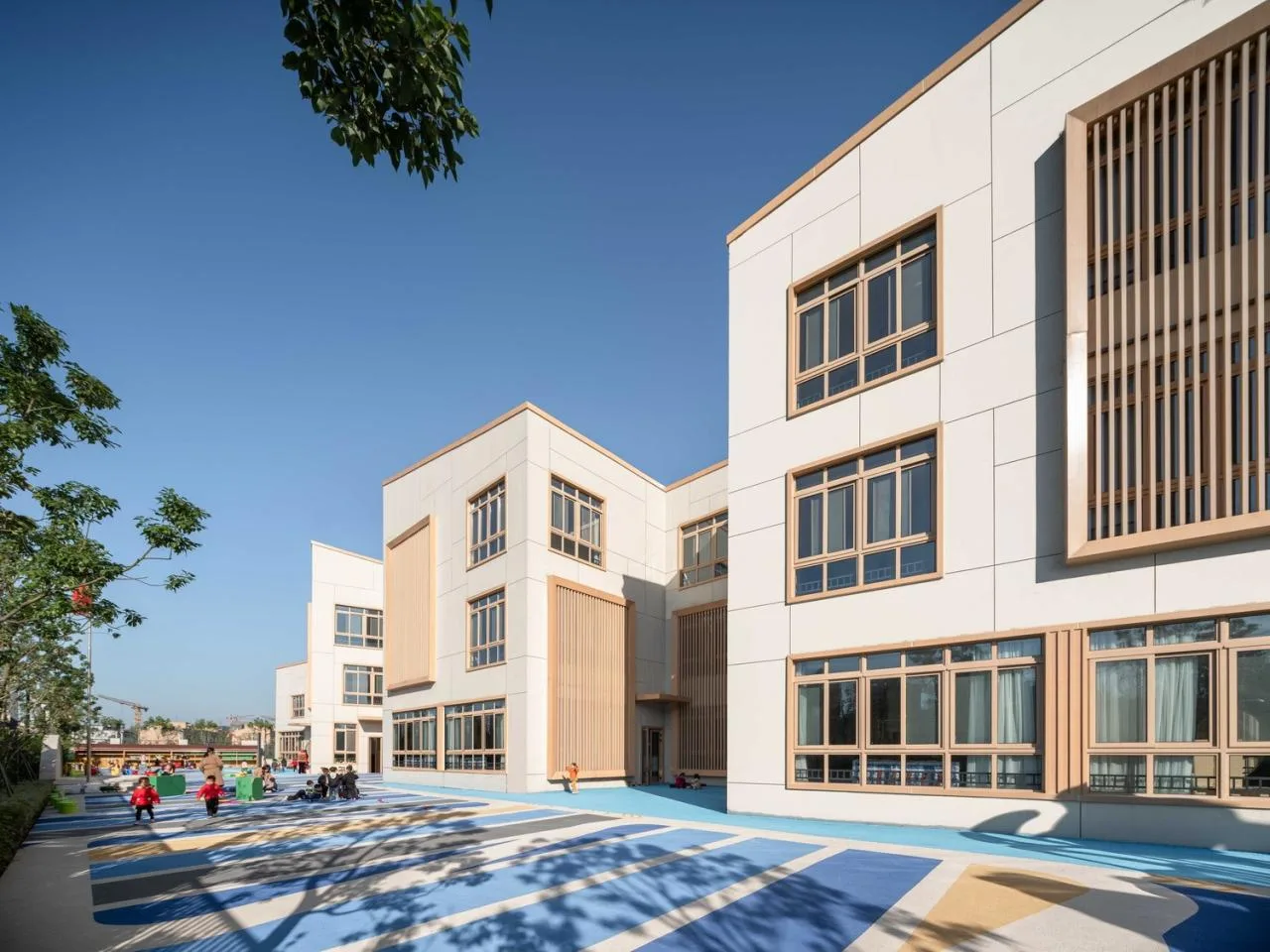
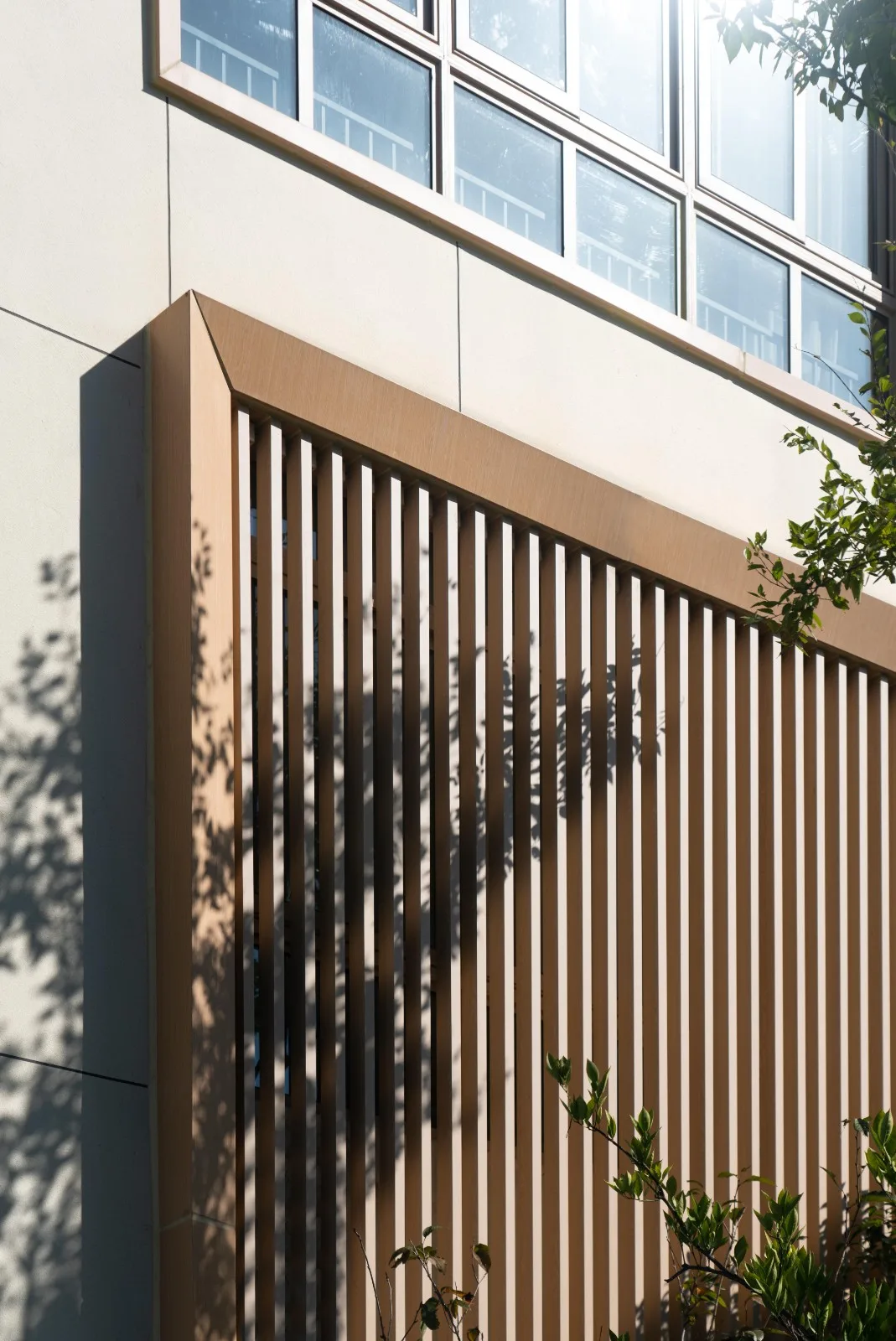
Large windows and corridor spaces incorporate numerous grilles that block direct sunlight while creating captivating light and shadow patterns. The imitation wood grain aluminum tube grilles, combined with rooftop greenery and courtyards, make children feel as though they are wandering through a forest, enjoying nature while growing strong in a green, healthy environment.
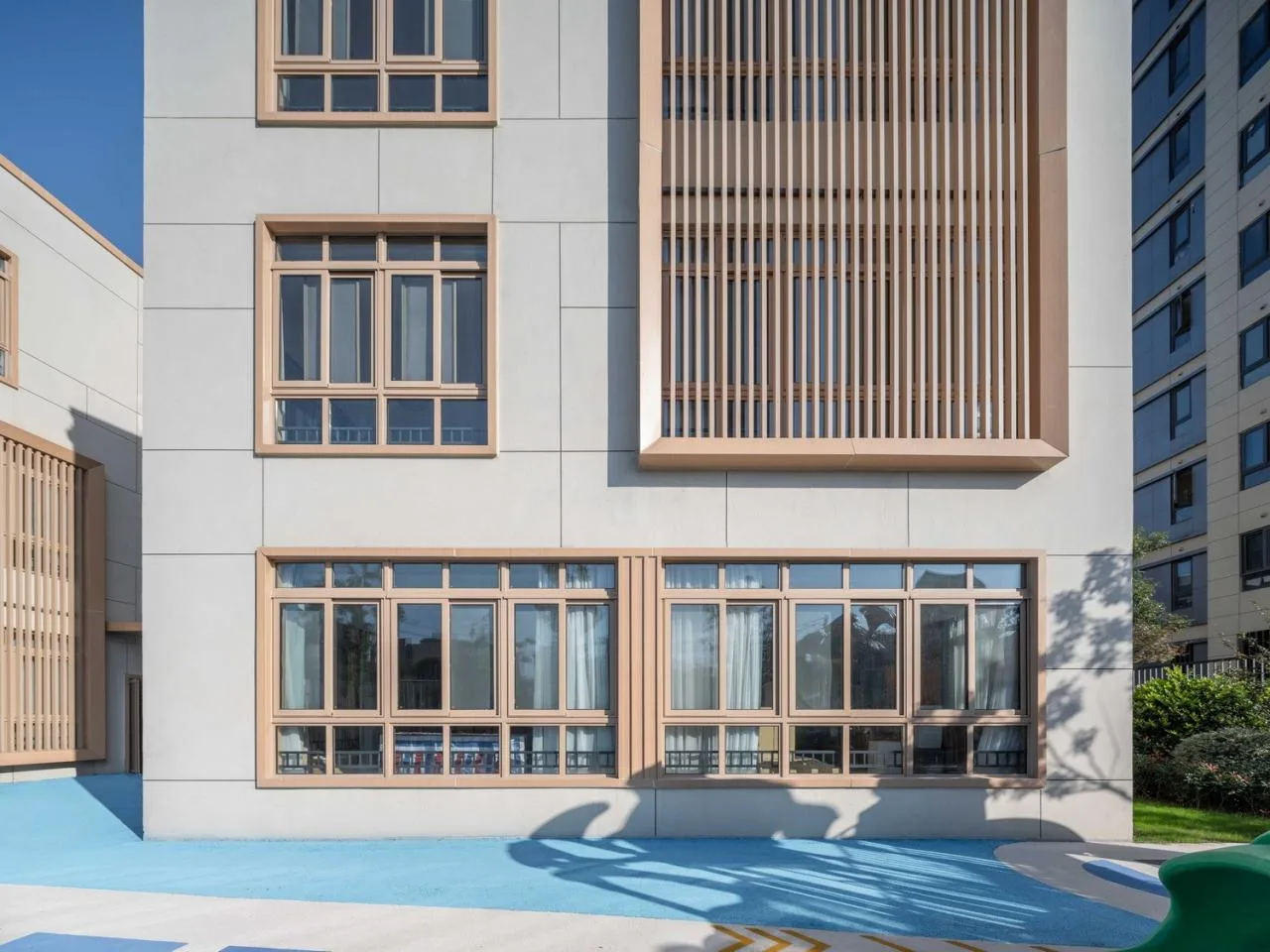
The classroom modules protrude playfully, with slightly tilted skylines that break the building’s massiveness, creating a rhythmic and symmetrical façade design that softens the overall impression.
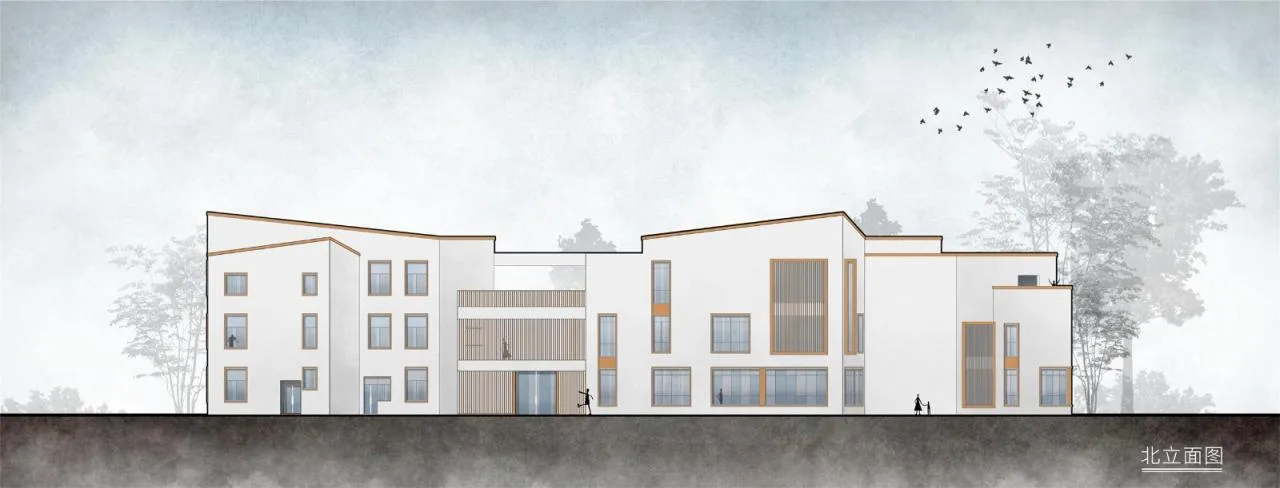
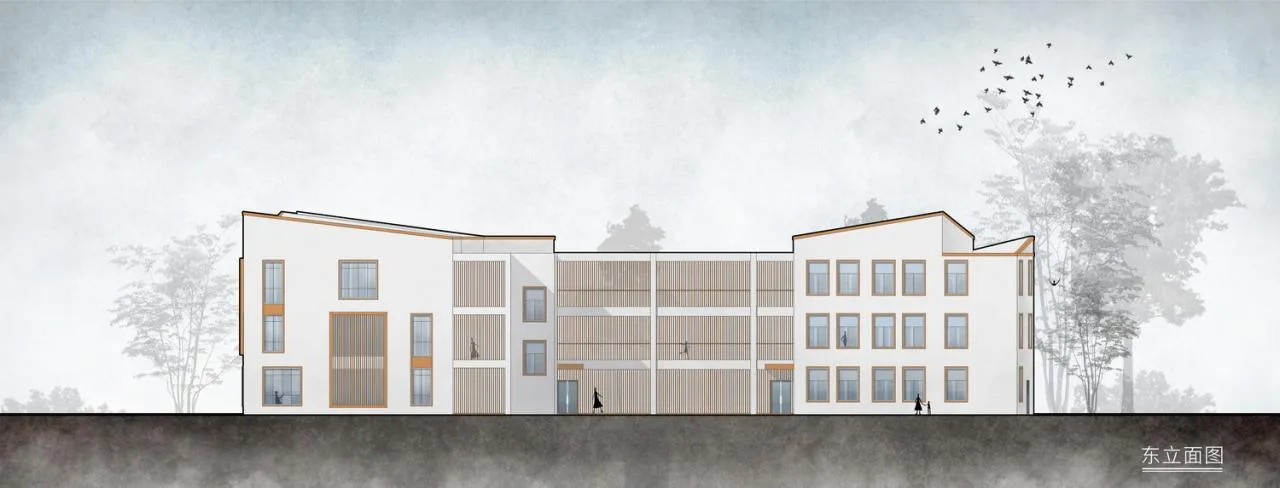
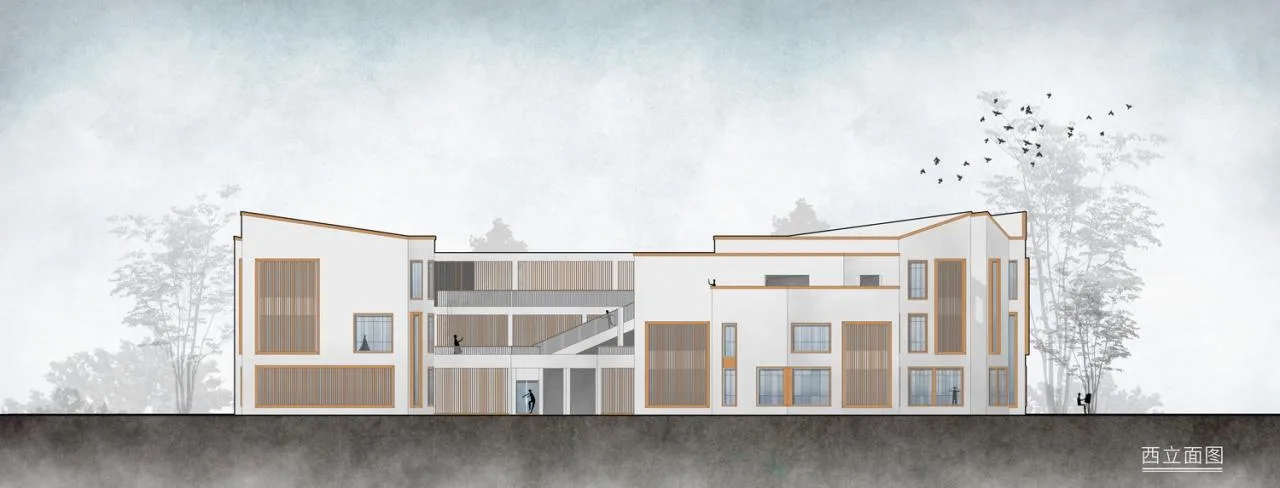
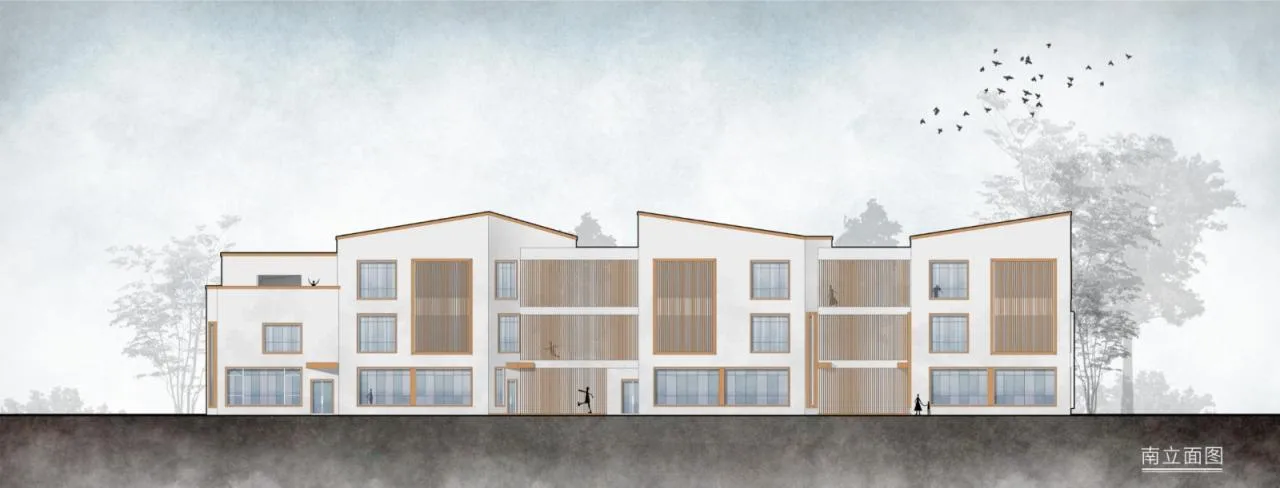
⊙ Elevation View
4. Light-Guided Organic Spaces
Different color and lighting environments evoke varied feelings, requiring differentiated designs according to functional zones. The kindergarten’s interior is dominated by pure white and natural wood tones, creating an open and bright atmosphere. White spaces serve as a canvas for user decoration, fostering a warm and comfortable environment.
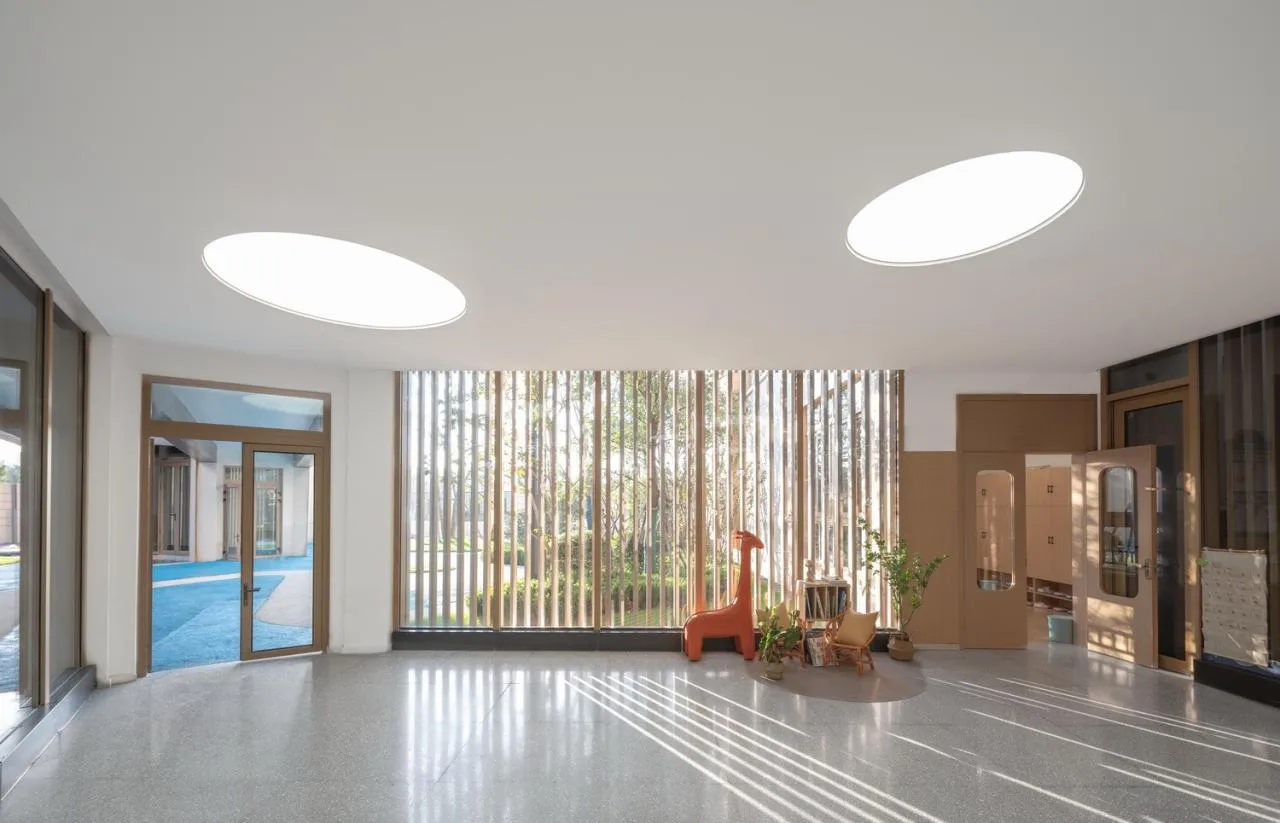
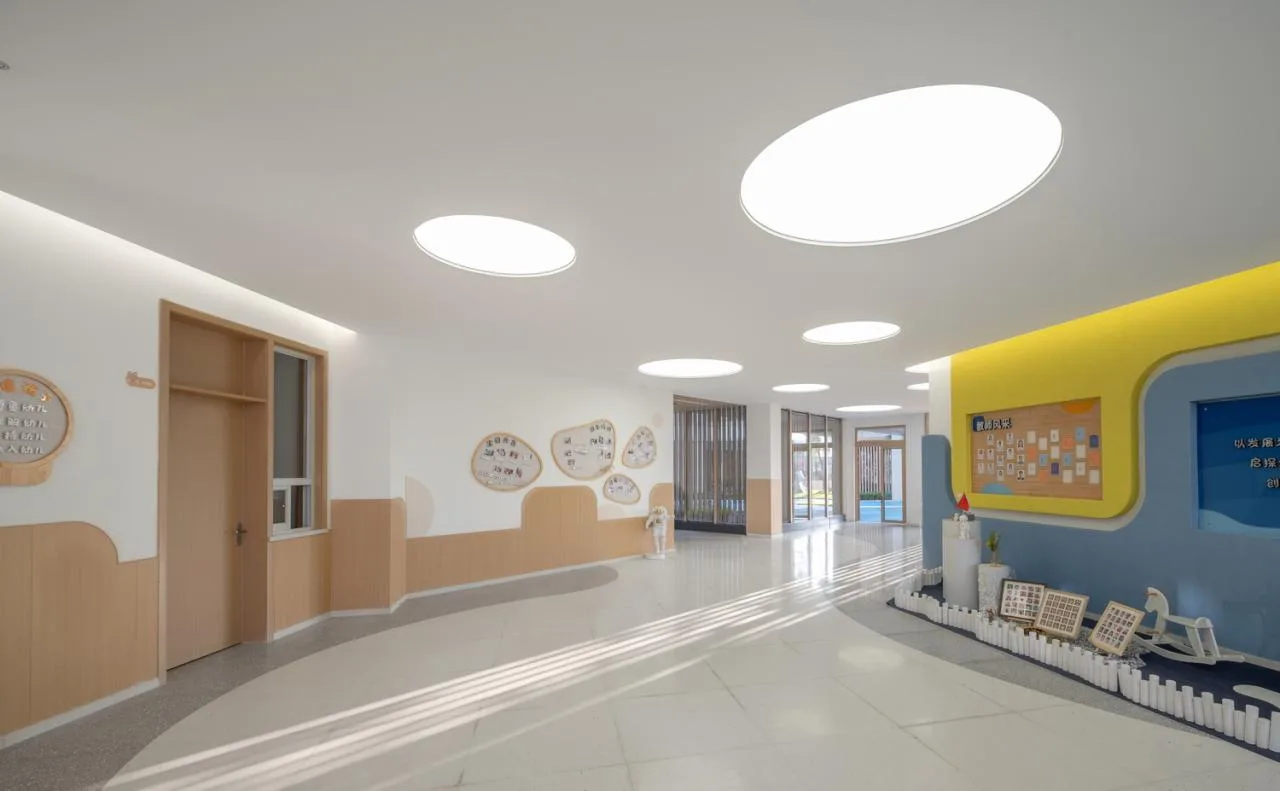
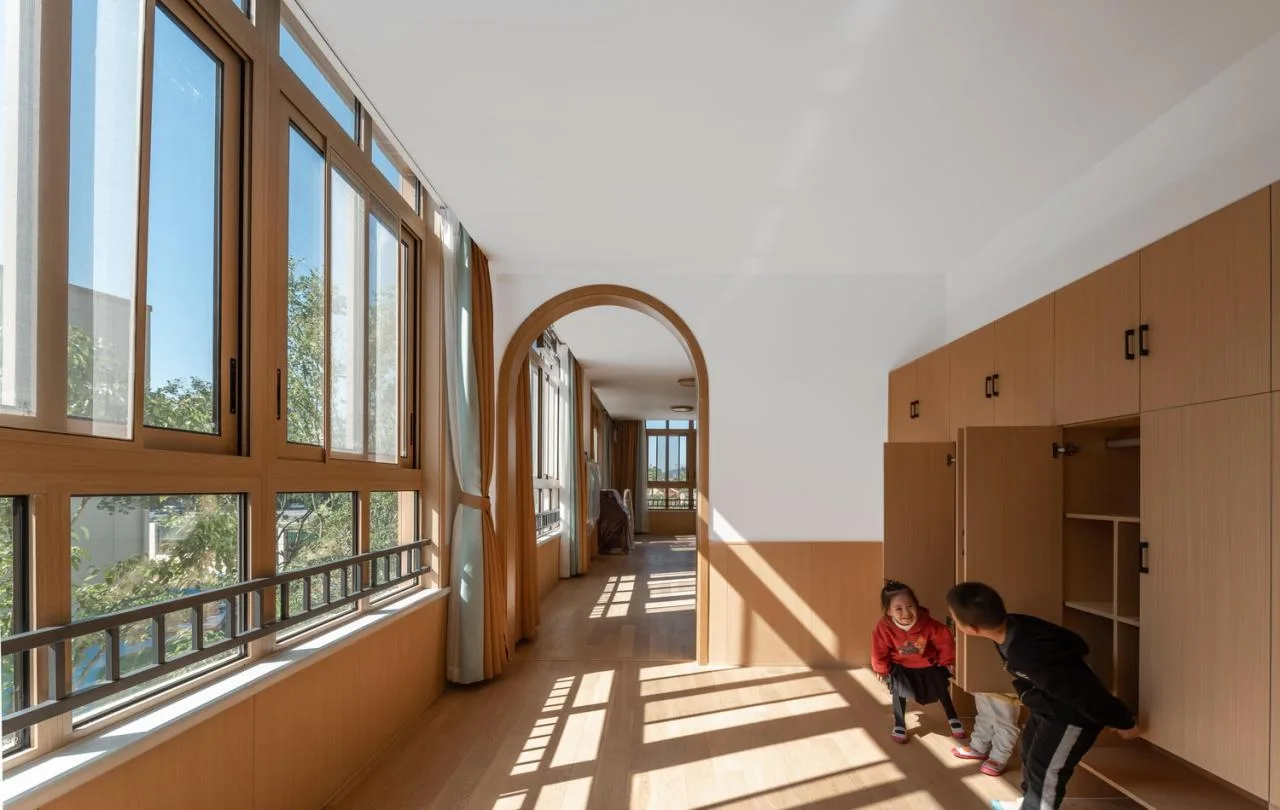
The corridors are narrower compared to rooms, featuring arched doorways that segment views and create a soft spatial effect. Large, bright windows invite outdoor scenery inside, enhancing spatial depth. The corridor width also accommodates functional cabinetry, optimizing space use.
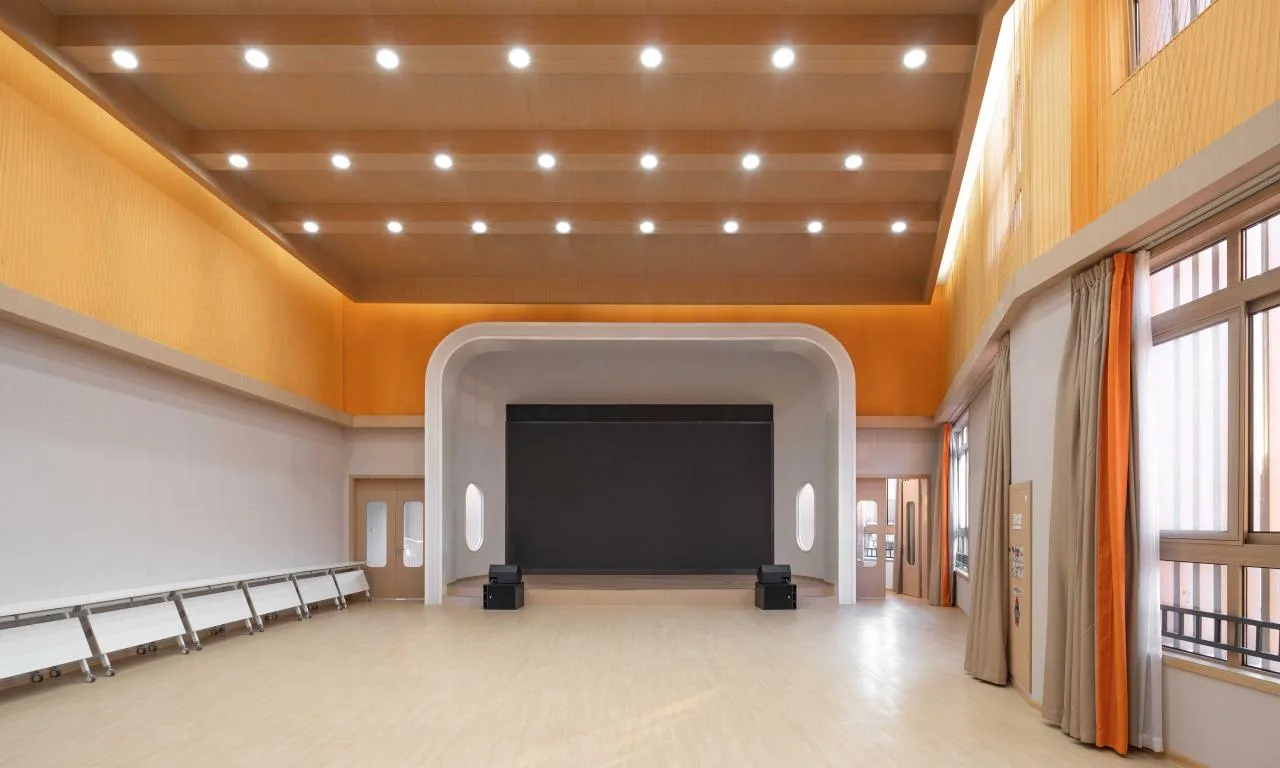
The multifunctional hall hosts various activities and features a large glazed façade with grilles that allow natural light while preventing direct sun exposure. The interior uses warm colors that are lively enough to stimulate young children’s energy.
The twelve classrooms are arranged into four three-story blocks, each accompanied by a courtyard positioned at the entrance to the children’s living units. These 7×1.9m courtyards are enclosed on three sides by grilles without a roof and are surrounded by walkways, creating semi-open spaces that balance privacy and openness.
Unlike fully enclosed indoor spaces, these courtyards offer ambiguity and enrich the architectural sequence. The interplay of light and shadow through the grilles provides engaging visual effects and psychological comfort. Additionally, the courtyard facilitates ventilation and natural lighting for adjacent washrooms, combining practicality with discretion.
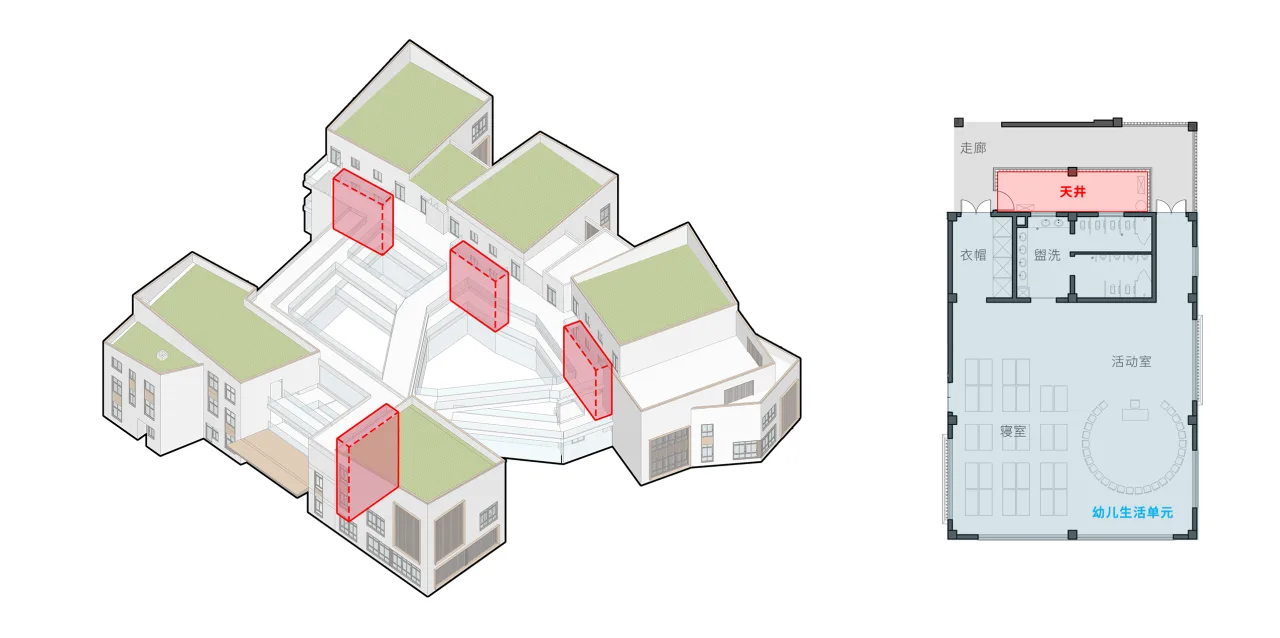
⊙ Courtyard Location Diagram
Conclusion
Kindergarten is where children first experience the world beyond home. Our goal was to create a space full of possibilities and freedom, encouraging children to embrace diversity and develop exploratory thinking. Throughout the design process, we sought to respect children’s perspectives by “getting down to their level,” listening to their voices, and appreciating the diversity and independence of building users.
Project Information
Project Name: Guoke Wenzhou First Kindergarten
Location: Ouhai Avenue, Wenzhou City, Zhejiang Province
Project Owner: Wenzhou Wanxian Real Estate Co., Ltd
Function: Kindergarten
Building Area: 4,800 square meters
Architectural Design: Chengzhi Design
Design Director: Xu Xiaokang
Design Team: Wu Di, Jin Lei, Zhou Xinjian, Liu Ran
Landscape Design: Shanghai Senyi Landscape Design Co., Ltd
Interior Design: Zhejiang Guangnian Space Design Co., Ltd
Construction Drawing Design: Zhejiang Natural Architecture Design Co., Ltd
Design Period: December 2017 – April 2018
Completion Date: May 2021
Graphic Arrangement: Chengzhi Brand
Project Photography: Xingzhi Imaging















Must log in before commenting!
Sign Up