
In the Yancheng Nanhai Future City Infrastructure and Public Supporting Project (Phase I) EPC general contracting bid, the bidding documents explicitly require the inclusion of a BIM model. The technical proposal must describe the establishment of the BIM model, as well as the inspection and guidance of the design’s scientific validity, progressiveness, and reasonableness. This aspect is assigned a specific weight in the overall scoring.
This project encompasses park construction, municipal engineering, water transportation engineering, and building engineering. The mechanical and electrical systems within underground spaces and projects like Huashi University are complex, involving numerous components, specialized functions, and high technical demands. Typically, construction drawings offer only preliminary pipeline layouts within the plane range, which often leads to clashes and conflicts in critical zones—especially areas with dense pipelines, intersections, and multiple professional pipelines in ceiling spaces during actual construction. These issues can negatively impact construction quality, speed, and even the functional and aesthetic outcome.
To address these challenges, BIM modeling is proposed as a tool to optimize design and improve the efficient operation and coordination of various mechanical and electrical systems. Using BIM software such as Revit and Navisworks, a three-dimensional BIM model of the project is created on the computer. This enables the integration, arrangement, navigation, inspection, and adjustment of various professional pipelines within the 3D model, ultimately arriving at a comprehensive, balanced, and reasonable pipeline layout plan.
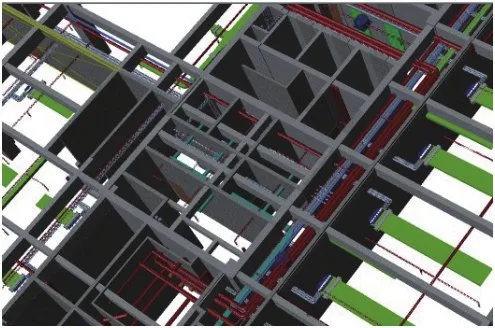
Figure 1: Schematic diagram of model nodes
Based on the established building model, BIM technology enables node collision analysis and clash detection, which quickly identifies design errors before construction begins. This approach prevents rework and delays during construction, accelerates project progress, reduces material waste, and lowers construction costs.
For on-site verification, virtual construction is implemented through BIM software modeling to anticipate construction challenges and make construction planning more vivid and accurate. Additionally, by comparing virtual construction models with actual site photos, dynamic control and management of the entire construction process become possible.
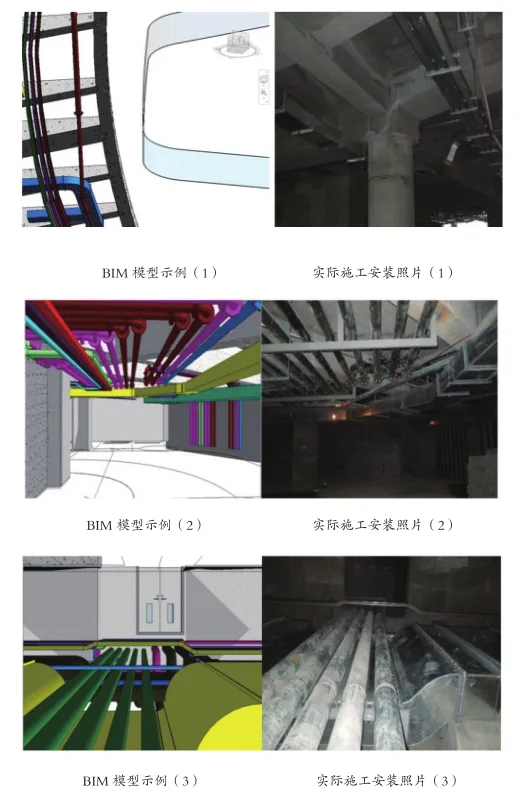
Figure 2: Example of BIM model alongside actual construction and installation photos
Regarding modeling and computational complexity, BIM’s automatic component quantity statistics function allows for rapid and accurate counting of various components, reducing the workload of cost estimation. It also facilitates timely evaluation of cost fluctuations caused by design changes affecting material quantities. Theoretical engineering quantities can be extracted from the BIM model to guide procurement, while actual labor, material, and machinery quantities can be derived from the schedule model for cost monitoring. This enables comparison and analysis among model quantities, actual consumption, and contractual quantities, supporting dynamic cost management.
When calculating steel bar samples, BIM technology replaces manual sampling. Building models can be quickly created by drawing or importing CAD electronic drawings, and the software automatically performs sampling calculations of various components according to specifications and construction requirements. Offering broad processing capabilities, precise results, intuitive presentation, and optimized material cutting solutions, BIM can replace over 90% of manual sampling work, enabling personnel to complete this task efficiently and professionally. These capabilities significantly shorten quotation times and help maintain budget control.
In the EPC bidding for the Jiangsu Binhai liquefied natural gas (LNG) project’s dredging works—including the terminal, harbor basin, and waterway—the bidding documents require submission of BIM results with explanations of their rationality and advantages, which factor into scoring. This project involves constructing a new LNG berth designed for ships ranging from 80,000 to 266,000 m³ capacity, with the main ship type being 177,000 m³. The design considers dual berths for long-term cargo offloading. A new workboat and large cargo terminal will also be built to accommodate 3,000-ton general cargo ships and project workboats. Additionally, a wave and sand barrier embankment approximately 2,510 meters long, 700 meters wide at the entrance, and with a 4.0-meter elevation at the top will be constructed. Utilizing BIM for detailed design and segmentation of this large-scale project is a sound approach.
For efficient design management, the project is divided into several units and worksets, which are then linked together. Given the project’s size and workload, it is essential to organize the overall model into three main parts: the LNG terminal, the workboat terminal, and the torch platform. Each major section can further be divided into multiple professional worksets based on model depth, enabling collaborative design efforts.
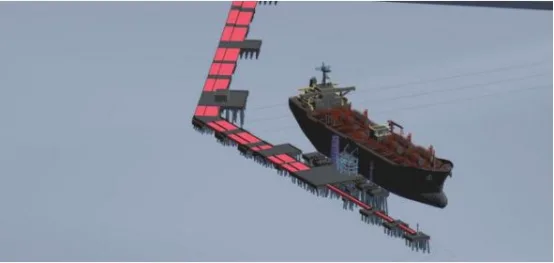
Figure 3: LNG Terminal
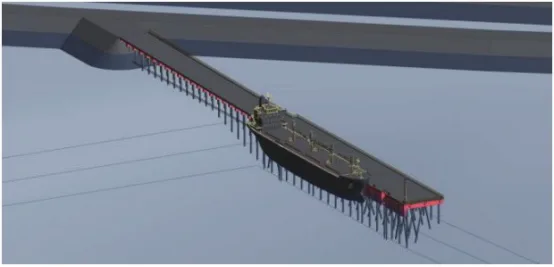
Figure 4: Workboat Terminal
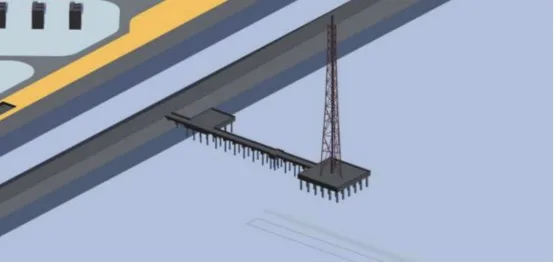
Figure 5: Torch Platform
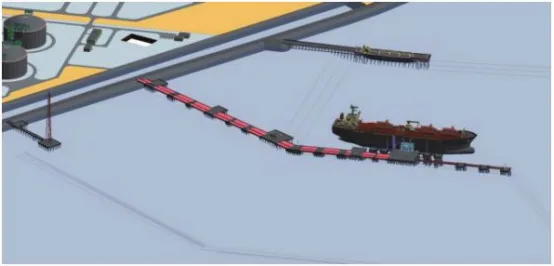
Figure 6: Overall Model
After completing collaborative BIM designs for the three major sections, the overall model is integrated through linking, as illustrated below.
BIM technology allows simulation of the entire construction process and optimization of design schemes. This approach addresses challenges of large project volumes and tight schedules while ensuring ease of implementation and minimizing project investment.
From the application of BIM technology in the bidding documents of these two projects, it is evident that BIM helps analyze key construction challenges, optimize plans, reduce costs, and increase the feasibility of new technologies. It minimizes conflicts during construction and shortens project duration. The intuitive visual models enhance the technical bid’s strengths, providing a significant advantage in the bidding process.
Source: “China Water Transport,” February 2022
Authors: Guo Mengyue and Fang Jingwen
















Must log in before commenting!
Sign Up