
When working with Revit series software, it is recommended to link 2D or 3D building CAD files as the basis for structural modeling. This is because the beam and column families in Revit architectural 3D drawings differ from those used in structural modeling. Therefore, it is important to independently build a structural BIM model.

Linking 2D or 3D building condition diagrams mainly provides accurate component positioning for structural modeling. Begin with the first-floor plan, using dimensions from the provided floor plans, elevations, and section drawings. Utilize Revit commands—such as axis, foundation, walls, beams, columns, floor slabs, doors, windows, and stairs—to draw positioning axes and the main structure based on the building’s base map.
Next, proceed to model the second floor. If the layout on the second floor closely resembles the first, you can selectively copy components from the first floor to the second. Then, refer to the detailed drawings to add or modify components as needed. This approach streamlines the modeling process, saving time until the complete 3D model of the project is finalized.
The 3D models created using Revit software have the following key characteristics:
(1) The fundamental unit of description is the building element;
(2) The building plan, elevation, and section information are interconnected, automatically preventing inconsistencies common in 2D design drawings;
(3) Support for collaborative workflows across multiple disciplines on a shared data platform;
(4) Visual display capabilities that intuitively highlight potential design issues.
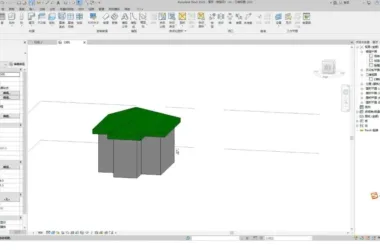
Revit series software, based on BIM modeling, facilitates the creation of complete buildings and structures through detailed 3D models. These models incorporate not only geometric details—such as length, width, and height—but also essential data including spatial positioning, material specifications, and component relationships. With Revit’s built-in multi-view browsing feature, users can explore the building’s overall form and intricate details from any angle, achieving a full 360° view without blind spots.













Must log in before commenting!
Sign Up