
The deepening stage of the plan focuses on further optimizing the design to ensure its feasibility and compliance with technical requirements. Once finalized, the design must be approved by the relevant departments before being handed over to the construction drawing design team.
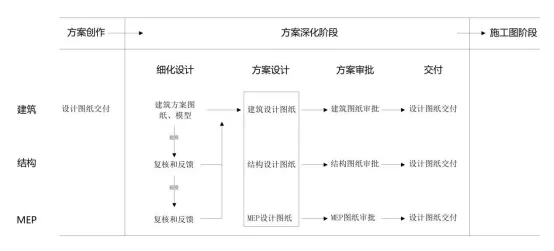
1. Traditional Design Process
The traditional design process is typically refined by the architectural team. During this phase, software tools like Ecotect and GBS are utilized to simulate and enhance the design scheme, ensuring it meets technical specifications and other requirements. After modifications, the architectural materials are submitted to the structural and MEP teams for review and feedback. Following coordination and adjustments, each of the three disciplines produces separate two-dimensional drawings. Throughout the drawing process, multiple submissions and reviews occur at different intervals to maintain consistency in the design outcome. Once finalized, the drawings undergo a thorough review before being delivered.
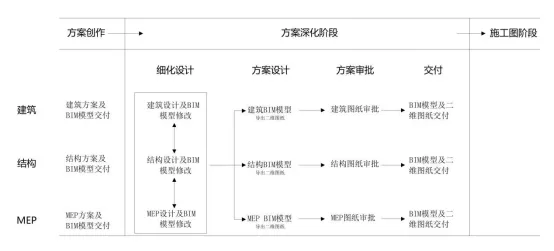
2. BIM Collaborative Design Process
The BIM-based collaborative design approach builds upon the information model developed in the previous stage. Similar to before, it employs a parallel collaboration method where the architecture, structure, and MEP teams work together on the same platform. This setup allows real-time communication and feedback, facilitating coordination among the various specialty models. The teams export the necessary 2D drawings for review and deliver both the models and drawings to the construction drawing design department.
3. Comparison of the Two Methods
① Traditional two-dimensional design often results in inconsistencies between plan, elevation, and section views. In contrast, BIM collaborative design exports all drawings from a single model, effectively eliminating such errors.
② At this stage, all three departments—architecture, structure, and MEP—collaborate, significantly increasing efficiency under the BIM platform. However, software interface challenges remain. BIM models must be exported as DWG files to interface with most simulation software, which complicates the quantitative design process. Since two-dimensional drawings are inherently in DWG format, they allow more straightforward simulation.
③ Regarding workload, the BIM approach increases the effort during this stage, as it involves tasks traditionally reserved for the construction drawing phase. Nevertheless, when viewed over the entire design cycle, the overall workload does not increase.
④ Looking ahead, auditing processes are expected to shift gradually toward three-dimensional methods. The format of auditing documents will evolve from two-dimensional drawings to 3D models, greatly improving both the quality and speed of audits.
















Must log in before commenting!
Sign Up