
Construction drawing design represents the final phase of architectural design, focusing primarily on resolving technical challenges, process workflows, and material considerations during construction. The goal is to produce precise, error-free drawings that effectively guide the construction team to successfully complete the building project.
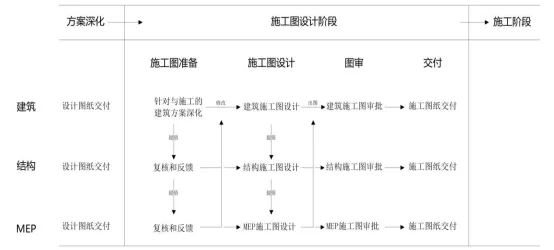
(1) Traditional Design Process
In the traditional construction drawing design process, each discipline reviews and revises the approved drawings based on the previous stage, contributing their professional requirements. Information is exchanged between disciplines, and the construction drawing phase mainly deepens the design outcomes from earlier stages. Following coordination, the construction drawing design commences.
This method relies on interactive collaboration, where each discipline coordinates to identify and resolve errors. After comprehensive integration, all drawings are finalized. Upon approval, these drawings are delivered to the construction team for implementation.
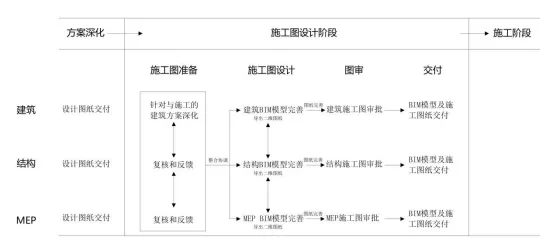
(2) BIM Collaborative Design Process
With BIM collaborative design, some construction drawing tasks are completed during earlier stages, in contrast to traditional workflows where modeling begins only at the construction drawing phase. The focus shifts to refining two-dimensional drawings.
During construction drawing preparation, simple refinements and modifications to the model are performed. Architecture, structural, and MEP disciplines integrate their models and use BIM software to detect errors, omissions, clashes, and discrepancies within the design. Once corrections are made, annotations and comments are added to the 2D drawings.
These 2D drawings are then exported for review and delivered together with the 3D model to the construction department, ensuring a comprehensive and coordinated design package.
(3) Comparison of the Two Methods
① Traditional interactive design methods struggle with information sharing at this stage, whereas BIM enables real-time, parallel information exchange, significantly boosting work efficiency.
② Two-dimensional drawings often fail to capture all building details and can miss errors during cross-disciplinary reviews. BIM software’s visualization capabilities allow for more thorough detection of errors, omissions, clashes, and inconsistencies, greatly improving accuracy and efficiency.
















Must log in before commenting!
Sign Up