
BIM collaborative design extends beyond cooperation within or between professions; it also fosters collaboration across every stage and among all designers involved. This approach emphasizes parallel workflows, where every designer actively collaborates at each phase of the project. Such collaboration is key to resolving many challenges faced by today’s design firms.
However, traditional design methods, which have long been established, still hold value. Completely abandoning these methods during the current transition period would hinder the adoption and growth of new approaches. Studying the BIM system in the context of China’s current design industry is essential for its successful development in the country. By comparing various design stages and considering China’s national conditions, the following insights emerge:
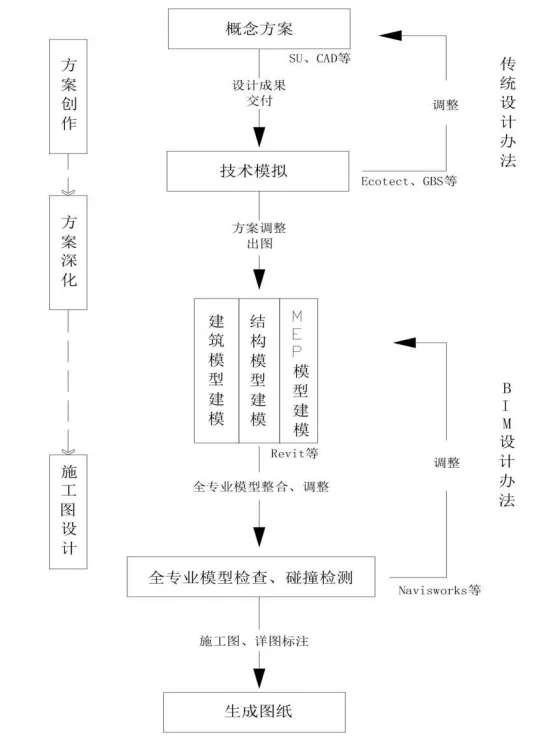
During the design and creation phase, architects need to rapidly express their ideas and engage in discussions with their peers.
At this stage, speed of expression is crucial. Considering the current landscape in China, architectural design is primarily led by the architecture discipline, and using non-BIM software such as SketchUp and CAD often offers greater advantages than mainstream BIM platforms. Additionally, many simulation tools used in later design stages rely on traditional 2D drawing formats. Due to the incomplete integration of BIM software interfaces, traditional methods remain more effective at this point.
BIM modeling work typically begins during the plan development phase, allowing designers to fully leverage BIM’s benefits. This gradual introduction facilitates acceptance among designers, improves efficiency, and reduces potential design errors. While this approach may increase workload from a single-stage perspective, it effectively shifts some construction drawing tasks earlier in the process.
In the construction drawing phase, unlike the project described here, most modeling is already completed. The primary tasks include refining detailed models for all disciplines, integrating these models within BIM software for further optimization and clash detection, and, once verified error-free, annotating and exporting construction and detail drawings. This process enhances both work quality and efficiency, culminating in the delivery of finalized drawings and models to the next project team.
















Must log in before commenting!
Sign Up