
Spectacular constructions are often seen as accidental or explosive designs occurring sporadically. Building such structures is incredibly challenging, and many artists and architects hesitate to undertake them. Consequently, most people—especially the general public—have only a limited impression of monumental forms, with visual impact becoming the primary criterion for judgment. This tendency leads modern architecture to shield its more complex aspects from becoming mere tools for public commentary and marketing. So, how should we approach constructing our personal and social spaces through these architectural wonders? In this issue, the editor invites you to explore the concept of “Spectacle” and uncover the intricate “inner” world hidden beneath these grand exteriors.
In recent years, the public has increasingly appreciated the wonders of space itself—complex structures and gallery-like interiors filled with light—while the exterior often becomes a play of forms and context. This echoes Le Corbusier’s profound experience with light and form during his first visit to the Acropolis in Athens, a sentiment now widely shared. The values promoted by the first generation of modernists have been absorbed and are now presented in ways that engage non-professional audiences in architectural “performances.”
It is undeniable that truly magnificent architecture embraces these values. Architect Charles Moore once described the ‘moment of Jesus Christ’—a weary traveler arriving at a hotel in Portman, struggling through a low, dark entrance into the lobby, only to witness the grand space roar overhead as he calls out for his son. Such experiences evoke a feeling of smallness, much like the awe we expect from spectacular architecture.
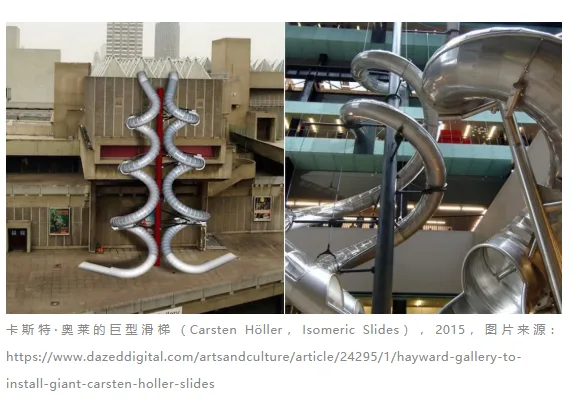
However, our appreciation for spectacles has become somewhat distorted. The spatial and tactile values of architecture have dangerously slipped into a shallow and superficial realm. Given this, the complex structures and spatial abstractions of such works require focused attention to truly “read” the wonders of their “inner” worlds. Like challenging modern music and painting, this “difficult” architecture has been visually translated for the public through culture and media, garnering only surface-level recognition.
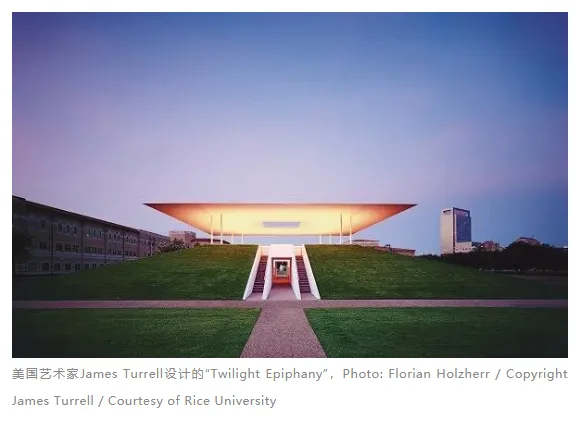
Amidst this evolution, the civic sphere emerges as the ideal platform to showcase the art of constructing wonders. These structures prompt us to reflect on our bodies, social relationships, and how we build both personal and communal spaces. Next, the editor will present several case studies to explore design details that go beyond creating merely grand exteriors.
01
Zaha’s Spatial Wonders
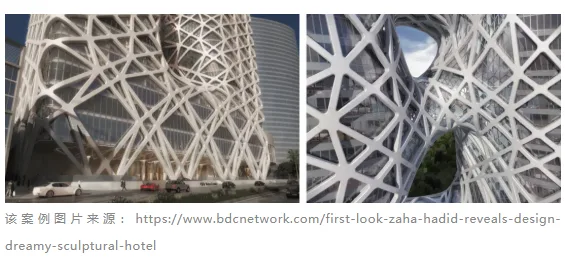
The Dream City Hotel on Macau’s Cotai Strip, designed by Zaha Hadid Architects, stands as a spectacular building with exposed structural frameworks. The tower rises over 40 floors and offers approximately 780 guest rooms, suites, and sky villas. Amenities include conference and event spaces, game rooms, restaurants, spa centers, and an aerial swimming pool. All these features are unified under a single cohesive shell, integrating various areas and support facilities behind the residences and enabling seamless operation under one roof.
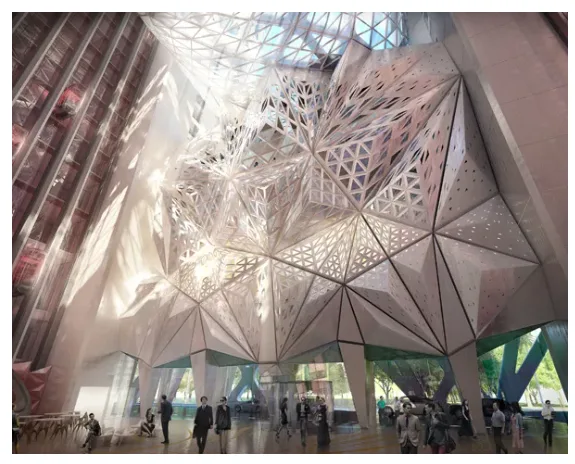
The tower’s design blends dramatic public spaces with spacious guest rooms, employing innovative engineering to unify form and function. The rectangular base is compressed into a cohesive whole, featuring a series of central gaps that define many internal public spaces. Traditional architectural elements such as roofs, walls, and ceilings merge to create a sculptural form. The exposed exoskeleton intensifies the building’s tension, optimizing the interior layout while enveloping the entire structure. This external framework also defines the building’s composition and its relationship with the surrounding environment.
02
The City of Heaven
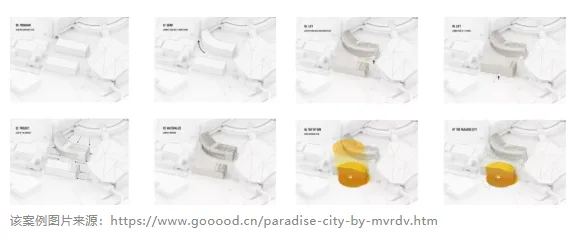
Paradise City, designed by MVRDV, is a dual-structure entertainment complex located within a new tourism hub in Seoul, South Korea. The commercial complex and nightclub share an architectural language that echoes the surrounding buildings. A golden orb floats in front of the structure and plaza, boldly marking the nightclub entrance like a beam of light leading into the dark interior. While maintaining mystery, the building connects to urban planning, rising like a suspended curtain open to visitors. This massive concrete form creates a gentle spectacle, presenting a smoother aesthetic and softer design lines.
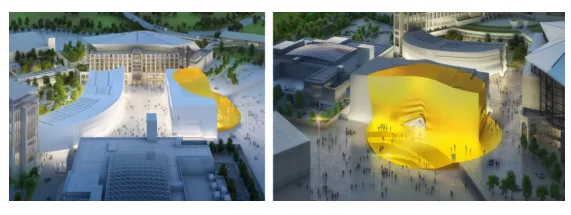
The project utilizes two simple volumes to create a new urban space. These spatial clusters leave their mark on the surrounding facades and extend across two buildings. The 3,600-square-meter commercial complex connects directly to the casino, providing easy access for tourists, while the adjacent 6,200-square-meter nightclub maintains a linear position. Elevated above service areas and underground parking, Paradise City’s urban platform offers the spectacle expected from entertainment architecture, balancing grandeur with understated simplicity.
03
Alien Vortex
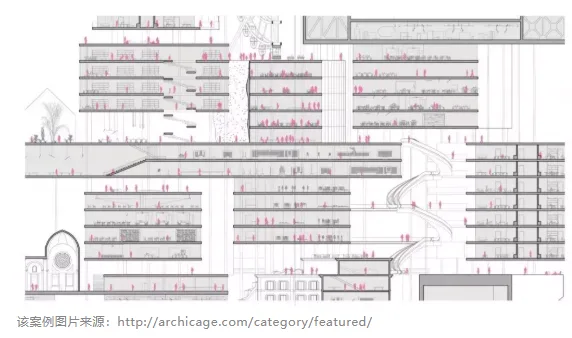
“Maelstrom,” designed by Bennett Oh from the University of Waterloo, is a hybrid wonder combining architecture and urban planning. The project reflects the complex nature and demands of urban life, intersecting various systems, populations, projects, and activities. It forms an internal microcosm composed of unexpected events and interactions.
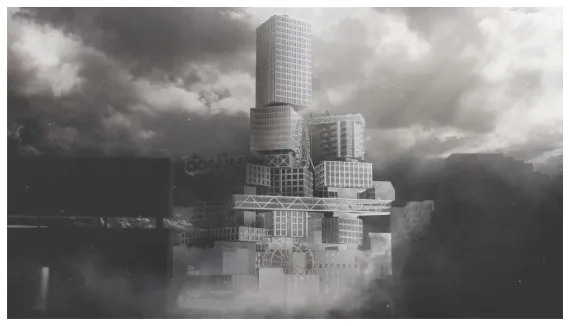
To emphasize this concept, vertical movement is approached uniquely. Avoiding planning errors—where urban blocks serve solely as traffic corridors—the project intertwines spaces and activities tightly, forming a complex network of public areas. The spatial journey between each level becomes a spectacle itself. The structure follows a low- to mid-rise integration concept, complemented by a striking mixed-use high-rise. The aim is to emulate the bustling urban experience while maintaining clear hierarchy and intuitive navigation.
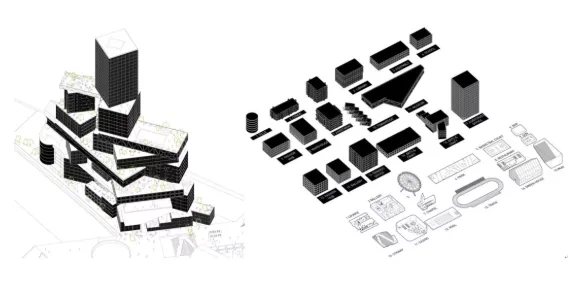
Every block, ceiling height, and facade dimension is optimized. The public space enclosed by these blocks transforms into a vibrant city living room. These spaces bridge the city and the building, creating new public levels for interaction between tourists and residents. The architectural structure balances ease of construction and cost, ensuring the vision is achieved effectively.
04
The Wonders of Culture
Cesis, a small town in Latvia located in the northern Vizeme Highlands, prioritizes tourism for urban development. Medieval churches and castles are major attractions, but despite their historical value, they struggle to draw large crowds. Cesis requires a new cultural landmark to boost its economy and shape an appealing urban identity. Designer Julia Khomutskaya aims to bring fresh tourist wonders to Cesis inspired by the “Bilbao Effect.”
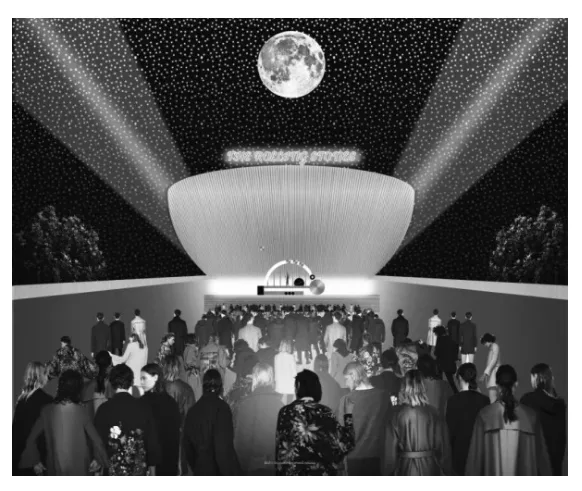
In 1991, Frank Gehry’s Guggenheim Museum in Bilbao transformed a declining industrial port city into a world-renowned tourist destination. Similarly, this project centers on music, aiming for a spectacular effect by demolishing old buildings and redeveloping the former factory into a music center. Multiple music platforms and multifunctional halls unite under one roof. Beyond hosting festivals, the venue serves as a cultural and educational hub for the city.
This avant-garde architectural sculpture has become a modern symbol, emphasizing strict functionalism while leaving a profound impression on the public. The spatial experience conveys grandeur from the exterior to the interior.
05
The Constantly Growing Spectacle
Form is equally important in both film and architecture. By questioning this, the competition project by Jinish Gadhiya and Vatsal Upadhyay creates a metaphorical link between the two, challenging pure architectural form and exploring the essence of Indian cinema, or ‘Bollywood.’
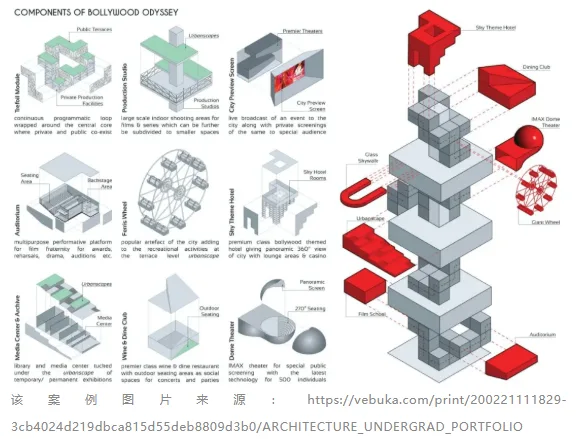
The bottom-up design disrupts traditional construction norms. The module functions as an open loop, seamlessly connecting private and public spaces. Growth radiates around a central point offering panoramic city views. A large-span, column-free volume serves as a production studio, nestled between modules to create an urban landscape in the sky above. This arrangement provides public spaces on every floor, in contrast to typical high-rises, which have public areas on only one level.
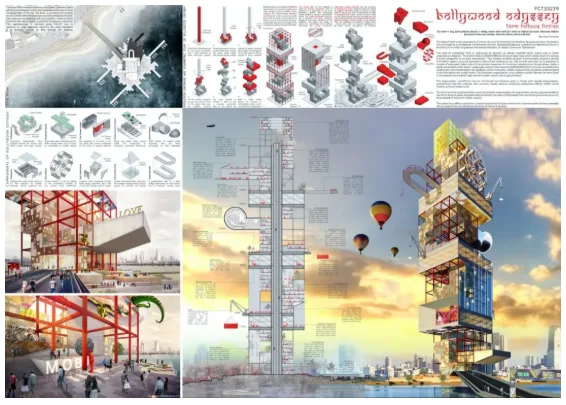
This structure comprises a film academy, media center, corporate production offices, an IMAX dome theater, and a preview cinema. Ground-level additions such as ferry terminals, Ferris wheels, and glass pedestrian bridges root Bollywood within a “unified Indian culture” as a unique art form. The tower offers a diverse cultural experience where cinema blends with daily life, creating a continuously evolving visual and architectural spectacle infused with mixed reality and fantasy.
06
Environmental Wonders Equipment
Ocean acidification has accelerated in recent years, severely impacting marine ecosystems. To address this, Gary Kellett designed the environmentally friendly device Coastalkape as part of the evolo competition. Its goal is to regulate seawater pH by adding pulverized coccolithophores. The ideal location for this project is England’s southeast coast, home to a vast chalk geological belt. The plan involves excavating these chalk mines, refining the material, storing it in large silos, and pumping it into the sea to neutralize acidification.
The Coastalkape functions like a giant mobile excavator and refinery, slowly moving along the southern Forland cliffs. It continuously excavates thin chalk layers and processes them into fine particles no larger than 500 microns. This ensures the chalk powder remains suspended in the upper seawater layers, carried further by ocean currents.
On the surface, mechanical attachments monitor pH levels and transmit data back to shore. When acidity rises, Coastalkape activates, spraying a fine chalk mist through high-pressure jets along a pipeline. This creates a vast neutralizing plume on the sea surface, a magnificent spectacle itself.
Sometimes we hope that constructing wonders can respond to global changes—rapid advances in molecular nanotechnology, shifting climates, or even the rise of artificial intelligence. Faced with these immense transformations, individuals often feel small and powerless. Architecture, as one of humanity’s most intimate artificial environments and shelters, naturally plays a public role.
In an overwhelming world, there is much work ahead. These wonders must carry deeper significance beyond visual awe. They should genuinely impact humanity and engage with the natural environment. To realize these ambitions, students and designers need to move beyond media-driven models of spectacle construction and explore the profound social meanings embedded in the delicate design of monumental structures.
















Must log in before commenting!
Sign Up