
Located at the foothills of the Taihang Mountains and beside Yishui Lake, Yixian County’s villages in Baoding City, Hebei Province, have seen remarkable transformations over the past two years. Situated over 100 kilometers from Beijing and 200 kilometers from Shijiazhuang, this 142-square-kilometer area of mountains and waters has become a “construction testing ground,” with new projects frequently initiated. Simultaneously, art is taking root and flourishing in the countryside. A once-primitive ancient village now harmoniously blends simplicity with contemporary fashion and art, offering a lifestyle that’s close to the city yet deeply connected to rural life. Tiangang Village, a circular art museum, stands at the forefront of these changes.
01. Preparing the “Soil”
In 2019, LongiTaihe Group restructured its cultural, tourism, and commercial sectors, leading to the official establishment of Yuange Cultural and Business Travel Group (“Yuange”). The Yuange Yishui Lake Cultural and Tourism project, which includes Tiangang Zhixing Village, entered its planning phase. That same year, Jianlan Architecture was invited to lead planning, architectural design, and operational tasks. At the time, both developers and design teams faced urgent challenges in the field, making Tiangang Village their first step towards revitalization.
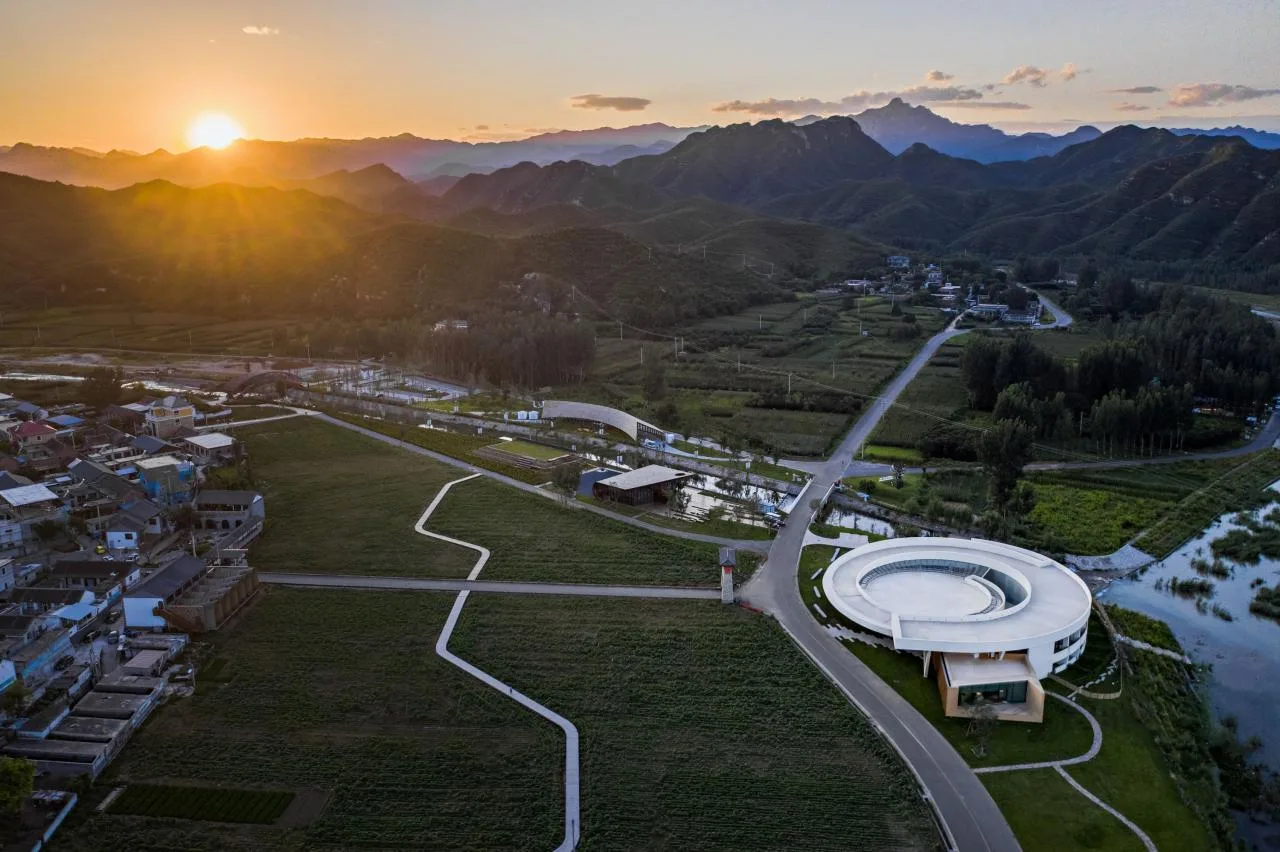
Tiangang Village, nestled deep within Yixian County’s mountains, faces several challenges: traffic congestion, limited infrastructure, conservative community attitudes, and a generally low cultural level among the labor force. Despite its scenic surroundings and rich, unique folk culture—including martial arts clubs and the Jiuqu Yellow River Lantern Festival—the village has struggled economically for years. In 2013, it was designated a key provincial-level poverty alleviation target. The 2016 Hebei Province tourism development conference sparked industrial poverty alleviation efforts, leading to improved infrastructure and emerging specialty industries. However, without a robust industry, capital, or talent network, Tiangang Village was unable to unlock its full economic potential.
Revitalizing the village was like a strategic game of Go, where every move and stage is crucial in forming a cohesive whole. Building upon asset consolidation and infrastructure upgrades, Yuange and Jianlan anchored their first project, Zhixing Village, in Tiangang Village. Their goal was to ignite development in the Yishui Lake western area and ultimately create an “Alliance Village.” For Jianlan Architecture, with years of experience in rural revitalization and successful urban-rural projects, Tiangang represented a fresh opportunity. By integrating planning, design, and operation, and building on their success with Comprehensive Rural Revitalization 1.0 in Jingyang District, Deyang, Sichuan Province, Jianlan embarked on Rural Revitalization 2.0 in Tiangang. Their mission: “to promote human change through the integration of knowledge and action, opening new possibilities for the countryside.”
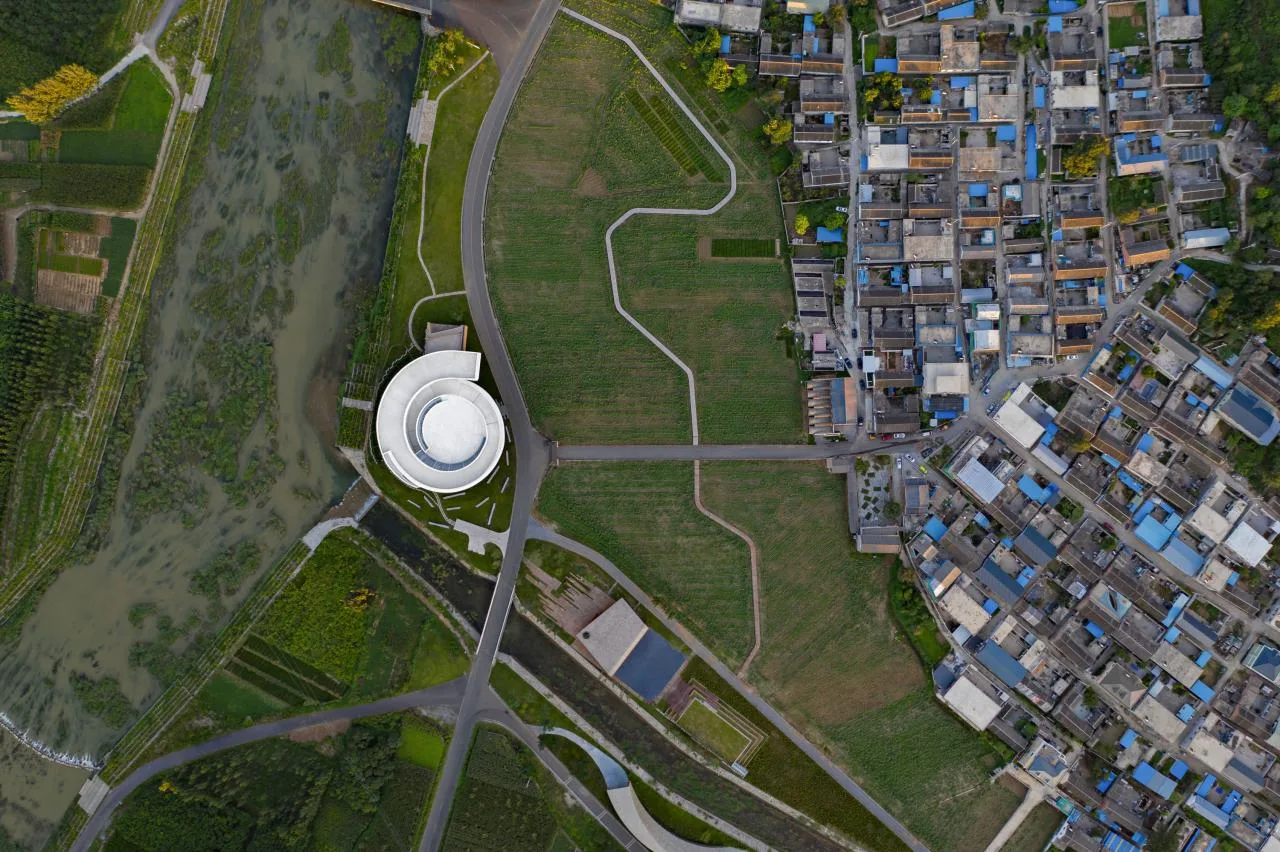
As wood cannot stand without a foundation, revitalizing rural areas requires nurturing the “soil” to support growth. Jianlan approached the countryside holistically, cultivating the “soil” in five dimensions: methodology, industrial strategies, new farmers, intrinsic motivation, and problem-solving. This approach enriched the foundation, enabling sustainable industries and fostering urban-rural integration. Tiangang Village served as a “counterexample” during its first village upgrade phase: a semi-circular “tourist service center” was built at a key Huanhu Road intersection, offering panoramic views. Though not adjacent to the lake, it was accessible by boat. Despite favorable site conditions, the building remained vacant for three to four years due to a lack of visitors. This “abandoned building” became the precursor to the art museum.
02. Reconstructing the “Abandoned”
Architect Zou Yingxi often describes China’s rural revitalization as “brainless and unhappy”: leadership lacking vision, communities feeling discontented. Tiangang Village faced similar challenges initially. Across the country, many rural areas experience the same phenomenon: in efforts to transform their appearance, talented architects construct beautiful houses, but without meaningful content, these quickly become hollow shells. The “tourist service center” typified this problem—a building assumed to attract visitors without addressing fundamental questions: who will come, why, and for what purpose? This raises the question: does architecture create problems or solve them?
In response, Jianlan took full responsibility for design, operation, and content during Tiangang’s revitalization. The “Zhixing Village” IP was introduced, applying a methodology of “cultivating soil” that addresses issues through assistance and activation—essentially implementing action steps like “breaking the ice, loosening the soil, sowing, and watering.”
In 2019, Yuange and Jianlan established a presence in the village throughout construction, fostering cognitive shifts and planting hope through the fusion of knowledge and action. This gradually built confidence among villagers, investors, and developers, motivating wholehearted investment. As Zou Yingxi remarked, “The success of rural revitalization is based on ‘belief’ rather than ‘calculation’.”
By April 2021, Yuange Tiangang Zhixing Village officially opened to the public, with the “Yishui Triennial” already quietly established beforehand. Over two to three years, continuous artist residencies and local creative projects have transformed “residency” itself into an artistic activity—expressing rural life through art, fostering cultural dissemination, and sowing seeds of hope to resist “homogenization” in Zhixing Village.
Inspired by Japan’s mature art festival model, the team avoided treating festivals simply as events or museums as emotionless spaces. Instead, these function as catalysts, attracting and promoting diverse industries, activating local economies, and encouraging engagement. Under Zou Yingxi’s leadership, Hanlan introduced industries such as coffee shops, lecture halls, homestays, markets, study tours, fishing, and specialty crop cultivation. These elements are scattered throughout the village like art installations, with locals serving as “signposts.” This intentional dispersion helps bridge the urban-rural divide, offering immersive rural experiences that relax the urban visitor’s nerves and deeply integrate local culture and art. Importantly, these industries are not randomly paired but carefully curated, with pioneers playing a demonstrative role. In Zhixing Village, Kagura Coffee (part of Kagura Group alongside Kagura Architecture) was the first industry to take root.
Behind the “abandoned buildings” lies the initial sorting of structures and sites by village officials during early revitalization. Jianlan seized this opportunity to renovate and upgrade their functions. Post-renovation, the building now supports multifunctional uses—art galleries, hotels, and restaurants. Unlike traditional scenic spots or resorts, it serves as a gathering place for artists and art events, creating synergies with substantial investments. This marks the first step in rural revitalization through art, establishing a sub-center for Yishui Lake and Yuange’s inaugural pilot project combining agriculture, culture, tourism, and rural revitalization. Like casting stones to find directions, it stirred the first vortex in Tiangang Zhixing Village.
03. Crafted with a Single Stroke
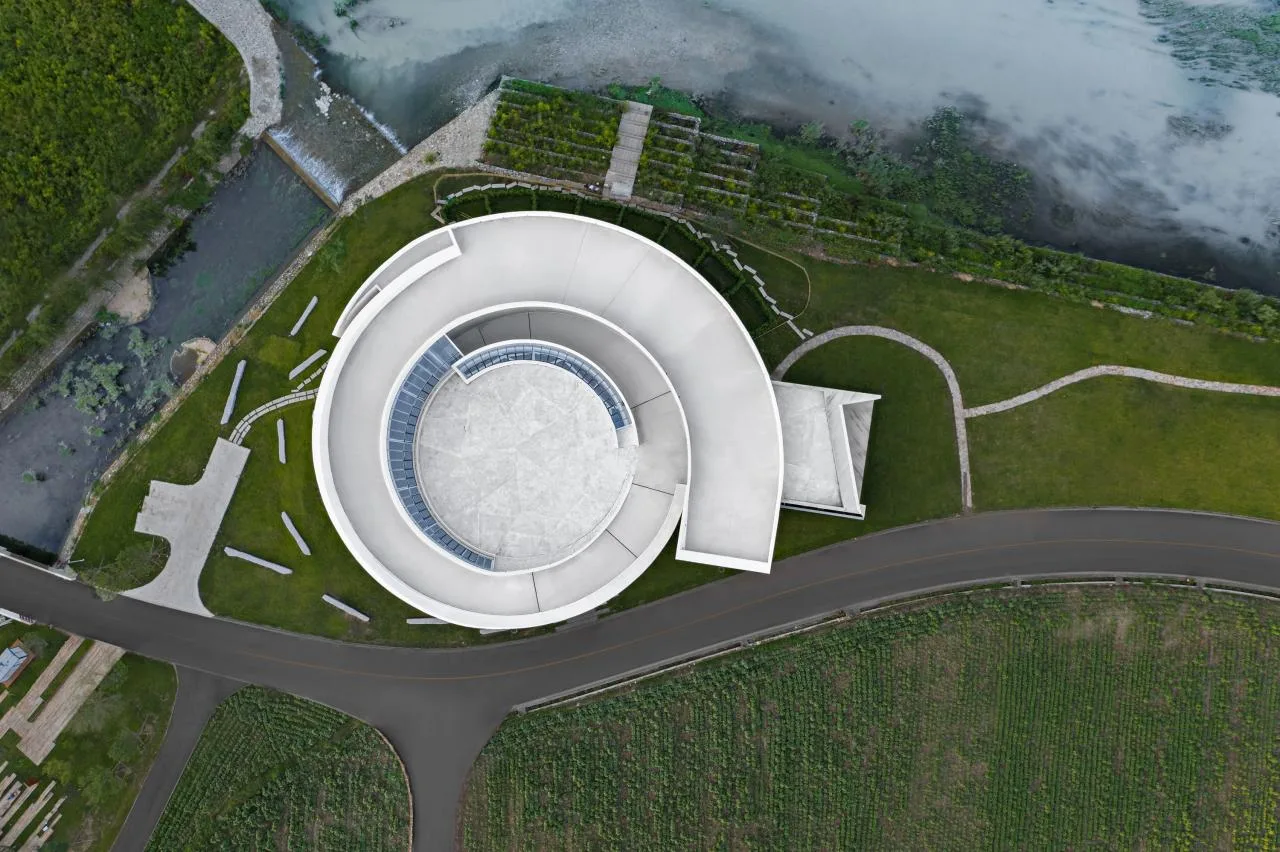
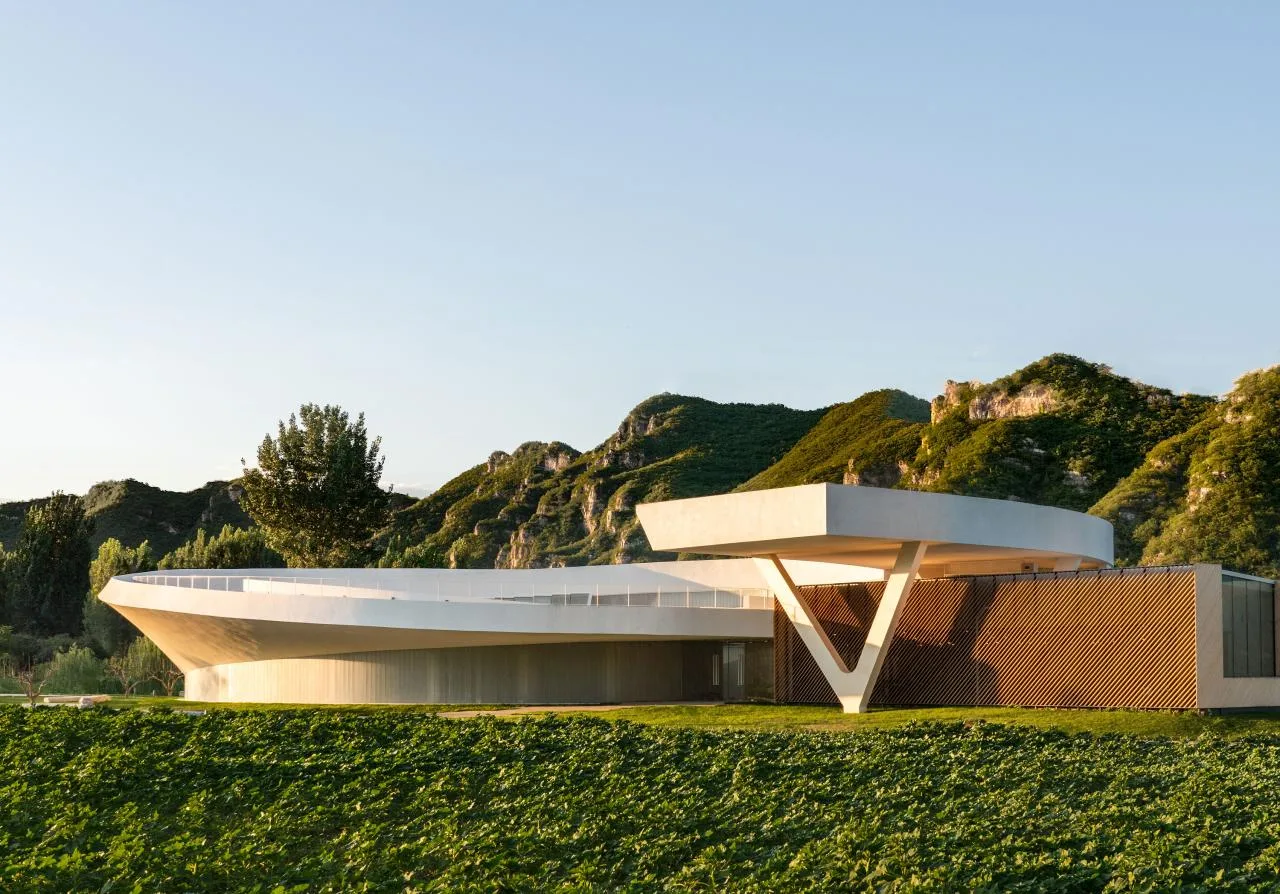
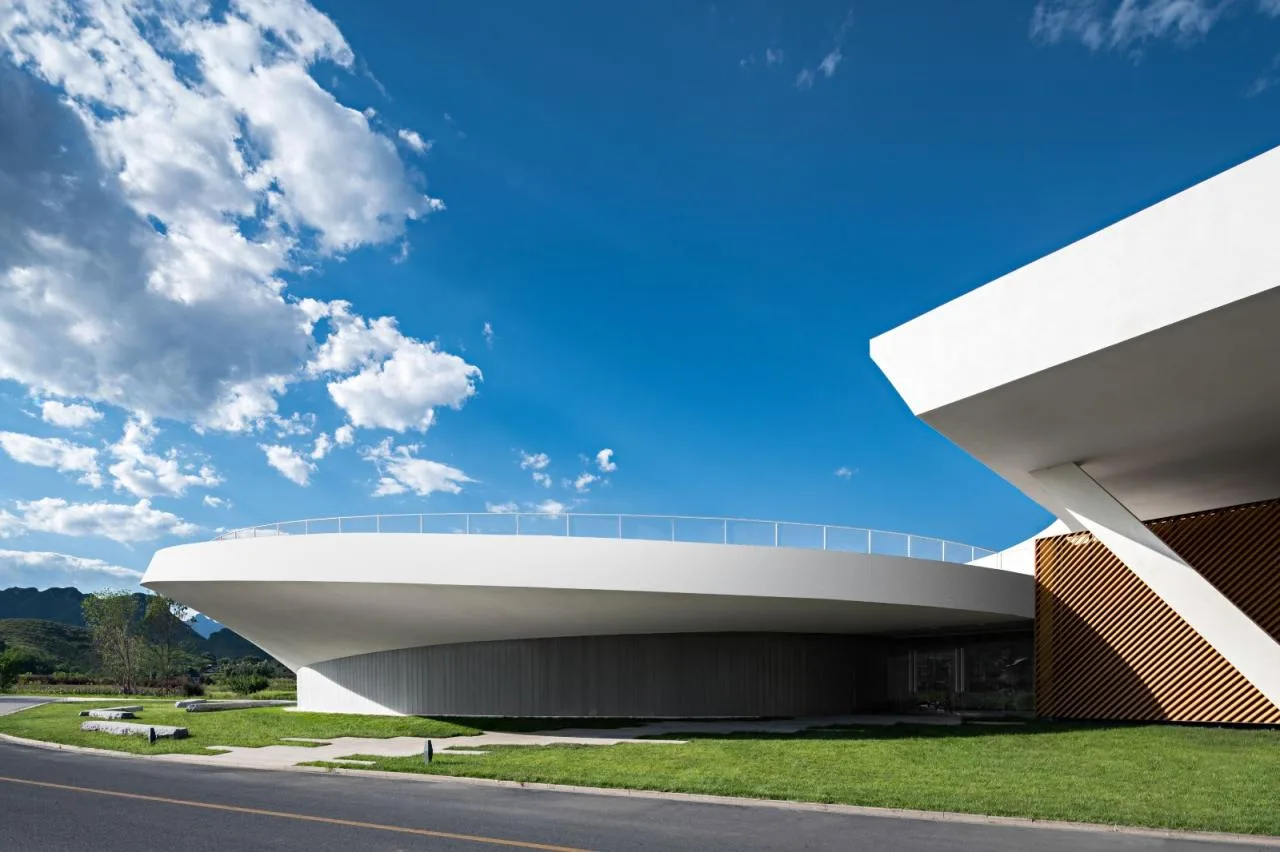
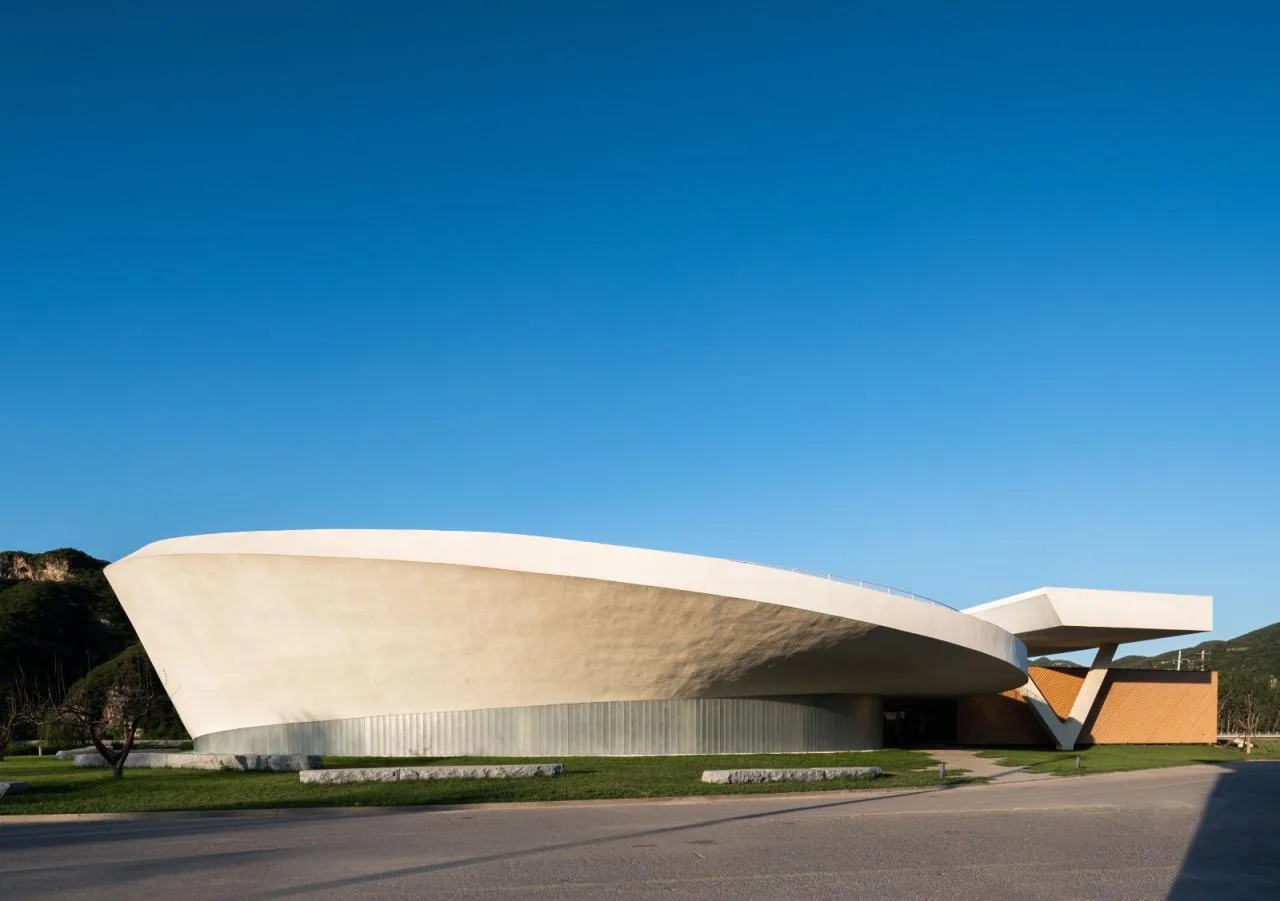
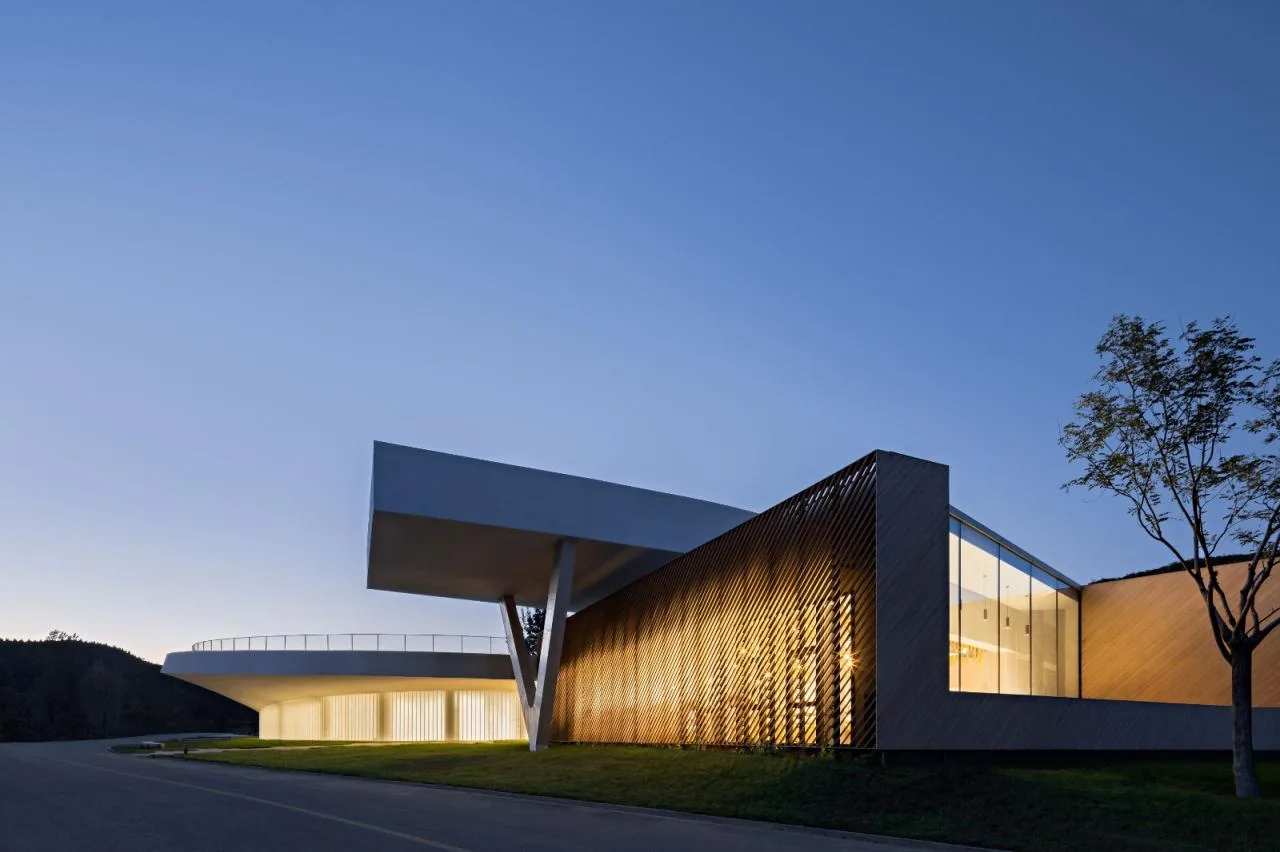
The semi-circular concrete frame stands amid the mountains and waters, overlooking Tiangang Village. The chaotic surroundings and fragmented structure evoke a rural area trapped in stagnation. Jianlan demolished some original buildings and continued development: a ribbon-like volume spirals upward along the inner curve of the semicircle, gradually completing the form and creating dynamic relationships between observer and observed. This continuous, harmonious structure metaphorically embodies Eastern natural philosophy—harmonious coexistence of heaven, earth, mountains, water, and humans. It bridges mountains and waters, continues cultural heritage, and connects art, industry, and urban-rural warmth.
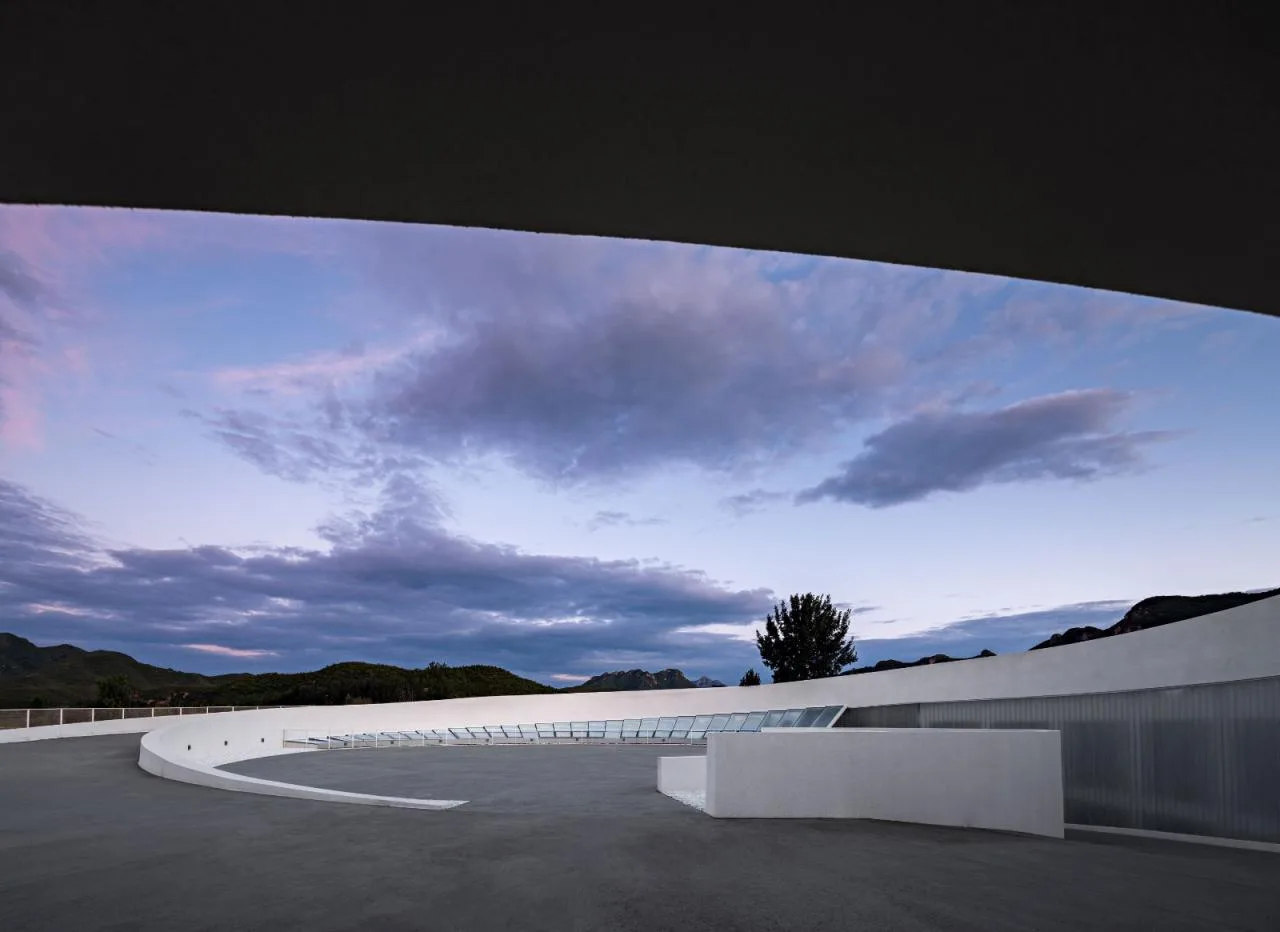
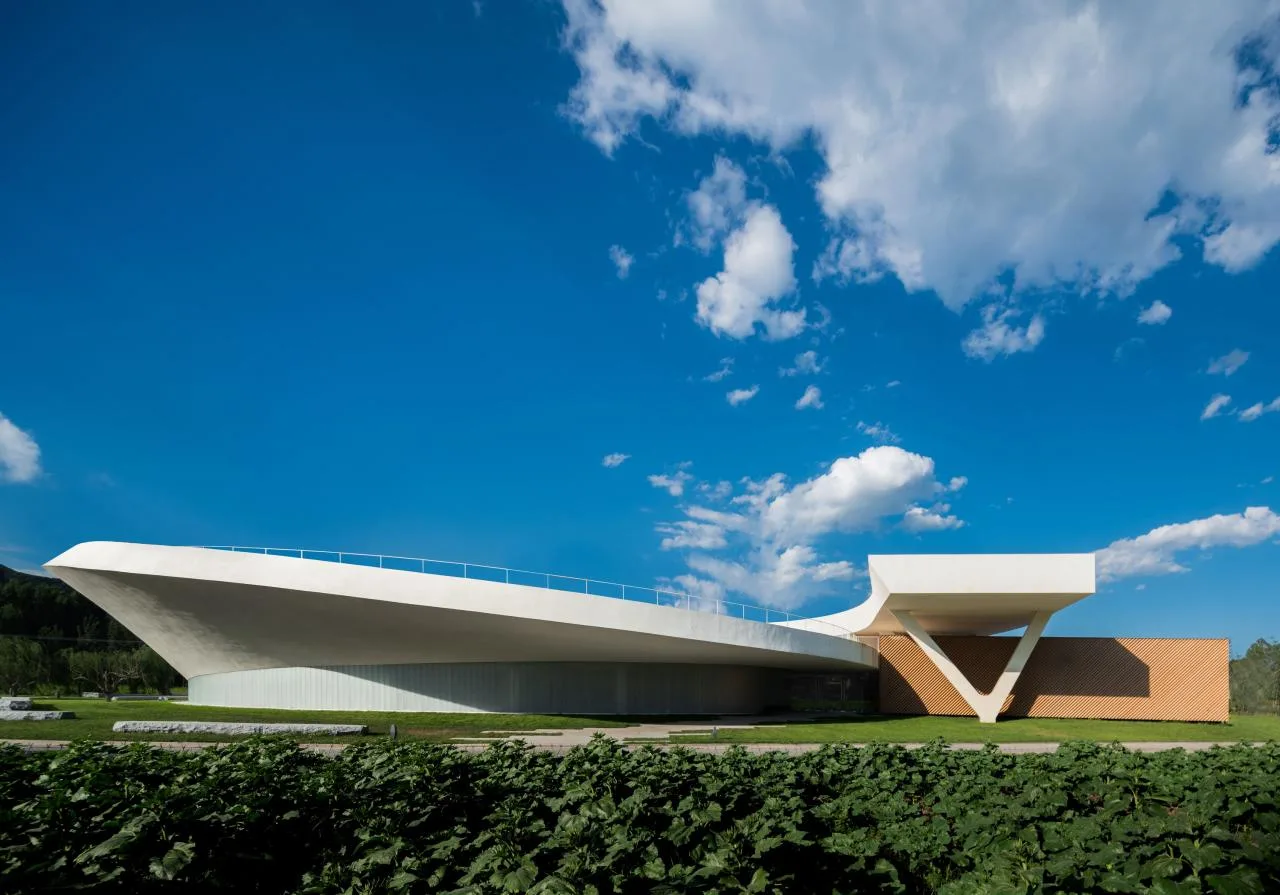
Jianlan believes that “architecture supports landscape creation, and landscape extends architecture.” Hence, the exhibition building itself becomes a form of “earth art.” The structure’s white granular paint preserves color purity, while its pure geometric forms trap sunlight. This sculptural architecture, set against rice paddies and local villages, strengthens the bond between the building and its natural environment, amplifying tension by engaging the surroundings.
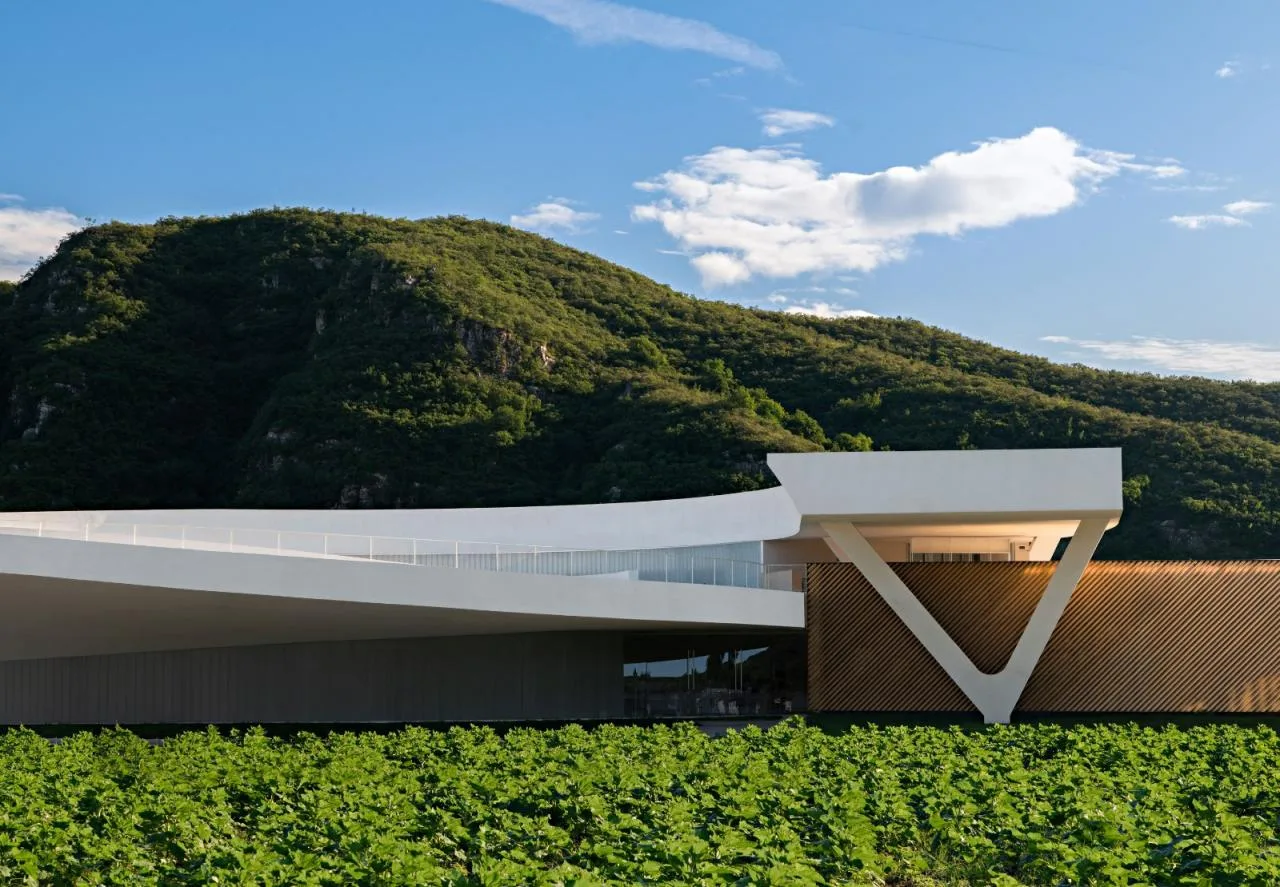
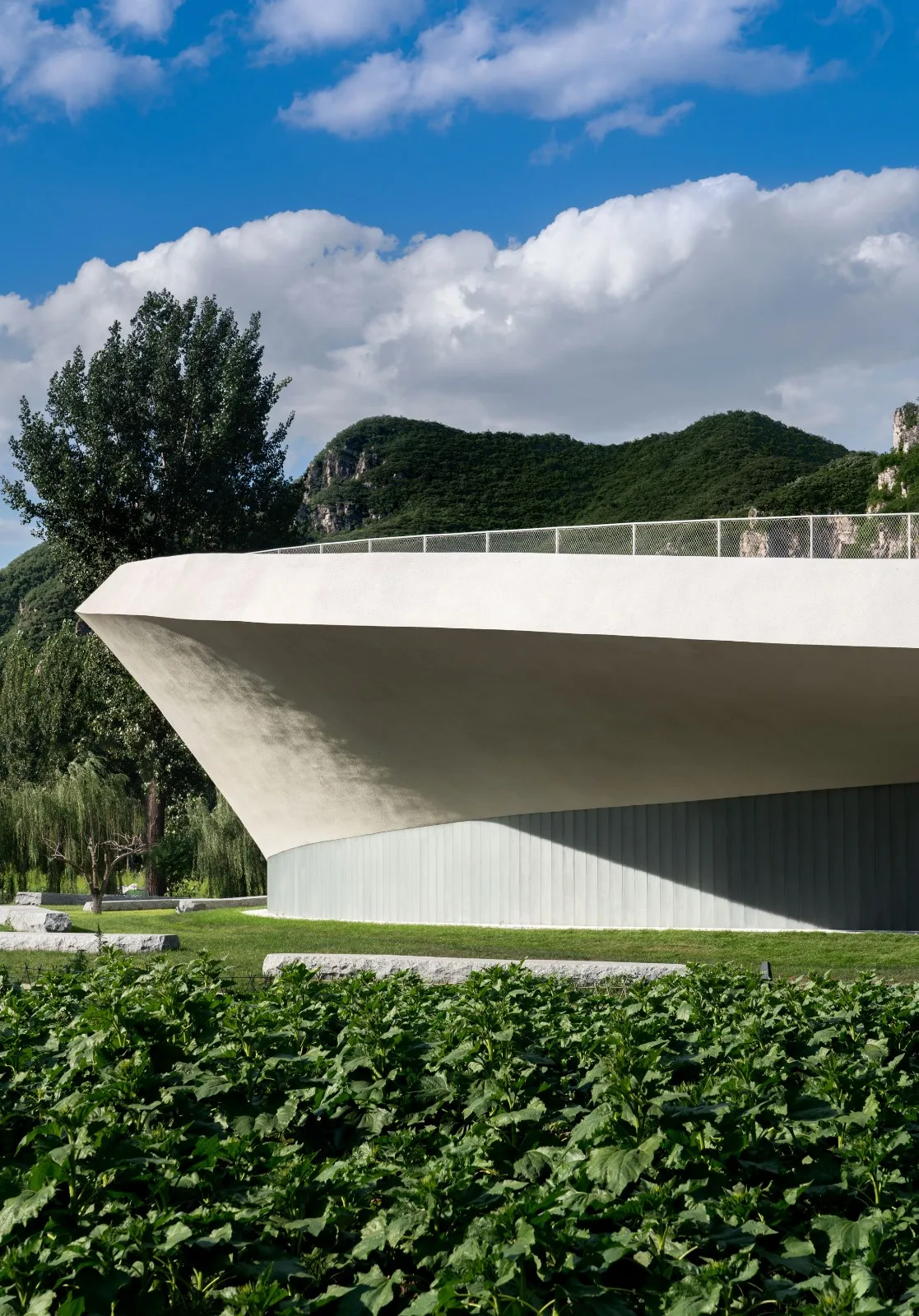
The architectural design centers on problem-solving: the half-arc façade faces the riverbank and distant mountains, housing 14 guest rooms with private, tranquil views. The side facing the village and main road serves as a threshold, accommodating public spaces such as reception and dining, with a large circular exhibition hall at the core.
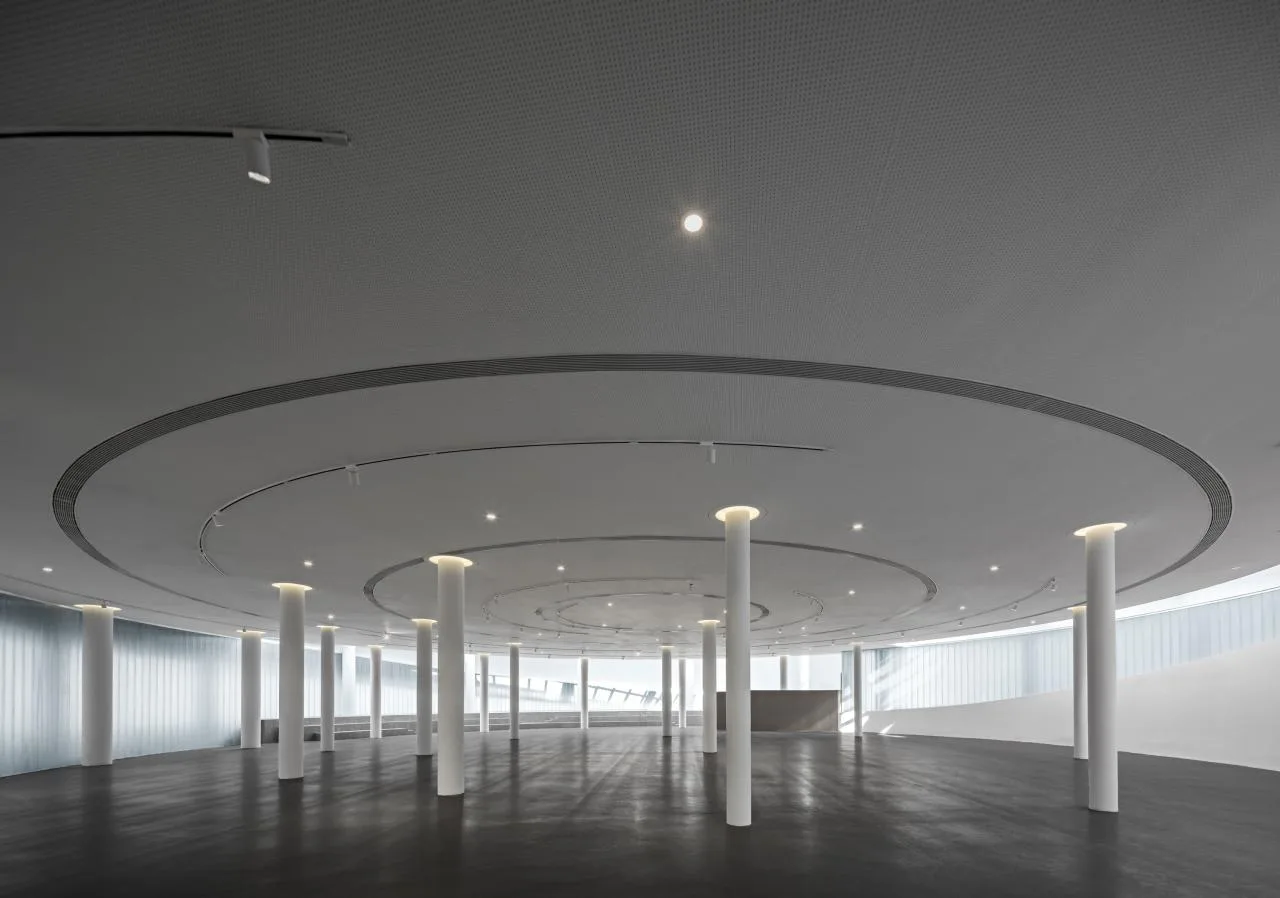
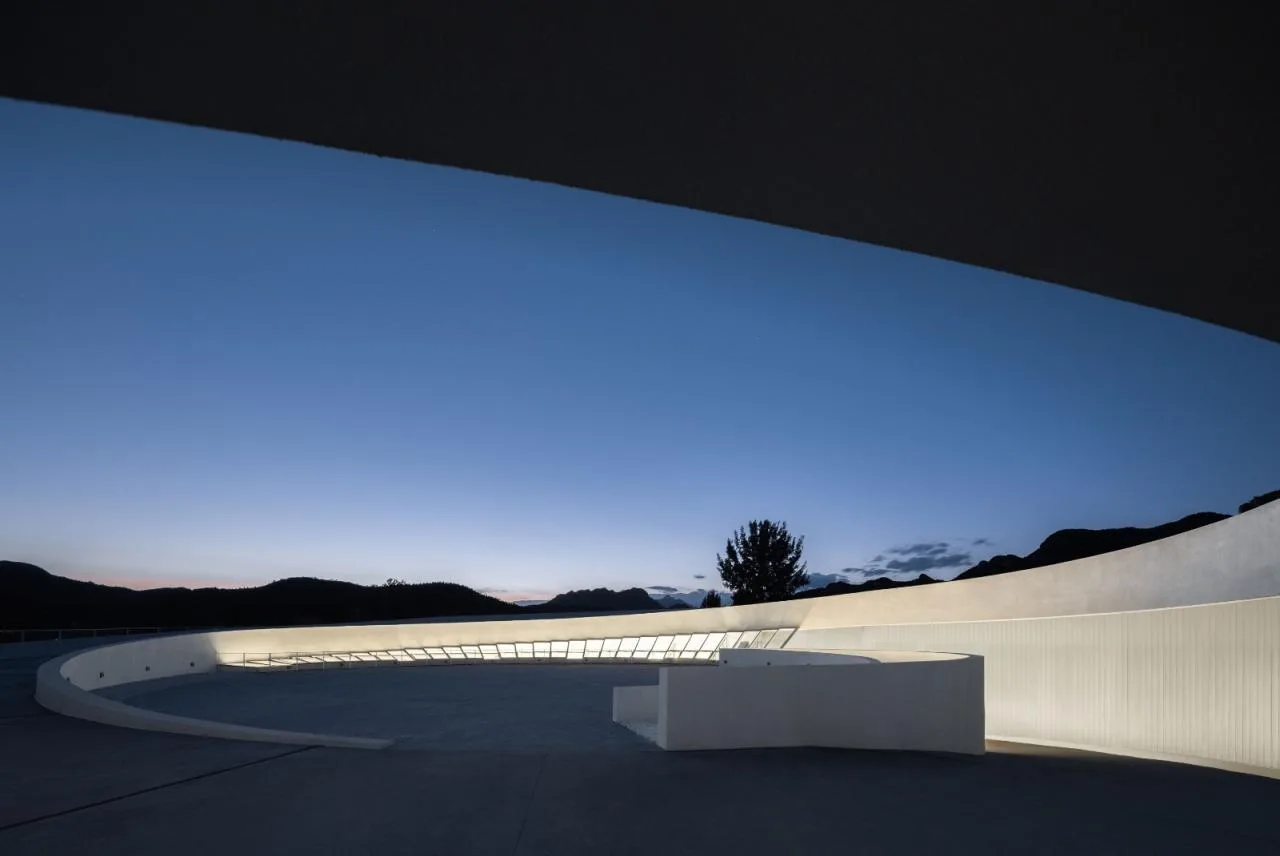
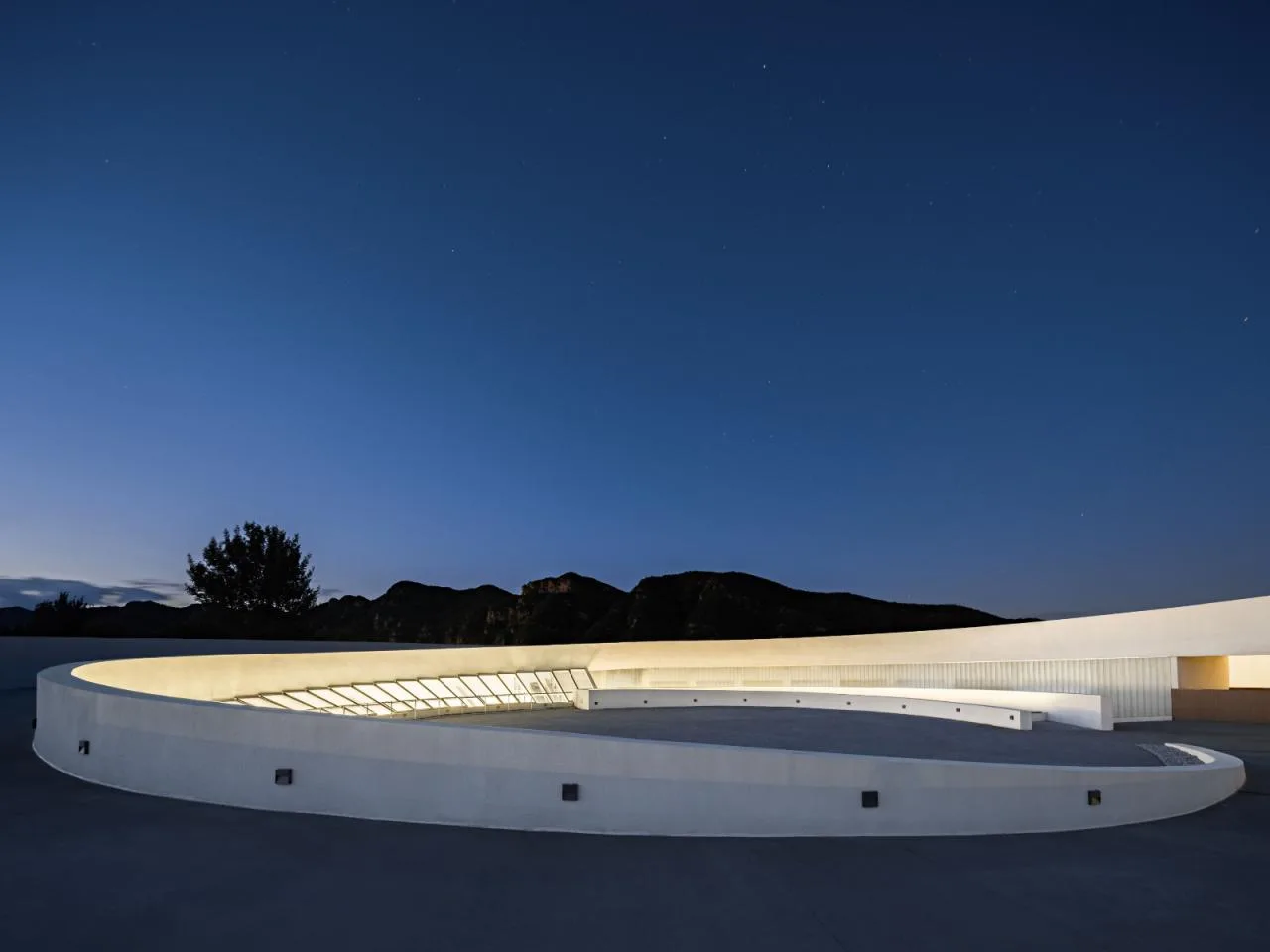
To accommodate diverse exhibition needs, the architecture is designed to be “constantly evolving.” Exhibition halls, corridors, rooftop terraces, galleries, and outdoor spaces are interconnected in a “vortex,” enabling transformations across walls and ceilings and maximizing use of the building’s “sixth façade.” To maintain distance from street views, some exterior walls feature U-shaped glass, allowing limited natural light while subtly obscuring the outside scenery. At night, these glass surfaces emit a soft glow, making the building appear as a suspended vortex, evoking surreal imagery.
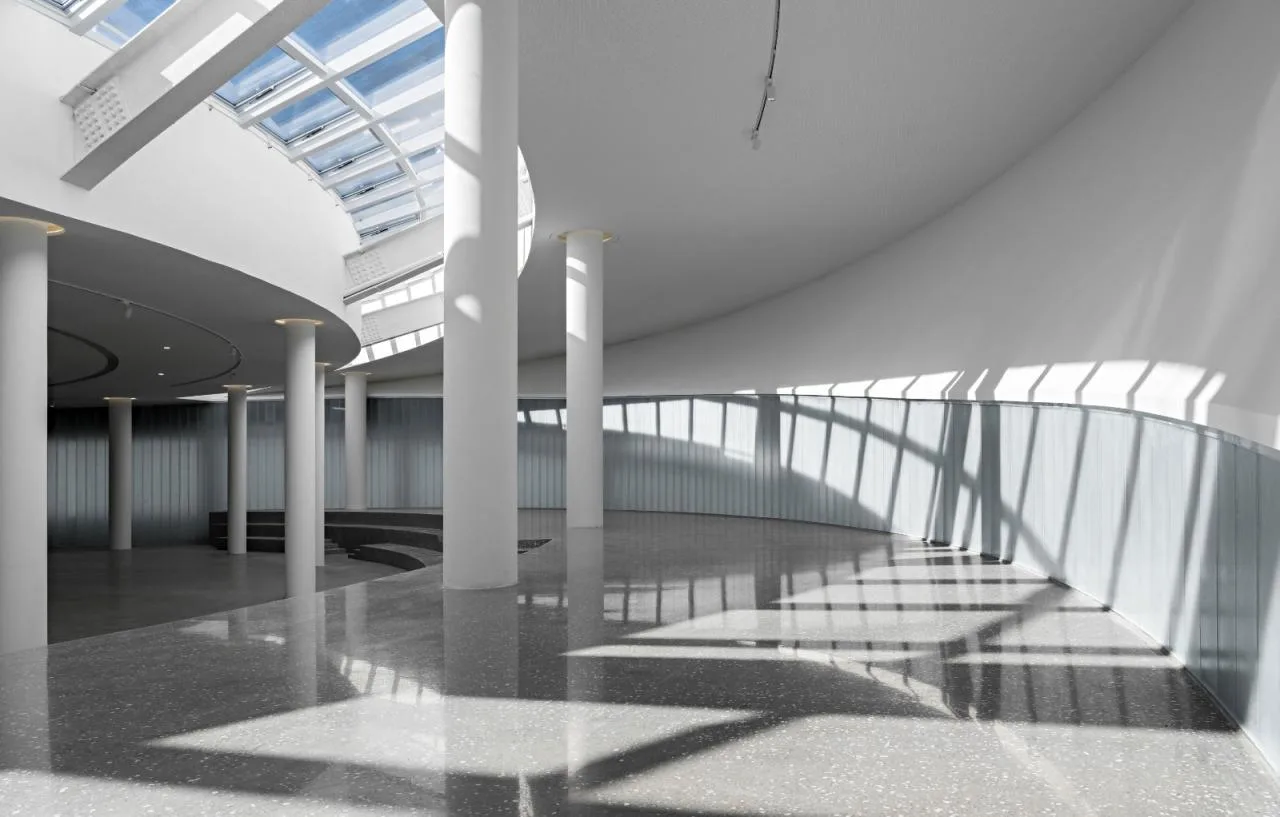
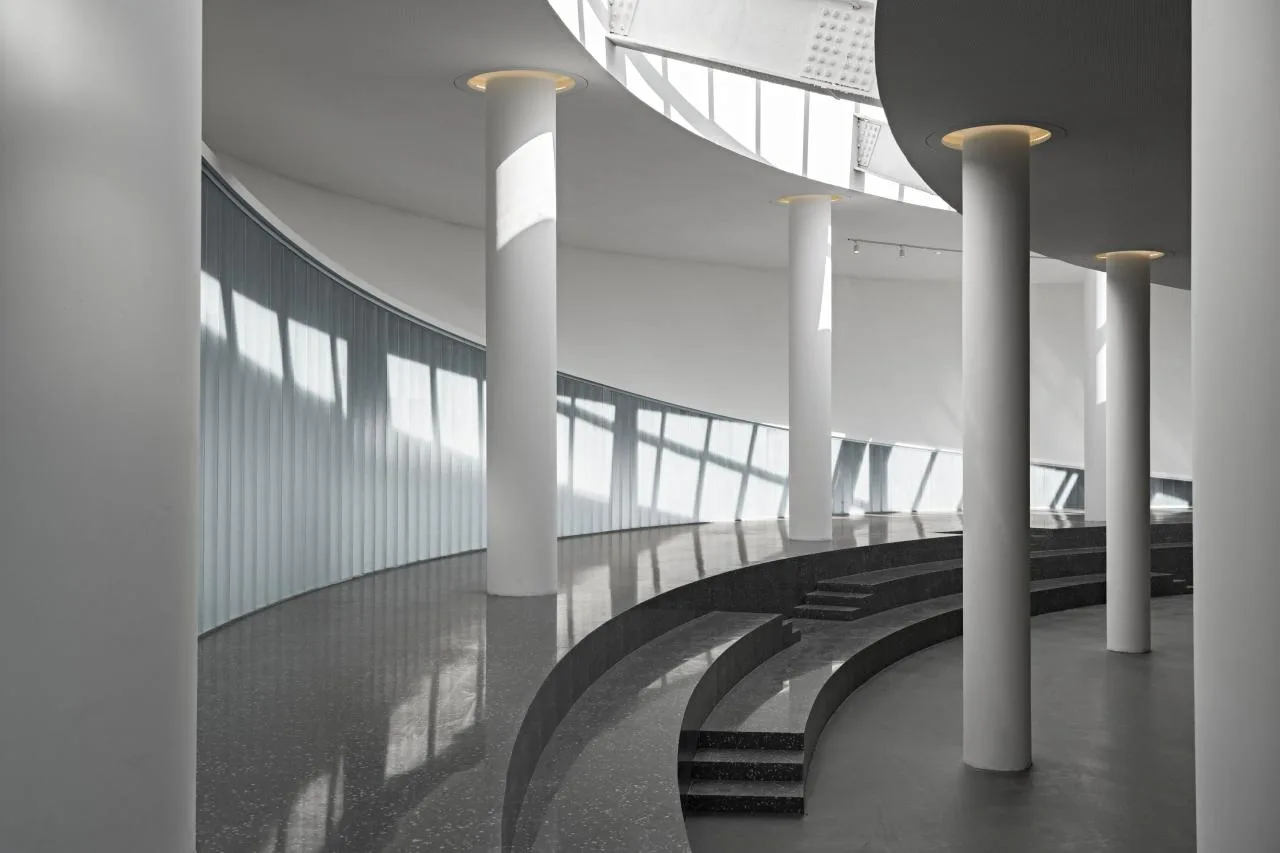
The result is a hotel within an art gallery and an art gallery within a hotel. Guest rooms gain value through constantly changing artworks, while exhibition halls benefit from hotel and restaurant support, enhancing reception and service capabilities. Jianlan integrates sustainability throughout the project—ensuring the longevity of industries, the time visitors spend consuming urban-rural experiences, and the durability of physical spaces.
04. Revealing the “Essence”
Entering the building from the site, visitors follow the building’s curve, experiencing constantly shifting spatial impressions. Passing under expansive eaves and past sturdy columns, they encounter the vortex’s starting point—an initial spatial surprise.
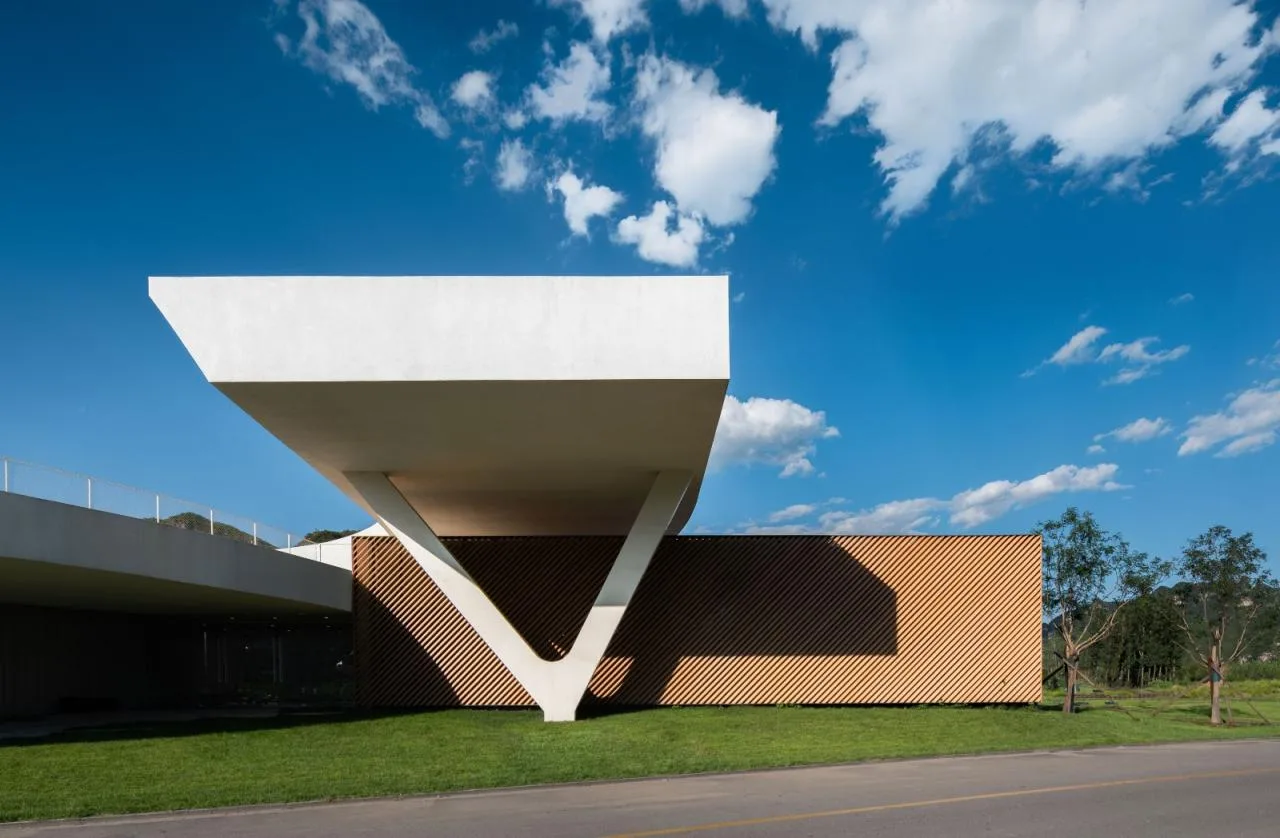
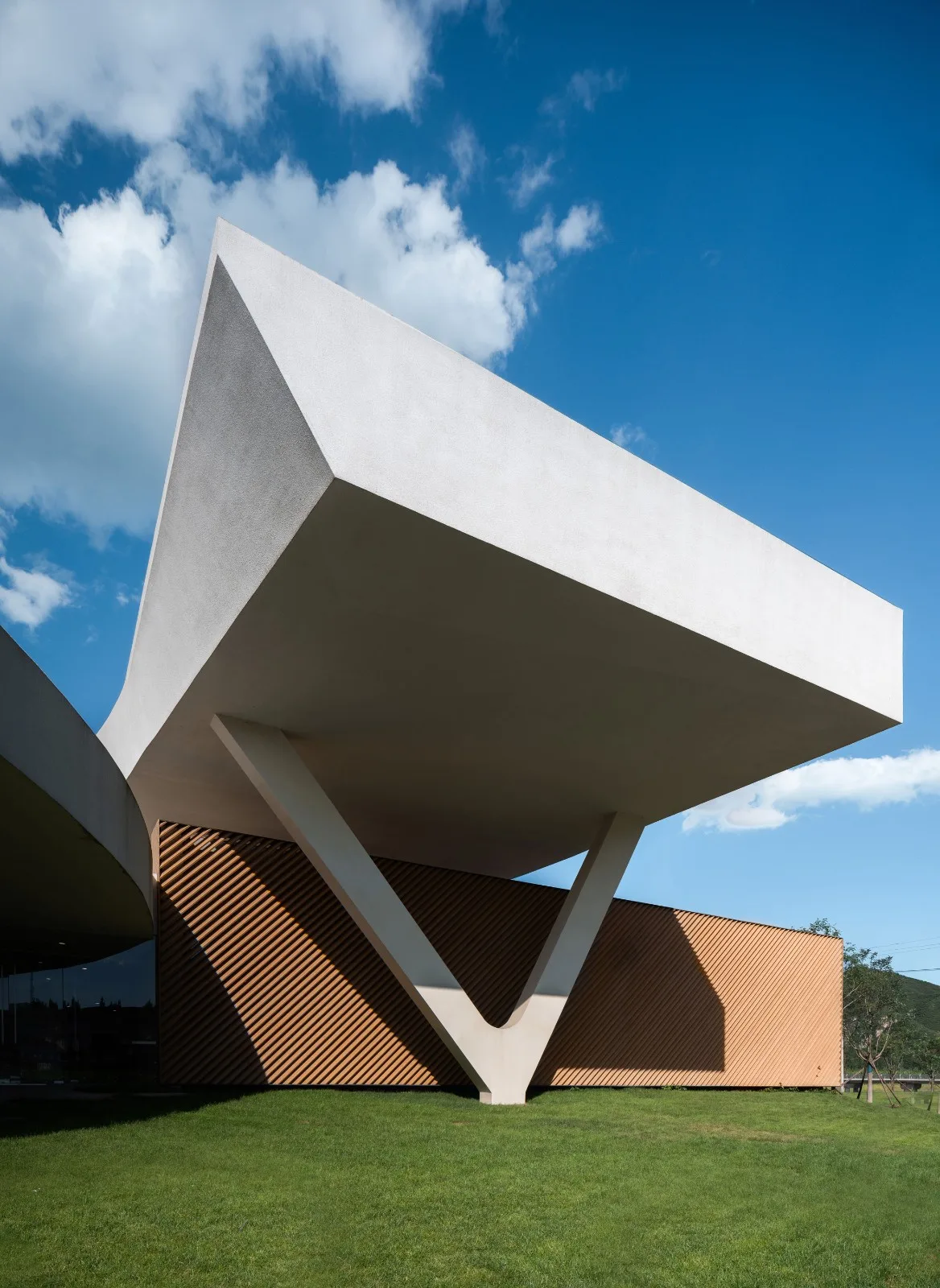
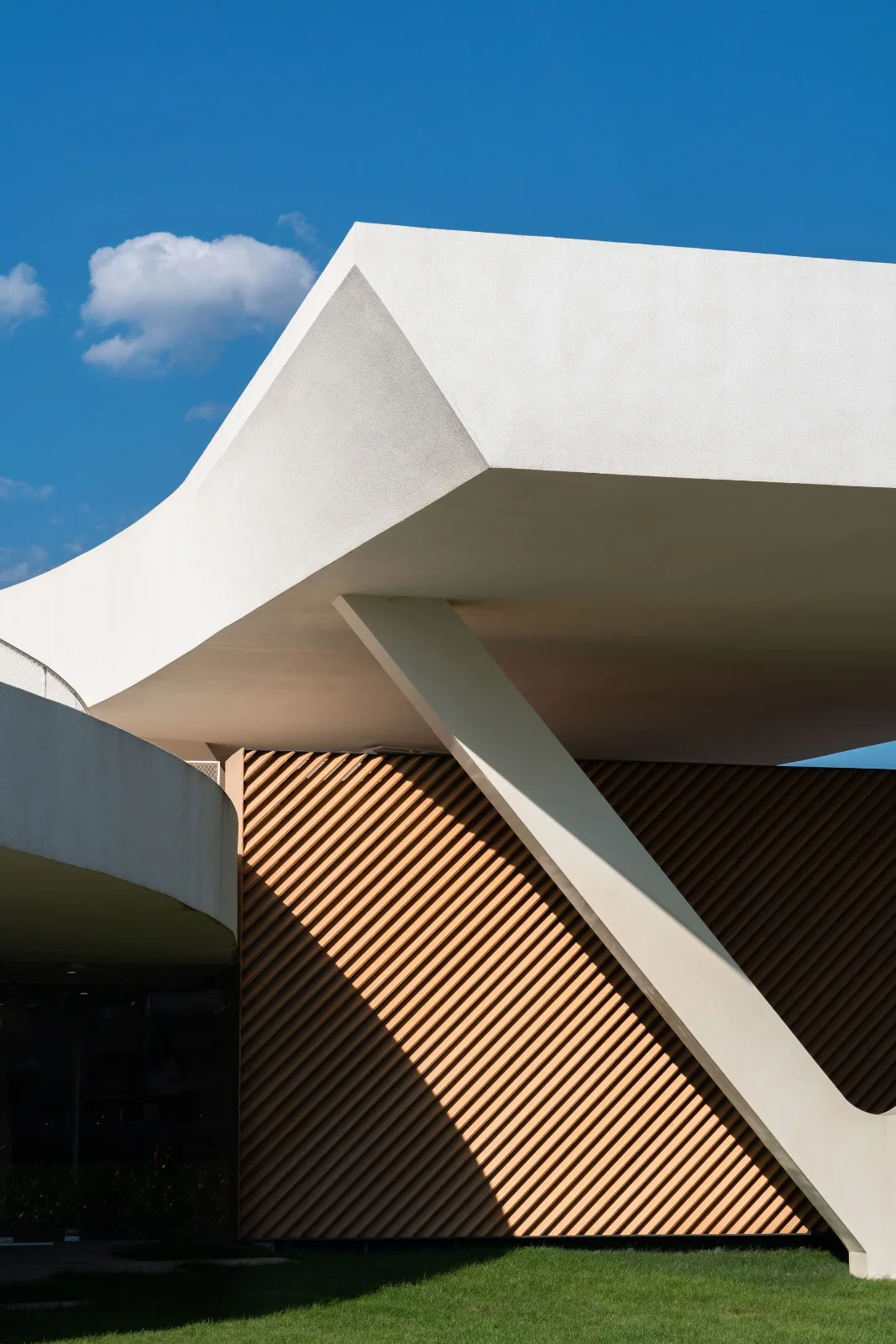
Ascending the slope, the building maintains an ambiguous boundary between “inside and outside,” offering multidimensional views of both scenery and exhibits—marking a second surprise.
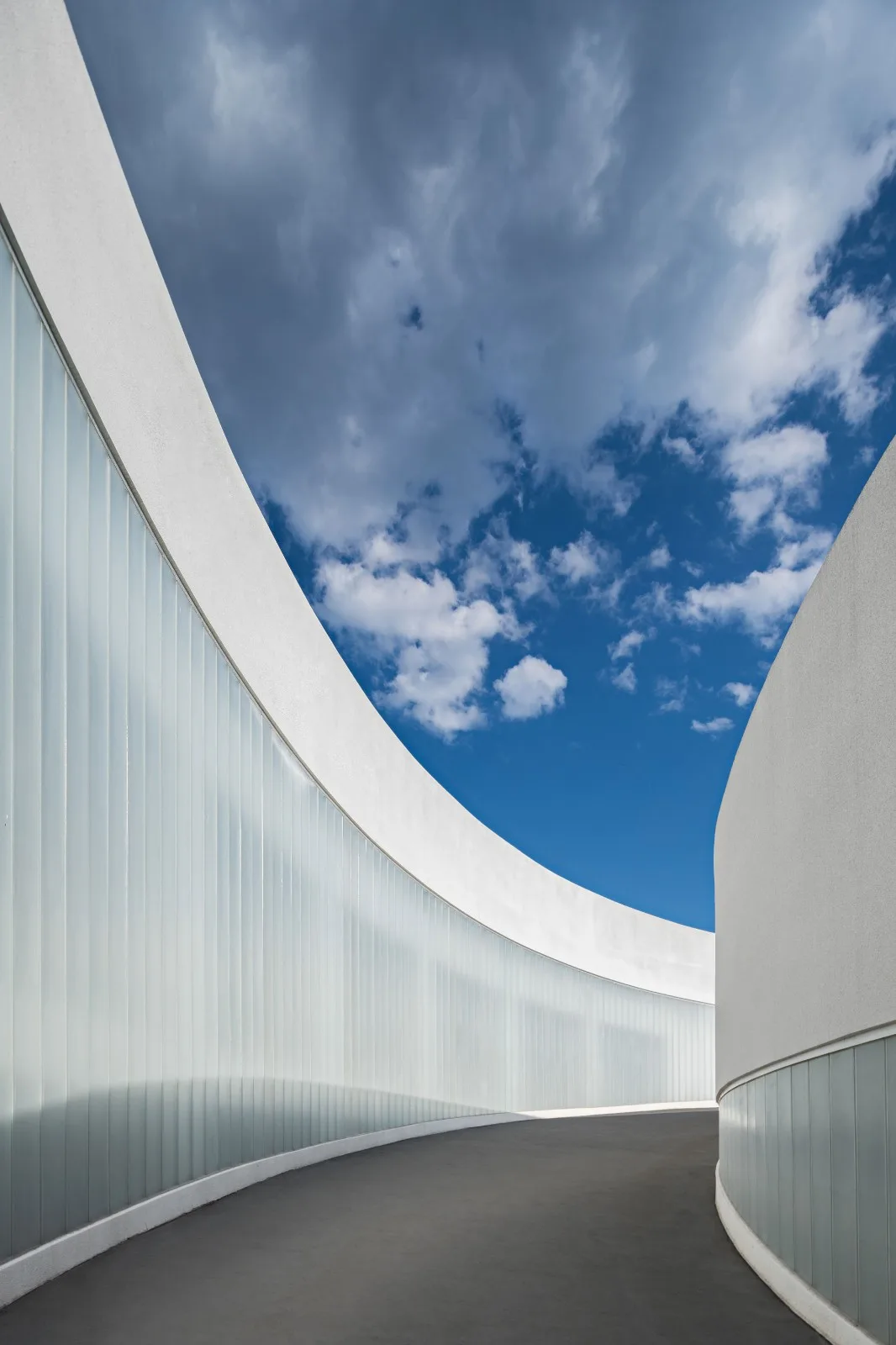
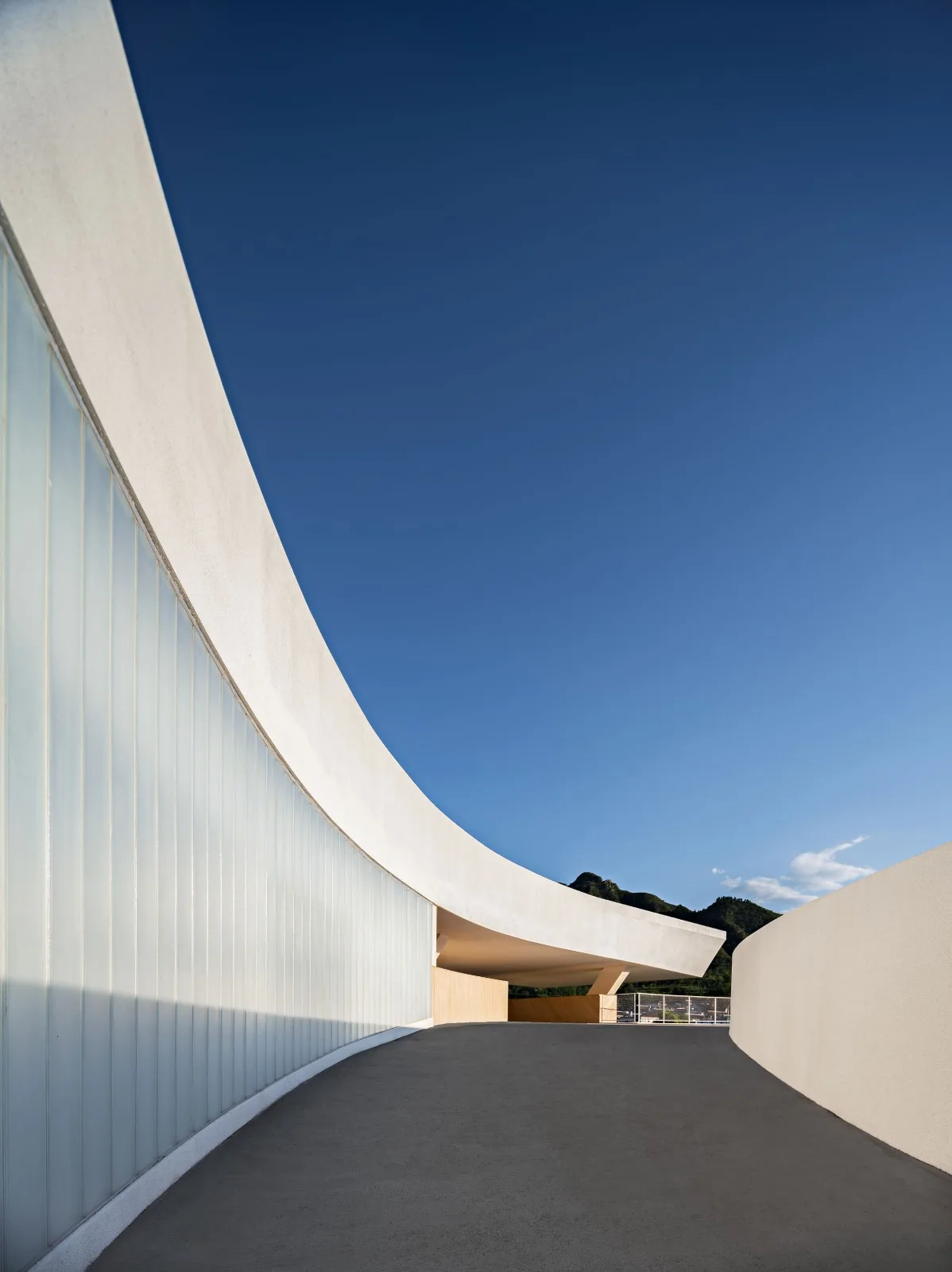
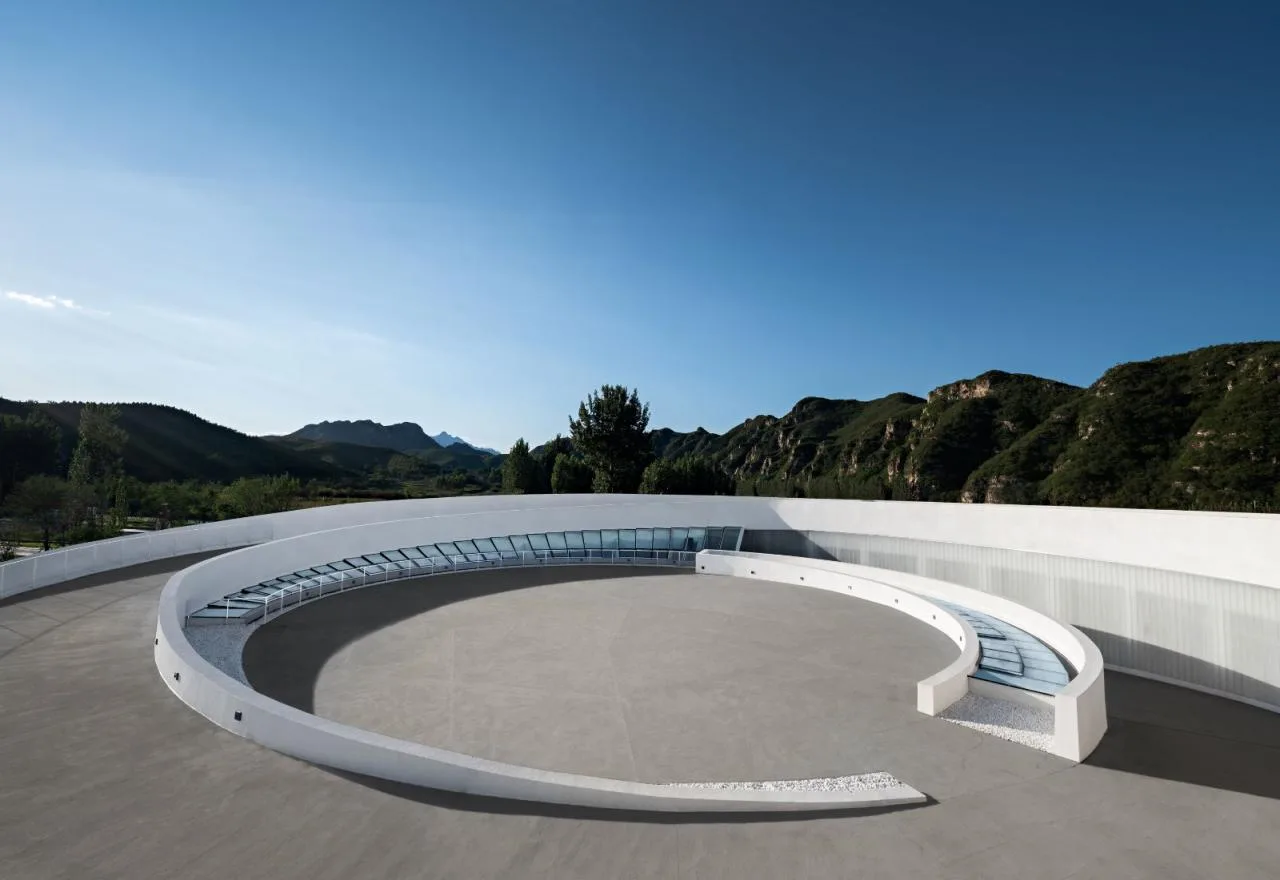
At the spiral’s peak, an observation deck offers sweeping views of Watchtower Village, showcasing its blend of old and new. Moving forward, the building itself becomes a focal point for outside viewers—an ultimate spatial surprise.
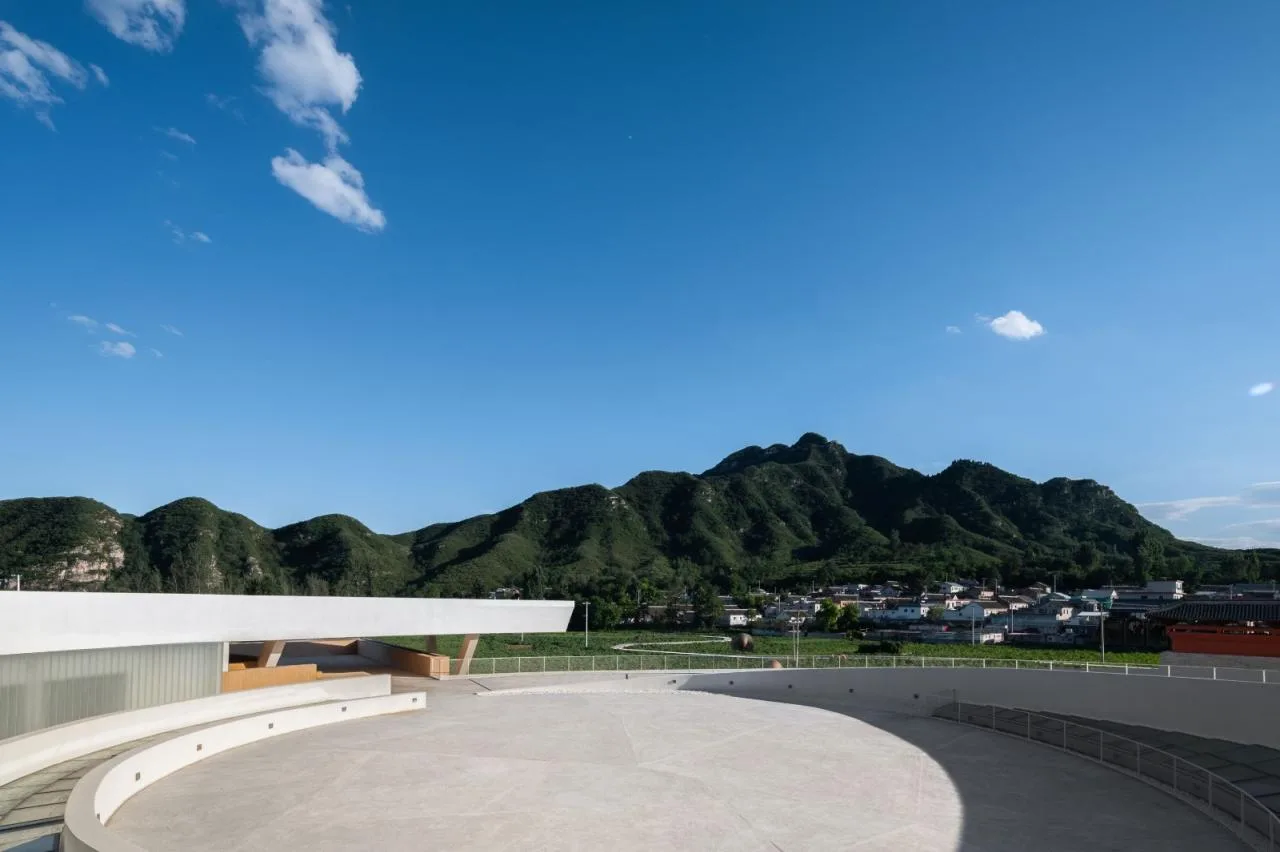
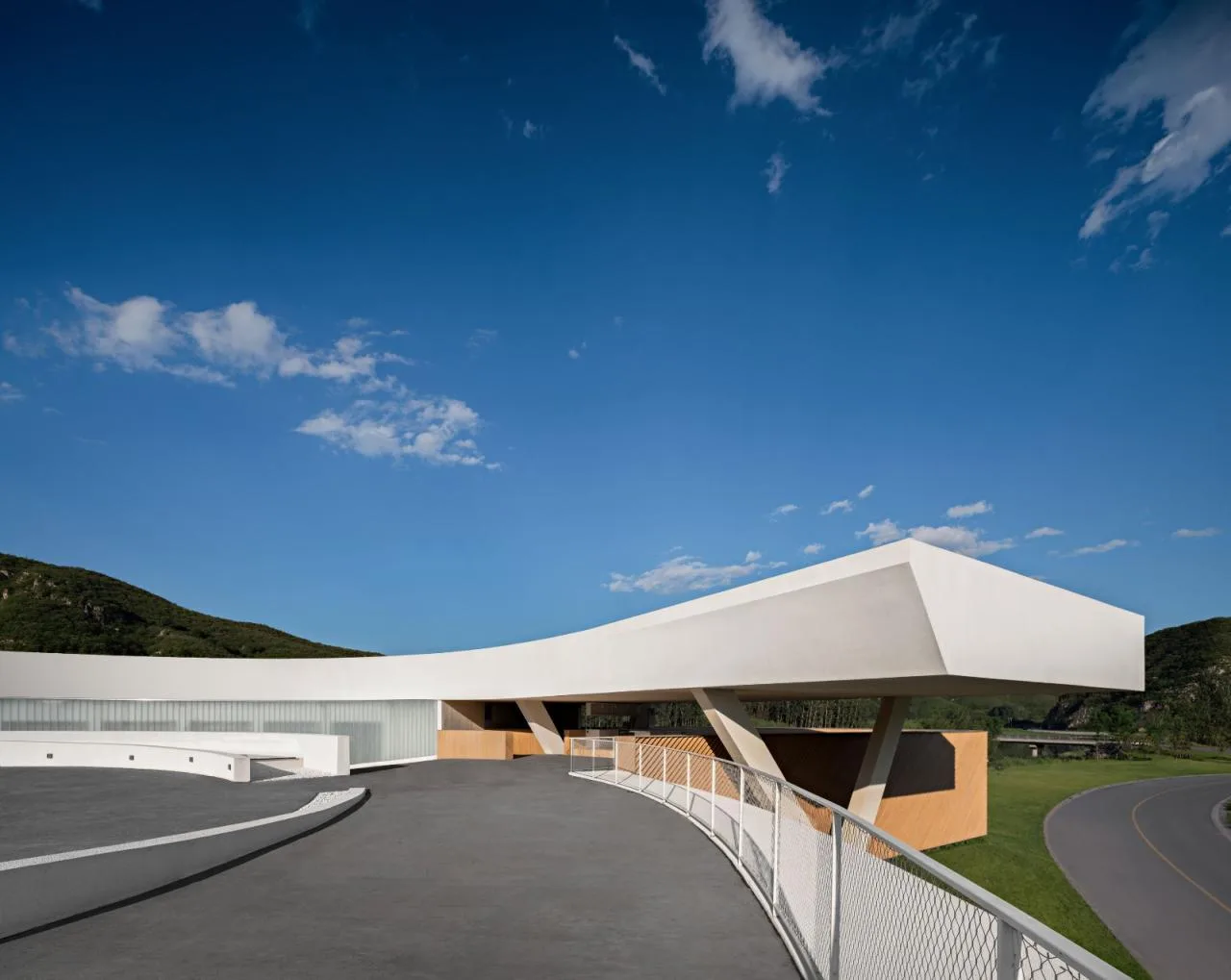
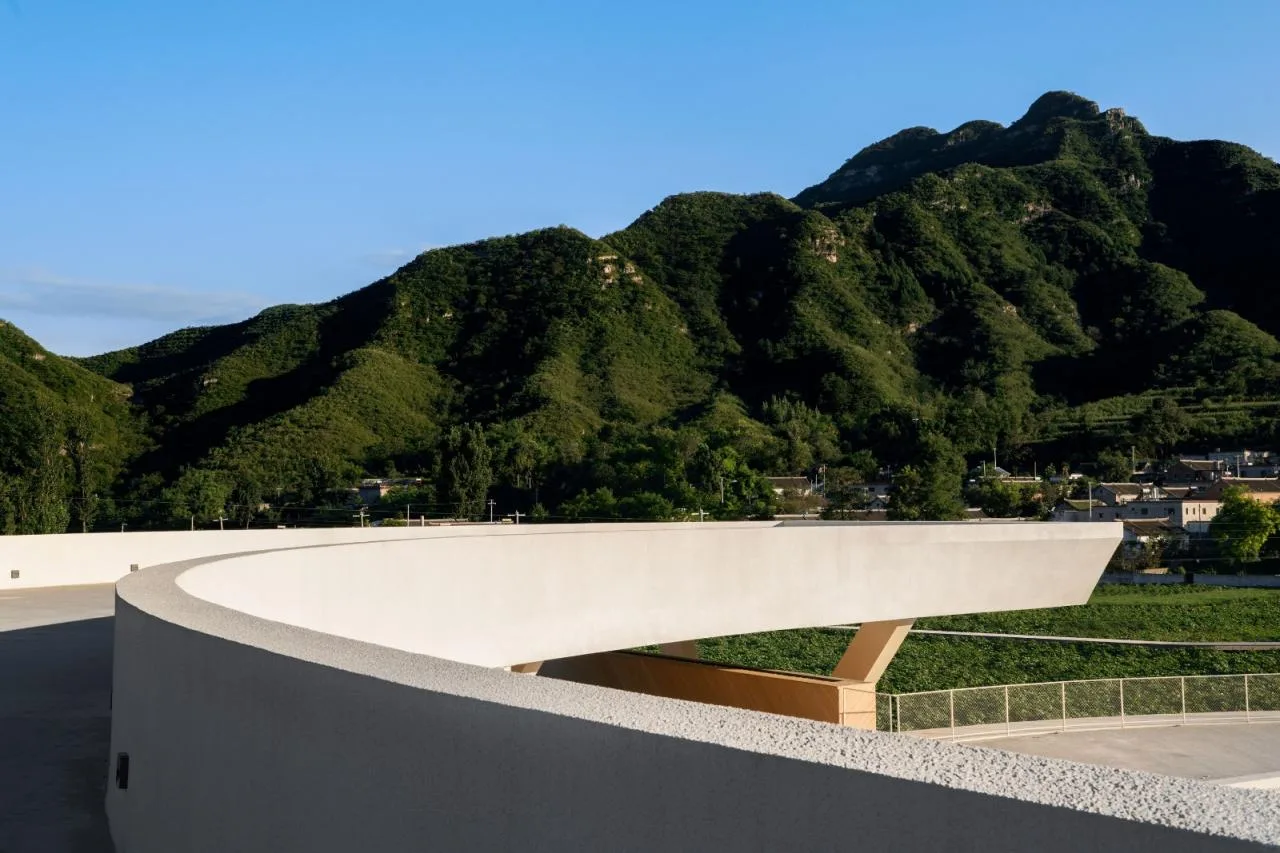
This layered and evolving experience resembles the Buddhist concept of “enlightenment.” In the previously disordered Tiangang Village, Jianlan has built a meaningful, structured, and effectively managed “knowledge-action village,” reshaping the “soil” through this “reorganization of perception.”
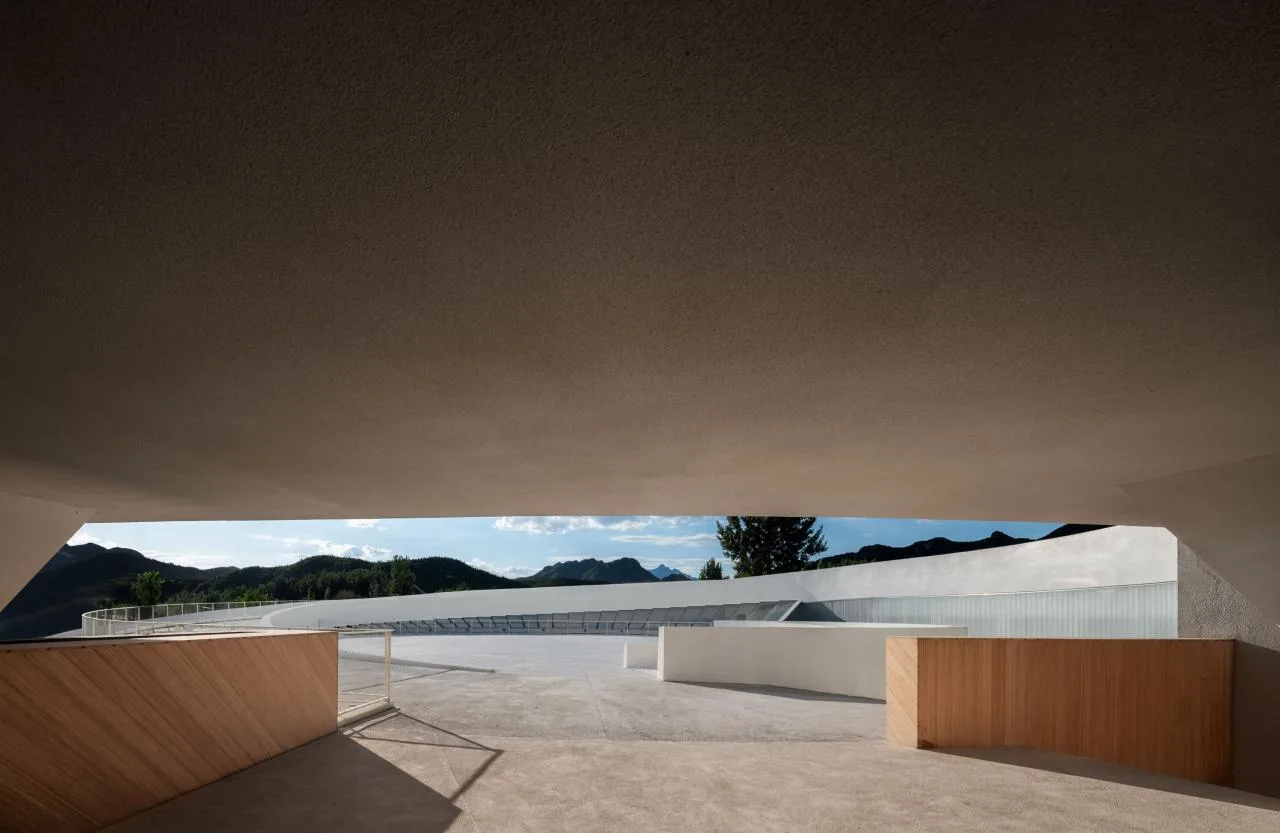
Building on the original concrete structure, Jianlan introduced steel elements to gradually twist the main façade outward and upward, transforming eaves into walls. The original column grid was inadequate for new structural loads and functions. The architects embraced this challenge, arranging columns in a seemingly random, jungle-like pattern that meets mechanical needs while serving as the building’s sole decoration.
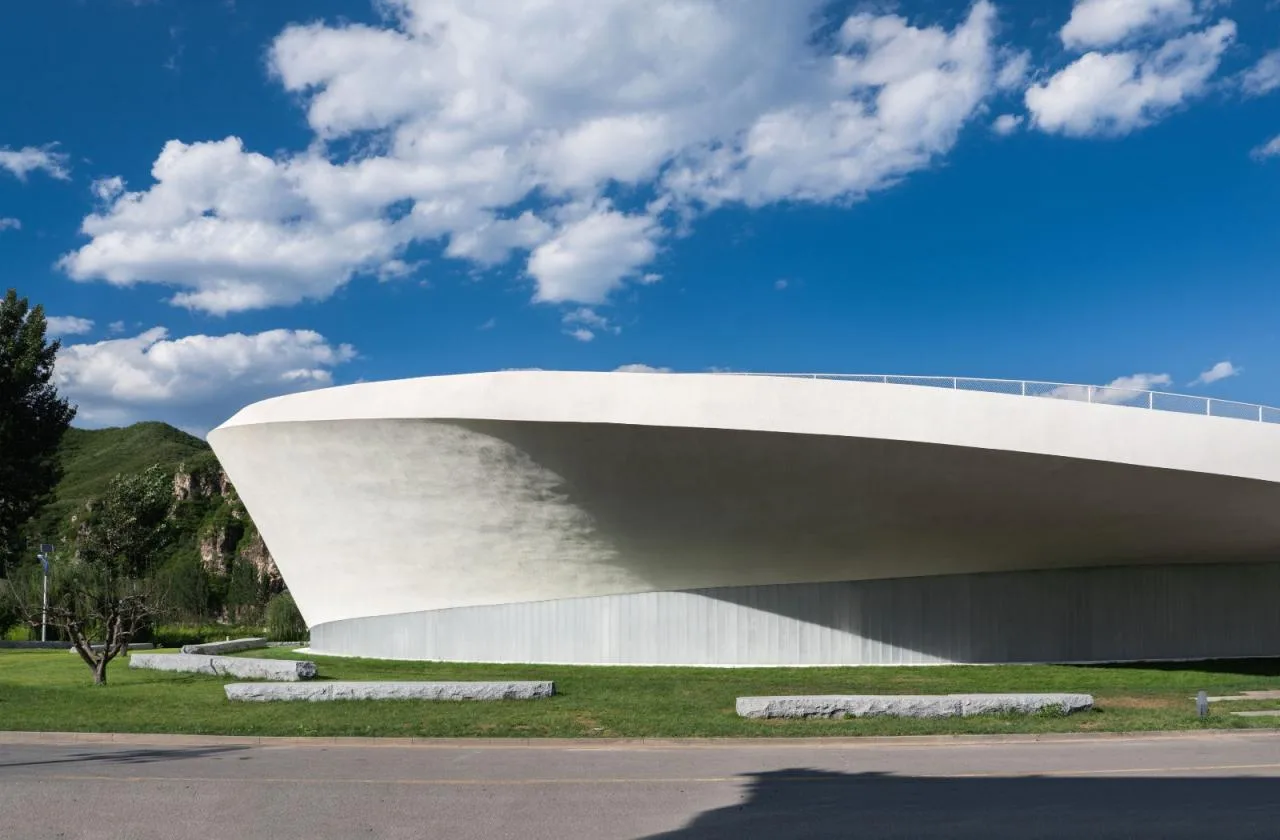
For an art museum, exhibits—not decoration—are paramount. Zou Yingxi aims to expose the “essence” of the space, restoring the original “pastoral feeling.”
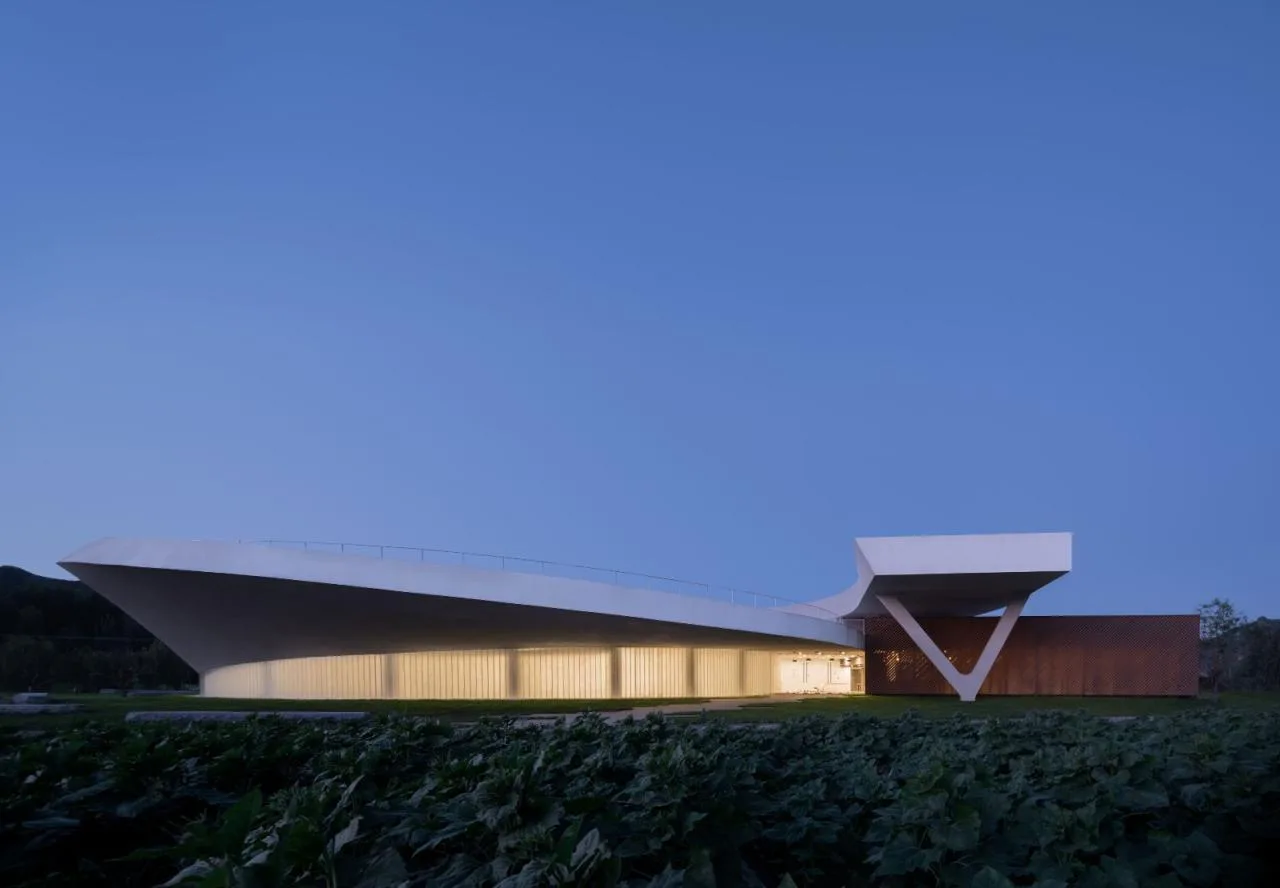
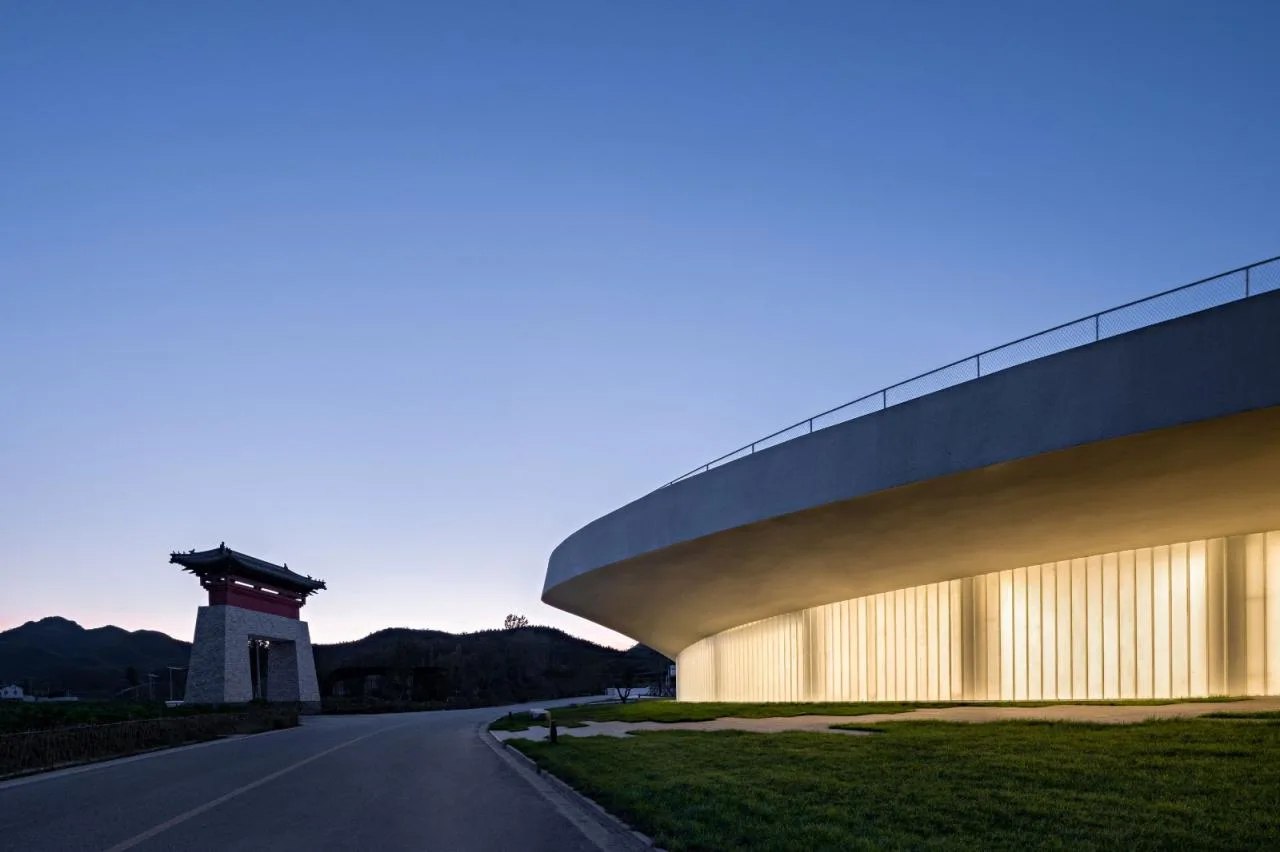
The main entrance features a concrete floor lifted and curled into a sign-in table, revealing grass beneath and capturing the countryside’s “pastoral essence.” Inside the dining area, irregular wooden columns of varying heights support an exposed ceiling, as if peeling back the building’s skin to reveal its “structural essence.”
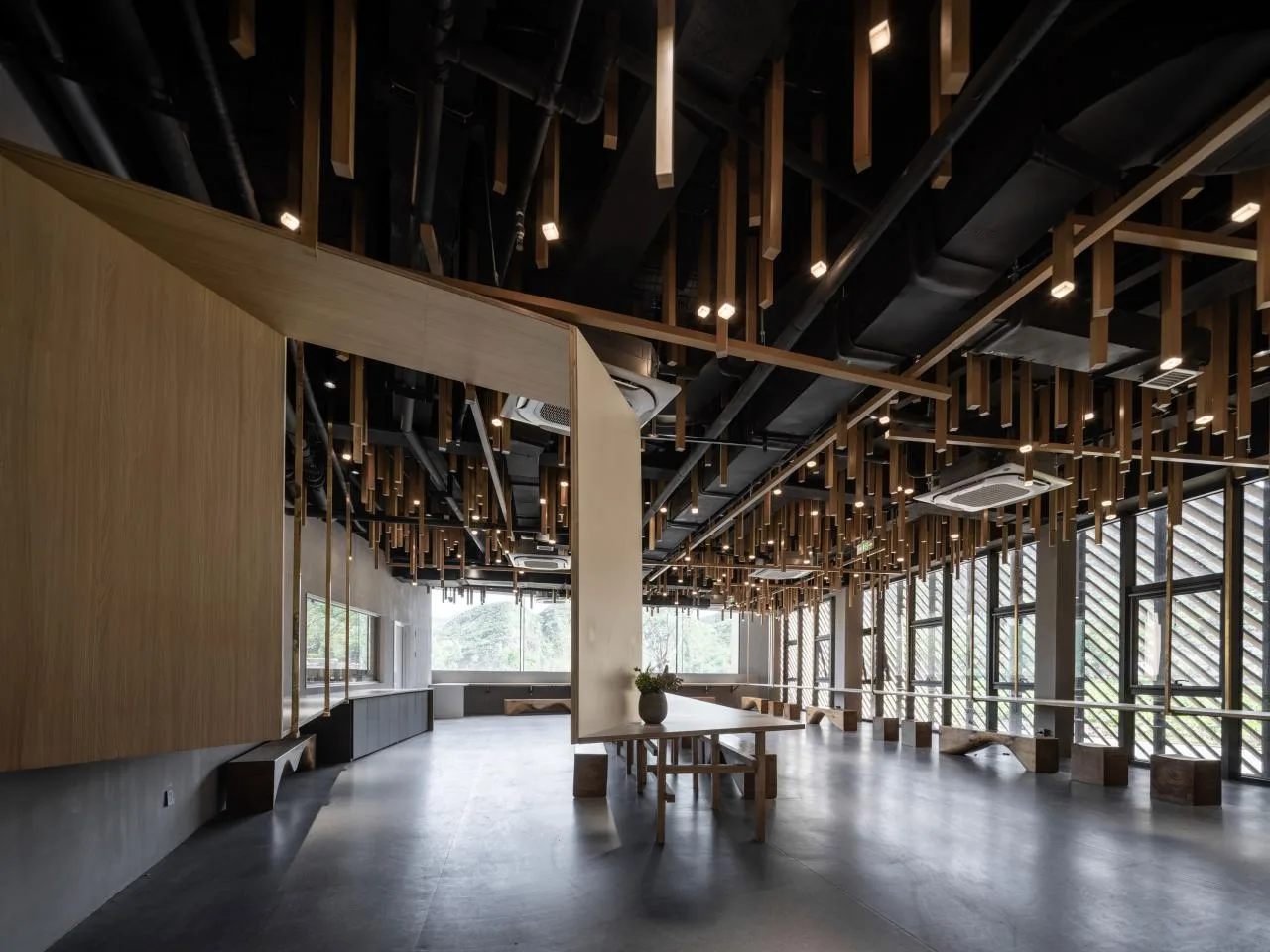
Wood and cement unify the interior’s visual language, creating a warm, tactile environment that dialogues with the surrounding countryside and mountains. The use of natural materials is essential to achieving a pastoral atmosphere. Light, too, acts as a “natural material,” with skylights evenly illuminating the interior and creating dynamic shadows. The space functions like a sundial, embracing freedom and the passage of time.
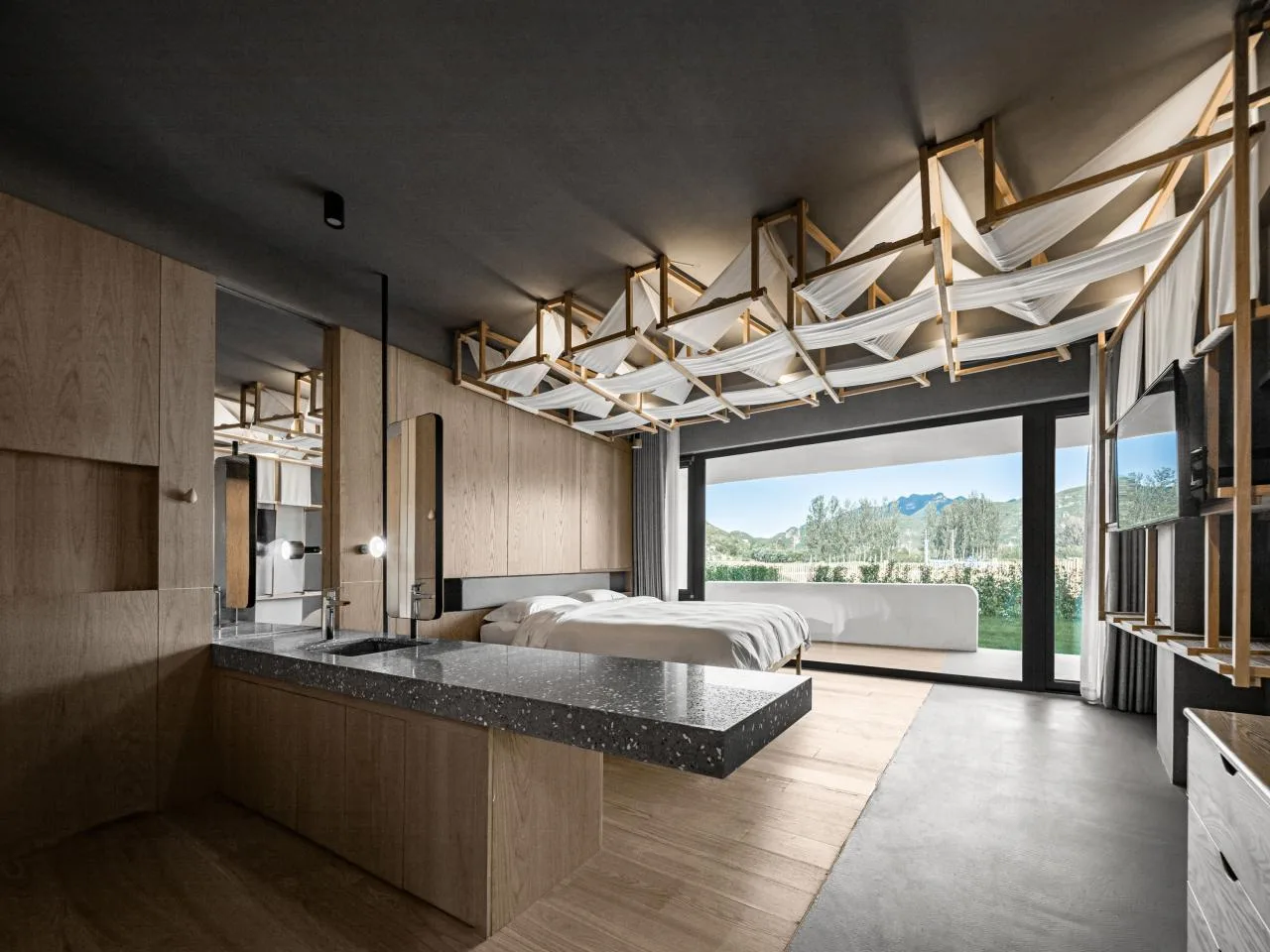
By introducing time into space, the art center becomes a theater of life—a spiritual haven shared by artists, tourists, and locals. Following the completion of the art center and surrounding buildings, the village witnessed a surge of “foreign” artists, tourists, and investors attracted by these “strange yet beautiful buildings and artworks.” With its superior natural landscape, architectural interventions, and innovative operation models, Zhixing Village is poised to become a premier vacation destination near Beijing.
Project Drawings
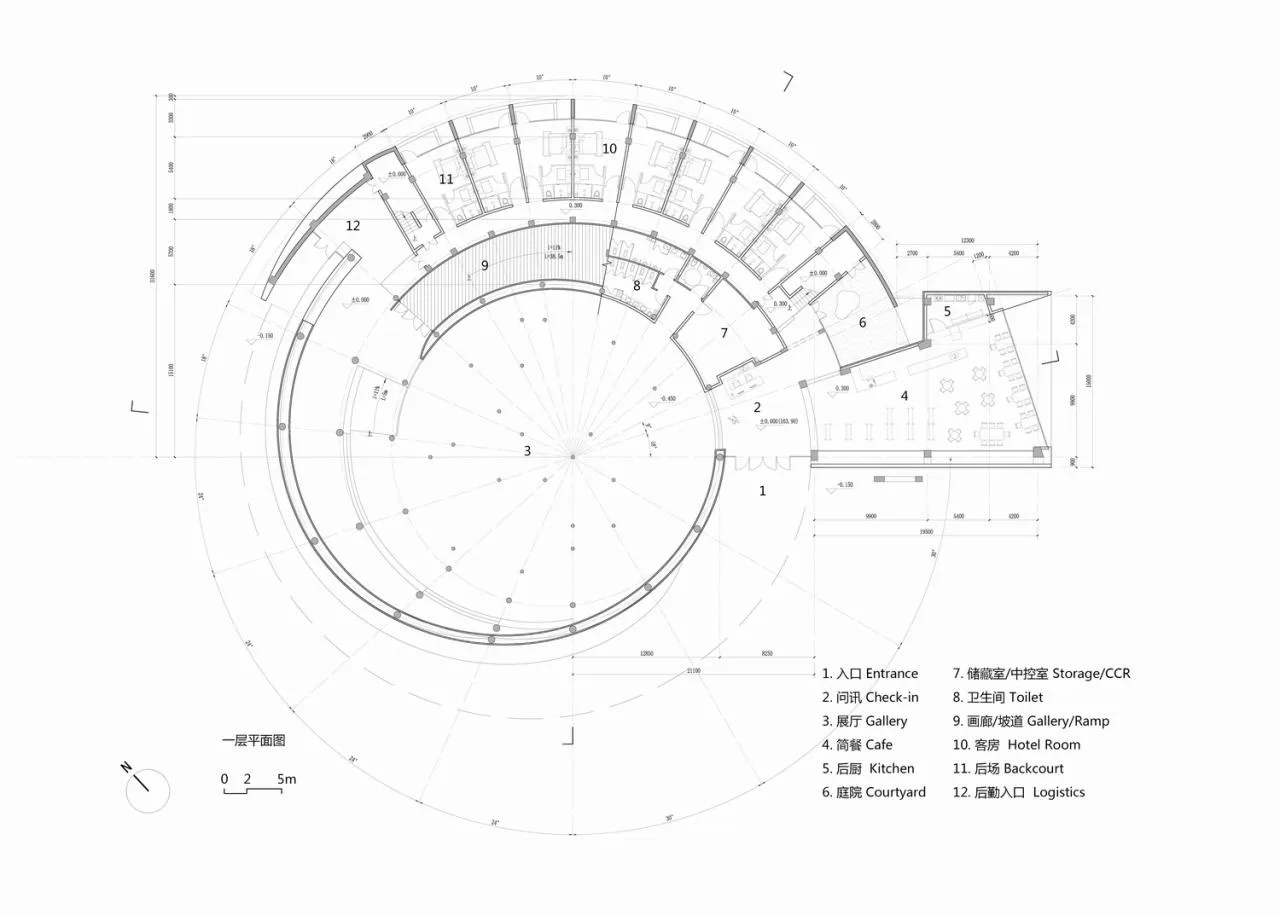
△ First floor plan
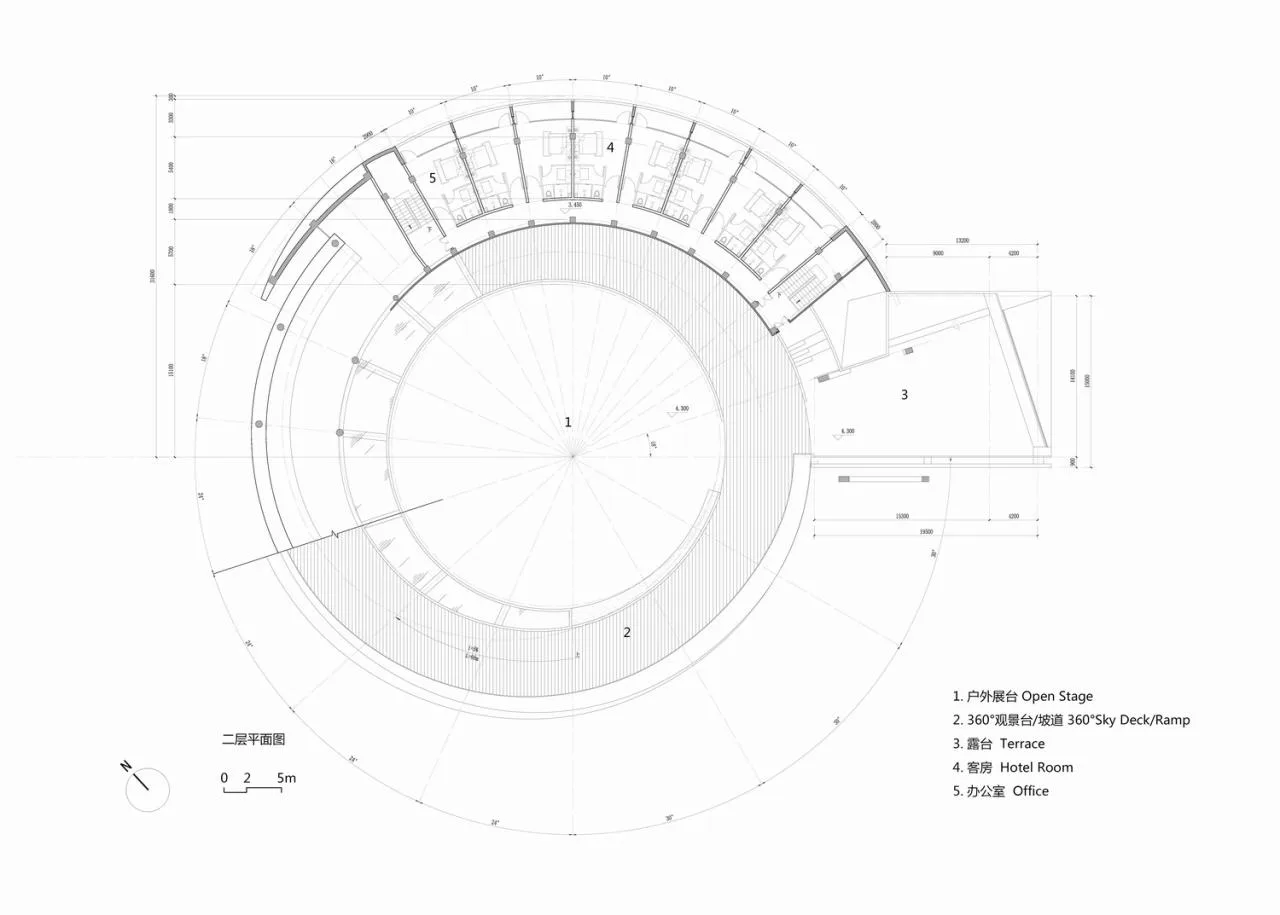
△ Second floor plan

△ Functional analysis chart
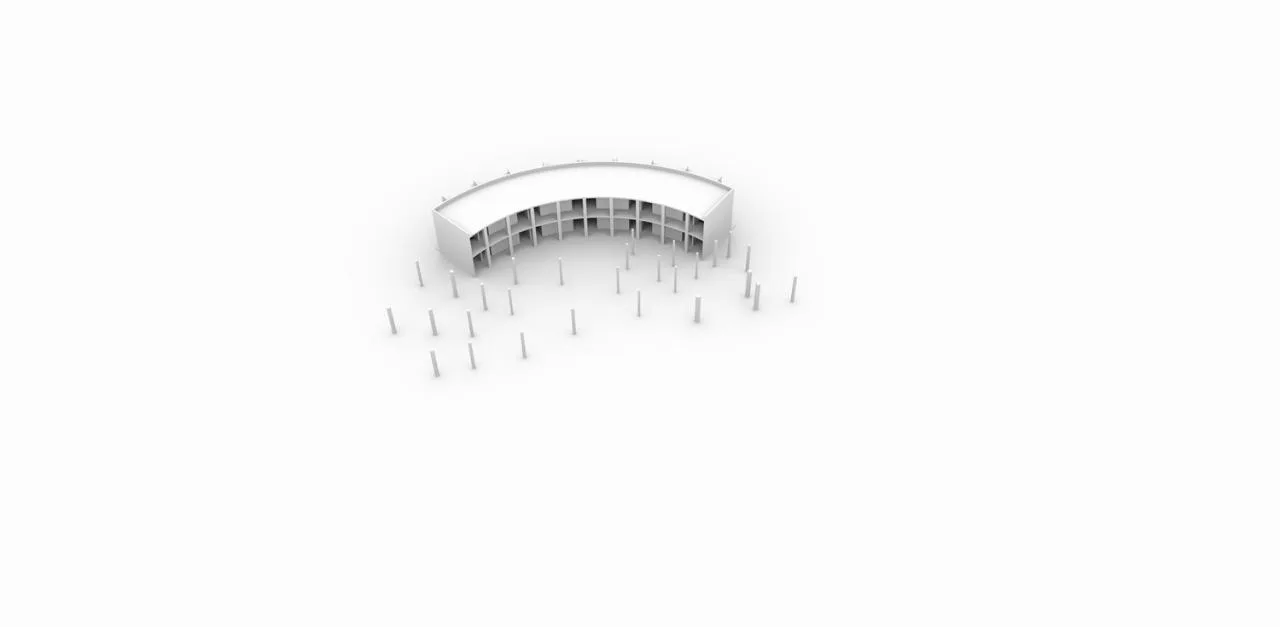
△ Functional analysis chart
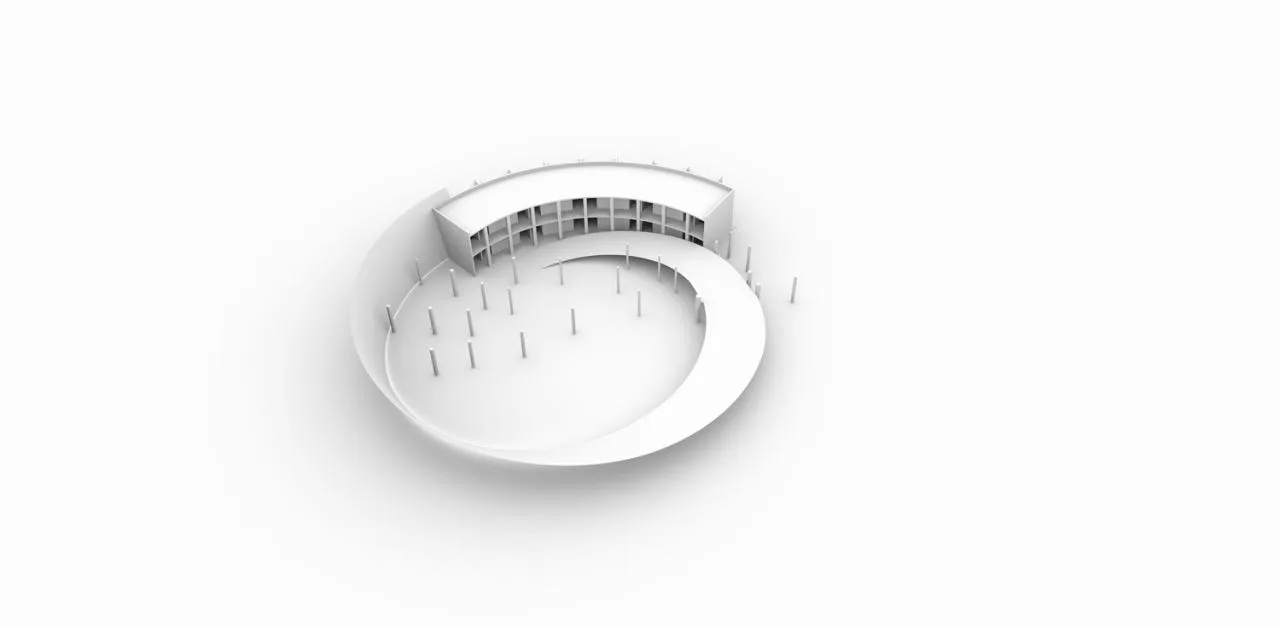
△ Functional analysis chart

△ Functional analysis chart

△ Functional analysis chart

△ Functional analysis chart
Project Information
Project Name: Tiangang Art Center
Location: Tiangang Village, Yixian County, Baoding City, Hebei Province, China
Owner: Yuange Cultural and Business Travel Group
Investor: Yuange Cultural and Business Travel Group
Project Type: Architectural, Landscape, and Interior Design
Design Period: February 2020 – August 2020
Construction Period: September 2020 – April 2021
Site Area: 2,736.81 square meters
Building Area: 2,586.95 square meters
Indoor Area: 2,586.95 square meters
Floor Area Ratio: 0.95
Green Coverage Rate: 23%
Project Function: Art Gallery + Hotel
Project Team Members
Lead Architect: Zou Yingxi
Project Architects: Gao Bo, Jin Nan, Jiang Zhihua, Chen Shifang, Tian Yahong, Wang Ziqiang
Interior Design Team: Xia Fuqiang, He Min, Cao Zhenzhen, Qian Guoxing, Liu Tingting, Li Qianqian, Feng Yan, Guo Mengjia, Li Hui
Landscape Design Team: Xu Lu, Li Beibei, Zhang Junchao, Liu Shuang, Liang Jingqi, Shi Qingqing
Soft Decoration Design Team: Shu Kun, Gu Yuecheng
Construction Unit: Zhongwai Jianhuacheng Engineering Technology Group Co., Ltd.
Structural Consultant: Beijing Zhonghe Jiancheng Construction Engineering Design Co., Ltd. – Lu Lijie Team
Lighting Consultant: Yike Guang Lighting Design (Shanghai) Co., Ltd.
Project Cost: 20 million RMB
Materials and Manufacturers
Bamboo and Wood: Shanghai Mosuo New Decorative Materials Co., Ltd.
U-shaped Glass: Shahe Longlong Glass Products Co., Ltd.
White Granular Elastic Paint: Guangdong Depway Coatings Co., Ltd.
Photography by Zheng Yan
Camera: Peanut Studio















Must log in before commenting!
Sign Up