
“I don’t like to be tied down; I am a free spirit.”
— Strolling in the Clouds
© CreatAR Images
The Duoyun Academy Huangyan store, designed by Wutopia Lab, officially opened its doors on June 26, 2021. This marks the first Duoyun Academy location outside Shanghai, symbolizing a cloud of idealism slowly rising along the banks of the Yongning River.
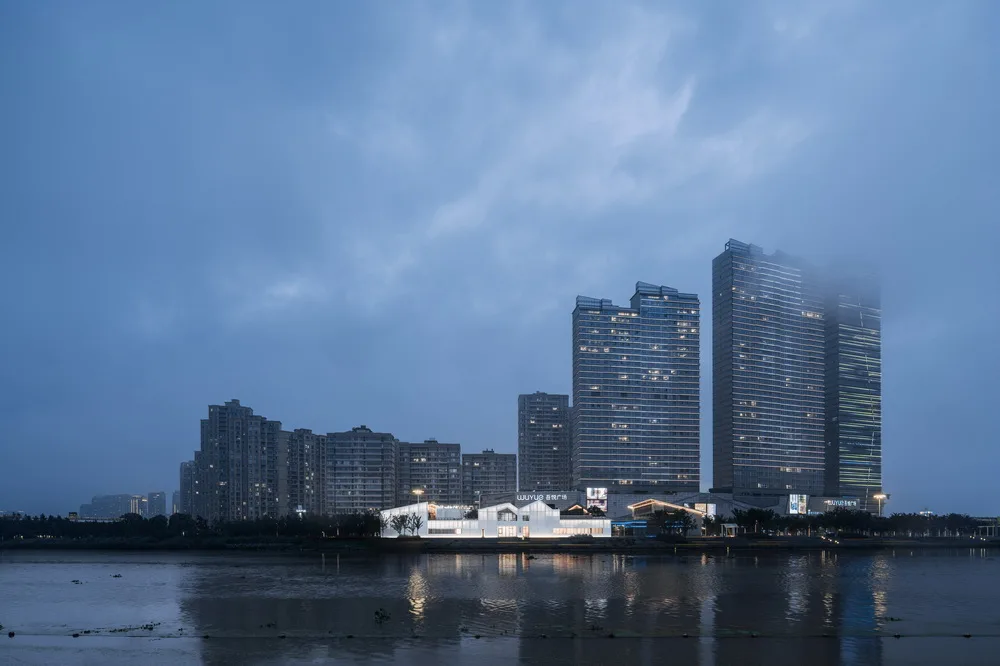
Baiyun Township by the Yongning River, where clear reflections grace the mountains and waters.
—– Yu Ting
Subtypical and Symbolist Writing
Design often begins with an emotion. Standing by the Yongning River during the day, I was captivated by the calm, eastward flow of the water. The flat, distant composition of the southern Chinese landscape invited my gaze to stretch along the horizon and relax. At night, locals gather by the river, lively and cheerful yet never noisy. The air was slightly humid, and a gentle breeze carried fresh droplets across my face. I envied the peace and joy of this city — a rare feeling in bustling Shanghai. Suddenly, I envisioned a cloud rising slowly and serenely over the river.
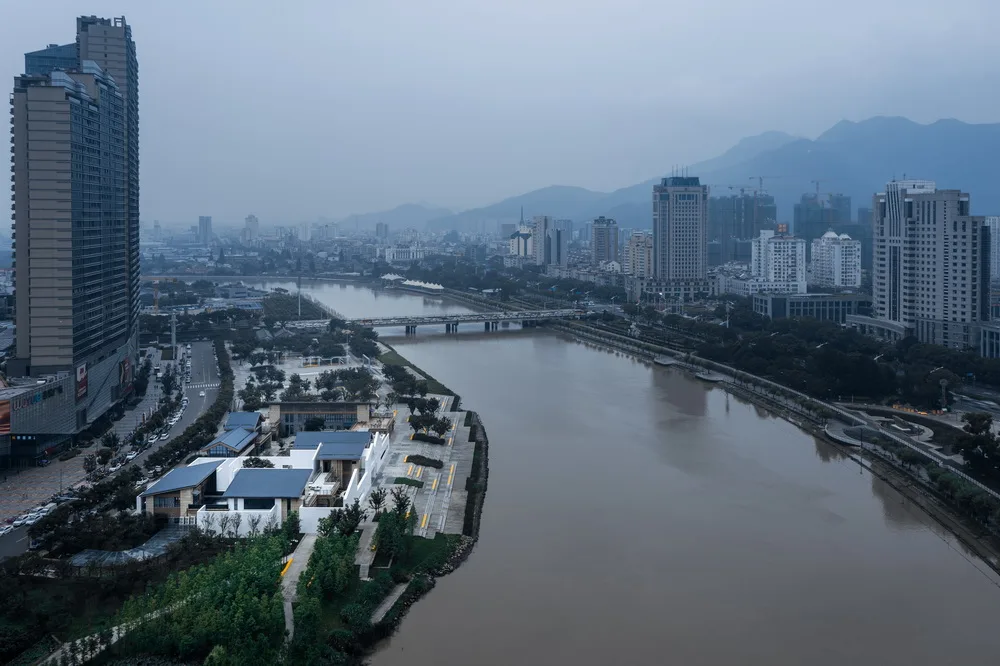
△ Along the Yongning River
Subtraction as Addition
Clouds embody a complex yet pure aesthetic. Instead of altering the cluttered commercial facade, I chose to envelop it with a continuous white perforated aluminum panel wall. This unbroken white surface creates a refined, misty layer by the river through controlled perforations, concealing the bookstore within. The aluminum walls serve as facades that can be peeled back to become courtyard walls or a hybrid of both. This continuous white wall acts as an additive element to achieve a peaceful visual subtraction. A cloud rises by the river, and within it, the bookstore’s readers find themselves immersed.
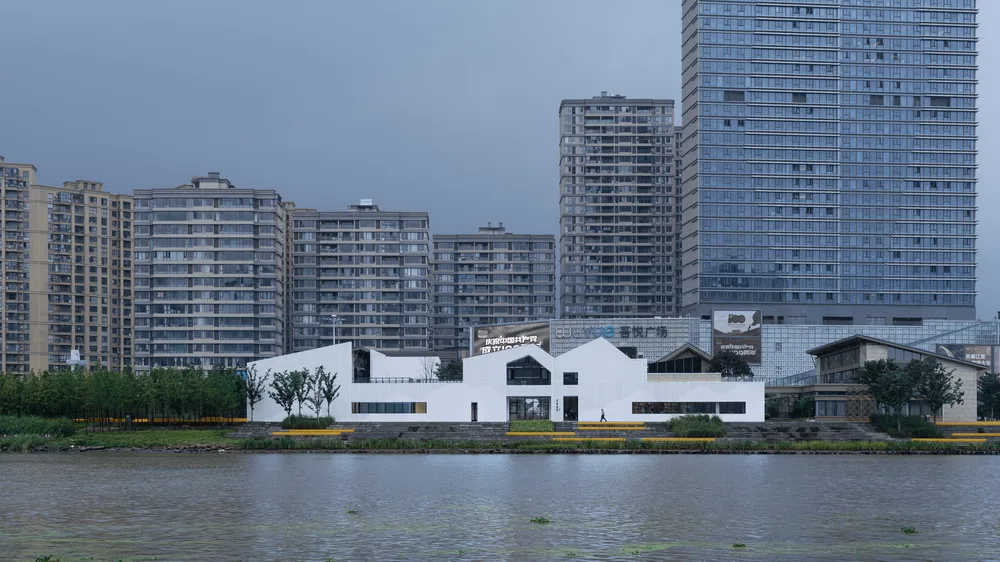
△ South facade
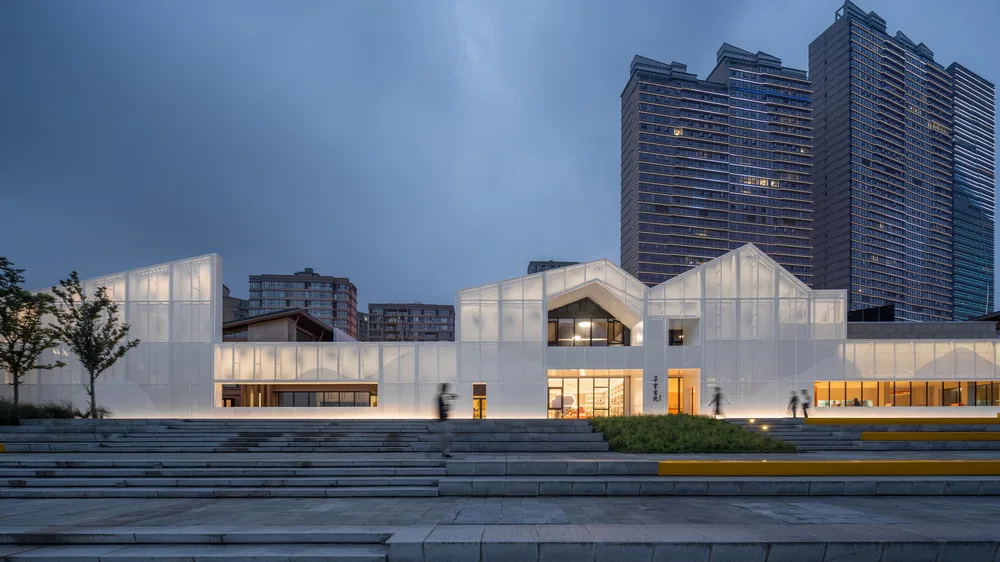
△ South facade
Traditional Typology
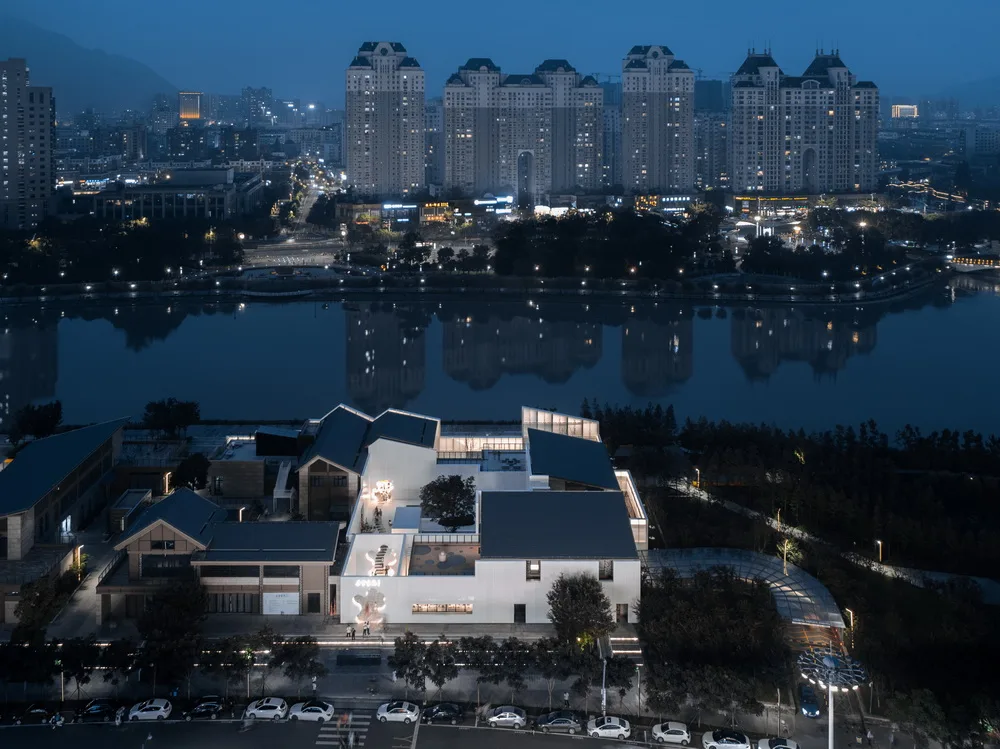
The academy occupies Buildings 1 and 3 in a cluster of four structures along the Yongning River. Building 1 is actually two connected buildings at ground level, forming a unified whole. The public space includes a basement courtyard and an evacuation staircase, creating a decentralized focus without a clear center. Traditional academies achieve scale and form through orderly groups of buildings. If we consider the dispersed Buildings 1 and 3 as pavilions, towers, and halls typical of traditional architectural complexes, we notice the absence of a courtyard as the central element. To unify these scattered structures, creating a courtyard became the natural solution.
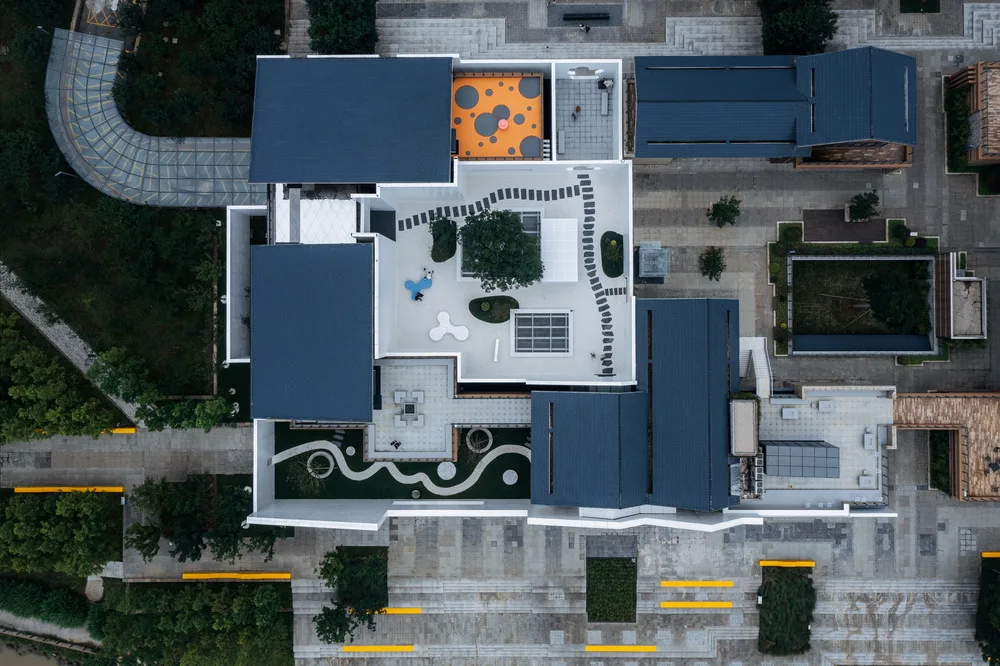
△ Bird’s-eye view of the academy
Between Buildings 1 and 3, I designed a square courtyard tucked behind the alley between Buildings 1 and 2 (which belongs to another owner). Rather than stopping there, I transformed this alley into a front yard — the official entrance to the academy.
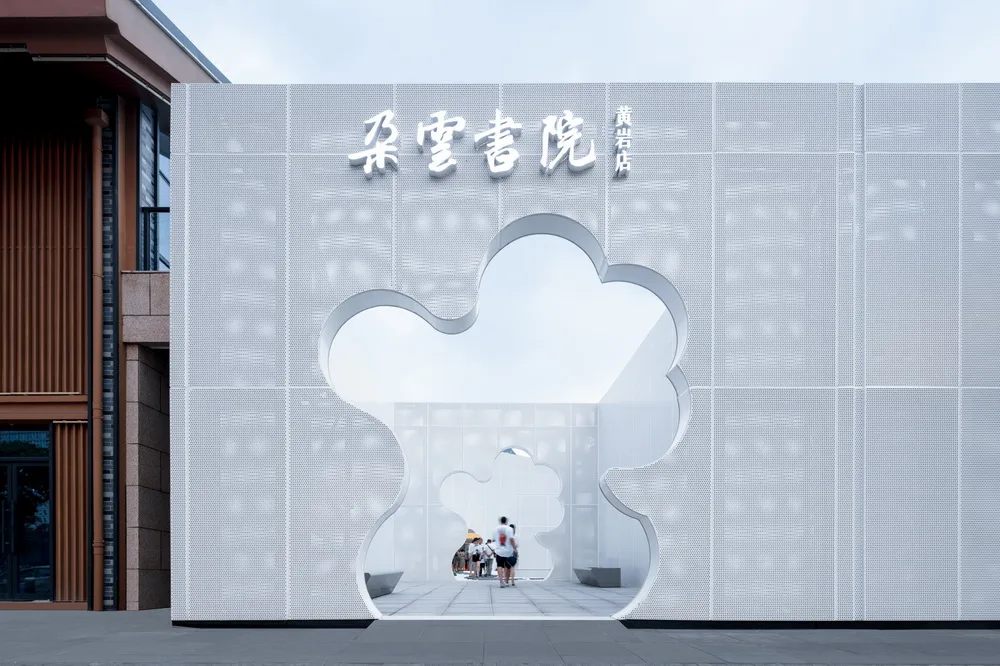
△ Entrance of the academy
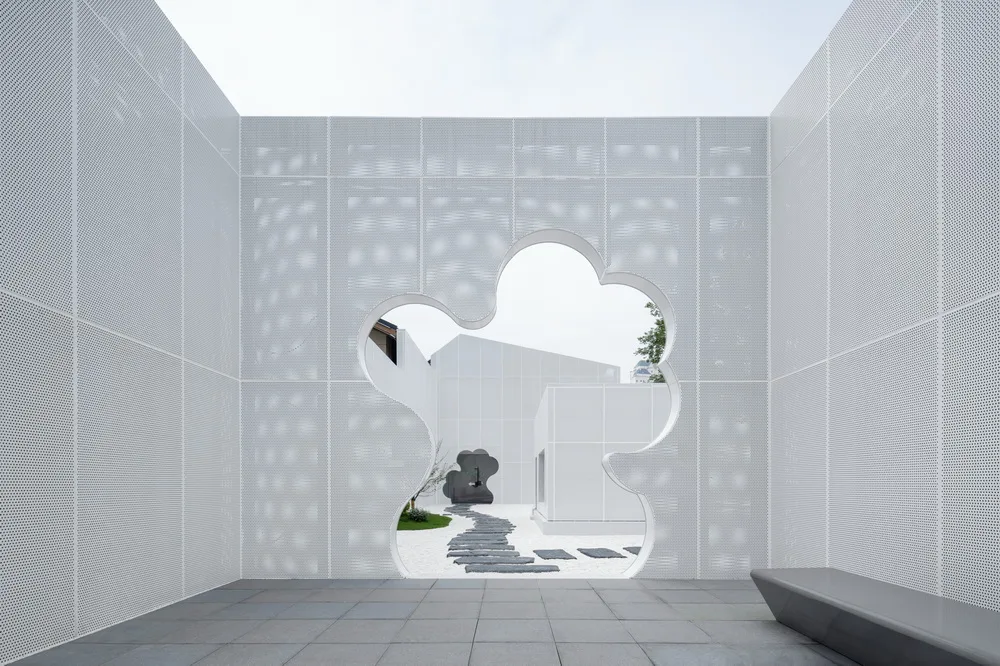
△ Front yard
Passing through multiple doorways, visitors reach Building 3, the main entrance. The first area is the lifestyle book section (hall), with a coffee area (pavilion) by the water to the east. The staircase from the coffee area to the second floor doubles as a display space (pavilion) and connects circulation. The coffee shop’s second floor houses the future city reception room (building).
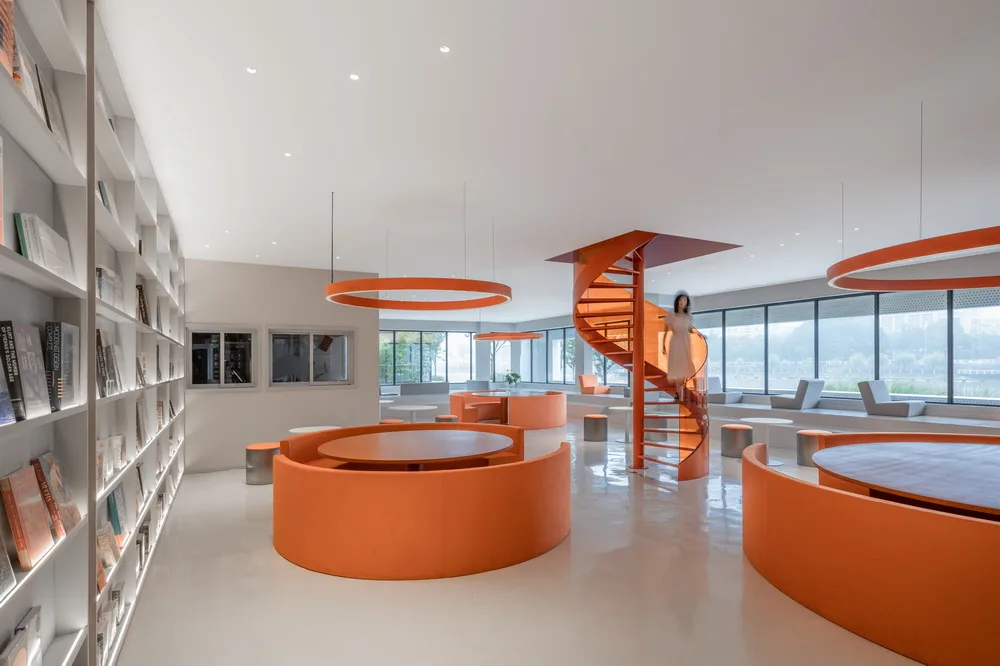
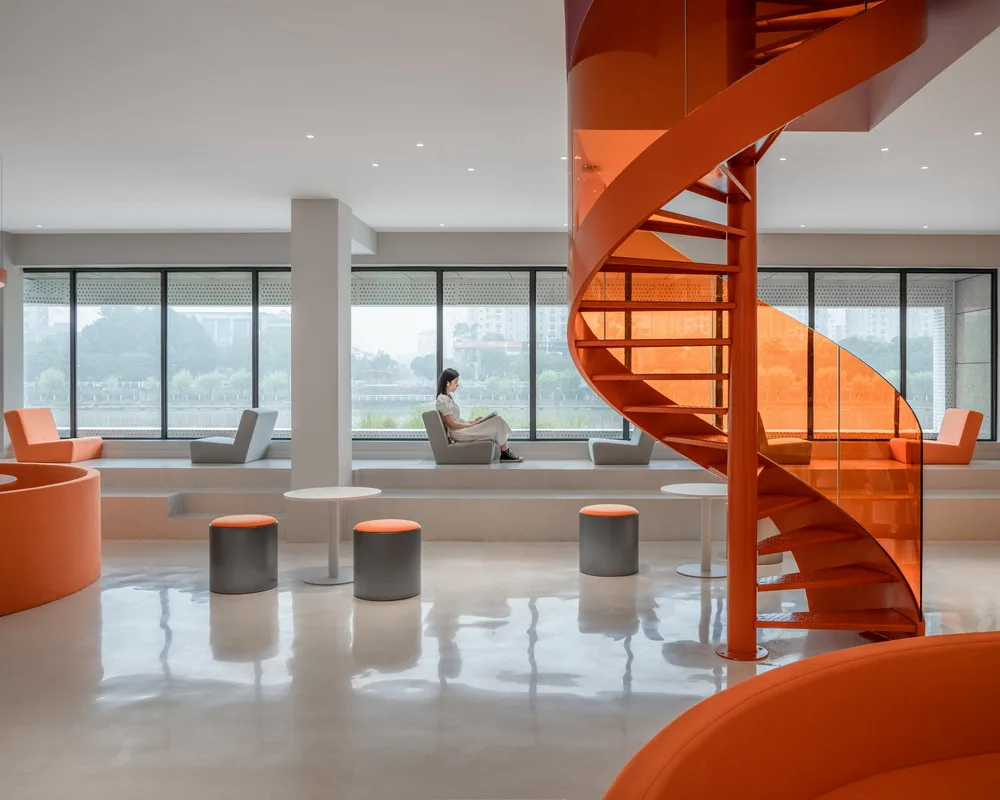
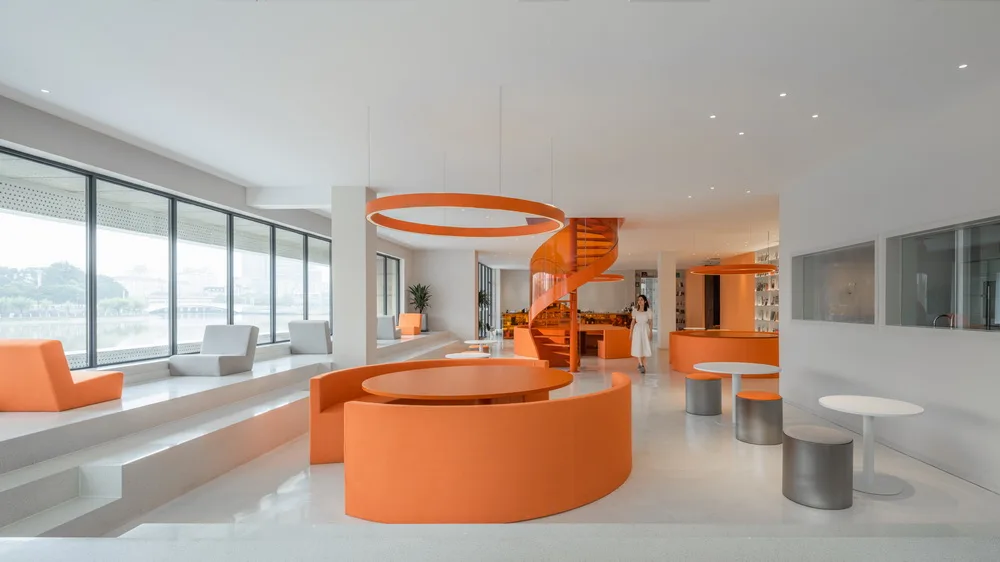
△ Coffee area by the water (pavilion)
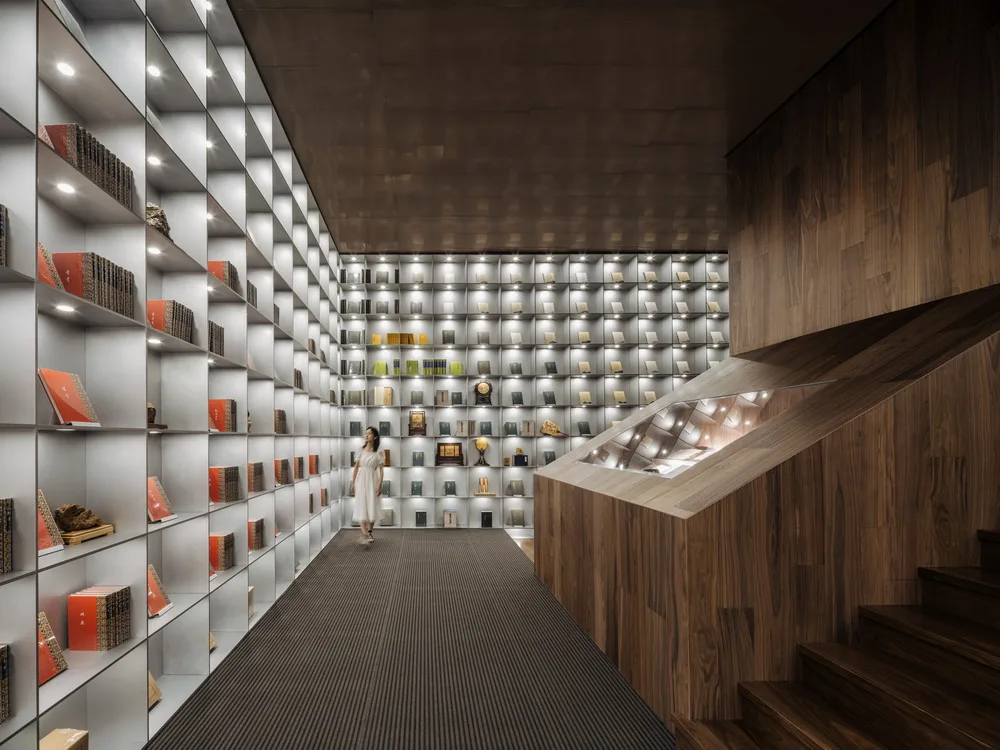
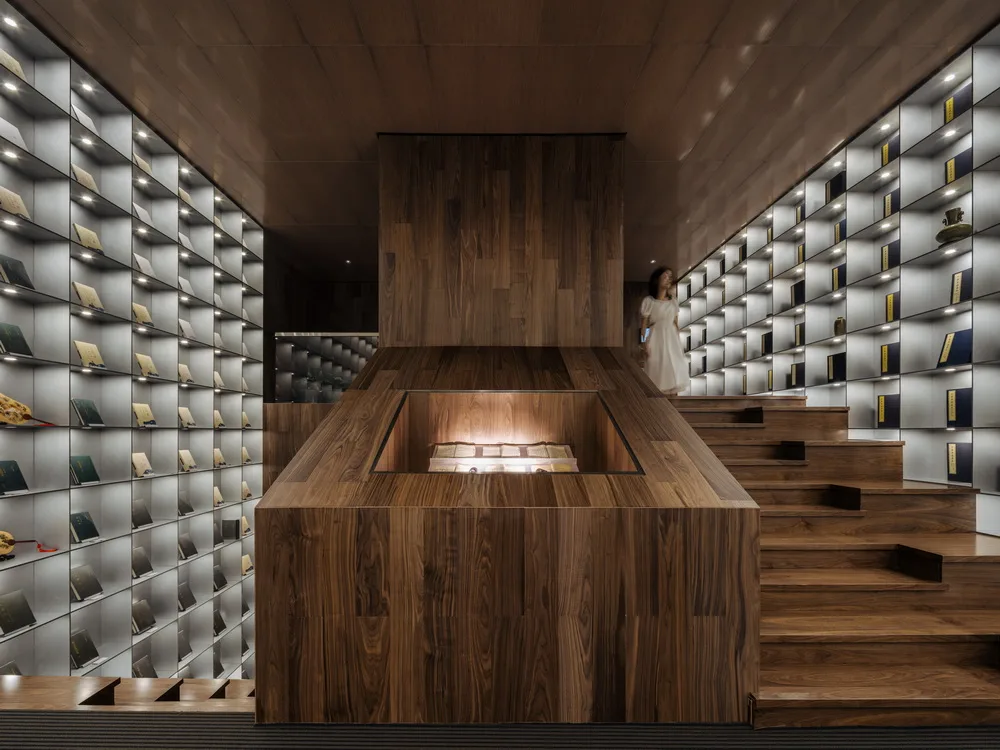
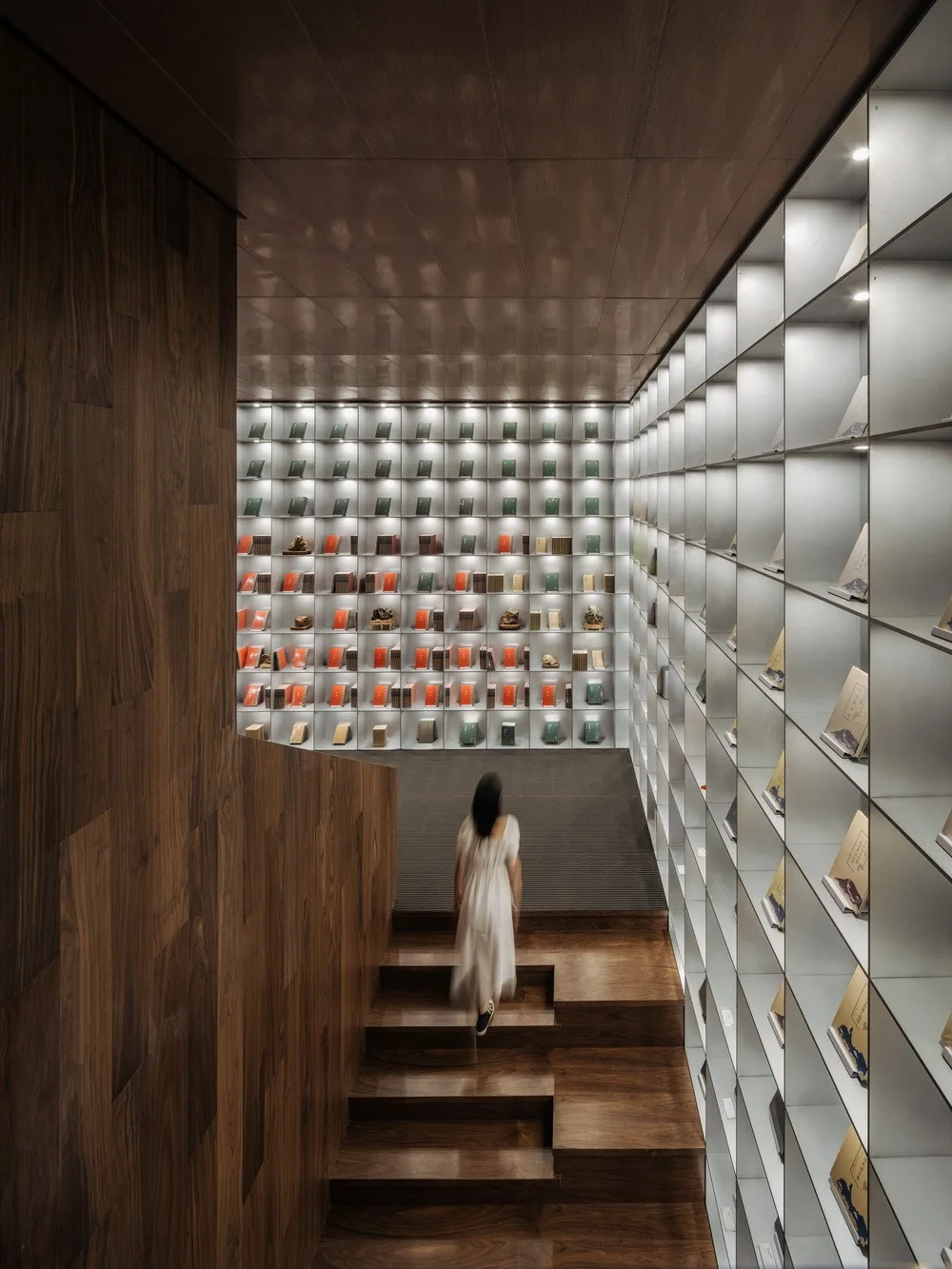
△ Shanben Exhibition Area (Pavilion)
An indoor corridor was added on the west side, connecting to Building 1 and designed as an exhibition gallery. The first floor of Building 1 houses the bookstore, beginning with the attitude-oriented bookshelf area (pavilion) unique to Duoyun. Turning north leads to the main bookstore display area (hall). Beyond the cashier lies the reading space (residential area) designed along the corridor, followed by the cultural and creative zone (studio).
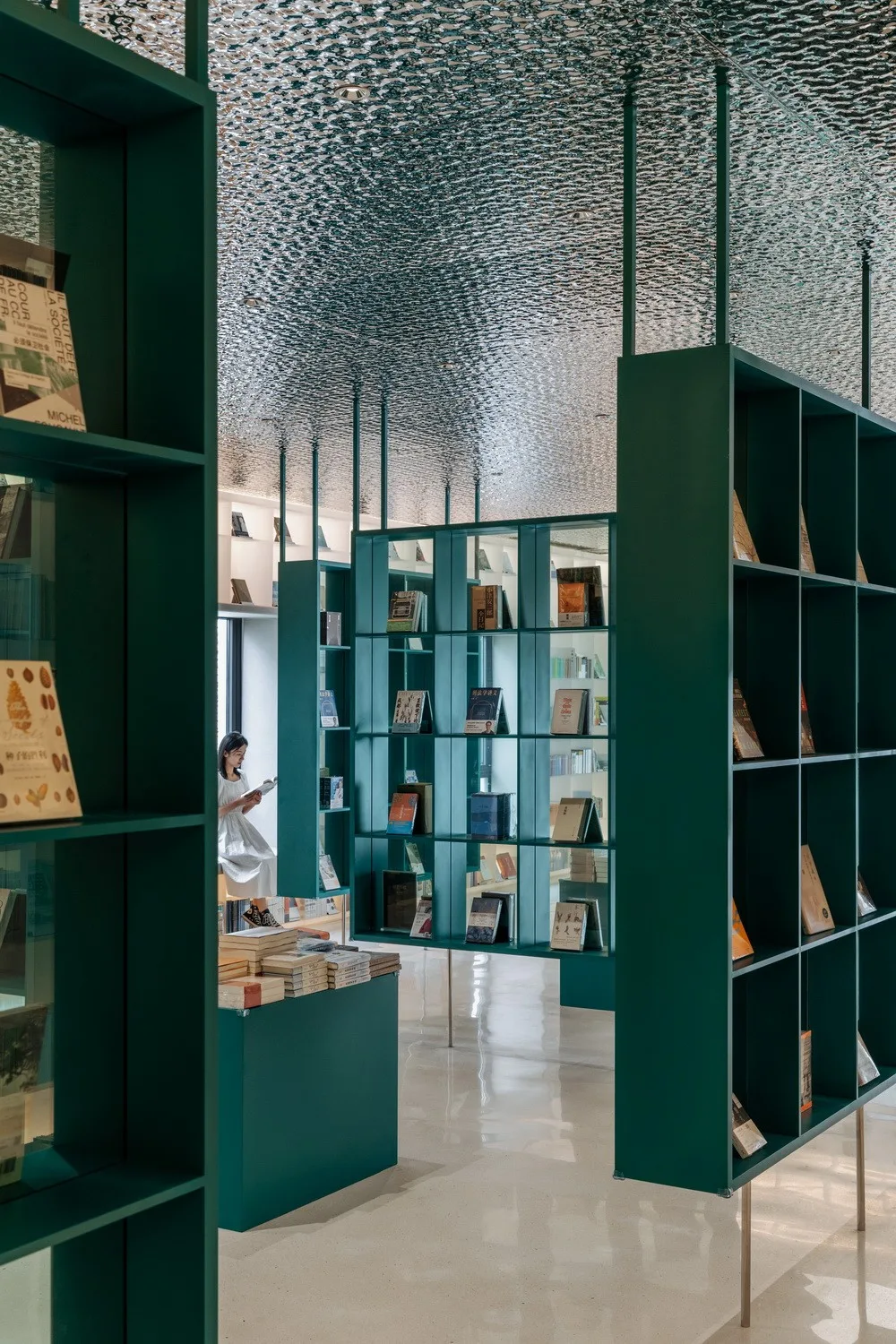
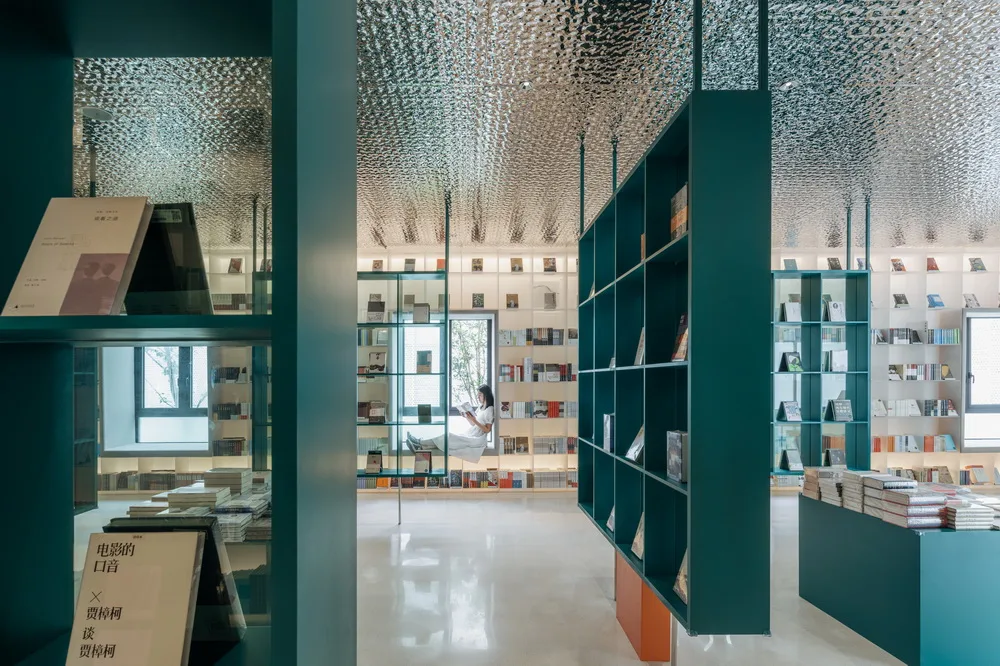
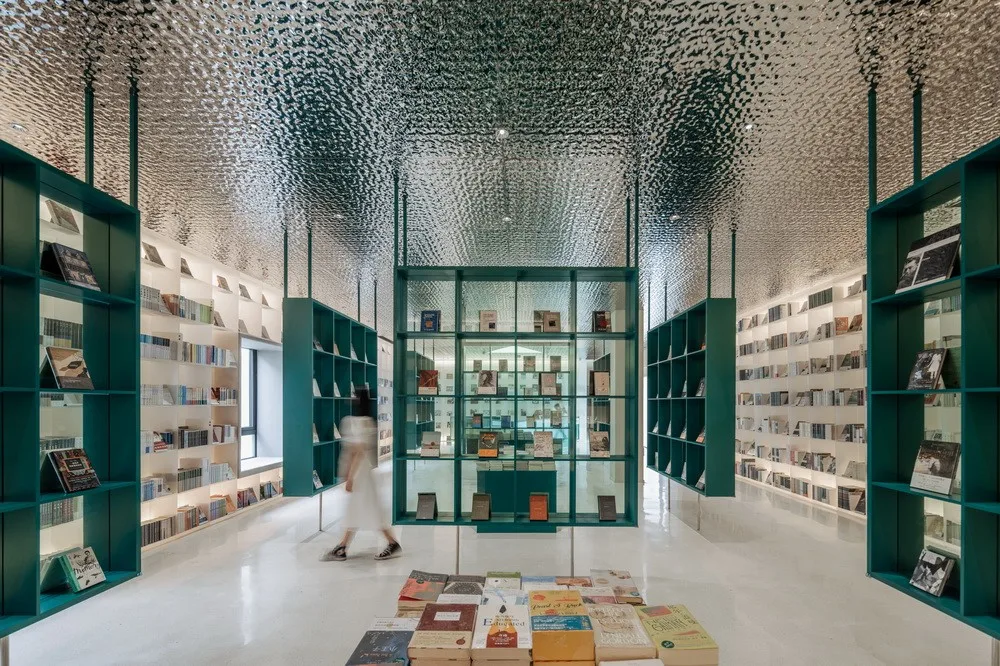
△ Main display area (hall)
The exhibition hall is located upstairs within the cultural and creative zone. The bookstore’s second floor features a tiered speech area (room). These second floors are connected by rooftop platforms that serve as children’s play areas, mirrored terraces, discussion terraces with fire pits, and maze terraces doubling as coffee grounds.
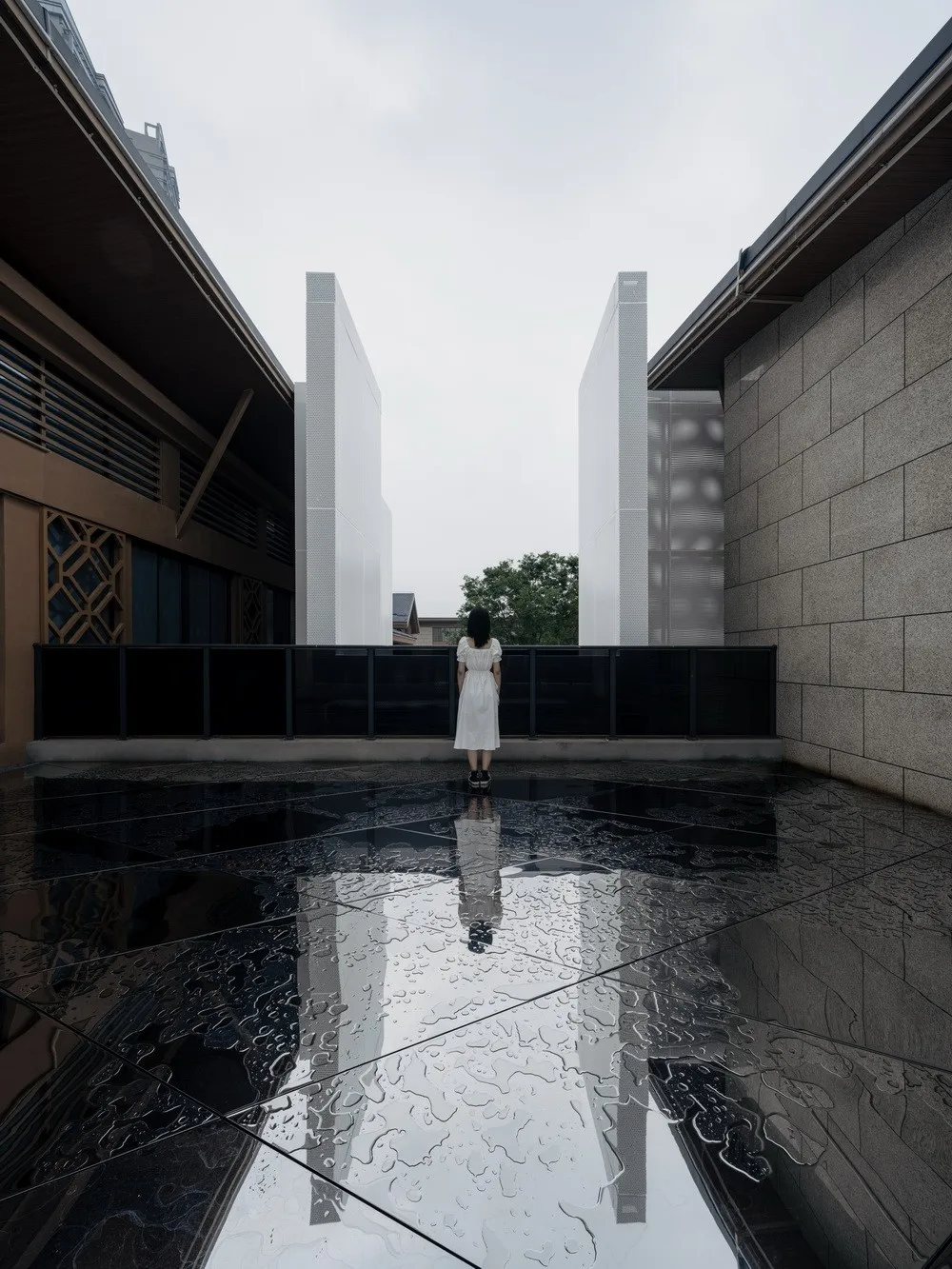
△ Mirror terrace
Borrowing architectural types such as pavilions, towers, and courtyards effectively links function with garden architecture. This approach helps audiences unfamiliar with architecture understand and support the transformation of public spaces through new courtyard designs, integrating the complex into an accessible academy. Named Baiyun Court, this courtyard and its three side courtyards (front, south, and west), along with surrounding walls, unify Buildings 1 and 3 into a visually continuous complex. Thus, a new academy space emerges from traditional architectural typology, rewriting a set of scattered commercial buildings and creating a fresh visual and spatial identity.
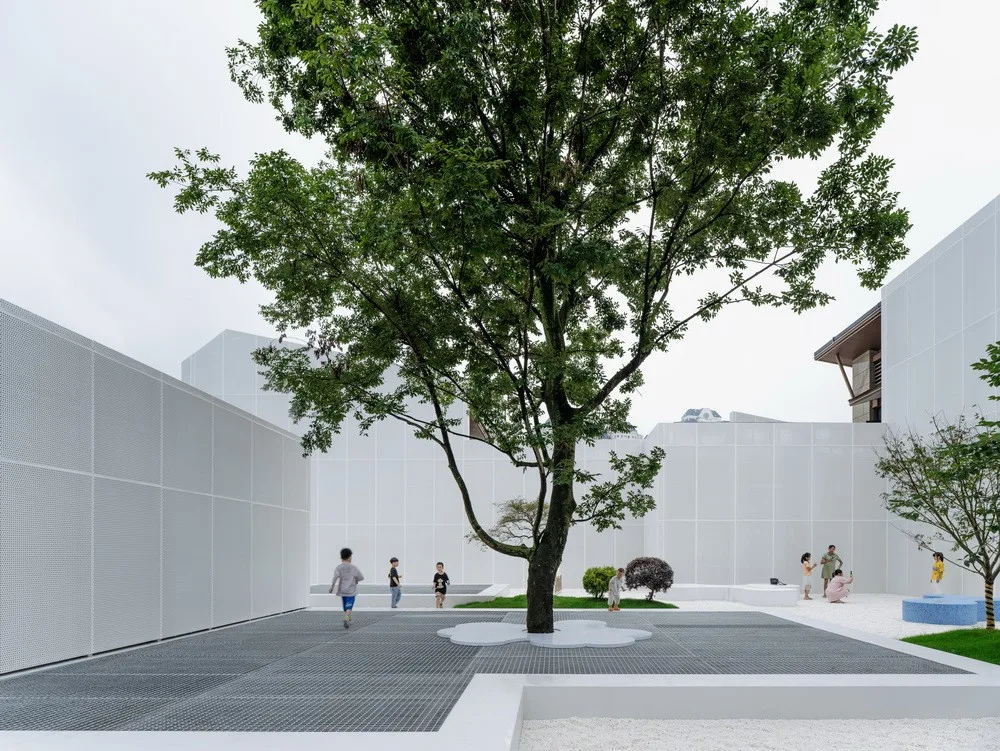
△ Baiyun Court
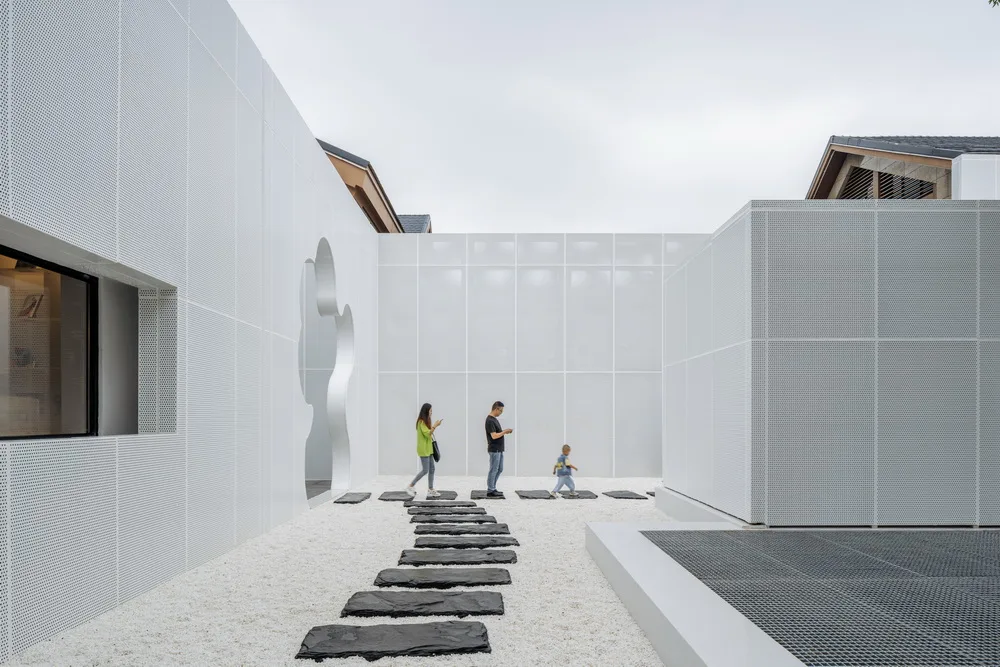
△ Baiyun Court
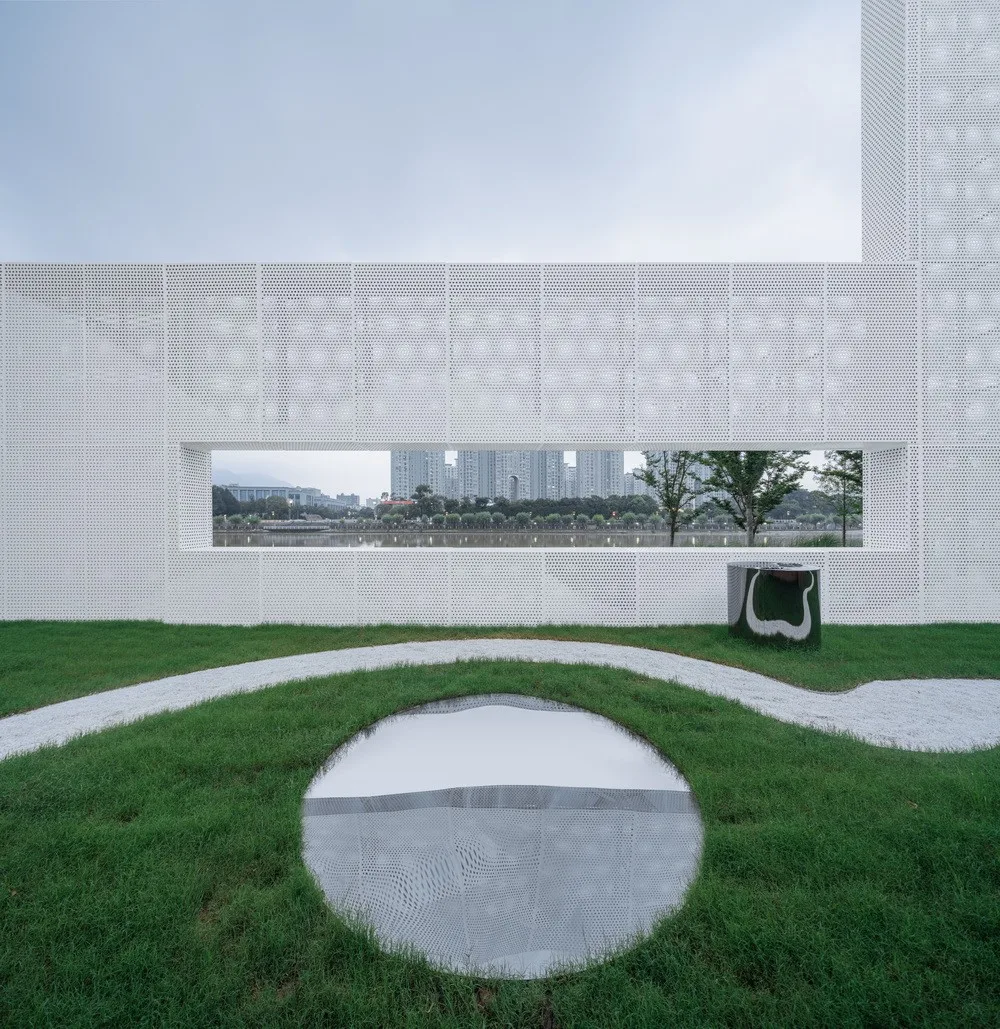
△ Nanyuan
The Colorful Auspicious Clouds of Metaphors and Symbols
I firmly believe architecture should be rich in metaphor. We distilled clouds into easily recognizable symbolic forms, incorporating them into doorways, signs, and even visual identity. The white of clouds envelops the architectural background, enhancing the symbolic meaning of clouds and representing the ‘cloudy’ essence of Shanghai. The orange hue, drawn from Huangyan’s famous oranges, symbolizes the cloudy atmosphere of Huangyan and dominates the entrance book area and coffee space. This palette constructs a narrative of five-colored auspicious clouds, from white to orange.
The bookstore and cultural zones adopt green as their primary color — a classic in Duoyun Academy furniture and significant since blue is reserved in Taizhou. This green represents ‘Qingyun’ (Blue Cloud). The speech area upstairs uses crimson as the red cloud, and the exhibition area upstairs features pink-purple as the purple cloud. Each of these five colors corresponds to a major functional area, deepening the cloud metaphor and weaving a story that connects Shanghai, Huangyan, history, literature, and local identity. This narrative of Five Colored Auspicious Clouds replaces typological borrowing, enriching the symbolic language and establishing a ‘myth’ of reading amidst the clouds.
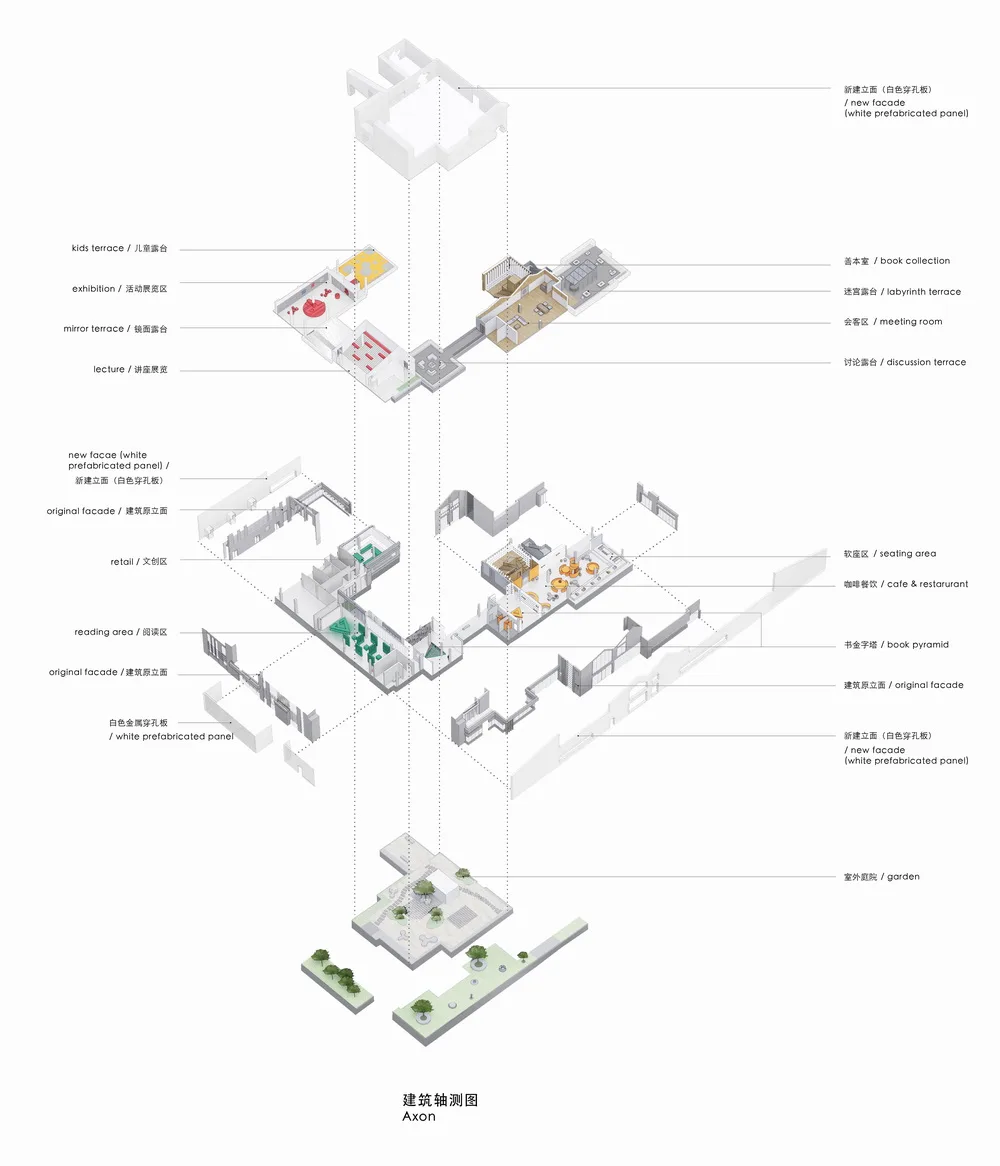
△ Axonometric diagram
Pyramid and Maze
When exploring spatial visual focus, the architect was inspired by Roelof Louw’s 1967 Pyramid of Oranges. We created a pyramid-shaped bookshelf filled with orange books in the lobby. Although it resembles a ziggurat in shape, the pyramid serves as the dominant centerpiece, while a larger green pyramid bookshelf anchors the attitude bookshelf area (pavilion). The triangular form extends to a semi-transparent acrylic cash register, controlling the visual focus in the main bookstore area (hall). The orange color’s connection to Huangyan aligns with the artist’s installation titled Soul of City. In this light, the Huangyan Duoyun Bookstore embodies the Soul of Huangyan.
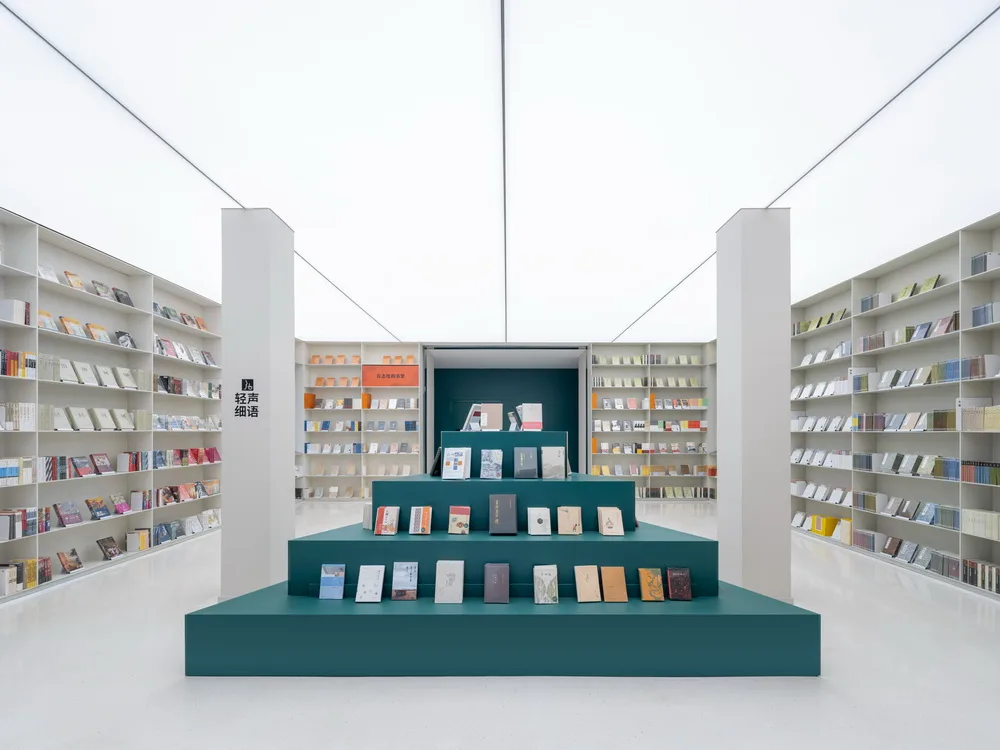
△ Bookshelf area (pavilion)
I am fascinated by how time experiences emerge through the complex arrangement of direction, vision, and pace. A maze is a perfect architectural form to combine with light and craft this experience. Here, bookshelves and furniture form the walls of the bookstore maze. Transparent and semi-transparent surfaces blur light, creating a space filled with curiosity and gentle disorientation. Time seems to slow down.
In the coffee area (pavilion), the orange furniture resembles ripples on water. Sitting on the high platform by the window, lost in thought on the sofa, the river unfolds like a scroll — evoking the timeless feeling of Chinese landscape paintings, reminiscent of my first emotions by the river.
Due to structural beams beneath the roof panel, a skylight could not be installed above the checkout counter to unify water and sky. Instead, a luminous ceiling was used, though it lacks the desired light effect.
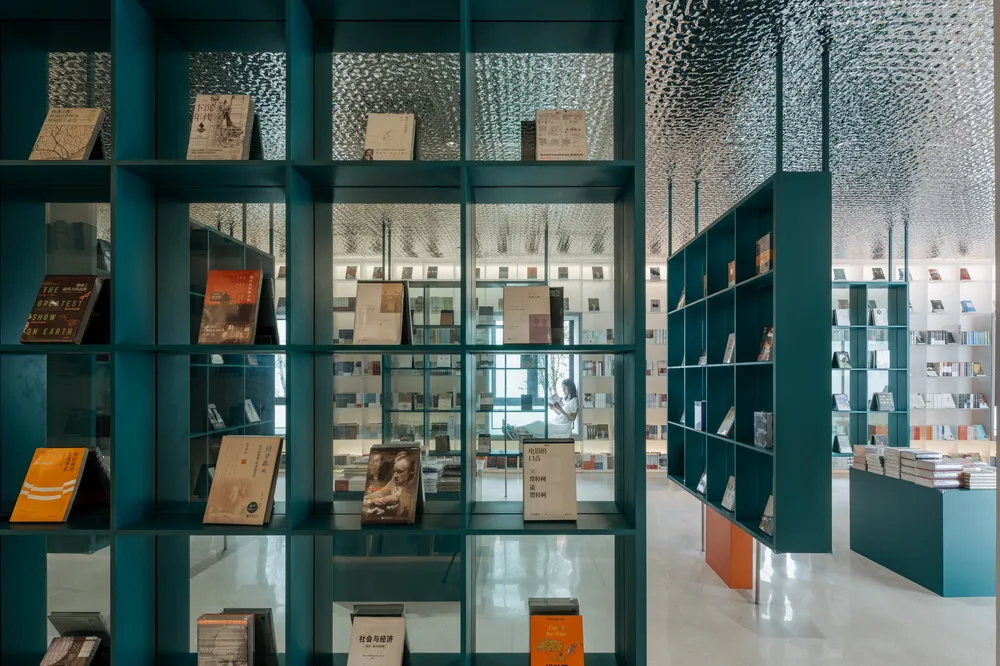
△ Main display area (hall)
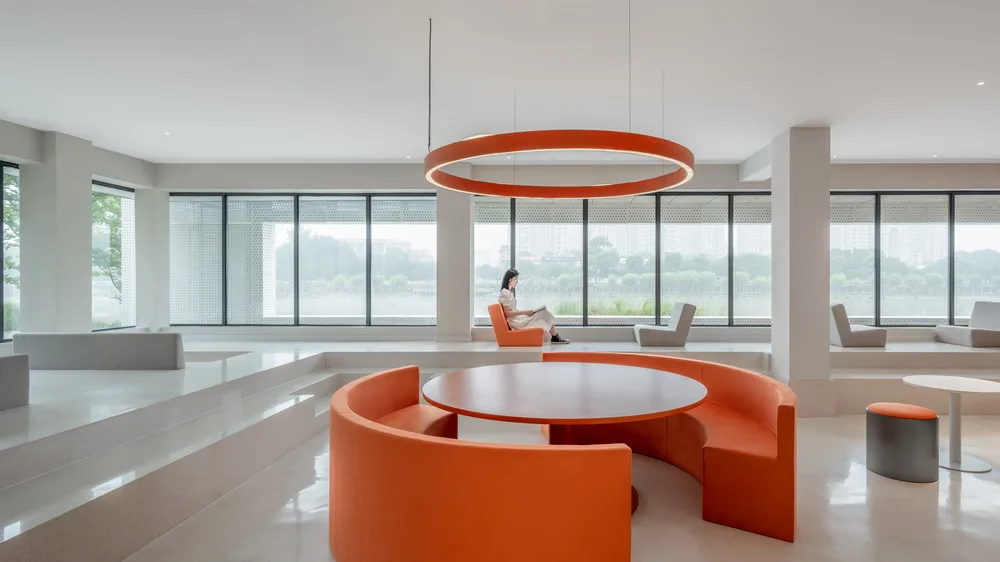
△ Coffee area (pavilion)
Water Surface and Sky
To enhance the maze’s disorienting effect, corrugated aluminum panels were used for the ceiling, mimicking the shimmering waves of the Yongning River. The rooftop platform above the checkout area acts as a mirror reflecting the sky, creating a space where direction and time dissolve by merging water and sky on either side of the floor slab.
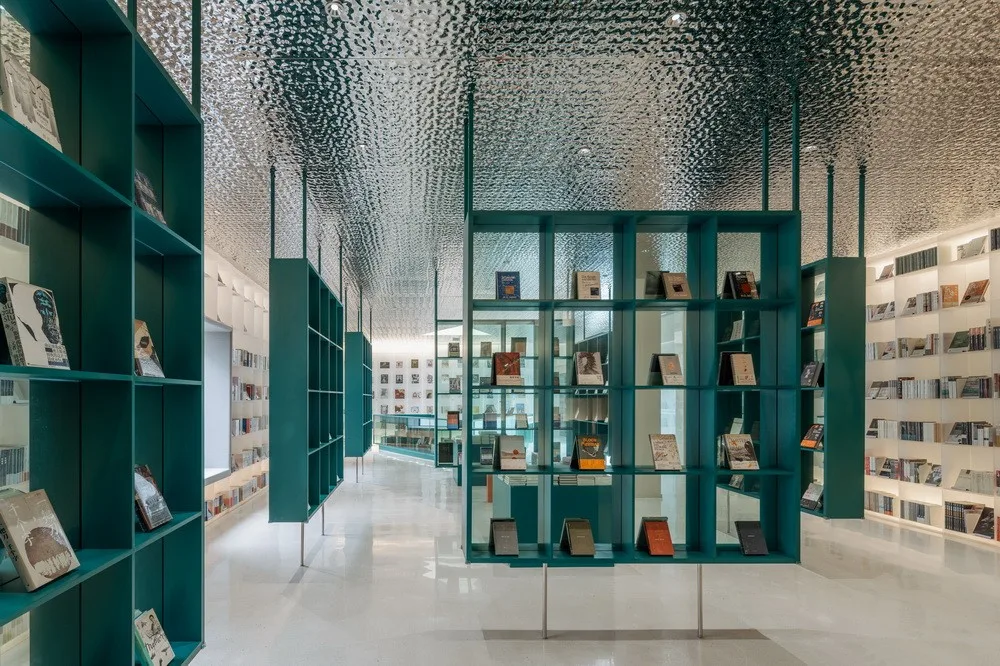
△ Bookstore main display area (hall)
The Myth of Baiyun Court
The courtyard at Duoyun Academy Huangyan Branch reflects my exploration of the spirit behind traditional gardens. With the owner’s full authorization, I took ownership of the courtyard’s design, crafting a world that fits my vision and local context. Existing structures and facilities were removed, while original trees and plants were preserved. Fire stairwells and smoke exhaust courtyards were renovated to meet regulations. I envisioned the courtyard as a water surface, with three clusters of trees forming a “one pond, three mountains” paradigm common in Chinese gardens.
The arrangement of trees draws inspiration from my favorite painter Ni Zan. While the white stones and greenery evoke Japanese dry landscape gardens, the true inspiration comes from a fragment in Qiu Ying’s “Landscape Scenery,” depicting withered Chinese mountains and waters. In that painting, a vibrant rose blooms on a broad white stone floor resembling shimmering waves—simple and sparse. The courtyard in the painting is enclosed by bamboo curtains; in ours, white perforated aluminum panels create a semi-transparent enclosure. Light filters through, casting mottled shadows that enliven the space. This courtyard does not imitate traditional gardens but expresses the Chinese longing to create a vibrant fairyland—even amid urban density—known as the Peach Blossom Spring. It represents a contemporary dream.
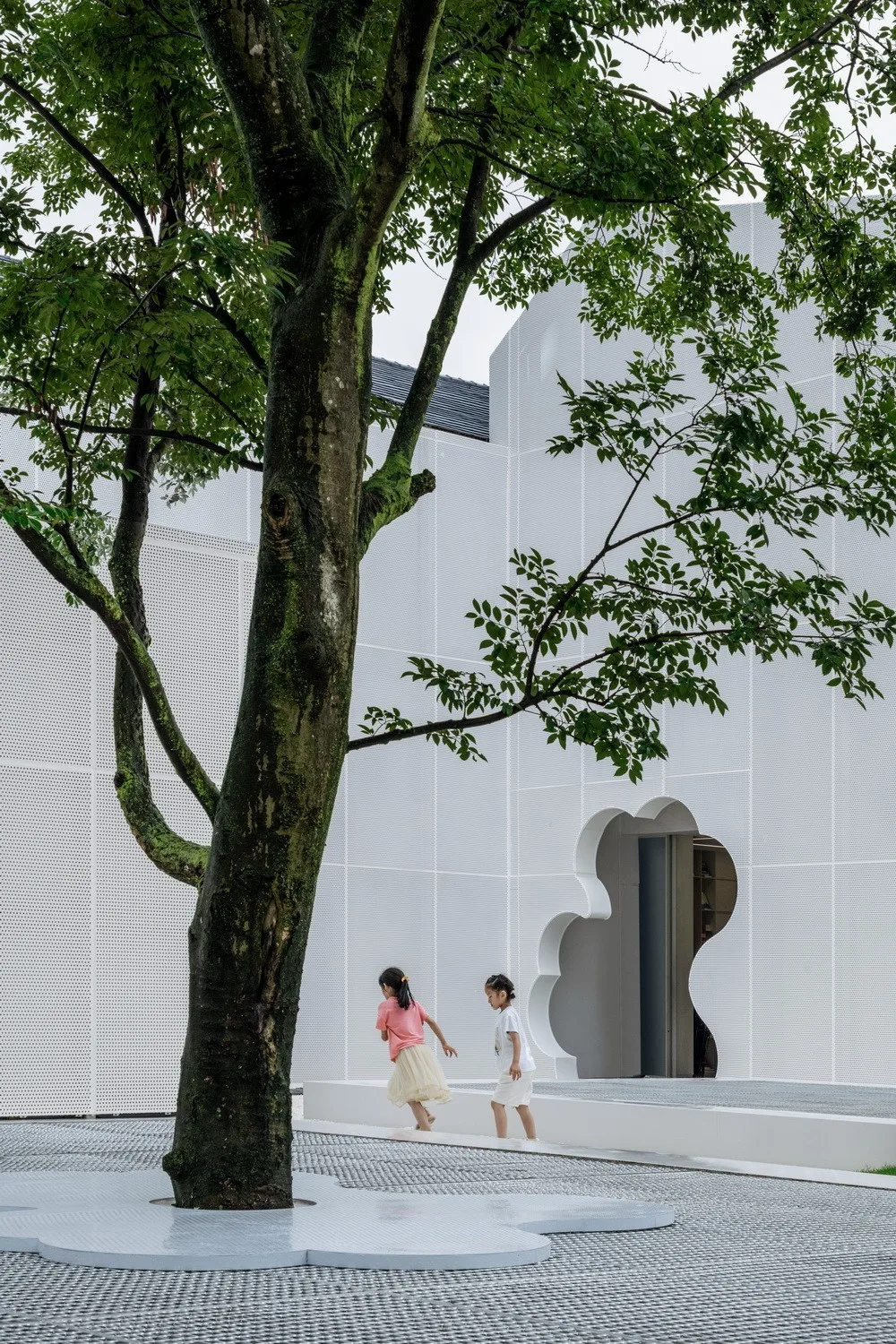
△ Baiyun Court
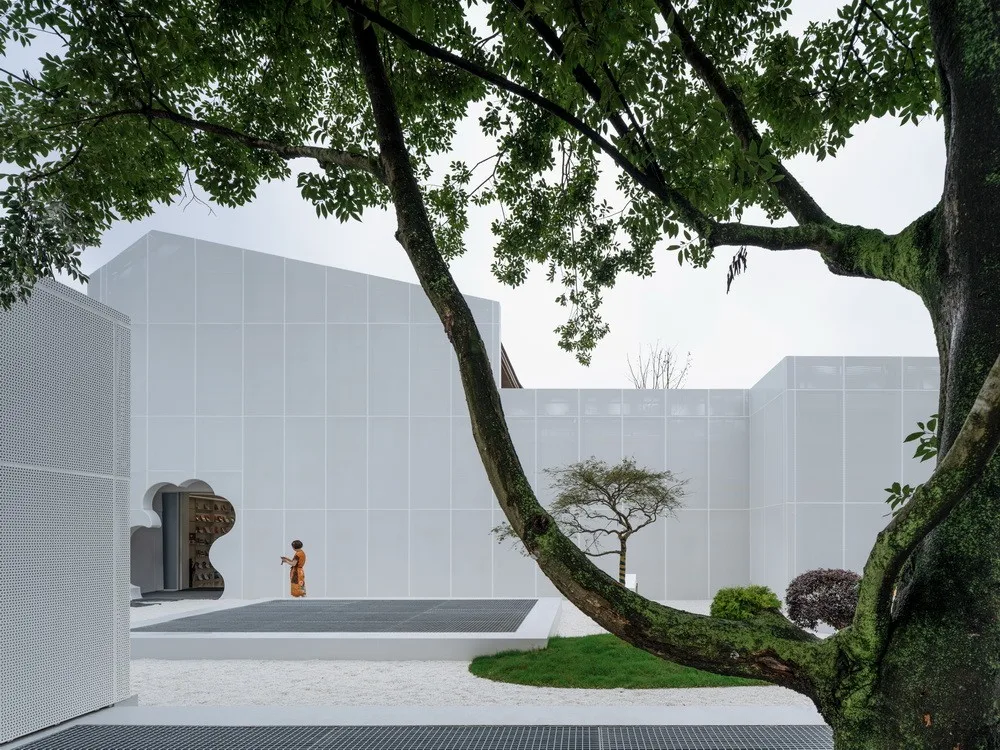
△ Baiyun Court
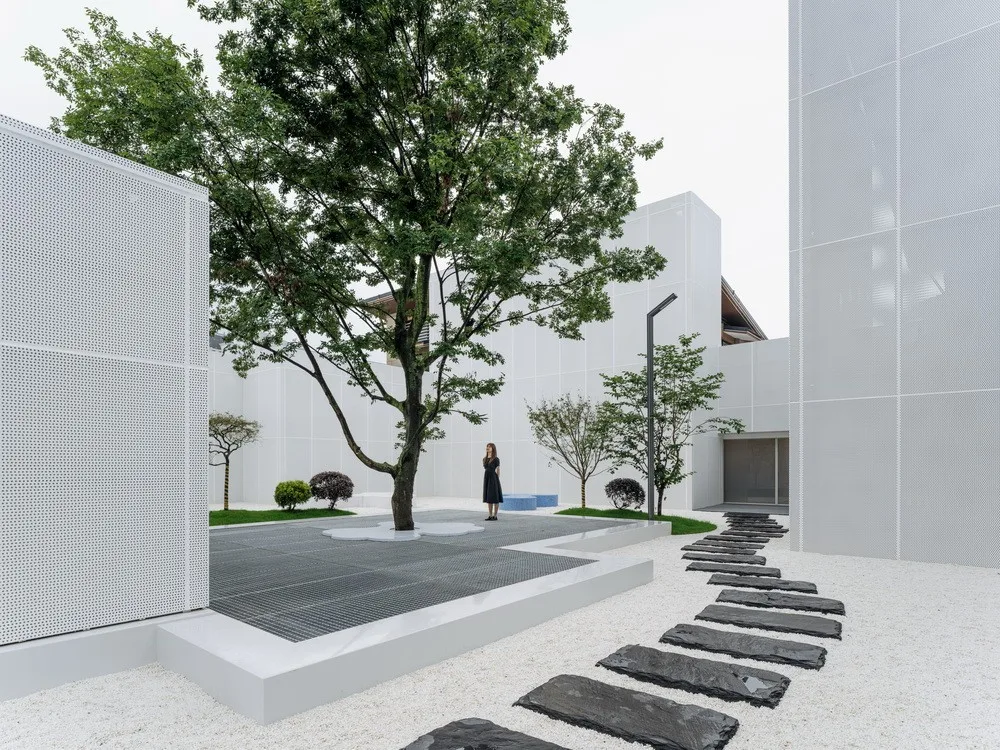
△ Baiyun Court
Dreams and Reality
The white aluminum wall does not cover all the old buildings. In many parts of Baiyun Court, visitors are immersed in a dreamlike experience. In others, traces of the original structures peek through. This interplay between dream and reality constructs a sense of magical realism — an unfamiliar familiarity. It is a surprise I am pleased to witness.
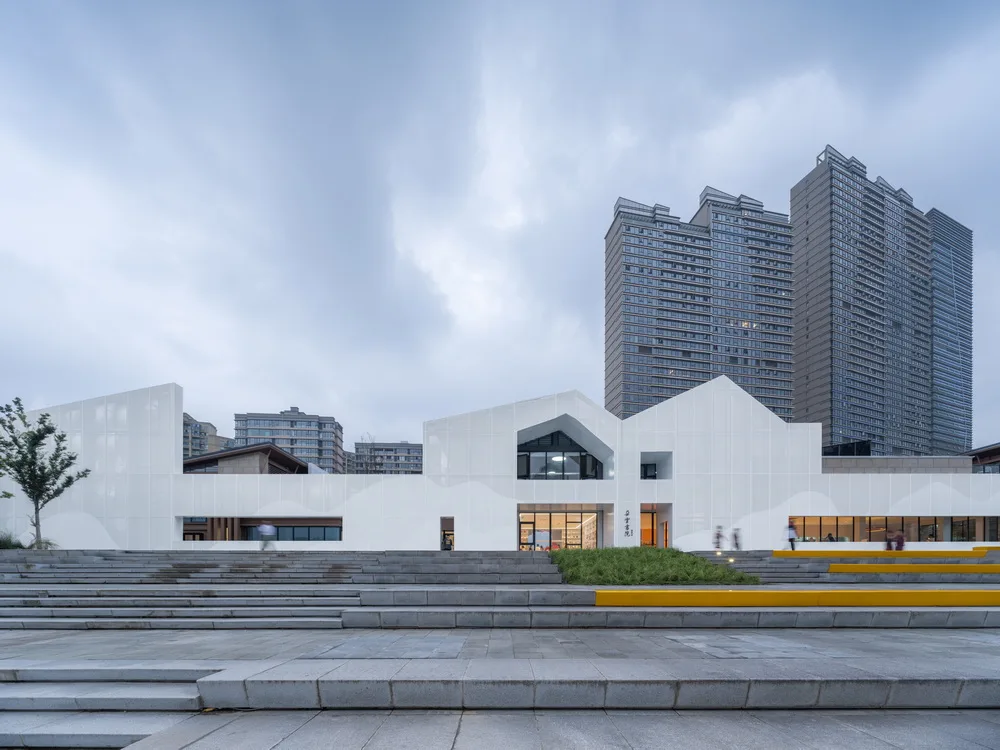
△ South facade
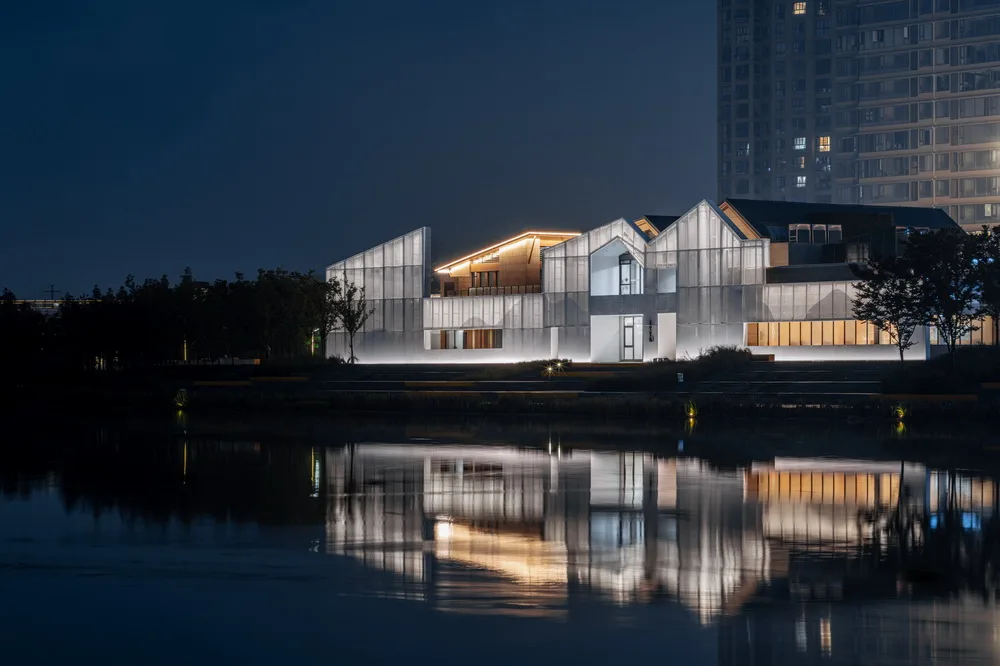
Two Easter Eggs
Visitors will find two cloud-shaped stools—one white, one blue—in the Baiyun Pavilion. These are made from recycled plastic sourced from ocean debris. Taking advantage of Huangyan’s reputation as the capital of molds, molds were produced locally to cast the recycled plastic. This environmentally conscious choice stems from my daughter’s environmental education and reflects the architect’s commitment to sustainability.
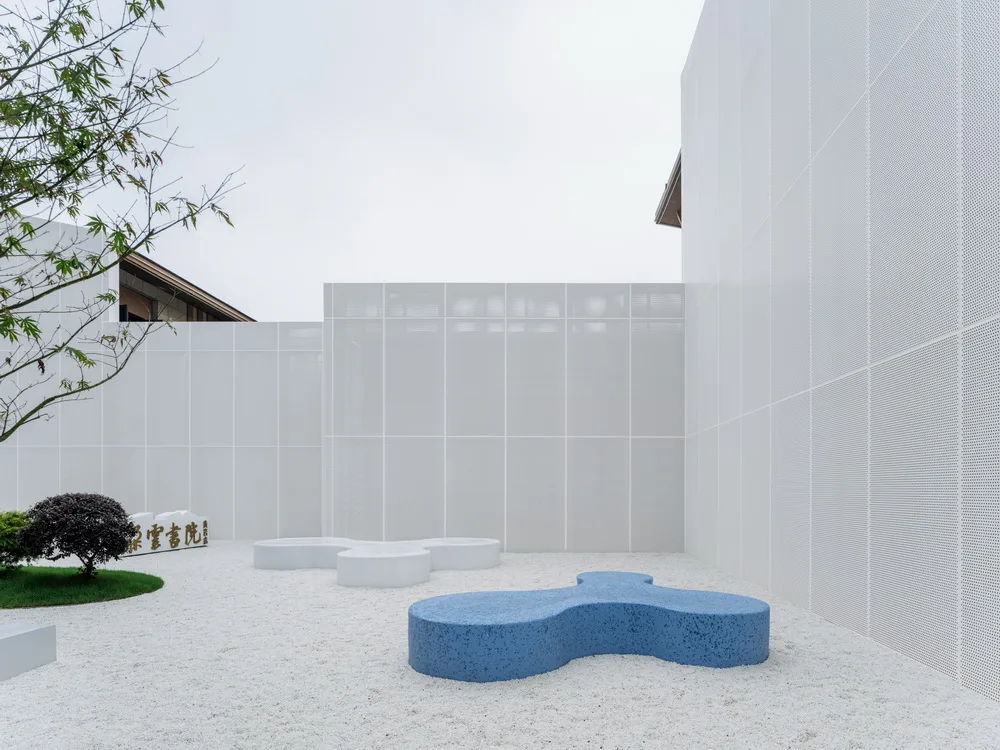
△ Two cloud stools, one white and one blue
Up the spiral staircase in the café, a blue glass room awaits. Under sunlight, the intersection of the orange stairs and roof glows a beautiful purple. At the press of a switch, the blue glass turns clear and transparent, revealing the Yongning River before you. This glass, developed by a local Huangyan company, is used here for the first time in architecture — also featured in the speech area. I have long dreamed of this scene: in spring, sitting on the stairs as the blue fades away and cherry blossoms bloom beneath like clouds. It is truly magical.
“Don’t look up; you’re in the clouds.”
—- Wang Hai (Big Head Fellini)
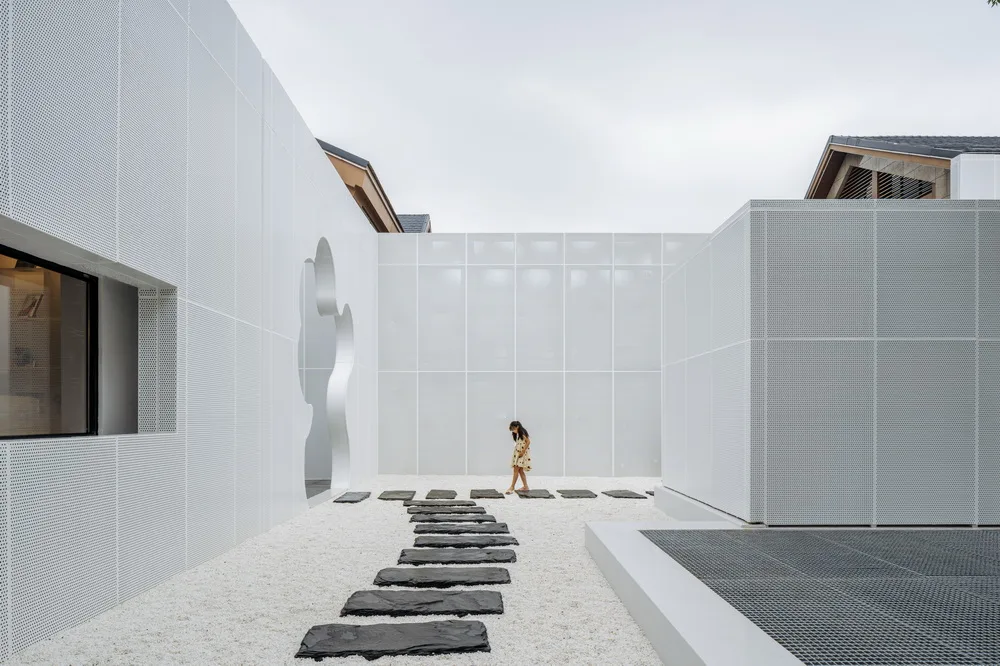
The Duoyun Academy Huangyan Branch is a bold statement for small cities in the new era.
Architecture is storytelling. I believe a bookstore should embody the spirit of its city or region. The Duoyun Academy Huangyan Branch is my interpretation and response to Huangyan’s culture and people. Small Chinese cities often lack contemporary art forms that reflect their spirit. In the Internet age, residents of third- and fourth-tier cities possess confidence and discernment. Architects here need not blindly chase big-city trends or remain stuck in historical styles. Abstract artistic language and metaphor can shape new forms and spaces that resonate locally. The Huangyan branch exemplifies this approach. If small Chinese cities were as content, peaceful, and future-focused as Huangyan, with its rich history and scenery, China would be even more beautiful.
Video production: Wuto lini studio
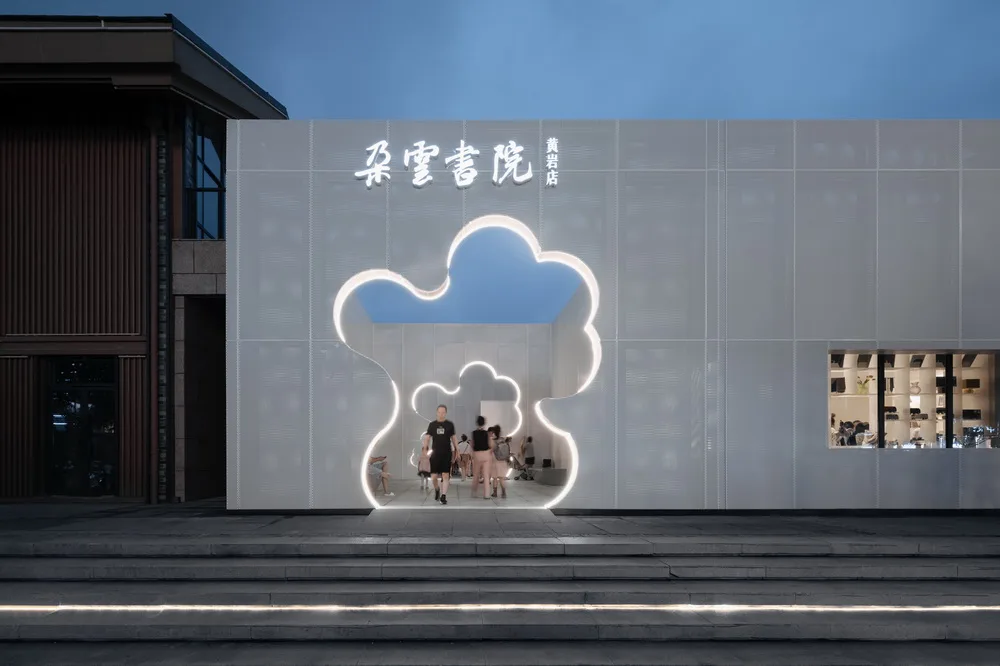
△ Entrance of the academy
“You may have a raging fire, but you want it to burn so calmly and pleasantly.”
—- Yu Ting
Technical Drawings
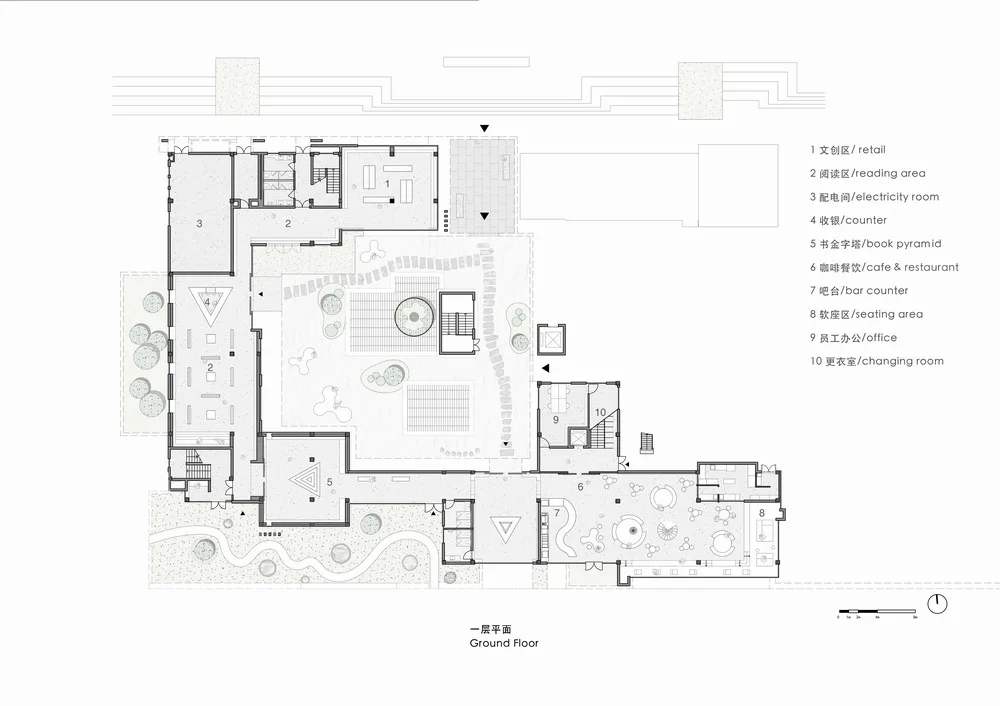
△ First floor plan
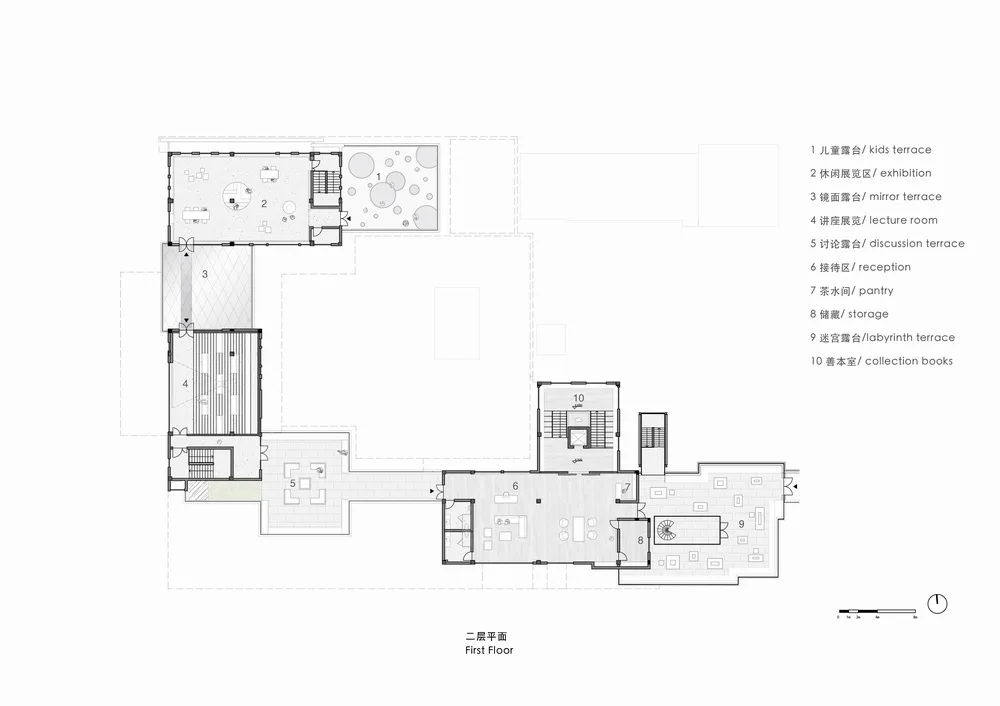
△ Second floor plan
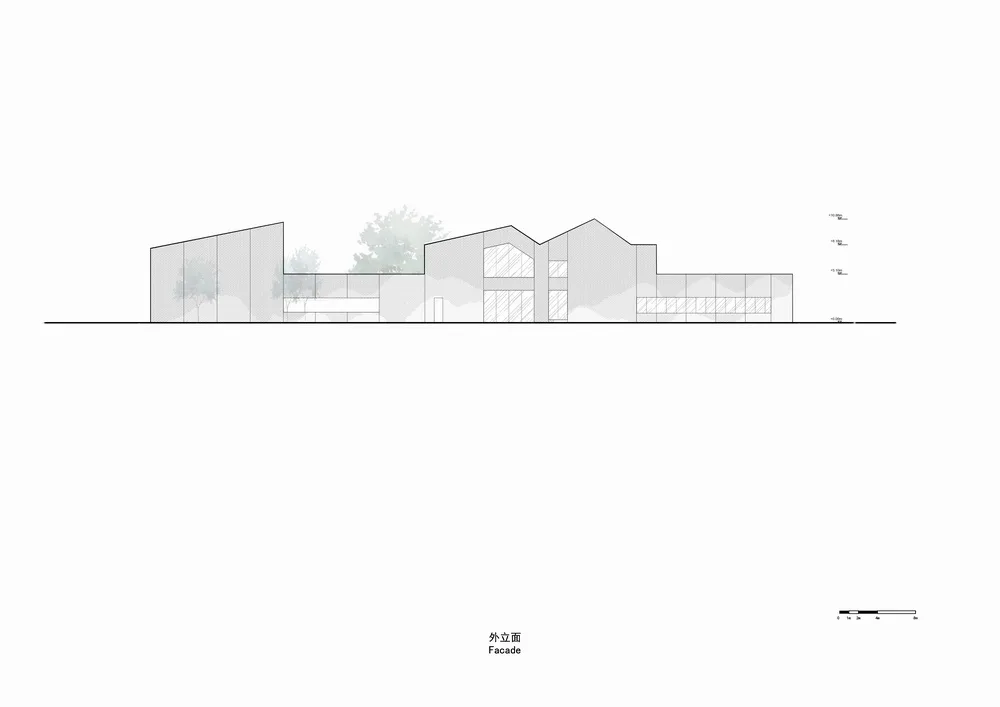
△ Exterior elevation view
Project Information
Project Name: Duoyun Academy Huangyan Store
Designer: Wutopia Lab
Contact Email: project1@wutopia.work
Lead Architect: Yu Ting
Project Manager: Pu Shengrui
Preliminary Project Architect: Wang Zhuo’er
Later Project Architect: Pu Shengrui
Design Team: Begoña Masia, Song Junzhu, Wu Yaping, Wang Jiajun, Wang Lei, Dai Yunfeng, Zhang Minmin, Guo Jiannu, Wu Xiaoyan, Chang Xueen, Lu Ye, Zhang Wensui, Meng Dong, Jing Yawei
Project Architect Assistant, Resident Architect: Mi Kejie
Construction Time: June 2021
Project Address: Taizhou, Zhejiang
Building Area: 1,726 square meters
Design Consultation: Architecture Design | Office ZHU
Lighting Consultants: Zhang Chenlu, Cai Mingjie
Construction Drawing Design: Shanghai Chengyu Space Design Co., Ltd; Shanghai Zhiye Architectural Design Consulting Co., Ltd
Construction Team: Taizhou Huangyan Municipal Landscape Construction Development Co., Ltd; Xingwei International Home Furnishings Co., Ltd; Zhangjiagang Yujia Metal Decoration Co., Ltd
Photography Copyright: CreatAR Images
Video Copyright: CreatAR Images
Interview Video Copyright: Wuto lini studio
Owner: Taizhou Huangyan Yongyun Cultural Development Co., Ltd; Shanghai Century Duoyun Cultural Development Co., Ltd
Main Materials: Paint, acrylic, perforated aluminum plate, baked paint aluminum plate, granite, steel mesh, gravel, micro cement















Must log in before commenting!
Sign Up