
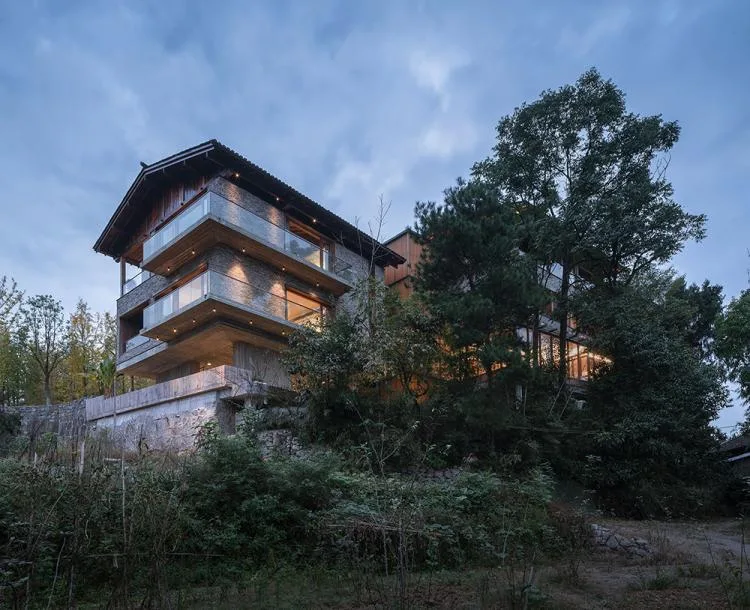
View of the homestay from the northwest side © Zhao Yilong
Origin
Ma’ershan Village is located about a 25-minute drive from Zhangjiajie’s main urban area. While the mountains here may not boast unique peaks like the Zhangjiajie Scenic Area, they remain lush with abundant trees. Scattered houses dot the slopes and fields, offering a distinctive rustic charm. Originally, two wooden pavilions stood on the site for barbecuing, surrounded by pine trees, bittersweet seed trees, small bamboo groves, and ginkgo forests. From the northern viewpoint, a continuous mountain panorama unfolds like a scroll across the landscape. This natural environment and tranquil atmosphere were the primary inspiration behind Lin Yushan’s design of the homestay.
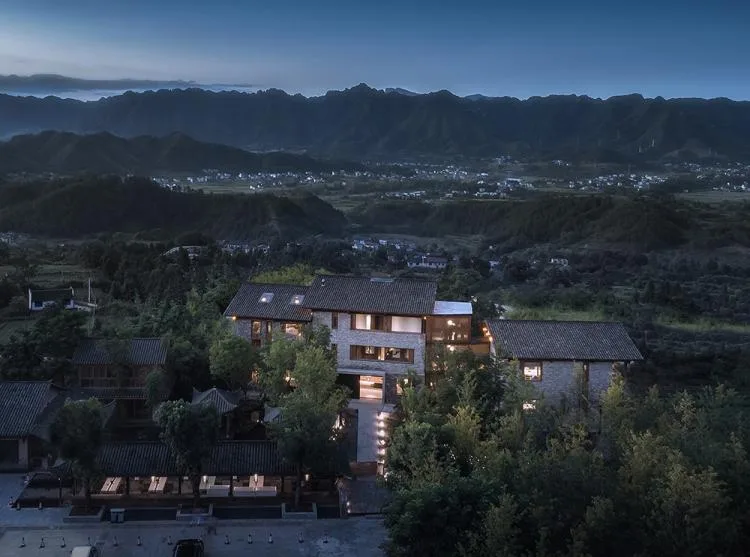
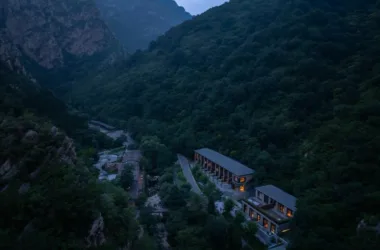
△ Bird’s-eye view from the south showing the relationship between the homestay and distant mountains © Zhao Yilong
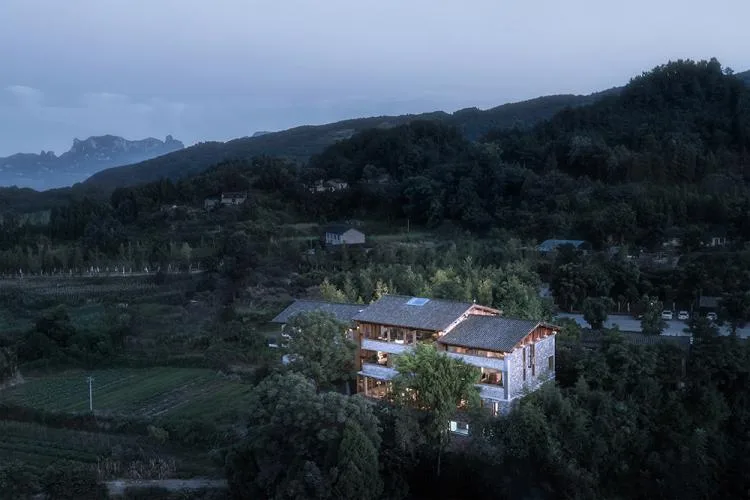
△ Bird’s-eye view from the north showing the homestay nestled among trees © Zhao Yilong
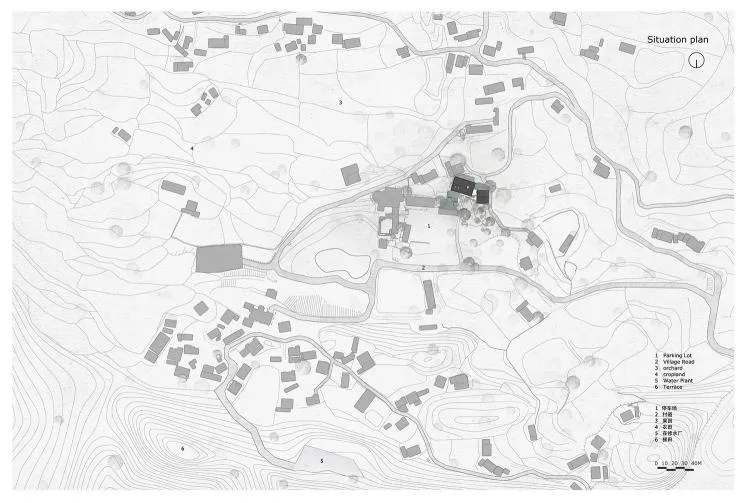
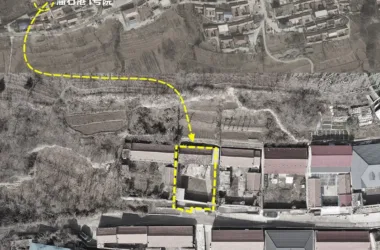
△ Project location © Jianlin Architecture
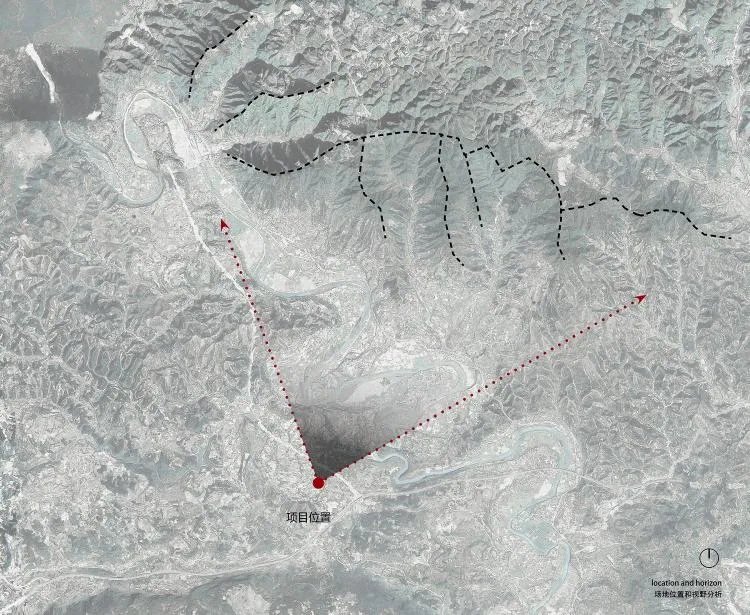
△ Visual relationship diagram © Jianlin Architecture
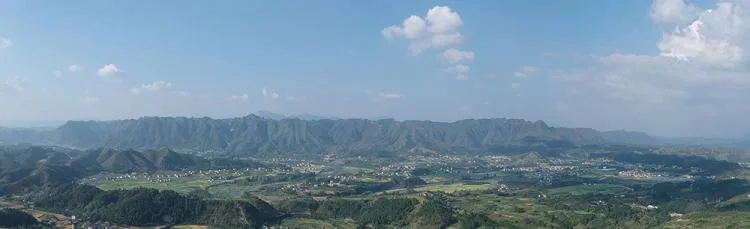
△ Horizontal mountain view © Jianlin Architecture
Ma’ershan Village offers favorable conditions for construction and serves as a model of beautiful countryside in Zhangjiajie. It attracts a steady flow of local tourists, especially on weekends when many visitors come for sightseeing and relaxation. The owner, having grown up in Ma’ershan Village, holds a deep affection for the place. The homestay renovation aims to provide comfortable accommodation for returning locals while preserving the original rural spirit and charm.
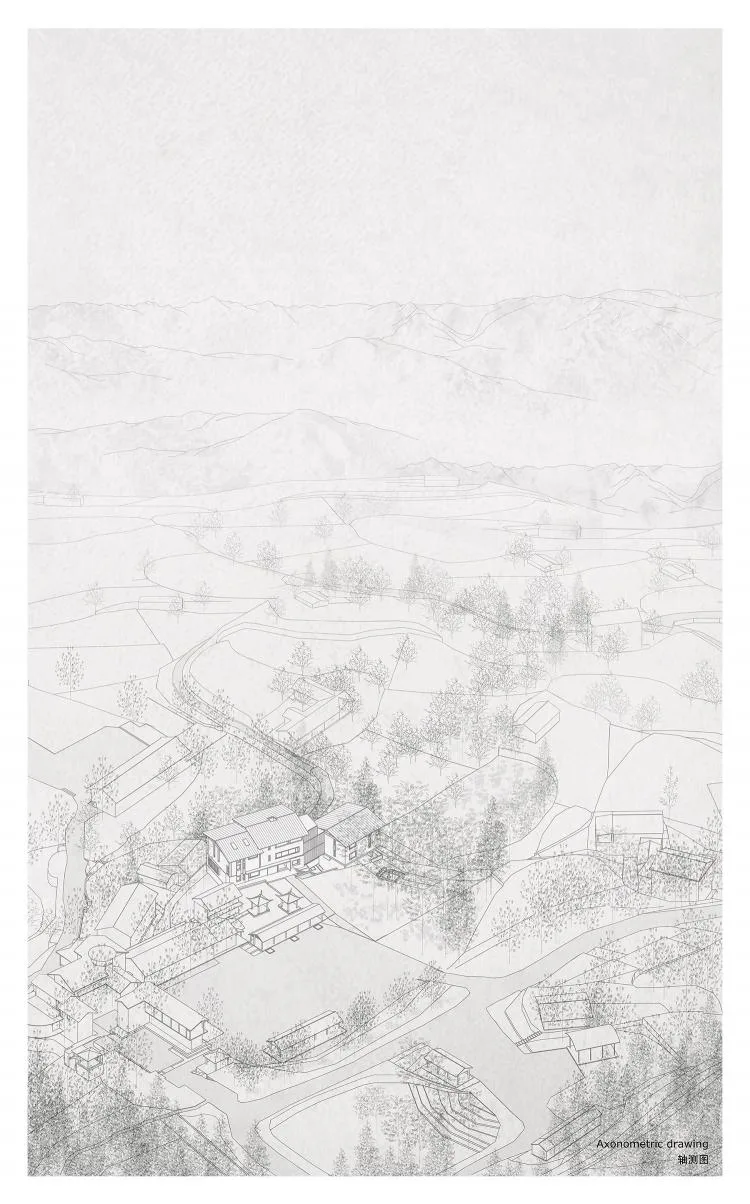
△ Axis measurement scene diagram © Jianlin Architecture
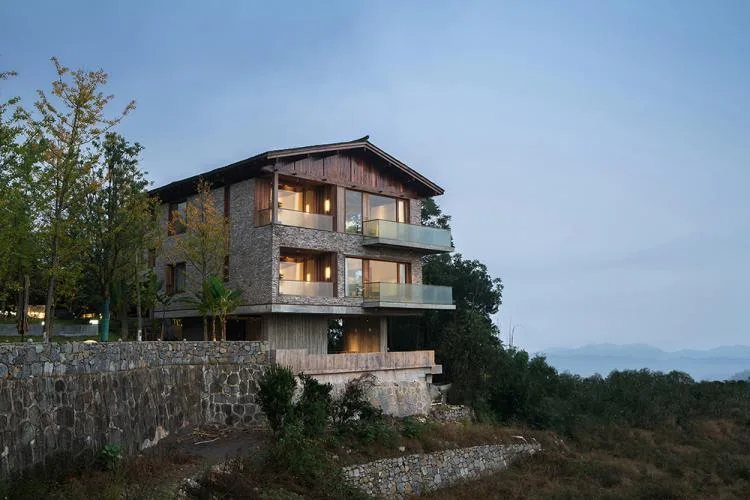
The east facade fully visible from the stone ridge © Zhao Yilong
Site Strategy and Spirit
The construction site comprises three homesteads arranged along a long narrow strip of land with a nearly 3-meter height difference from east to west. Two homesteads are on the western side, and one is located at the lower eastern end. The buildings form two main volumes—one taller and larger, the other lower and smaller—connected centrally by a semi-transparent staircase. The terrain slopes higher in the south and lower in the north.
Taking advantage of the site’s existing conditions, part of the underground space was excavated to serve as storage and equipment rooms. The eastern height difference is designed as an open gray space, offering guests a flexible semi-outdoor area. The site’s water features cascade down outdoor steps, creating multiple small waterfalls that provide a soothing soundtrack along the walking paths.
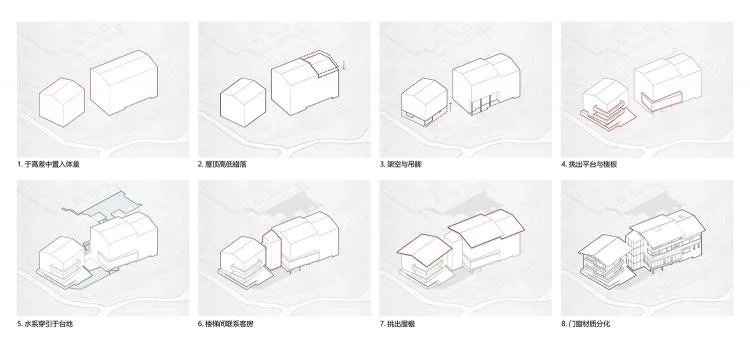
△ Conceptual design process © Jianlin Architecture
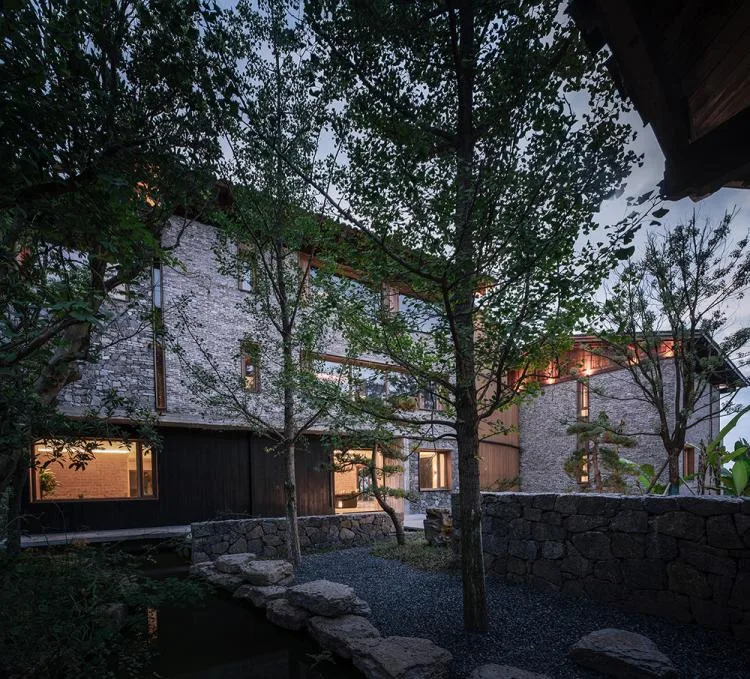
△ Evening view from the south © Zhao Yilong
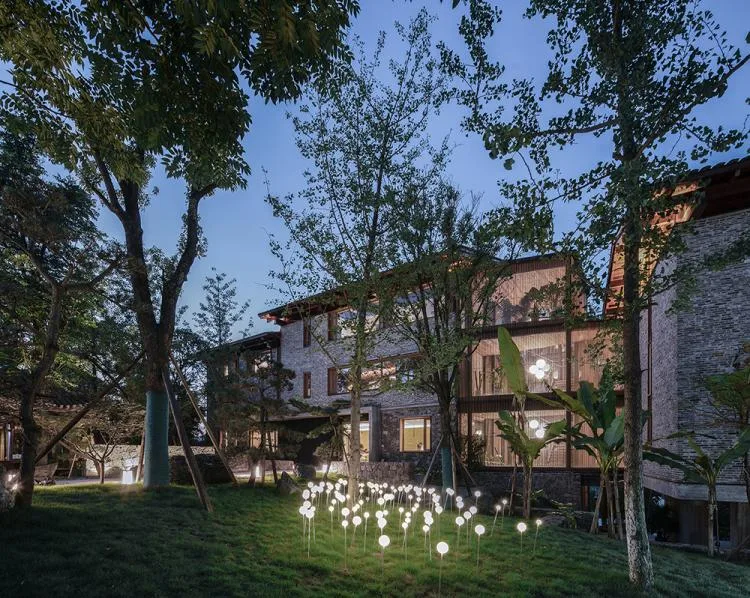
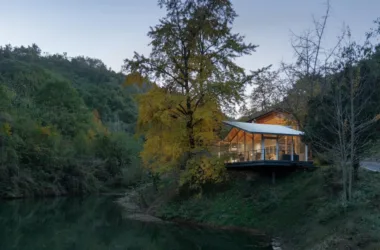
In the evening, the ginkgo forest faces the homestay © Zhao Yilong
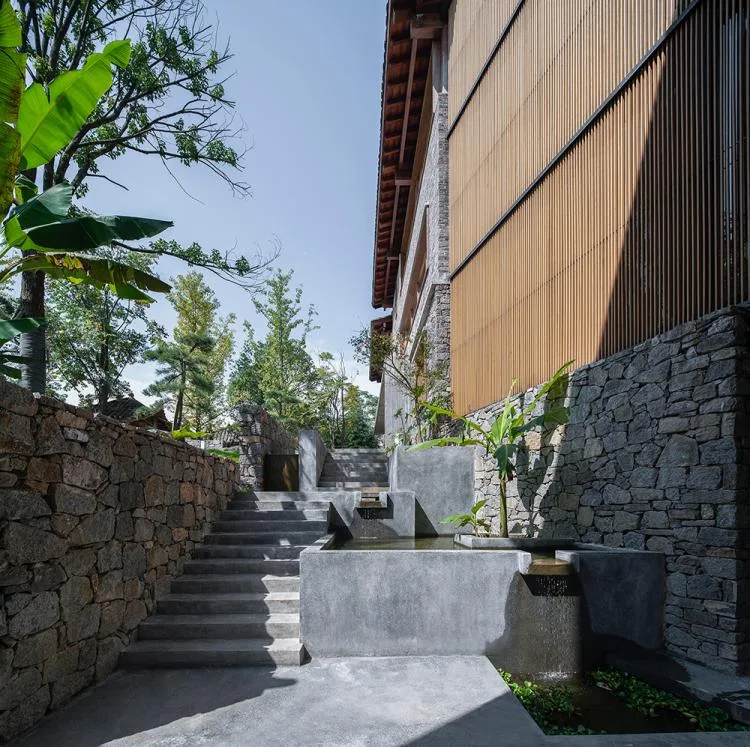
△ Steps and water features following the terrain’s natural contours © Zhao Yilong
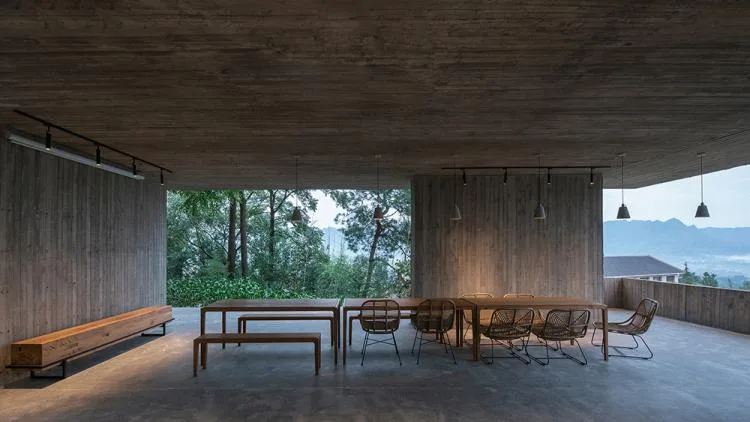
An elevated gray space with faint views of distant mountains © Zhao Yilong
The most striking aspect of the site is the interplay between mountains and forests. To preserve the original atmosphere, as many trees as possible were retained. The buildings are enveloped in vegetation, and likewise, people are enveloped within buildings, maintaining a sense of privacy akin to “holding a pipa and half-covering one’s face.” This layering enriches the experience of walking on the ground floor. Seasonal changes also alter the tree forms and environmental transparency, with buildings becoming more or less visible depending on the foliage density.
As a key design element, the distant mountains are meant to be experienced in multiple ways: from the lower parts of the building, the mountains are faintly visible through tree trunks; ascending higher reveals wider views and a continuous mountain panorama. Different window designs in guest rooms frame the distant mountains uniquely, including long scroll views, framed fragments, and continuous broken frames, each corresponding to varying spatial scales and experiences.
The site extends beyond its physical boundaries to include surrounding trees, neighboring houses, distant mountain backdrops, adjacent fields, and enclosed bamboo groves. People are integrated into this setting, with the building’s spaces and views revolving around these natural elements.
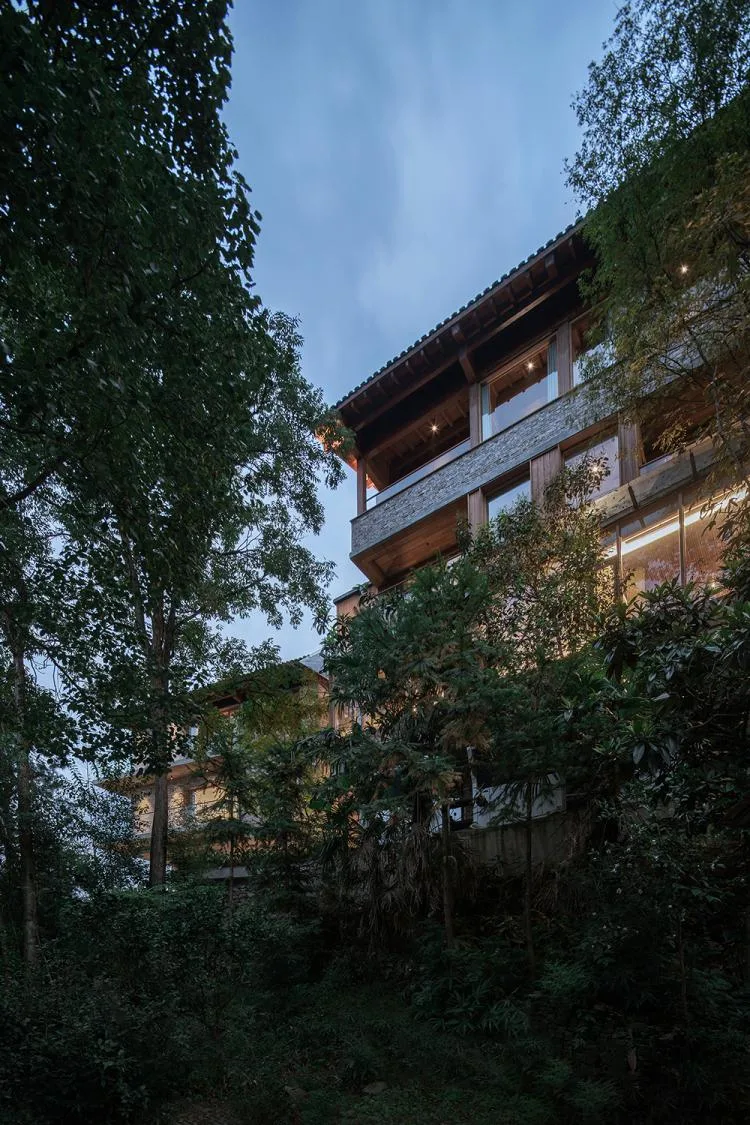
View from the north, facade surrounded by trees © Zhao Yilong
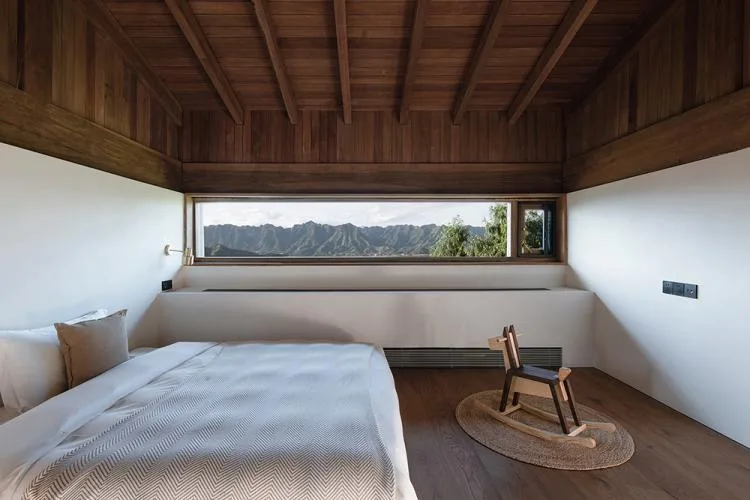
△ Far mountain scroll horizontal frame landscape © Zhao Yilong
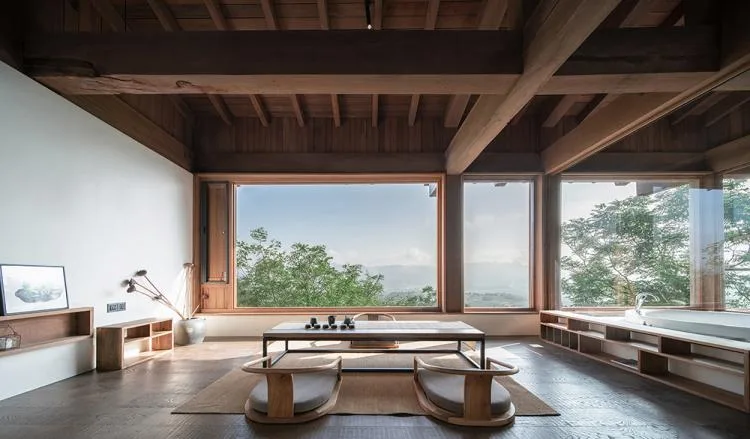
△ Continuous frame format showcasing distant mountain scenery © Zhao Yilong
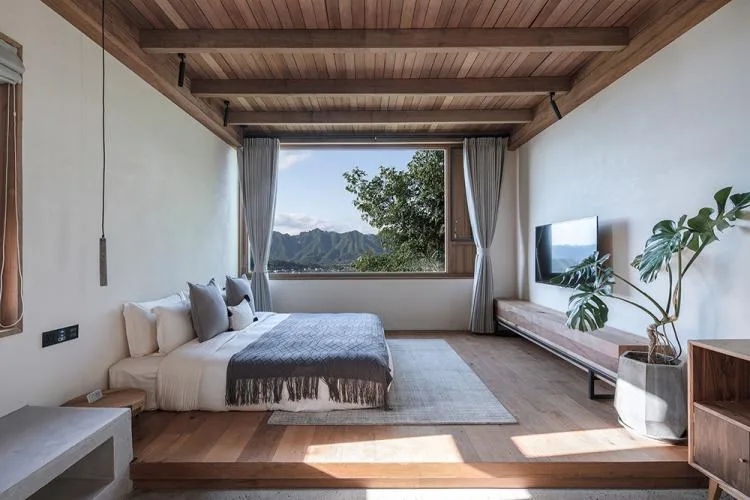
△ Segmental distant mountain frame landscape © Zhao Yilong
Distant Mountains and Nearby Forests: An Emotional Connection
The reception hall on the first floor features a horizontally extended, low-ceilinged space that compresses the visual and physical senses, creating an intimate atmosphere. A few steps to the right leads to a sunken leisure area with continuous horizontal glass windows offering expansive views. Low-level trees with lush branches and rustling leaves, combined with occasional glimpses of distant mountains, create a serene setting.
Continuing left from the lounge, guests find a water bar and breakfast restaurant. The bar counter is situated against a natural landscape, where dappled bamboo shadows add a dynamic, natural ambiance.
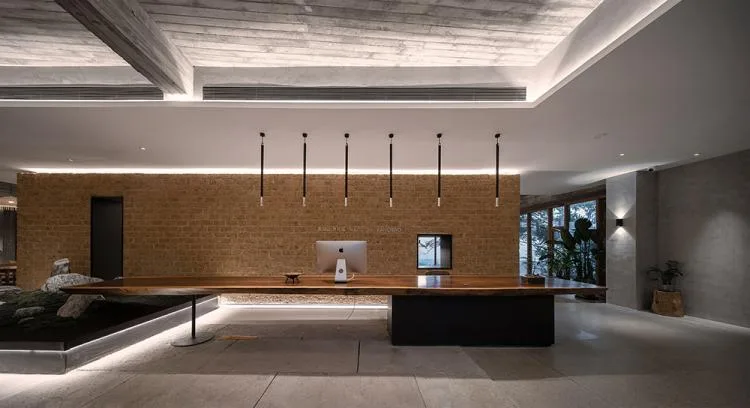
△ Horizontally extended reception hall © Zhao Yilong
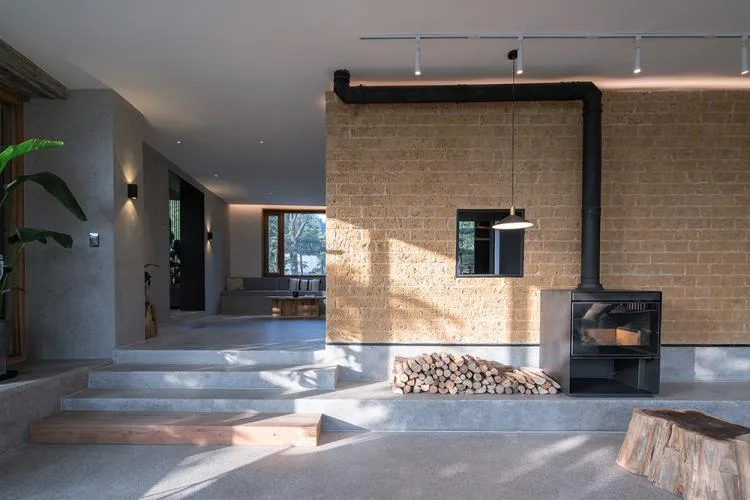
△ Relationship between earthen brick walls and elevated platforms © Zhao Yilong
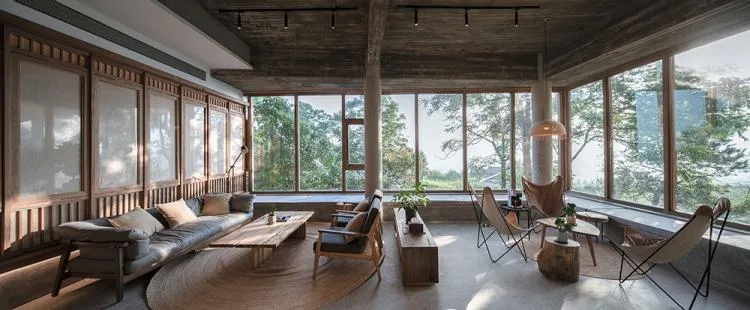
Long horizontal glass windows bring the forest scenery indoors © Zhao Yilong
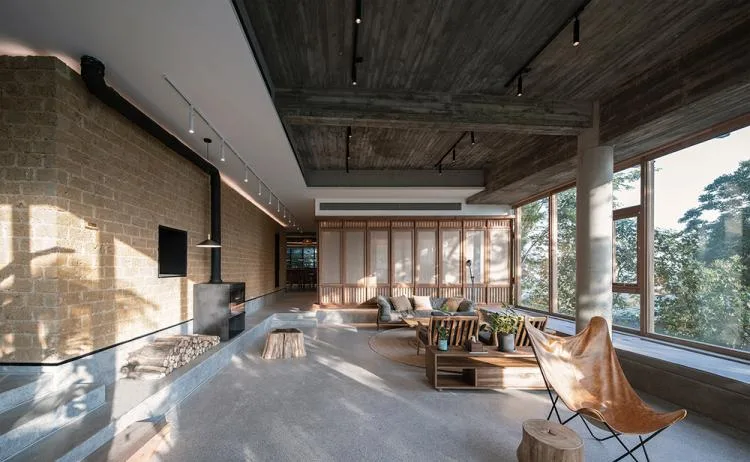
△ Forest light and shadow cast into the leisure space © Zhao Yilong
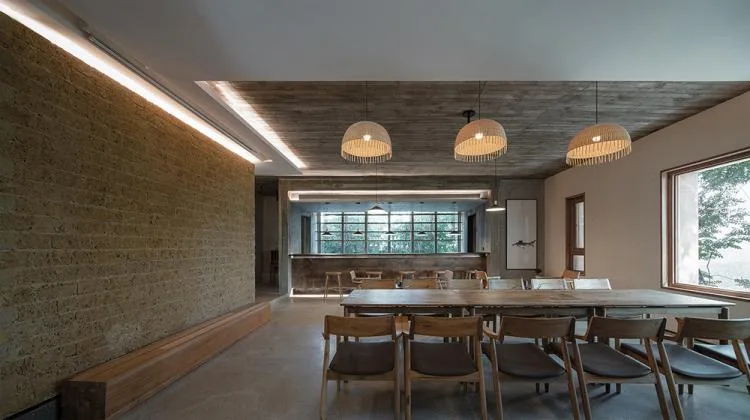
Water bar and bamboo forest adjacent to the breakfast area © Zhao Yilong
From the reception hall, a bamboo lattice corridor leads to two guest rooms on the first floor. The northeast-facing room offers expansive views of village fields and distant mountains, changing with the seasons as crops evolve in color and type. The room layout is simple, oriented towards two landscape directions: the bed faces north toward the mountains, while the tea area looks east over the fields. An L-shaped leisure balcony extends outdoors. The bathroom features a dry-wet separation with an open design, and a bathtub is positioned next to a large glass window, allowing bathers to feel close to nature.
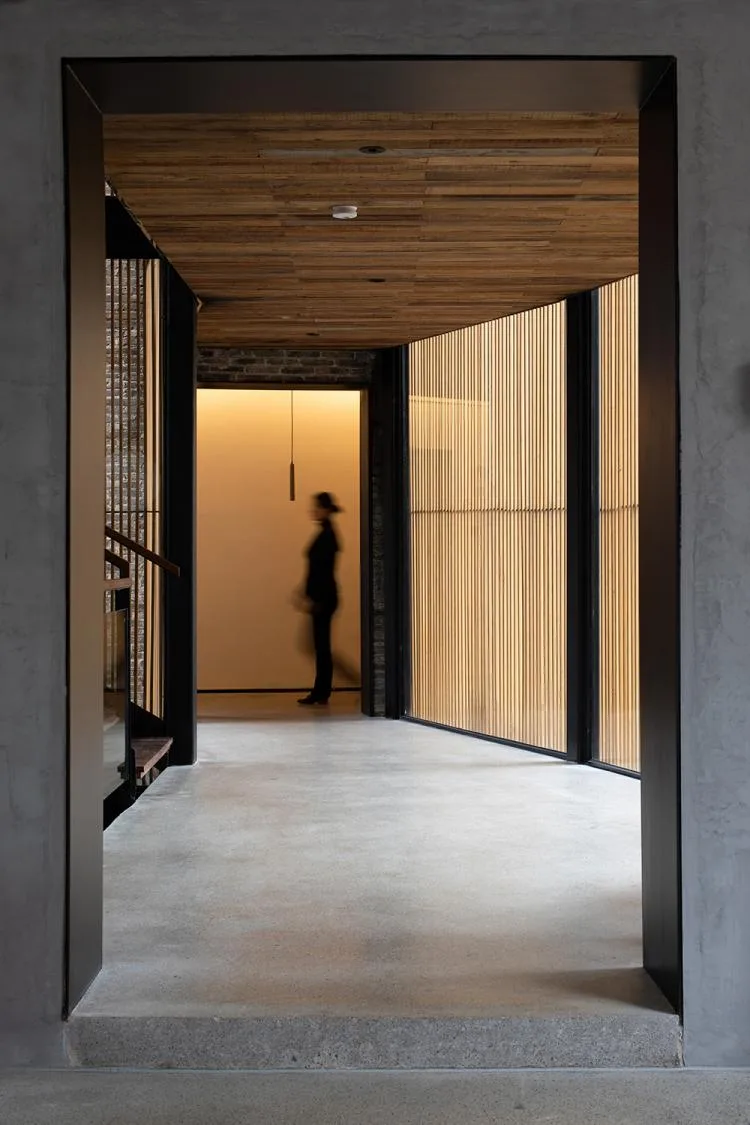
△ Corridor with finely detailed grid interface © Wu Ang
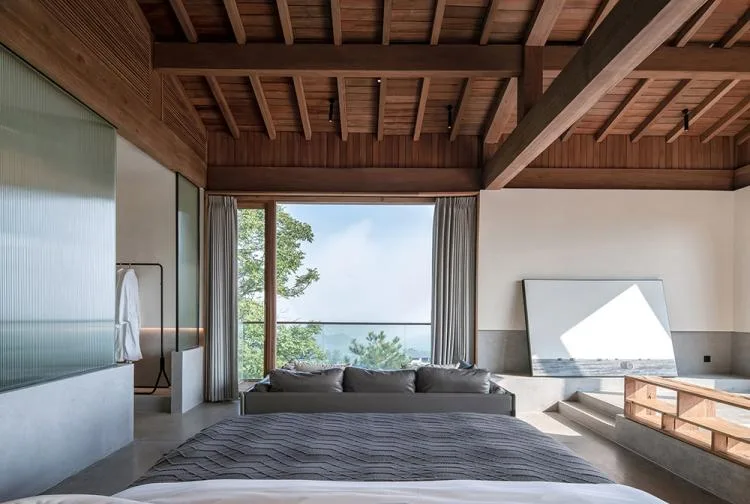
King-size bed in the guest room facing the northern mountain view © Zhao Yilong
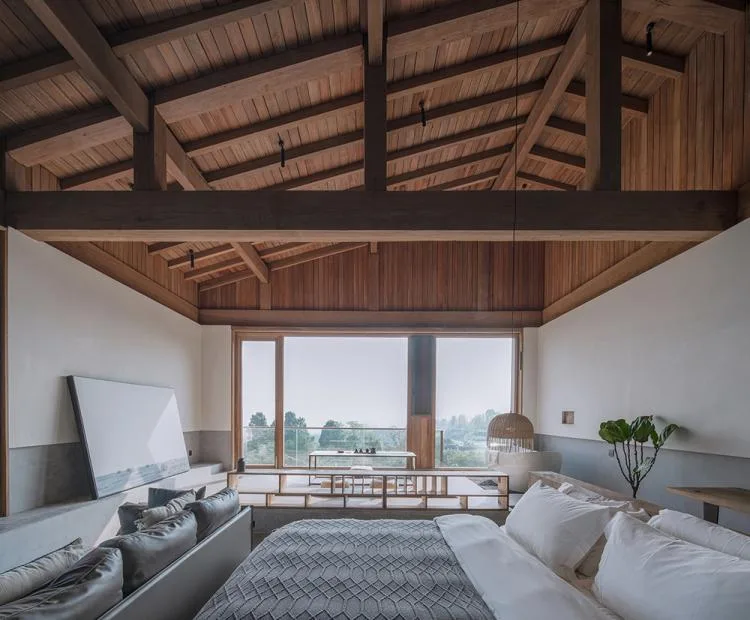
Tea area on the east side facing open fields © Zhao Yilong
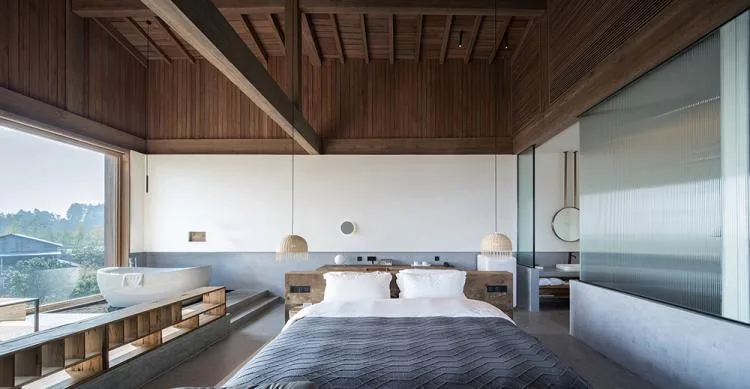
△ Guest room with bathtub positioned by the east window © Zhao Yilong
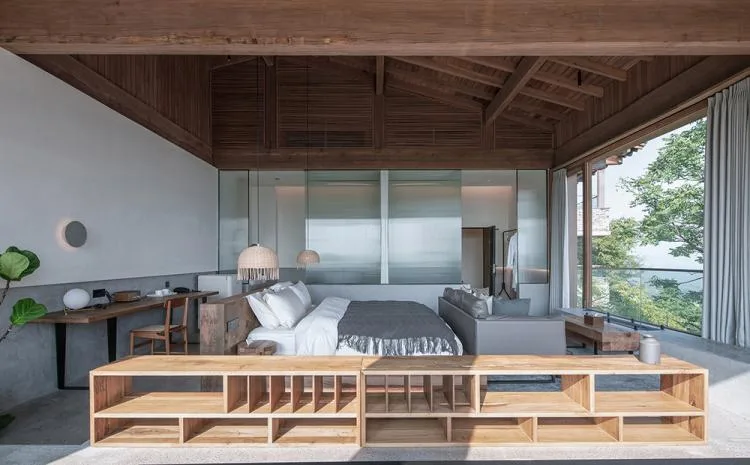
△ View of an open-plan bathroom in the guest room © Zhao Yilong
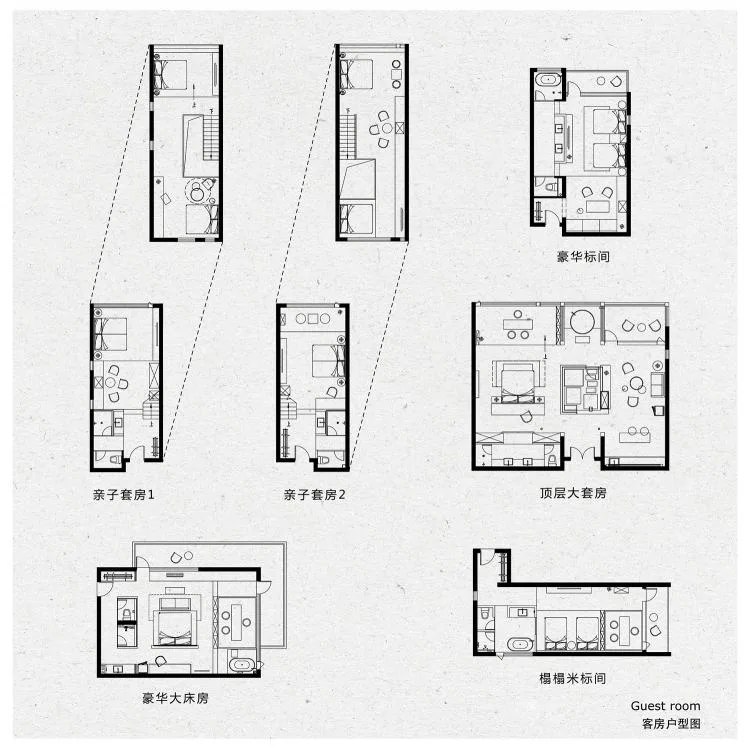
△ Guest room layout diagram © Jianlin Architecture
Ascending the stairs leads to the second-floor guest room, designed as a parent-child suite with two levels connected by internal stairs. Different ceiling heights and floor materials distinguish areas according to their use. The first floor contains one large bed, while the second floor has two large beds facing north and south, providing a family-friendly living experience. The upper level exposes the wooden roof structure, with a narrow, long window on the north attic wall framing the distant mountain scenery like a horizontal scroll.
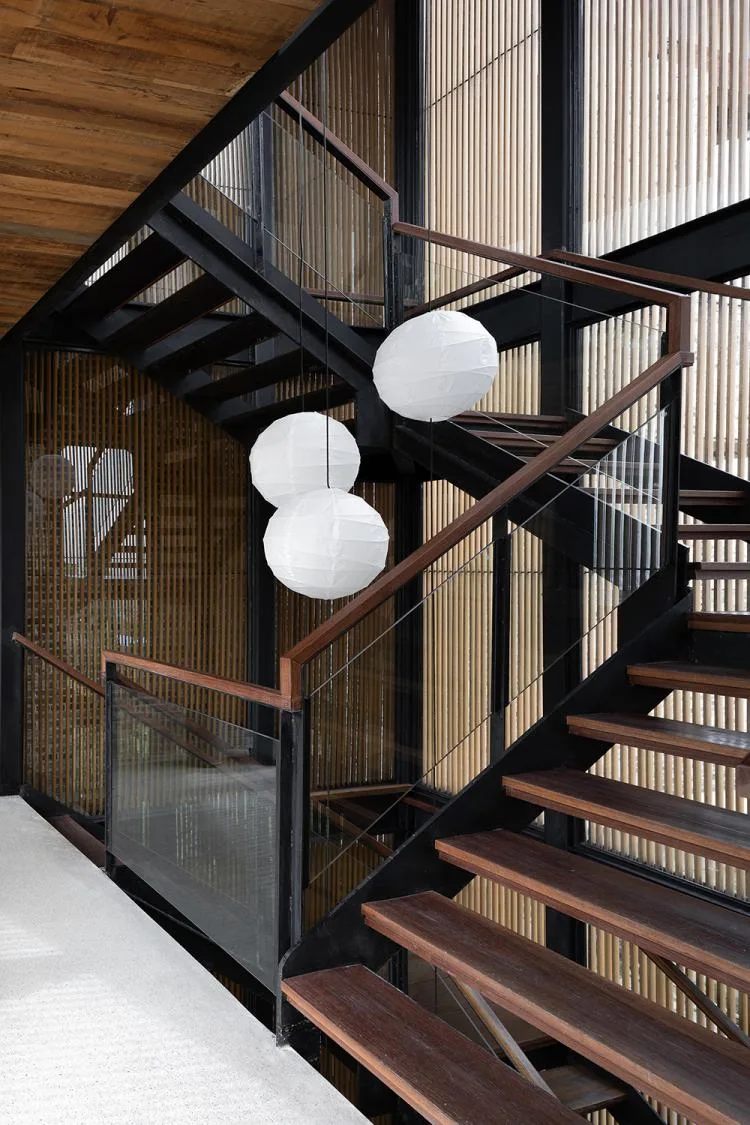
△ Lightweight, transparent steel staircase space © Wu Ang
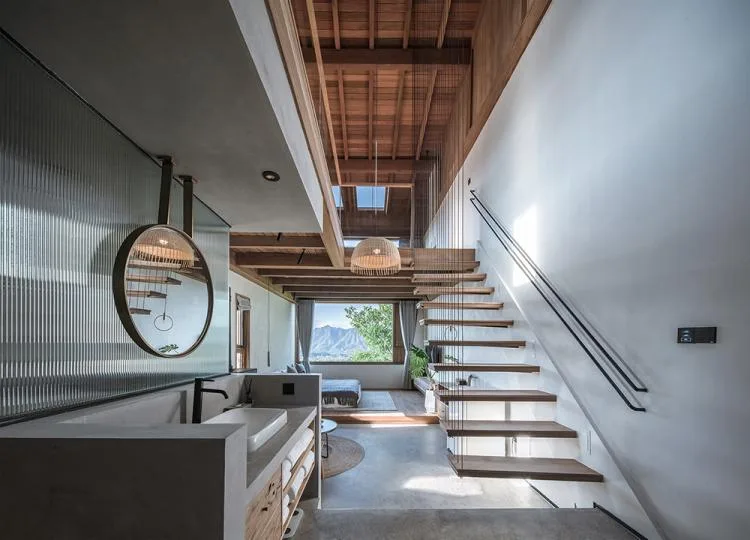
Family rooms featuring internal cantilevered stairs © Zhao Yilong
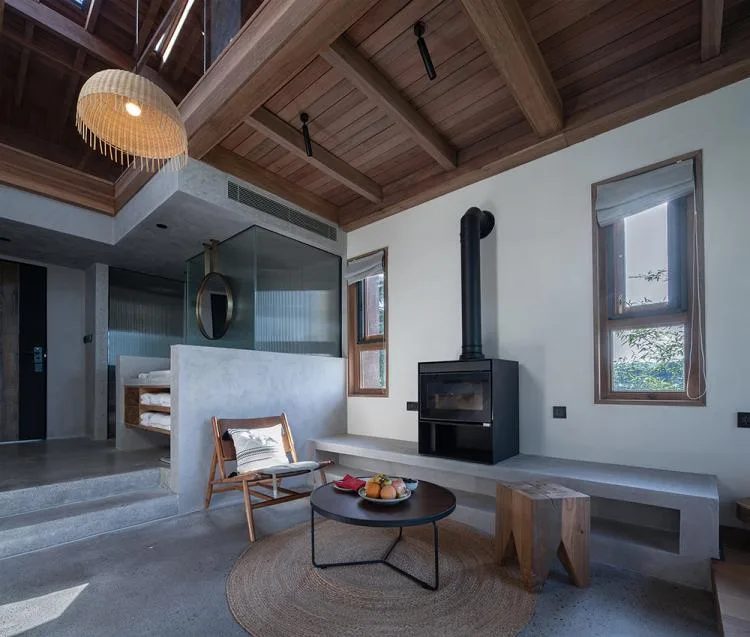
△ Enhanced guest room space with elevated experience; real fireplace adds warmth to the homestay © Zhao Yilong
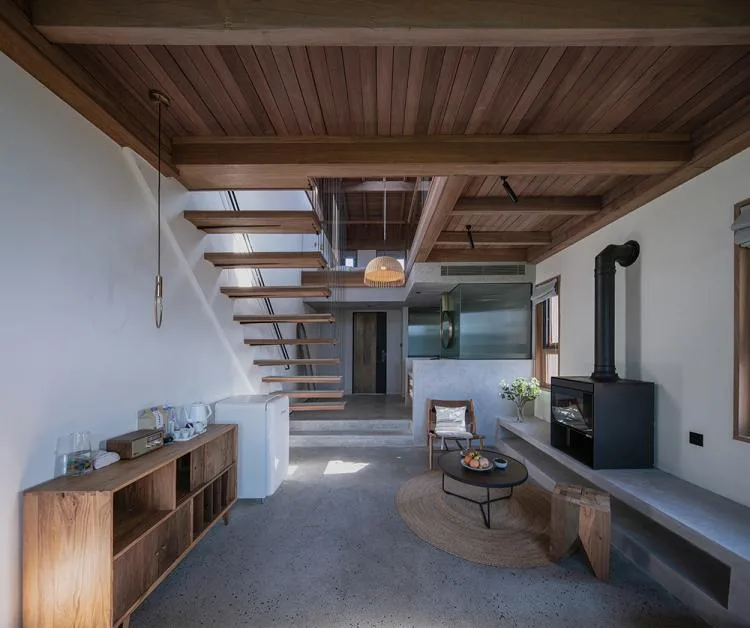
△ Parent-child rooms with partial ceiling height variation © Zhao Yilong
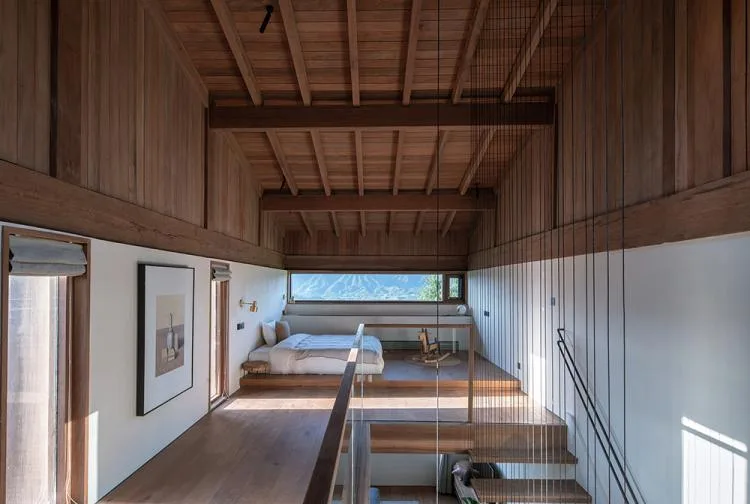
Exposed wooden structure in the parent-child space designed with lowered ceiling height © Zhao Yilong
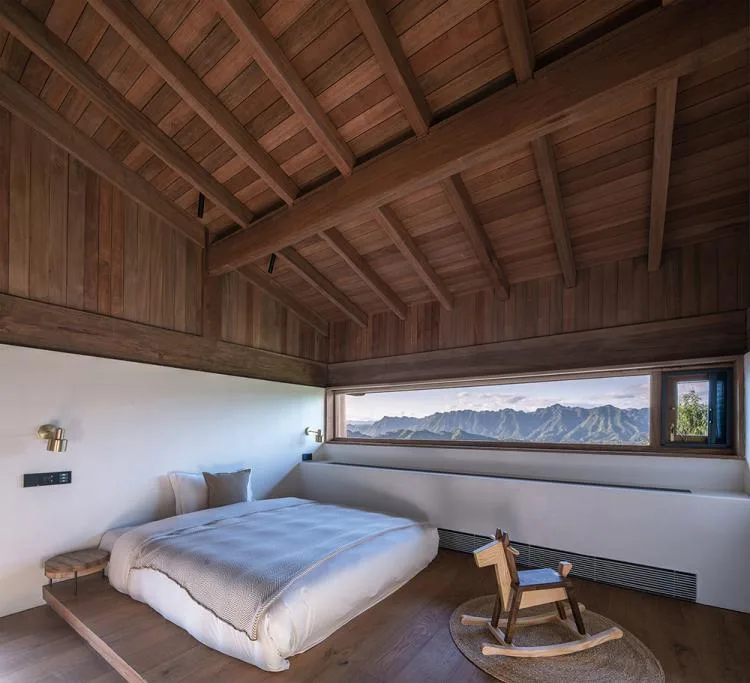
Mountain frame horizontal view; air conditioning units discreetly integrated into wall niches © Zhao Yilong
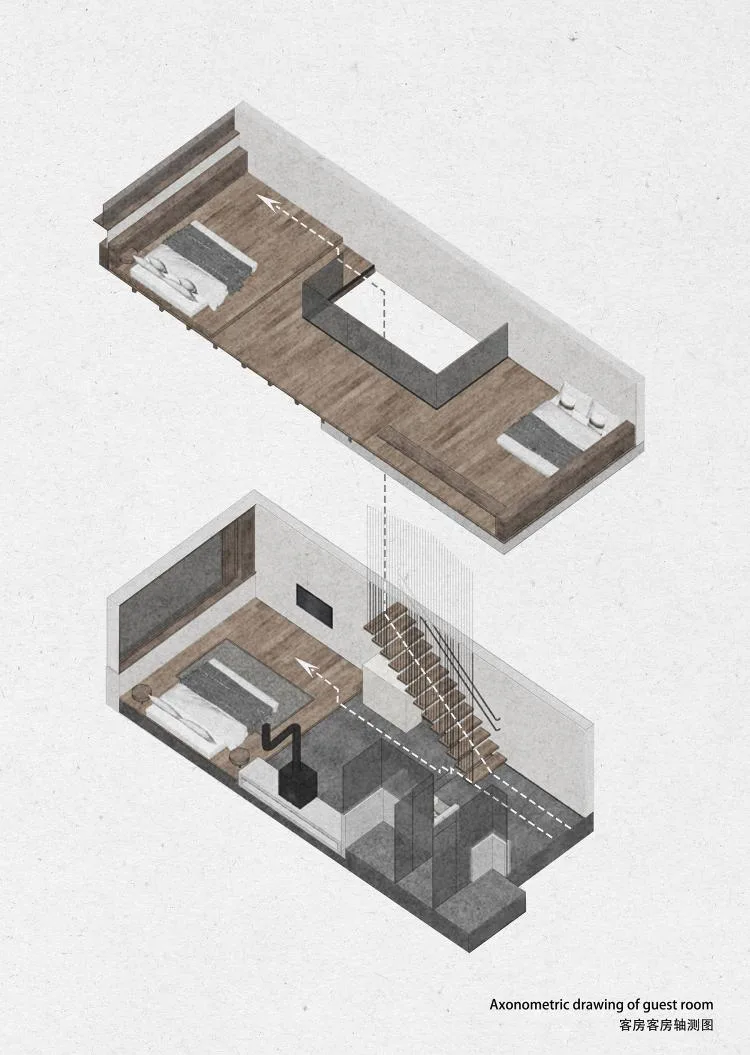
△ Guest room axonometric diagram © Jianlin Architecture
The top floor features a spacious suite with a horizontally extended layout. Upon entering, guests are greeted by continuous mountain views that fill the room, with tree branches close by creating a layered visual effect. Sitting on the balcony, guests enjoy gentle breezes while sipping tea and admiring the mountains.
The suite’s layout is divided by an inner courtyard and bathtub, separating sleeping and dining areas from a leisure water bar space. The design emphasizes transparency and openness, revealing exposed wooden roof beams and a clear relationship between structure and space. Morning bird songs and drawn curtains add to the relaxing and joyful atmosphere.
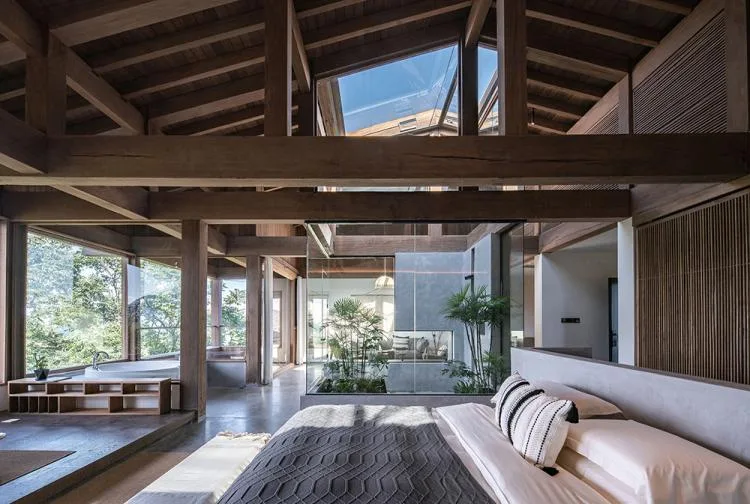
△ Transparent suite space viewed through wooden structure and courtyard © Zhao Yilong
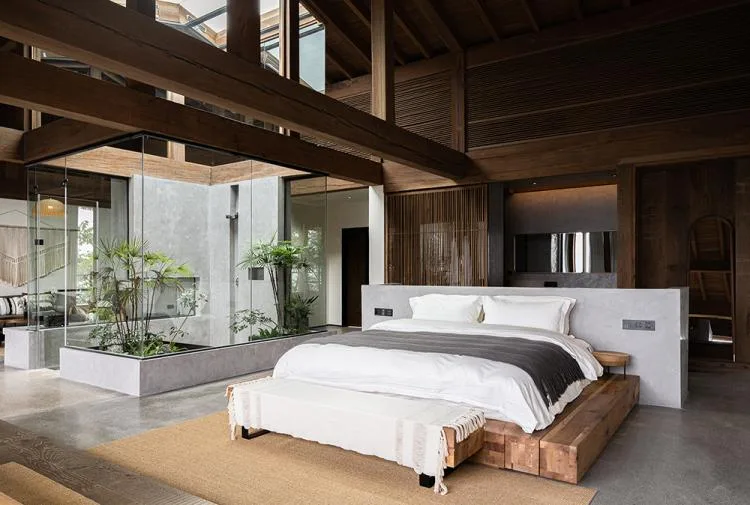
The courtyard, integrating the shower, patio, fireplace, and bathtub foyer, is arranged along the central axis © Wu Ang
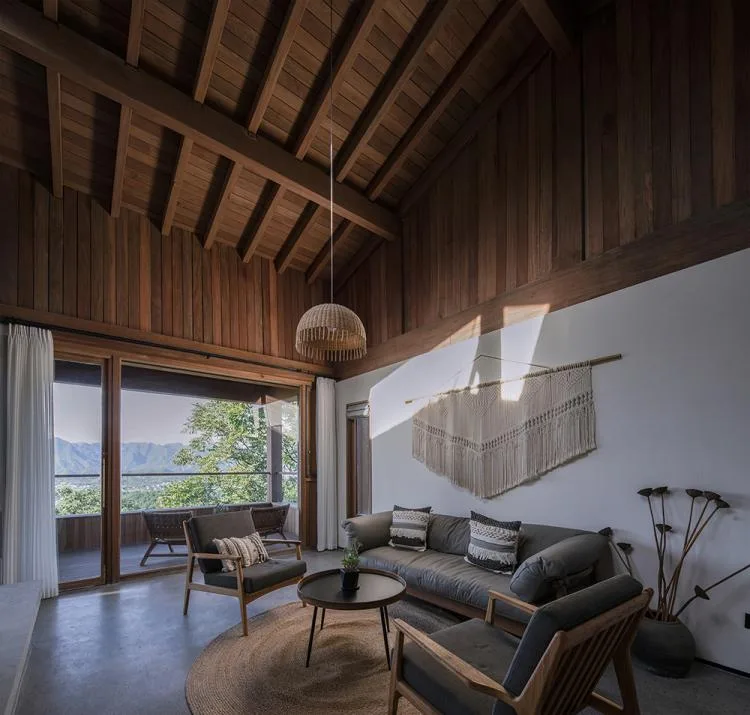
Independent suite leisure space © Zhao Yilong
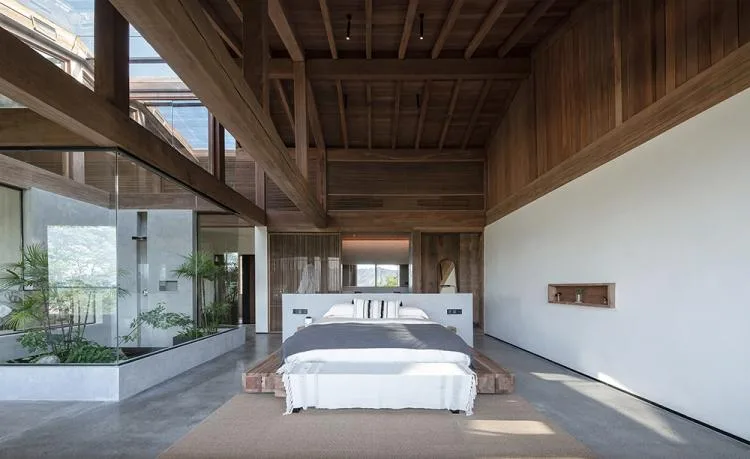
△ Horizontal extension of the large suite’s spatial layout © Zhao Yilong
Structural System and Local Materials
The building’s façade materials were selected to reflect local characteristics, re-establishing the connection between nature and construction. The design emphasizes the use of local materials, which helps control costs and enables local craftsmen to participate easily. Common materials include cobblestone, earthen brick walls, washed stone, terrazzo, blue brick, and small blue tiles. These materials are readily available, simple to work with, and allow for manageable construction precision.
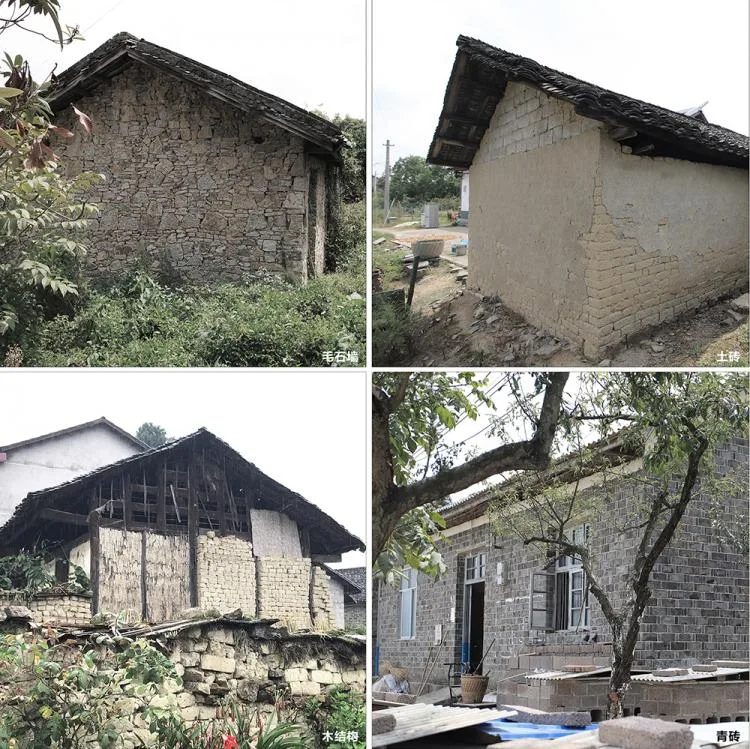
△ Traditional local building materials © Jianlin Architecture
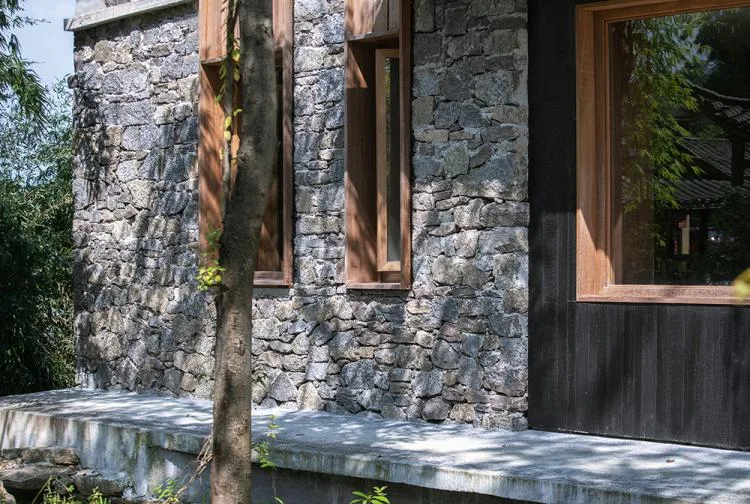
△ Rubble masonry walls on site © Zhao Yilong
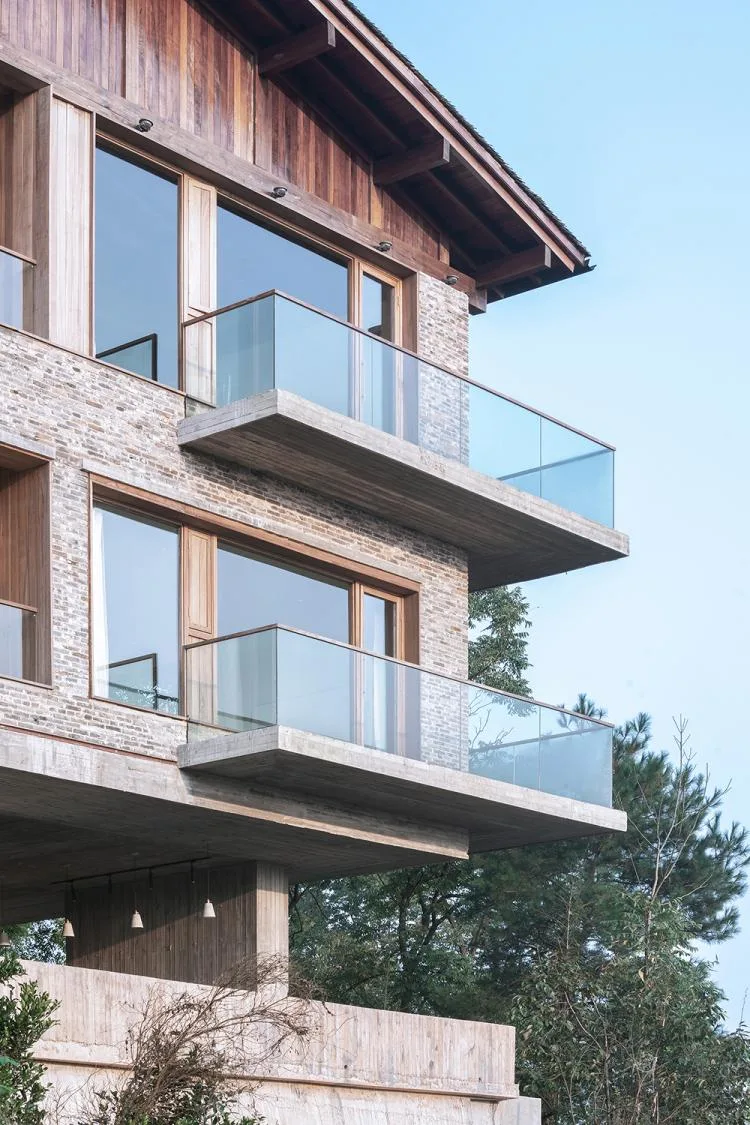
△ Details of east facade with cast-in-place concrete, solid wood, and blue brick © Zhao Yilong
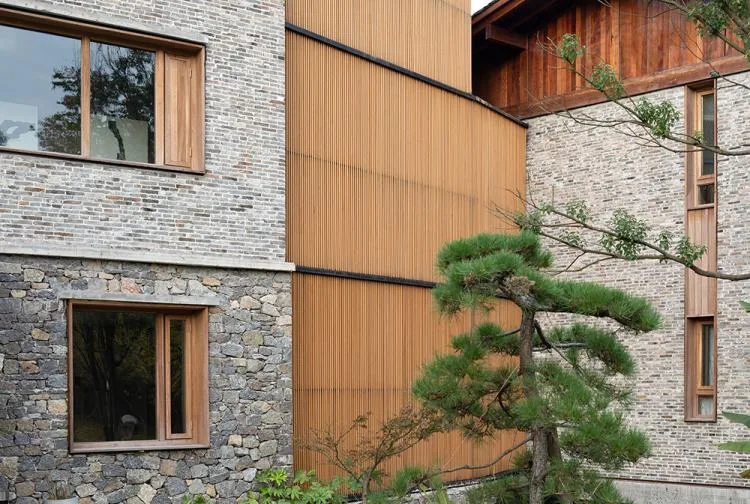
Material interplay between stone, green brick, bamboo lattice, and solid wood window frame on the south facade © Wu Ang
Structurally, the design aims for the building’s framework to be an integral part of the space and wall system, clearly perceptible. Using wooden formwork concrete for monolithic pouring creates shear walls that also serve as inner and outer wall surfaces. The exposed wood grain and cement textures provide a tactile, raw finish. This approach enables column-free large open spaces, reducing visible columns and increasing spatial freedom.
Traditional local wooden structures are used extensively in the upper building sections, integrated with the shear wall system. Wooden structural members remain exposed indoors without additional finishes, making the structural material also serve as a spatial surface. Electrical wiring is routed through roof insulation cavities, achieving a seamless blend of structure and interior design.
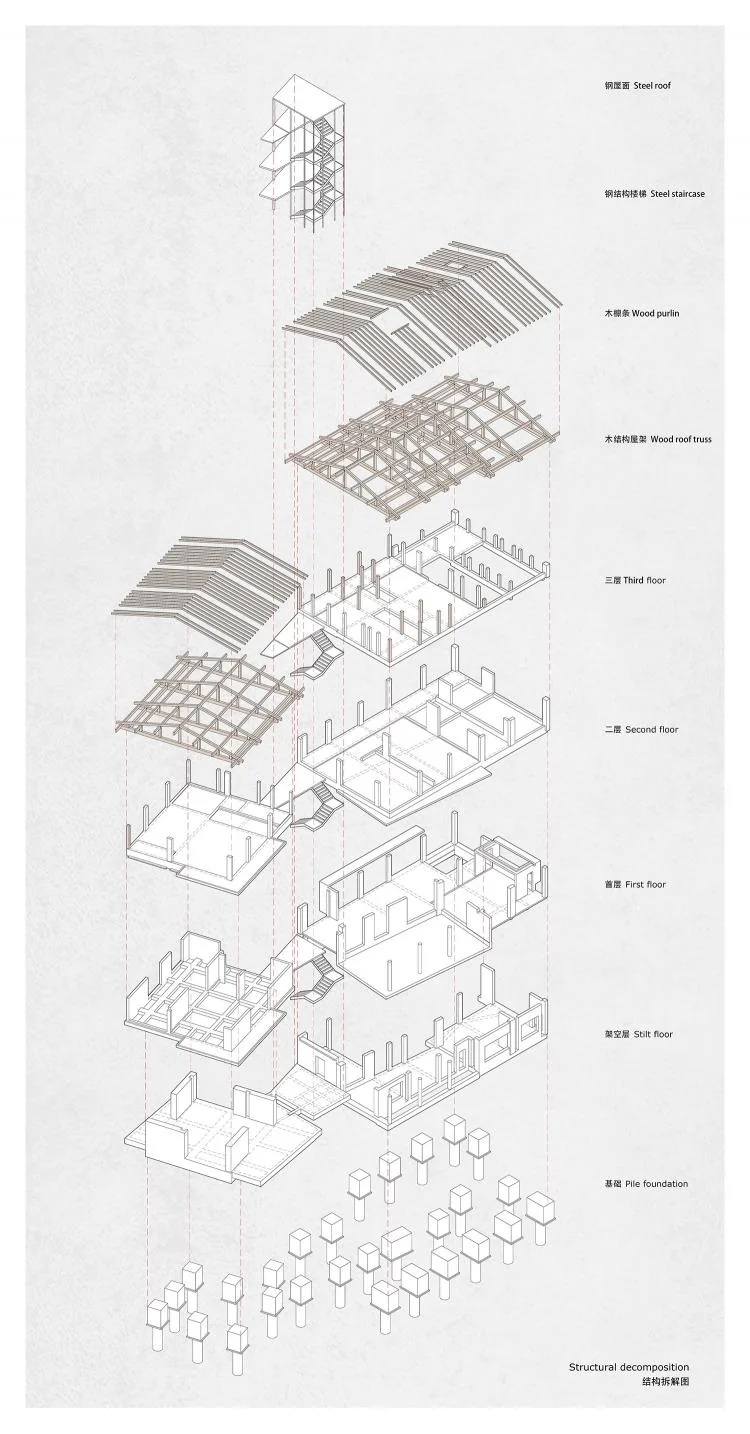
△ Structural assembly diagram © Jianlin Architecture
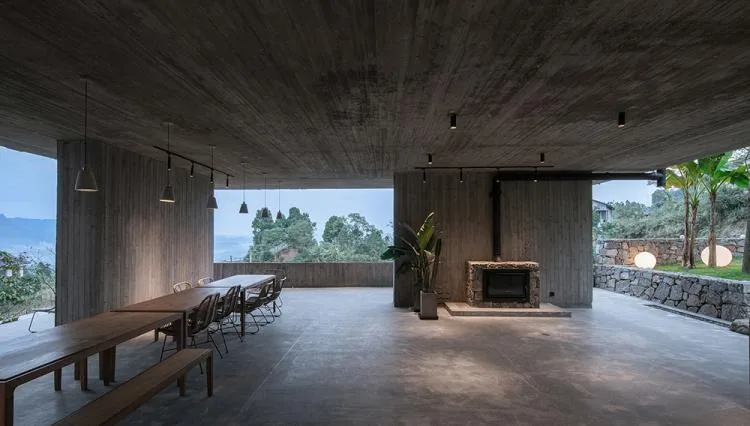
△ Exposed overhead outdoor concrete space © Zhao Yilong
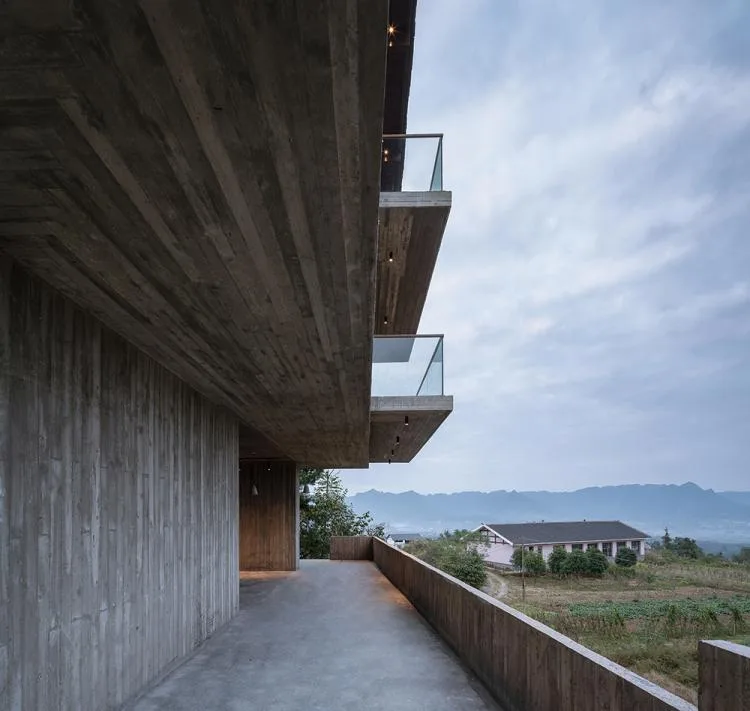
East side cast-in-place concrete volume and balcony © Zhao Yilong
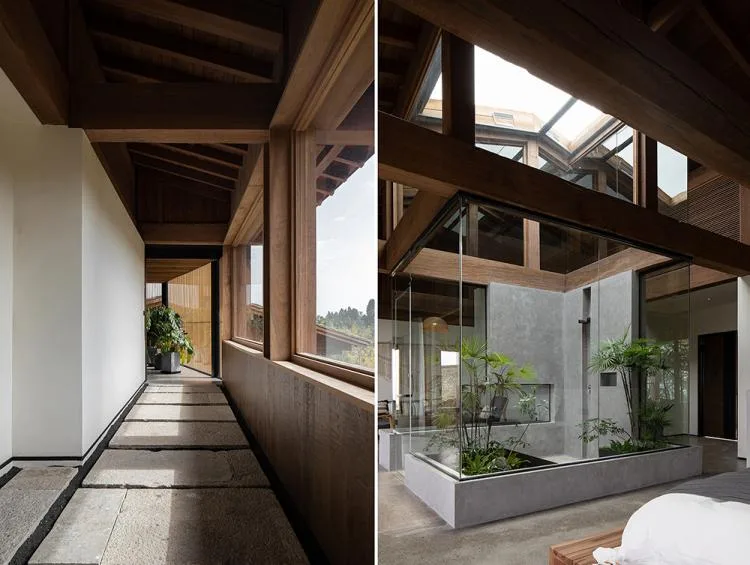
Exposed corridor under wooden roof structure © Wu Ang
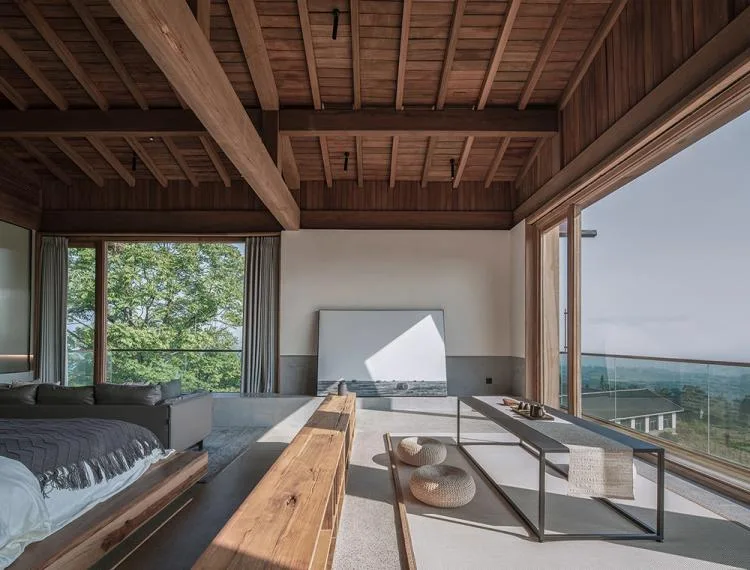
△ Guest room with exposed wooden roof structure © Zhao Yilong
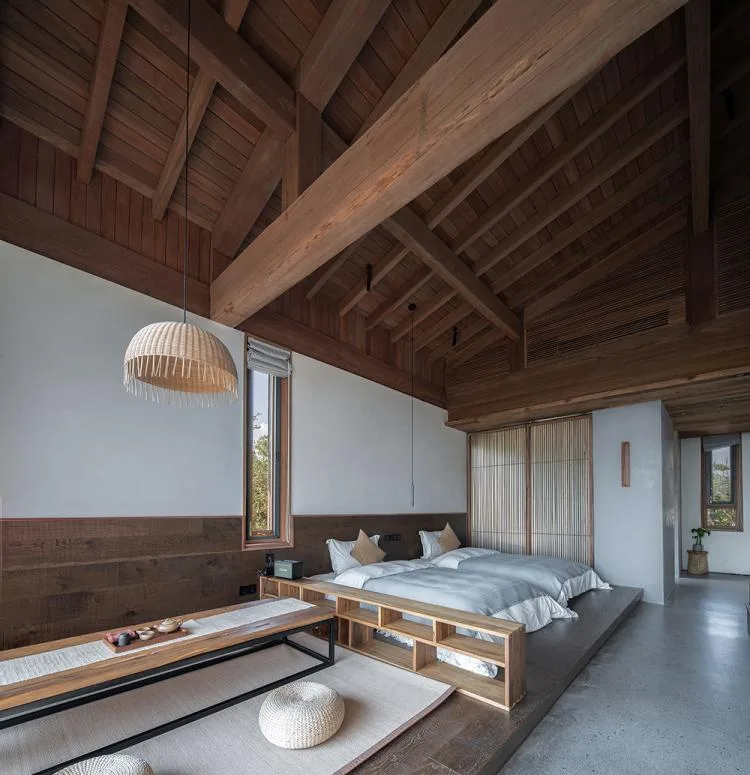
△ Standard rooms featuring exposed wooden roof structures © Zhao Yilong
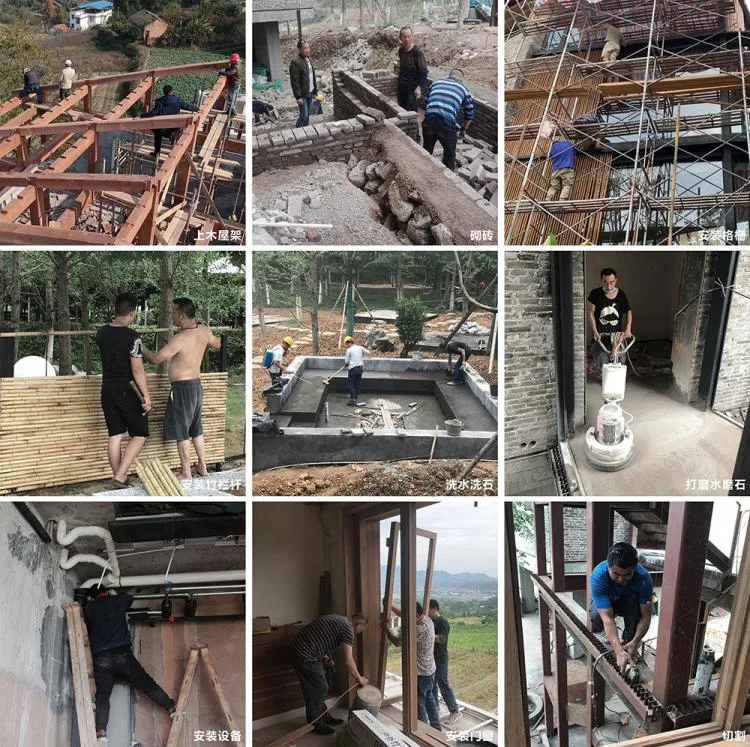
△ On-site construction scene © Jianlin Architecture
Understanding Precision
One ongoing challenge is reconciling traditional construction methods with modern design demands. How can craftsmen accurately interpret architectural drawings? How can seemingly disparate materials be organized effectively into spatial compositions? The answer lies in precision control. Precision does not mean delicacy alone; it is an intuitive, internal logic that can be communicated through language and training, though not always fully captured in drawings.
Precision is abstract but essential on-site. For instance, stone masons are instructed to expose the natural stone surface without cement joints; mortar should be recessed three centimeters within the rough stone wall. Stone sizes should vary naturally without color selection, and stones within 1.5 meters height are anchored to inner walls with hooks. Landscape walls use stones larger than a third of those in building walls. If a master craftsman can meet these guidelines, the work is considered precise.
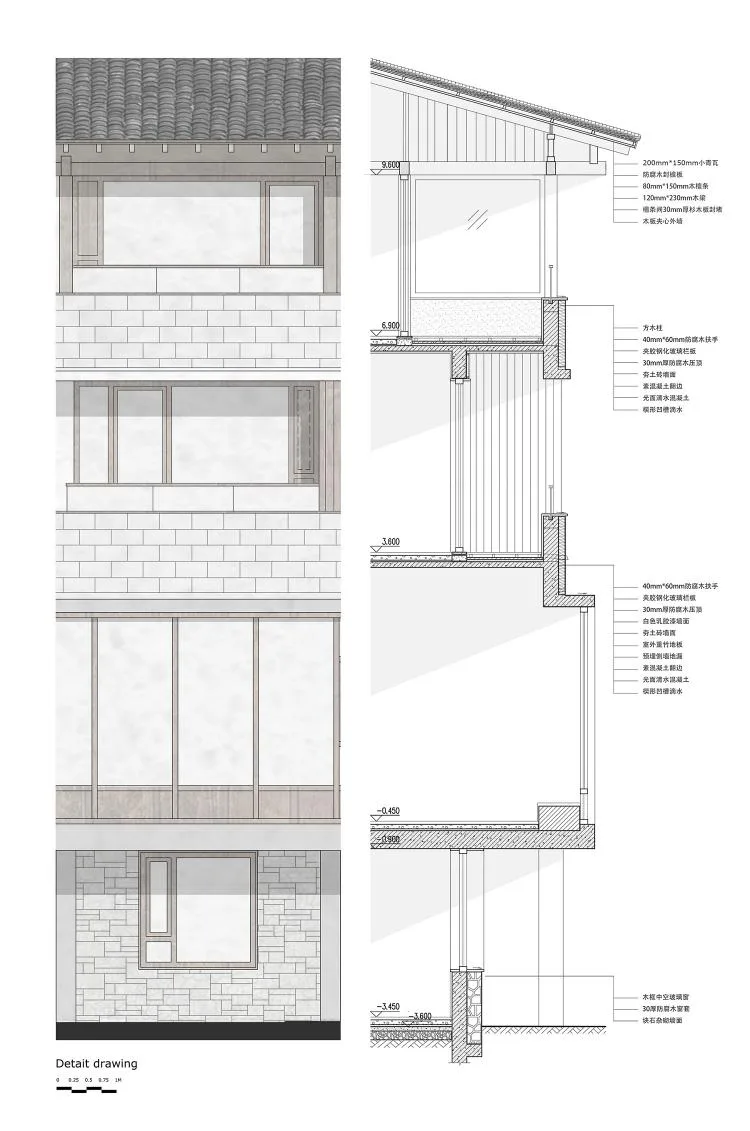
△ Detailed drawing of north facade wall © Jianlin Architecture
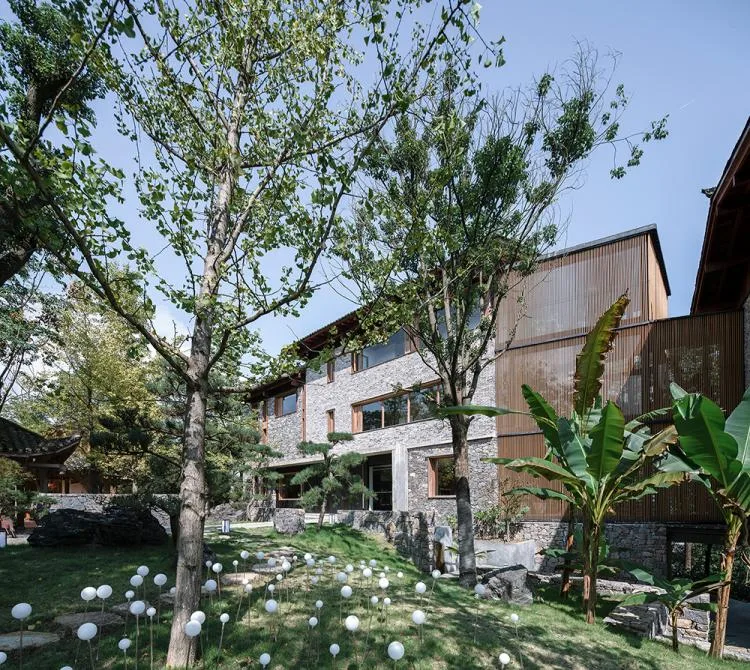
Daytime view of the building’s south side © Zhao Yilong
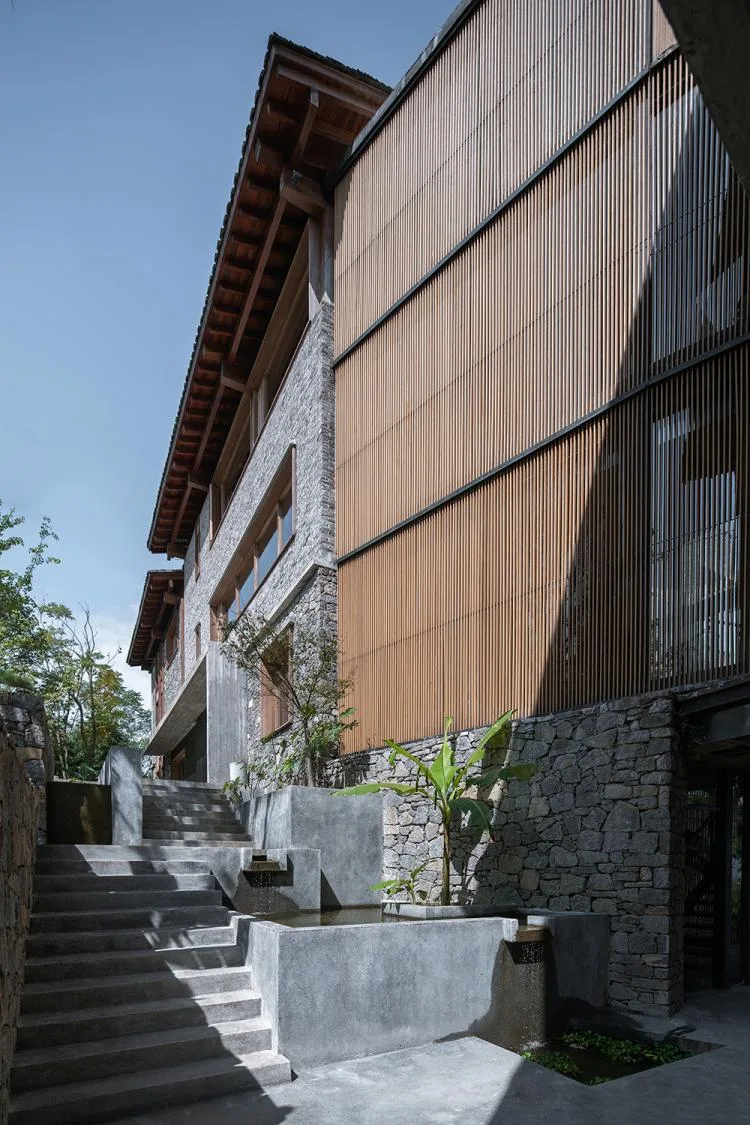
△ Relationship between washed stone, rubble wall, and bamboo grating on the south staircase facade © Zhao Yilong
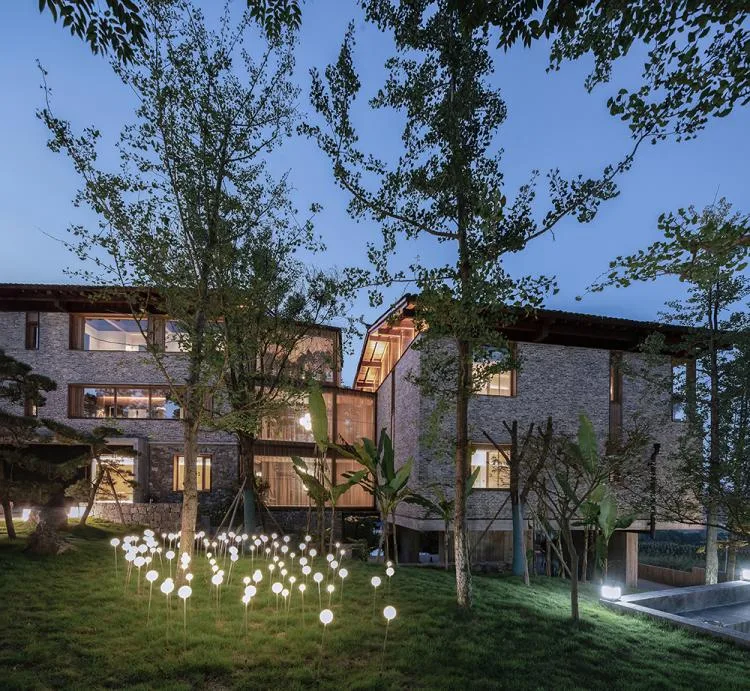
Evening light revealing the interplay of the south facade’s virtual and real elements © Zhao Yilong
Integrated Design Implementation
This project represents a comprehensive integrated design approach, encompassing project positioning, regional and architectural planning, interior design, soft furnishings, landscaping, lighting, structure, utilities, heating, smart systems, and signage. The design process is holistic and systematic, ensuring strong coherence between building and interior spaces, harmonizing hard and soft furnishings, connecting architecture and landscape, unifying structure and materials, and coordinating all disciplines effectively.
This integration minimized conflicts across trades during construction, significantly shortening the building schedule and reducing costs. Indoor landscaping is seamlessly connected, further saving expenses. The integrated design ensures a consistent design language, material continuity, smooth indoor-outdoor transitions, and a rich spatial experience, culminating in a unified, complete architectural expression.
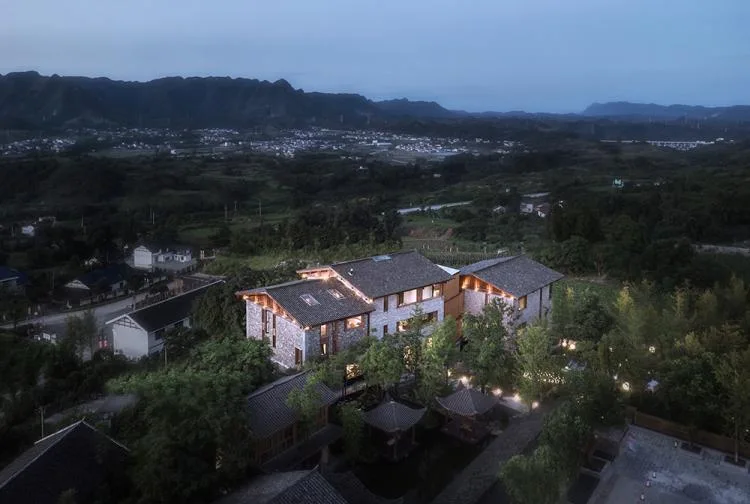
Southwest bird’s-eye view of homestays and distant mountains © Zhao Yilong
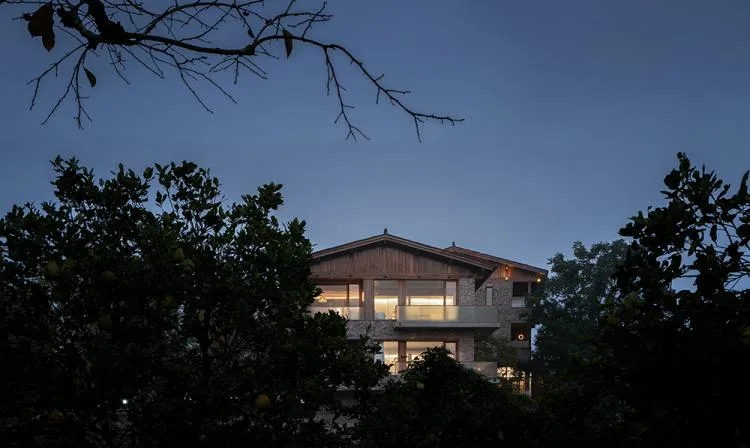
Entering the village and climbing the mountain, the homestay emerges through the forest © Zhao Yilong
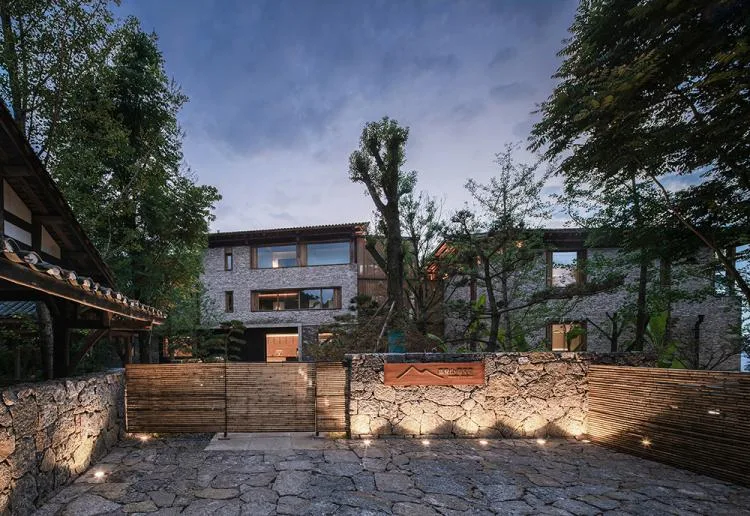
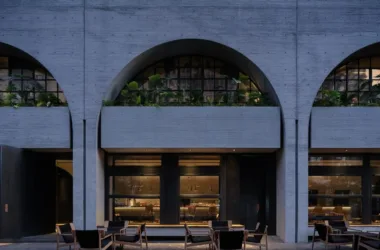
△ Night scene at the homestay’s main entrance © Zhao Yilong
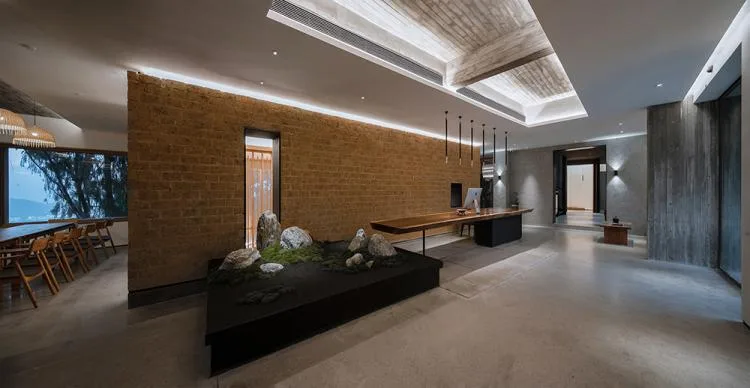
△ Relaxation area inside the homestay lobby © Zhao Yilong
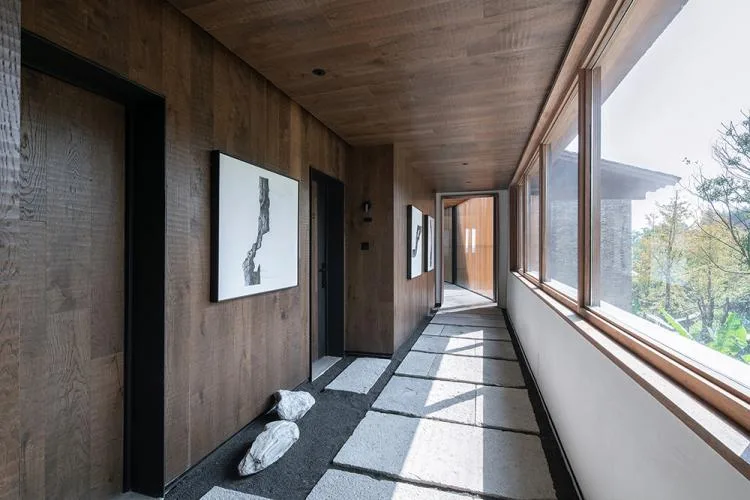
△ Guest room entrance corridor © Zhao Yilong
Integrated design will be a defining approach for future practices, especially for small and medium projects, offering the best value for homeowners. It not only offers comprehensive design solutions but also simplifies coordination among design teams, minimizes conflicts, accelerates construction, and reduces costs.
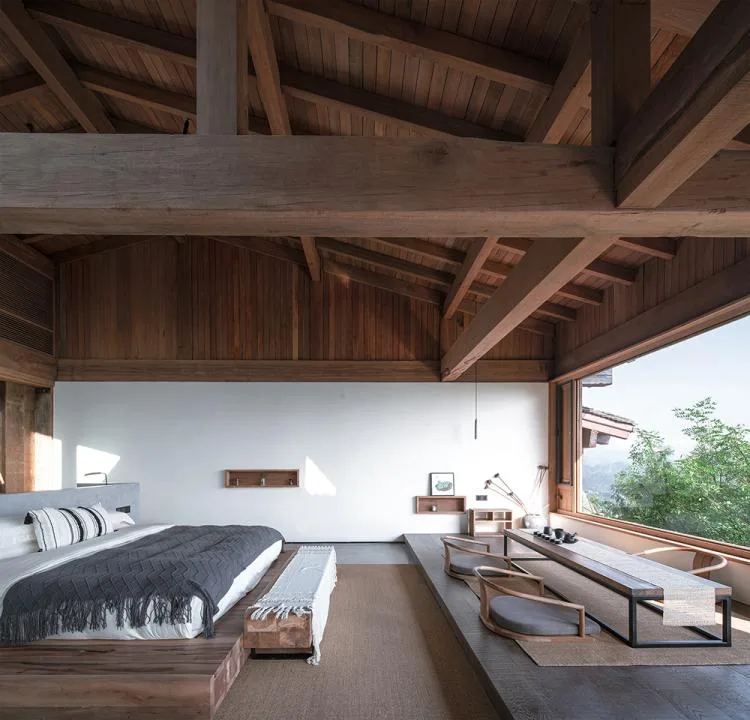
△ Indoor scene of the grand suite © Zhao Yilong
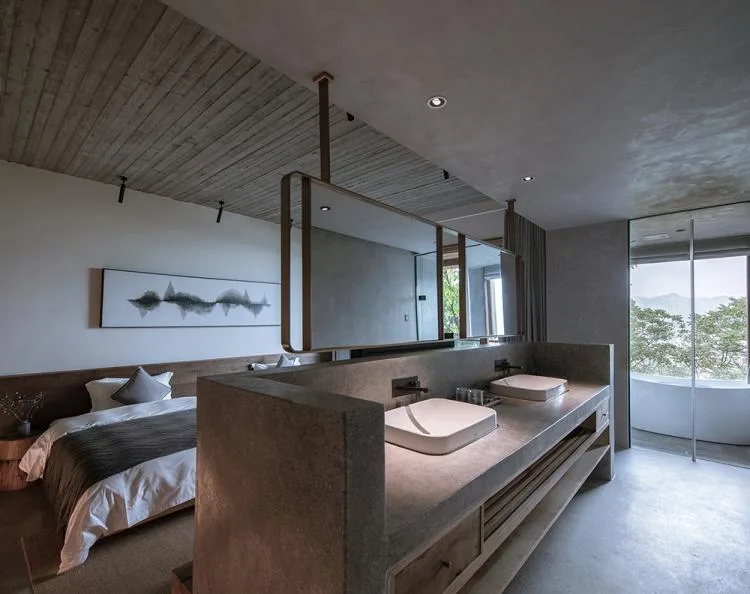
△ Standard room with open bathroom interior © Zhao Yilong
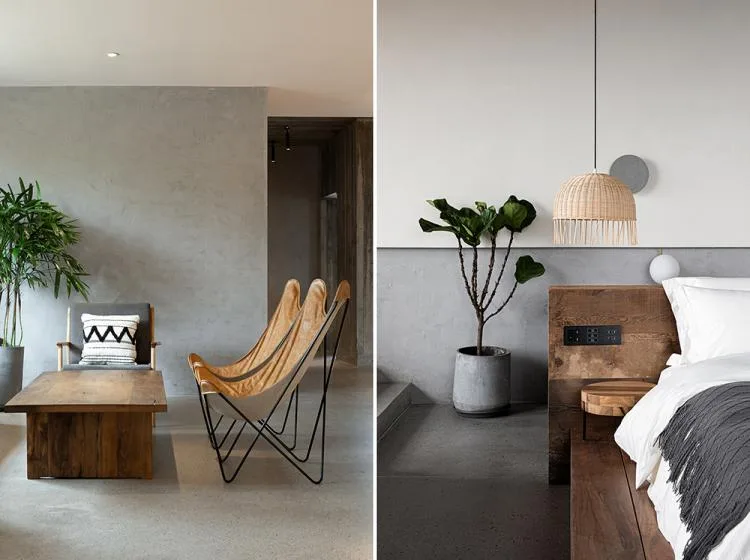
△ Partial interior soft furnishings in guest rooms © Wu Ang
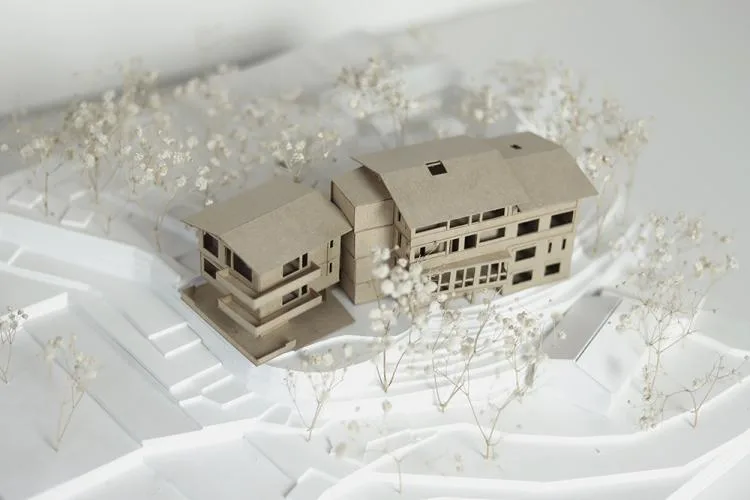
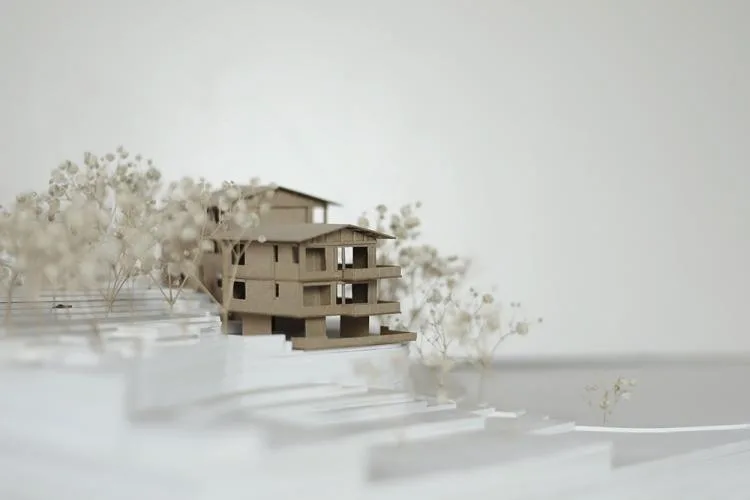
△ Handmade architectural model © Jianlin Architecture
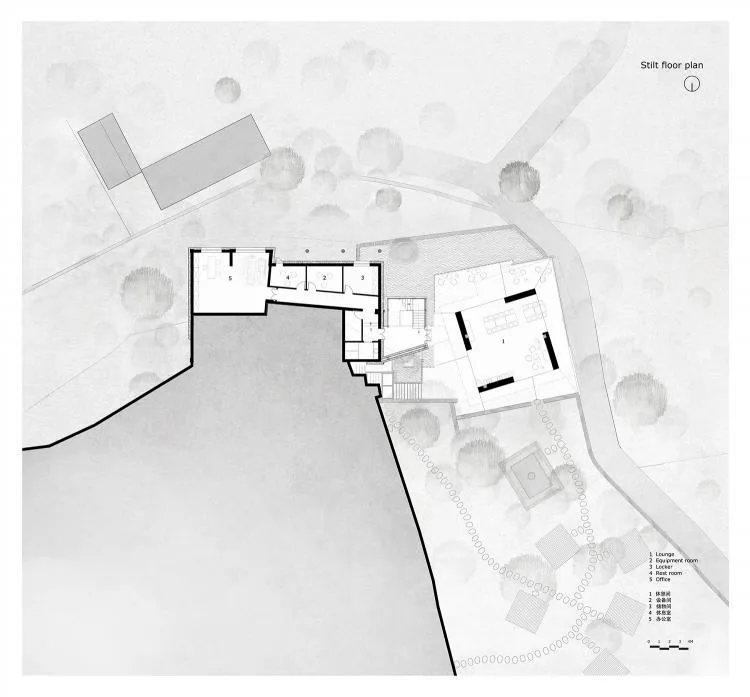
△ Overhead floor plan © Jianlin Architecture
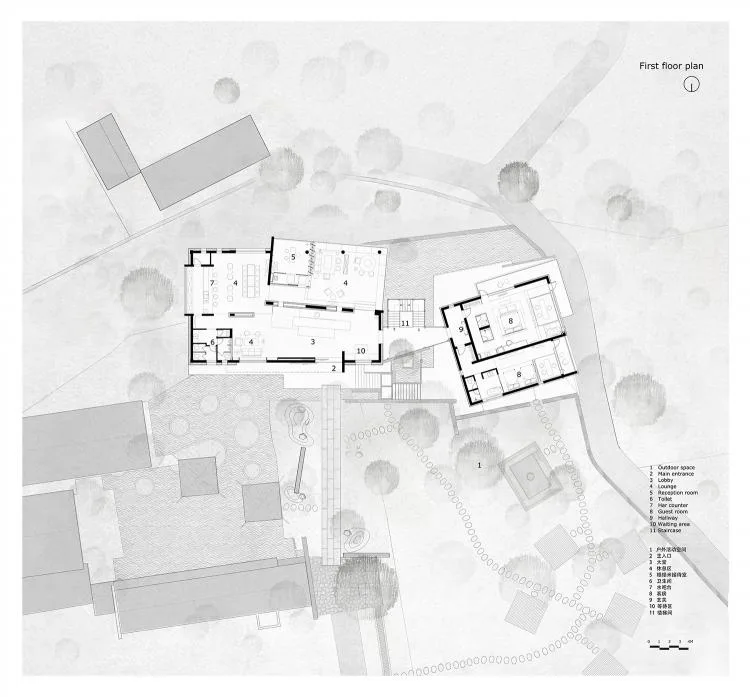
△ First floor plan © Jianlin Architecture
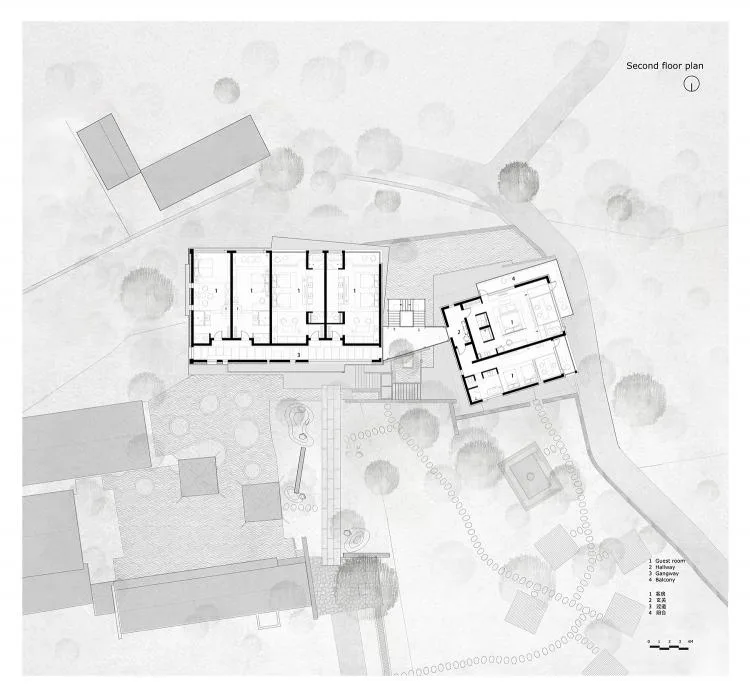
△ Second floor plan © Jianlin Architecture
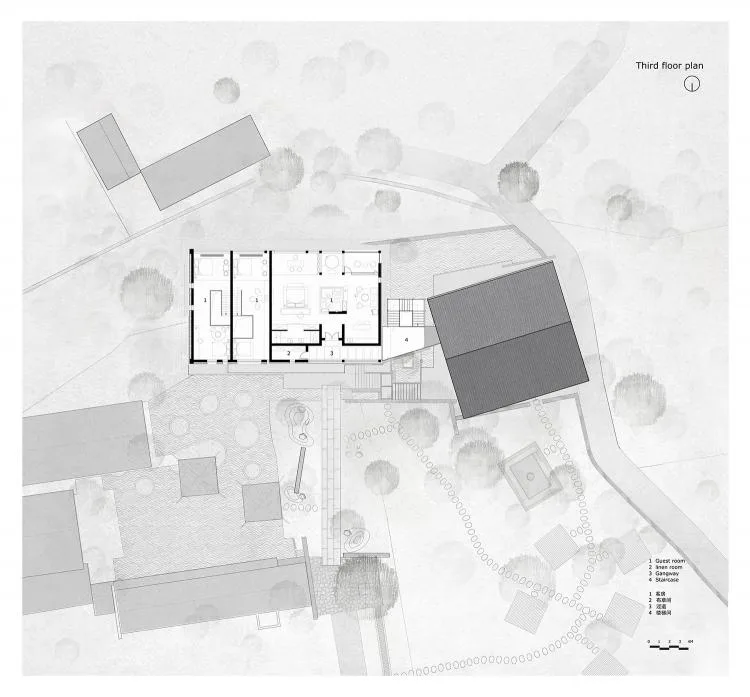
△ Third floor plan © Jianlin Architecture
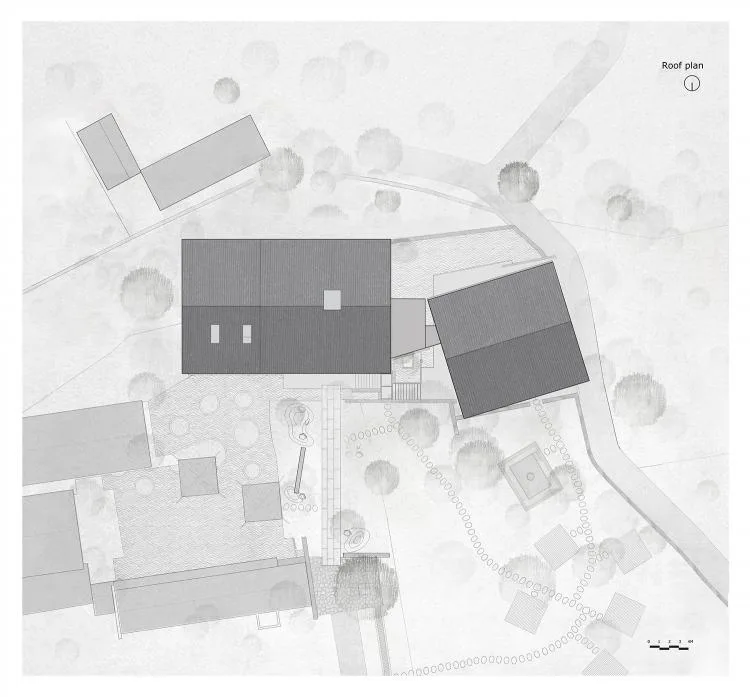
△ Roof plan © Jianlin Architecture
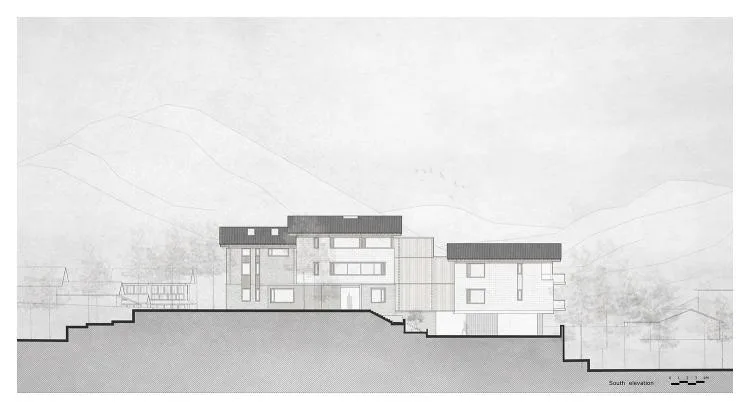
△ South elevation view © Jianlin Architecture
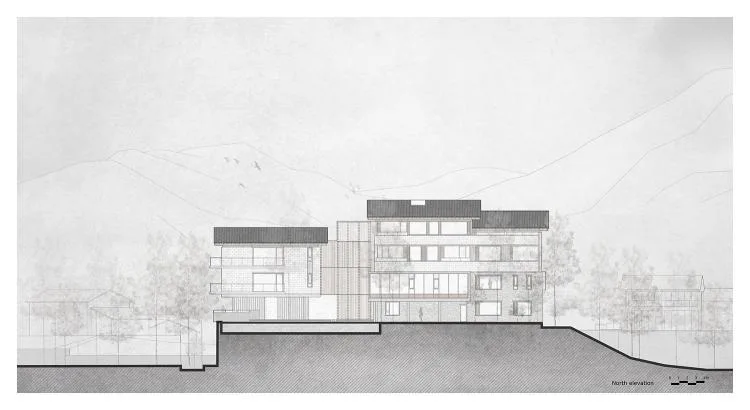
△ North elevation view © Jianlin Architecture
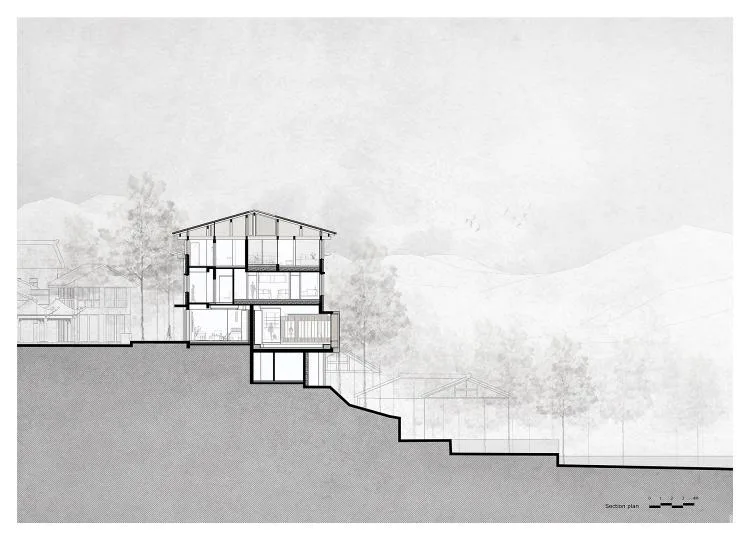
△ North-south sectional diagram © Jianlin Architecture
△ Lin Yushan House Construction Video
△ Ma’ershan Linyushanfang
Project Information
Project Name: Zhangjiajie Ma’ershan · Linyushanfang (also known as Yan’erwo)
Location: Ma’ershan Village, Zhangjiajie City, Hunan Province
Owner: Zhangjiajie Beautiful Rural Tourism Development Co., Ltd
Project Type: Cultural tourism homestay hotel
Design Period: February 2019 – June 2019
Construction Period: August 2019 – August 2020
Design Firm: Jielin Architectural Design Firm
Lead Architect: Chen Lin
Architectural Designers: Liu Dongying, Shi Weiquan, Chen Song
Interior Architects: Liu Dongying, Shi Weiquan, Chen Yini
Soft Decoration Designers: Chen Yini, Shi Weiquan, Zhao Yiwei
Brand Design: Virtual Valley Design
Structural Engineer: Gao Xiang
Landscape Designer: Wuxi · Luchen
Furniture Brand: The Room
Structural System: Concrete frame shear walls combined with steel-wood structure
Design Scope: Planning, architecture, interior, soft furnishings, landscape, brand identity, integrated design
Materials: Wooden formwork concrete, African teak wood, rubble walls, green bricks, earthen bricks, small green tiles, terrazzo, washed stone, synthetic bamboo
Floor Area: 1200㎡
Architectural Photography: Zhao Yilong, Wu Ang
Article Written by: Chen Lin
Video Editing: Ding Shiying












Must log in before commenting!
Sign Up