
Chengdu, known as the city of Tianfu, has traditionally been characterized by its tranquil simplicity. However, with rapid development, it has begun to embrace the surrounding mountains. The iconic shape of Shu Mountain is deeply ingrained in local consciousness, its continuous and ethereal silhouette captivating all who see it. The Chengdu Huajiantang Hotel, a project we designed, stands as a significant public building within the first phase of Vanke’s suburban complex, “Tianfu Vanke City.” Positioned at the city’s edge yet in dialogue with Shu Mountains, it integrates seamlessly into the natural landscape. Here, mountains serve as both a home and a symbol. Through spatial experience, we sought to capture the spirit of Shu Mountain architecturally.
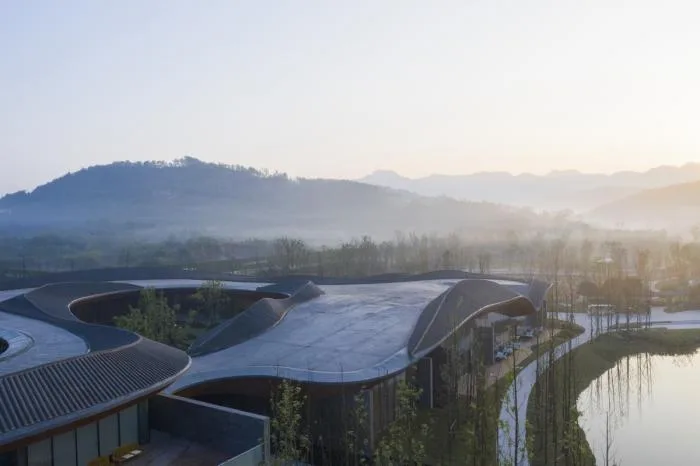
Unlike Western perspectives that often view mountains as rugged and rigid, Eastern philosophy sees mountains as fluid. Time transcends moments to span trillions of years, guiding us to the present. Mountains are no longer just landforms; they become clouds drifting between heaven and earth, embody qi—the vital energy—flowing through the courtyards of traditional orthogonal systems. This duality inspired the unique overlay of orthogonal and flowing design elements in the Chengdu Huajiantang Hotel’s layout.
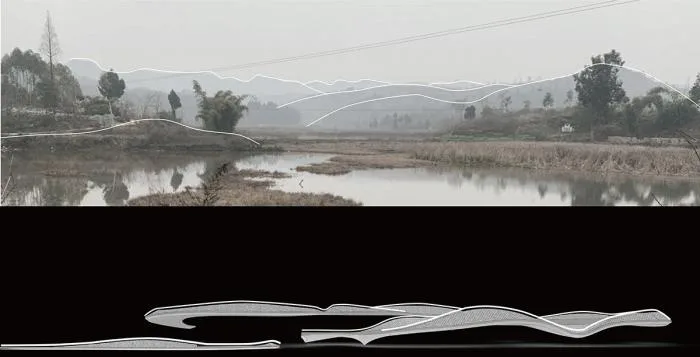
▲ Spatial Intentions
Building on this foundational spatial relationship, the project unfolds along an east-west main axis aligned with a north-south temporal axis. This generates a seemingly spontaneous fluidity within the space. The design incorporates numerous classical garden elements and architectural relationships, harmonizing with the site to create a refined space imbued with traditional Eastern ritualistic qualities.
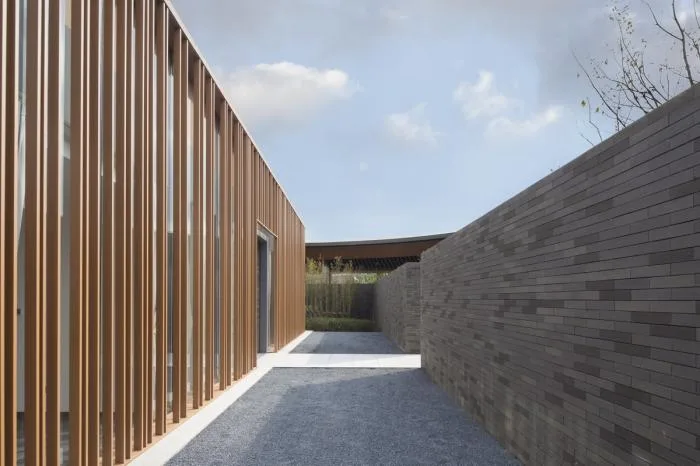
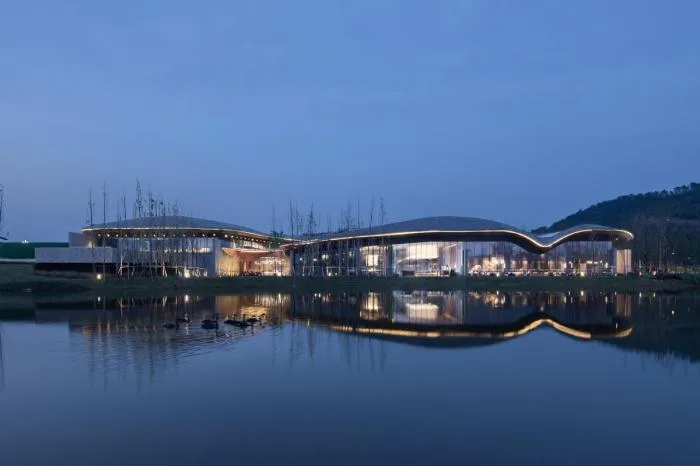
Visitors enter the site through a bamboo forest at the entrance, passing a series of lakeside scenic walls set against a natural backdrop. Flowing eaves connect the walls and landscape, framing the tea room by the lake. As one walks along the lakeside, the southern architectural forms align with the pathway, and the scenery gradually transforms with each step. At the exhibition hall’s entrance, eaves of varying heights intersect, creating dynamic spatial interactions.
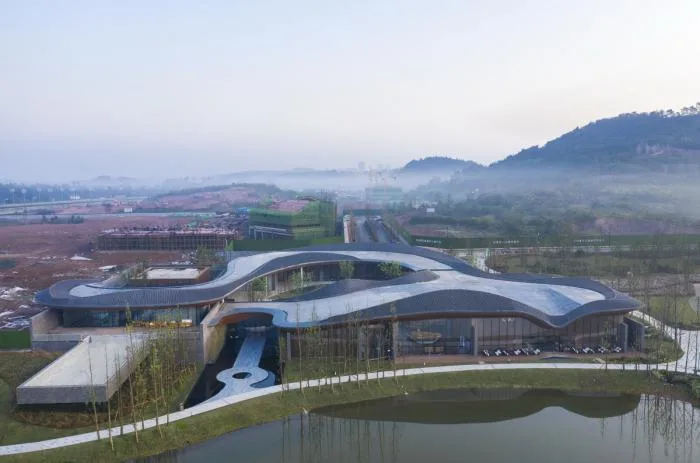
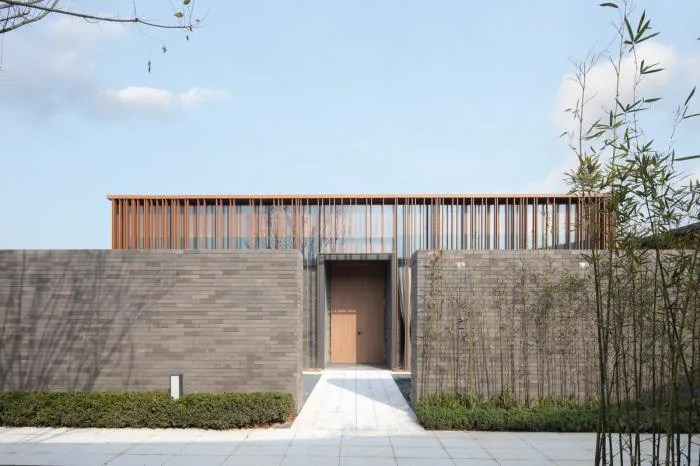
The building’s main entrance is concave and exhibits a balanced symmetry. The design extends the lakeside pathway as an axis, combined with a roof structure that echoes the silhouette of mountains. Symmetrical water features and other elements enhance the ceremonial grandeur of the entrance. Flanked by enclosing scenic walls, the entrance frames the initial visitor experience, inviting guests into the heart of the building.
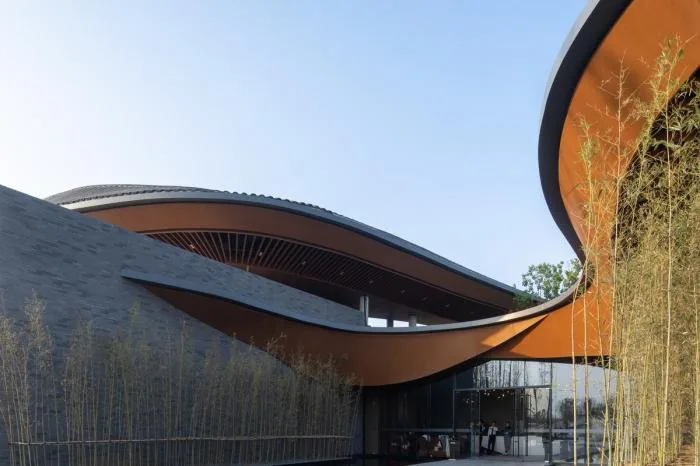
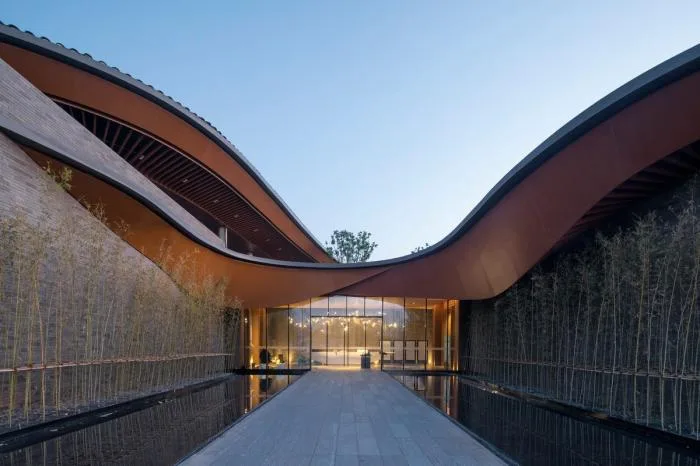
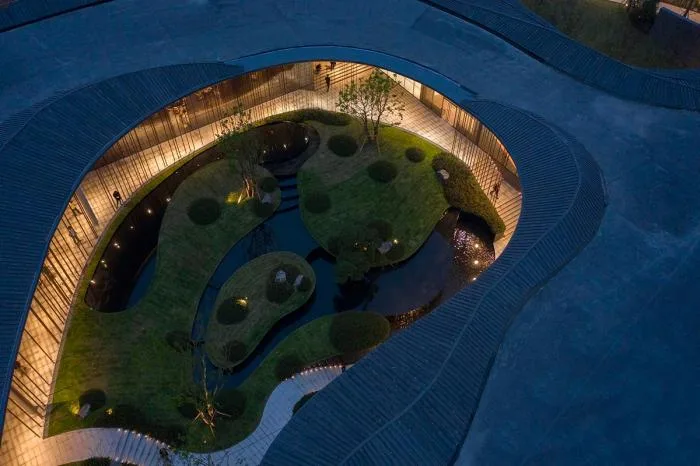
Moving eastward through a sequence of spaces defined by north-south walls, visitors access the main exhibition hall and the Dieshui Courtyard to the north. Inspired by traditional Chinese corridor spaces, Chengdu Huajian Hall offers free, leisurely wandering and a secular spatial experience akin to a park. At the center lies a spacious courtyard, complemented by a series of landscape transitions along the corridors, creating a continuous and visually engaging environment.
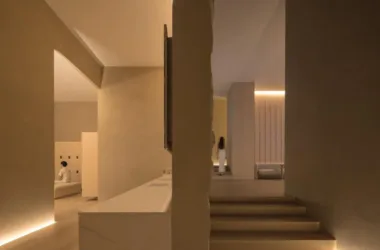
As visitors traverse the interconnected courtyard-walled spaces, light and shadow shift, altering spatial depth and perception. Each successive threshold enriches the spatial narrative and interpretive layers. The design resonates deeply with Eastern courtyard traditions, presenting a spatial sequence oscillating between openness and enclosure: open, suppressed, reopened, and so forth. This layered progression offers visitors a “long scroll” experience, weaving time and space into a complex, interlaced panorama.
▲ Presentation of Scattered Narrative Space at Chengdu Huajian Hall
We envision this “long scroll” providing visitors with a progressively unfolding narrative experience. The architecture itself manifests the essence of mountains and water: continuous peaks, flowing streams, and spaces that shift with eaves and ridges—sometimes revealing steepness, other times concealing it.
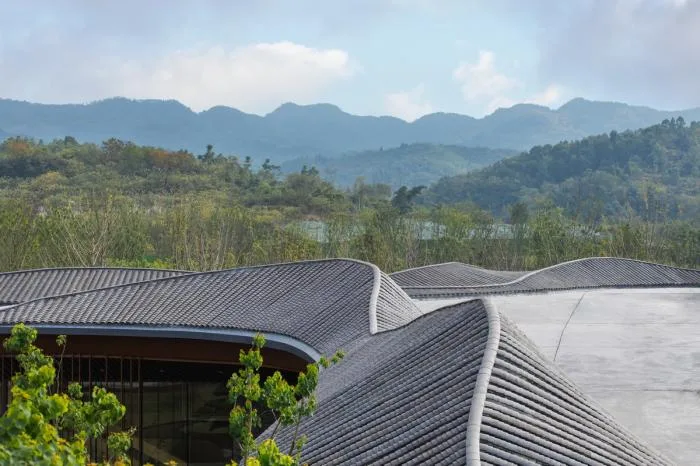
At the master planning level, hills and dense vegetation planted along the highway buffer external disturbances, creating a tranquil overall environment. The internal lake and the Longquan Mountains to the north together compose a layout of harmonious natural elements—mountains and water in close proximity.
The project is divided into three parts: hotel rooms, public hotel areas, and residential spaces, each requiring enclosed layouts. Considering construction scale, timeline, landscape views, and privacy, the plan arranges these components sequentially from west to east, with the public hotel area serving as the initial focal display center.
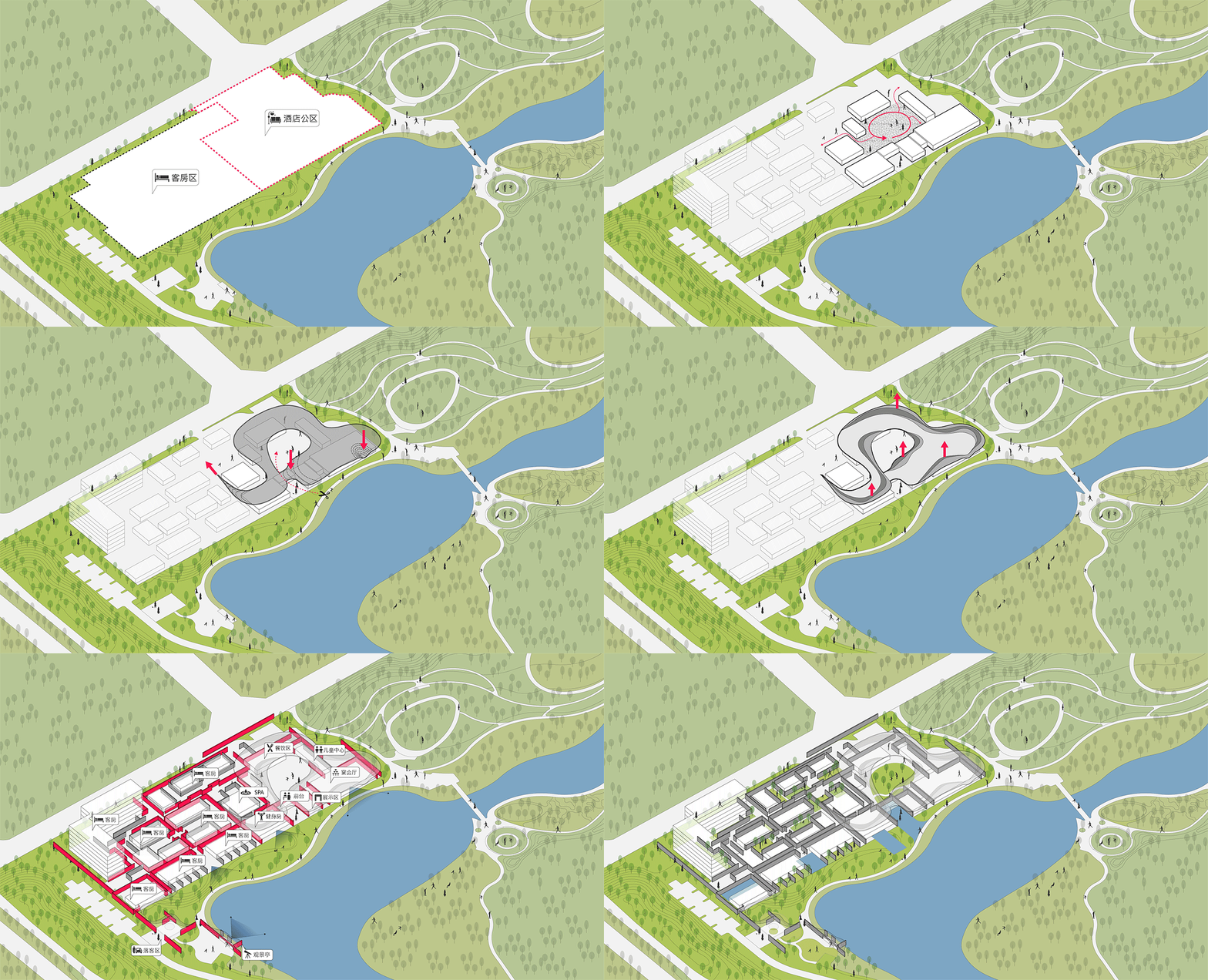
▲ Diagram of Block Formation
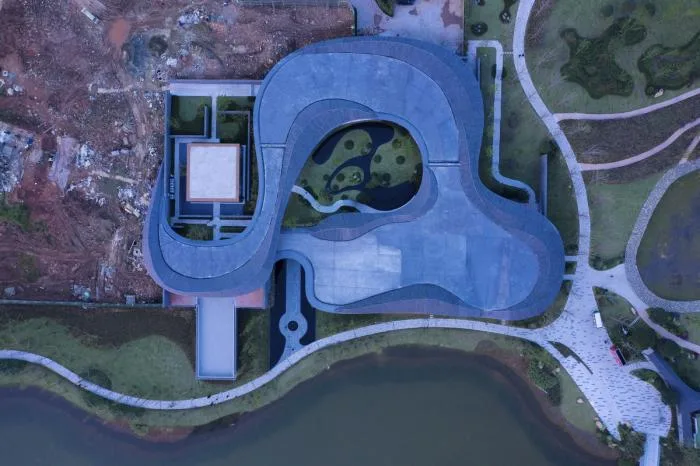
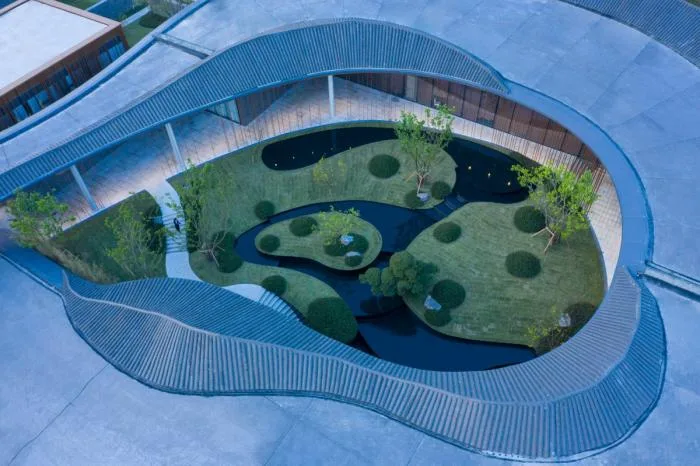
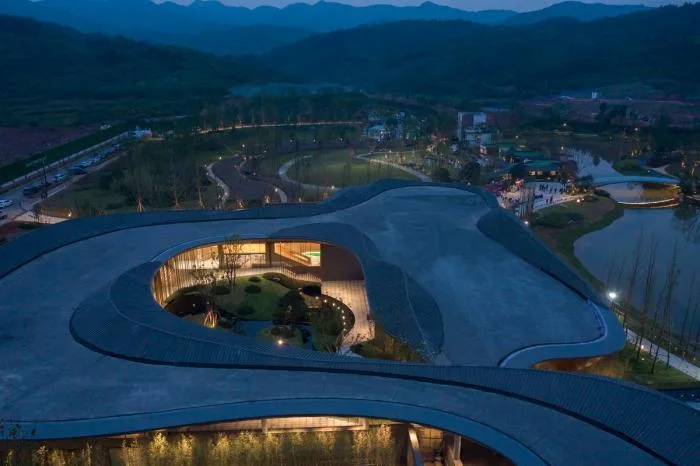
To meet the functional needs of the first phase’s public hotel area as a display hub, the layout forms a circular flow centered on the inner courtyard. This circular arrangement rises gradually, guiding visitors’ sightlines along the building roofs until they fully cross over to view the courtyard.
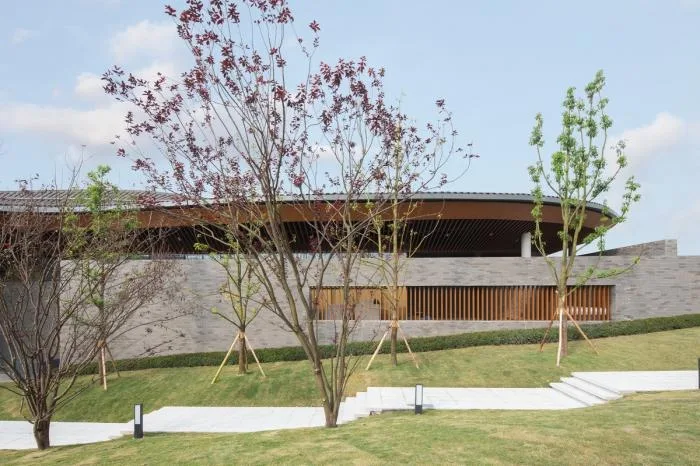
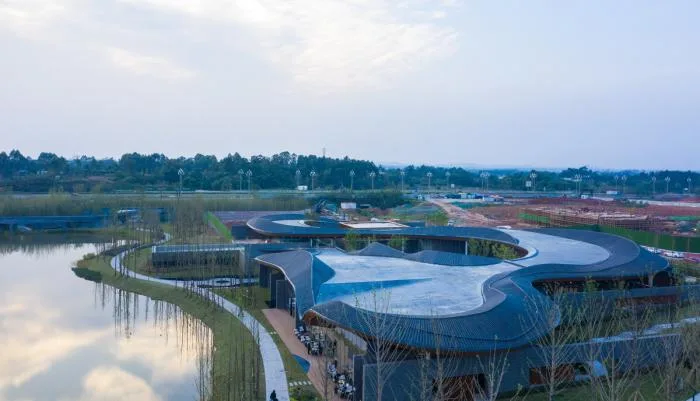
From this vantage, visitors can appreciate the lake and distant Longquan Mountains, creating dynamic views between rooftops and the surrounding landscape. The upward spiraling architectural form allows observers outside the building to peer through the roof into the interior, establishing a unique perspective interplay between facade and roof.
This shifting perspective, transitioning through the roof from exterior to interior and back, creates a distinctive formal dialogue between the building and its environment. Inspired by this, the roof design echoes the continuous mountain forms nearby.
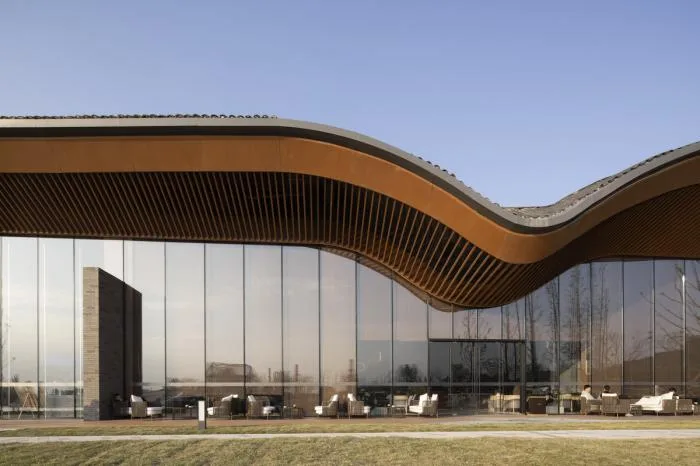
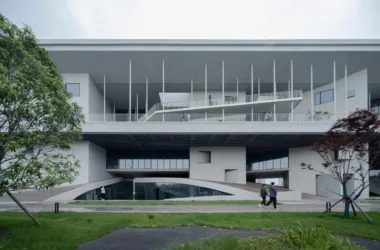
Under the expansive roof, a series of orthogonal spaces enclosed by transparent curtain walls fulfill functional requirements and simplify construction, while offering scenic views of the lake and courtyard. Grey brick walls between glass facades and beneath eaves strategically block and guide sightlines, framing landscapes and enriching the architectural experience. The building’s formal logic is deeply integrated with the surrounding nature.
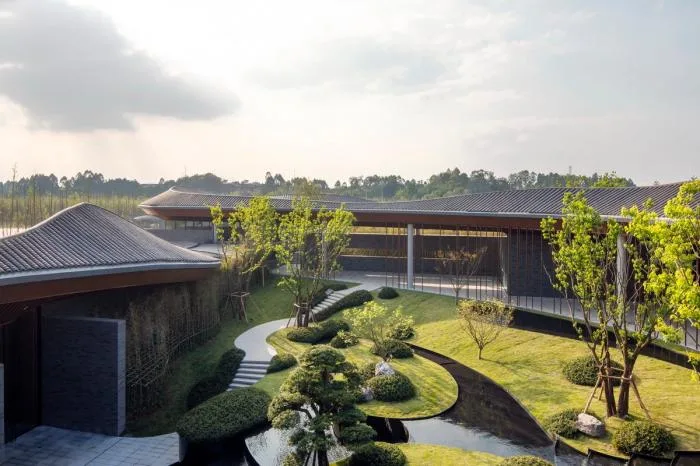
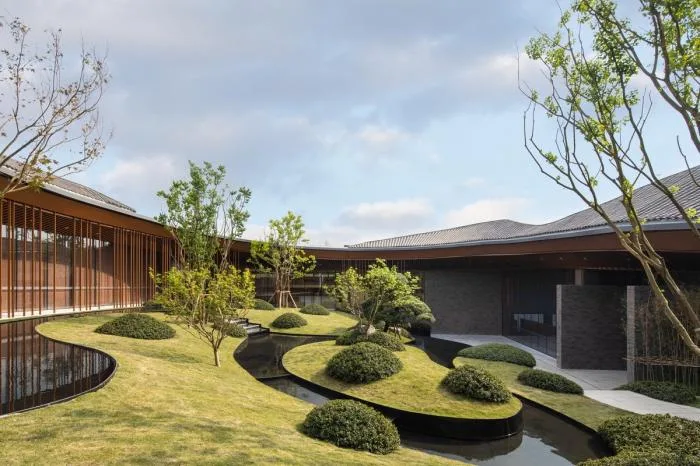
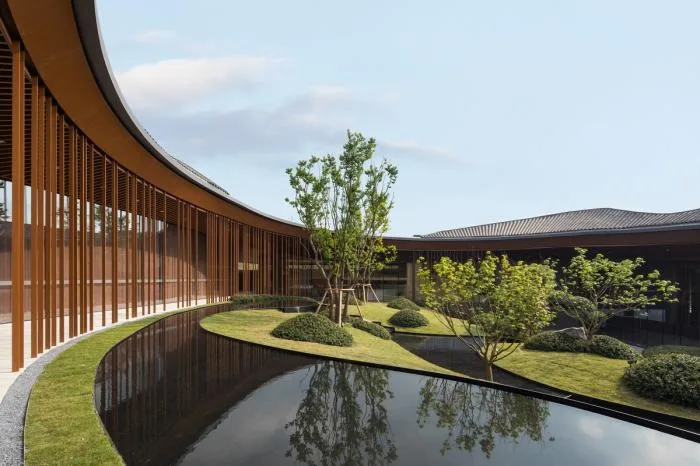
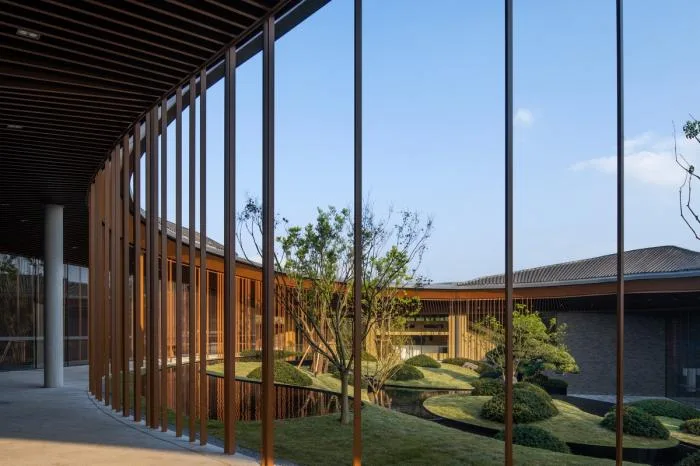
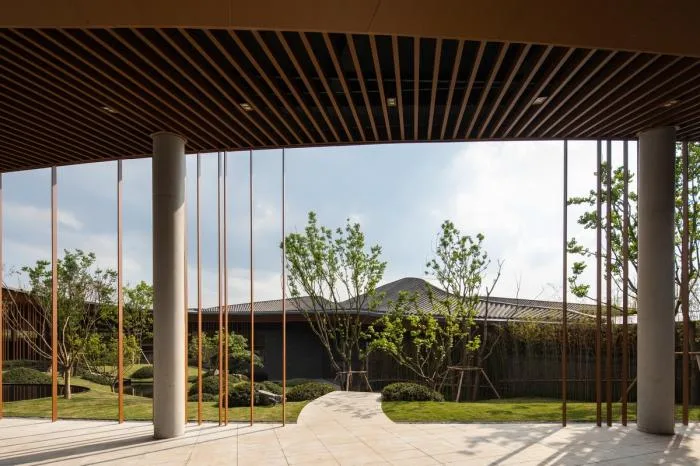
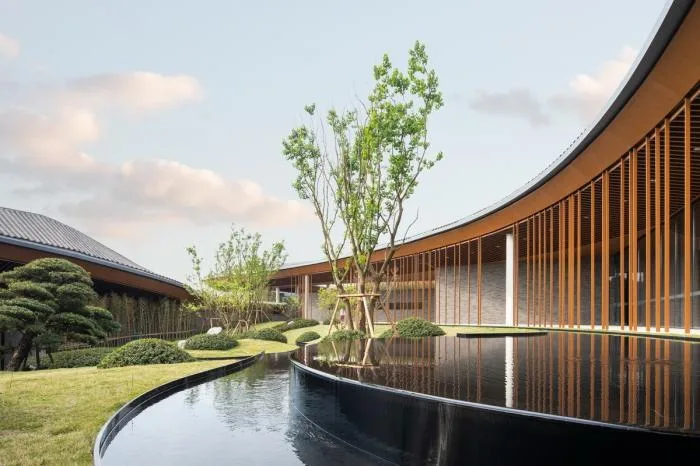
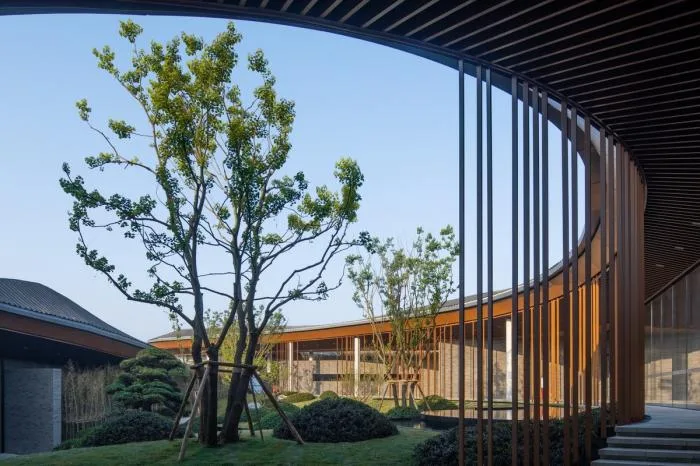
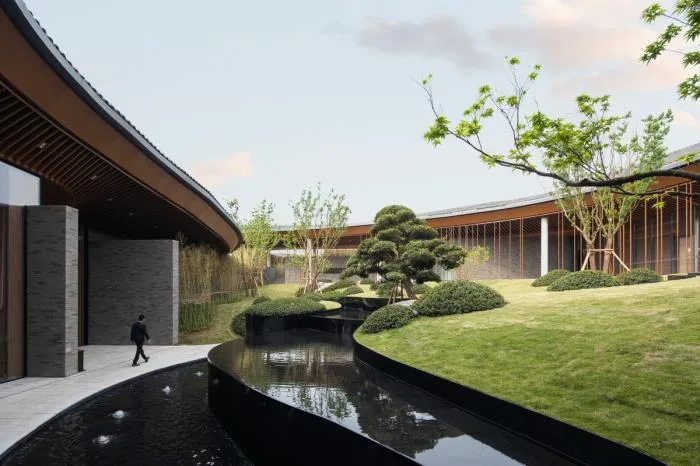
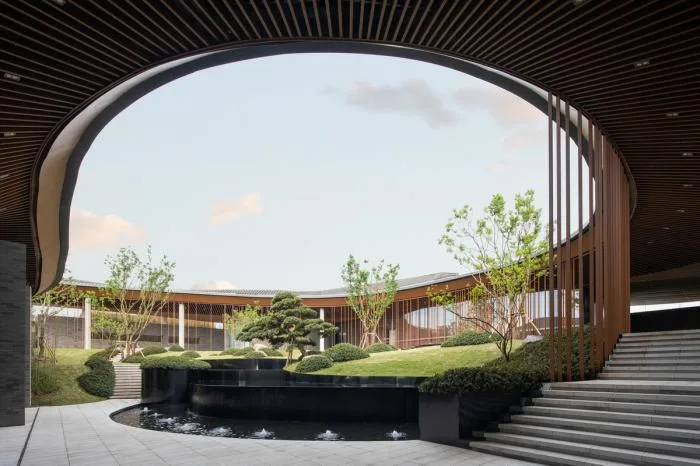
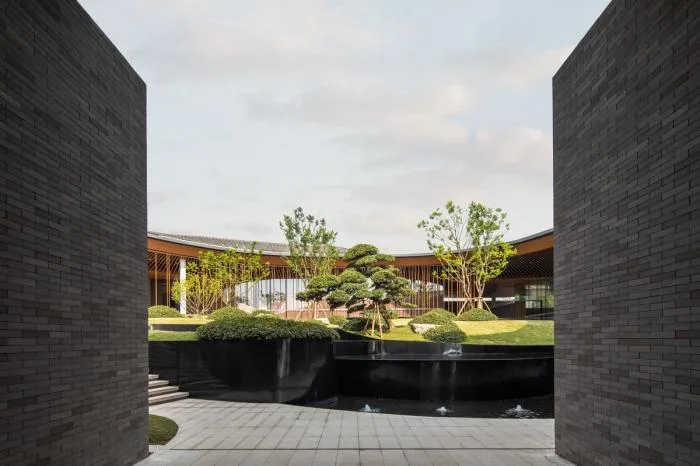
The building’s exterior combines sweeping eaves with transparent curtain walls, emphasizing the roof’s form and its harmony with the surrounding mountain landscape. Inside the courtyard, a ring of imitation wooden latticework beneath the eaves enhances the roof’s curvature and fosters a private, Zen-inspired interior space with a delicate transparency.
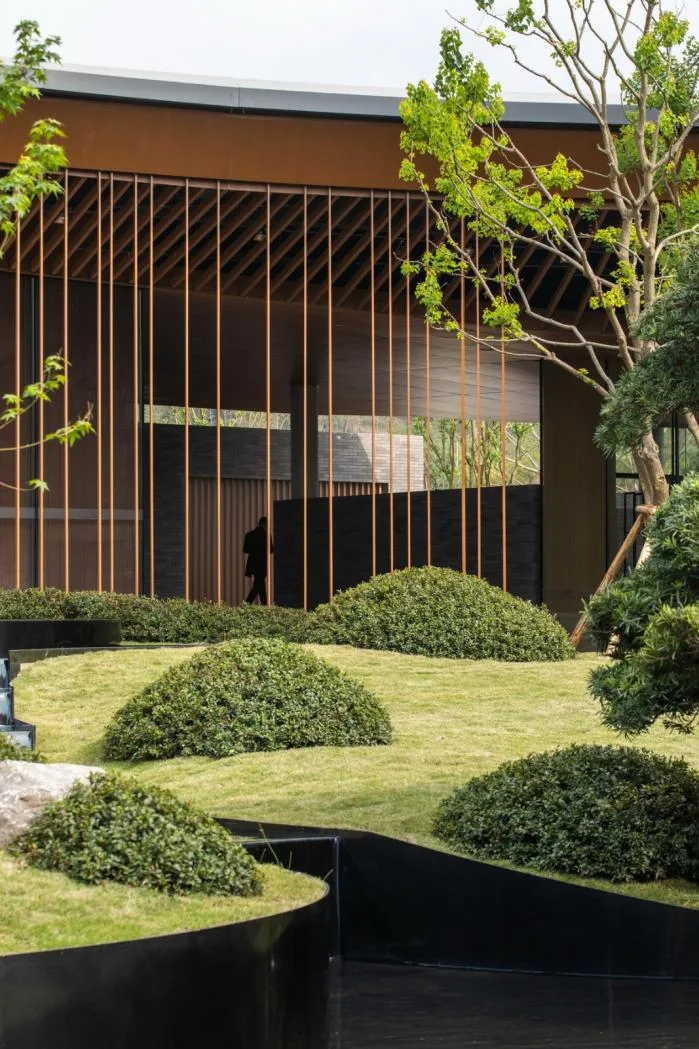
The SPA area, designed as an independent volume, forms a square linear space enclosed by walls. Positioned at the highest point along the lakeside flow, the infinity pool offers framed views of the lake through the building’s projecting eaves. The pool’s flowing form enhances the building’s hierarchical presence along the lakefront. Paired with the slope design, the SPA area stands prominently within the mountain’s concave spatial context.
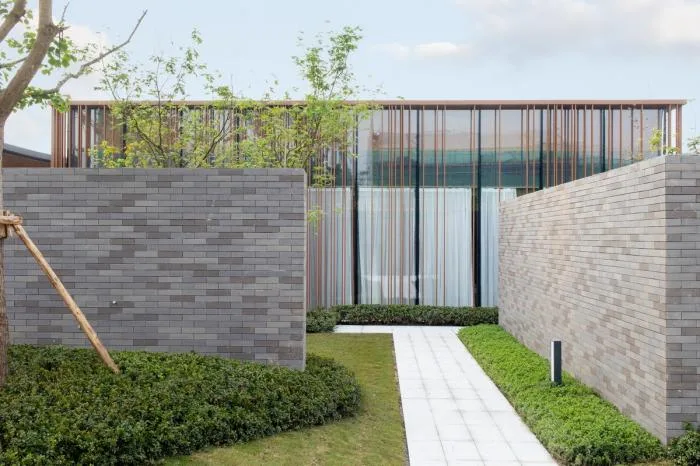
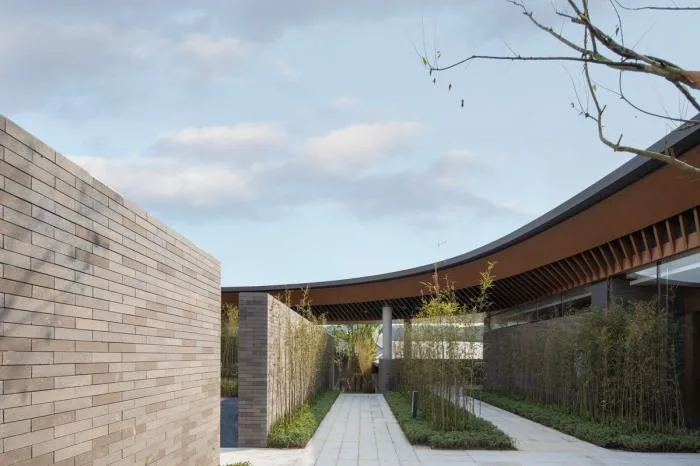
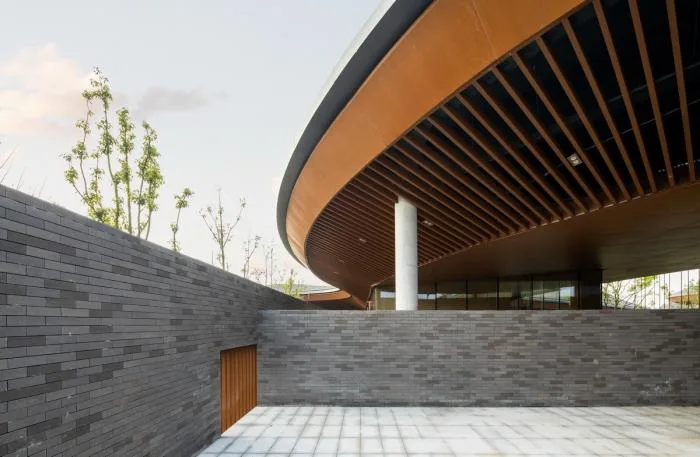
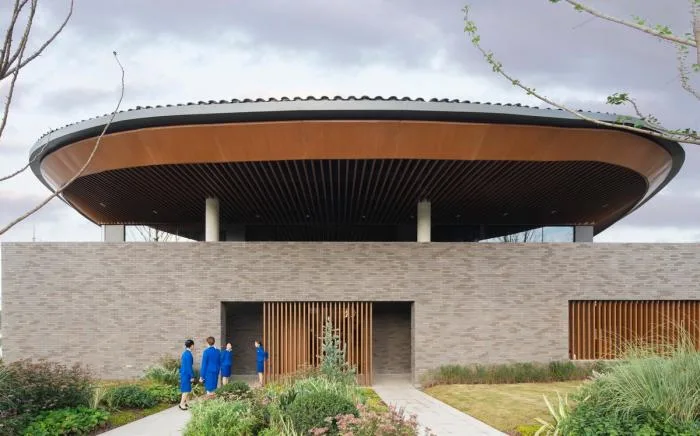
Similar to our previous project, Lin Pan Xing Guan in Chengdu, Chengdu Huajiantang employs techniques inspired by Chinese landscape paintings to reshape site spatial typologies, exploring new spatial possibilities. The scattered perspective technique found in traditional landscape scrolls demonstrates how multiple overlapping spatial narratives can coexist within a single composition. This aligns with the diverse and complex demands of current construction projects operating in multifaceted scenarios. Along this extended axis, stories and life unfold gradually, like a continuous scroll.
We previously explored similar narrative and spatial organizational methods in a project centered on Tongling Mountain. There, the dialogue between spaces under eaves and the mountain, overlapping exterior walls of bedrooms, bifurcated ridges and courtyards, the grand copper entrance doors, and the interplay between end eaves and mountain formed independent yet connected storylines. However, the scale of Tongling Mountain Residence is limited compared to the larger and more functionally diverse hotel format in Linpan Xingguan. Thus, from the outset, we designed a set of “functional long rolled facades” corresponding to functional zones, behind which lie spatial narratives reflecting different programmatic elements.
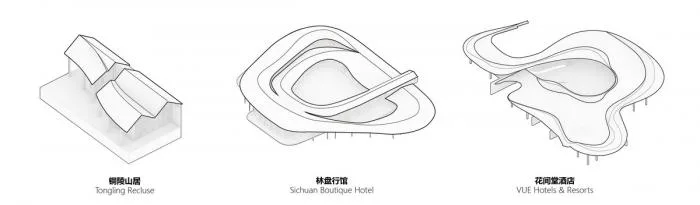
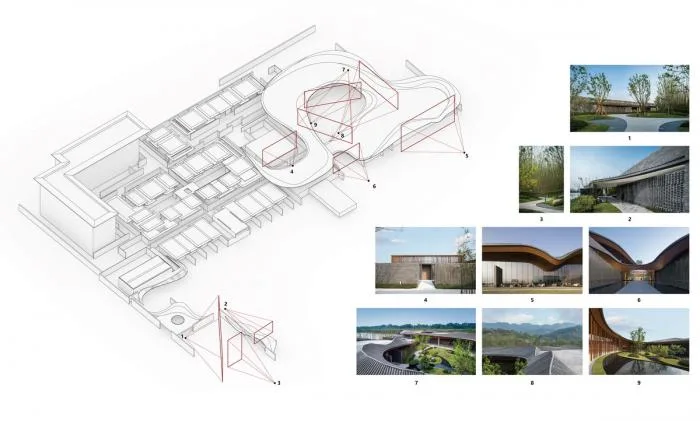
▲ Axonometric Diagram

▲ Song Dynasty painting scroll “Along the River during Qingming Festival”
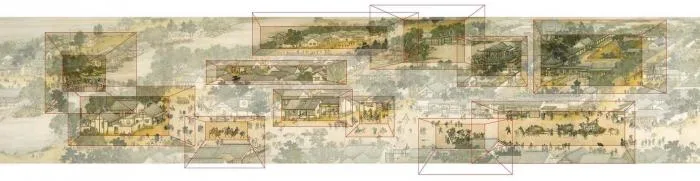
Scattered perspective in the painting “Along the River during Qingming Festival”
As a key spatial element, the eaves transform the two-dimensional “functional long rolled facades” into multidirectional three-dimensional extensions. This layering reproduces traditional spatial characteristics: forest clusters surrounded by mountains and water, trees interspersed, and the harmonious integration of houses and courtyards. Simultaneously, these rich spatial variations provide contemporary experiences and novel spatial typologies. In Chengdu Huajian Hall, houses, eaves, water, trees, and people intertwine as dynamic elements within this flowing “long scroll,” blending visitors, architecture, and nature.
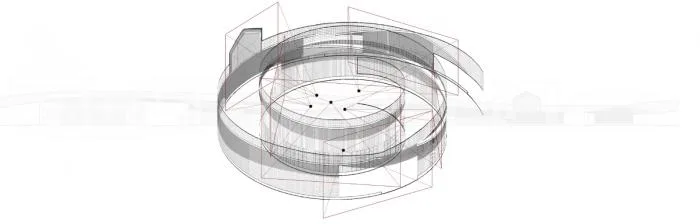
▲ Spatial Narrative Facade: Diagram after Long Curling and Folding
Project Drawings
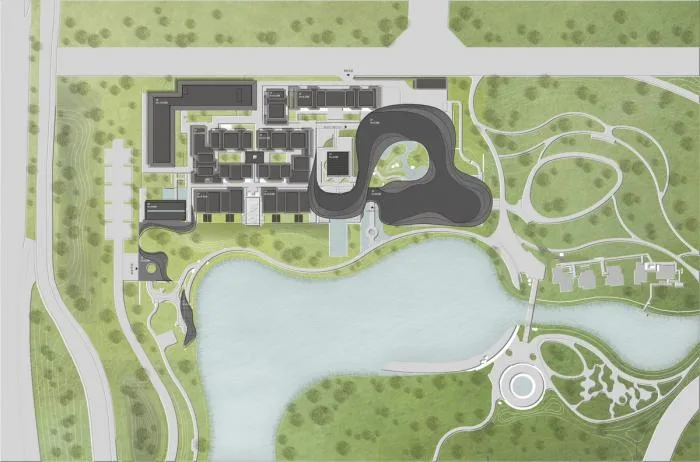
▲ General Layout Plan
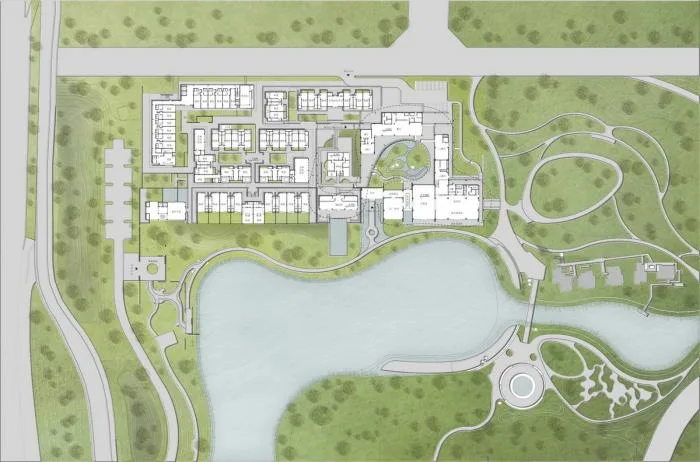
▲ Floor Plan

▲ East Elevation

▲ South Elevation
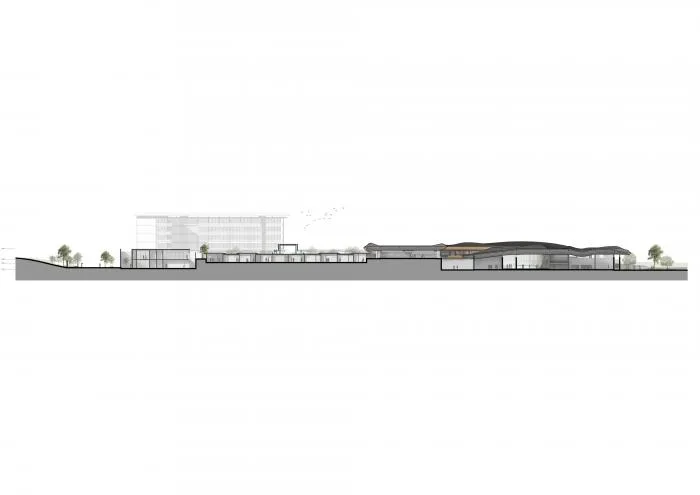
▲ Section View
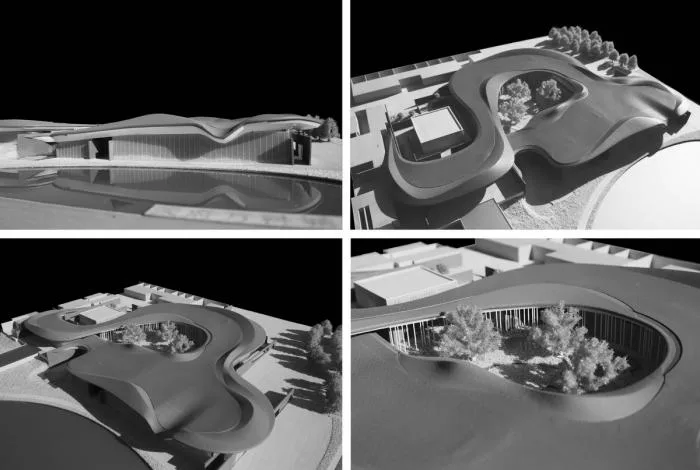
▲ Physical Model
Project Information
Owner: Vanke (Chengdu) Enterprise Co., Ltd.
Project Type: Hotel and Exhibition Center
Location: Chengdu, Sichuan
Building Area: 16,119.78 m² (Phase I: 2,759 m²)
Design Year: 2019
Total Investment: 140 million RMB
Architectural and Interior Design Lead: RSAA / Zhuang Ziyu Studio
Project Team: Zhuang Ziyu, Qi Zhengdong, Li Na
Architectural Design Department: Zhao Yu, Xia Boyang, Fan Hongyu, Chen Ye (Intern), Liang Lingjie (Intern)
Interior Design Department: Zhao Xin, Xu Jiatong (Soft Decoration Consultant), Wang Xinru, Cai Wei, Guo Zhenrong, Jin Ruoxi
Planning and Landscape Concept: RSAA / Zhuang Ziyu Studio, Sasaki Associates
Construction Drawing Coordination: Chongqing Changxia Anji Architectural Design Co., Ltd.
Interior Construction Drawing Coordination: Zhuhai Mingde Engineering Design Co., Ltd.
Landscape Scheme and Construction Drawing Coordination: Chongqing Shangyuan Architectural Landscape Design Co., Ltd.
Construction Contractor: Fujian Ludu Construction Co., Ltd.
Interior Construction Contractor: Chongqing Jiasheng Decoration Engineering Co., Ltd.
Curtain Wall Contractor: Sichuan Yufei Building Decoration Engineering Co., Ltd.
Lighting Design: Zhongao Guangke (Beijing) International Lighting Design Co., Ltd.
Rendering Collaborators: Beijing Jiansu Visual Digital Technology Co., Ltd., Chengdu Zaomeng Space Decoration Design Co., Ltd.
Photography: Existence of Architecture – Architectural Photography
Camera: Sohu Extreme Exploration Studio












Must log in before commenting!
Sign Up