
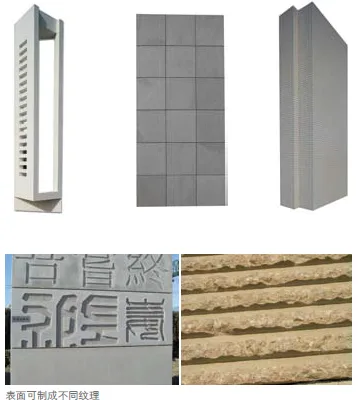
Exterior wall decorative panels come in various types, including brick cladding panels, stone cladding panels, plain concrete cladding panels, and colored concrete cladding panels.
1. Characteristics and Applications
Prefabricated concrete cladding takes advantage of concrete’s strong plasticity to fully capture architectural design intentions, giving large public buildings distinctive exterior walls. These decorative concrete panels are made using reverse molding technology, featuring a decorative surface layer. Through creative design of colors, tones, textures, styles, and irregular patterns, these panels imitate natural materials such as marble, granite, brick, tile, and wood.
The simplicity and solidity of plain concrete reflect the timeless character of ancient and natural architecture. Manufactured industrially in factories, these panels offer fast construction, high quality, and low maintenance costs. Depending on project requirements, the panels can be designed as composite insulated exterior wall panels that combine decoration, insulation, and wall enclosure (prefabricated components), or as decorative cladding for composite walls.
2. Technical Performance and Standards
Thermal Insulation: Ordinary concrete panels are layered with 50-80mm polystyrene boards, achieving a heat transfer coefficient under 0.60 W/(m²·K), meeting the “Energy Saving Design Standards for Civil Buildings.”
Structural Performance: Panels comply with GB50010 “Code for Design of Concrete Structures” and GB50204 “Code for Acceptance of Construction Quality of Concrete Structures.”
Decorative Quality: Panels meet the requirements of GB50210 “Code for Quality Acceptance of Building Decoration and Renovation Engineering.”
Seismic Resistance: The panels are attached to the main structure using flexible connections, ensuring good adaptability to inter-story displacement during earthquakes. They are suitable for seismic fortification zones up to intensity 8.
3. Product Specifications
To accommodate various building facades, the panels come in different formats such as full-room panels, horizontal strip panels, and vertical strip panels.
Dimensions:
- Full panels: Height equals one story; width typically below 4.5 meters.
- Horizontal strip panels: Height corresponds to the space between upper and lower windows; width generally below 6.0 meters.
- Vertical strip panels: Height equals one story; width fits the distance between adjacent windows.
Insulated composite panels are 180-220mm thick, while single panels range from 60-160mm thick.
Weight: Insulated composite panels (140-220mm thick) weigh approximately 200-350 kg/m². Veneer panels 60-80mm thick weigh about 140-200 kg/m², and 100-160mm thick veneer panels weigh around 250-400 kg/m².
4. Installation Methods
The decorative concrete panels connect to the main structure through a flexible system featuring lower supports and upper tension connections. Currently, flexible connections include elastic sliding nodes and elastic-plastic deformation nodes. The gap between panels and the main structure ranges from 30-50mm, with panel-to-panel seams sized between 15-25mm.
5. Panel Seam Waterproofing
Appropriate building sealants should be selected based on the exterior finish. Sealant performance must comply with relevant national or industry standards.
6. Supporting Components
After product design, the manufacturer provides the construction team with detailed drawings and lists of structural embedded parts and connectors. All embedded elements on the exterior panels are supplied by the manufacturer.
7. Key Design Considerations
Design begins by dividing the building facade into panels. During construction drawing development, collaboration with the manufacturer is essential to determine load requirements (including usage, handling, and lifting loads), panel sizes, connection methods, and reserved structural embedded parts.















Must log in before commenting!
Sign Up