
Euclid stands as a beacon in the history of human scientific thought.
Geometry mirrors humanity’s evolving understanding of the world and opens the door to shaping space. Architecture, as a human creation reflecting our worldview, has traversed various historical periods, showcasing classic works imbued with geometric sculptural qualities.
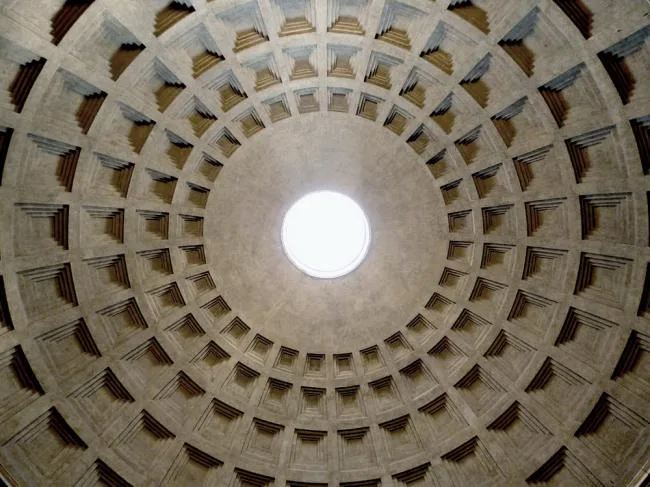
▲ Dome of the Pantheon in ancient Rome
Ultimate Purity
Less is more
In designing the Xuhui Yinshengtai Boyue · Fengxi Tai Life Art Museum, we pay homage once again to the timeless elegance of classic geometric space. Situated in the entryway formed by two high-rise residential buildings, a bold diagonal line disrupts the calm of the rectangular plane, dividing the space into two complementary, wedge-shaped minimalist forms that together create a cohesive whole. Here, the space is thoughtfully deconstructed and meticulously reassembled.
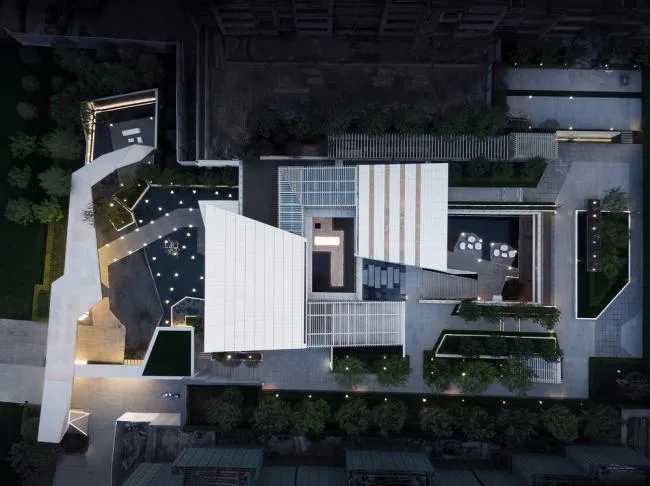
▲ Aerial view of Bo Yue · Feng Xi Tai Living Art Museum © Architectural Photography
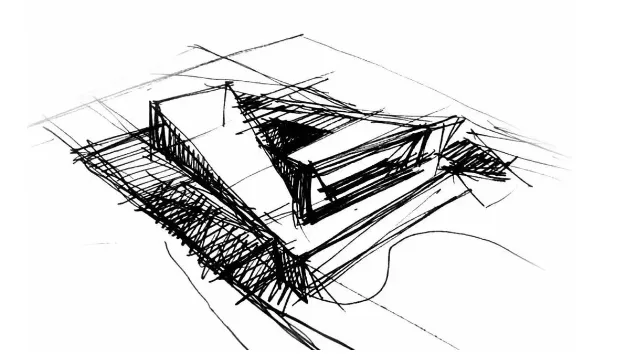
▲ Concept sketch
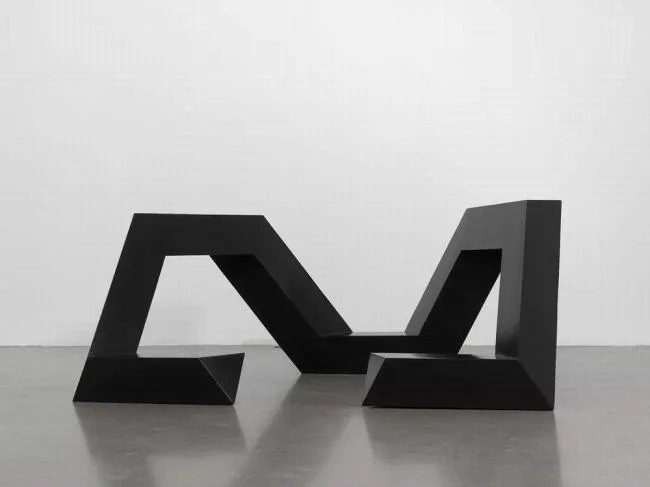
▲ Tribute to Classics – Iconic Minimalist Sculpture by Tony Smith (Image Source: Network)
The two clean, wedge-shaped volumes exude sculptural strength. The ultimate pure geometric form needs no additional ornamentation. It should be simple, unadorned, solid—without elaborate textures or personalized colors. For this reason, nearly pure white stone was the natural choice, despite its high cost. Each stone piece was meticulously selected and screened to achieve an almost flawless pure form.
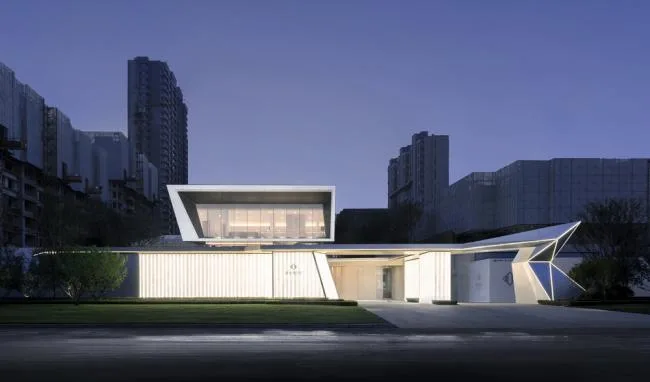
▲ West side overall view © Architectural Photography
From Facade to Space
Using a straw as a tool, once used, it becomes a tool again.
Carve a doorway into a room, treat it as nothing, and use it as a room.
This straightforward volumetric segmentation does not arise from the architect’s personal expression in BIM work, but rather from thoughtful responses to site conditions and functional requirements. On one hand, due to a height difference exceeding 3 meters, the main functional volume of the Life Art Museum is situated in the semi-basement level, with only the west entrance serving as the exhibition facade. On the other hand, during the sales phase, the art museum needed a highly recognizable architectural form, while later functioning as a community home hall and clubhouse, it had to provide a comfortable living experience while addressing the height difference.
Given extremely strict area limitations, the above-ground form is very constrained. Creating an impressive architectural image on a limited display surface, while avoiding superficial facade design, became a key challenge in solving BIM training problems.
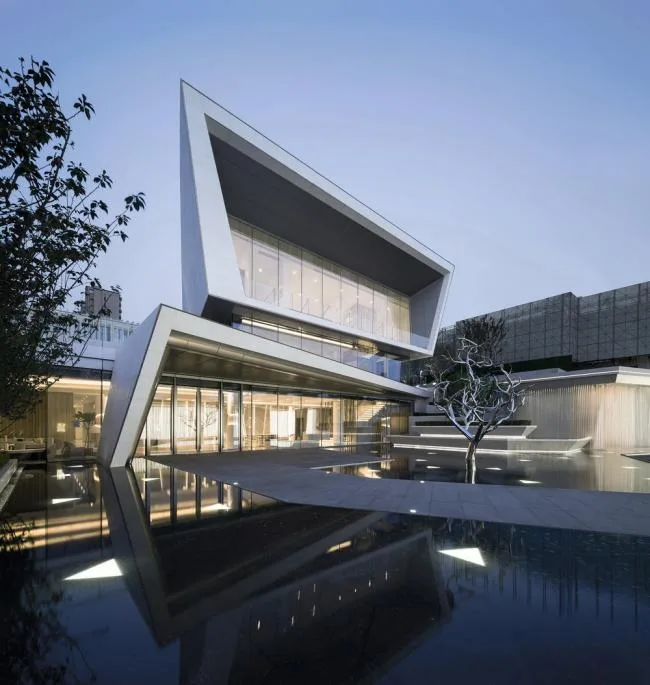
▲ Realistic image of the west entrance © Architectural Photography
Confronted with numerous contradictions, the design focus shifted from the facade toward spatial depth, allowing the design to extend inward. Two sunken courtyards organically connect various functions while providing natural light and ventilation. Large steps facilitate seamless transitions between different elevations, creating a dynamic home experience with changing views at each level.
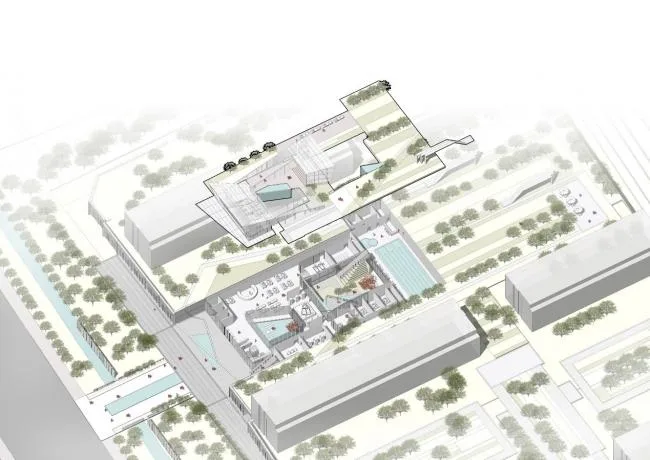
▲ Early-stage spatial concept analysis
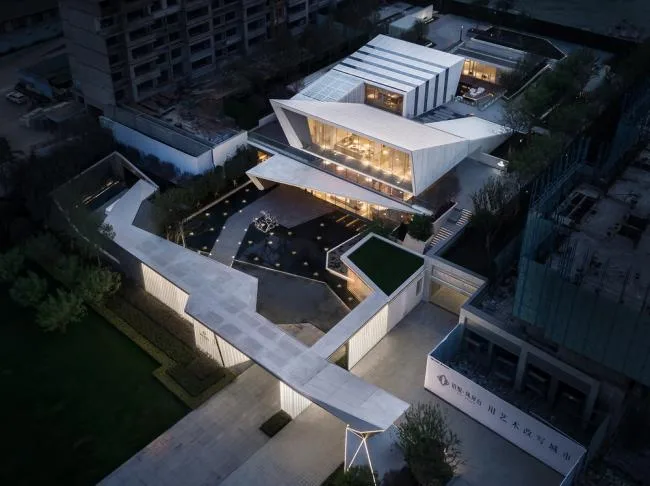
▲ Aerial view of the site © Architectural Photography
Two complementary wedge-shaped volumes extend in opposite directions, connected by a landscaped corridor. The rich volumetric form compensates for limited site area, while the extended courtyards blur the boundaries between indoors and outdoors, creating a dramatic and dynamic spatial experience.
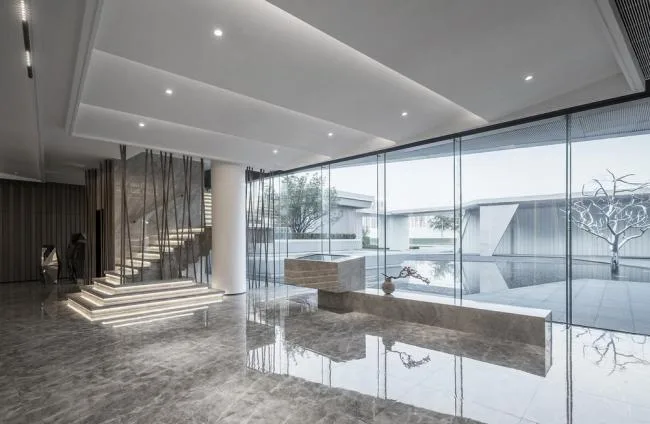
▲ Realistic view of the main hall © Architectural Photography
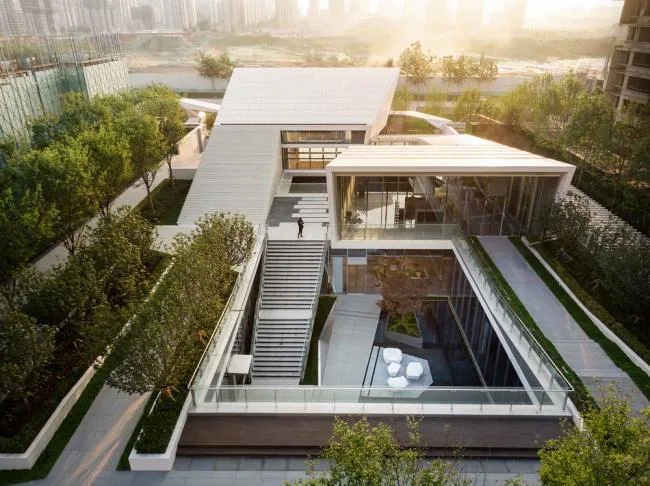
▲ Realistic views of the two courtyards © Architectural Photography
Architecture as Landscape
Humans dwell poetically upon the earth.
In the fiercely competitive real estate market, expectations for project completion have risen, making the integration of architectural and interior landscape design an inevitable evolution.
At the Boyue Fengxitai Living Art Museum, the idea of architecture as landscape permeates the entire design. Courtyard landscapes extend indoors, while the architectural form reaches to the ground, creating corridors that become part of the landscape itself.
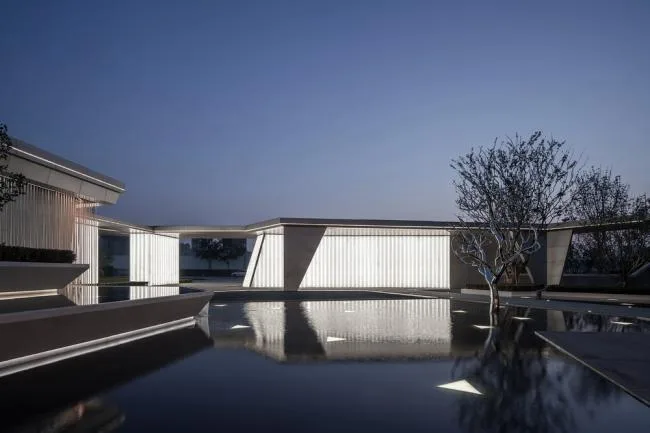
▲ Entrance courtyard © Architectural Photography
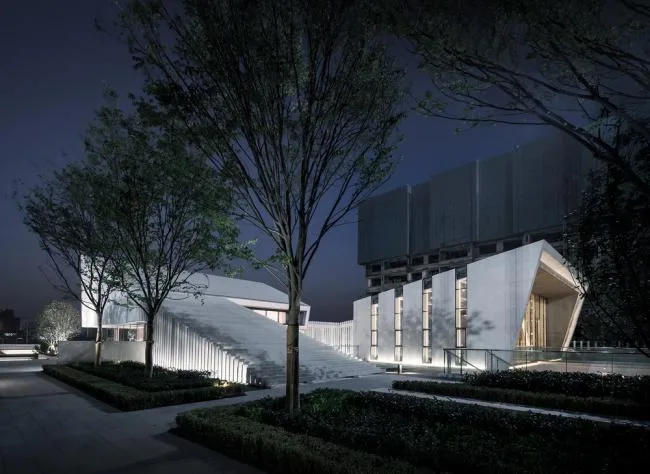
▲ Architectural form extends to ground, forming corridor landscape © Architectural Photography
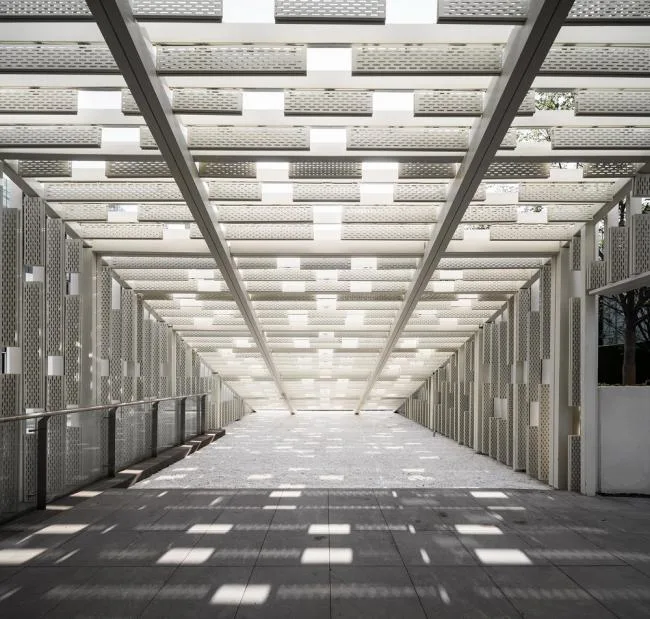
▲ Lighting and shadow play in the corridor © Architectural Photography
The oblique segmentation design language continues indoors and within the landscape. The original square order is subtly deconstructed, weaving and interlocking to create a vibrant new whole.
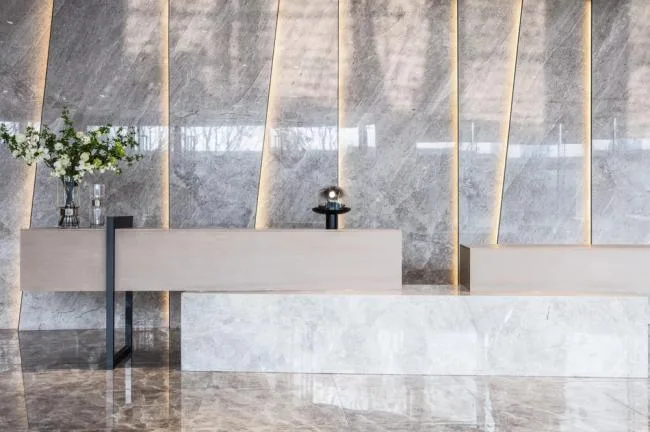
▲ Entrance hall background wall © Architectural Photography
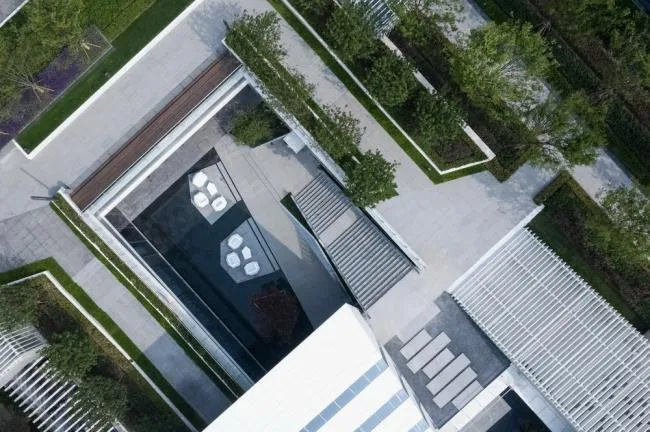
▲ Steps and waterfront platforms in the courtyard © Architectural Photography
Watching and Being Watched
You stand on the bridge, enjoying the view;
Someone upstairs watches you enjoying it.
The gradual layering of architecture and courtyard enriches spatial hierarchy. The towering glass facades seamlessly integrate indoors and outdoors. Walking through the building and courtyards becomes a spectacle in itself.
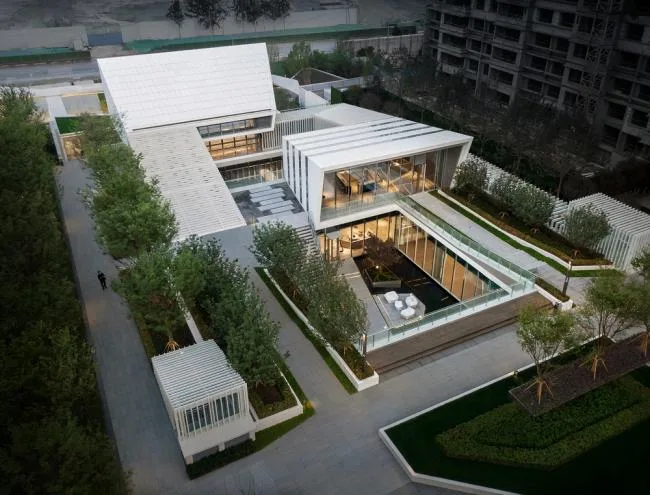
▲ East side aerial view © Architectural Photography
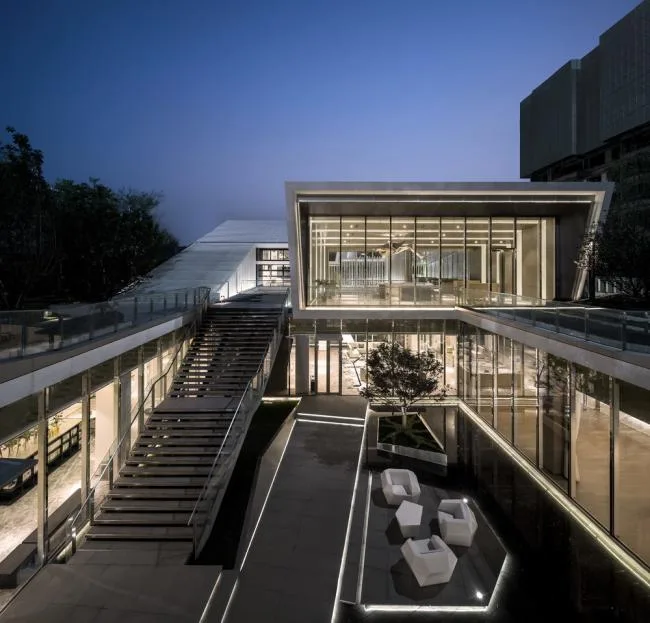
▲ Realistic courtyard scene © Architectural Photography
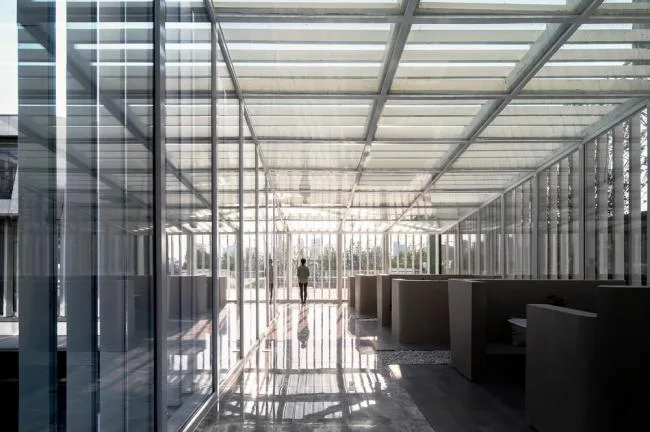
▲ Lighting and shadows in the corridor © Architectural Photography
The clubhouse, delivered to the community, is more than a venue for residents’ activities—it also serves as a scenic courtyard view for high-rise dwellers. Therefore, the building’s fifth facade has been carefully crafted. The division between virtual and real on the roof follows the overall design logic, while the rainwater channel on the sloping roof is designed as a long groove, preventing the risk of sudden snow slides during northern winters.
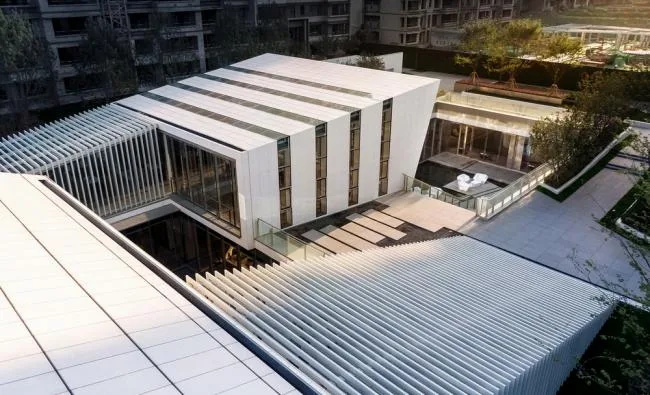
▲ Fifth facade © Architectural Photography
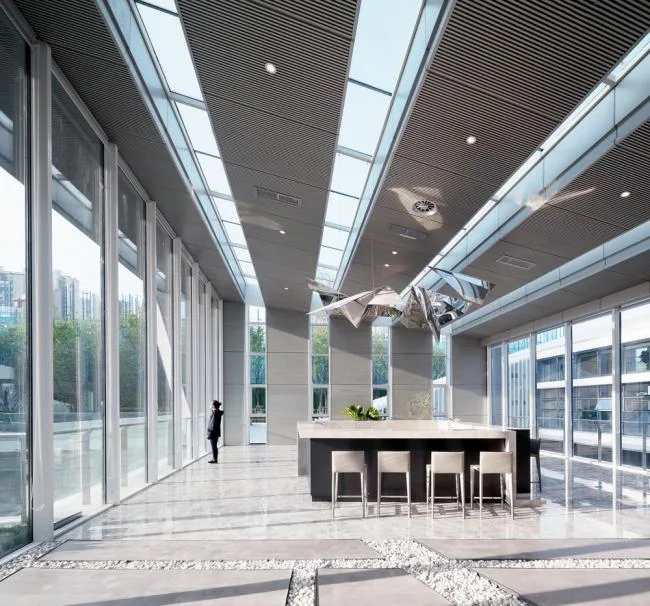
▲ Rhythmic indoor light and shadow © Architectural Photography
Precision in Details
Architecture begins with two bricks carefully joined.
Devoid of elaborate moldings or intricate decorations, the quality of the building hinges on meticulous control of materials and details. To achieve the final effect, designers, various specialists, owners, and construction teams collaborated tirelessly, balancing compromise and persistence.
To realize a modern, lightweight structure and save construction time, steel frames were adopted as the building’s main body. The design phase accounted for prefabricated part processing cycles. Unlike concrete slabs, steel floor slabs cannot be easily lowered. Multiple compromises and adjustments were necessary at the indoor-outdoor floor slab junction to perfect the design.
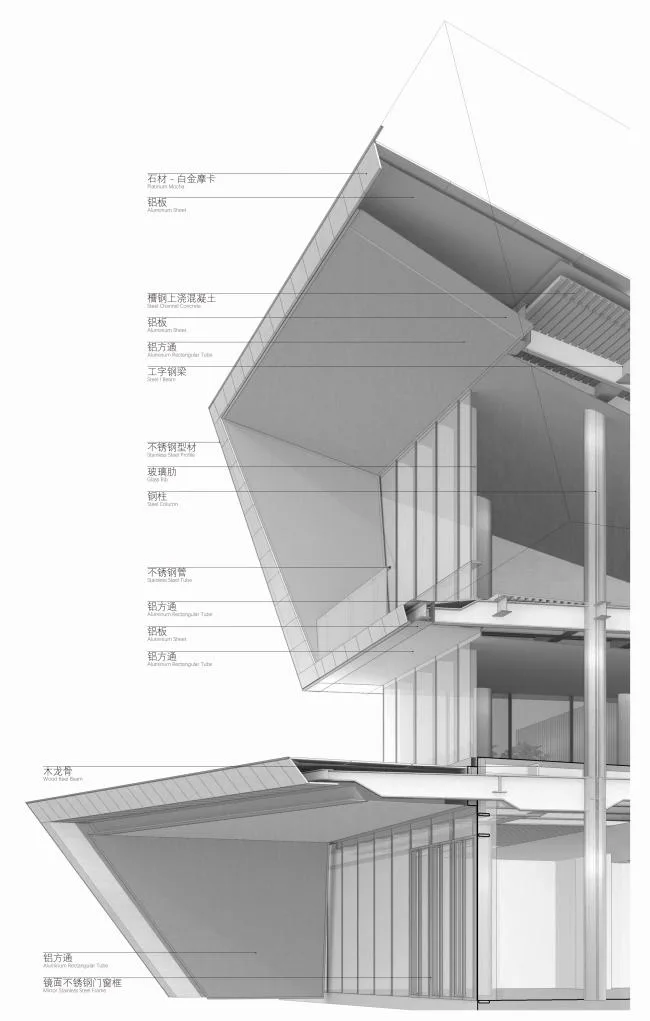
▲ Construction decomposition
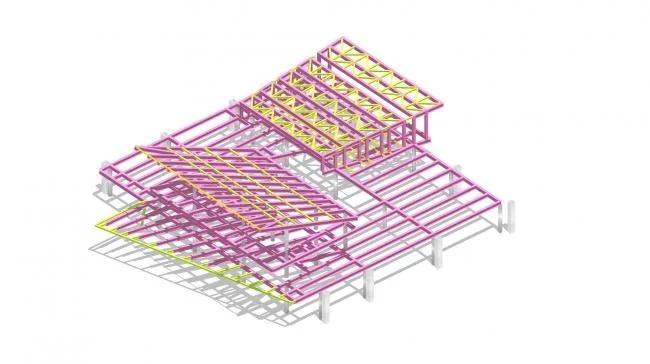
▲ Steel structure model verification
The team underwent a lengthy process to find pure, textured stone for the main facade. Thanks to the construction team for providing continuous sample comparisons, and to the owners for their patience and support. Ultimately, the ideal stone was selected during a site visit to Shuitou, Fujian.
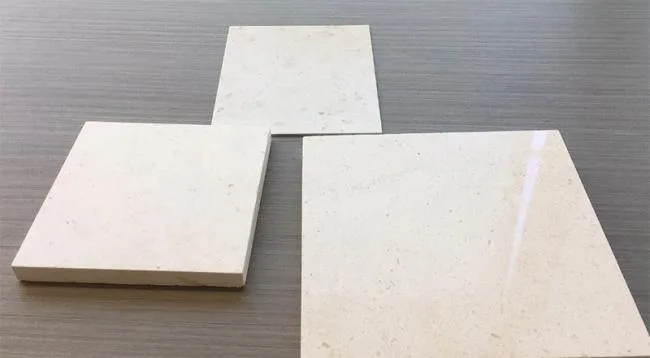
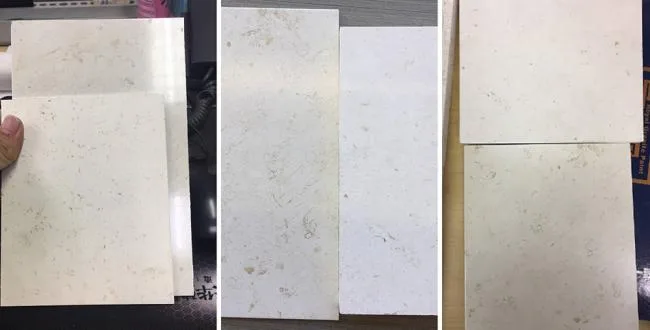
▲ Stone samples were carefully compared and selected
The pure stone was precisely cut, combining wide joints with dense splicing to enrich surface texture while maintaining a strong sense of volume.
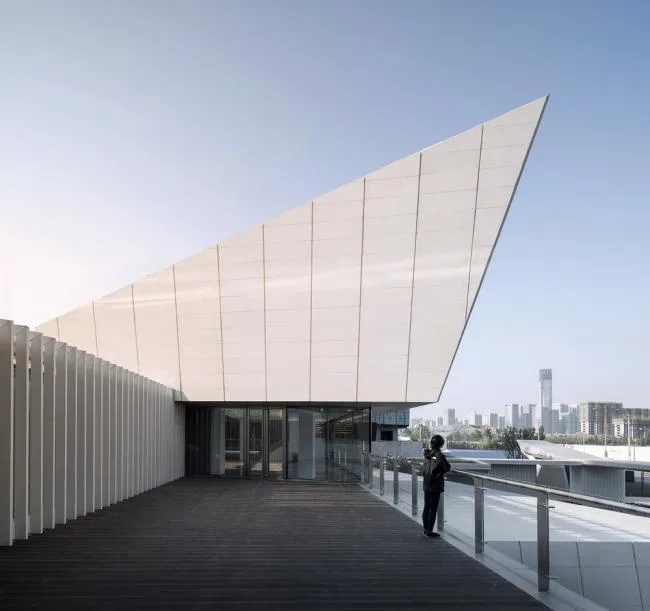
▲ Main wall stone uses a combination of wide joints and dense splicing © Architectural Photography
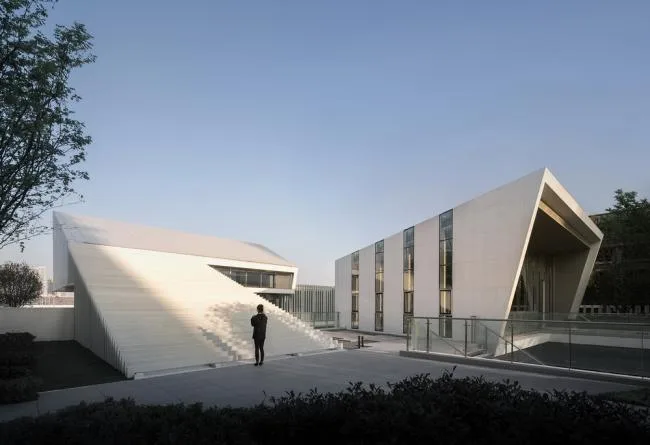
▲ Realistic view of main wall stone © Architectural Photography
The stone volume’s corners are rounded and edged with straight metal strips, enhancing refinement while preventing fragile stone edges.
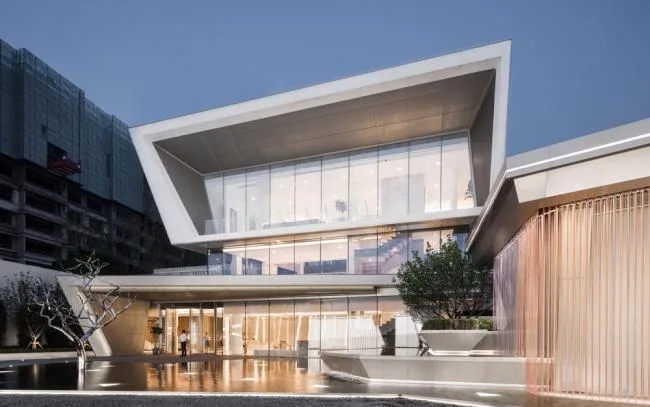
▲ Stone edges detailed with metal © Architectural Photography
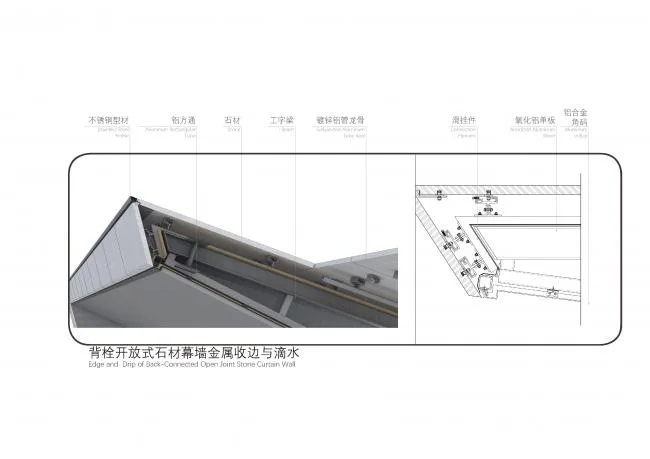
▲ Metal edge structure analysis
The entrance stone canopy is large, supported on only one side, yet maintains a lightweight feel. The design employs segmentation, enlarging the main body to accommodate structural elements while keeping the outer stone edges slender. The interior side features a fine aluminum plate grille, enhancing tactile delicacy at human scale. Throughout this process, the designer and structural engineers engaged in repeated discussions to refine steel beam sizes and outsourcing dimensions, each carefully balanced within practical limits.
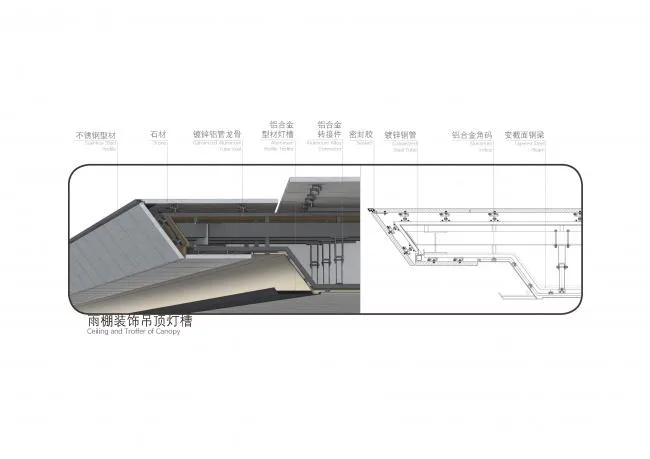
▲ Canopy edge closure structure analysis
To preserve the integrity of the fifth facade, the roof initially featured an open stone curtain wall. However, considering material weight, waterproofing, and cost, the final design adopted a roller-coated imitation stone aluminum panel, achieving a uniform overall effect.
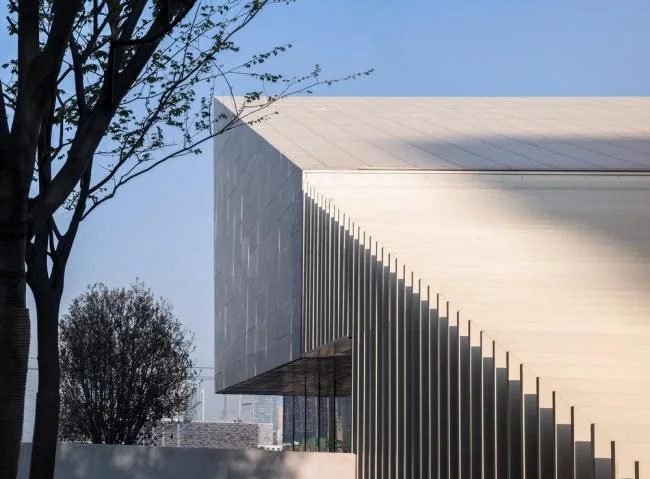
▲ Realistic roof with imitation stone aluminum panels © Architectural Photography
After extensive coordination with landscape and flood control teams, transitions between the building and courtyard water features were carefully orchestrated. The glass curtain wall slightly protrudes toward the water, creating a light, floating posture that maintains distance between the building and water, beautifully outlined by lighting.
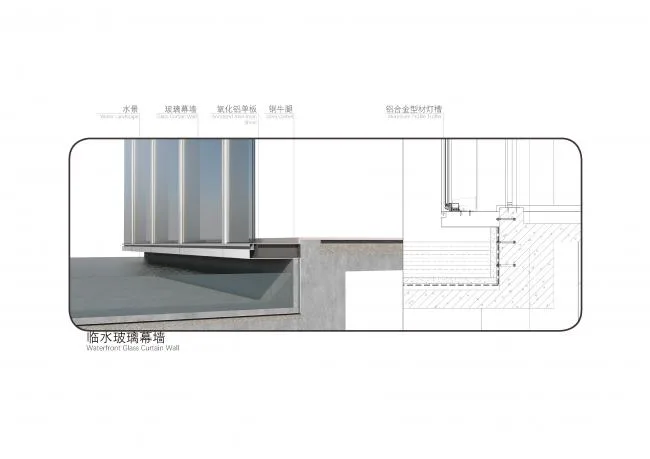
▲ Water surface structure analysis in courtyard landscape
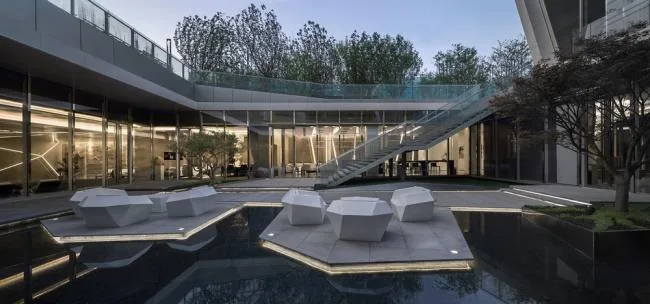
▲ Realistic courtyard water surface scene © Architectural Photography
Saluting Classics with Ingenuity
The story behind a work often surpasses the work itself.
The design of Boyue Fengxi Tai Life Art Museum draws from the heritage and evolution of classics, creatively addressing multiple levels of functionality, experience, and spirit. This was achieved through persistent, long-term teamwork. The commitment to remaining true to the original intent and honoring the classics with ingenuity forms the foundation of this project’s realization. In an era dominated by rapid turnover, this offers a profound insight that transcends the work itself.
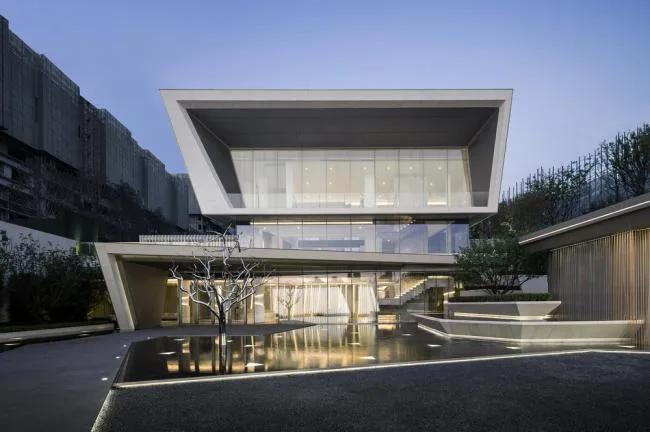
▲ West entrance view © Architectural Photography
Project Information
Project Name: Xuhui Yinshengtai Boyue · Fengxi Platform
Location: Fengshan Road, Xinggang Road, Jinan City, Shandong Province
Owner: Xuhui Yinshengtai
Building Area: 2,658 square meters
Completion Date: May 2019
Design Team: Wu Xin, Wang Yusun, Qi Lichao, Chen Xizhou, Li Changhe, Shao Yuanbo, Zhang Weizheng
Construction Drawings: Tongyuan Design Group Co., Ltd
Steel Structure & BIM: Tongji University Architectural Design and Research Institute (Group) Co., Ltd
Landscape: Didong Planning and Design Co., Ltd
Interior Design: Shenzhen Dejian Design Consulting Co., Ltd
Curtain Wall Consultant: Shanghai Anlei Curtain Wall Engineering Co., Ltd
Curtain Wall Construction: Shanghai Meite Curtain Wall Co., Ltd
Architectural Photography: A Literal Translation of Architectural Photography













Must log in before commenting!
Sign Up