
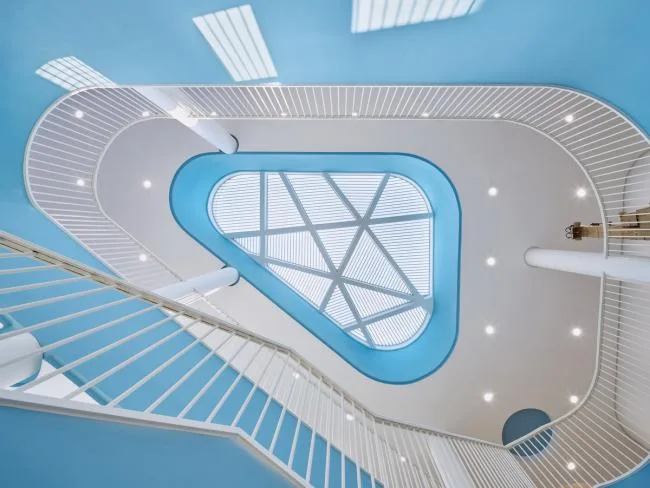
▲ Courtyard of Shengli Primary School Affiliated Kindergarten
Located amidst the high-density residential towers of Qianjiang New City, the site for Hangzhou Shengli Primary School Affiliated Kindergarten is under 3,900 square meters. Despite its limited size, the design accommodates nine classrooms with diverse functions. Facing strict spatial constraints, the architects employed several strategic design approaches to fulfill functional needs while creating vibrant, sunlit spaces that foster children’s vitality.
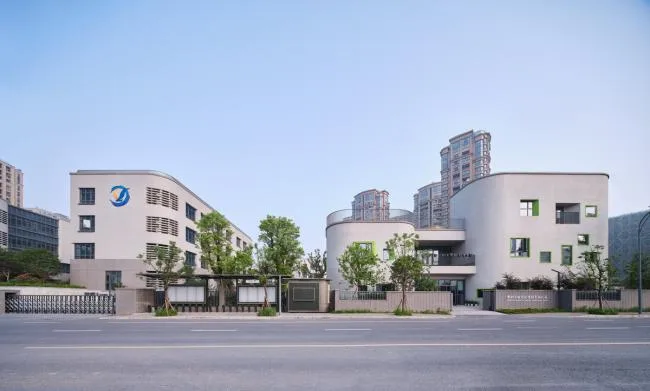
The alignment between the main entrance of the affiliated kindergarten and Shengli Elementary School’s physical design
Designing Within Constraints
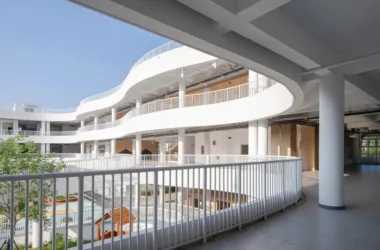
Outdoor areas and nature play a crucial role in the healthy development of young children. To maximize outdoor activity space and minimize shading from the nearby high-rise residential buildings and the southern-facing elementary school, building volumes were concentrated along the site’s eastern, northern, and western boundaries. This arrangement encloses quiet, spacious outdoor areas.
The teaching units, serving as high-usage activity zones, are organized as north-south oriented blocks inserted into the building mass to capture ample sunlight.
To balance functional area requirements with plot ratio limits, the design incorporates underground spaces and rooftop terraces. Multifunctional activity rooms and support facilities like kitchens are located in the basement, which is naturally ventilated and lit through skylights, high side windows, and sunken courtyards. Rooftop terraces on the first and second floors provide additional safe outdoor activity spaces for children.
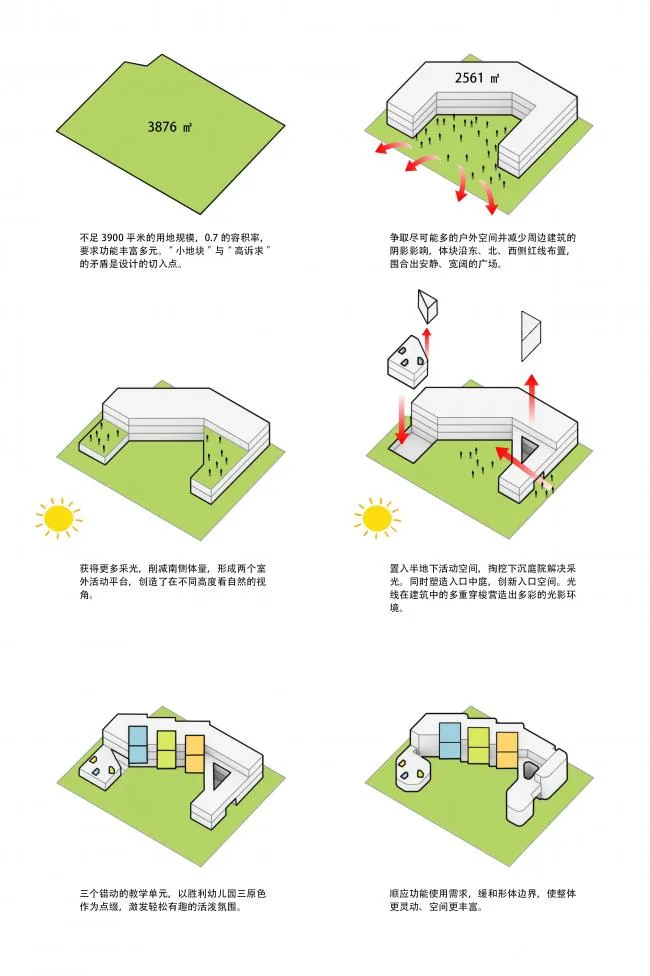
▲ Conceptual generation of the building form
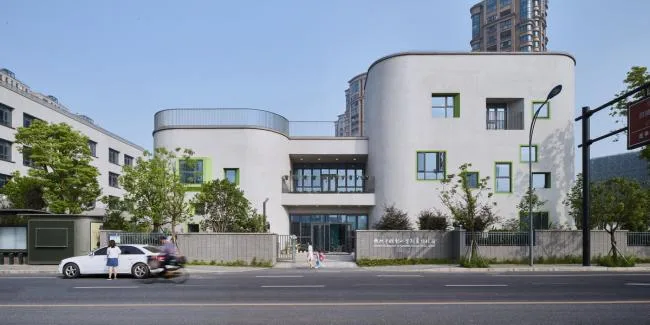
▲ Main entrance façade closely aligned with the site boundary
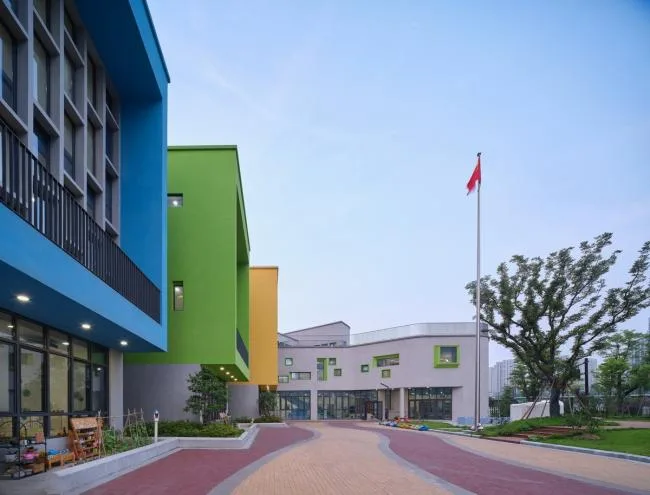
▲ Tranquil inner courtyard
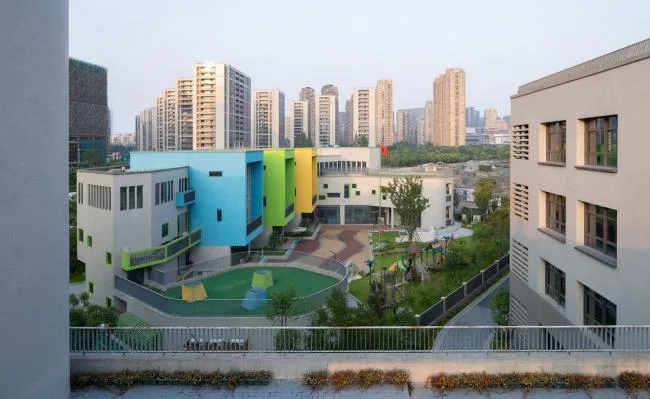
▲ Outdoor activity space and rooftop terrace area
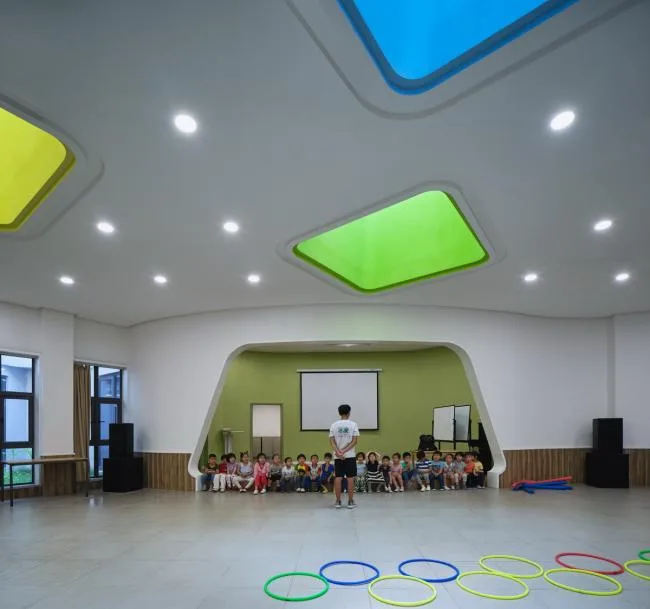
▲ Underground multifunctional activity room with sunken courtyard
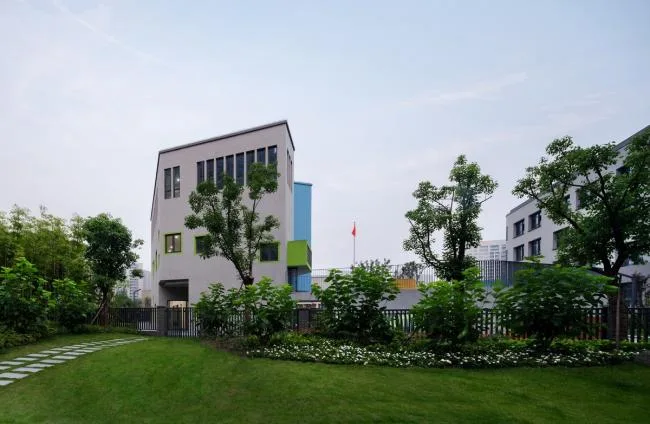
To alleviate pressure on the kindergarten from the western elementary school and to enhance courtyard lighting and ventilation, the multifunctional activity room on the western end is situated underground.
Light and Shadow Design
The architects aimed to craft spaces that spark children’s imagination by thoughtfully designing light and shadow interplay.
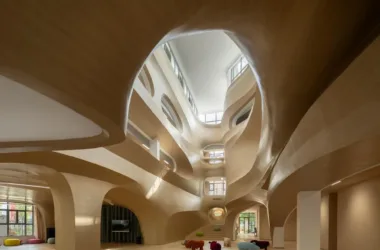
The atrium at the main entrance (BIM-designed) is filled with natural light. Sunlight streams through a rounded triangular skylight, casting dynamic shadows via the straight staircase’s railings. In the afternoon, light enters diagonally through a point window on the west side. This allows children to freely play and explore the changing shadows while moving up and down the stairs—aligning with the educational philosophy to stimulate vitality and encourage independent growth.
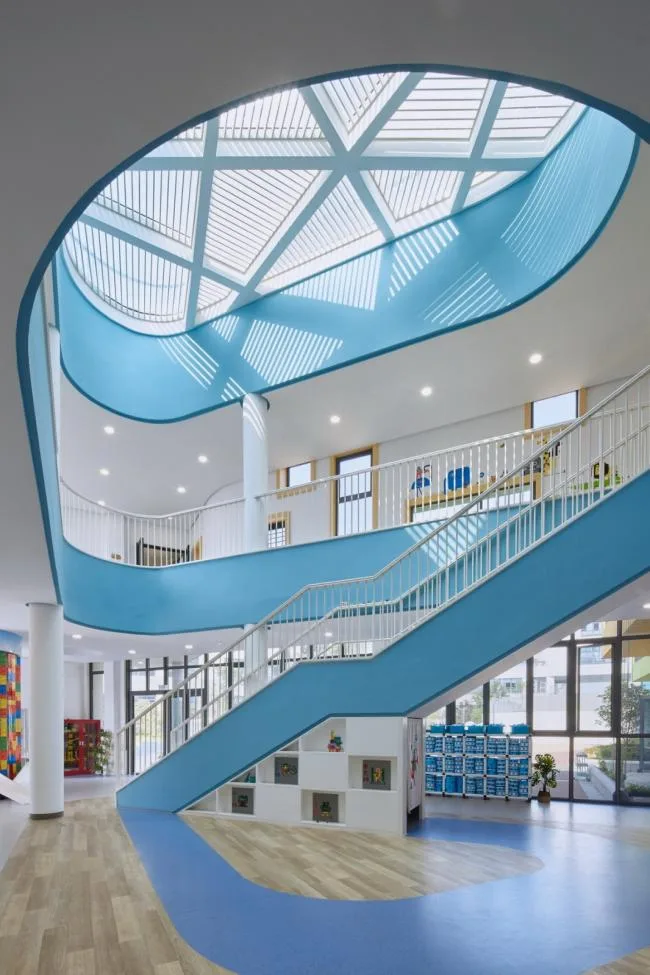
▲ The blue ribbon design extends throughout the atrium
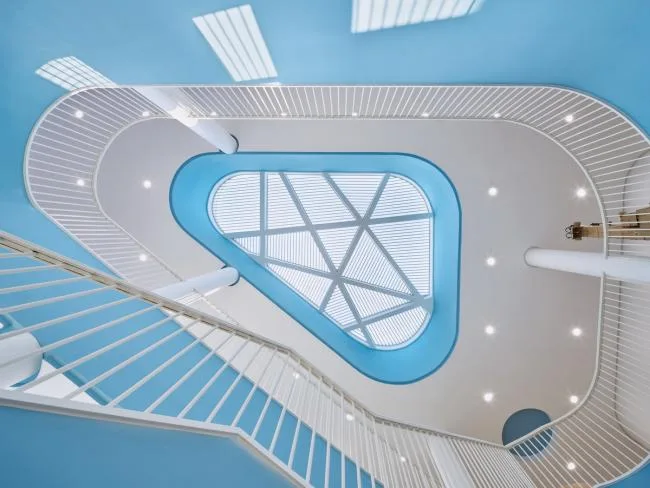
▲ Courtyard skylight
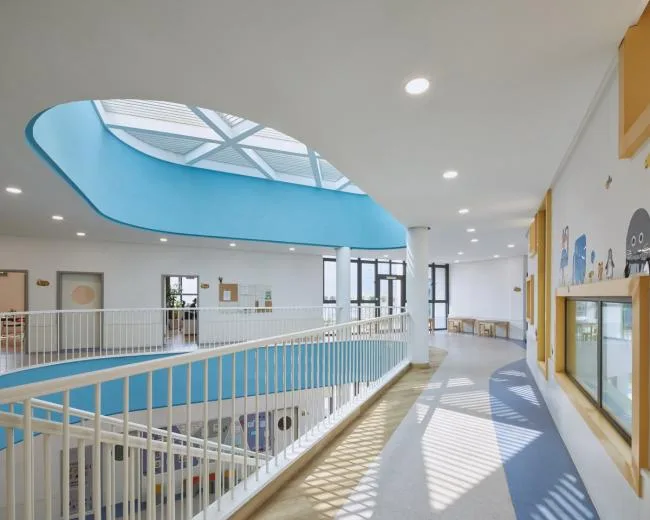
▲ Corridors and spaces bathed in sunlight
Inside the teaching units, light filters through French window frames, creating a pattern of staggered rectangles that inspires children’s creativity. In the semi-basement activity space, three irregular, colorful skylights invite children to look upward, sparking curiosity and exploration of this enchanting light display.
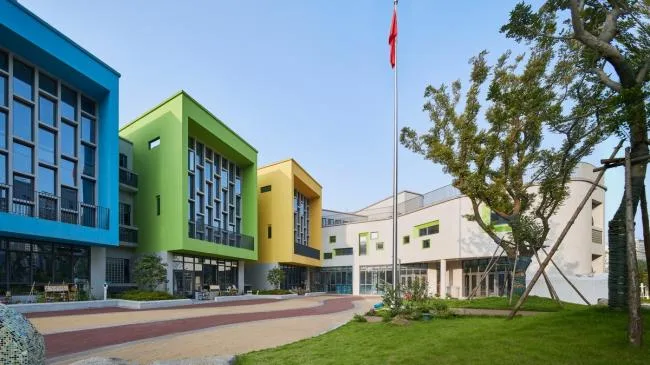
▲ Teaching Unit facade design
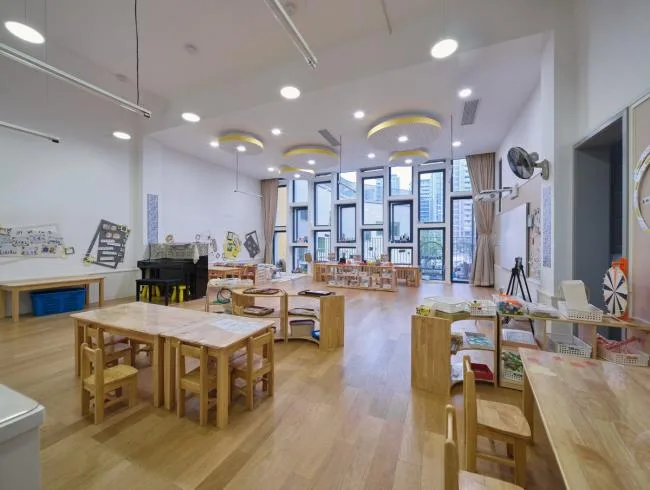
▲ Teaching Unit interior
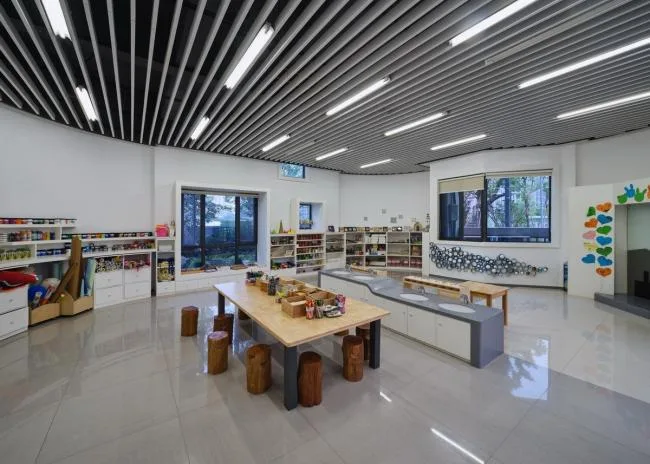
▲ Art and Creative Studio
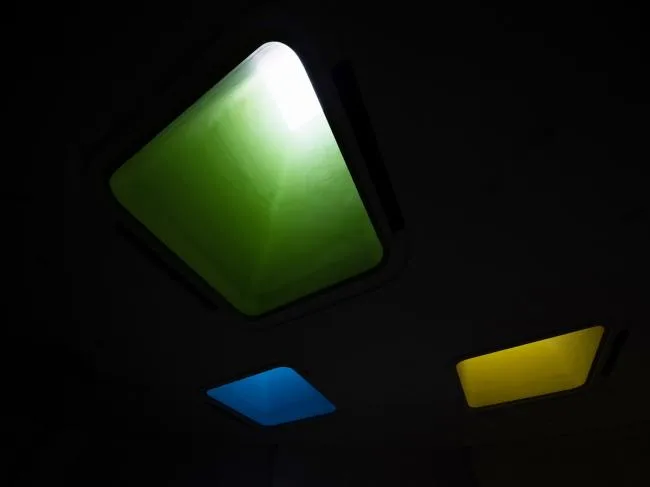
▲ Enchanting colored skylight
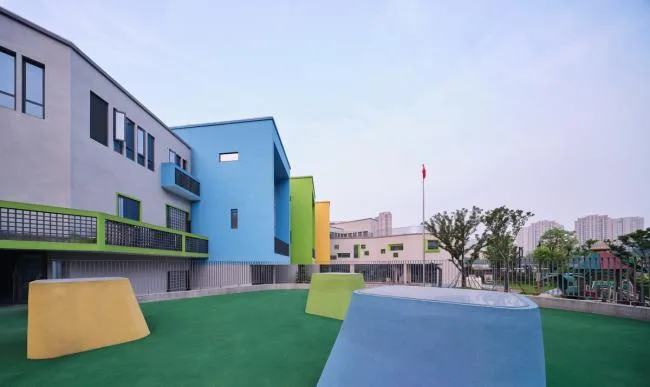
▲ Distinctive skylight shape in the multifunctional activity room
The exterior features staggered, varied-sized concave and convex windows that express playful creativity. These windows differ in height inside the classrooms, offering children versatile uses such as sitting, leaning, or gazing outward—enhancing their unique experience of observing the outside world.
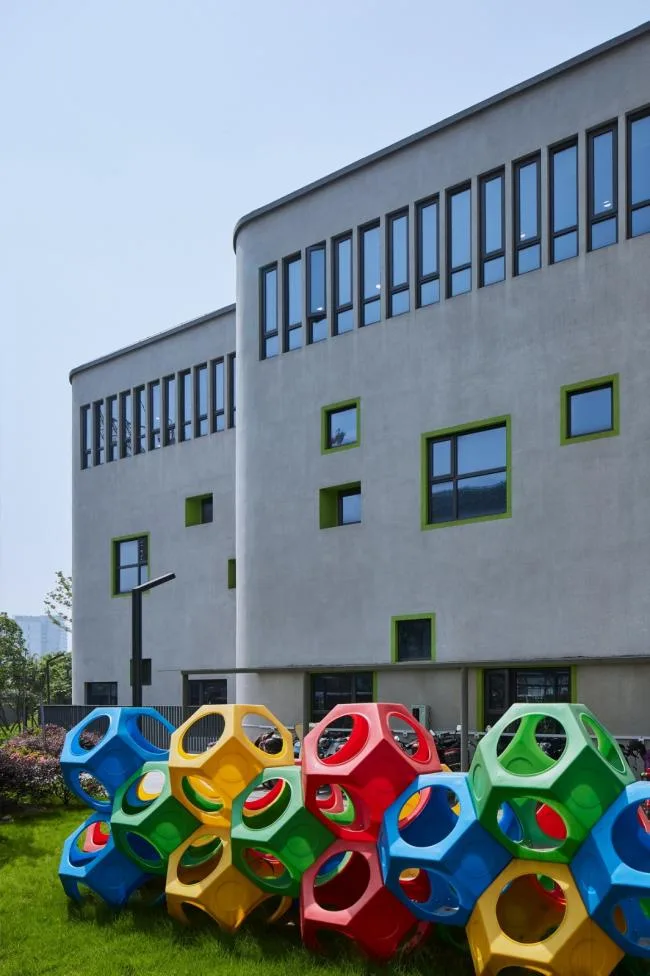
▲ Exterior façade with point windows at staggered heights
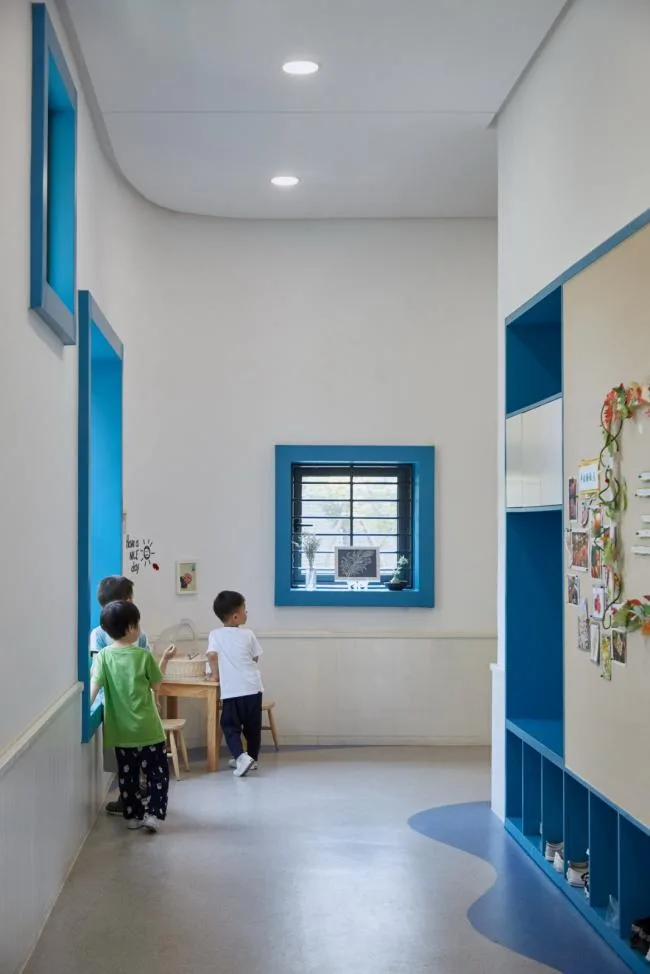
▲ Interior observation windows with staggered heights
Primary Colors as Accents
The architect adopted a restrained color palette, drawing from the three primary colors—vine yellow, sky blue, and grass green—found in the original Victory Elementary School logo. These colors are used as design elements with contrasting techniques to evoke a lively and relaxed atmosphere.
Against a predominantly light gray exterior, the teaching blocks stand out as floating volumes highlighted by bright primary colors, helping children easily identify their classrooms. Inside, milky white walls and wooden flooring create a warm and inviting environment.
To accommodate different lighting needs and room heights for activity and nap areas, loft designs are incorporated within the 4.5-meter-high teaching units. This approach improves space efficiency and offers children a cozy, flowing attic experience.
The interior maintains a bright milky white base color, with color used strategically to connect or distinguish indoor and outdoor spaces. For example, blue ribbons unify the atrium’s ground, stairs, corridors, and skylights, enhancing spatial coherence. Additionally, corridor window frames on each floor of the teaching units are painted in different primary colors, helping children orient themselves by floor.
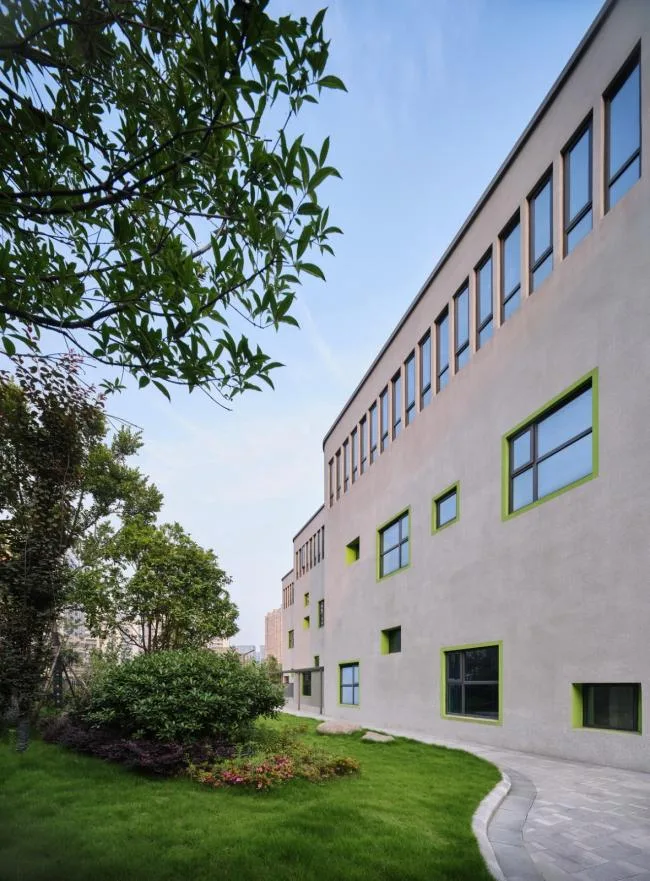
▲ Colorful concave and convex point windows on the exterior façade
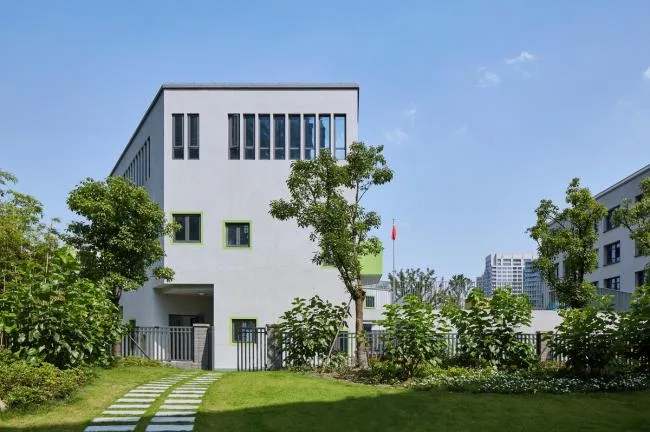
▲ Light gray tone dominating the exterior façade
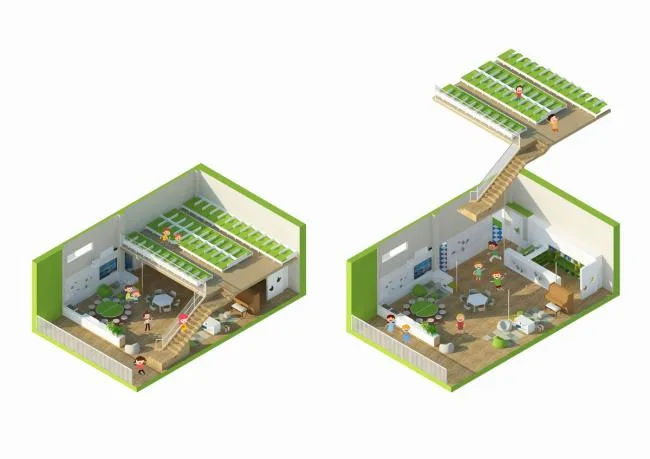
▲ Loft teaching unit separating activity and nap areas
Collaborative and Iterative Process
From project inception to its completion and opening a year ago, continuous dialogue between the architect and all stakeholders was essential to shaping and refining the space.
The architect designed a highlighted atrium with a flowing staircase to enhance children’s spatial awareness and experience. Early design stages involved active communication to understand and honor this core space of the kindergarten.
Constructive feedback from the client was welcomed, leading to the creation of versatile blank spaces where teachers and students could freely express themselves and arrange the environment independently. This mutual respect for users and a deep understanding of the architect’s vision allowed the design to evolve thoughtfully.
Throughout teaching units, activity rooms, courtyards, corridors, and outdoor areas, BIM technology was seamlessly integrated into rich educational, play, and social interaction environments—ensuring children fully enjoy experiential learning in diverse spaces.
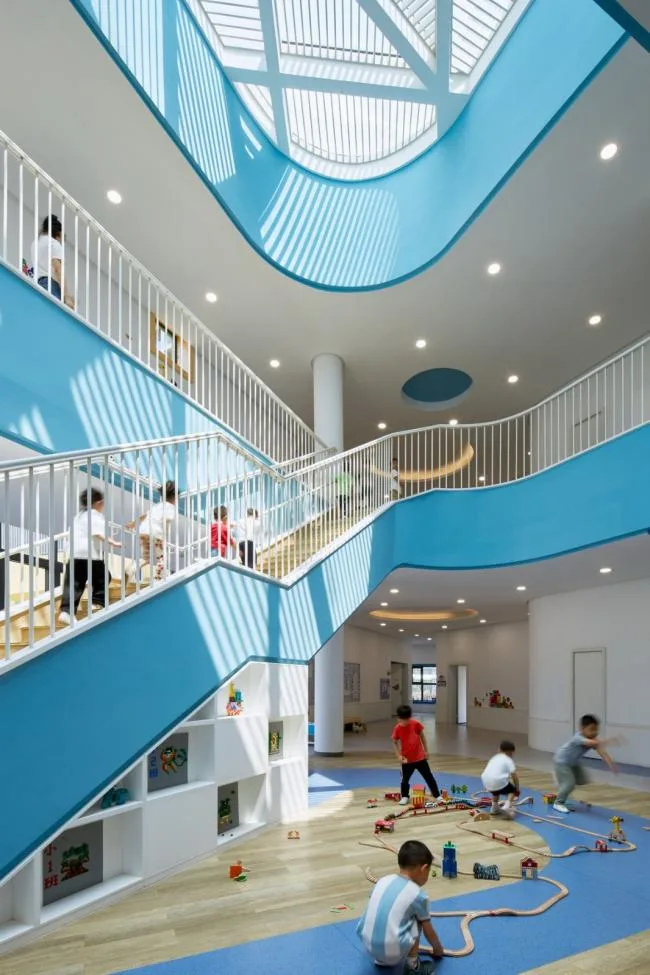
▲ Children experiencing and exploring the courtyard
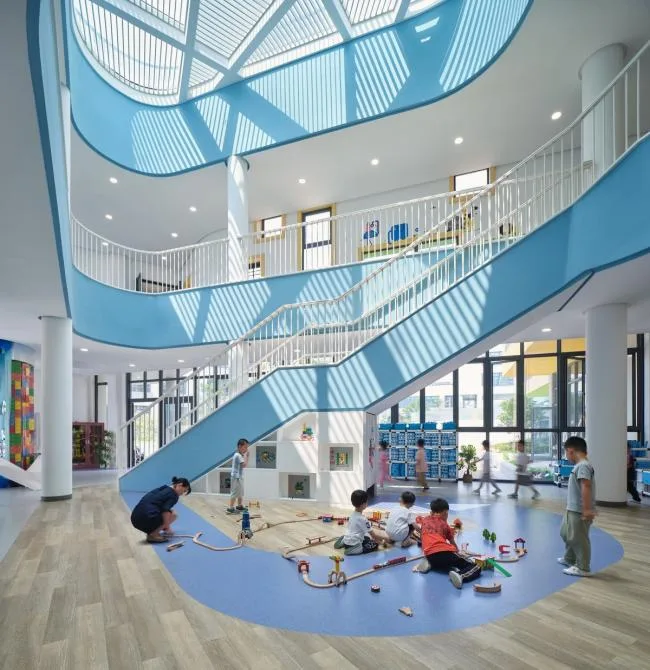
▲ Interaction and arrangement among teachers, students, and other users of the space
Design Drawings
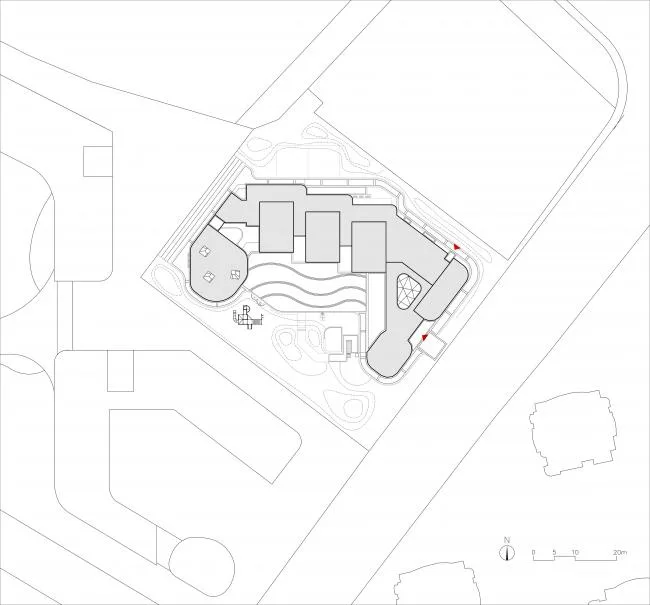
▲ General layout
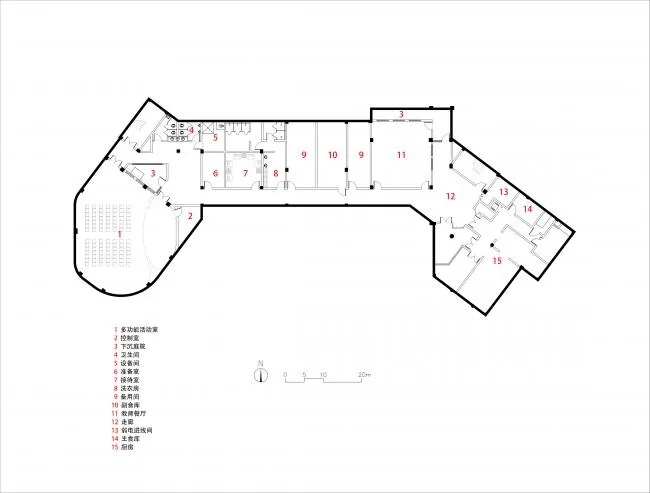
▲ Basement floor plan
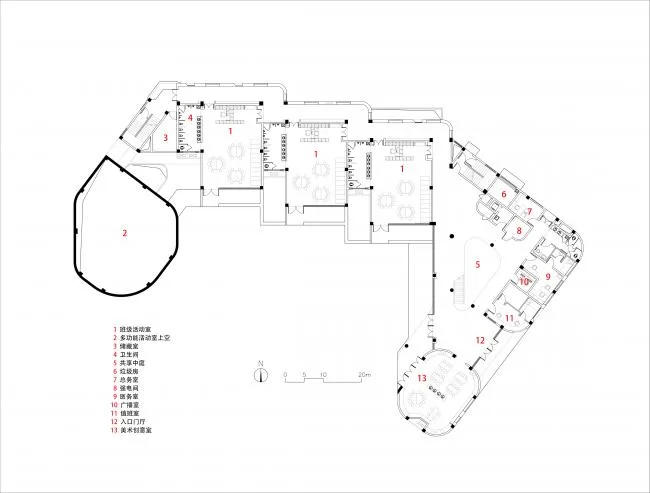
▲ First floor plan
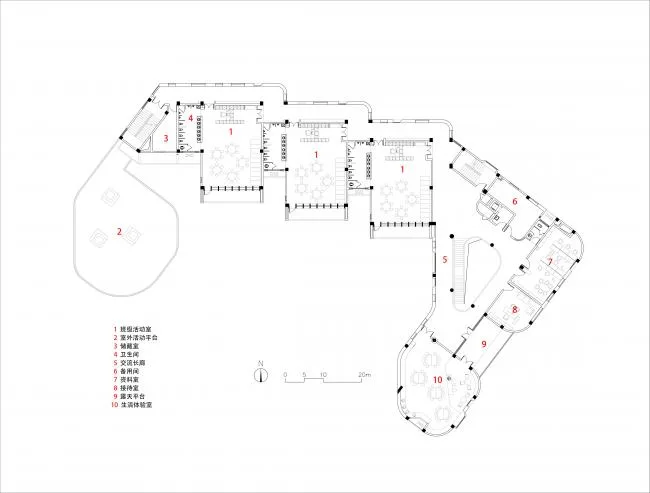
▲ Second floor plan
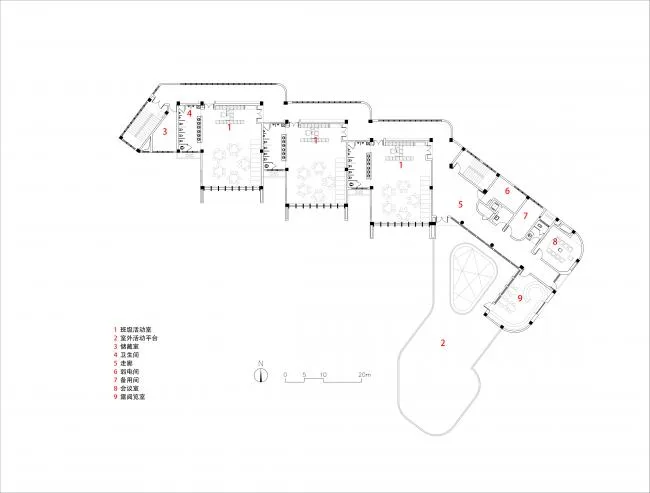
▲ Third floor plan
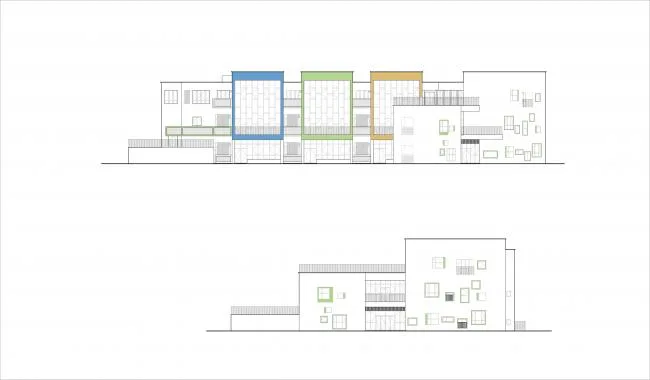
▲ South elevation and main entrance elevation
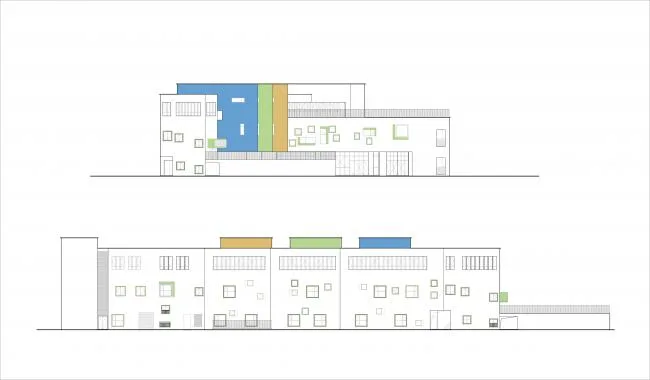
▲ North and west elevations
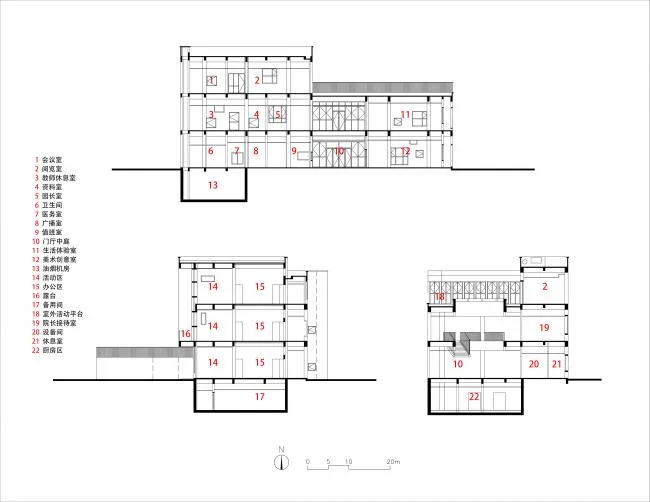
▲ Sectional view
Project Information
Project Name: Hangzhou Shengli Primary School Affiliated Kindergarten
Architectural Design Unit: Zhejiang University Architectural Design and Research Institute Co., Ltd
Design Period: October 2014 to November 2015
Completion: August 2016 – July 2018
Ground Floor Area: 2,561 square meters
Total Construction Area: 3,485 square meters
Lead Architect: Fan Xuzhuang
Architectural Team: Wang Su, Zhang Yuansheng, Xu Danhua
Structural Team: Jin Zhenxin, Li Shaohua, Chen Shengxian
Equipment Design Team: Fang Huoming, Lin Lujia, Zheng Guoxing, Huang Qinpeng, Ren Xiaodong, Li Xiangqun, Ye Agile, Zhou Yanxin
Interior Design Team: Li Jingyuan, Zhu Lifeng, Tian Ning, Zhu Xiaoyan, Ren Zhiyong
Landscape Design Team: Yao Haojun, Li Jiangfu, Zhou Wenqiang, Li Wenjiang
Curtain Wall Design Team: Jiang Qi
Photography Copyright: Zhang Yong
Client: Qianjiang New City Construction Command Center, Hangzhou












Must log in before commenting!
Sign Up