
Abstract: This article presents a comprehensive overview of the application of BIM technology in managing prefabricated steel structure engineering projects, based on real-world case studies. It highlights the benefits and value of integrating BIM technology with the EPC general contracting management approach across various stages such as component design, factory production, and on-site construction.
Keywords: BIM technology; Information modeling; Prefabricated components; Prefabrication
1. Project Overview:
This project involves a three-story prefabricated steel structure kindergarten, covering a total construction area of 5,354 m², with a building height of 12.2 meters and designed for a seismic intensity of 7. The main structure is a steel frame system, while the floor slabs include inverted T-shaped prestressed concrete composite panels, reinforced concrete composite panels, and cast-in-place slabs. The exterior walls are assembled using prefabricated panels connected to the steel framework, achieving an impressive 93% assembly rate. As a finely decorated project facing challenges such as tight schedules, complex node types, and technical coordination across multiple disciplines, the adoption of BIM technology has significantly enhanced work efficiency and simplified on-site management.
The Application of BIM in Project Management
2.1 Design Phase
2.1.1 Facade Design Analysis
The project’s exterior walls feature external cladding, while interior partitions utilize ALC strip boards, both employing non-plaster construction techniques. The northwest corner is adorned with a light steel keel and aluminum buckle panels. Using a BIM 3D model, the building’s design can be visualized intuitively in three dimensions, showcasing everything from structural dimensions and material types to color schemes and lighting effects. This provides valuable insights into the structural design’s feasibility, decorative aesthetics, and layout functionality. (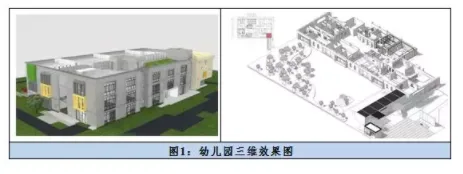 )
)
2.1.2 Clash Detection
BIM technology is leveraged to accurately model each component, allowing for comprehensive clash detection. Numerous conflicts were identified, including clashes between pipeline routes and structural elements, as well as between various pipelines. BIM engineers categorized these issues and communicated them to relevant design professionals. The design team then developed targeted solutions, optimizing building layout, structural design, pipeline routing, reserved openings, and construction sequencing. This early-stage coordination minimizes design changes, reduces rework, and prevents idle labor. (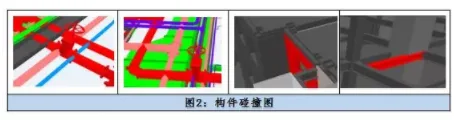 )
)
2.1.3 Node Sample Inspection
The project includes a wide variety of prefabricated components such as steel beams, columns, exterior cladding panels, and composite panels, featuring complex node structures that require advanced construction techniques. Relying solely on 2D drawings proved challenging for on-site management. To address this, BIM QR code technology was implemented, with unique QR codes attached to each component. On-site personnel can scan these codes to access detailed information, including dimensions, weight, location, material properties, and installation instructions, directly from the BIM model. This approach streamlines information flow, enhances construction efficiency, enables precise management, and visualizes building technology. (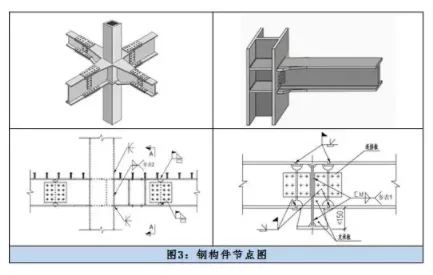 )
)
2.2 Factory Production and Processing Stage
2.2.1 Detailed Design
Early in the project, a drawing review meeting for prefabricated components was held, where specialists provided detailed feedback on design issues. The factory applied BIM technology to rationally segment and optimize component modules, enabling precise factory production. This approach improves the accuracy of prefabricated components, speeds up installation on site, enhances installation quality, and ensures proper component formation and node connections.
2.2.2 QR Code Encoding
BIM engineers generate unique QR codes for each prefabricated component. These codes are printed and affixed to components before factory dispatch. Upon shipment, management personnel scan these codes with mobile devices to verify component quality. The data is uploaded to a cloud platform, allowing real-time tracking of component delivery, transportation, installation, and acceptance via the cloud-based information system. (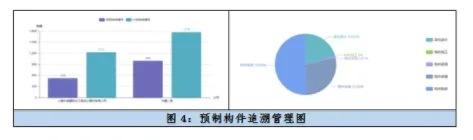 )
)
2.2.3 Component Production
The project involves numerous and varied prefabricated components, including steel bar cutting for PC components, installation of embedded parts in composite and exterior panels, hole reservation, and bolt hole setting for steel structures. BIM technology supports production workers by providing clear, comprehensive, and multi-angle views of component information. This clarity improves factory processing efficiency and facilitates component production management. (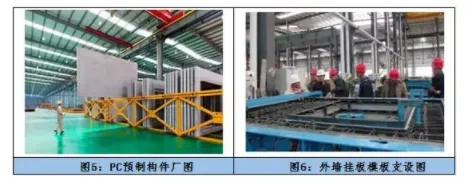 )
)
2.3 Construction Phase
2.3.1 Construction Site Layout
Effective division and layout of functional areas on the construction site are essential for smooth project execution. A well-planned site layout enhances construction efficiency and reduces costs. BIM technology’s 3D visualization capabilities provide valuable support in planning site roads, material yards, processing areas, and equipment placement, all while complying with construction standards. By creating a 1:1 scale BIM model of the site layout, project managers gain a clear understanding of the spatial relationships among personnel, machinery, materials, and the environment. This facilitates rapid adjustments to optimize site organization and achieve a logical, efficient layout.
2.3.2 Component Entry Verification and Hoisting
During construction, a large volume of components arrives on site daily, making acceptance and management complex. Upon arrival, management staff scan the component QR codes to access detailed product information and quickly verify compliance with design and factory processing standards. Components that do not meet the requirements or sustain damage during transport can be promptly reported for replacement. During hoisting, workers can scan the QR codes to retrieve critical data such as weight, dimensions, installation location, and assembly sequence. This integration with BIM-based on-site management ensures efficient, orderly construction and aids progress control. (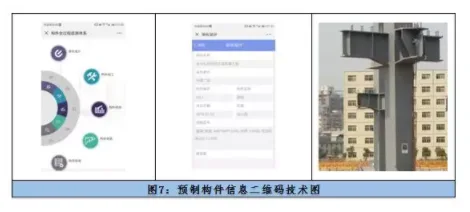 )
)
2.3.3 Quality Management
Ensuring the high quality of construction techniques is critical to overall building quality. To guarantee proper construction arrangements, planning, and the correct application of new technologies such as prefabricated component installation and non-plaster exterior facades, dynamic simulation is performed using BIM software. The 3D visualization of key details—such as connections between exterior wall panels and floor slabs, binding of connecting bars in prefabricated composite panels, and gap filling methods—ensures accurate transmission of construction technology information. This reduces misunderstandings by workers unfamiliar with new methods, prevents deviations from technical requirements, and maintains construction quality throughout the project.
3. Conclusion: Combining BIM technology with the EPC general contracting management model has significantly enhanced project control across design, procurement, and construction phases. It has helped identify design conflicts among different disciplines, facilitated factory production management, optimized on-site construction layouts, and promoted coordination among various specialties and workflows, enabling meticulous management throughout the entire prefabricated building construction process.
4. References:
He Guanpei. BIM Overview. Beijing: China Architecture & Building Press, 2011.
Analysis Report on BIM Application in China’s Construction Industry (2017). Beijing: China Architecture & Building Press, 2017.
Shi Guangxi. The Application of BIM Management Concepts in Construction Project Management. Engineering Technology Research, 2017, (12): 148-149.
Yellow Strong. On BIM. Beijing: China Architecture & Building Press, 2016.
Author: Liao Xiaoming, Chen Gong, Li Yajun















Must log in before commenting!
Sign Up