
The Sichuan Anren OCT “Water West East” Linpan Cultural Exchange Center is situated at the heart of the Linpan area in Anren Town, Dayi County, Chengdu City, Sichuan Province. Nestled beside the Alnus River to the west, it is surrounded by vast fields and bamboo forests. This project aims to harmonize the original forest landscape while preserving the materials and spatial elements characteristic of traditional western Sichuan architecture. Guided by innovative performance-based building structures and cutting-edge digital construction methods, it explores the coexistence of architectural culture and modern construction techniques. The design seamlessly merges local heritage with new technologies, embodying the spirit of the region while embracing future architectural concepts.
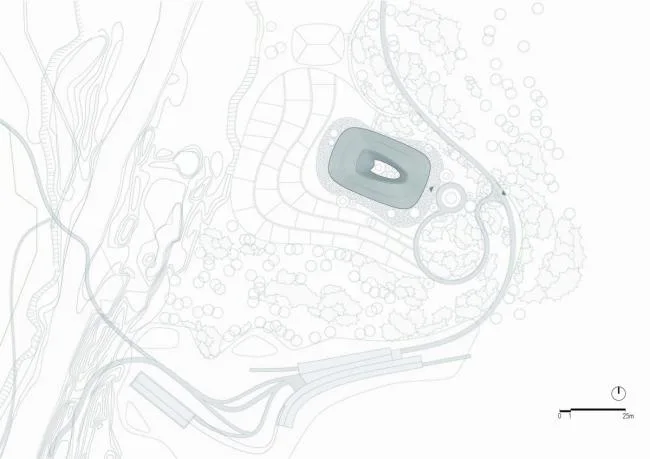
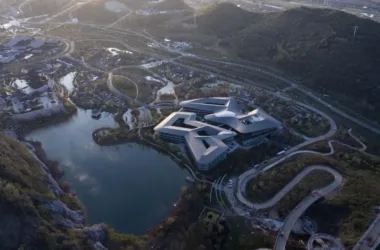
▼ Overall project layout
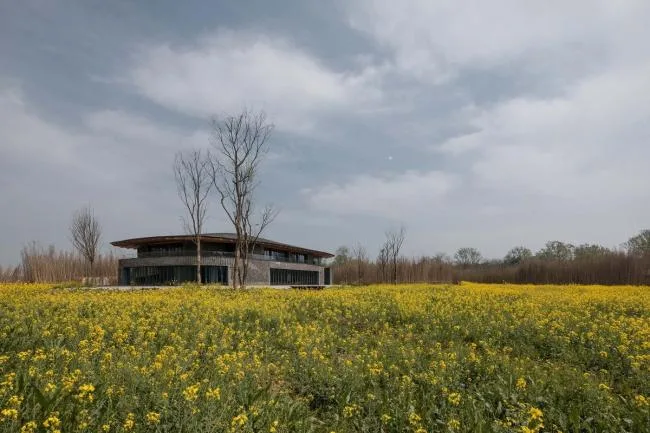
▼ Rapeseed fields surrounding the project
Composite Forest Landscape
The western Sichuan Plain boasts a rich history and a distinctive forest landscape. Linpan represents a composite landscape model that integrates production, lifestyle, and natural scenery. Over time, its way of life and architectural forms have evolved into cultural symbols, deeply embedded in the folk traditions of western Sichuan. Amidst bamboo groves and wooden rivers, the freedom and natural wildness of rural life emerge effortlessly.
The overall spatial planning and design draw inspiration from a regulated seven-character poem by Song Dynasty poet Huang Jian titled “Passing Anren.” It describes a misty morning by the Panxi River, where the wind and rain envelop the surroundings, moistening clothes with wild hues and nurturing the spring soil. The vastness, meaning, form, and environment evoked in the poem are seamlessly integrated into the project’s concept, serving as a spiritual foundation to connect with the place.
▼ Misty wilderness atmosphere
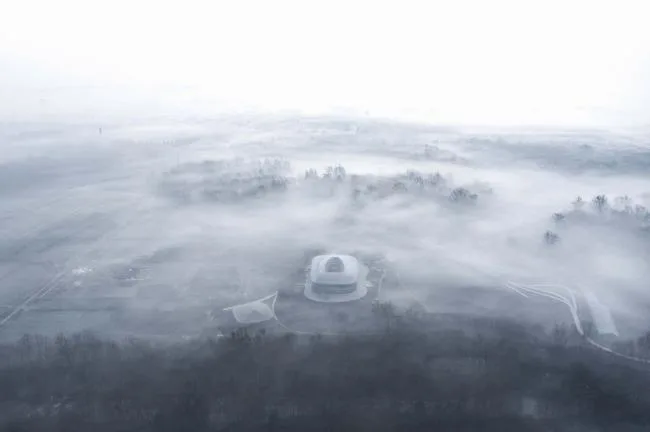
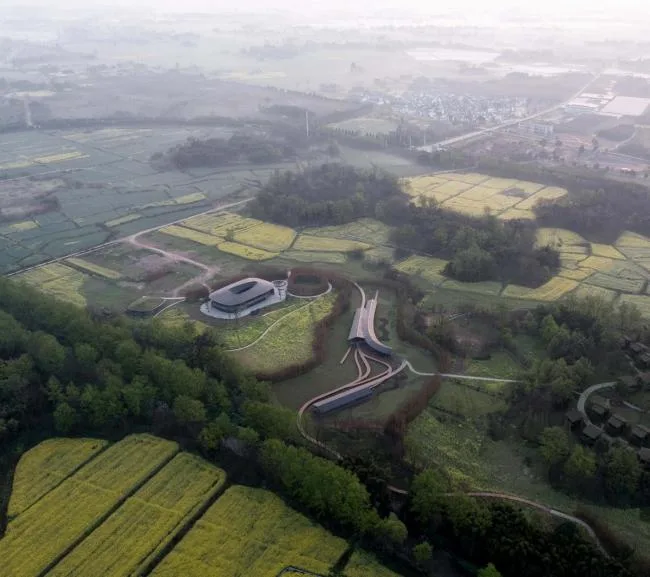
As a pioneering demonstration center for future redevelopment of the forest area, the project seeks to foster coexistence between new buildings and forest landscapes. The Alnus River and its surrounding vegetation are fully preserved, while expansive vegetable fields envelop the structures, maintaining the living experience of agricultural and forest land. Rather than selecting a conspicuous roadside location, the design team chose to create a path that invites natural perception. Through layered forest panels, it achieves a multi-layered and immersive spatial atmosphere.
▼ Aerial view showing the project surrounded by cultivated vegetation
Future Spatial Experience
The spatial layout consists of three main building groups: the corridor, the main building, and the agricultural service auxiliary building.
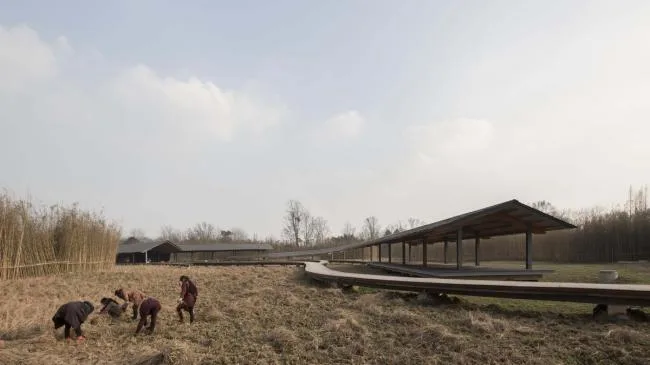
The long corridor serves as a pedestrian entrance, integrating the building’s sloping roof design with rural infrastructure. Future plans include incorporating tea pavilions, souvenir shops, and running stations beneath the corridor, redefining the public nature of the forest living space. Elevated and floating above the landscape, the corridor transforms natural ecology crossings into architectural space. This concept draws on traditional village and town typologies while introducing future spatial experiences through digital design.
▼ A long corridor serving as a public communication space
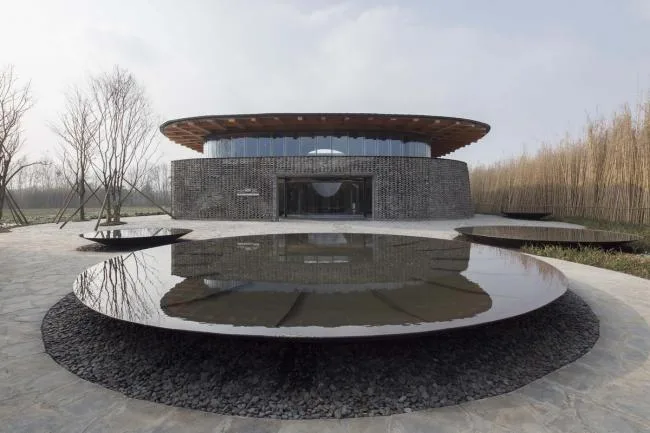
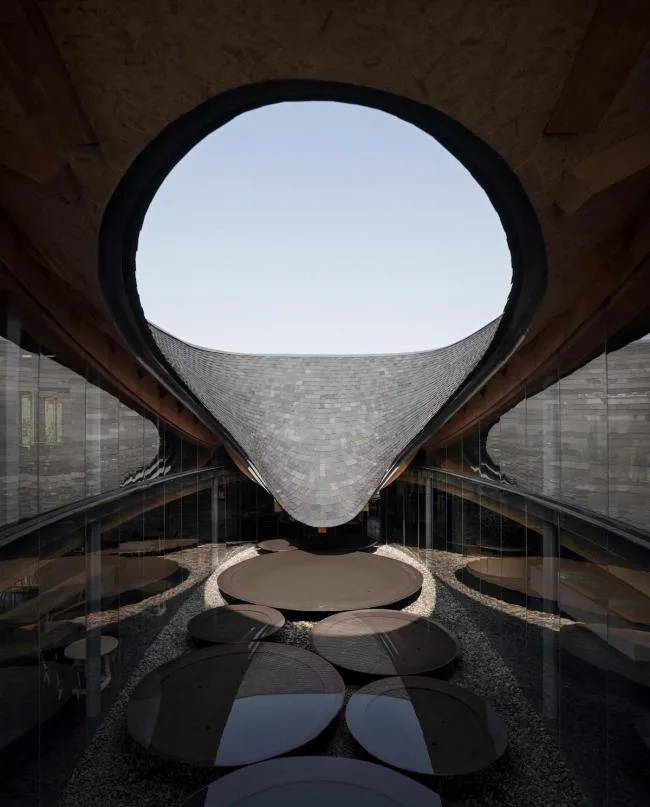
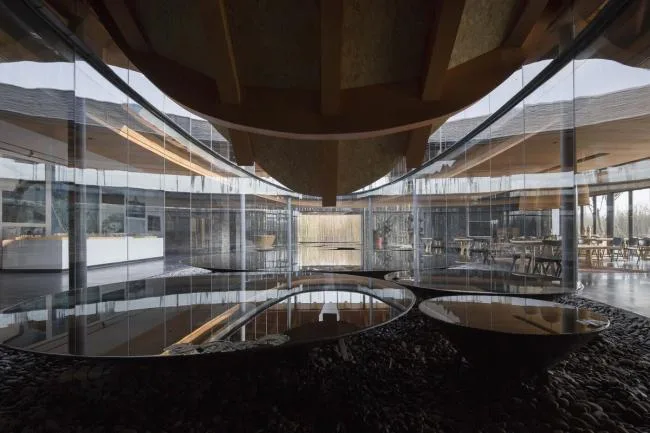
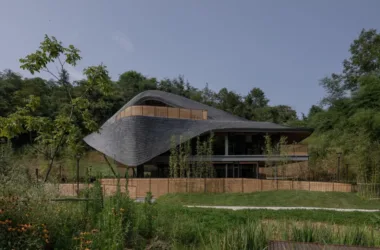
The main building’s design concept is inspired by the traditional Chinese inkstone used in calligraphy. The building’s overall silhouette is stable and upright, reconstructing the foundation and roof of traditional Chinese architecture: a solid and stable base, paired with a graceful and agile roof. These elements merge and interact, creating a series of topological transformations between form and meaning. The roof extends outward prominently to create an open and expansive spatial gesture. Simultaneously, it curves inward toward the inner courtyard, connecting the boundary between sky and earth with elegance. This reinterpretation of local elements fosters a close relationship between traditional architectural components and contemporary nonlinear aesthetics—reflecting the project’s goal to shape a growing forest habitat model.
The building’s exterior design draws inspiration from the traditional Chinese inkstone used in calligraphy.
▼ Curved roof extending toward the inner courtyard
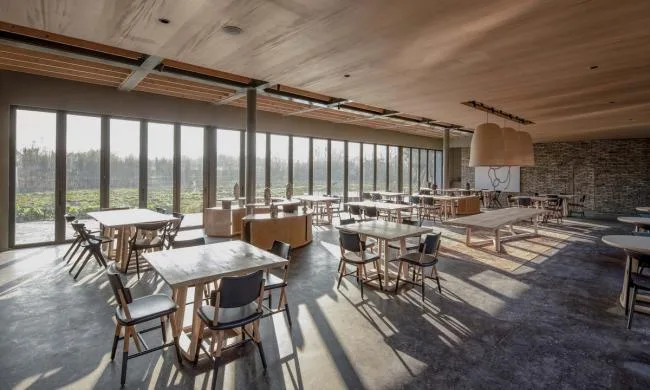
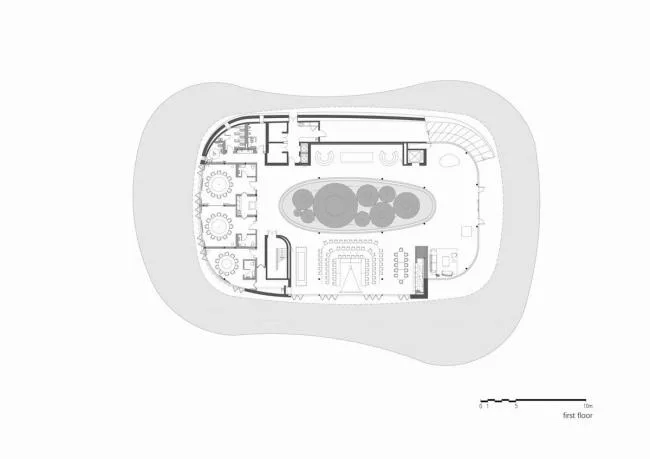
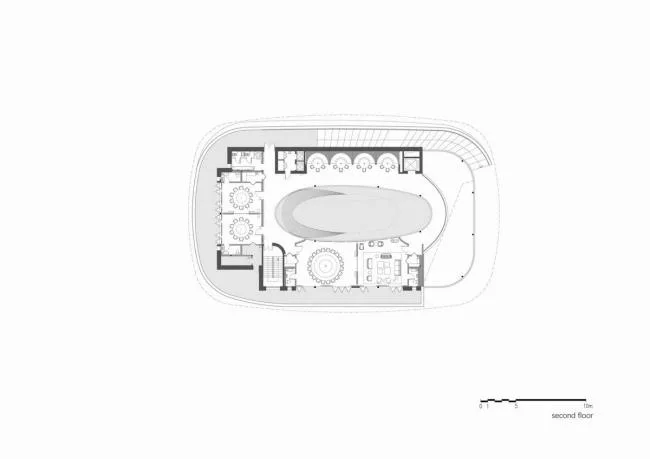
The two-story courtyard space envisions the leisurely lifestyle of the Chengdu Plain. The ground floor accommodates exhibition, reception, conference, communication, and related auxiliary functions. The second floor features a series of private rooms of varying sizes, designed for tea tasting, qin playing, dining, chess, and interactions with nature and the surrounding environment.
▼ First floor communication area
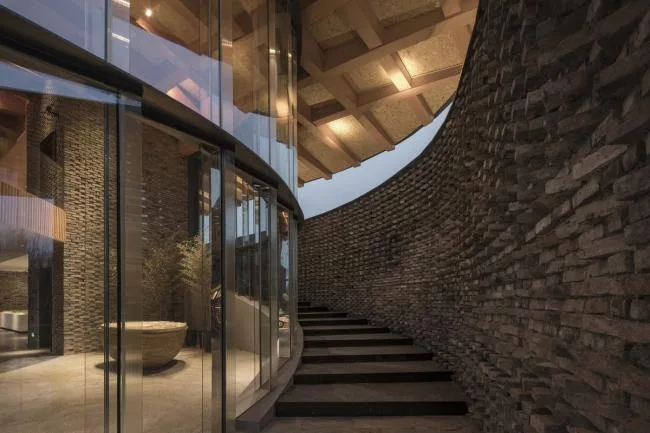
Ascending the gentle outer slope, visitors transition from enclosed spaces to open field landscapes. As the sun rises and sets and seasons change, the views and experiences vary, offering a unique opportunity to connect with nature.
▼ Gentle sloped staircase leading to the second floor
The agricultural auxiliary building features a covered soil structure with brick walls, primarily supporting tool storage for agricultural rotation activities across the landscape. It also serves auxiliary roles such as rest and dining areas.
Digital Design and Construction
Performance-based structural design driven by digital technology aims to optimize building performance through geometric calculations, structural simulations, iterative processes, and refinements. This approach integrates geometric, structural, and construction logic to blend traditional and contemporary design seamlessly.
Traditional Chinese wooden frame construction relies on the principle of “small wood, big use” using logs. By combining glued laminated timber and steel-wood composite structures, new possibilities for modern wooden architecture emerge. Within the context of beautiful rural architectural practices, this project explores innovations and continuations of traditional wooden framing using new materials and structural technologies.
The Linpan Culture Exhibition Center employs steel columns to create a lightweight, transparent space. The roof combines variable cross-section glued laminated timber beams with square tube steel and I-beam steel beams, forming a simple yet warm protruding canopy.
▼ Lightweight and transparent space shaped by steel-wood structure
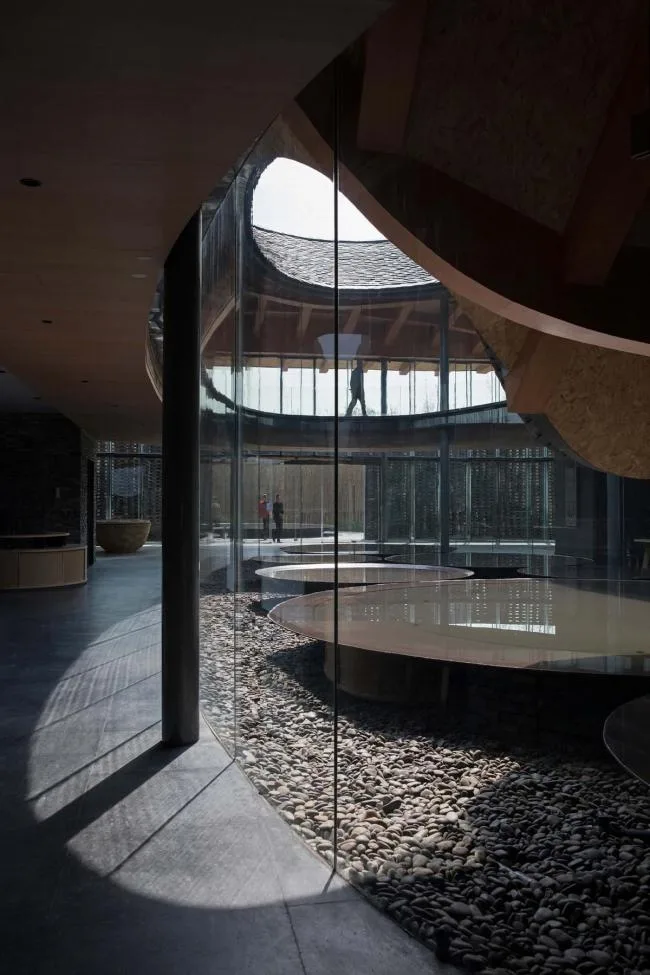
In the main beam structure of the “Shuixidong” building, variable-section I-shaped steel beams act as the “Ang” element found in traditional wooden arches. One end supports outward overhanging wooden beams, while the other supports inward internal wooden beams, balancing the roof truss at the outer steel column nodes. The connection between I-beams and wooden beams uses steel plate inserts and bolts, providing elegant design and clear force transmission.
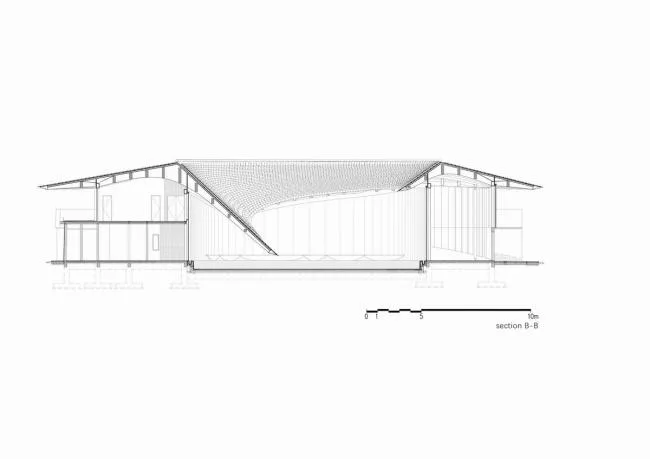
This steel-wood cantilever beam design meets comprehensive material, structural, spatial, and aesthetic requirements: the lightweight wooden beam provides excellent horizontal overhang capability, while the upper I-beam handles tension and prevents steel instability. The I-beam enhances the stress resistance of the laminated timber beam and balances the roof truss via lever principles. Composite beams preserve the space beneath the eaves, and the traditional “deep eaves” element is expressed in a concise, modern form.
▼ Courtyard view
Digital simulation and optimization play a key role in adjusting the proportions of steel-wood composite materials throughout the project. Using Millipede software, real-time topological analysis was performed on variable cross-section glued laminated timber beams, optimizing beam and column dimensions to their minimum. Since all component geometry is based on a shared parameter system, feedback between structural and geometric parameters is flexible and efficient.
The main beam ultimately features a double-line variable cross-section with a straight outer edge and curved inner profile. The straight outer edge facilitates the installation of waterproofing and insulation layers on the roof, while the curved inner profile results from structural performance optimization.
▼ Section A-A
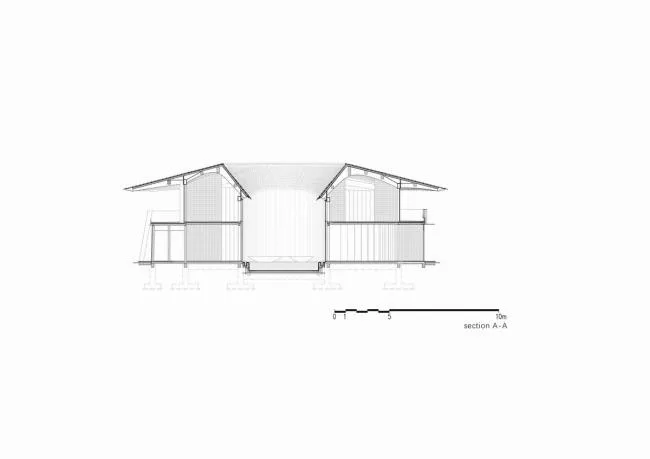
▼ Section B-B
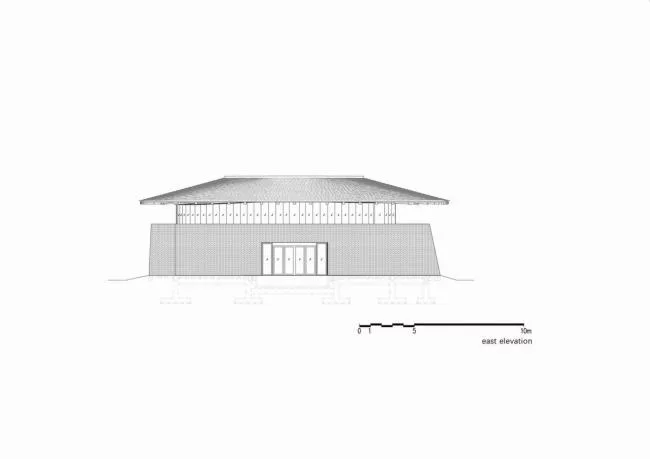
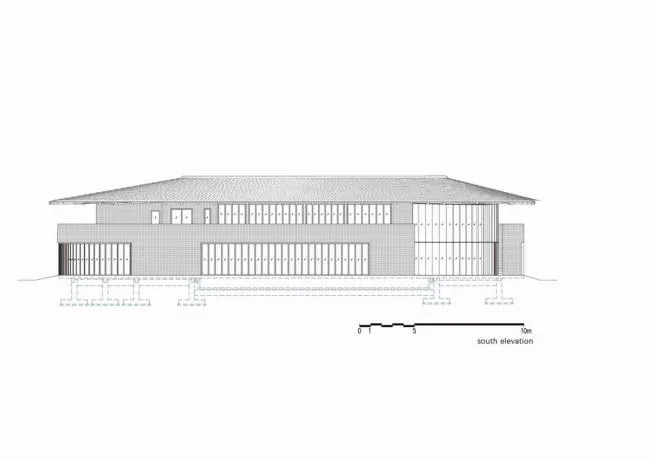
The exterior brick wall design takes inspiration from traditional full-length brick walls, extracting grayscale values from a river flow intention map and varying the rotation angles of staggered bricks to develop the initial design. After thorough consideration of formal, structural, and digital construction logic, the final façade design was achieved through iterative optimization.
The project employs laminated wood, recycled bricks, and slate tiles as primary materials, exploring new possibilities for digitally constructed contemporary prefabricated buildings inspired by new materialist philosophy. The roof is clad with deep blue shale tiles, with geometric forms and tile segmentation optimized through combinations of straight and curved surfaces, and overlapping paving patterns, creating a distinctive spatial experience and architectural language.
▼ East elevation view
▼ South elevation view
Intelligent Human-Machine Collaborative Construction
The performance-based design approach presents “non-standard” and “gradient” ethnic component characteristics, while the parameterized integration of geometric data, structural performance, and construction information ensures seamless coordination between architectural design and construction phases.
Given the large volume and short construction cycles for the brick walls at the Linpan Culture Exhibition Center, an innovative “digital brick construction” process combining robot prefabrication and on-site assembly was developed. The brick walls cover over 1,000 m² and are divided into more than 400 units measuring 1.5m x 1.5m each. Each unit is robotically fabricated in the factory, prefabricated, assembled, and then installed on-site, showcasing efficiency and precision.
Digital timber construction is especially critical for this building with numerous irregular components. The roof structure’s variable cross-section timber and steel-wood nodes are precisely crafted via milling. Guided by model-based data, non-standard steel and wooden parts were prefabricated in the factory and assembled on-site within a month, achieving effective cost control.
“Robot Plastic Printing Construction” leverages renewable plastics for creative and efficient production. This technology supports customized mass production, particularly suitable for rural settings in China. In this project, it is widely applied to indoor auxiliary structures such as partition walls and furniture seating.
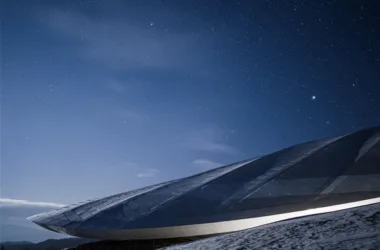
▼ Architectural night view
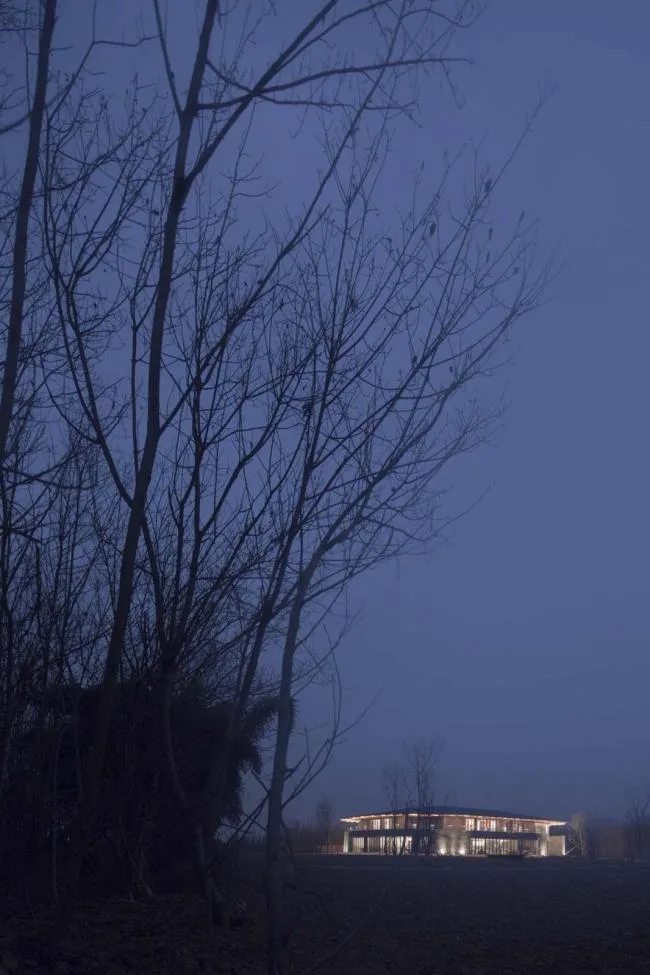
The Sichuan Anren OCT “Water West East” Linpan Culture Exhibition Center represents the first comprehensive application of multiple digital construction techniques in rural China. Its blend of wildness and refinement within an ecological forest setting promotes dialogue and integration between technology and culture, continuing the local spirit. This experimental project aims to introduce intelligence, sustainability, and industrialization concepts into the socialist new countryside, offering a fresh perspective for future rural development in China.
▼ First floor plan
▼ Second floor plan
Project Information:
Designer: Shanghai Chuangmeng International Architectural Design
Location: Anren Ancient Town, Chengdu City, Sichuan Province, China
Category: Cultural Center
Principal Architect: Yuan Feng
Design Team: Han Li, Kong Xiangping, Gu Huajian, Chen Hao, Zhao Chuanshi, Fu Yuhao
Building Area: 2200.0 m²
Project Year: 2018
Photographers: Su Shengliang, Tian Fangfang
Interior Design Team: He Fuzi, Wang Ju, Wang Yifei, Liu Luwen, Tang Jingyan, Cui Mengmeng
Structural Engineers: Zhang Zhun, Huang Tao, Wang Rui, Chen Zeju
Electromechanical Team: Wei Dawei, Wang Yong, Yu Ying
Digital Construction: Zhang Wen, Wang Xuwei, Peng Yong, Zhang Yong, Hao Yancun, Xu Shengyang, Shanghai Yizao Building Intelligent Engineering Co., Ltd.
Prefabricated 3D Printing: Zhang Liming, Li Ce, Liu Liangliang, Zhang Jie, Dai Shilong
Landscape Design: Sichuan Yinengda Construction Engineering Co., Ltd.
General Contractors: Sichuan Yinengda Construction Engineering Co., Ltd., Shanghai Yizao Building Intelligent Engineering Co., Ltd.
Owner: Chengdu Anren Overseas Chinese Town Cultural Tourism Development Co., Ltd.












Must log in before commenting!
Sign Up