
1. Process Flow
Lifting and positioning of composite panels → supporting → correcting elevation and placement point lengths → fixing and reinforcing supports → releasing hooks
2. Operation Process
(1) Verify the number, reserved holes, position, and quantity of junction boxes on the laminated board, as well as the pointer direction for placing the laminated board. When lifting composite panel components, follow the procedure of slow lifting, then fast lifting, followed by slow placement.
(2) Ensure the lifting points are located according to the design conversion diagram to maintain balance. There must be at least four lifting points, using steel pole beams for multi-point lifting.
(3) Before hoisting the laminated board, mark the elevation control line on the calibrated wall using a chalk line, and inspect the support elevation of the horizontal components. Cut, chisel, or repair any deviations to meet installation requirements.
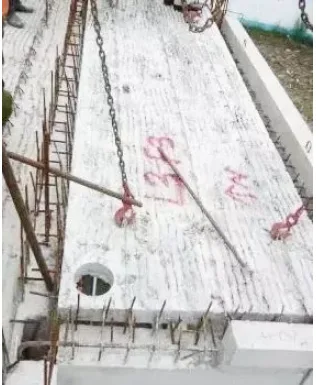
(4) Lift the composite panel components sequentially, maintaining a stacking gap of 15mm.
(5) Install temporary supports when hoisting composite panel components into place, ensuring the upper and lower temporary supports align vertically.
(6) When lifting, raise the horizontal components approximately 500mm above ground first. Check the lifting ropes for twisting or jamming, and ensure the force is evenly distributed across all lifting points. When the components are about 1000mm from the installation position, stabilize them by hand and slowly lower into place.
2. Construction Technology for Hoisting Prefabricated Composite Beams
1. Process Flow
Hoist prefabricated composite beam into place → precisely adjust axis and elevation → temporary fixation → support → release hooks
2. Operation Process
(1) Inspect the number, direction, appearance, specifications, quantity, position, and secondary beam mouth location of the prefabricated composite beam. Select an appropriate steel beam pole for lifting. Each lifting rope must correspond one-to-one with the lifting ring on the beam.
(2) Before hoisting, mark the beam’s bottom elevation and edge control lines on the calibrated wall with ink lines.
(3) Lift the main beam first, then the secondary beam; ensure the main beam is calibrated before hoisting the secondary beam.
(4) Maintain a 15mm stacking gap, and use 1–10mm shims at placement points. Axis control for the stacked beams should be based on the control line for accurate placement. Adjust the beam bottom elevation with independent supports beneath. Once axis and elevation are correct, spot weld the main reinforcement of the beam to the shear wall or beam reinforcement, then remove the sling.
(5) Provide at least two independent supports for each prefabricated composite beam, depending on the span size. At the junction of main and secondary beams, position the main beam’s bottom formwork and the single assembly residential support simultaneously.
3. Quality Requirements
(1) Install temporary supports immediately as horizontal components are placed. Adjust their height based on elevation and boundary control lines to maintain component elevation.
(2) The distance between temporary supports and horizontal component supports should not exceed 500mm. Along the length of the horizontal component, temporary supports should be spaced no more than 2000mm apart. For composite panels with spans of 4000mm or more, add temporary supports at the midpoint to prevent sagging; the arching height should not exceed 0.3% of the panel span.
3. Construction Technology for Hoisting Prefabricated Staircases
1. Process Flow
Hoist and assemble prefabricated staircase → correct elevation and axis position → temporary fixation → support → release hooks
2. Operation Process
(1) Before hoisting, check the stair landing, beam mouth, and their elevations.
(2) Inspect the embedded sleeve screws’ positions, thread integrity, weight of each piece, and serial numbers.
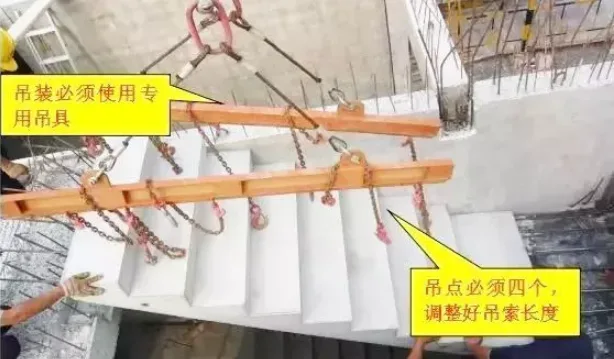
(3) Tighten the hanging ring screws and embedded sleeves. Adjust the rigging chain length to ensure the stair landing remains horizontal. Test-lift the prefabricated staircase board to verify accurate lifting point placement and uniform sling force. Limit the lifting height to no more than 1 meter.
Prefabricated staircase hoisting:
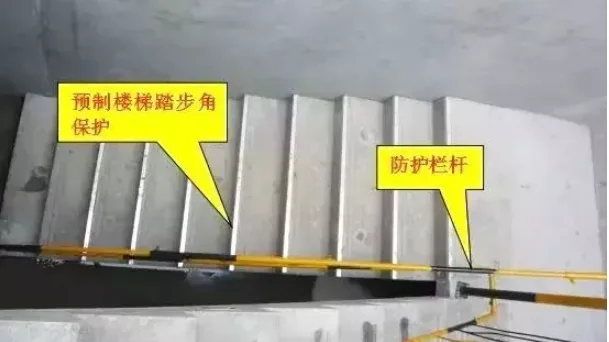
Protection Requirements for Prefabricated Staircase Products:
(4) Ensure the prefabricated staircase’s landing remains level during lifting. Use adjustable horizontal suspension beams for balanced lifting and positioning, with at least four lifting points.
(5) When the staircase is in place, one end of the reinforcement should be anchored into the laminated beam with a length of 15mm; the other end should extend into the landing and rest on the landing formwork. Position components precisely following control lines using pry bars or similar tools, ensuring stable placement.
(6) After installation, verify the stair elevation and stairwell width dimensions.
3. Quality Requirements
During transportation, place flexible gaskets at points where prefabricated staircase components contact rigid supports.
After installation, protect stair treads with wooden strips or adhesive aluminum corner strips.
Cover the surfaces of prefabricated staircase components during concrete pouring at structural nodes to prevent contamination.
4. Construction Technology for Hoisting Prefabricated Balconies and Air Conditioning Panels
1. Process Flow
Positioning and layout → component inspection and verification → component lifting → prefabricated balcony hoisting → correction of elevation and axis → temporary fixation → support → release hooks
2. Operation Process
Before lifting, verify the component number, position, quantity, and external dimensions of embedded lifting rings and reserved pipeline holes.
Elevation and position control lines should be marked with ink on corresponding calibrated wall positions.
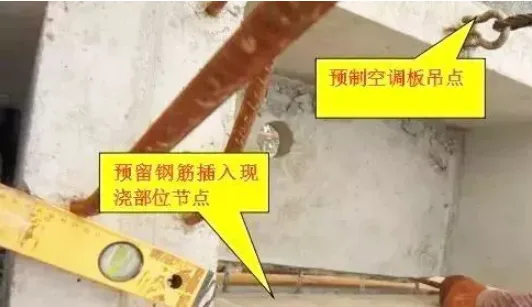
For hoisting prefabricated air conditioning panels and balcony panels, ensure lifting point positions and quantities match the conversion diagram.
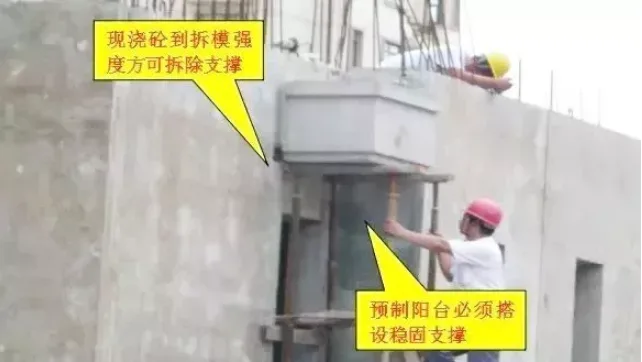
Four pairs of prefabricated cantilever components with negative bending moment bars should extend through reserved holes individually. After placement, install supports underneath. Once calibrated, spot weld or tie the negative bending moment bars to the indoor composite panel steel support.
Prefabricated air conditioning panel hoisting:
Requirements for Lifting Prefabricated Balconies:
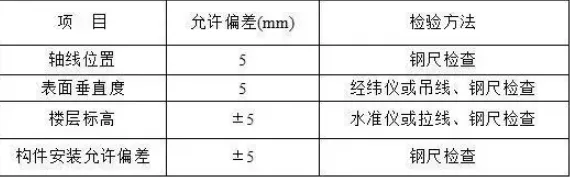
3. Quality Requirements
Source: Prefabricated Technology













Must log in before commenting!
Sign Up