
Foundation pit support engineering is a critical aspect of construction projects. It must be carried out strictly according to relevant standards to prevent serious impacts on surrounding buildings and the environment. Below, we have summarized the key construction points for foundation pit support engineering to help address common challenges encountered during actual construction. Let’s explore these points together.
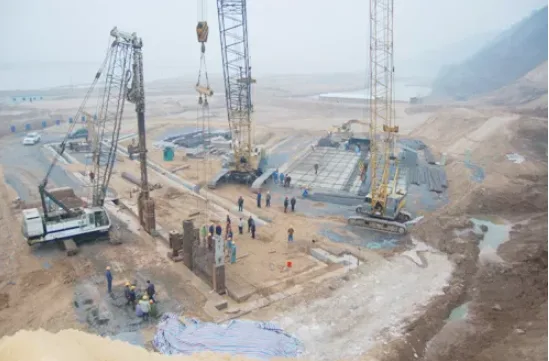
1 Excavation Support Methods
(1) Shallow foundation pit support methods mainly include anchoring support, inclined column support, short pile transverse partition support, temporary retaining wall support, and steel pile transverse partition support. Anchor pull support and inclined column support are commonly used for large, shallow foundation pits or when mechanical excavation is employed. Short pile transverse partition support and temporary retaining walls are typically used for wide foundation pits or where the lower slope in some sections is insufficient. Steel pile transverse baffle support is often applied in conditions with low groundwater levels and moderate depths, such as in cohesive or sandy soil layers.
(2) Deep foundation pit support methods include pile support, underground continuous walls, cement soil pile walls, reverse arch walls, and others. Pile support and underground continuous walls are frequently used for deep foundation pits with safety levels between one and three along the pit walls. Cement soil pile walls are common for pits with safety levels two or three. Reverse arch walls are suitable for pits with a safety level of three, but they are not recommended in silty soils.
2 Key Points for Foundation Pit Support Construction
(1) Before starting construction, select the excavation support method carefully based on actual site conditions. Ensure maximum safety and stability while considering economic factors. At the same time, implement appropriate preventive measures to guarantee smooth excavation support work.
(2) Follow the chosen foundation pit support plan and adhere to the principles of “slot support, support before excavation, layered excavation,” and strictly avoid over-excavation. The total construction period should be calculated based on the pit depth, accounting for the time required for layered excavation and support.
(3) When using mechanical excavation, leave a certain thickness at the design elevation for manual excavation. If the construction access road crosses the pit’s top, install an intercepting ditch to prevent surface water from entering the pit. Additionally, set up a 1-meter-wide guardrail between the pit’s edge and the access road for safety.
(4) Avoid excessive excavation depth and speed. Large excavation height differences or rapid progress can disrupt the original soil balance, reduce soil shear strength, and increase the risk of soil sliding and collapse accidents.
(5) Implement waterproofing measures during pier foundation excavation, and pour the foundation promptly to prevent bearing capacity loss caused by prolonged exposure or surface water immersion. After foundation completion, backfill and compact the pit in a timely manner.
(6) Assign professional construction monitoring personnel to oversee the excavation site and surrounding structures. They should analyze monitoring data dynamically, predict upcoming work impacts, and forecast potential risks. If displacement exceeds warning thresholds, take effective corrective measures promptly to ensure project safety.
Article source: Architectural Technology Magazine














Must log in before commenting!
Sign Up