
The core of construction industrialization lies in production industrialization, with design standardization being the key factor. The most critical step is to establish a set of adaptable modules based on BIM workflows and module coordination principles.
Building on this foundation, the design optimizes the size and types of each functional module to achieve universality and interchangeability of building components. This ensures that the building attains the best balance of functionality, quality, technology, and cost-effectiveness during construction, facilitating a shift from extensive to intensive construction methods.
Scientific Disassembly of Prefabricated Components
Standardization hinges on the scientific disassembly of components. How prefabricated components are broken down affects building functions, facades, structural stress conditions, load-bearing capacity, and overall project costs.
Components are primarily categorized based on their function and load-bearing role into vertical components, horizontal components, and non-load-bearing components. Vertical components mainly consist of prefabricated shear walls. Horizontal components include prefabricated floor slabs, balcony air conditioning panels, and stairs. Non-load-bearing components, such as PCF exterior panels and decorative elements, enhance the building facade and overall aesthetics.
The disassembly of components is guided by five main considerations:
- Reasonable force distribution.
- Requirements for production, transportation, and lifting.
- Reinforcement construction requirements for prefabricated components.
- Connection and installation construction needs.
- Standardized design requirements for prefabricated components.
The ultimate goal is to achieve “fewer specifications, more combinations.”
1. Column Splitting
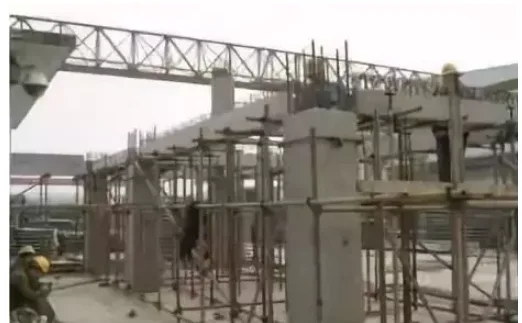
Columns are generally divided according to their floor height. According to the Technical Specification for Prefabricated Prestressed Concrete Integrated Frame Structures (JGJ224-2010), columns may be split into multiple sections. However, challenges such as membrane detachment, transportation, lifting, and support make multi-section columns difficult to manage. Additionally, steel bar connections are prone to deformation during lifting, making verticality control challenging.
Therefore, columns are often designed as single-section units based on their height. This approach facilitates better verticality control, simplifies production, transportation, and lifting, and ensures quality.
Multi-section column:

Single-section column:
2. Floor Slab Splitting
Floor slabs are divided into unidirectional composite panels and bidirectional composite panels. When split into unidirectional panels, the slab is divided along the non-load-bearing direction. The prefabricated bottom slab employs a separable joint that can be assembled at any position. For bidirectional composite panels, integral joints are used between prefabricated base plates. The joint location is set along the secondary stress direction, where stress is relatively low. A 300mm wide post-pouring strip is placed between prefabricated base plates to connect the reinforcing steel bars at the panel base.
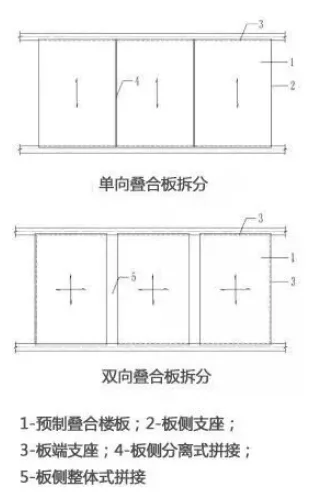
For ease of truck transportation, prefabricated base plates typically do not exceed 3 meters in width and 5 meters in span. Within a room, base plates should be divided into equal widths as much as possible to reduce the variety of prefabricated plate types.
If the slab span is small, joints can be positioned near internal partition walls, allowing the prefabricated slab joints to remain untreated until after the internal partitions are constructed. Lighting positions should also be considered, with joints generally avoiding lamp locations. Floor slabs in bathrooms and areas dense with electrical conduits are usually constructed with cast-in-place concrete.
The thickness of prefabricated base plates is determined by load requirements during prefabrication, lifting, and on-site pouring. Typically, prefabricated base plates are 60mm thick, while cast-in-place concrete layers are at least 70mm thick.
3. External Wall Panel Splitting
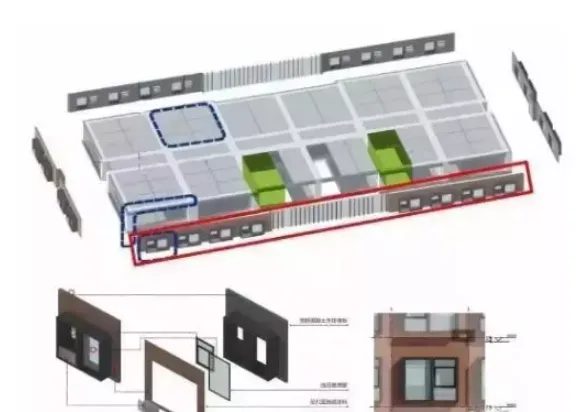
External wall panels serve as non-load-bearing enclosure elements on prefabricated concrete frame structures. Their disassembly is generally limited to one floor height and one bay width.
The dimensions of external wall panels must consider construction and transportation constraints. Excessively long or tall panels can experience significant internal forces due to inter-story displacement of the main structure.
Panel size should align with the building facade’s characteristics, ensuring joints correspond to facade features. This approach balances size control with facade design requirements.
4. Beam Splitting
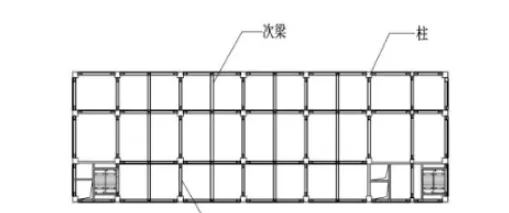
Beams in prefabricated frame structures include main and secondary beams. Main beams are typically divided into single-span units corresponding to the column grid, though double-span beams may be used for shorter spans. Secondary beams are split into single spans based on the spacing between main beams.
5. Stair Splitting
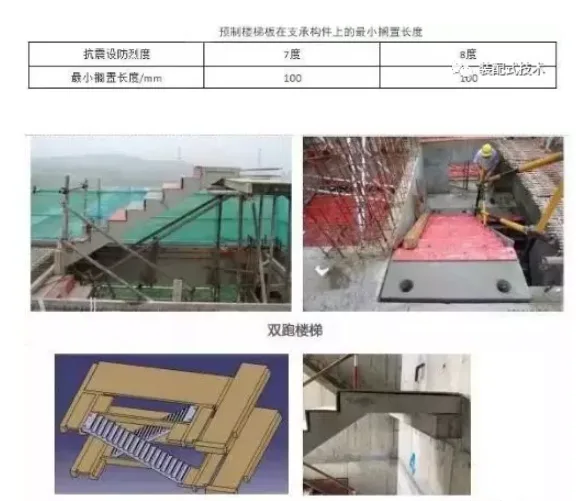
Scissor stairs should be divided into units consisting of one running staircase. To reduce the weight of prefabricated concrete stair slabs, designing them as beam stairs is advisable. Installing ladder beams in the middle of prefabricated concrete stair slabs is not recommended, as it can slow installation and complicate connections.
The landing slab at the half-level of a double-run staircase can be cast-in-place, prefabricated together with the stairs, or constructed as a 60mm + 60mm composite panel.
Prefabricated stair slabs must be connected with one end hinged and the other end sliding hinged to accommodate rotational and sliding deformations caused by inter-story structural movements. The minimum length of the stair slab resting on supporting components must also meet structural requirements.
Article source: Prefabricated technology
















Must log in before commenting!
Sign Up