
The use of shaped concrete in prefabricated buildings has a global history spanning over 30 years, with numerous applications domestically as well. However, many precast concrete assembly companies still have concerns about the costs associated with molds, and we fully understand these worries.
Cost is a critical factor for any business owner. No matter how excellent a product is, if its price is too high for the market to accept, all efforts will be in vain.
Today, Lao Zhang will focus specifically on the most pressing issue: the cost of using molding molds. We will set aside discussions about safety, customization, efficiency, and environmental benefits for now.
When discussing cost, two conditions must be established. First, the decorative effect achieved with molds cannot be directly compared to ordinary exterior wall paint or mushroom stone finishes. Second, the mold must be reusable. If a mold is only used eight to ten times, the cost distribution will be far less advantageous. This is similar to tunnel engineering, where the cost-efficiency of a tunneling machine becomes apparent only when amortized over a long tunnel—say, 10 kilometers. Otherwise, there is no clear cost benefit or comparison.
To clarify this further, let’s take a look at the table below:
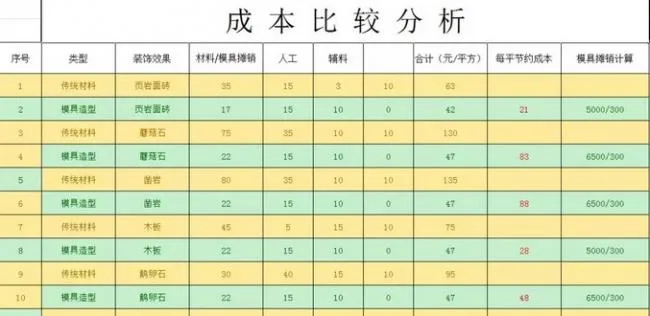
The table above presents a very conservative estimate, assuming the mold is amortized over only 300 uses. In practice, if proper procedures are followed—such as using a water-based release agent, maintaining curing temperatures below 65°C, and storing molds flat—it is common for a single mold covering 10 square meters to be reused 800 to 1,000 times.
Additionally, older molds can be cut, repaired, and reassembled for ongoing use in construction. This means the actual cost of using molds is likely lower than the figures shown in the table above.














Must log in before commenting!
Sign Up