
Abstract: This article categorizes and analyzes common quality issues encountered with prefabricated components during the construction of prefabricated buildings. It explores the root causes of these problems and proposes targeted solutions focusing on component production, detailed design, and construction technology. These solutions have been applied in pilot projects with positive results, offering valuable guidance for quality control in future prefabricated building projects.
Keywords: prefabricated components, leakage, manufacturing, sensing ruler, finished product protection
Prefabricated modular buildings offer significant advantages, including high production efficiency, labor savings, and alignment with the “four savings and one environmental protection” policy strongly promoted by the government. However, the construction technology for these buildings remains immature, and the quality management system requires further development. Previous research and preventative measures primarily targeted cast-in-place structures, making traditional approaches insufficient for prefabricated and assembled buildings. This article examines common challenges faced during prefabricated building construction and presents specific countermeasures.
Common Quality Problems and Cause Analysis of Prefabricated Components
1.1 Production and Processing
Production issues typically include missing or uneven edges and corners, warping, uneven surfaces, and protruding ribs. Surface defects such as roughness, peeling, sanding marks, contamination, honeycombing, and holes are also frequent. These problems often stem from mold leakage, improper vibration (either insufficient or excessive), severe leakage, and inadequate production inspections during manufacturing.
Additionally, cracks or fractures often develop during transportation and hoisting due to oversized panel spans causing compression between panels or excessive deflection. Such cracks can spread across the entire panel, leading to damage. Warping may also result from improper production or maintenance, while uneven, insufficient, or missed application of release agents during demolding can cause panels to stick to molds. Processing oversights may expose truss bars or cause detachment of embedded parts on laminated surfaces.
1.2 Joint Leakage
Waterproofing quality directly impacts a building’s long-term functionality. Traditional large panel prefabricated buildings rely on pressure-balanced horizontal and vertical joints, with horizontal joints designed as stepped joints and vertical joints featuring cavity drainage. Despite structural waterproofing measures, joint leakage remains a frequent problem, primarily because joint waterproofing is often overlooked. Effective waterproofing requires integrated consideration of structure, insulation, thermal performance, construction, and installation. Only through thoughtful design can optimal waterproofing be achieved.
1.3 Lifting and Positioning
Without a tailored hoisting plan that considers the unique quality, shape, installation height, and site conditions of each prefabricated component, problems with verticality and flatness are unavoidable during installation.
1.4 Installation of Pre-Embedded Pipelines
Blockages, detachment, misalignment, and threading difficulties arise mainly from poor connection of embedded pipelines during component production. Concrete may enter pipelines during vibration causing blockages, or integrated pipeline decorations may become detached or misaligned due to inadequate fixation. Additionally, the design often neglects curvature such as corners during assembly, leading to 90° right angles in pre-embedded conduits that hinder threading on site.
1.5 Finished Product Protection
Due to insufficient personnel and systems for component management, and the need to meet on-site assembly line demands, factories often produce components too far in advance, resulting in prolonged storage. Without proper protection and storage, damage to components is inevitable.
Measures to Address Quality Issues of Prefabricated Components
2.1 Production Stage
The quality of prefabricated components is crucial to the overall safety of structures. At the preparation stage, it is essential to inspect raw materials such as steel, cement, sand, and stone to ensure compliance. Molds must possess adequate strength, rigidity, stability, and precision, with installation ensuring straightness, tightness, and accurate dimensions.
During processing, steel reinforcement cages should be accurately sized and placed according to specifications. The position of steel bars and embedded parts must be corrected before pouring concrete. Protective layers for steel reinforcement should use specialized plastic pads or washers to maintain accuracy. Connectors and reserved holes in wall panels require precise positioning. Pouring and curing standards should match those of cast-in-place structures. For thin board-type components, smaller vibrating rods should be used, increasing vibration points and duration. After curing, components should be inspected for appearance and dimensional accuracy. Defective parts must be promptly addressed. Common visual defects include loose or protruding steel bars and exposed reinforcement. Dimensional checks should verify length, width, height, and protective layer thickness.
2.2 Design Phase
2.2.1 Control the Span of Prefabricated Components
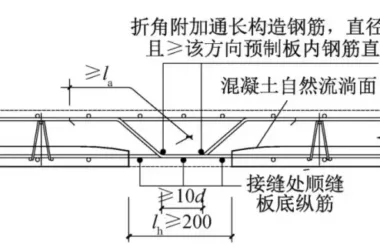
To reduce panel breakage during hoisting caused by excessive span, designers should limit panel spans within acceptable deflection ranges.
2.2.2 Waterproof Measures
Design should prioritize water diversion over blocking and drainage over waterproofing. Wall panel joints can be shaped as tongue-and-groove with an elevated inside and lower outside, combined with pressure relief cavities to prevent water ingress through capillary pores. Shim placement at the bottom addresses leveling issues. After installation, panels should be connected via transverse connectors on the inner side of the outer wall panels, followed by inner diagonal supports to ensure perpendicularity. Waterproof tape should be applied between assembly joints to prevent leakage. Window frames, prone to leakage at exterior walls and openings, should be cast integrally during factory processing.
2.3 Construction Phase
2.3.1 Component Lifting and Positioning
Before hoisting, select appropriate mechanical models and lifting equipment based on component weight, shape, installation height, and site conditions. Lift components following a sequence of lifting, positioning, and preliminary calibration, starting with rough adjustment and finishing with fine tuning. After the wall panel is hoisted, adjust horizontal alignment, in/out positioning, and verticality to ensure facade flatness.
Once in place, verify indoor and outdoor verticality against pre-arranged floor control lines. Align elevation markers on wall columns with the prefabricated components and adjust elevation clips for uniform height. Use pry bars to correct lateral deviations based on positioning lines on the floor and components. After rough alignment of wall openings, employ diagonal braces for fine adjustments.
2.3.2 Application of High-Precision Vertical Sensing Ruler
Traditional verticality detection uses rulers with about 1/150 accuracy. A new vertical sensing ruler has been developed that connects wirelessly to smart devices, enabling remote vertical adjustment with accuracy exceeding 1/1000. Unlike traditional devices limited by construction conditions and unable to comprehensively detect wall panel verticality (especially exterior walls), this new sensor greatly expands detection range and significantly enhances overall wall construction quality.
2.3.3 Pre-Positioning and Reservation of Pipelines
Pre-positioning drainage risers and wire boxes on prefabricated kitchen panels (see Figure 4) improves efficiency for installing drainage and flat-top pipes. On bathroom composite panels, embedded pipes are protected using plastic covers and short connectors inserted into pre-embedded parts during construction. This reduces damage and prevents concrete intrusion during pouring. These accessories are reusable, material-efficient, and environmentally friendly.
2.3.4 Strengthen Quality Acceptance of Prefabricated Components Upon Entry
On-site acceptance should follow specifications, reviewing quality certification, structural and functional inspection reports, appearance defects, dimensional deviations, embedded part compliance, surface quality, keyway standards, and component identification. Except for sampling dimensional deviation checks, all other inspections require full verification to ensure installed components meet quality standards.
2.3.5 Develop Effective Transportation and Stacking Plans
Transportation from factory to site and within the site should account for the stress characteristics of components, implementing targeted measures to prevent damage. Steel supports designed to component dimensions must have sufficient rigidity to avoid deformation during transport and storage. Sleepers should be placed at contact points between components and supports. Components should be classified and stacked in installation order within crane reach and away from other construction activities.
2.3.6 Protection of Prefabricated Components and Finished Products
On-site waste wood can be repurposed as frame columns, stair treads, and other protective devices to prevent damage to concrete components during construction.
2.3.7 Training for Construction Personnel
Since construction staff may be unfamiliar with prefabricated assembly procedures, training in industrialized building knowledge, skills, and operating protocols is essential to ensure project quality and safety.
3. Conclusion
This study summarizes the quality challenges and solutions related to prefabricated components in modular buildings. Quality control spans all stages—from design through production to on-site construction. Systematic improvements, rigorous acceptance procedures, and strengthened quality management are necessary to ensure quality and earn recognition from users and the market for prefabricated modular housing.
Author: Liu Guoshun, Shanghai Construction Second Construction Group Co., Ltd
Copyright belongs to the original author














Must log in before commenting!
Sign Up