
BIM Software Tip: Volume Layout Issues in Revit
It’s important to understand that the modeling techniques for volumes differ from those used for conventional models. With traditional models, we typically switch between various views, combining plans and elevations. However, when working with volumes, most operations are performed exclusively in 3D views. This discussion focuses primarily on layout.
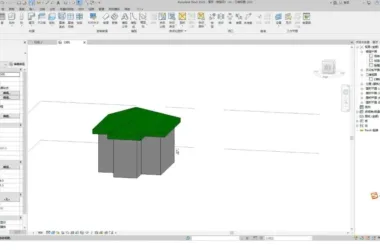
Layout involves defining a path and a section perpendicular to that path. Since we work only in 3D views, drawing a section perpendicular to the path directly is not possible. Instead, we use points in conjunction with the path. There are two ways to place points: drawing on the surface or drawing on the work plane. The outcomes differ depending on the method used. First, we draw the path. Then, when creating the section, we place points and use these points to draw on the work plane.
We discovered that points placed on a surface do not necessarily lie on a straight line but rather on a plane defined by a specific elevation. Because of this, the points might not align perfectly on a straight line, and the work plane associated with the point may not be perpendicular to the path. Drawing points on a surface can lead to inconsistent results. In contrast, drawing points on a work plane ensures a straight line theme and a single work plane perpendicular to the path, which can serve as a vertical plane for layout.
Therefore, when laying out, the second method—drawing on the work plane—is preferred. Using the path and the work plane, we then draw a contour (such as a circle) based on the point’s work plane. This contour can be parameterized, allowing us to generate a shape.
Debugging the Radius:
We identified an issue that requires locking the contour at this stage.
Only by locking the contour can the layout be considered complete.
Summary:
1. Choose point placement by drawing on the work plane rather than on the surface.
2. Complete the layout, then select and lock the contour.
3. Whenever possible, use reference lines for both paths and contours to ensure accuracy.













Must log in before commenting!
Sign Up