
Ensuring the safety of foundation pits is a crucial aspect of construction projects. During the excavation and support phases of deep foundation pits, various internal and external hazards may arise. How can these risks be transformed into safe practices to prevent accidents? It is essential to implement safety measures in key areas. So, what are the critical considerations in prefabricated R&D?
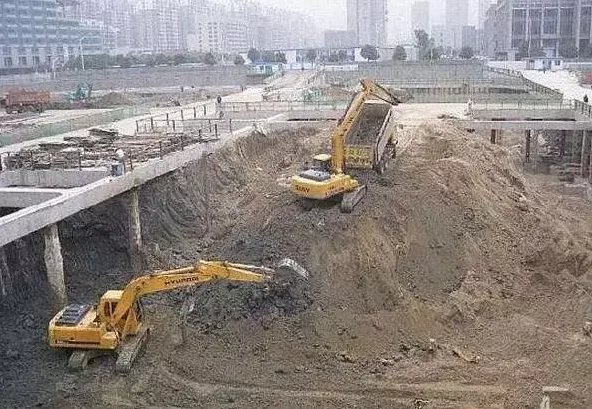
External Causes
Geotechnical Investigation
Some foundation pit accidents stem from inadequate surveying. Insufficient survey efforts and inaccurate assessment of soil properties by surveyors can render the collected data unsuitable for guiding the actual project. Survey inaccuracies may lead to overestimated soil physical and mechanical parameters, causing calculation errors that make support systems unable to withstand external forces, ultimately resulting in accidents.
Common Regulatory Shortcomings
- Insufficient undisturbed soil samples and limited mechanical testing fail to accurately reflect the true soil conditions of the foundation pit.
- The survey team often overlooks the influence of thin-walled soil samplers on design parameters and neglects comprehensive analysis of local soft soil characteristics when selecting recommended soil mechanics parameters.
- Recommended values for direct shear consolidation fast shear indexes in survey reports sometimes deviate from standard specifications, often being too high.
- Significant discrepancies exist between the soil layer proportion coefficient m provided in reports and values from similar engineering projects, with contradictory soil mechanical parameters.
Data Authenticity Issues
If the collected geotechnical data significantly diverges from known values in similar projects, it could indicate lost original test records, making it impossible to verify the data’s authenticity.
Uncontrolled Groundwater
When municipal pipelines are more abundant or located closer to the construction site than those in prefabricated house projects, protective measures must be in place to avoid pipeline damage. A failure in the connecting wall can lead to collapse and allow silt to flood the foundation pit, causing ground subsidence. A ruptured underground water supply pipeline may result in water flowing back into the pit.
Soil infiltration failure includes issues such as:
- In saturated aquifers—especially those with sand, silt, or permeable interlayers—poor waterproofing of retaining walls or waterproofing failures can allow water and sand particles to enter the foundation pit.
- Severe soil erosion from this infiltration can cause ground collapse.
Improper Support Method Selection
Before installing supports, on-site surveys are essential to gather relevant data and understand the underground structure. This ensures the support design is rational and effective. If survey data is inaccurate or soil conditions misunderstood, inappropriate support methods may be chosen.
Anchor rod support is widely used but has specific application limits. Improper use can undermine its effectiveness:
- If anchor rods are too short, the friction between the rod and soil may be insufficient to counteract active soil pressure, risking overall soil sliding.
- Incorrect anchor rod placement or inadequate prestress leads to weak resistance and excessive deformation.
- Insufficient support stiffness can cause excessive bending, with support nodes failing before the support structure itself. Improper positioning of supports may introduce additional bending moments, leading to support failure.
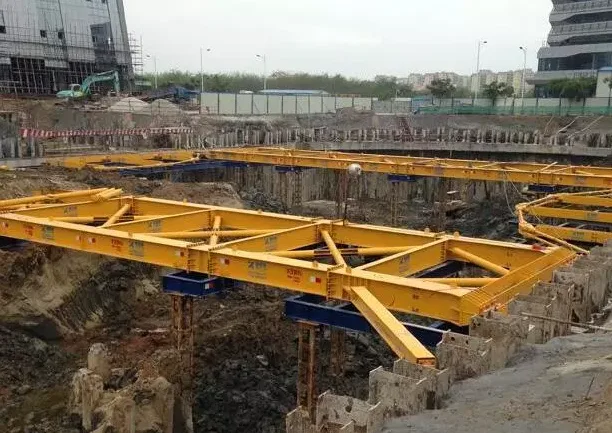
Internal Causes
Management Issues
Construction plans should undergo thorough review and collaborative discussion among multiple parties to identify potential problems early, improve feasibility, and lay a solid foundation for quality construction.
Given the many uncertainties during foundation pit excavation, standardized site management is vital. Responsibilities and roles must be clearly defined before construction begins.
Technical Issues
Stratification
Excavation must proceed layer by layer, from top to bottom, strictly avoiding over-excavation or bottom excavation. Excavation and support installation should be synchronized. The length of excavation sections should be carefully determined based on depth and slope, avoiding excessive length.
Once excavation reaches the design elevation, cushion concrete must be poured immediately to reduce deformation. Bottom concrete should be completed within 5–7 days, and related structural layers constructed promptly to establish a permanent force balance system, effectively controlling foundation pit deformation.
Dewatering
Before excavation, dewatering increases the soil’s horizontal resistance within the pit, reducing deformation. Dewatering speed should be controlled carefully. During this process, monitoring of nearby buildings, underground pipelines, and surface settlement is essential.
Recharge wells should be installed outside the pit, with recharge measures taken as needed to protect surrounding buildings. If monitoring data approaches or exceeds warning thresholds during excavation, the cause must be analyzed immediately. Problems should be identified accurately, and construction steps adjusted accordingly to control deformation and ensure safety.
Support
Supporting piles in deep foundation pits bear significant external forces. These should be protected with reinforced concrete, and excavation should proceed only after concrete pouring is complete. During soil excavation, care must be taken to avoid damaging nearby pipelines.
A Century-Old Plan Demands Quality Foundation Pits

Improve Survey Quality
- Data must be collected and analyzed by professionals, with survey points evenly distributed and detailed data analysis performed.
- Designers experienced in deep foundation pit design should address any data gaps or uncertainties by consulting relevant experts promptly. Arbitrary parameter estimation or underestimating soil lateral pressure must be avoided to ensure adequate reinforcement. Design schemes should be reviewed by senior experts to determine the optimal solution.
Adopt Reasonable Excavation Techniques
The placement of post-pouring strips in the foundation slab significantly influences deep foundation pit construction. Soil layers must be excavated in the prescribed sequence, moving from south to north, with finishing treatments conducted on the northern side.
Rubber soil may appear in foundation pit layers, especially during rainy seasons or in high groundwater areas. In such cases, surface soil should be removed and replaced with a thick gravel layer.
If quicksand forms during excavation, heavy stones should be used to stabilize it, reducing dynamic water pressure and facilitating excavation. Various methods can also reduce water pressure on soil, maintaining balance and stability to ensure smooth construction.
Early in the project, maintaining safe and orderly operations during rainy seasons is critical. Scientific measures to prevent slope collapse must be implemented to ensure the foundation pit’s safe and successful completion.
Effective Monitoring
Excavation Monitoring
- Monitoring points should be laid out to cover areas within 1–2 times the excavation depth beyond the foundation pit edge, protecting critical objects.
- At least two displacement observation reference points should be established outside the influence zone.
- Horizontal and vertical displacement monitoring must be conducted with the following guidelines:
- For level 3 foundation pits with excavation depths up to 7m, monitoring points should be no more than 20m apart.
- For level 1 and 2 pits exceeding 7m depth, monitoring points should be no more than 10m apart.
- Each typical slope section must have at least three monitoring points.
- Horizontal displacement monitoring includes displacement magnitude, rate, and direction.
- Baseline monitoring values must be recorded before excavation, with at least two measurements taken.
- Monitoring frequency should correspond to construction progress. If deformation exceeds standards or changes rapidly, observation frequency should increase. Continuous monitoring is required if accident signs appear.
- During construction, horizontal and vertical displacement monitoring must be conducted at least once daily. If rapid deformation is detected, monitoring should be intensified.
- Daily and periodic monitoring reports should be submitted per design requirements, with a comprehensive summary report provided at project completion.
Monitoring of Retaining Structures
Inspection of retaining structures must verify their integrity and strength. For cast-in-place piles, check for defects such as necking, mud inclusions, or fractures. For rotary jet grouting piles and cement mixing piles, lightweight probing methods assess strength and uniformity.
Horizontal displacement at the top of retaining structures should be regularly measured. During deep foundation pit excavation, monitoring should occur every 2–3 days on average, with frequency adjusted based on conditions.
Detecting horizontal displacement early helps identify deformation problems promptly, ensuring timely corrective action.
Article source: Architectural Technology Magazine













Must log in before commenting!
Sign Up