
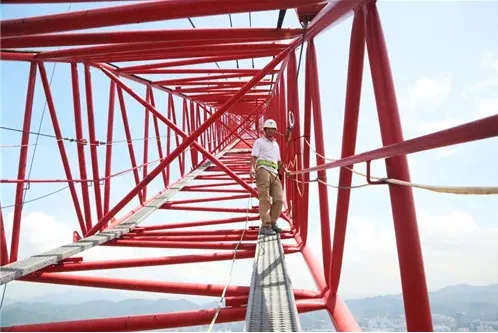
Tower cranes are essential in construction, particularly during structural assembly. By enhancing command, management, and coordination of tower crane operations, we can ensure their safe and efficient use. This approach helps maximize performance while meeting production schedules.
01. Tower Crane Collapse Accidents
Strictly Prohibit Overloading
Issue: During construction, some tower crane operators may take unnecessary risks by exceeding the crane’s maximum load capacity to lift materials. This practice must be avoided.
Explanation: Tower cranes are designed with rated loads that reflect their rental or purchase price. While they include a theoretical overload margin to satisfy operational needs, some operators misuse this margin to save costs. Different crane models rely mainly on lifting torque control. When either the working radius increases or the load exceeds the rated capacity, the overturning moment surpasses the crane’s stabilizing moment, risking collapse.
Conclusion: Overloading a tower crane is strictly forbidden to prevent accidents.
Avoid Inclined Lifting
Issue: In windy or complex lifting conditions, some operators may lift loads at an angle to hasten material transport. This is highly dangerous.
Explanation: Diagonal lifting increases the crane’s overturning moment by creating horizontal and vertical force components at the lifting point. This adds stress to the tower crane’s base support, lowering stability and increasing collapse risk.
Conclusion: Always confirm that the load is within the rated capacity before lifting. Establish a vertical lifting path and avoid inclined lifts. Operating in winds above level six is strictly prohibited.
Ensure Proper Foundation Leveling and Soil Conditions
Issue: The choice of foundation depends on site conditions.
Explanation: Tower cranes bear their own weight plus lifted loads. Uneven foundations or insufficient ground resistance can cause collapse. Excessive vertical deviation increases the overturning moment, reducing stability. Additionally, cranes on soft or loose soil risk soil loosening and tipping, especially under heavy loads.
Conclusion: Install tower cranes on firm, solid ground with adequate bearing capacity. Reinforce the foundation as needed.
02. Other Safety Considerations
Foundation Reinforcement Methods
Method 1: Use soil compaction, soil replacement cushion layers, drainage consolidation, or vibration compaction. Each method varies by soil type, equipment, technology, and cost. The soil replacement cushion layer is most common due to its lower cost but applies mainly to areas with thin weak foundation layers.
Method 2: Combine the tower crane foundation with existing building foundations or floors, allowing easy installation and removal. This cost-effective method requires structural reinforcement calculations to ensure safety under increased load.
Track Laying Precautions
1. Follow manufacturer instructions strictly for laying tower crane subgrade and tracks. For medium-sized towers (3–15 tons), the soil bearing capacity should be 0.12–0.16 MPa; heavy-duty towers (over 15 tons) require >0.2 MPa. The soil must be leveled, compacted, covered with sand and gravel, and equipped with drainage.
2. Sleepers can be wood, prefabricated reinforced concrete, or steel, with cross-sectional dimensions specified by the manual (e.g., 16mm × 240mm or 180mm × 260mm). Sleepers should be at least 1200mm longer than the track gauge. When using one long and two short sleepers, a channel steel tie rod must be installed every 6 meters to maintain gauge. The spacing between sleepers should be 600mm. Standardized roadbed boxes must be inspected before use.
3. Secure track sides firmly with nails or pressure plates on each sleeper, ensuring no loosening. Track joints should be staggered and placed on sleepers with a height difference not exceeding 2mm. Joint clamps must fit the track, and all bolts must be tightened.
4. Track horizontal deviation must not exceed 1/1000 longitudinally or transversely. Measure at least three points within a 10-meter range on both tracks and calculate the average.
5. Install a limit position stopper 1 meter from the track end. It should be higher than the walking wheel radius to prevent derailment after power failure.
6. Fixed tower crane foundations must be constructed according to design drawings. Design calculations and construction details should be part of the special construction organization plan. After construction, inspect and document results.
Process Requirements
1. Tower cranes must be properly grounded to prevent lightning strikes, using welded copper wires of at least 10mm². Ground resistance should not exceed 4 Ω.
2. After installation, vertical deviation between the crane body and ground must not exceed 3/1000 under no load.
3. Pre-tightening forces of connecting bolts and pin shafts must meet standards. Hydraulic systems, safety valves, electrical protections, and other components must be properly adjusted.
4. The torque limiter’s error must not exceed 8% of its rated value. If exceeded, it must cut power to lifting and amplitude-increasing motions, but allow lowering and amplitude reduction.
5. Ultra-high limiters must cut power to hook lifting when the hook frame is within 1 meter of the fixed pulley.
6. Variable amplitude limiters must cut power when the trolley is within 0.5 meters of the boom end.
7. After installation verification, cranes must pass no-load, static load (125% rated load), and dynamic load (110% rated load) tests before use.
03. Key Safety Inspection Points
- Torque Limiter: Automatically cuts power when lifting capacity reaches 110% of rated capacity to prevent overload.
- Weight Limiter: Cuts upward lifting power if load exceeds rated value but allows downward movement.
- Height Limit: Stops lifting at specified limits to prevent over-travel. At 2:1 wire rope magnification, limit is 1000mm; at 4:1, limit is 700mm.
- Variable Amplitude Limiter: Decelerates trolley within 1.5m of arm buffers and stops it at 0.5m.
- Rotary Limiter: Limits rotation to ±540° in both directions.
- Hook Safety: Prevents wire rope slippage due to improper hook angle or hook selection, avoiding dropped loads.
- Small Car Rope Break Protection: Prevents trolley from slipping if variable amplitude rope breaks.
- Wire Rope Anti-Slip Groove: Prevents wire rope from jumping out of groove during rotation, reducing risk of hook failure.
- Wire Rope Deformation Inspection: Look for wavy deformation, cage distortion, strand or wire extrusion, diameter changes, flattening, twisting, or bending.
- Rope Clamp: Clamp plate must be on the load-bearing side; U-bolt positioned at rope end without crossing.
- Standard Section Screws: Ensure connecting bolts are complete and securely fastened.
- Wall Attachment: Use a theodolite to check verticality during installation. Deviation below the attachment point should not exceed 2/1000; above, not more than 4/1000.
Article source: Architectural Technology Magazine














Must log in before commenting!
Sign Up