
Introduction: Integrating Building Information Modeling (BIM) and Radio Frequency Identification (RFID) technologies throughout the entire management process—from component manufacturing to installation—can significantly enhance production efficiency. Below is an overview of how BIM and RFID are applied in managing prefabricated construction projects.

Currently, the progress of prefabricated construction is often limited by factors such as manufacturing speed and transportation methods. Design modifications can negatively impact component production and frequently lead to errors, omissions, clashes, and delays during installation. Integrating BIM and RFID across the entire process—from production to installation—can greatly improve efficiency. The following sections analyze the specific applications of these technologies in prefabricated construction management.
1. Application of BIM Technology in Prefabricated Building Construction Management
BIM technology is primarily applied in three key areas within prefabricated construction management: construction site management, 5D dynamic cost control, and visual project briefings.
(1) Construction Site Management. BIM-based site management involves using virtual layouts before construction begins. This includes simulating the operation of major construction machinery to minimize crane arm interference while ensuring full coverage of the construction area by tower cranes. It also helps optimize the layout of material storage sites to reduce or eliminate secondary handling.
(2) BIM-Based 5D Dynamic Cost Control. 5D BIM extends the 3D model by integrating time and cost data, enabling dynamic construction cost management. Through virtual construction, material stacking, project progress, and financial investments on-site are continuously evaluated for feasibility. This process helps identify issues early, allowing optimization of resource allocation and scheduling to meet cost and timeline targets, ultimately guiding subsequent construction phases (see Figure 1).
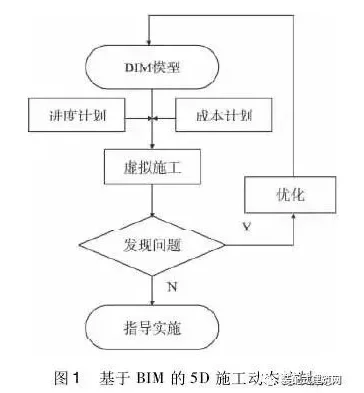
The process begins with establishing a BIM model that includes all project-related data, such as component names, specifications, models, and supplier details. Next, time and cost parameters are added to each 3D model component to create a comprehensive 5D model. Using computer simulations, virtual construction is performed to verify the reasonableness of schedules and cost plans, identify potential risks or issues, and adjust the model and plans as needed. Once optimized, this model directs the actual construction implementation.
BIM also effectively manages changes during construction. When design modifications occur, BIM links these changes to the model, reflecting their impact on quantities and costs. This allows decision-makers to better understand cost implications and adjust budgets and investment plans promptly.
(3) Visual Project Briefings. Visual disclosure uses BIM to virtually present construction processes—especially new techniques, procedures, and complex nodes—in full-scale 3D before each phase begins. This approach reduces misunderstandings caused by subjective interpretations, making information clearer and communication among departments more efficient.
2. Application of RFID Technology in Prefabricated Construction Management
Prefabricated construction management differs from traditional approaches by encompassing five key stages: production, transportation, entry, storage, and hoisting of components. Timely and accurate tracking of components’ manufacturing, transport, and arrival information is crucial for effective progress control and construction flow. Proper on-site component information also facilitates organized stacking, minimizing secondary handling.
Traditional material management often suffers from errors and delays. To bridge the gap between production and construction phases, RFID technology is applied throughout the entire prefabricated construction process, as illustrated in Figure 2.
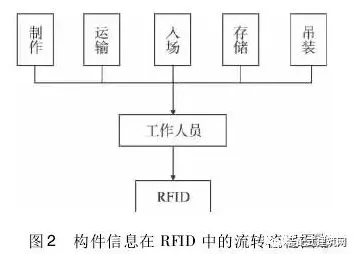
(1) Component Manufacturing Stage. At the prefabrication yard, personnel use writing devices to encode all relevant component information—such as prefabricated column sizes and maintenance details—onto RFID chips. Components are coded following user needs and existing engineering contract coding rules (see Figure 3). The RFID chip, containing all component data, is embedded into the component for access by future project staff.
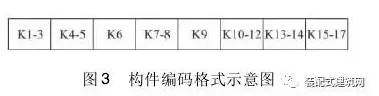
K1-3: Project name, represented by English letters. Projects with fewer than three letters are preceded by a zero. For example, the Olympic project is represented as 0AY;
K4-5: Unit engineering code using numbers 1-99—for example, Building 9 of the Olympic Village is coded as 09;
K6: Above ground (1) or underground (0) engineering designation;
K7-8: Floor number, e.g., 9 floors above ground is represented as 09;
K9: Component type, such as Column (C), Beam (B), Floor (F);
K10-12: Quantity code;
K13-14: Work status, updated with RFID information collection status, e.g., Storage Stage (CC), Installation Stage (AZ);
K15-17: Reserved expansion area.
(2) Component Transportation Stage. RFID chips are embedded in transport vehicles to monitor their status in real time, enabling route optimization for the shortest distance and time. This reduces transportation costs and accelerates project timelines.
(3) Component Entry and Storage Management. Upon vehicle arrival, RFID readers at access points notify relevant personnel to conduct entry inspections and on-site acceptance. After approval, components are transported to designated storage locations according to regulations, and arrival information is recorded on the RFID chips for future reference.
(4) Component Hoisting Stage. Ground workers and machinery operators each carry RFID readers and displays. Workers scan component information, which immediately appears on displays. Operators then lift components in sequence based on this data, streamlining the hoisting process and saving time and effort. RFID technology also enables precise short-range positioning to quickly locate and arrange transport vehicles, further improving operational efficiency.
3. Integrated Application of BIM and RFID in Construction Process Management
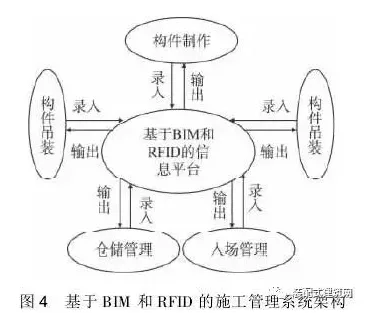
In modern construction information systems, BIM and RFID typically operate as separate platforms—construction control and material supervision, respectively. By combining these technologies, a modern information platform can be established (see Figure 4) for comprehensive construction process management in building projects based on BIM and RFID.
By adding positional and progress attributes to the BIM database, software applications can track the location and status of components within the model. The specific applications include:
(1) Component Production and Transportation Stage. The BIM-based database serves as the core data foundation, while RFID-collected information is promptly transmitted and matched with model data via location and progress attributes. This integration accurately predicts whether components will arrive on schedule, compares actual progress against plans, and allows for timely schedule or process adjustments to prevent delays, accumulation of components, or excessive site and capital use.
(2) Component Entry and On-Site Management Stage. When components arrive on site, RFID readers capture their information and update the database, matching it with the BIM model’s location and progress attributes to ensure data accuracy. Defining positional attributes in BIM also allows precise visualization of each component’s location. This facilitates point-to-point stacking when storing components or materials, avoiding unnecessary secondary handling.
(3) Component Hoisting Stage. Relying solely on BIM models requires manual input for lifting information, which is prone to errors and delays. Conversely, using only RFID provides limited data and requires interpretation from 2D drawings, which can vary by supervisor judgment. Integrating BIM and RFID enables timely information transmission with 3D visualizations for progress tracking and secondary calculations, improving accuracy and coordination during hoisting.














Must log in before commenting!
Sign Up