
Source: Ding Chengzhang Residential Industrialization
1. Development Status of Prefabricated Buildings
(1) Top-Level Design
Prefabricated and steel-structured buildings are currently experiencing an unprecedented period of rapid development. At the central policy level, there have been three groundbreaking “firsts”:
- For the first time, the State Council’s executive meeting proposed the development of green building materials and steel structure buildings.
- On November 4, 2015, Premier Li Keqiang chaired a State Council executive meeting to implement the spirit of the Fifth Plenary Session of the 18th Central Committee of the Communist Party of China, initiating pilot steel structure building projects linked to shantytown renovation and earthquake-resistant housing, along with expanding the use of green building materials.
- For the first time, the Central Committee of the Communist Party of China formally advocated for the development of prefabricated buildings and steel structures.
- On February 6, 2016, the “Several Opinions of the Central Committee of the Communist Party of China and the State Council on Further Strengthening the Management of Urban Planning and Construction” called for promoting new construction methods, emphasizing prefabricated construction to reduce waste and dust pollution, shorten construction periods, and improve quality. It encouraged the development of design, construction, and acceptance standards for prefabricated buildings, the establishment of national-level production bases, and aimed to increase the proportion of prefabricated buildings in new construction to 30% within about 10 years. It also promoted steel structure construction and modern wooden architecture where feasible.
- For the first time, green prefabricated buildings were highlighted in the government work report. On March 5, 2016, Premier Li Keqiang clearly stated the commitment to promote green buildings and prefabricated construction at the National People’s Congress and Chinese People’s Political Consultative Conference.
(2) Why Top-Level Design Is Necessary
Relying solely on technical experts is insufficient to advance steel structure buildings; political leadership must actively intervene to address systemic challenges. This time, the government has taken comprehensive action.
From a positive perspective, this demonstrates strong concern from the Party Central Committee, the State Council, and the National People’s Congress for the construction industry. On the other hand, it reflects deep-rooted issues within the construction sector that the industry alone cannot resolve.
A major challenge is the over-reliance on a limited range of building materials and methods, particularly the dominance of reinforced concrete construction in China.
Despite two decades of industry-led efforts to diversify materials and methods, progress has been minimal.
Consequently, central government intervention is essential to help transform the industry away from concrete construction’s dominance.
2. Six Roadblocks to Prefabricated Building Development
(1) The Greatest Technical Barrier: The “Limit State Three Coefficient Method”
China remains the only country still using the outdated “limit state three coefficient method” for structural design, a legacy inherited from Soviet-era standards during the peak of socialist construction.
This method, proposed by Su Xiu in 1957, calculates structural loads as follows:
S = γGGSK + ψQγQSQK + ψwγwSwK
(2) Dominance of Concrete Construction
China is unique in its overwhelming reliance on concrete construction. According to data from Mr. Dang Baowei of the China Construction Metal Structure Association, steel structures accounted for less than 3% of the construction industry between 2011 and 2015.
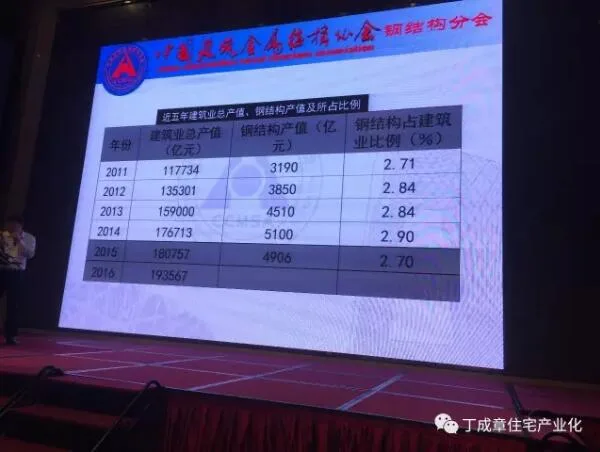
Figure 1
(3) Unique Housing Market Constraints
Chinese citizens are among the few worldwide restricted to purchasing only multi-story and high-rise apartments, limiting housing diversity and innovation.
(4) Lack of Oversight by the National Technical Supervision Bureau
Since 1949, China has adopted a “block division” government structure, where departments operate independently within their jurisdictions. For example, the General Administration of Quality Supervision, Inspection and Quarantine (AQSIQ) manages product quality outside construction, while the Ministry of Housing and Urban-Rural Development oversees construction departments.
Under this structure:
- AQSIQ standardizes all products except construction materials.
- The Ministry of Housing and Urban-Rural Development manages engineering construction standards.
- Quality responsibility for residential products manufactured in factories lies with local technical supervision bureaus, while on-site construction quality is managed by local construction departments.
This fragmented oversight leads to a “railway police” style approach where no single authority is fully accountable for the final quality of prefabricated residential products, weakening quality control after components leave the factory.
(5) Resistance to Implementing National Standardization Guidelines (GB/T20000.2-2001)
The international approach to technical standards emphasizes adopting international norms to reduce trade barriers while maintaining national characteristics. However, China’s construction industry stubbornly resists aligning with these guidelines, resulting in serious disconnects from global standards.
GB/T20000.2-2001 highlights that international standards represent collective industry experience and are key to eliminating technical trade barriers, as recognized by the WTO Technical Barriers to Trade Agreement.
(6) Refusal to Adopt Updated Standardization Guidelines (GB/T1.1-2009)
GB/T1.1-2009 supersedes earlier versions to provide a rigorous and clearer framework for drafting standards, aligning more closely with international ISO/IEC guidelines.
Despite its importance as a fundamental national standard for all industries, the construction sector continues to resist its implementation, undermining efforts to treat housing as a manufactured product with standardized technical requirements.
3. Approaches to Developing Prefabricated Buildings
(1) The Rube Goldberg Method
Many in China embrace the spirit of perseverance expressed in proverbs like “Foolish old man moves mountains” and “Grinding an iron rod into a needle through hard work.” In contrast, Americans tend to favor pragmatic solutions, focusing on circumventing obstacles rather than strictly adhering to rigid rules—a strategy they call the Rube Goldberg method.
Deng Xiaoping exemplified this pragmatic approach by recognizing the complexity of reform and advocating for “no argument” policies to buy time for implementation and gradual problem-solving. This method has allowed China to tackle large challenges by breaking them into manageable parts, leading to progress that may not have been obvious initially.
(2) Establishing a “Prefabricated Building Special Zone”
Following the successful establishment of economic special zones like Shenzhen in 1979—an initiative strongly supported by Deng Xiaoping—there is a proposal to create a dedicated “prefabricated building special zone” within the construction industry.
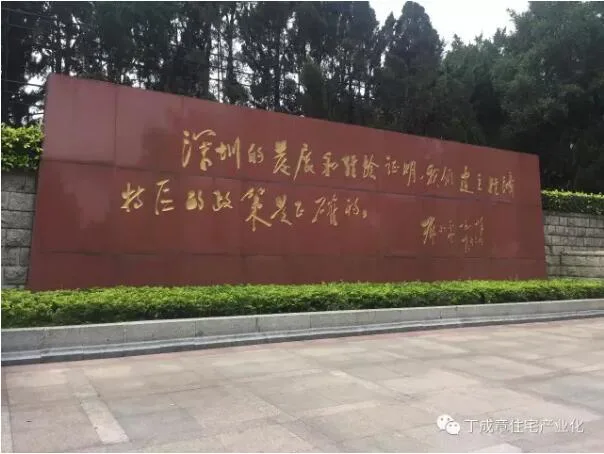
Figure 2
This “special zone” would be an institutional and technological innovation hub within the industry, not a geographical region, designed to pilot reforms in management, standards, and technology for prefabricated buildings.
(3) Why a Prefabricated Building Special Zone is Needed
For nearly 70 years, China’s construction industry has operated under the “Three Coefficient Method for Extreme States,” diverging significantly from global design methods such as the allowable stress design (ASD), load and resistance factor design (LRFD), and direct strength method (DSM).
This disparity is akin to incompatible railway gauges, making integration with international systems nearly impossible without radical change. The lack of progress over decades reflects systemic and institutional obstacles rather than purely technical issues.
Establishing a special zone focused on prefabricated buildings provides a controlled environment to innovate and reform systems, mechanisms, and technologies without destabilizing the broader industry.
As Mr. Zong Delin, a Chinese-American expert in prefabricated prestressed structures, notes, while the U.S. has comprehensive design and seismic testing standards, China’s current “Three Coefficient Method” lacks recognition of these advances, creating uncertainty in prefabricated building design.
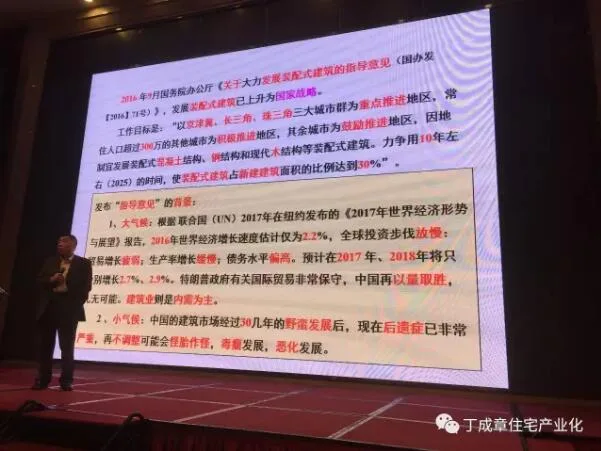
Figure 3: Prefabricated Assembly Type
After decades of insular development, the industry has formed entrenched interest groups resistant to reform, which previously stifled housing industrialization efforts. Many advocates lacked manufacturing experience, resulting in superficial approaches that failed to advance true industrialization.
There is concern that similar challenges could hinder current prefabricated building initiatives unless deep understanding and genuine innovation are embraced.
The government recognizes the difficulty of reforming this traditional sector, describing it as a “hard bone” to break. The 2017 government work report explicitly called for reform and development in the construction industry, signaling strong political will to accelerate progress.
Given the construction sector’s vast scale and complexity, reforms must proceed cautiously to avoid political, economic, or technological shocks.
Creating a “prefabricated building special zone” representing less than 5% of the construction industry’s output allows reforms to be tested and refined without disrupting the whole industry or provoking excessive resistance.
By adopting a pragmatic approach—”if there are difficulties, go around them”—many seemingly intractable problems can gradually disappear, as seen in past reforms.
4. Innovations in the Prefabricated Building Special Zone
Planned innovations include:
- Management system reform
- Technical standards and specification development
- Quality supervision improvements
- Financial subsidies
- Tax policy reforms
- Architectural education enhancements
- Technological innovation
(1) Management System Innovation
Currently, the General Administration of Quality Supervision, Inspection and Quarantine (AQSIQ) manages product standardization for all industries except construction. Allowing AQSIQ to oversee prefabricated building standards would align it with national practices and resolve persistent issues within the current construction management system.
(2) Technical Specification Innovation
1. International Standards and Practices
For instance, in the U.S., multiple organizations independently draft and publish steel structure standards, including:
- American Iron and Steel Institute (AISI)
- North American Steel Framing Alliance
- Steel Stud Manufacturers Association
- U.S. Department of Housing and Urban Development
- National Association of Home Builders Research Center (NAHB)
Internationally recognized structural design methods include ASD, LRFD, and DSM.
These countries operate voluntary standard systems where standards are guidelines rather than mandates. Designers bear responsibility and can innovate beyond standards if supported by theory, experiments, or practical evidence.
2. Current Status of Chinese Standards
Despite rejoining ISO in 1978 and WTO in 2001, Chinese building standards remain incompatible with international norms, forming a “standard island” distinct also from other Chinese industry standards. The construction industry’s resistance to international integration exceeds even government customs enforcement efforts, effectively blocking advanced technologies.
Since 2000, China’s construction drawing review system has ensured quality in cast-in-place concrete and block buildings through experienced reviewers; however, these reviewers may struggle to adapt quickly to the complex and unfamiliar prefabricated building standards, potentially delaying approvals or rejecting innovative designs.
3. Overcoming the Biggest Roadblock
The “limit state three coefficient method” remains the chief barrier to aligning Chinese and international structural design standards.
By transferring prefabricated building standards oversight to AQSIQ, China could adopt or equivalently apply advanced international standards, including those used in Taiwan, which employs ASD and LRFD methods and has vast experience in earthquake and typhoon resistance.
4. Learning from Other Industries
All other Chinese industries actively align with international standards, which enhances product competitiveness and attracts economic support.
Opening the door for prefabricated construction to adopt international standards would accelerate national building technology progress within 5-10 years and diversify China’s housing beyond the reinforced concrete frame and block wall model.
5. Learning from Developed Countries
The 2017 State Council opinions on construction industry development emphasize harmonizing Chinese and foreign standards and encourage group standards formulated through fair competition.
Currently, China’s steel structure standards lag behind those of organizations like AISI, which provides fundamental design methods and software used worldwide.
Fair competition under AQSIQ management would allow multiple standard-setting entities—including the Ministry of Housing and Urban-Rural Development, China Iron and Steel Industry Association, China Steel Structure Association, and others—to contribute effectively.
(3) Quality Supervision Innovation
1. Supervision of Building Materials and Components
AQSIQ oversees product quality throughout manufacturing, distribution, and consumption in other industries. However, for construction materials and components, supervision ends at the factory gate, with on-site management handled by local construction quality stations, leading to fragmented oversight.
Granting AQSIQ authority over prefabricated buildings would unify quality supervision and resolve long-standing ambiguities.
2. Current Supervision of Concrete Prefabricated Component Factories
Building components refer to factory-produced parts that constitute a building.
Under China’s “block division” government structure, product quality should fall under AQSIQ’s remit. Doors, windows, sanitary ware, cement, steel, and bricks have clear national standards and effective supervision. However, precast concrete components form a quality supervision “enclave,” with unclear management across regions.
For example:
- Beijing: The Ministry of Housing and Urban-Rural Development issued production qualifications for concrete prefabricated factories but later canceled them without clarifying supervisory responsibility. Both the Housing Bureau and Quality Supervision Bureau share partial oversight, leading to confusion.
- Shanghai: Prefabricated components must register at quality inspection stations.
- Shenzhen: The Housing and Urban-Rural Development Bureau manages precast concrete component quality.

Figure 4

Figure 5

Figure 6
3. Causes of Quality Supervision Enclaves
AQSIQ’s inability to manage building component quality stems from the lack of national and industry standards for “building components” and the absence of modern quality management systems in precast factories. These factories often lack process documentation, ISO9000 certification, supplier qualification procedures, and enterprise resource planning (ERP) systems.
Currently, AQSIQ can only issue “Quality Rectification and Production Suspension Notices.”
Because prefabricated construction is nascent with low output and few accidents, quality supervision remains lax. However, as the industry grows, responsibility for quality supervision will become a pressing issue.
The Housing and Urban-Rural Development Bureau asserts authority by labeling precast component factories as “second construction sites,” thereby extending on-site quality supervision to factory production.
This approach exploits the government’s segmented management: AQSIQ has no jurisdiction over construction sites, exemplified by the Xi’an subway cable incident where the Quality Supervision Bureau disclaimed authority once products reached the site.
To address the lack of product standards, the housing system uses the concept of “equivalent to cast-in-place,” applying existing concrete construction standards to precast components.
4. Tax Rate Differences Between Manufacturing and Construction Enterprises
Under current tax policies:
- Construction enterprises are subject to an 11% VAT rate.
- Manufacturing enterprises pay a higher VAT rate of 17% (or 3% for small-scale producers).
This 6% tax difference incentivizes classifying precast concrete factories as “second construction sites” to lower tax burdens.
Prior to VAT reforms, the difference was even greater, at 14%, reinforcing this practice.
Currently, with low profits in prefabricated construction, tax authorities overlook this discrepancy, but it will likely attract scrutiny as the industry expands.
5. Ensuring Long-Term Quality and Stability of Precast Components
Many precast concrete factories operate without modern factory management systems, relying instead on construction site practices and personnel.
This misalignment leads to quality and cost control challenges. Professionals specialized in factory management should oversee manufacturing, while construction site experts manage on-site work.
Historically, manufacturing leaders entering real estate often struggled due to incompatible management styles and slow decision-making processes unsuited to the fast-paced property market.
Similarly, engineering professionals venturing into factory management face steep learning curves.
This underscores the urgent need for a dedicated “prefabricated building special zone” to foster appropriate management models, standards, and innovations.














Must log in before commenting!
Sign Up