
1. Limitations of Traditional Two-Dimensional Pipeline Design
In large, complex construction projects, pipeline layout often faces challenges due to collisions between pipelines or with structural elements. This complexity can lead to construction difficulties, reduced interior clearance, costly rework, material waste, and even safety hazards. Traditional design methods address these issues through two-dimensional comprehensive pipeline layouts, which simply overlay individual specialty plans, assign relative pipeline positions based on certain principles, establish general elevations, and produce localized sectional drawings for critical areas. However, this approach has several significant limitations:
(1) Pipeline intersections rely heavily on manual inspection, making comprehensive analysis difficult and collisions prone to being overlooked. This is especially problematic in large buildings with complex structural systems and varying beam heights, where pipeline-to-pipeline collisions may be addressed but pipeline-to-beam conflicts are often ignored.
(2) Adjustments for pipeline crossings are typically localized, hindering coherence across the entire system. Resolving one collision may inadvertently create conflicts elsewhere.
(3) Pipeline elevations are generally assigned based on relative positioning principles, with only a few sections precisely located. Many pipelines lack fully accurate elevation data.
(4) Two-dimensional drawings with overlapping specialties become cluttered and unintuitive. The reliance on “Plan + Local Section” views is insufficient for clearly expressing complex multi-pipe intersections.
(5) Despite guidance from various specialty requirements, the complexity of spatial and structural systems often prevents full adherence to design principles, especially where clearance is limited. Consequently, local adaptations are necessary, exposing the limitations of traditional 2D pipeline design methods.
Given these shortcomings, adopting Building Information Modeling (BIM) technology for three-dimensional pipeline design has become the preferred solution for managing pipeline layouts in large, complex buildings.
2. Implementing BIM Technology for 3D Pipeline Design
BIM advancements have enabled comprehensive 3D pipeline design, with several software options available. After careful evaluation, we selected Autodesk’s Revit suite as the primary tool due to its specialized features:
(1) Revit includes Revit Architecture, Revit Structure, and Revit MEP, tailored for architectural, structural, and mechanical disciplines respectively, offering both individual strengths and seamless integration ideal for comprehensive pipeline design.
(2) The software’s high customizability allows creation of “component families” to build personalized libraries, which can be standardized for company-wide use.
(3) Revit’s extensible interface supports programming enhancements such as batch operations, boosting efficiency. Over recent years, we have focused on 3D pipeline design using BIM in multiple complex projects, accumulating valuable experience and technical knowledge.
3. Case Study: 3D Pipeline Design Application
3.1 Project Overview
The project is the F-24 plot in Pearl River New Town, Guangzhou, situated on the west side of the new central axis. It encompasses approximately 390,000 m² of floor space, including four basement floors (two with mezzanines), six commercial podium floors, and three towers. The west tower is a 9-story apartment building, while the south and north towers are both about 200 meters tall, featuring no intermediate floors. The south tower functions primarily as a hotel, and the north tower as office space, representing a typical super high-rise commercial complex (Figure 1). The owner imposes strict requirements on net interior height, especially in basement and podium commercial areas, limiting structural and pipeline occupancy to no more than 1350 mm. Balancing diverse building functions, complex structural systems, and intricate pipeline layouts to meet these net height constraints presents a significant design challenge.
3.2 3D Pipeline Design Process
Given the owner’s strict clearance requirements, a 3D comprehensive pipeline design approach is essential. Our process begins with establishing the civil engineering model, followed by modeling pipelines for each discipline, and then systematically adjusting and coordinating them to satisfy professional requirements and net height limits. Finally, documentation and drawings are produced. Below are detailed explanations for each stage.
3.2.1 Civil Engineering Model Creation
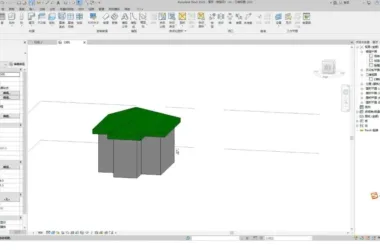
The civil engineering model integrates architectural and structural disciplines. Architectural elements—walls, doors, windows, curtain walls, elevators, and escalators—are modeled in Revit Architecture. Structural components—columns, beams, slabs—are modeled in Revit Structure. Structural beams are particularly critical since their heights directly impact pipeline elevations. Attention is also paid to structural drop panels. Figure 2 illustrates the structural model. The project features specialized structural elements, such as extensive beamless slabs in basements, thick slabs, and column caps, which significantly affect pipeline layout and must be carefully modeled following construction drawings. Revit’s customizable families facilitate modeling of these unique structural features.
3.2.2 Equipment Pipeline Modeling
Modeling and adjustment of equipment pipelines occur simultaneously, though for clarity, we separate them here. Pipelines are modeled using Revit MEP according to specialty construction drawings and divided into systems like supply air ducts, exhaust ducts, water supply, drainage, sprinklers, power cable trays, and lighting cable trays. Systems are distinguished by color coding, as shown in Figure 3. Modeling typically progresses top to bottom and from large to small pipes to simplify subsequent adjustments. Horizontal gravity drainage pipes require special attention—they must be modeled before air ducts and other water pipes because their slope prohibits upward bends, necessitating other pipelines to avoid them. Early modeling of gravity pipes facilitates better coordination.
3.2.3 Pipeline Adjustment and Clash Avoidance
To prevent collisions and control net height, pipeline avoidance adjustments are essential. Spatial relationships are closely monitored during modeling, and after local areas are modeled, Revit MEP’s clash detection tool is used to identify and resolve conflicts promptly. Waiting until full-floor modeling is complete slows detection and complicates corrections. The precision of the 3D BIM model allows fine-tuning of pipeline elevations. Figure 4 demonstrates precise adjustments at a complex pipe intersection to meet net height requirements, providing valuable guidance for construction teams.
3.2.4 Documentation and Visualization
Due to the 3D design approach, final deliverables differ from traditional methods. Our submissions typically include three layers:
(1) Conventional deliverables such as comprehensive pipeline plans and detailed local sections. For complex pipeline areas, 3D axonometric drawings are also provided to clearly illustrate spatial relationships, as shown in Figure 5 (a tower floor example).
(2) Pipeline elevation hierarchy diagrams—color-coded plans that visually communicate pipeline height variations using color depth and tone. This key feature of Revit MEP provides an intuitive overview of floor-wide pipeline elevations and net height, highlighting critical areas that influence clearance and guiding targeted adjustments or design revisions. Figures 6 and 7 illustrate this approach, which is well-received by owners and designers alike.
(3) Final BIM models are generally exported in 3D DWF format for owner review and construction coordination.
4. Advantages of 3D Pipeline Design Using BIM
For large, complex projects, BIM-enabled 3D pipeline design offers clear benefits. BIM modeling serves as a comprehensive “rehearsal” of the entire building, facilitating multidiscipline coordination and spatial review. It uncovers hidden design issues—often unrelated to code but critical to coordination and vertical space conflicts—that traditional single-discipline 2D reviews miss. Specifically, 3D pipeline design advantages include:
(1) BIM integrates all disciplines into one model, enabling thorough coordination checks. Collisions in space and direction are identified, and real-scale modeling reveals previously omitted details such as pipe insulation layers, exposing latent problems.
(2) Complete professional modeling of civil and equipment elements allows sectional and axonometric views at any location to observe and adjust pipeline elevations.
(3) BIM software can automatically detect all collisions among pipelines and between pipelines and structures, providing feedback for resolution and effectively eliminating conflicts.
(4) Accurate elevation determination and visual representation of floor net height distribution help identify bottlenecks, optimize designs, and precisely control ceiling heights.
(5) Beyond traditional plans and sections, the 3D BIM model offers intuitive, navigable views for clear understanding of pipeline relationships.
(6) The integration of equipment pipeline data into BIM enables accurate quantity takeoffs, partially automating equipment calculations.
5. Technical Insights and Practical Experience in 3D Pipeline Design
3D pipeline design is a key BIM application area. Although BIM technology and software have advanced significantly, ensuring high-quality, efficient design across projects requires attention to technical details and continuous exploration. Below are insights from our practice.
5.1 Project Experience
(1) The Revit suite demands high-performance hardware, especially for large projects like high-rises. Projects should be logically divided, commonly by floor or by civil and equipment disciplines, or combining both and linking models.
(2) To streamline design and maintain standards, technical supervisors must set up foundational configurations, including pipeline system types, colors, line weights, view templates, and annotation styles. A project template file should be prepared for reuse.
(3) In team collaboration (“worksets” in Revit), dividing work by discipline is common but hinders pipeline coordination and net height control. Dividing work by floor, assigning a single person responsibility for all pipelines on that floor, improves adjustment efficiency.
5.2 Technical Discussions
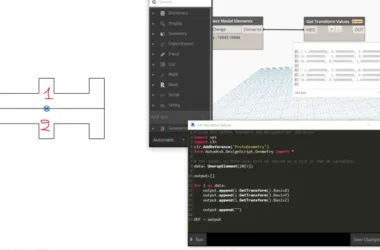
Comprehensive multidisciplinary modeling is labor-intensive. Improving modeling efficiency and accuracy is crucial. Our choice of Revit was influenced by its open API, enabling custom plugin development to automate repetitive tasks. Notable examples include:
(1) Sprinkler pipe modeling is particularly tedious. Our “Pick up the centerline pipeline” plugin (Figure 8) converts 2D lines with diameter annotations into 3D pipe models, automatically adding connectors, nozzles, and annotations in a single step, transforming manual work into instant automation and greatly enhancing productivity.
(2) Pipeline avoidance often requires bending pipes up or down, traditionally a multi-step process. Our “Pipeline height increase” plugin (Figure 9) reduces this to a single step, simplifying adjustments.
Additionally, the default pipeline elevation hierarchy color scheme in Revit has limitations—it doesn’t apply to fittings or endpoints, nor to 3D views, and height adjustments are cumbersome. Our custom “Pipeline Elevation Hierarchy” plugin addresses these issues, as shown in Figure 7. We have also developed various small plugins to boost efficiency, such as quick generation of local 3D views and automatic section creation from selected components. Due to space constraints, these are not detailed here. Importantly, these tools were developed by architects without professional programmers, demonstrating Revit’s commendable API accessibility.
6. Future Prospects of 3D Pipeline Design
As a fundamental BIM application, 3D pipeline design offers both immediate benefits and long-term significance. While BIM adoption is growing, many projects still rely on traditional 2D drawings due to familiarity and inertia. Promoting BIM through widespread 3D pipeline design adoption is an effective way to encourage designers to embrace this technology. We anticipate that more large, complex projects will leverage BIM for comprehensive pipeline design, enabling designers to overcome the limitations of 2D methods, enhance efficiency, reduce errors and rework, minimize resource waste, and elevate engineering design to new heights.













Must log in before commenting!
Sign Up