
Many large and mega projects are adopting BIM technology, but how can it be widely implemented across construction projects on a large scale? Pinming Group believes that scenario-based applications are the most effective way to realize the true value of BIM.
Why do we say this? Let’s hear from Li Zike, General Manager of the BIM Business Unit at Pinming Corporation. Below is the full text of Li Zike’s speech at the “2017 First China BIM Manager Summit Forum” (with some edits):

Good morning, experts, colleagues, and friends!
Tea Tasting has been serving the construction industry’s digital transformation for over 20 years. Today, it’s a rare and honored opportunity to host this conference organized by the alliance and association, where we can discuss BIM-related topics together.
Regarding BIM application, many large and mega projects are already using it, but how can we popularize and apply BIM on a much larger scale in project construction? This is something Tea Tasting is actively exploring and promoting. Hence, my talk is titled *”Research and Practice on BIM Scenario Application.”*
Understanding Scenario-Based Application
BIM application can be viewed on two levels: from isolated projects to all projects, and from individual use to lifecycle-wide adoption. Large projects usually have sufficient resources, talent reserves, and user-friendly software tools to carry out BIM tasks effectively. But many construction units lack these resources—so how should BIM be applied there?
Take the construction party as an example. The management environment often involves unfinished design drawings and tight on-site schedules, leaving little time for detailed modeling. The mismatch between on-site management and personnel investment limits BIM’s widespread use.
To address this, we propose scenario-based applications. But what exactly is scenarization? How can it help popularize BIM?
Let me share this concept with some images:

These four pictures all depict scenes of eating:
– Picture 1 shows a basic motivation: hunger, so the need is simply to eat.
– Picture 2 involves eating but also making friends; communication becomes a deeper need beyond just food.
– Picture 3 depicts a scene where the goal is to build a good relationship with a leader, hoping to secure projects.
– Picture 4, the “Hongmen Banquet,” is a formal scene where people watch but do not eat.
Motivation determines the appropriateness of the scene. For example, if I’m hungry, a bowl of noodles suffices. But if I want to impress an important guest, I need a place with a good atmosphere. If the goal is just socializing, I can even eat at home.
This highlights that scenarization centers on rationality—matching the environment and resources appropriately without blindly applying BIM or being dogmatic. A friend recently said we shouldn’t simply copy BIM application guides from others because resource and funding environments differ.
Pinming defines BIM scenario-based application as follows: during engineering construction, to complete one or more work tasks, BIM is rationally selected and applied based on actual project resources and management environments, to improve work or production efficiency.
There are three key elements:
1. Combine your own resources and management environment.
2. Choose scenarios reasonably.
3. Ensure improved work or production efficiency.
Without these, BIM application cannot progress far.
Reasonable Selection of BIM Application Scenarios
Regarding BIM application motivation, I categorize it into five types: policy requirements, winning awards, meeting homeowner standards, improving internal capabilities, and enhancing project value. Some leaders focus on management improvements, others on bidding advantages. Each scenario differs, so the depth of BIM use varies.
We identified 33 application scenarios, each with smaller sub-scenarios. How do we choose among them?
We measure implementation viability by five factors:
1. Relevance to the specific profession and job responsibilities.
2. Ability to solve actual on-site problems (e.g., drawing reviews).
3. Clear, explicit value.
4. Controllable costs.
5. Replicability—applications must be reproducible across projects.
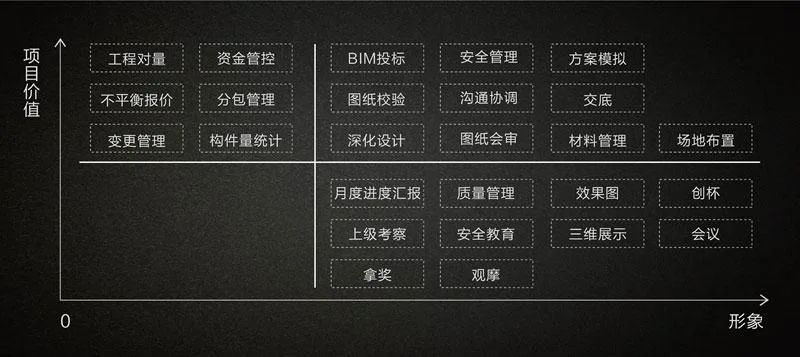
Scenario-based BIM application can be approached from two dimensions: image and project value, balancing both form and substance.
For example, in a project with Shanghai Construction Second Construction Company managing materials, previous practice required approvals before procurement. Their annual cost for turnover materials is 200 million yuan.
They now use modular buckle-type steel pipe scaffolding, which requires precise quantities for each component to ensure connectivity. Previously, estimations were rough, lacking refined data for management.
Now, using our module software and site layout tools, the main materials are accurately calculated and visualized for unified review, reducing costs by 30 million yuan annually.
This example shows that projects with both image and substance merit significant attention and bring great value.
However, many areas remain challenging, and some BIM applications are done quietly without much promotion. For significant visual needs, discretion is necessary—not just rejecting ideas but carefully selecting what to pursue.
BIM scenarization depends on matching actual project resources and personnel quality. For example, many projects lack staff familiar with modeling software but still need BIM. We offer a range of software solutions to suit different needs. If a project has a BIM personnel structure and corresponding software and hardware management, scenarization can be fully utilized.
Three Major Application Scenarios: Tracking Audit, Project Construction, and Smart Security
Based on our understanding, we have distilled three major BIM application scenarios:
– BIM tracking and auditing
– BIM project construction
– BIM smart security
After four years of industry research and development, we are now bringing these to market.
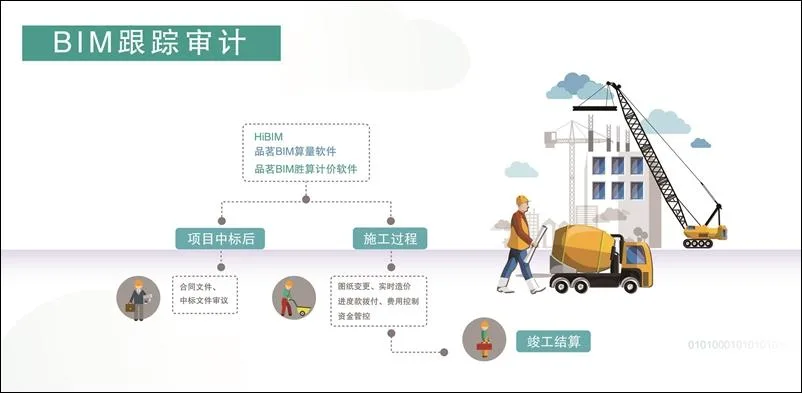
**BIM Tracking Audit:**
Primarily used by cost consulting firms for follow-up audits on behalf of owners, focusing on accounting of contract forms. A key challenge is generating greater value and visualization after model adjustments.
Real-time cost estimation after drawing issuance is essential, as is providing owners with up-to-date data for fund management. When changes happen, model-based pricing offers timely theoretical support for funding.
Many cost consulting firms now promote tracking audit systems within their projects.
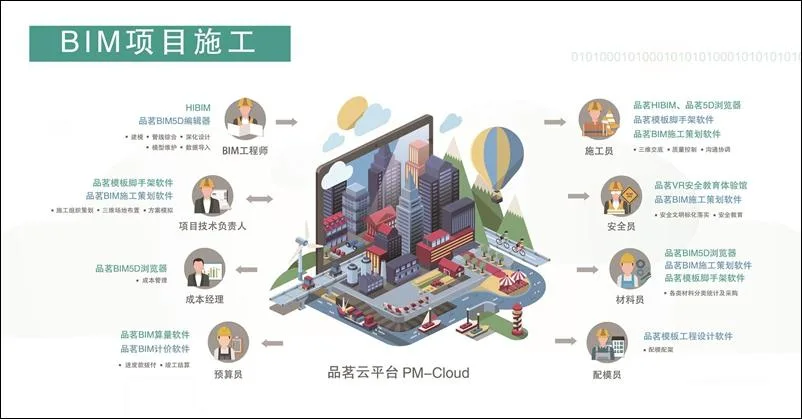
**BIM Project Construction:**
Construction units frequently use and discuss BIM project construction. Here is the system diagram of a Tea Tasting project construction.
A cloud platform connects various tools and software, allowing visual display so leaders can monitor application results and progress per role. Each position can download data from the platform or work independently.
For example, site layout can be done directly on software or integrated with the cloud platform.
We also actively promote output management. We released a quantity calculation software based on the Revit platform that integrates modeling, optimization, and output.
Currently, many BIM models remain solely within BIM centers, forcing quantity surveyors to remodel, which wastes labor. Our solution combines the model with domestic inventory quotas, allowing budgeters to adjust models and generate real-time outputs efficiently.
Our project construction application system is established, and I will share pilot project results shortly.
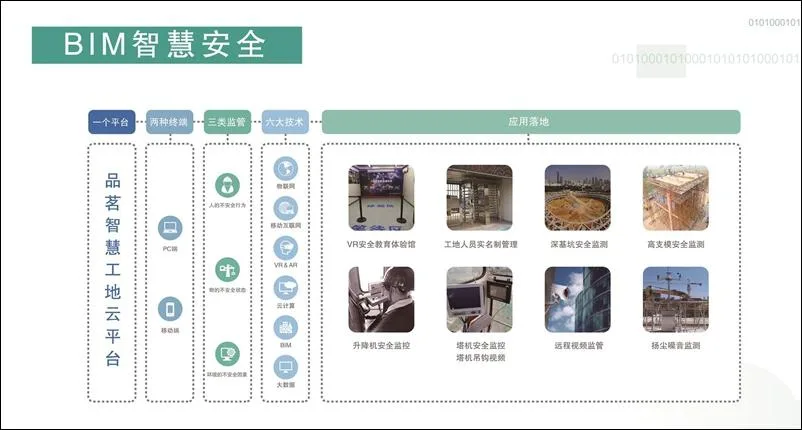
**BIM Smart Security:**
We have launched management applications for eight major security scenarios, unifying management of personnel, environment, and objects.
Through the intelligent construction site cloud platform, on-site staff positioning is combined with the model to monitor personnel in real time.
For example, tower crane safety is managed through three technical levels, integrating real-time status and models for safety oversight.
Another example is safety education. The Pingming VR Safety Education Experience Hall is one of the earliest products launched domestically, featuring 18 VR scenarios. The China Construction Third Engineering Bureau has widely promoted it.
Our security efforts encompass software and customer applications. The platform collects real-time data from over 10,000 tower cranes daily, with updates every 5 seconds on average.
We are exploring big data applications for safer tower cranes and are actively researching this area.
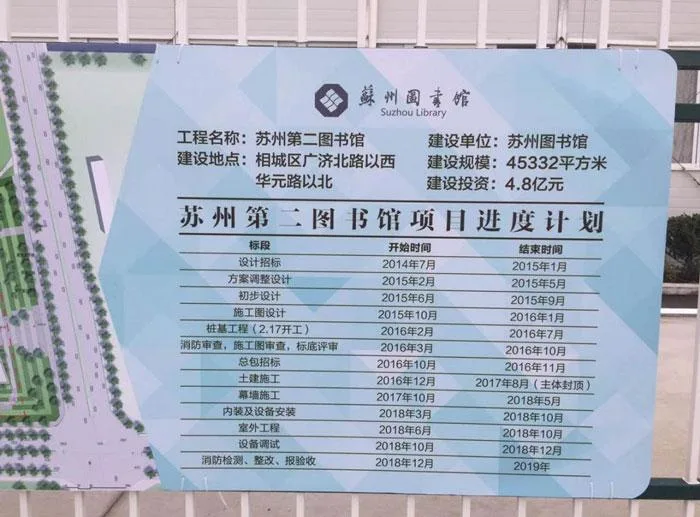
The Suzhou Second Library project was taken on by the general contractor in December 2016, with the basement roof poured on April 18, 2017
After introducing these three major application scenarios, let me share a practical case.
For the Suzhou Second Library project, the project leader initially wanted to use BIM personally. I reported all application points and scenarios to him, identifying which were useful.
We promoted these extensively in Beijing, Shanghai, and Guangdong, sorting through all applications to determine their value.
Since modeling personnel are indispensable, project coordination was tied to actual progress. The safety department manager and project manager coordinated promotion.
On-site layout and planning were handled not by BIM personnel but by the on-site technical staff themselves, who used BIM software to implement project planning, site arrangement, and progress simulation.
The basement roof was poured on April 18.
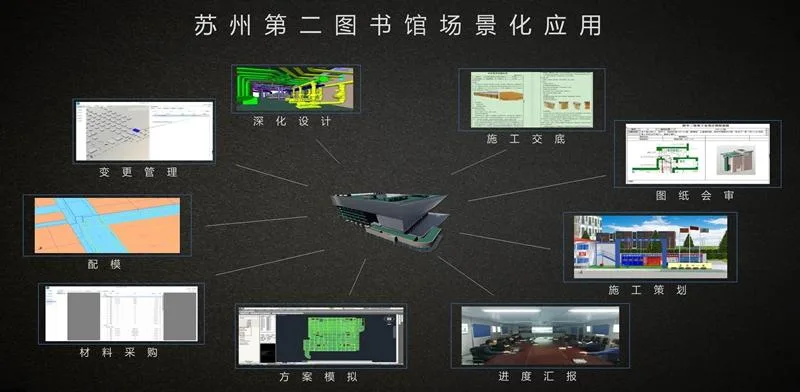
Regarding application results, we selected 9 key application scenarios. When evaluating return on investment, we consider how many people are needed to complete the work and how to match personnel to projects.
This pilot project is fully applying every aspect in practice. Currently, 13 companies and over 40 engineers are involved. Some have BIM software experience; others are new to BIM.
For each job, we organize tailored training based on the project’s actual applications. After learning, participants practice on the job.
Scenario-based applications have opened a new era for BIM. Today, they are no longer limited to large or well-funded projects but are widely promoted in small and medium-sized projects.
Scenario-based BIM aligns user needs and demands, achieving greater returns with less investment. It is essential not to operate at a loss. This guiding principle drives our current BIM promotion.
Thank you all!













Must log in before commenting!
Sign Up