
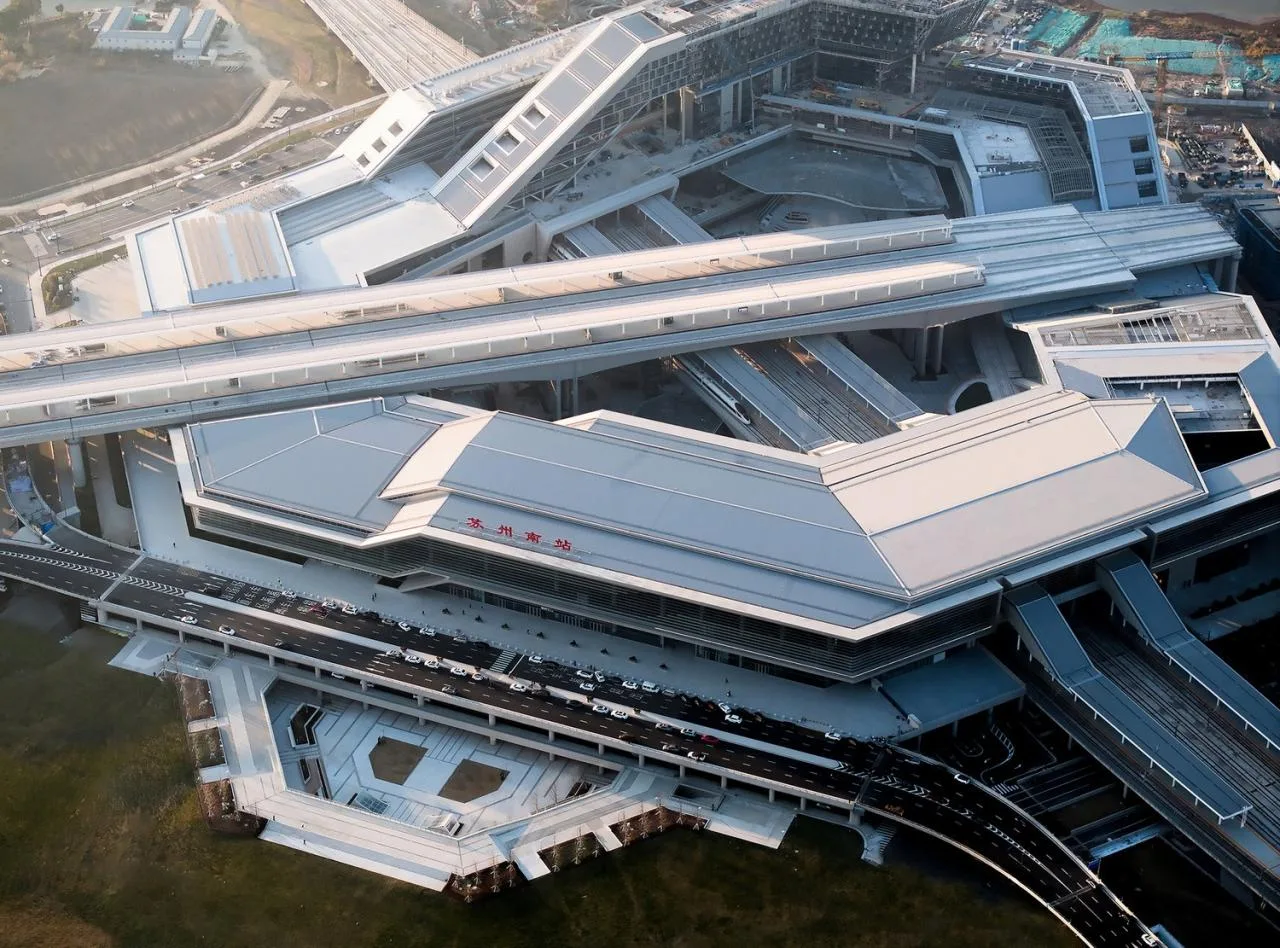
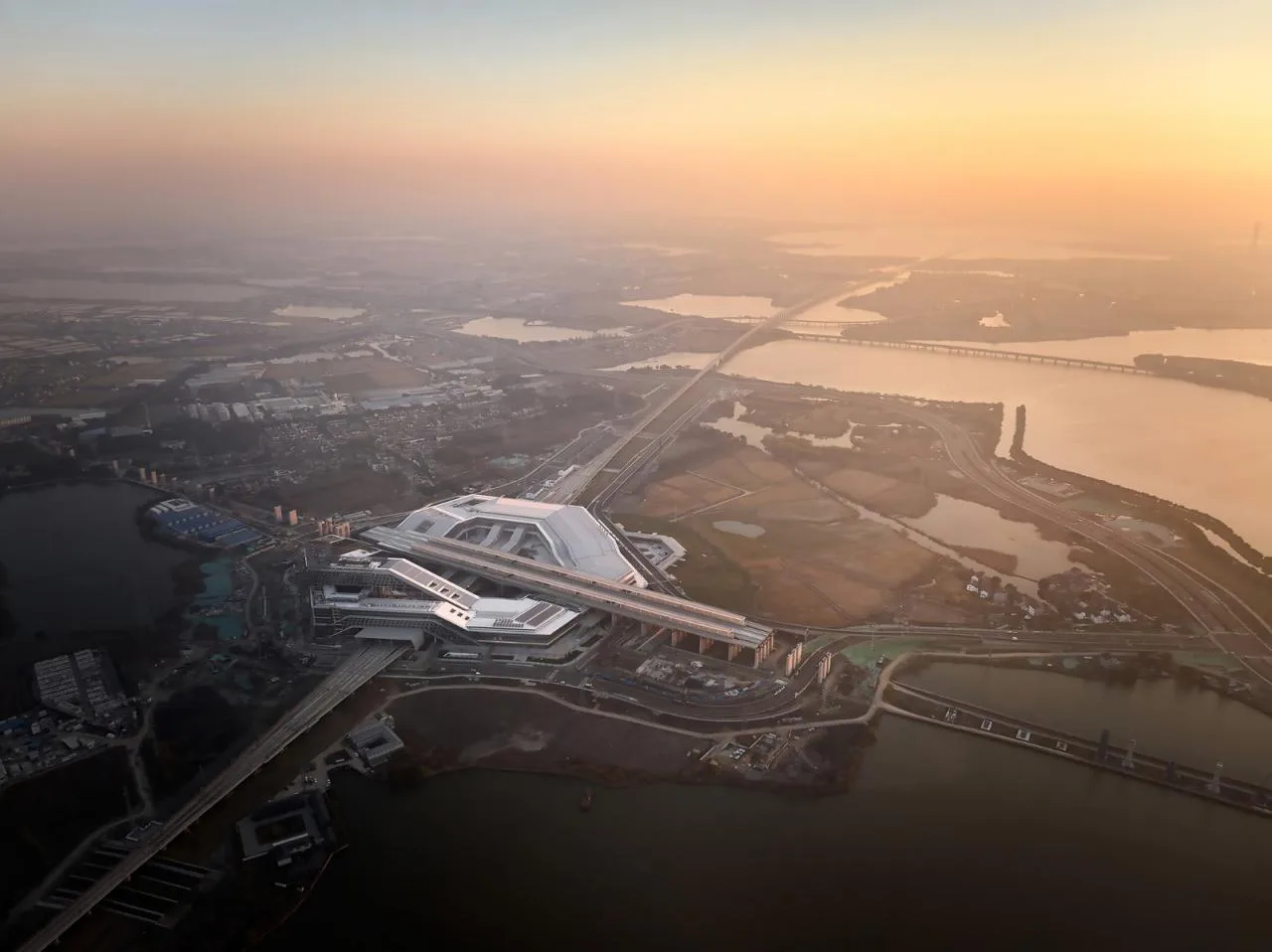
On December 26, 2024, Suzhou South Station—the first “hexagonal” three-dimensional transportation hub complex in China—officially opened. Located in the Wujiang Fenhu High-Tech Zone, it serves as the external gateway to the Yangtze River Delta Ecological Green Integration Demonstration Zone. This shared hub is positioned at the intersection of the Shanghai–Suzhou Lake High-Speed Railway and the Tongsu–Jiayong High-Speed Railway.
The station building spans 40,000 square meters, featuring 4 platforms and 12 tracks: two platforms and six tracks for the Shanghai–Suzhou Lake line, and two platforms and six tracks for the Tongsu–Jiayong line. The intercity and urban rail lines run parallel underground, forming a distinctive “*”-shaped layout.
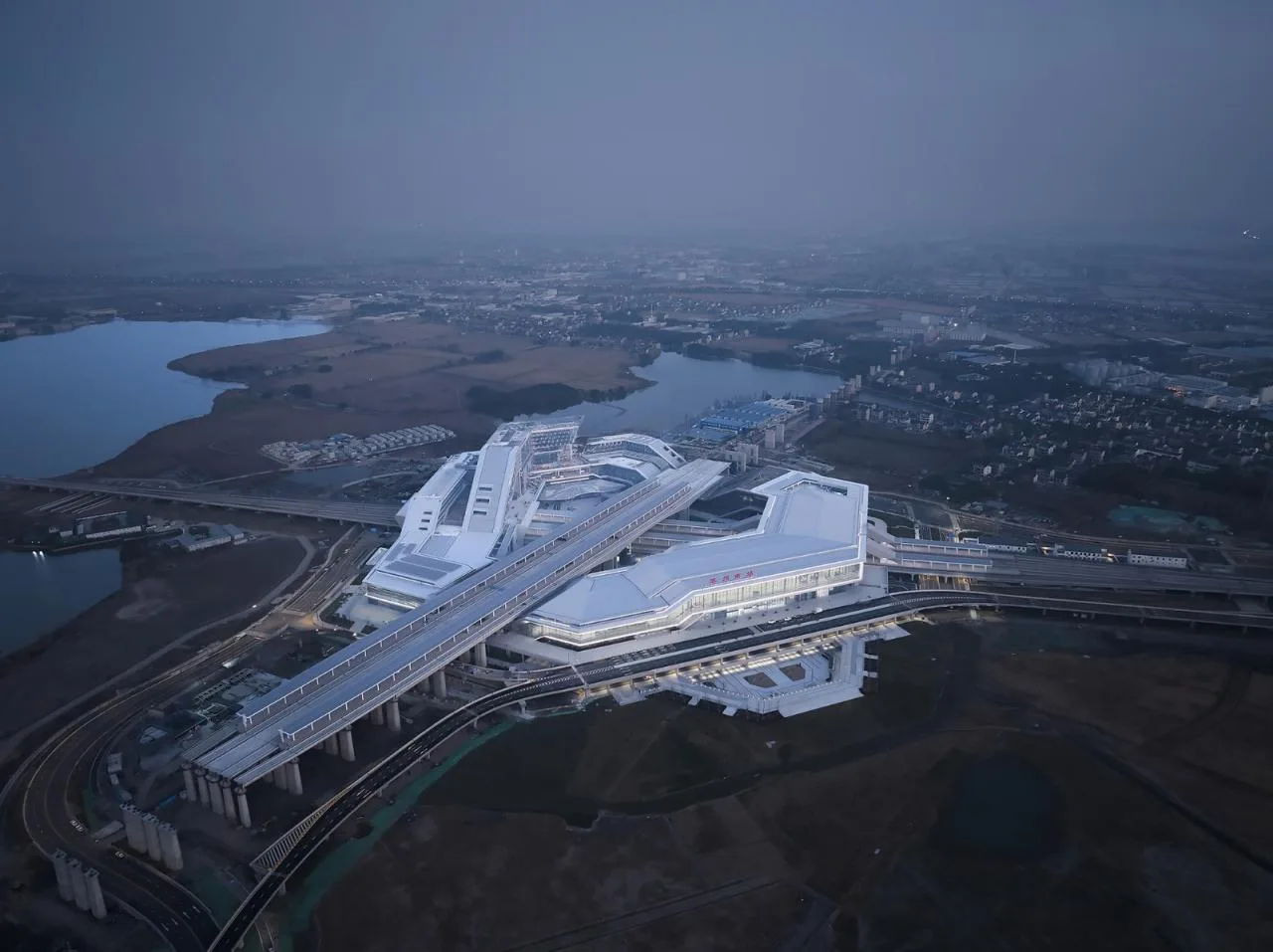
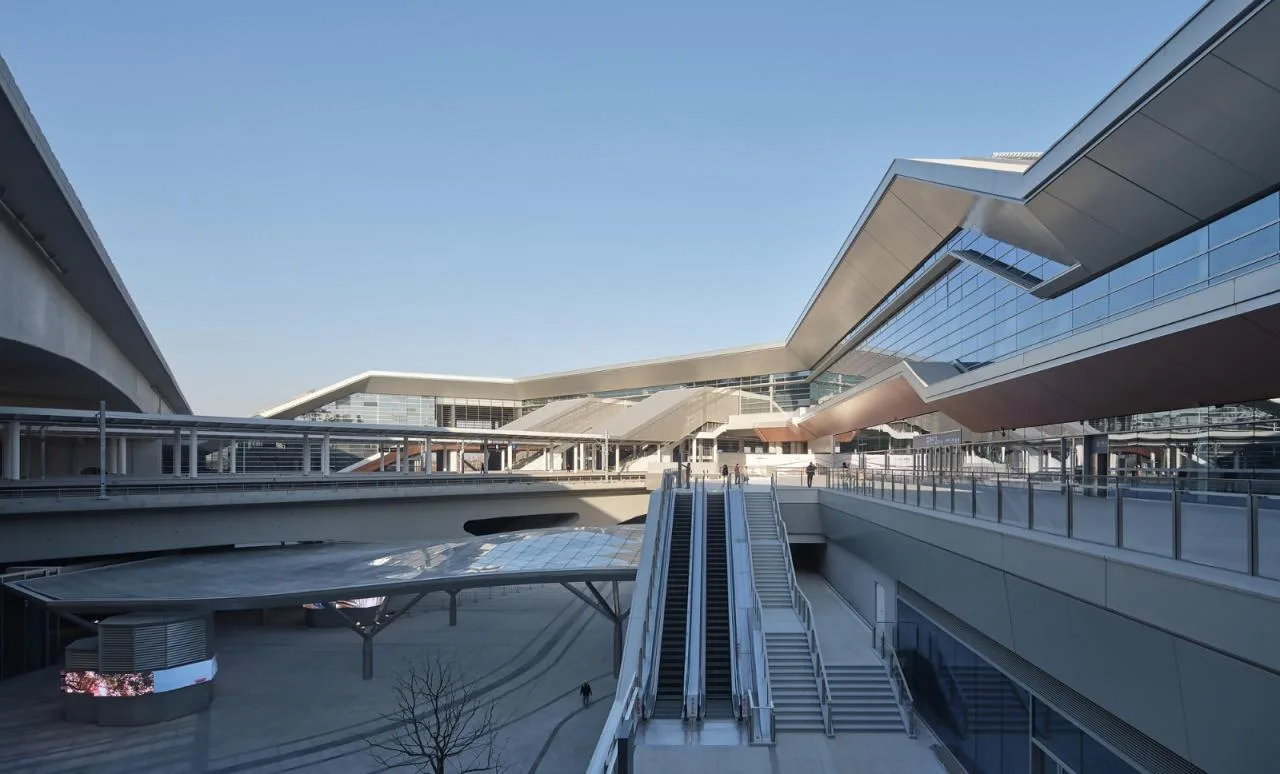
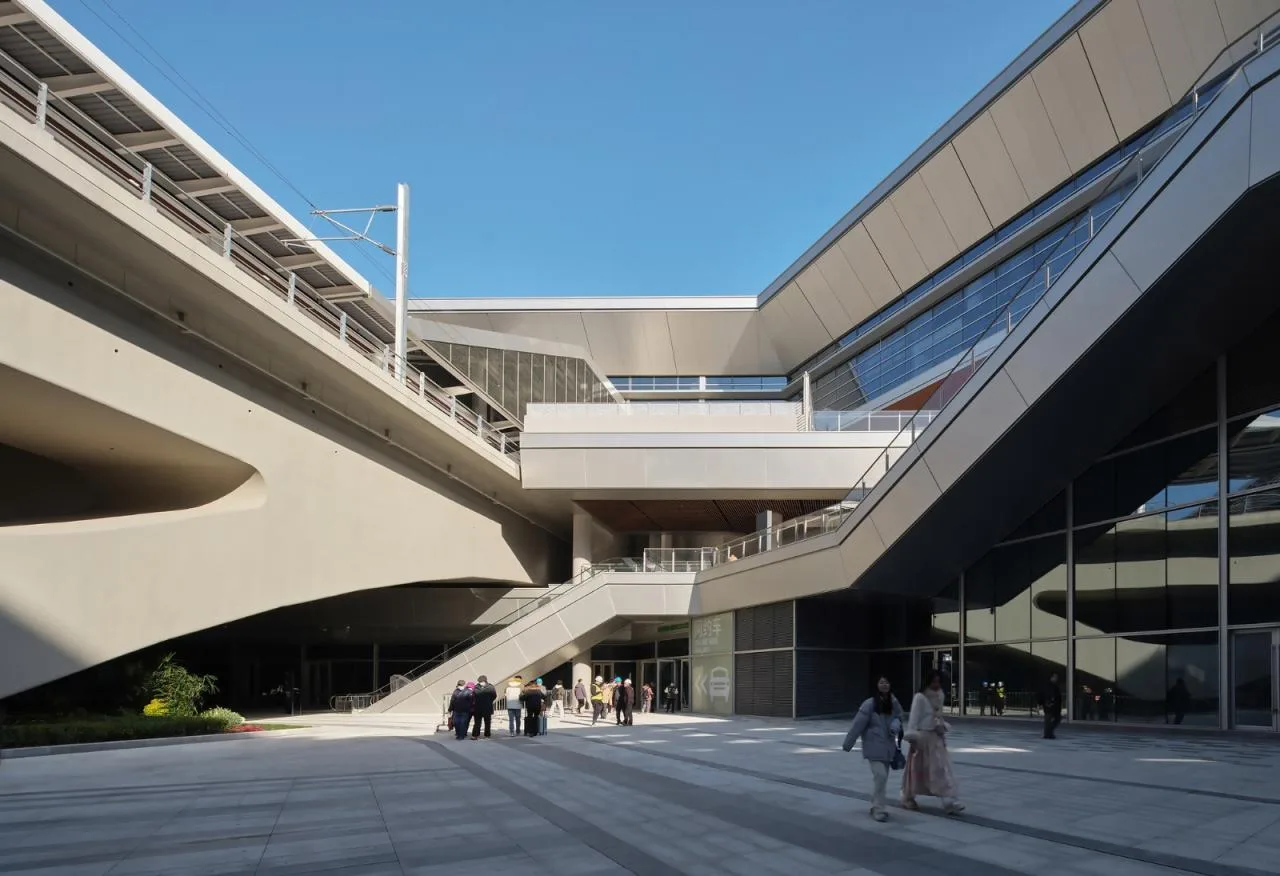
As a cutting-edge example of station-city integration tailored to China’s national context, the Suzhou South Station Hub Complex aims to craft an innovative space that combines the charm of a traditional water town with futuristic design. This vision is realized through efficient transportation organization and diverse, integrated development.
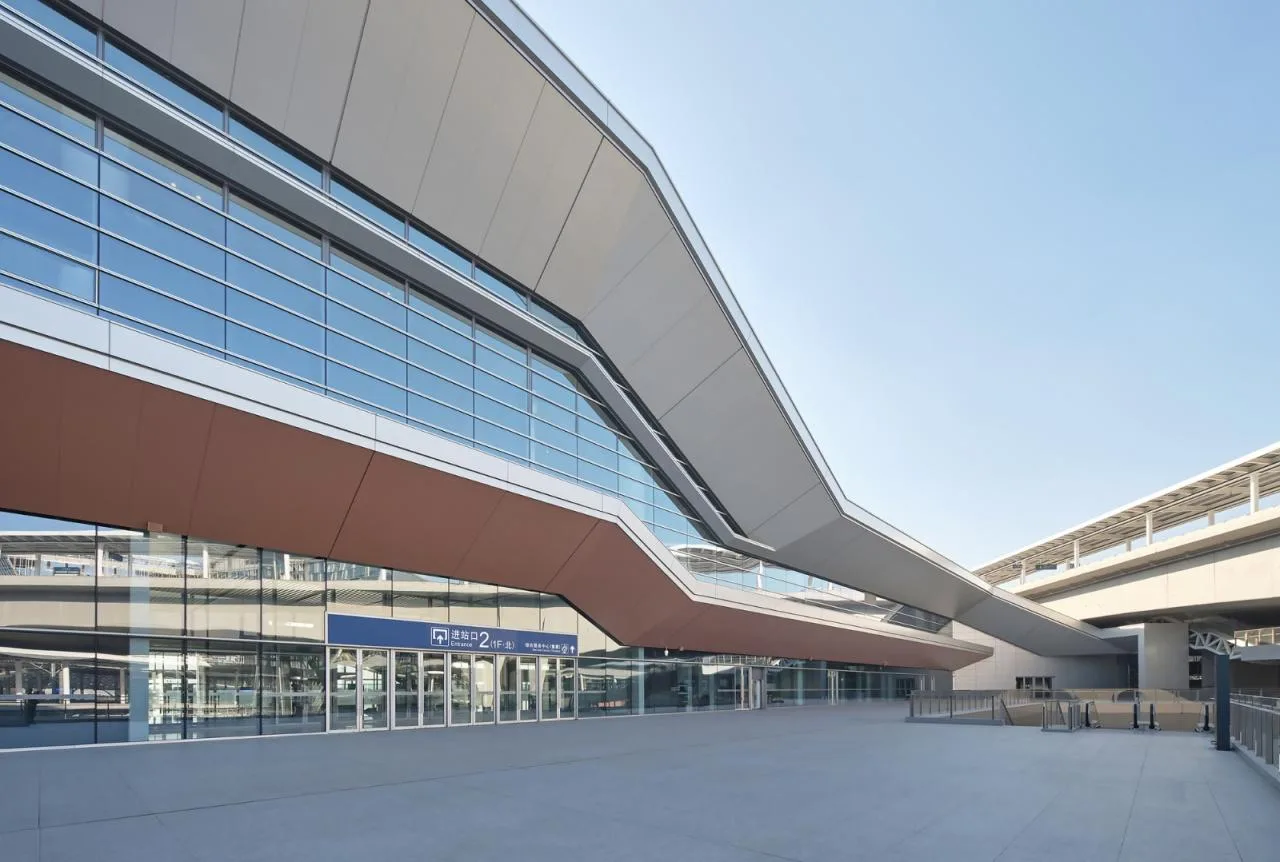
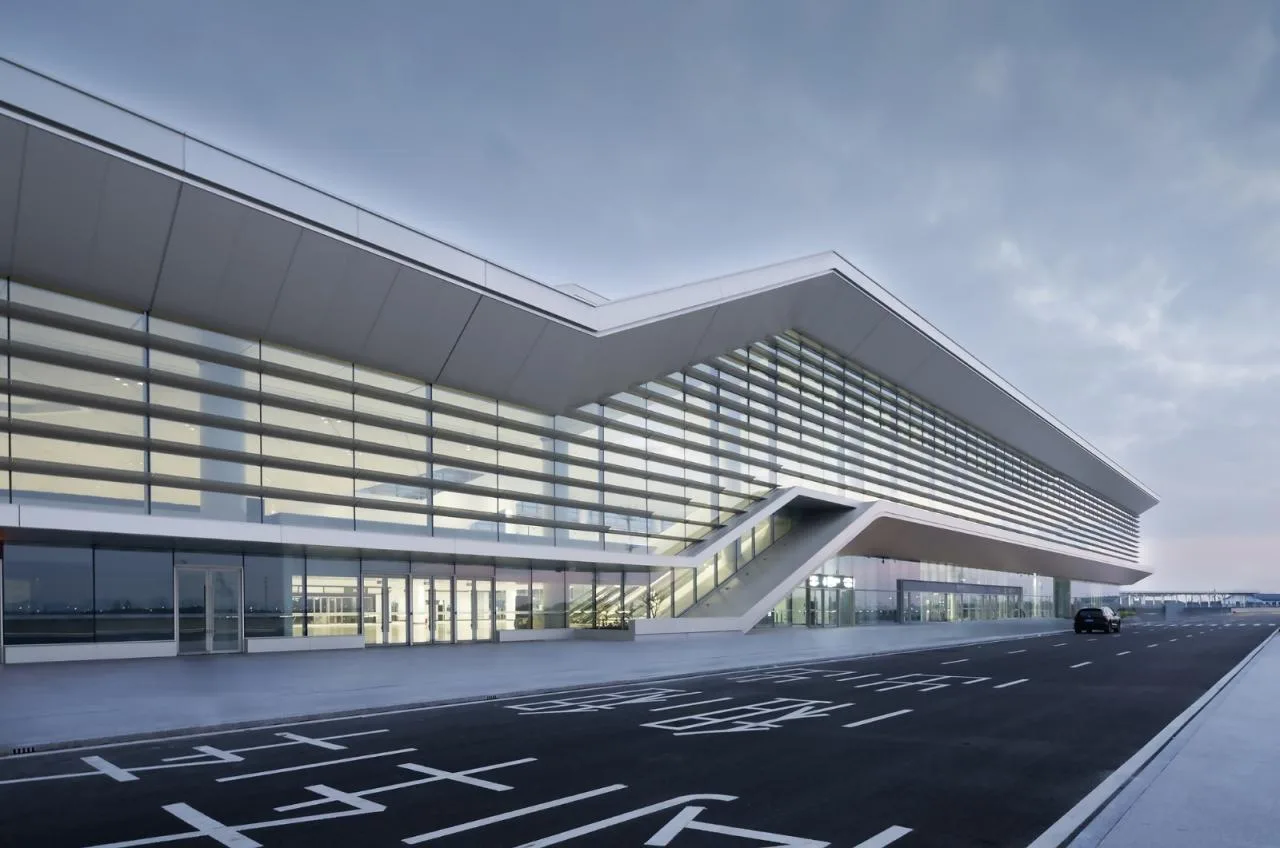
Innovative Cross-Yard Station Layout
Cross-shaped railway stations feature vertically overlapping railways from different directions. Typically, one railway line detours twice by 90 degrees to simplify traffic organization. While this design reduces complexity, it also slows train speeds, increases travel time, and can raise construction costs.
With China’s railway network becoming denser, the number of such cross-shaped stations is growing. However, these layouts need improvement regarding passenger transfers, urban connectivity, and spatial experience.
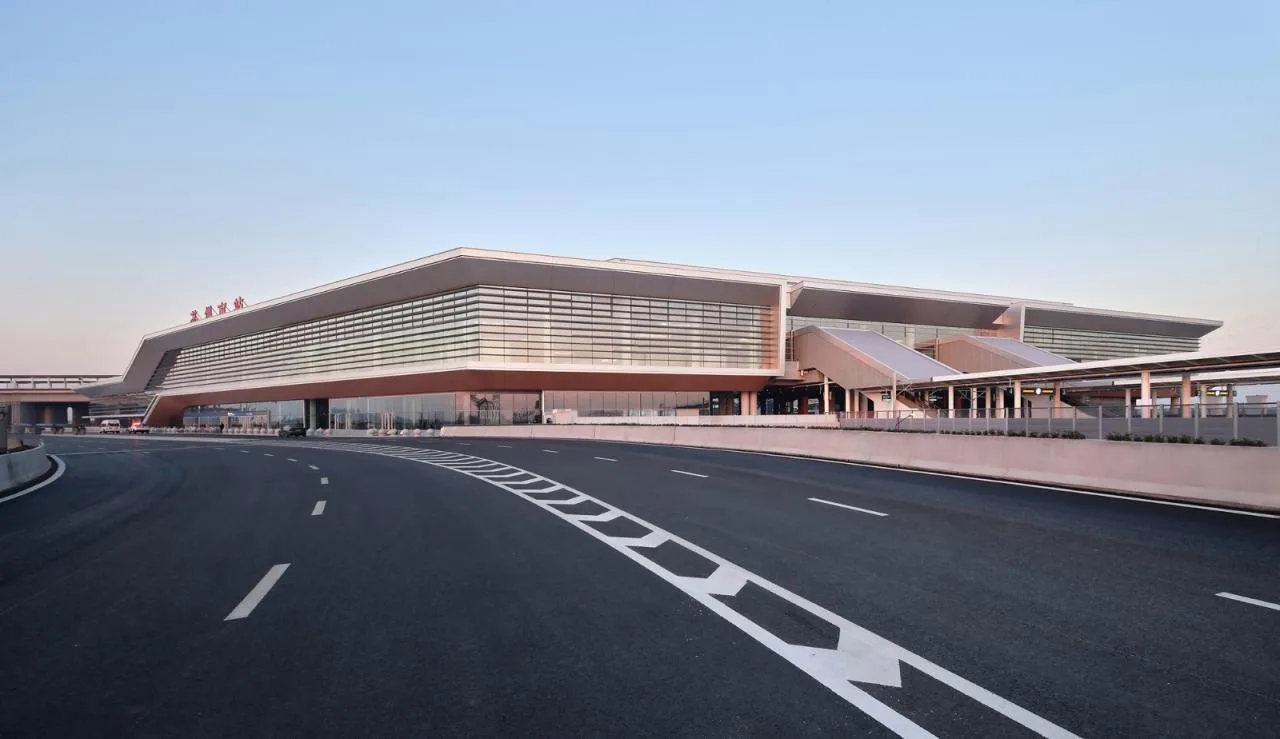
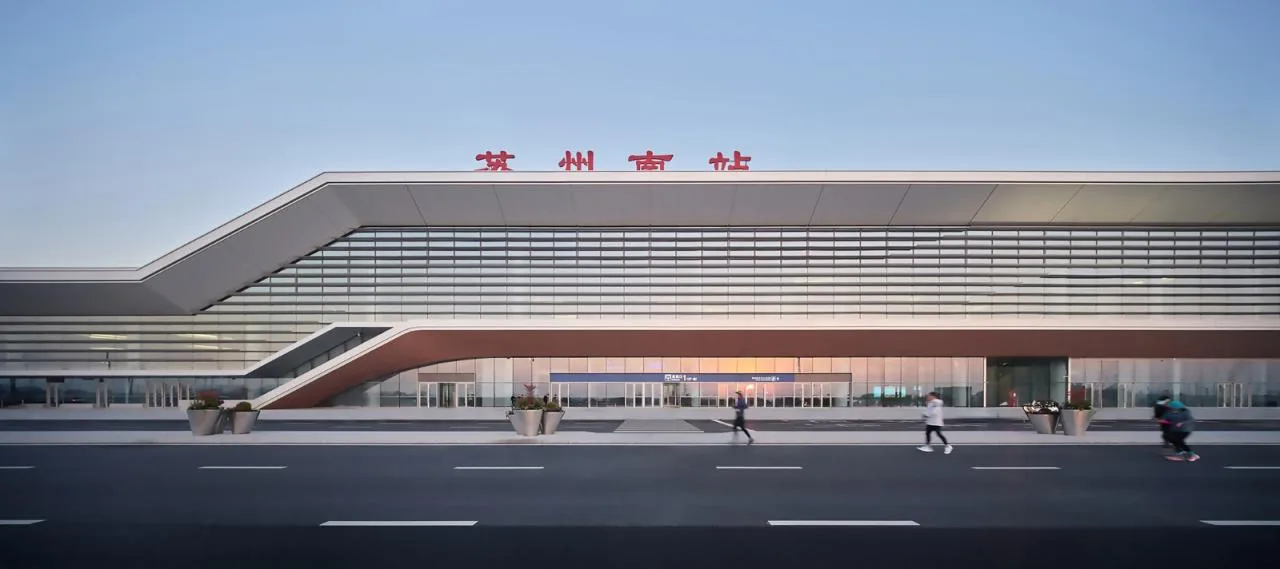
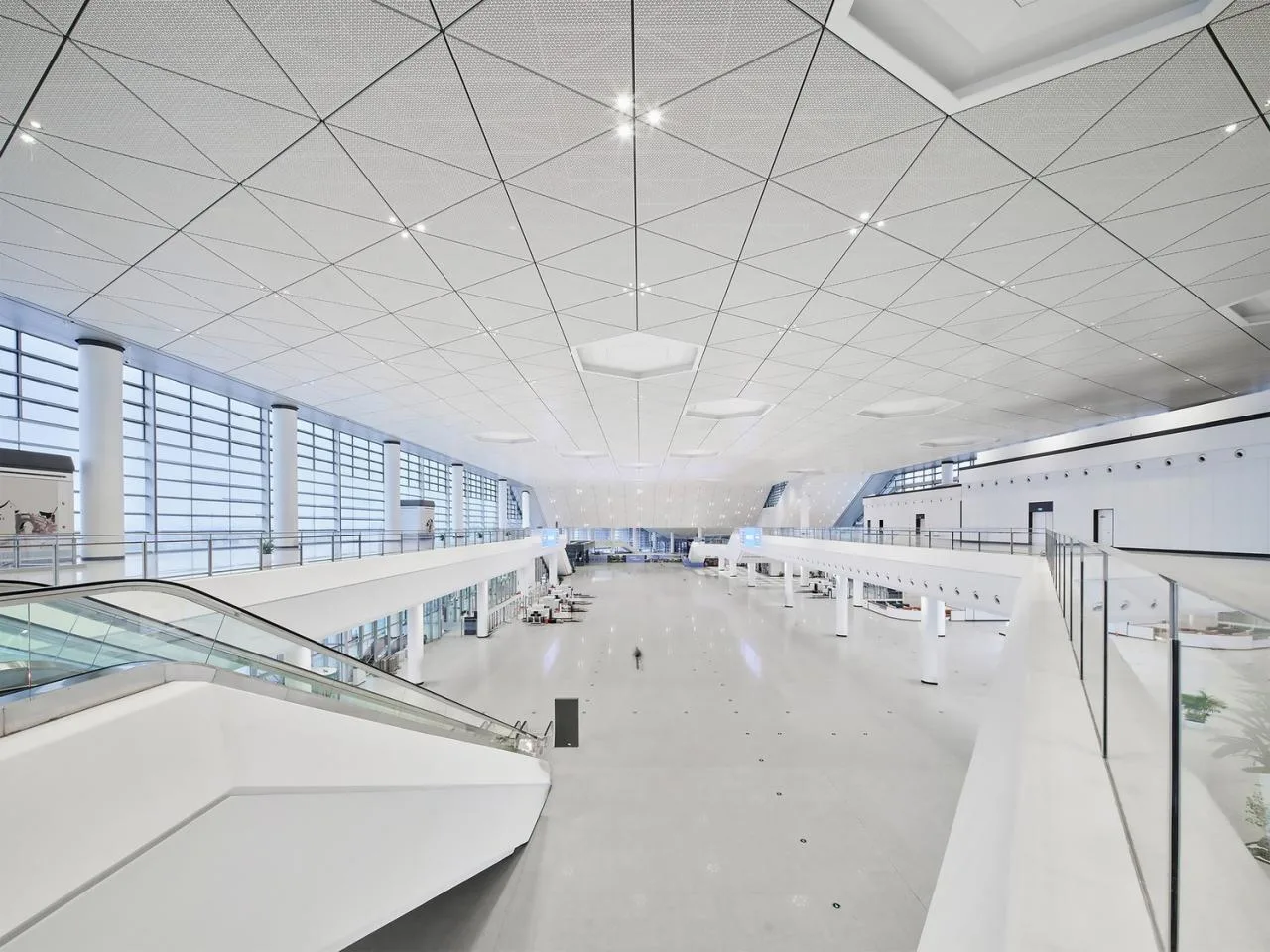
To address these challenges, Suzhou South Station introduces a unique “Z”-shaped asymmetric layout without altering the traditional station’s basic traffic flow logic. The Hu Su Lake Station adopts an “up and down” flow for entry and exit, while the Tong Su Jiayong Station uses a “down and in-out” pattern. Both stations share a unified entrance and exit hall, reducing passenger confusion and improving flow efficiency. Clear directional guidance has significantly enhanced the speed and ease of station access.
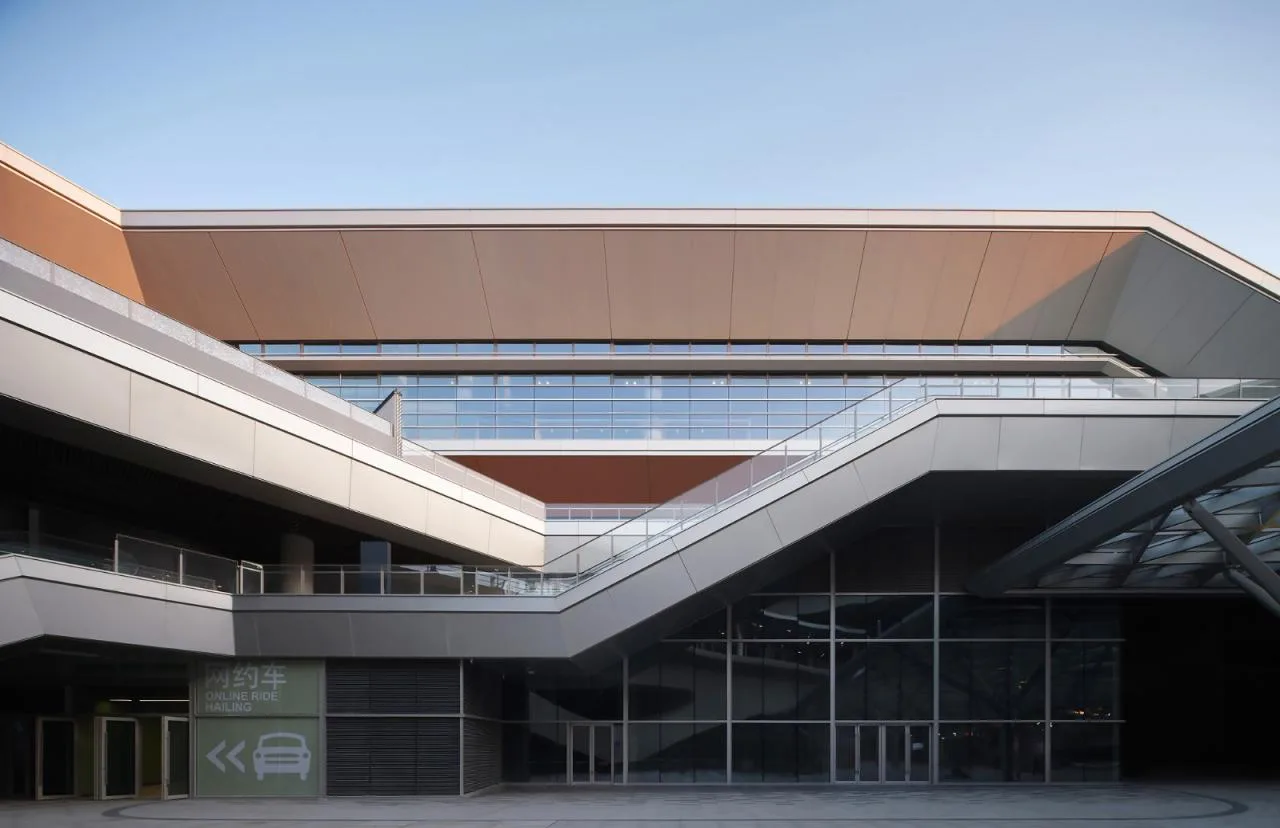
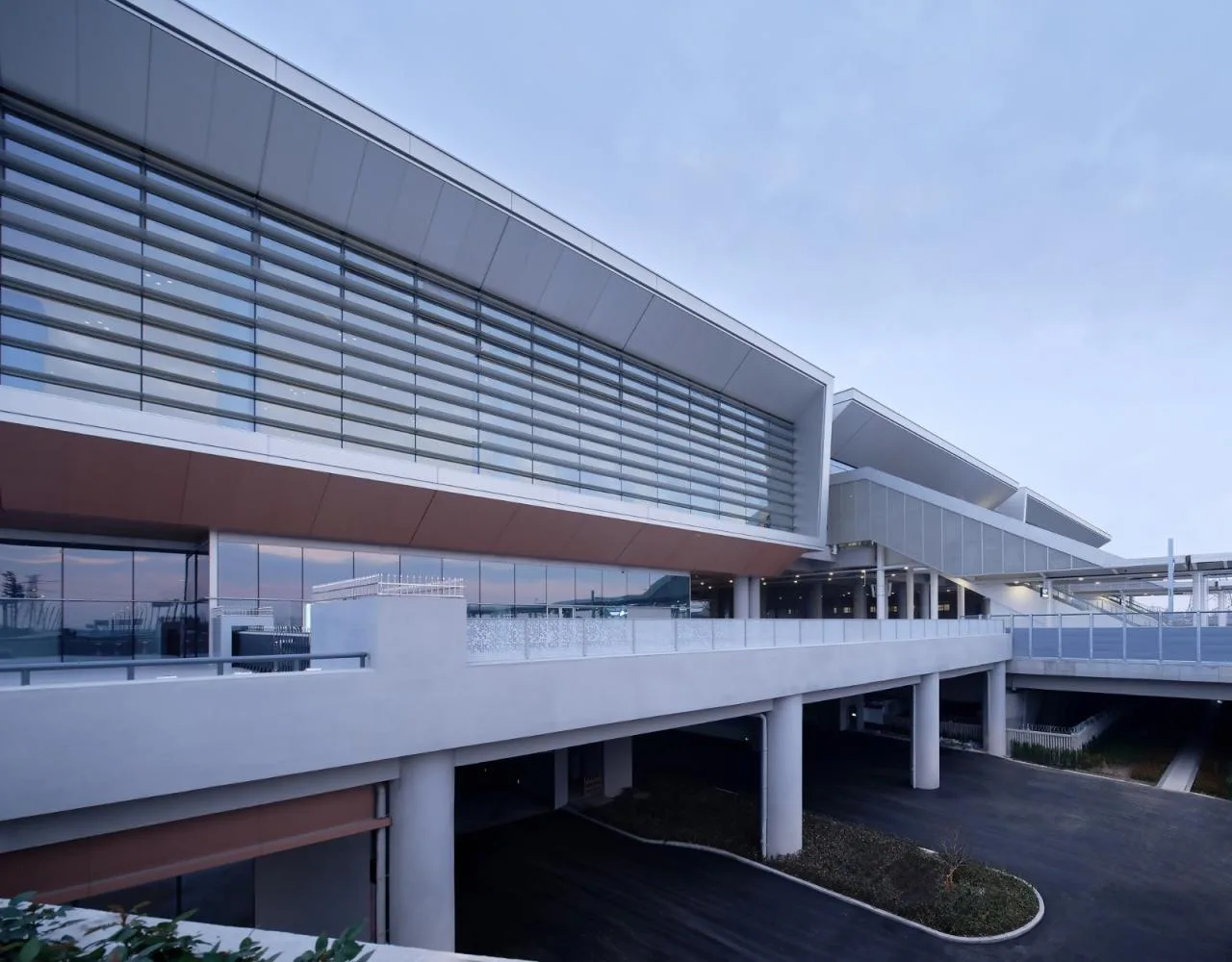
This innovative layout has revitalized inefficient land usage at the two railway intersections, enhancing the station’s connection to the city. Urban transportation transfer centers and centralized exit halls are positioned at these key points, providing seamless access to subways, taxis, long-distance buses, and local bus services.
Transfers between different transportation modes are conveniently kept within 200 meters, with average distances of 60 meters at entrances and 130 meters at exits. This design enables passengers to complete transfers within five minutes, promoting an efficient, safe, and comfortable transportation system with minimal hassle.
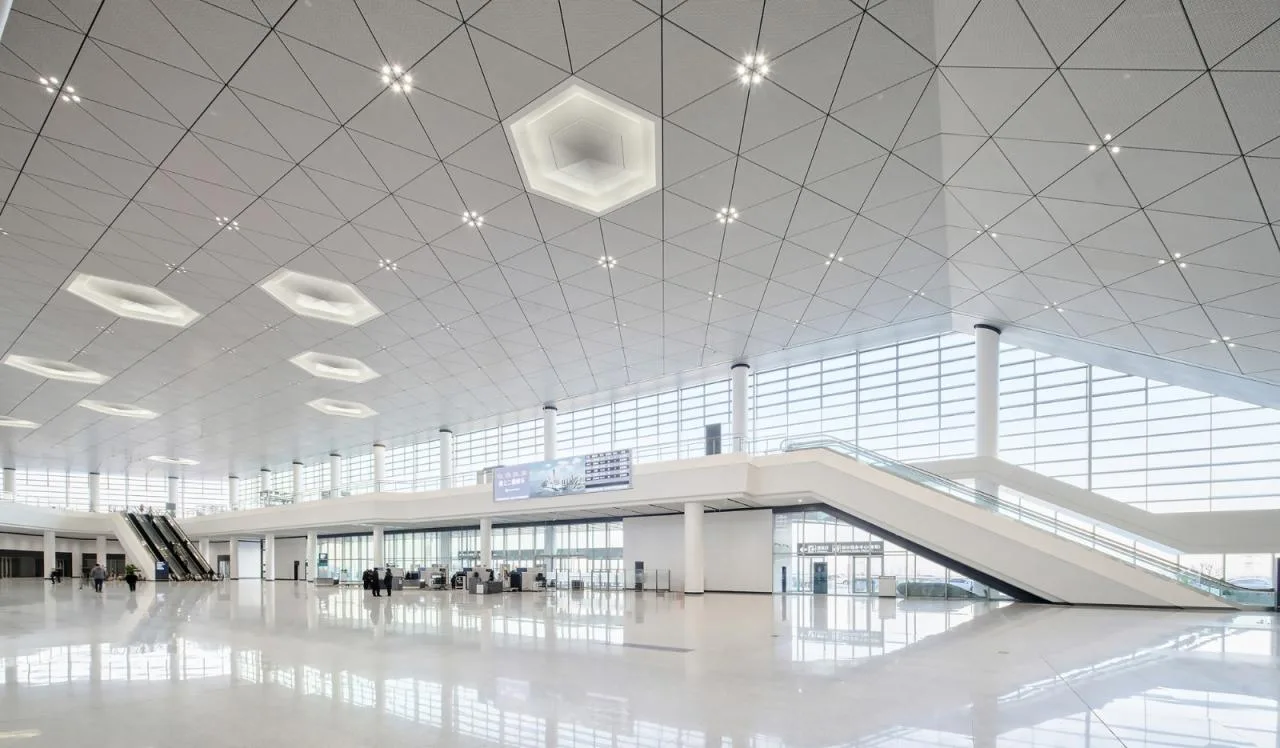
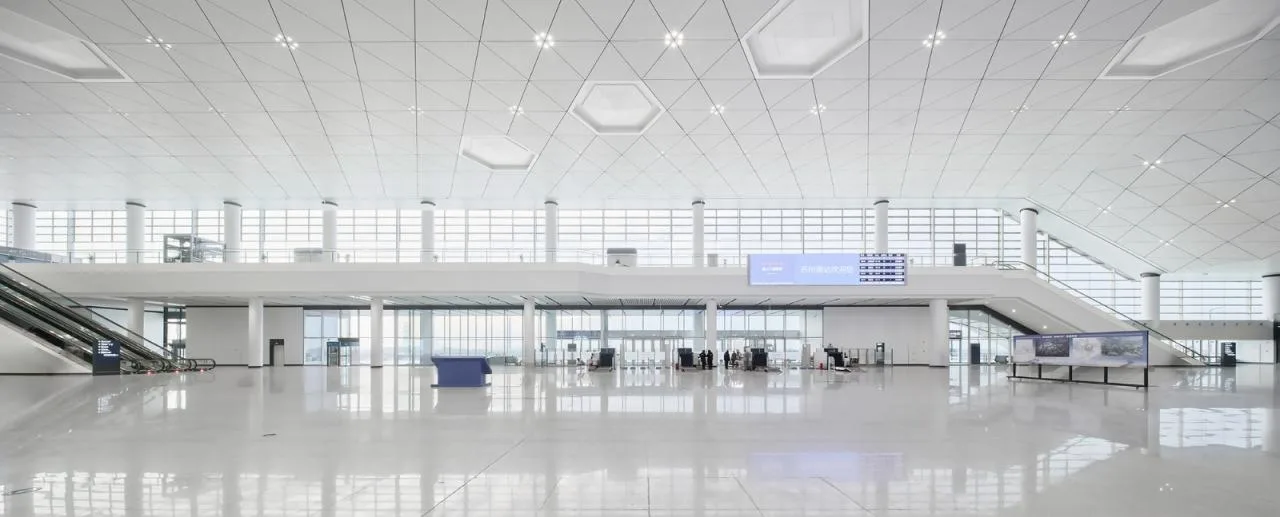
Three-Dimensional Integrated Hub in a Water Town Setting
Surrounded by a dense network of waterways, Suzhou South Station embraces its ecological green context while balancing strong urban development demands with limited land resources. The project pioneers an integrated station-city development model by merging local and railway red lines into a large-scale unified development boundary.
This approach fosters a shared community of interests among all stakeholders and aligns transportation planning with urban design. Unlike traditional models where local infrastructure must avoid national railway red lines, this comprehensive red line enables simultaneous, unified planning and construction. As a result, it bridges fragmented land areas separated by railways, promoting intensive land use and urban cohesion.
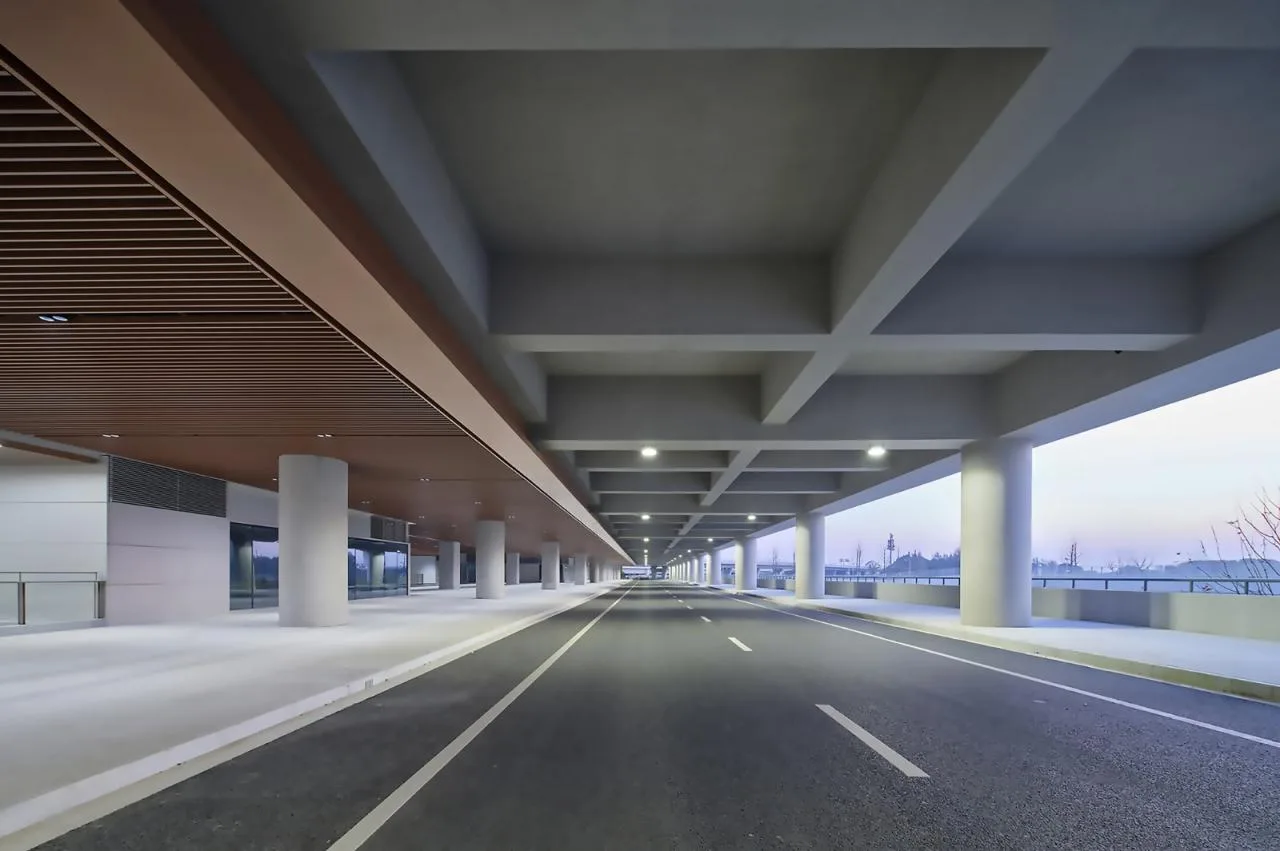
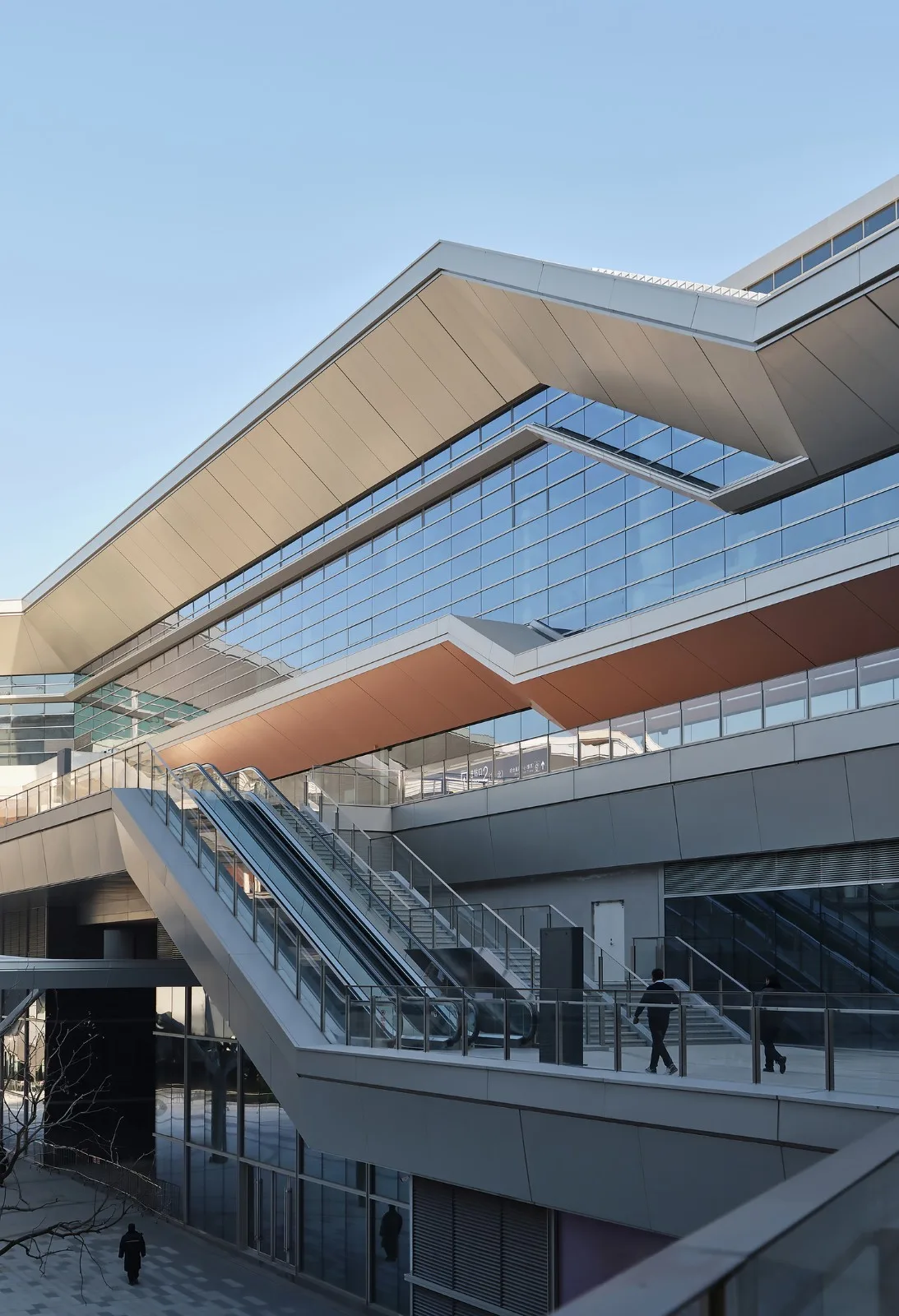
The hub complex covers approximately 244 acres with a total built-up area of about 373,000 square meters, including 223,000 square meters above ground (of which 72,000 square meters is dedicated to the high-speed railway station and related facilities) and around 150,000 square meters underground.
Beyond railway functions, the site includes hotels, conference centers, serviced apartments, technology innovation offices, commercial spaces, and urban reception facilities. To address property rights issues among overlapping spatial projects, Suzhou South Station implemented land layering and property rights confirmation through 3D modeling. This precise spatial division clarifies land use boundaries, providing a legal framework for construction, management, and rights allocation.
Water Town Cultural Gateway
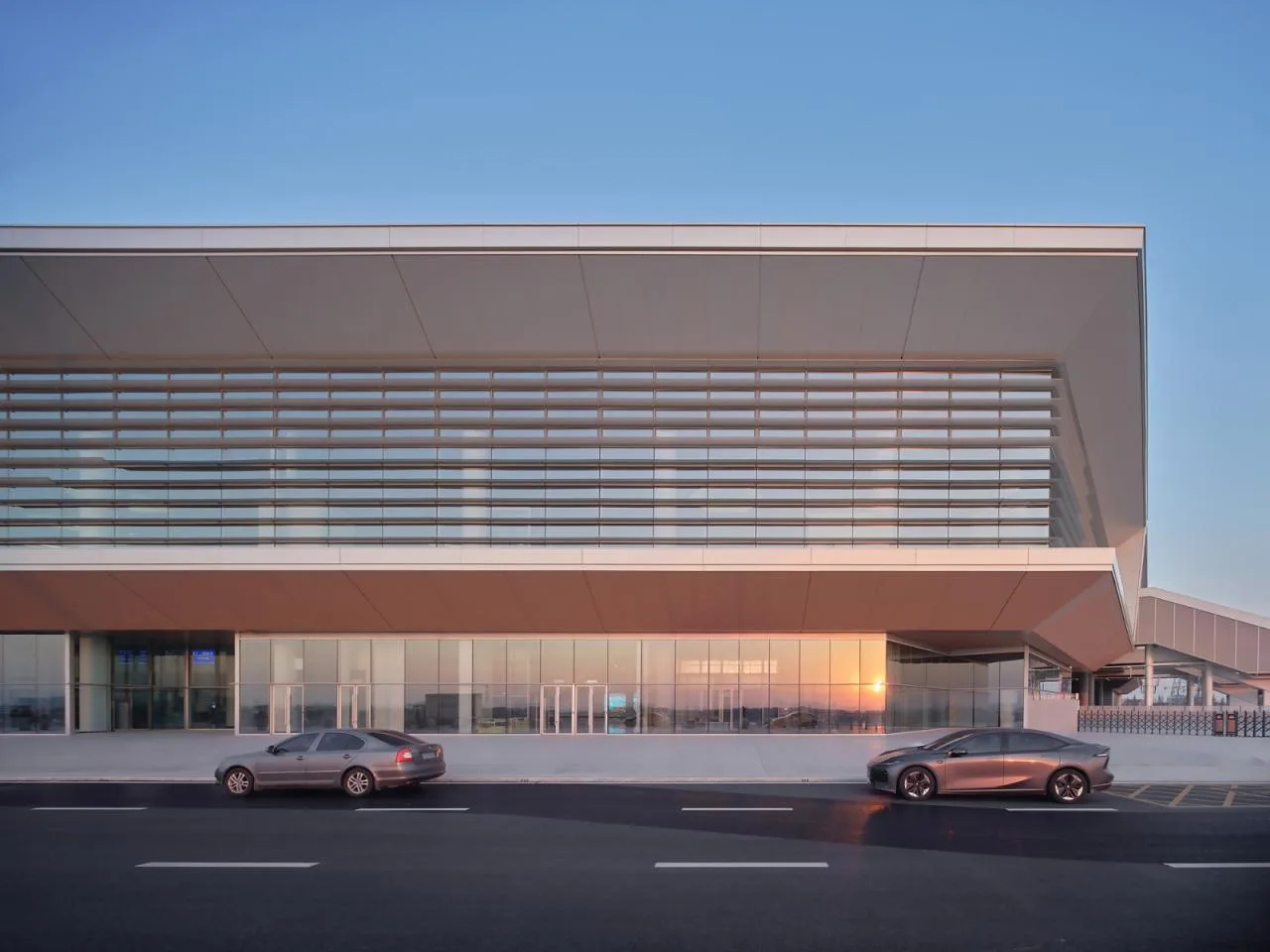
Putting people first, blending nature and technology, and harmonizing tradition with the future—these principles define Suzhou South Station’s design. The station showcases a clean, modern aesthetic infused with elements inspired by Suzhou’s iconic Jiangnan water towns, establishing a distinctive gateway image for the demonstration zone.
Following the “Overall Plan for Land Space of the Yangtze River Delta Ecological Green Integration Development Demonstration Zone (2021-2035),” the station’s architectural form embraces the “small-scale, low height, medium density” character of the water town to create a harmonious spatial scale.
Careful planning integrates transportation, functionality, and spatial arrangement while respecting the site’s water-town heritage. The design incorporates water town and garden elements, blending traditional architecture and garden concepts with modern techniques. Drawing on Jiangnan architectural identity and Suzhou garden philosophy of “adapting to local conditions,” the station’s main design concept, “six in one returning to the core,” emphasizes rational spatial experience, ecological green buildings, and a human-centered environment.
The station’s asymmetrical facade breaks from traditional symmetrical designs, enhancing visual appeal and uniqueness. This modern interpretation of Jiangnan style offers passengers a welcoming and comfortable travel experience that connects local culture with high-speed rail infrastructure.
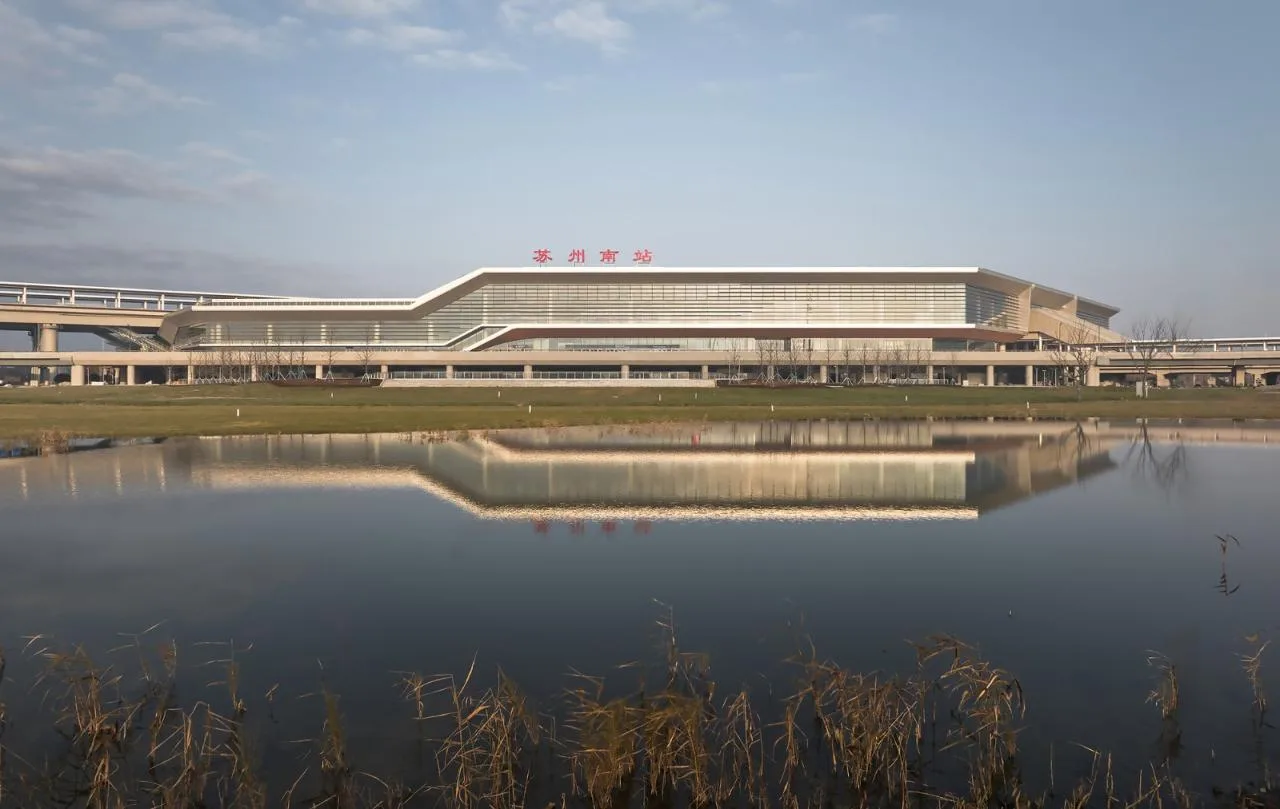
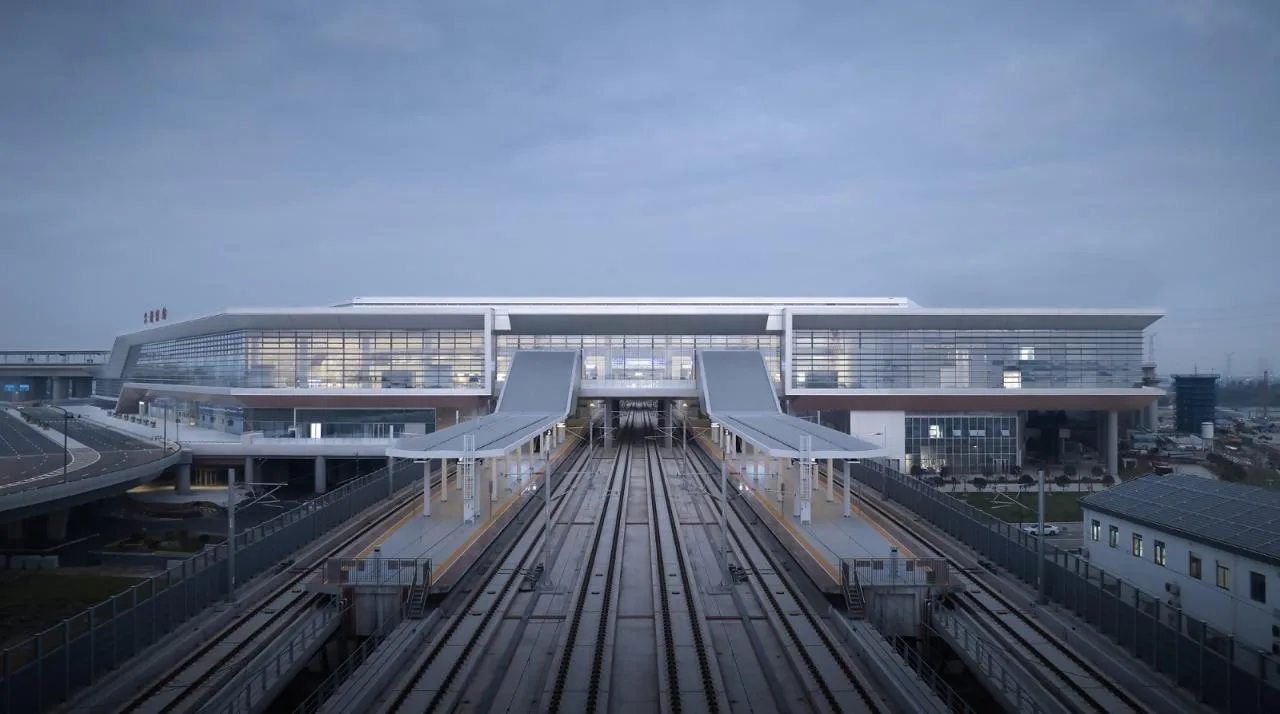
With rapid railway development and urbanization, integrating stations with cities has become vital for urban modernization and sustainability. Suzhou South Station exemplifies this trend, pioneering integrated station-city development in China. It stands as Suzhou’s urban gateway and the main hub of the Yangtze River Delta demonstration zone, driving ecological and green integrated development forward.
Project Drawings
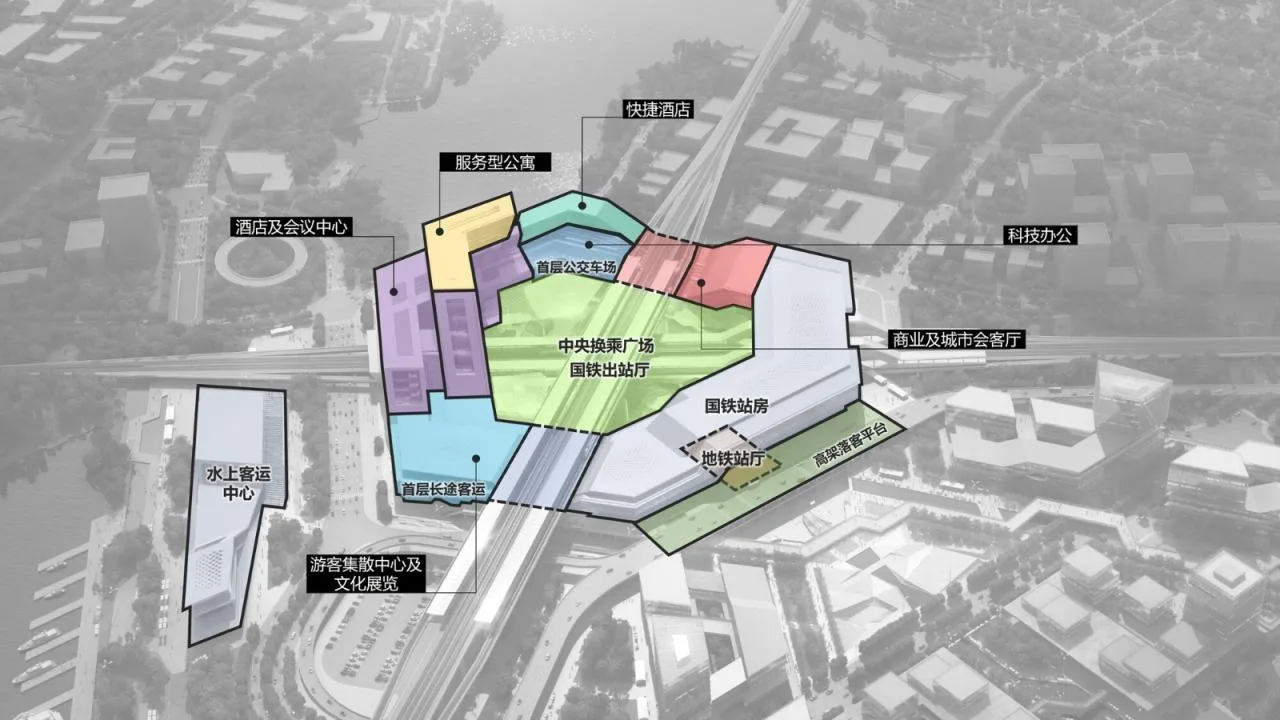
△ Function Diagram
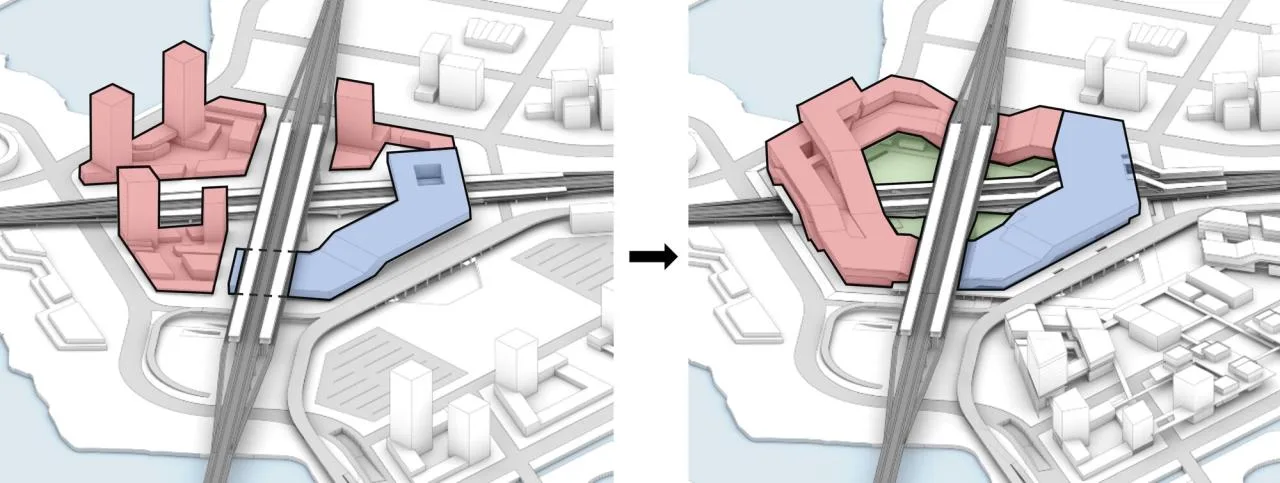
△ Analysis Chart
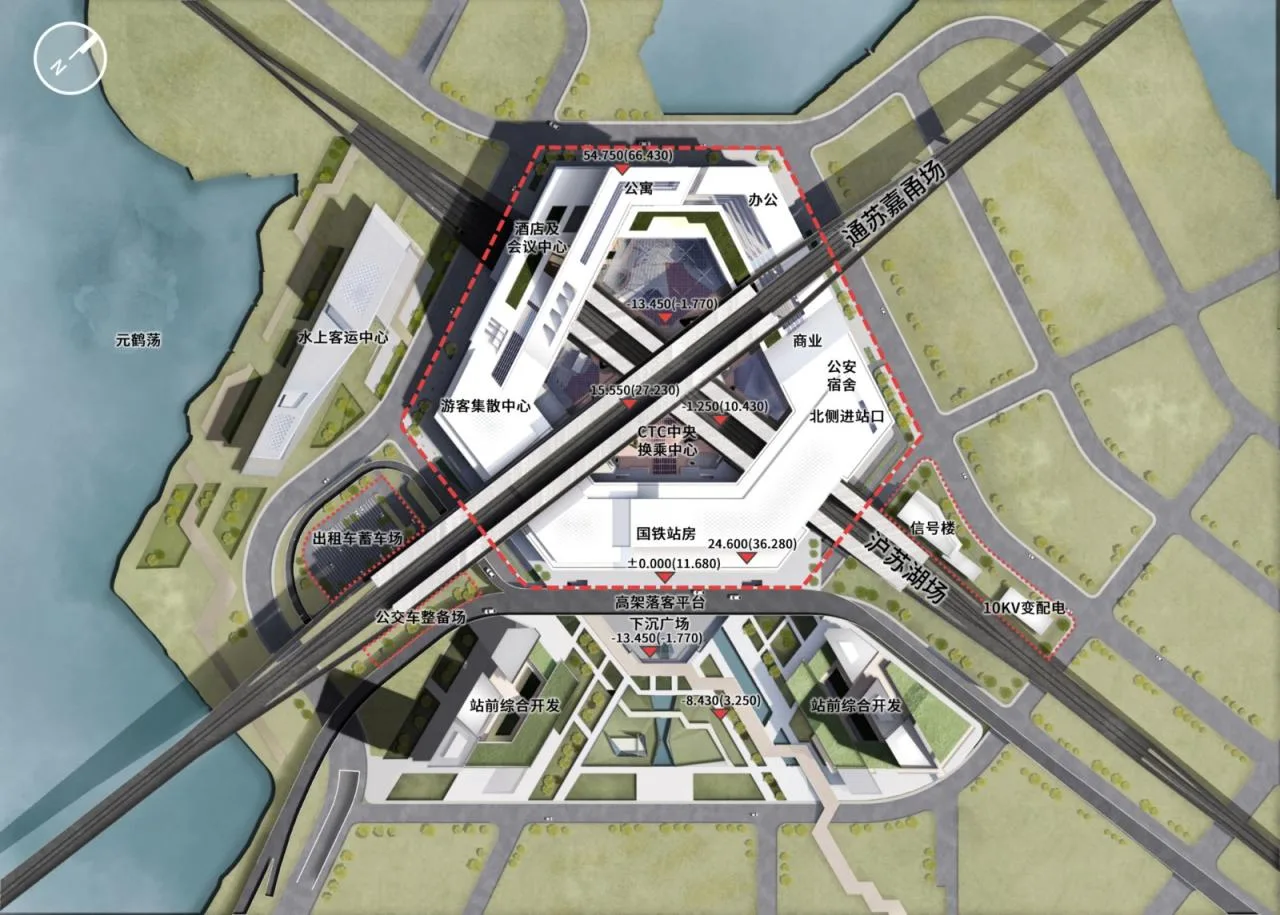
△ General Layout Plan
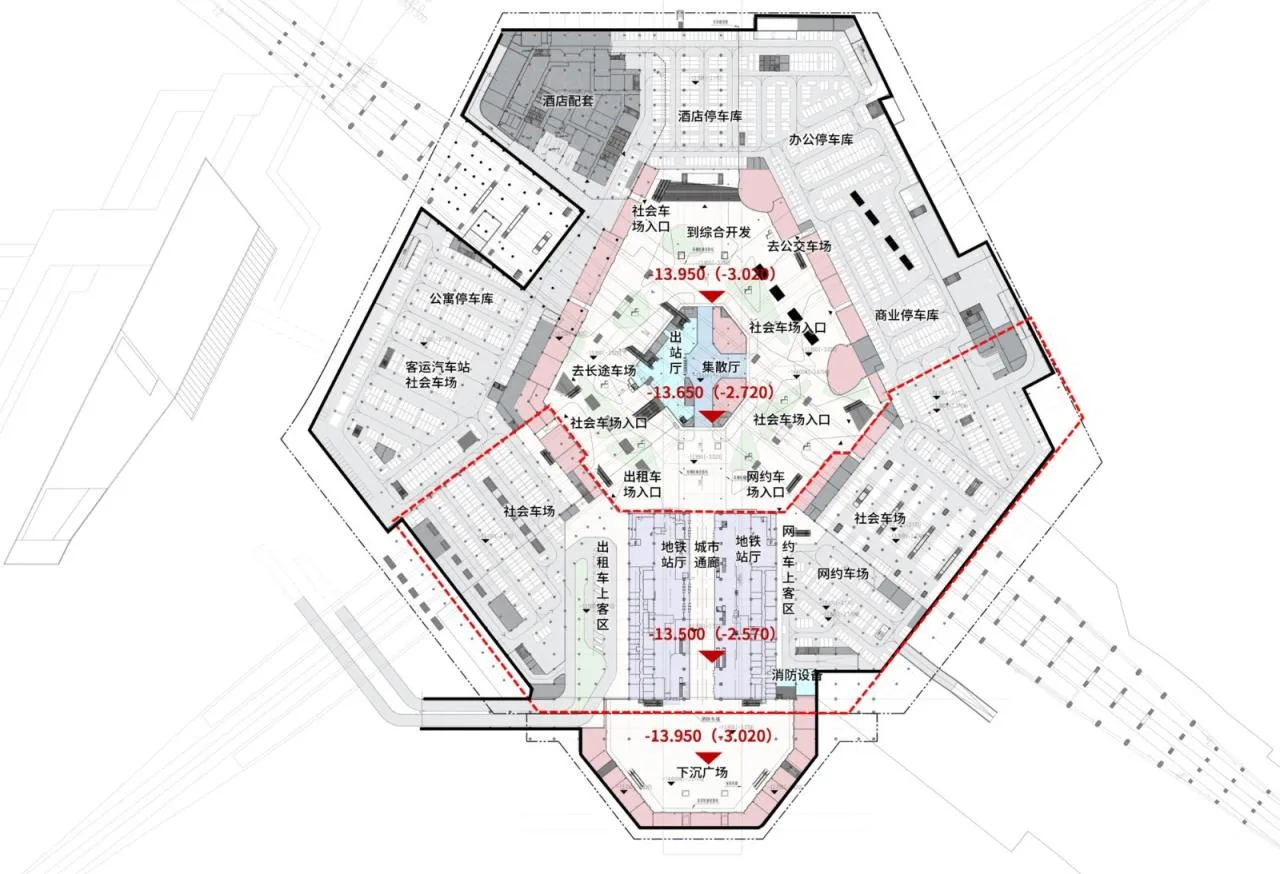
△ Underground Second Floor Plan
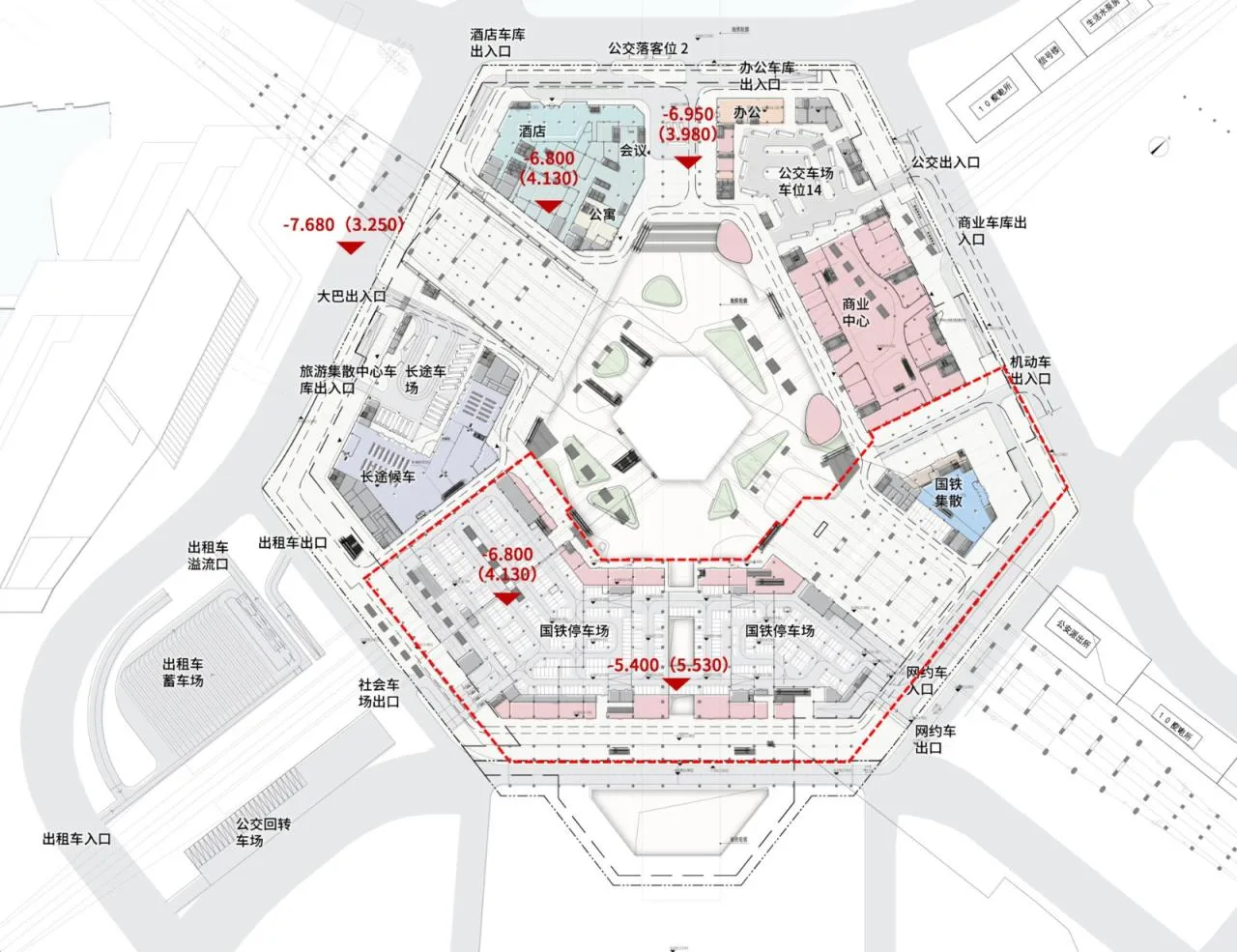
△ Underground Floor Plan
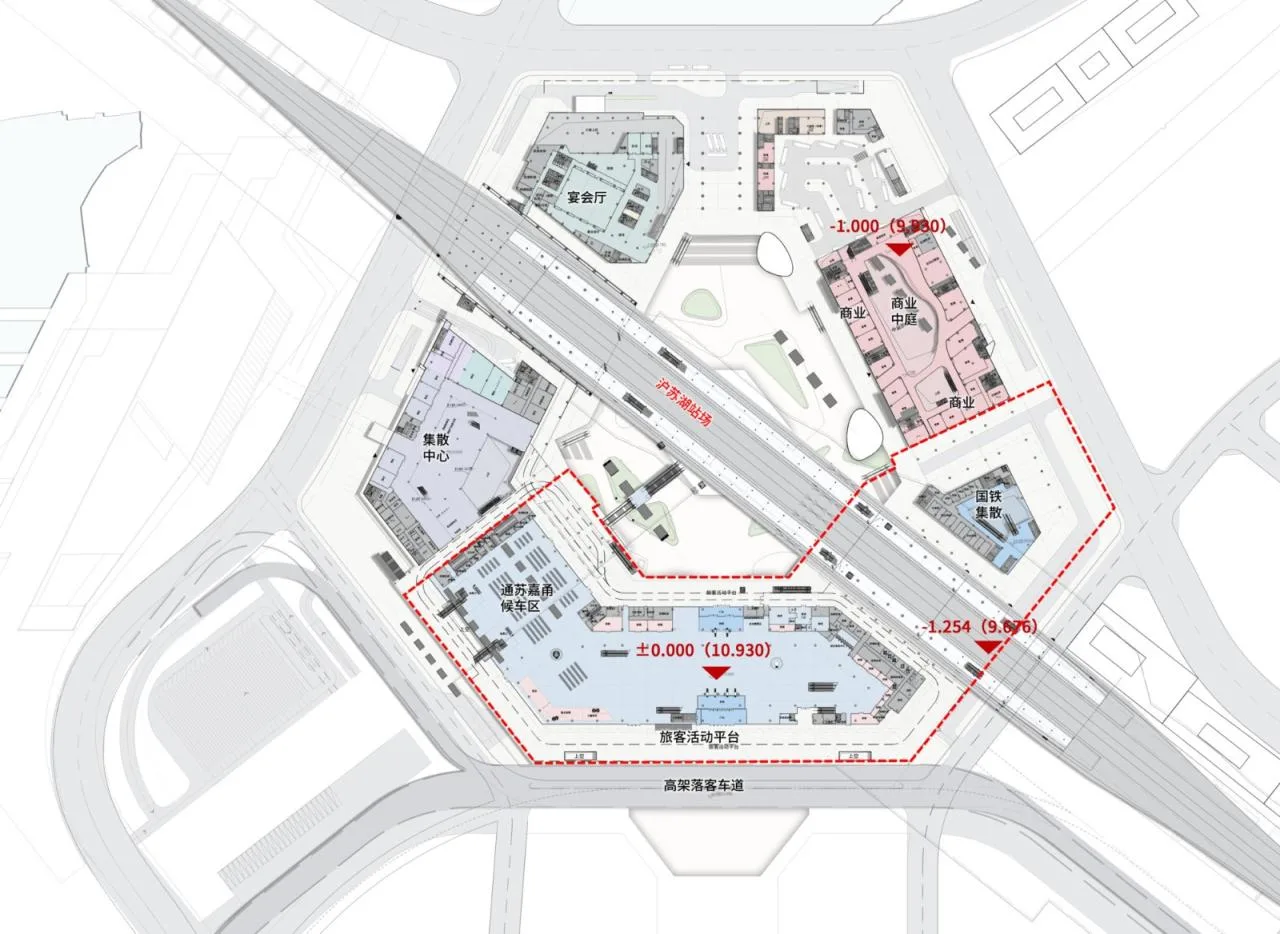
△ Plan View
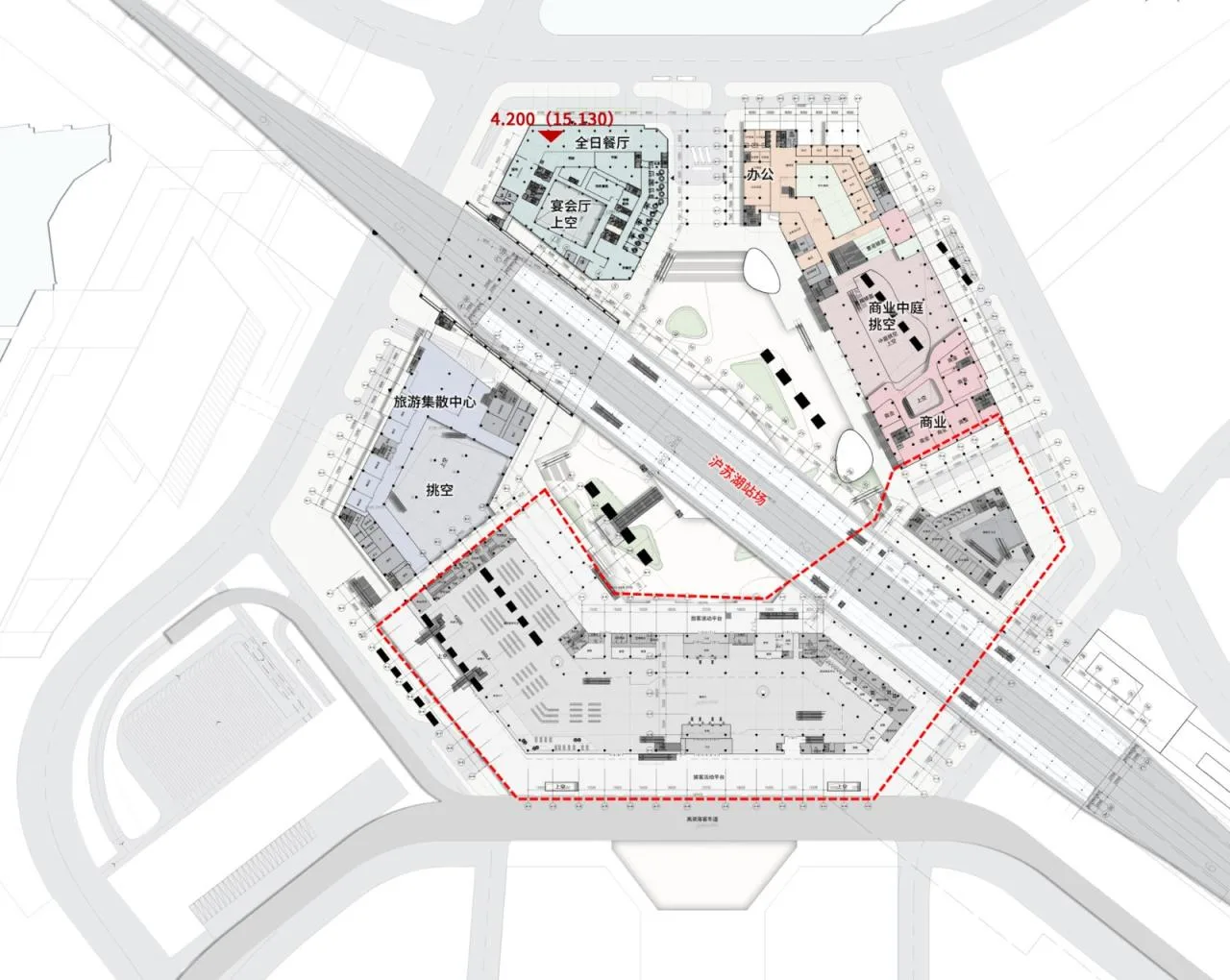
△ Second Floor Plan
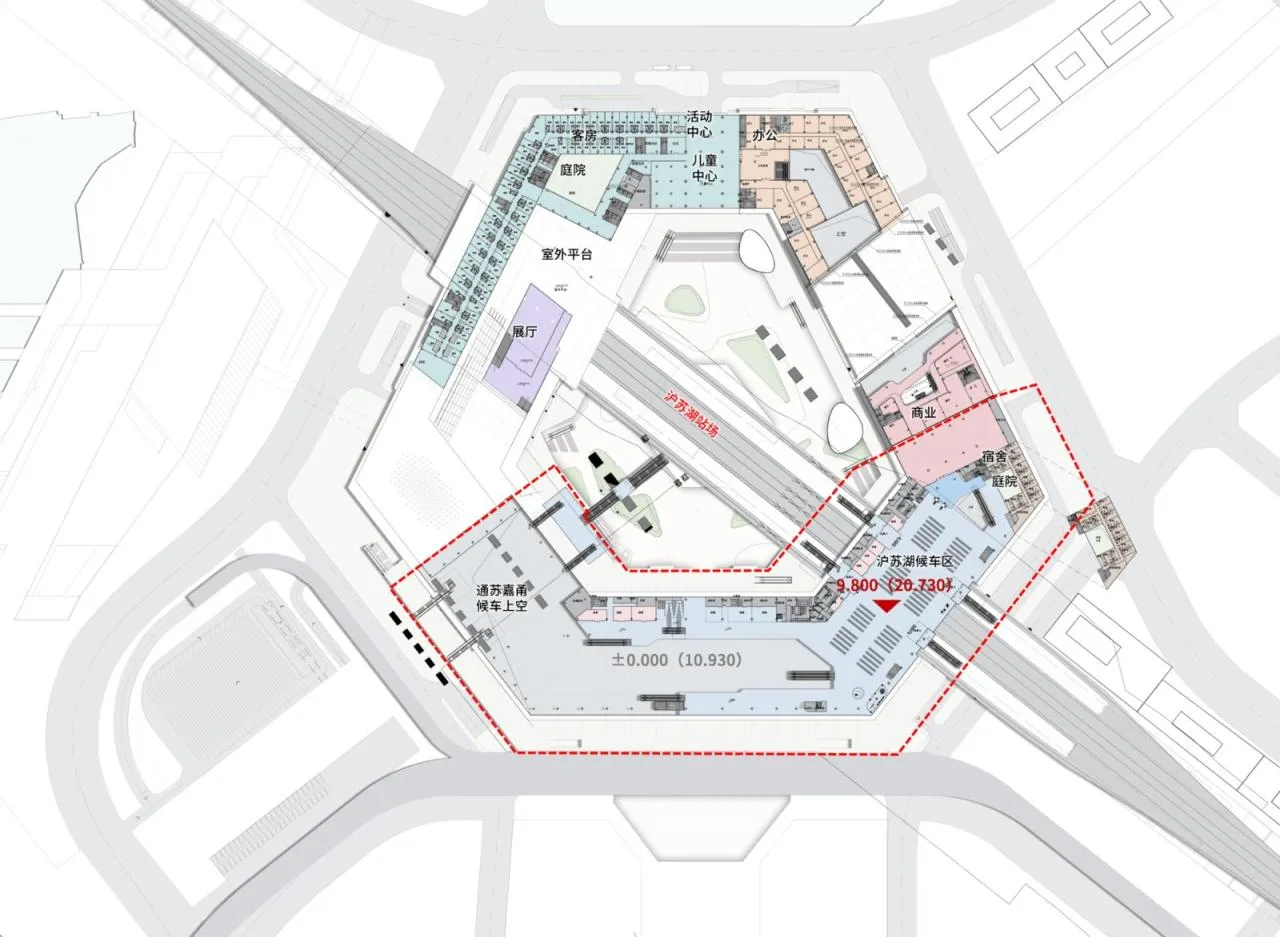
△ Third Floor Plan

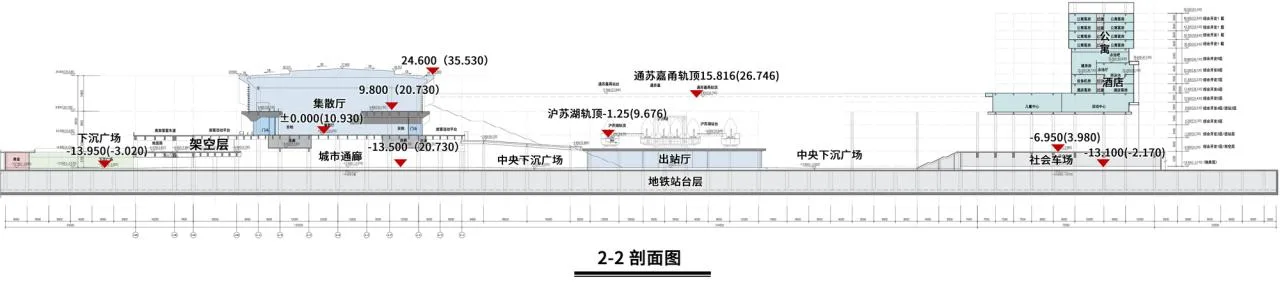
△ Section Diagram
Project Information
Architect: Architectural Landscape Design
Area: 72,000 m²
Project Year: 2024
Photographer: AOGVISION
Manufacturers: Changxing Qibin Energy Saving Glass Co., Ltd., FACEBOND, Guangdong Golden Curtain Building Materials Co., Ltd., Guangzhou Compton Zhigao Building Materials Co., Ltd., Hebei Zhengbangyuan Aluminum Co., Ltd., Qilu Paint Industry Co., Ltd., Shandong Hukouyuan New Material Technology Co., Ltd., Zhejiang Transfar Paint Co., Ltd.
Lead Architect: Yu Chen
Design Team: Guo Lei, Jiang Chang, Chen Liguo, Huang Fengming, Du Gangyong, Huo Xu, Zhao Mingzhen, Fang Yang, Liu Hui, Wu Hong, Liu Jingjing, Xia Qihong, Wang Xiuxiu, Li Qian, Sun Nengbin, Xu Ming, Wang Mengyao, Li Rongqi, Liu Mingming, Tang Zhichu, Ma Tianle, Wang Yuxin, Wen Huizi, Ma Ye, Gu Chenxi, Wang Menglin, Yue Tingyu (intern), Zhou Zhenyang, Wang Huifang, Xu Yicong
Structural Team: Yang Xuchen, Zhu Wei, Zhao Youqing, Ding Hanjie, Lv Yan
HVAC Team: Yu Kun, Yin Changyu, Huang Yue, Ruan Rongqiang, Wang Qi
Electrical Team: Li Pengzhan, Tang Lin
Water Supply and Drainage Team: Ji Diange, Shen Danqun, Zhang Haibo, Ge Yaoyao, Chen Sinan, Du Weifei
Principal: Shanghai Railway Hub Construction Command of China Railway Shanghai Group Co., Ltd. and Yangtze River Delta Investment and Development (Jiangsu) Co., Ltd.
Supporting Engineering Consortium: Huashe Design Group
Excavation Support: Suzhou Licheng Architectural Design Institute Co., Ltd.
Engineering Economics: China United Engineering Co., Ltd.
Curtain Wall Design: Architectural Environment Curtain Wall
Interior Design: Beijing Architectural Design and Research Institute Co., Ltd.
Logo Design: Yonghan Logo
Lighting Design: Gale Lighting, Maxo Lighting
Location: Suzhou














Must log in before commenting!
Sign Up