
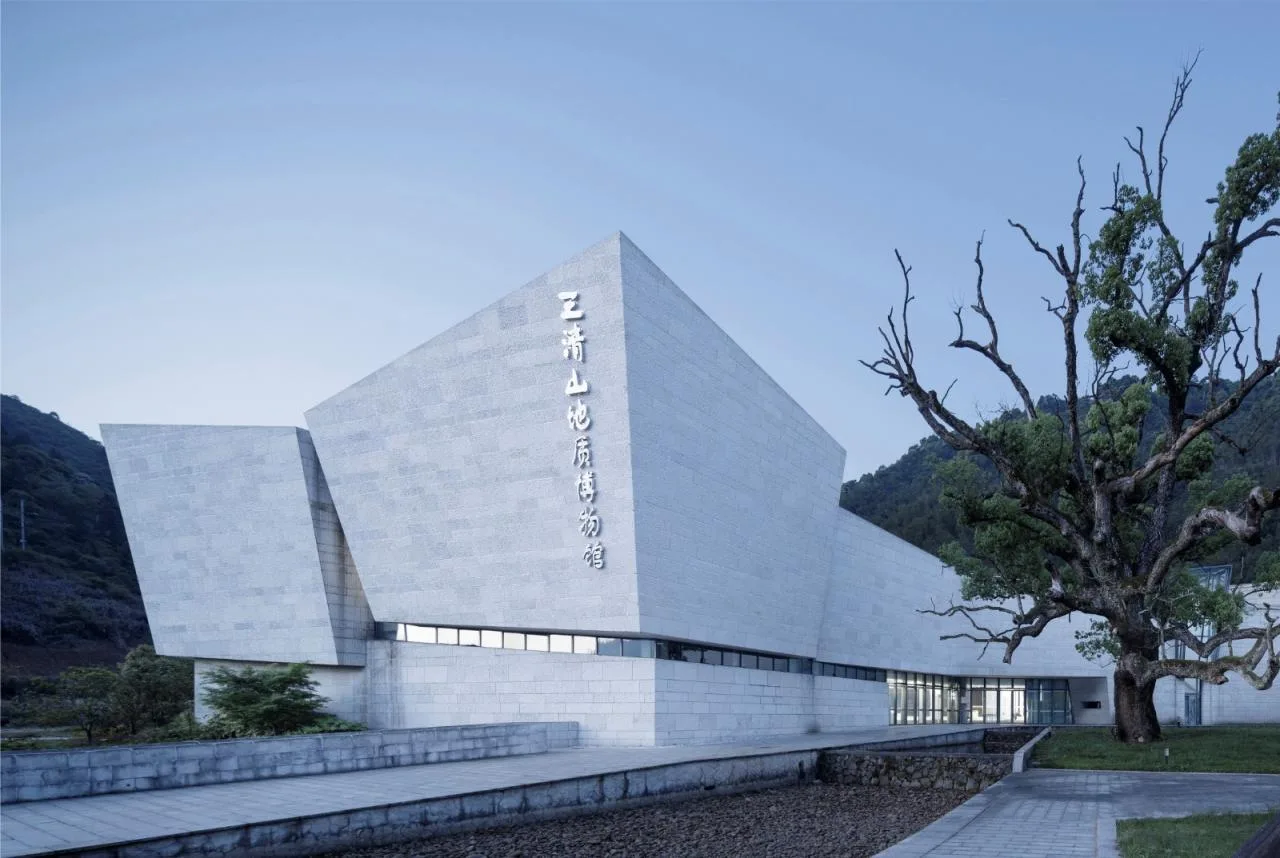
△ Local building scenes © Zhao Qiang
“How to cultivate contemporary architecture that embodies geological characteristics on site has been a constant challenge throughout the design process.” — Ye Changqing
Venue Impression
At the start of the design, in late spring, we walked through lush, fragrant greenery to reach a quiet valley stretching diagonally east to west. Nestled under winding mountains were numerous stone and brick houses. Terraced rice fields lay both in front of the mountain and behind the houses, with scattered ‘field stones’ occasionally dotting the rice paddies, creating a distinct mountain and wilderness landscape.
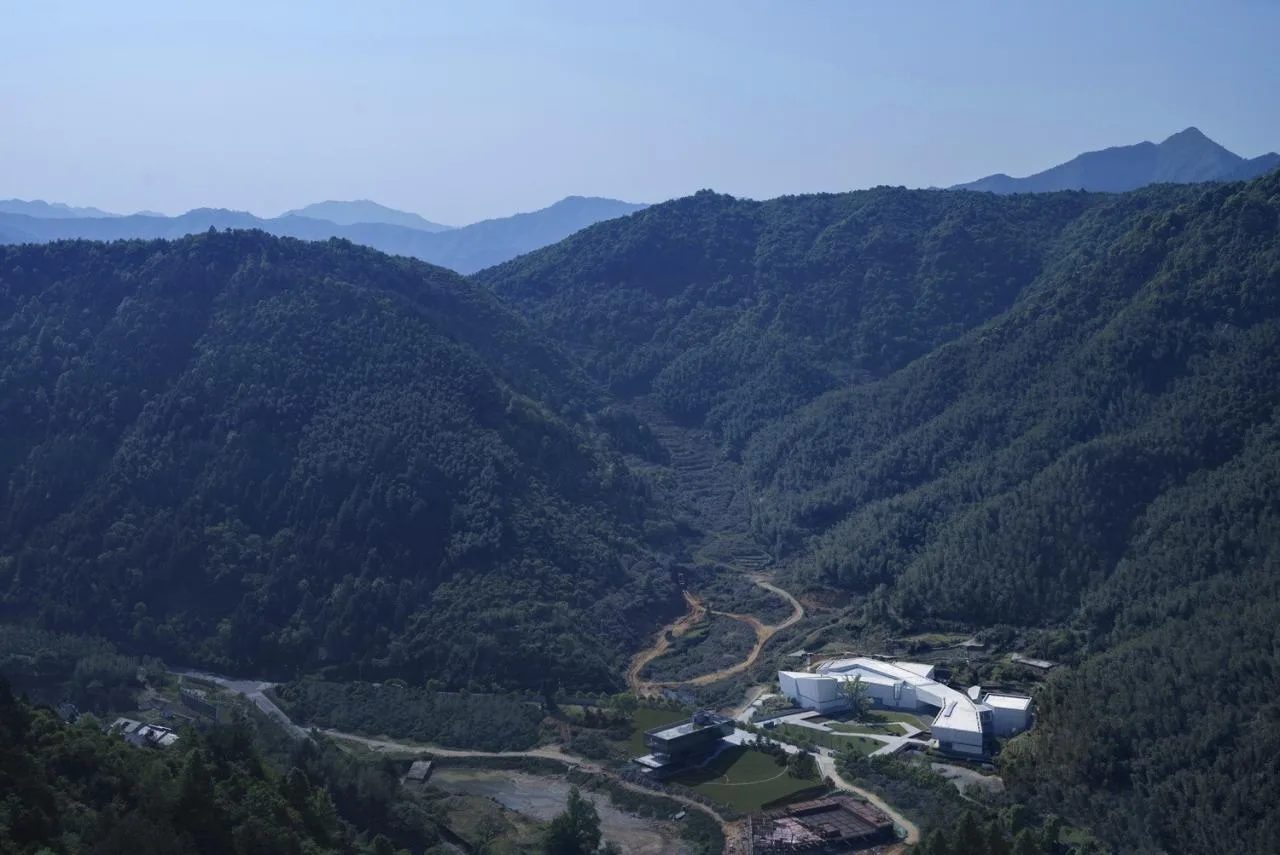
△ Panoramic north-facing bird’s-eye view © Zhao Qiang
The museum’s site selection was guided by this natural setting. Approaching the site, we found it situated on a slope that descends from south to north. Amidst the mountain fields’ remaining veins, two faint mountain streams converge. At the center of the site stands a flourishing, century-old camphor tree, its thick branches stretching south to north, seemingly resisting the slope.
The ‘Yamada Tree Stone’ left our first impression of the site.
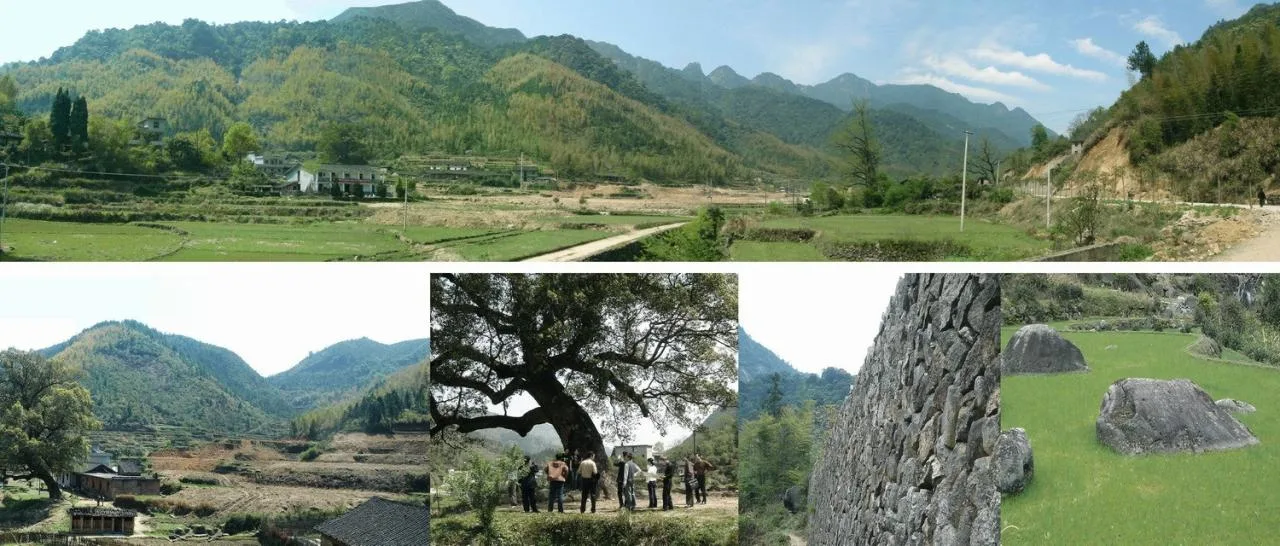
△ Site base and ‘Yamada Tree Stone’ © UAD
Geological Features
Mount Sanqing is a renowned world natural heritage site and geological park. Its geological history spans 1.4 billion years, marked by three major transgressions and multiple tectonic movements. Located at the unique junction where the Yangtze and Cathaysia plates collide—at the southeastern meeting point of the Eurasian continental and Pacific plates—Mount Sanqing represents the most systematic and typical region for such tectonic events.
It serves as a natural museum showcasing the global history of granite micro-landform formation and evolution. The remarkable rock formations, born from ancient plate collisions, are Mount Sanqing’s most distinctive geological and geomorphological features.
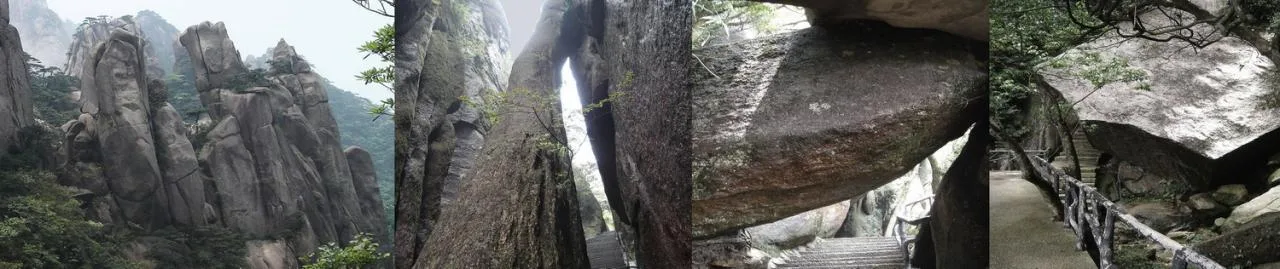
△ Rock sample from Mount Sanqing © UAD
Local Expression
1. Form Generation
The design of the Mount Sanqing Geological Museum began with understanding its geological origins and abstracting their shapes and textures. This included the compression and movement of two major geological plates, the intermingling of rocks and seawater, and the distinctive joints and broom-like fractures found in Mount Sanqing’s granite body—primarily vertical, with secondary transverse and horizontal directions.
The building’s form reflects bidirectional compression, undergoing longitudinal block-like splitting and stretching, further cutting, separation, horizontal sliding, and shearing along the transverse axis—expressing the “geological forces” shaping the landscape.
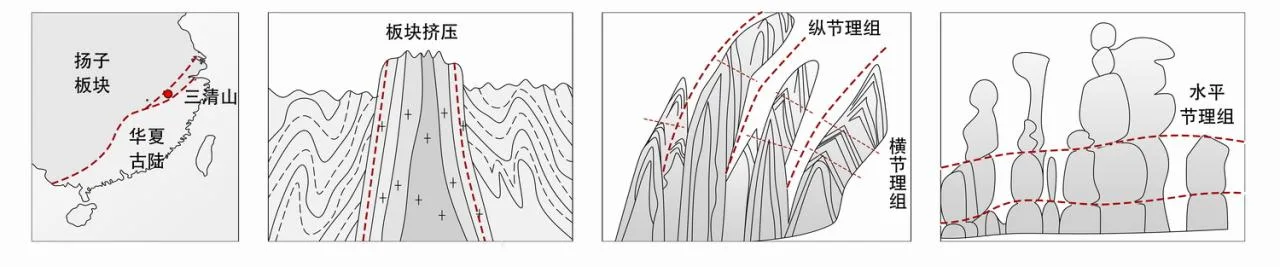
△ Geological plate and joint analysis diagram © UAD
The building’s form aligns with the site’s mountain shape and water runoff patterns. Following the slope descending south to north and the contour lines, the structure bends to form a semi-enclosed space centered around the century-old camphor tree. It then divides into east and west blocks, separated by a large open void and sky, echoing the mountain range’s direction and channeling the original mountain streams into the forecourt and scenic water system, completing the overall form.
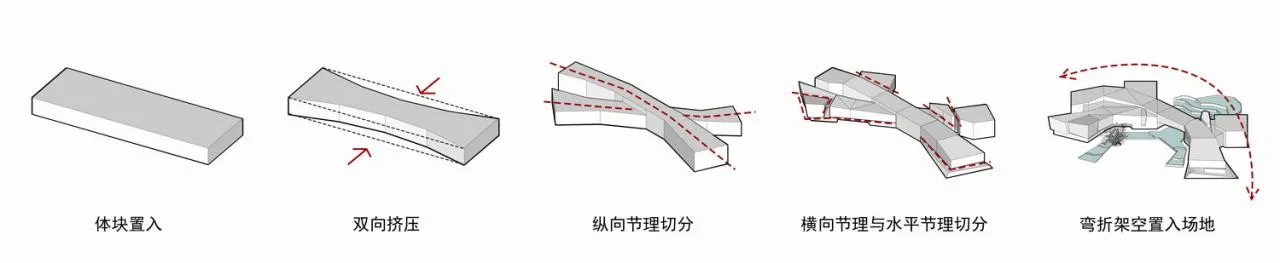
△ Shape generation analysis diagram © UAD
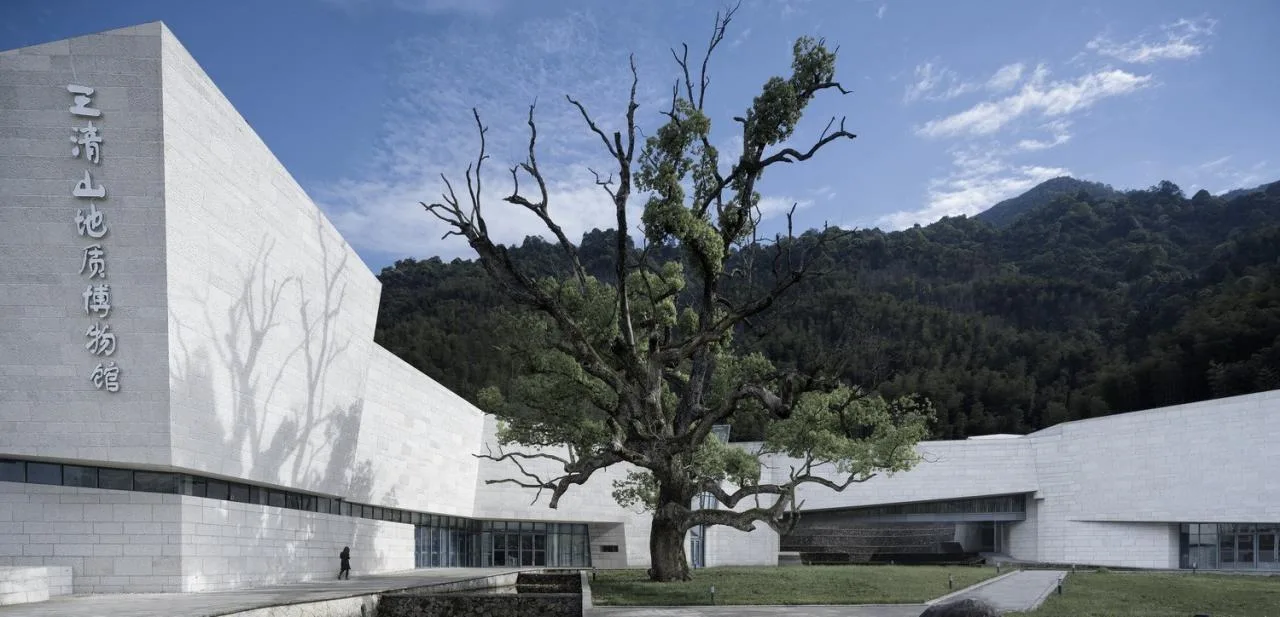
△ Main entrance scene © Zhao Qiang
2. Interior Space
The logic behind the form generation extends into the interior spatial design. Visitors enter the museum’s entrance hall by following the shade of ancient trees along the gentle slope at the northeast entrance. The exhibition route begins on the first and second floors of the eastern section, continues via a corridor bridge to the western area, and ascends to the next floor.
Upon exit, visitors are once again greeted by the square, ancient camphor trees, and distant mountains. The interior spaces evoke the “geological movements” theme, resembling Mount Sanqing’s rock walls—sometimes high, low, dark, or bright; fractured yet connected; filled with twists and turns that express geological processes like extrusion, flow, cutting, and interlacing.
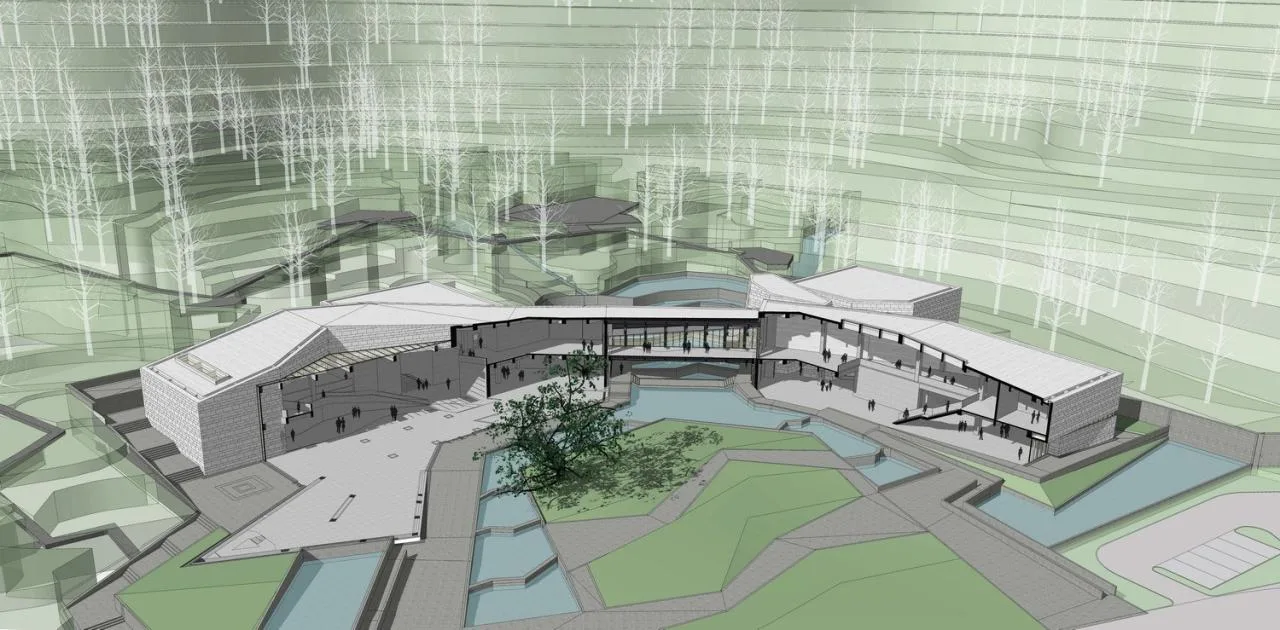
△ Continuous sectional view of space © UAD
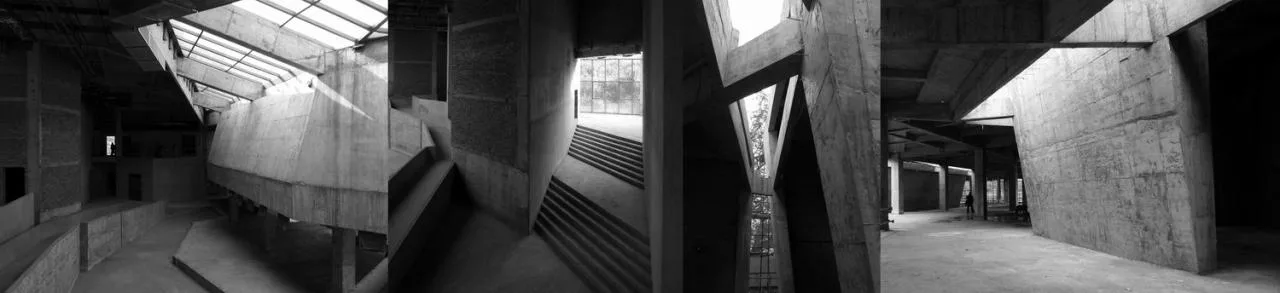
△ Interior space before exhibition © UAD
Functionally, the eastern part of the museum focuses on geological and geomorphological themes, featuring special exhibitions on geology, biodiversity, and mountain ecology. The western section hosts supplementary exhibitions on planning, red themes, research, and venue services, maintaining a balanced and orderly zoning with relatively independent public access.
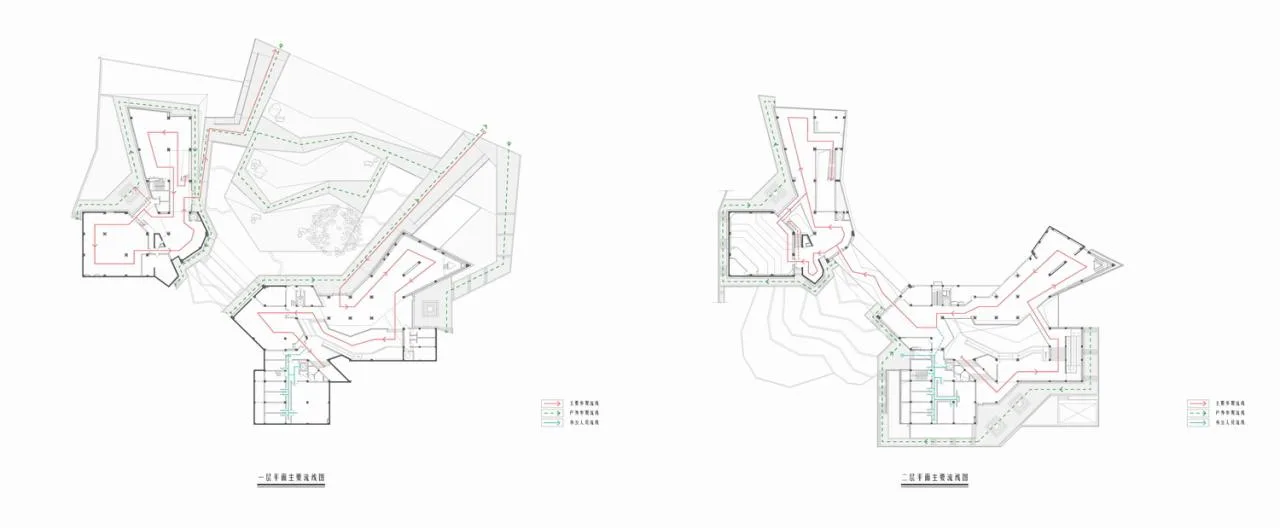
△ Line analysis © UAD
3. External Landscape
The site has a tradition of using local stone materials for constructing wall foundations and walls in original residential buildings. The century-old camphor tree, common in Jiangnan villages, often symbolizes village entrances or central outdoor gathering spaces. The site’s original terraced form is a natural “living” landscape shaped by human cultivation.
The external landscape design preserves this century-old camphor tree as a central element and respects the terraced terrain, descending gently and surrounded by local rubble stones, thus recreating the original terrain and cultural landscape.
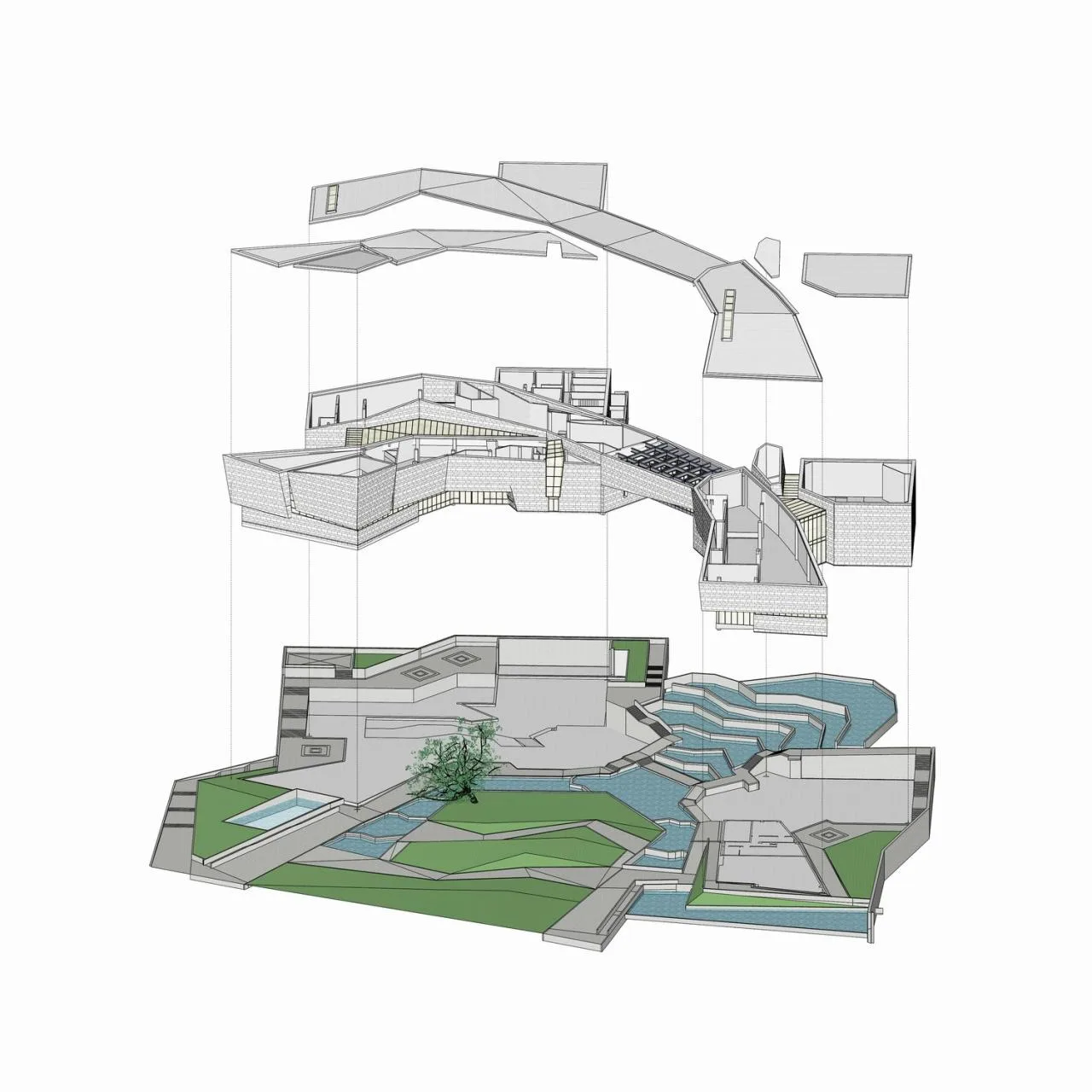
△ Shape and environmental decomposition axis side © UAD
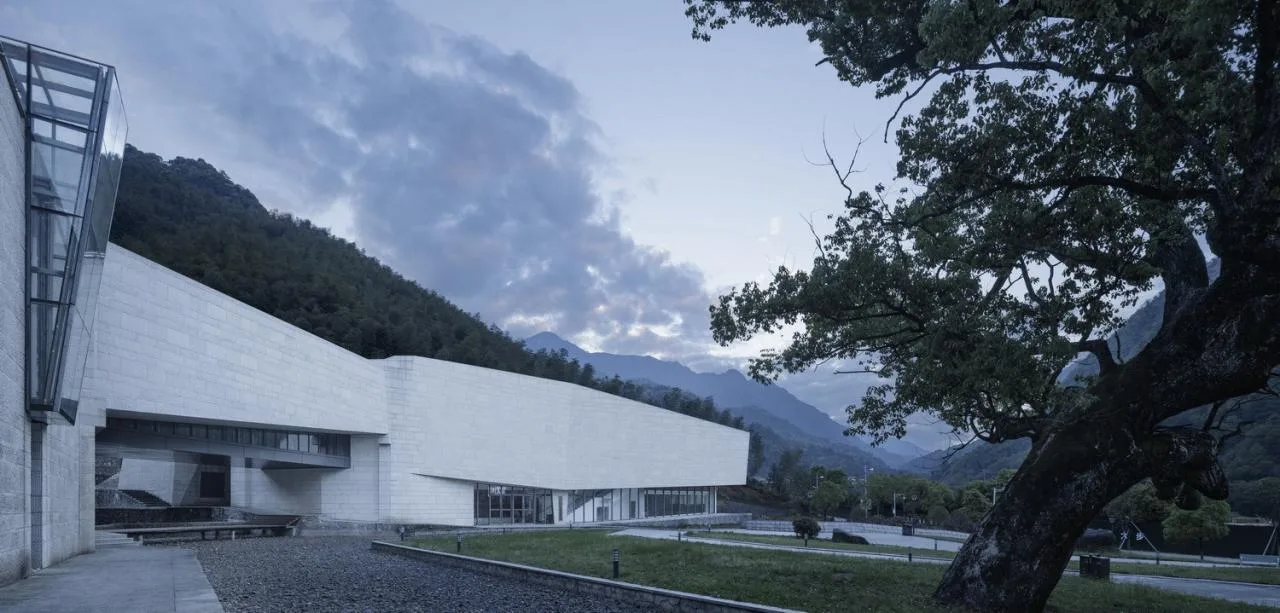
△ Ancient camphor trees, architecture, and distant mountains © Zhao Qiang
Water is another key element reflecting geological movement—the intermingling of rocks and seawater. The design integrates this theme through a cascading “pond field” connecting the forecourt and mountain staircase. During floods, it acts as a discharge channel for the mountain streams; in dry seasons, shallow water or exposed gravel reflects the theme in varied forms.
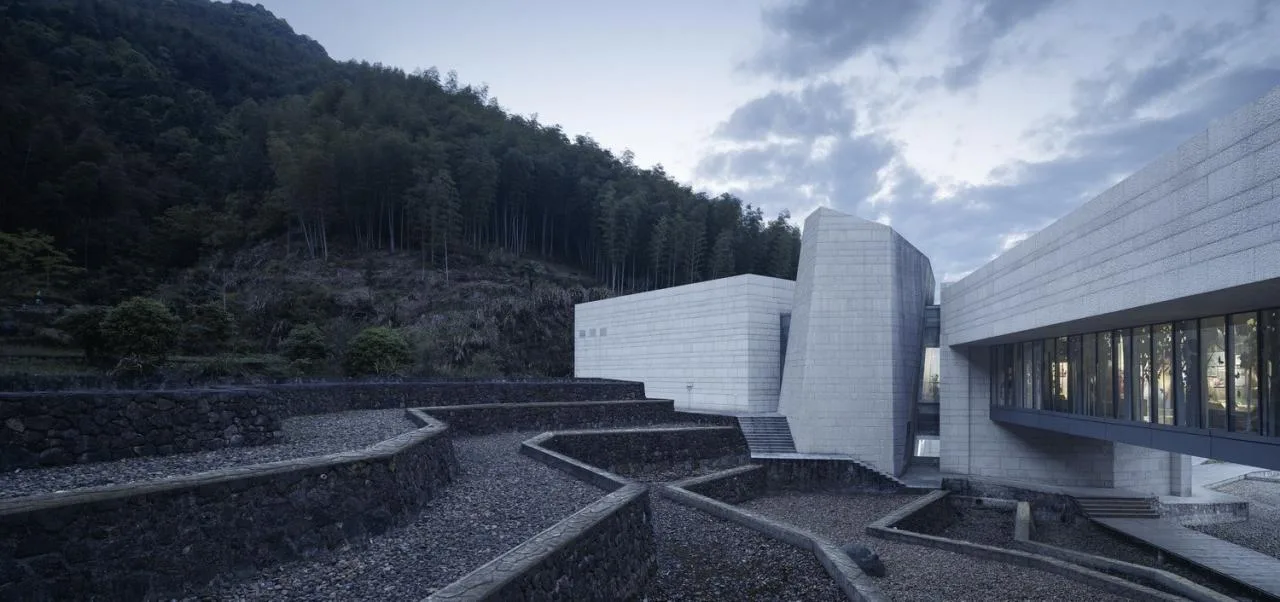
“Ikeda” cascading down the mountain © Zhao Qiang
Additionally, the forested area within the site will be renovated into an outdoor exhibition space, connected with the camphor tree square, corridor bridge, pond terraces, and forest trails, forming an outdoor exhibition route. This transforms the museum into a “panoramic museum” without walls, enhancing visitors’ immersive experience with architecture, nature, and exhibits, and providing flexible expansion options for future openings and collections.
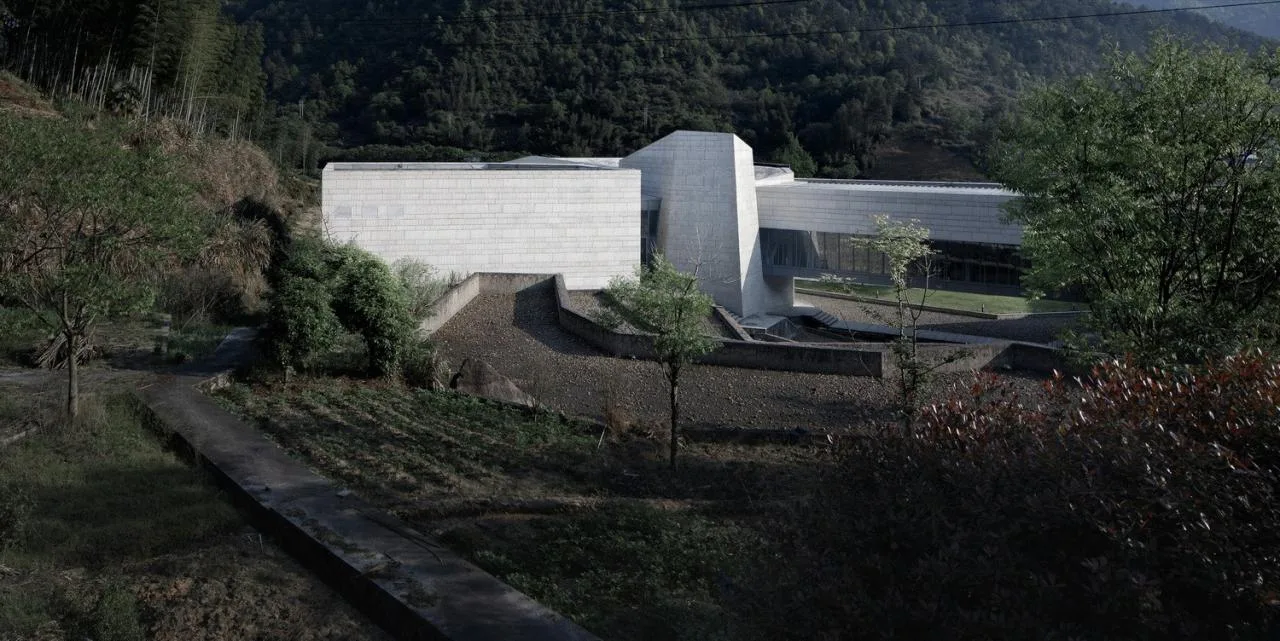
△ Experience Trail in the back mountain forest © Zhao Qiang
4. Structure and Construction
Structurally, the building uses reinforced concrete frames and locally cast-in-place reinforced concrete walls, with suspended steel structures supporting the bridge spans. The building’s fragmented form is punctuated by glass-enclosed “cracks” that resemble magma or seawater in geological movements. These glazed sections illuminate circulation areas, central halls, and special interior spaces, glowing as “light through the walls” at night.
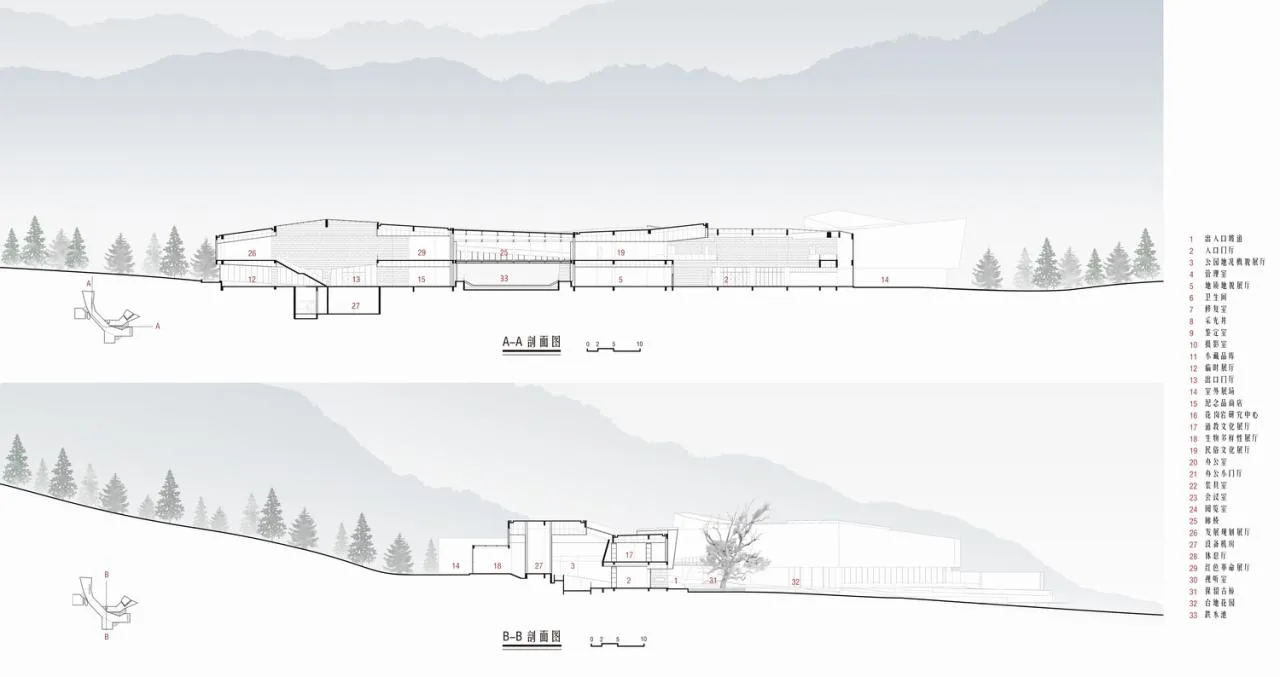
△ Building profile © UAD
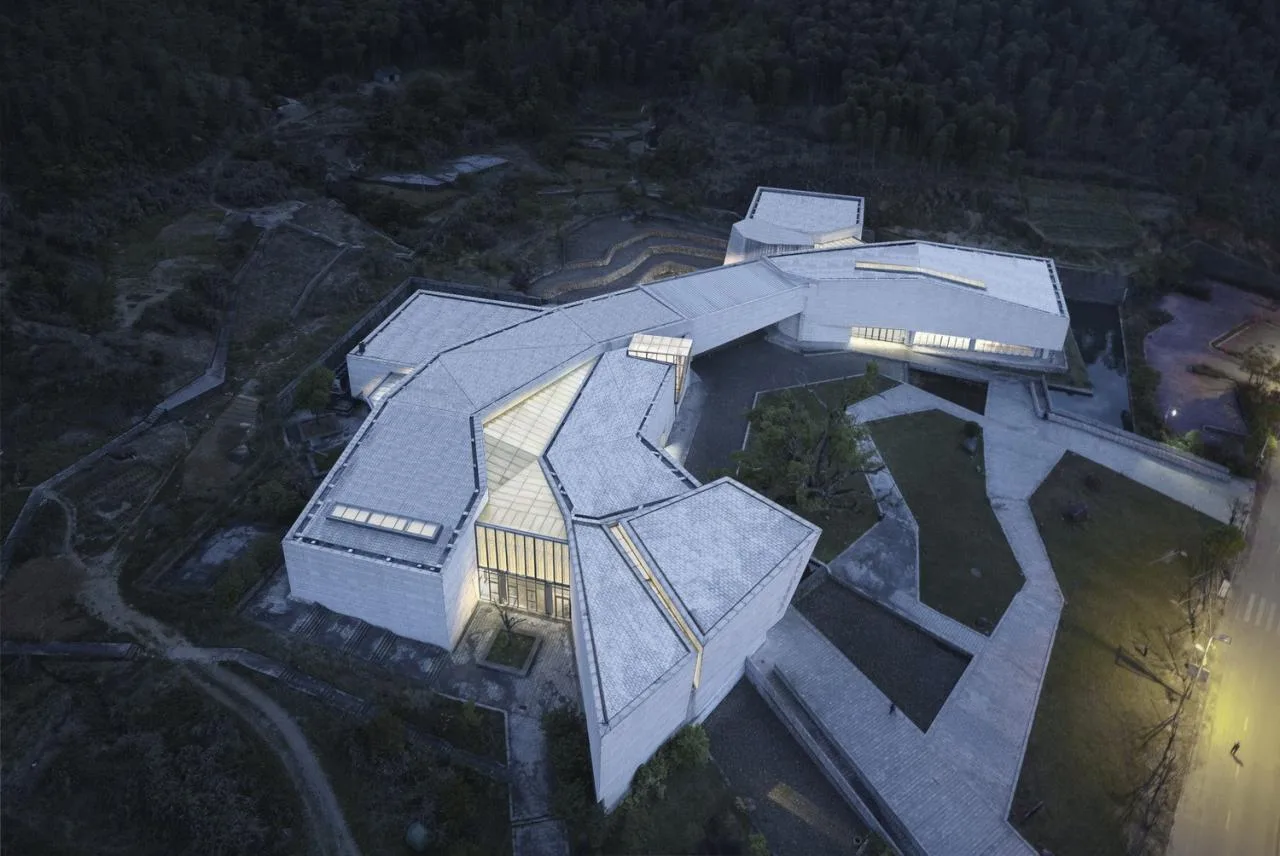
△ Northeast bird’s-eye night view © Zhao Qiang
The exterior solid curtain wall is crafted from stone quarried 40 kilometers away from the same mountain range. Its surface is grooved by machine and hand-chiseled with axes, creating vertical rough textures enhanced by the “geological” friction and displacement motif. Local stone materials are extensively used in the square and terraced landscaping. The square features a lychee-surfaced finish, the pond field’s base is gravel-paved, and the stair platform retaining walls use local rough stone built in the “tiger-skin wall” style, reflecting a harmonious blend between new architecture and the original environment.
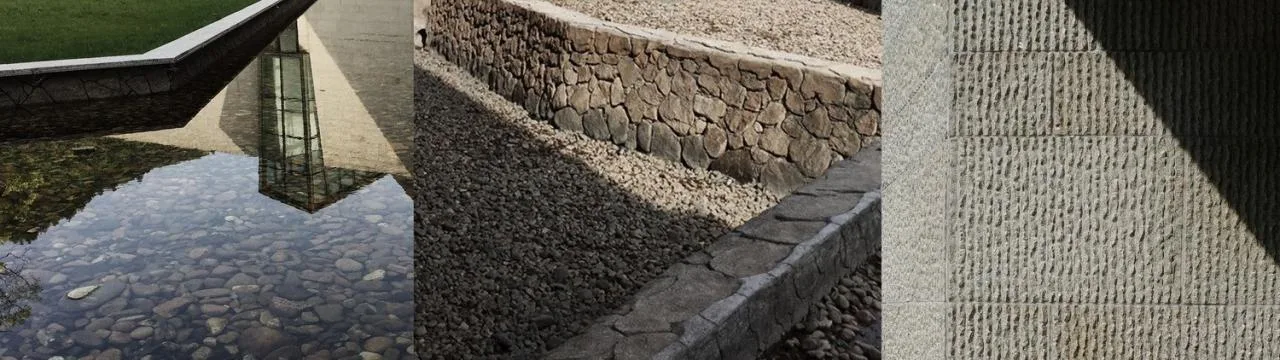
△ Stone material texture © UAD
Discussion
This project’s design involved two key preliminary considerations.
First, located at the mountain’s foot, how could the new building better relate to its site? From which perspective could the geological theme be more effectively expressed? The theory of “extended geomorphology” provided significant inspiration.
Topography studies surface morphology’s characteristics, distribution, origin, and evolution. As an interdisciplinary field between geography and geology, its origins trace back from the late 18th to mid-20th centuries (pioneered by J. Hutton in England, W.M. Davis in the US, and W. Penk in Germany). By the late 20th century, the 1994 International Conference on Topography classified geomorphology into macro and micro categories, later expanding into branches like climate, structural, dynamic, cultural, and historical geomorphology.
Architects such as Simmons, Kevin Lynch, Peter Eisenman, Kenneth Frampton, Charles Jenks, and David Leatherbarrow have continued enriching the architectural dialogue on topography, marked notably by the 2004 Venice Biennale’s focus on “Topography” under K.W. Foster, which introduced architectural subthemes like mimicry, clustering, pathways, concealment, and coding.
Today, geomorphological architecture has entered a new phase of “extended geomorphology,” increasingly inspiring architecture, landscape, and urban design worldwide.
The Mount Sanqing Geological Museum design aligns closely with topography’s core principles and its extended theories. At a macro level, we explore geological movement mechanisms—presenting a form of “pseudo-structural topography.” At the meso level, the site’s climate and surface topography are expressed through terrain contours and existing water bodies. The preservation of ancient camphor trees as a central architectural element, the continuation of original terraced fields, and the use of local materials embody a “humanistic geomorphology” that honors site memory.
The integration of architectural form, interior space, circulation routes, and outdoor landscape expands exhibition activities into the natural environment. This “experiential” and “situational” terrain architecture reflects contemporary “extended geomorphology” in practice, exploring, reproducing, and narrating the “land” from multiple dimensions.
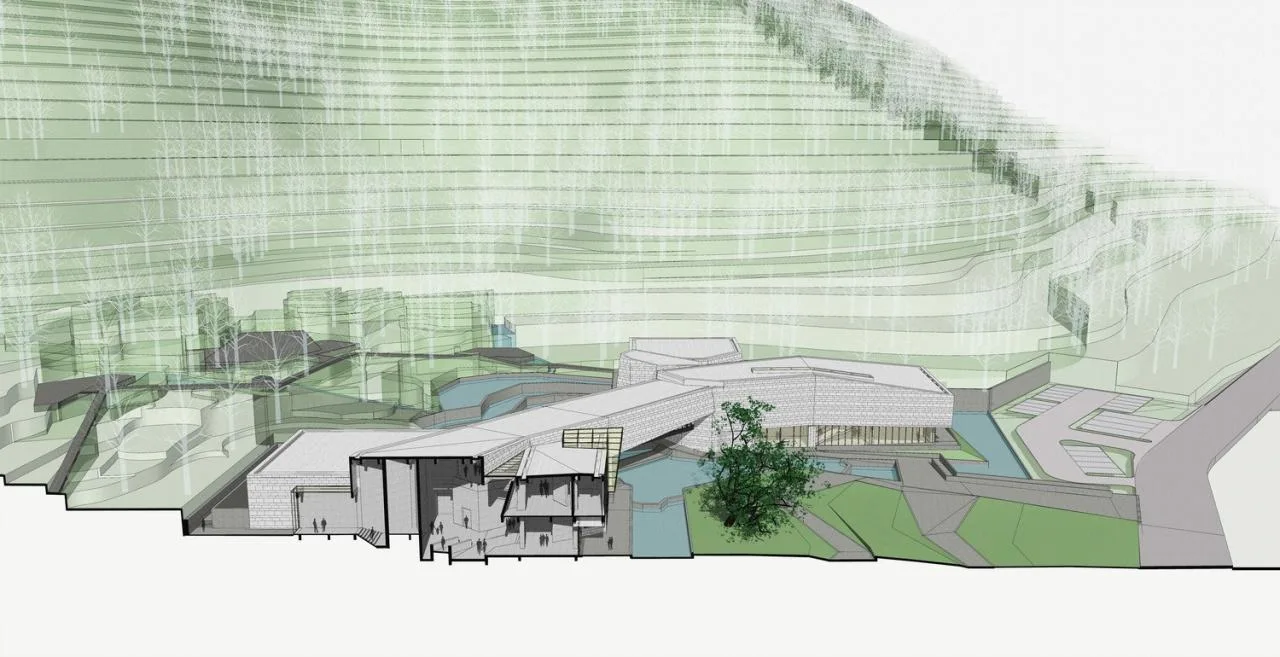
△ East area spatial sectional view © UAD
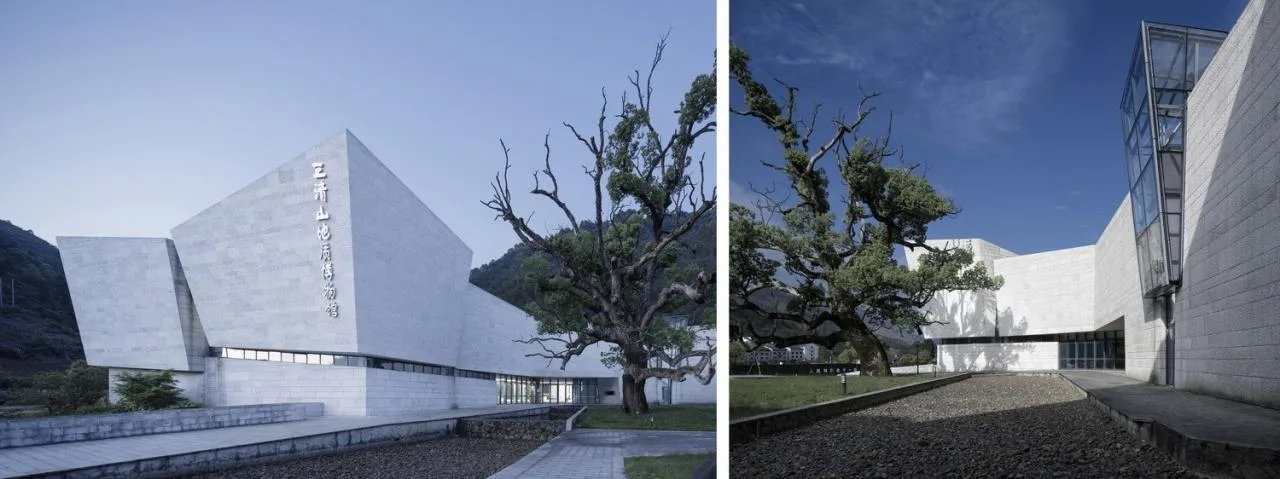
△ Local building scenes © Zhao Qiang
Second, for geology-themed buildings that employ “mimicry,” how do we balance concreteness and abstraction in form-making to achieve expressive yet architectural harmony?
Unlike traditional painting’s trend toward concreteness, architectural expression of concrete forms has often been implicit. From early human nest-building to ancient Egyptian pyramids, Greek columnar forms, Baroque architecture, Gaudí’s naturalistic designs, and the dynamic forms of Zaha Hadid, Frank Gehry, Daniel Libeskind, and parametric architecture—architecture’s tradition of “simulacra” and form remains subtle.
The Mount Sanqing Geological Museum’s form reflects this non-mainstream tradition. It deliberately avoids modernist ideals of “purity and consistency” and resists overly literal geological expressions. Instead, it seeks a meaningful “intermediate state”—“like but not like” natural artifacts. The building presents as a concise, powerful geometric entity, yet its spatial and morphological organization embraces dynamic interactions, reflecting the ongoing “temporality” of geological movement.
From this perspective, this “physical architecture” approach honors traditional architecture’s focus on environment and space, while pursuing an “endogenous” thematic expression. It embodies both the “reason” of being grounded and the “image” of geology, offering a unique architectural “writing” that transcends time.
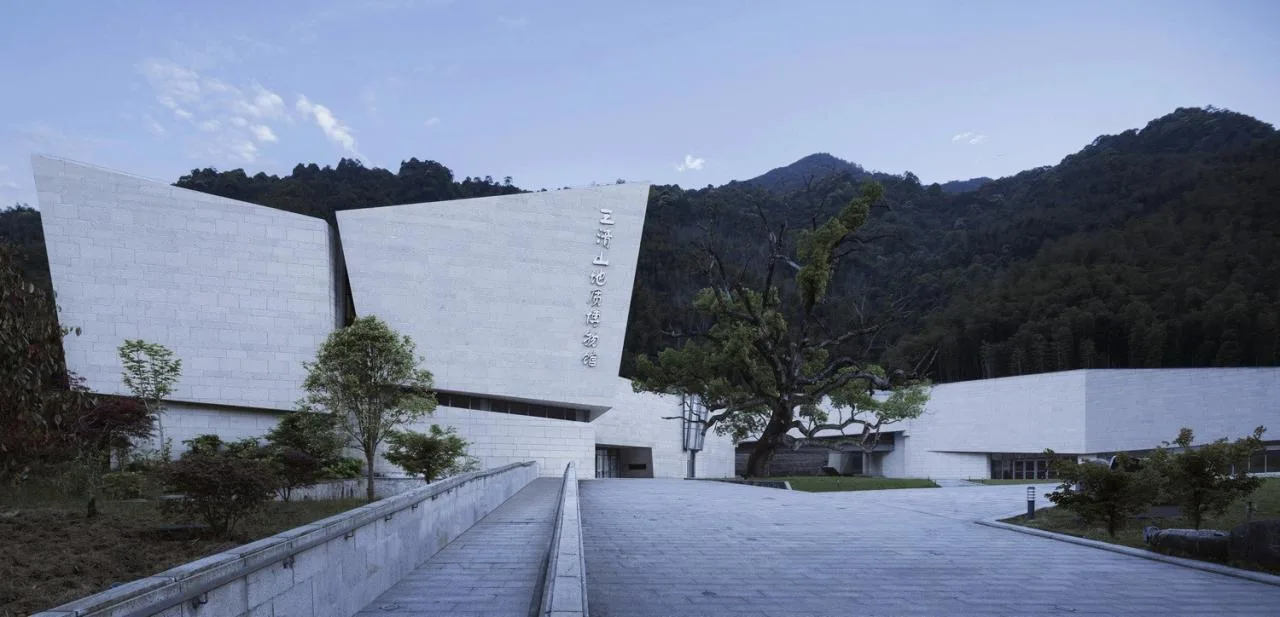
Northeast-facing view of the building © Zhao Qiang
The Sigh of Time
What began as an architectural journey in 2006 unexpectedly went through a long period of pause, twists, and unexpected changes. By the time the museum officially opened, the year was already 2020.
Today, these extraordinary processes form a unique context for this geological museum. When ocean transforms into land and terrain becomes architecture, the interplay of “mountains, trees, rocks” and “sea and mountain changes” becomes the building’s very “writing” of the earth—its terrain and geology.
Despite its imperfections, omissions, and regrets, we hope this project sparks further discussion on “terrain architecture,” “thematic architecture,” and “structural architecture.”
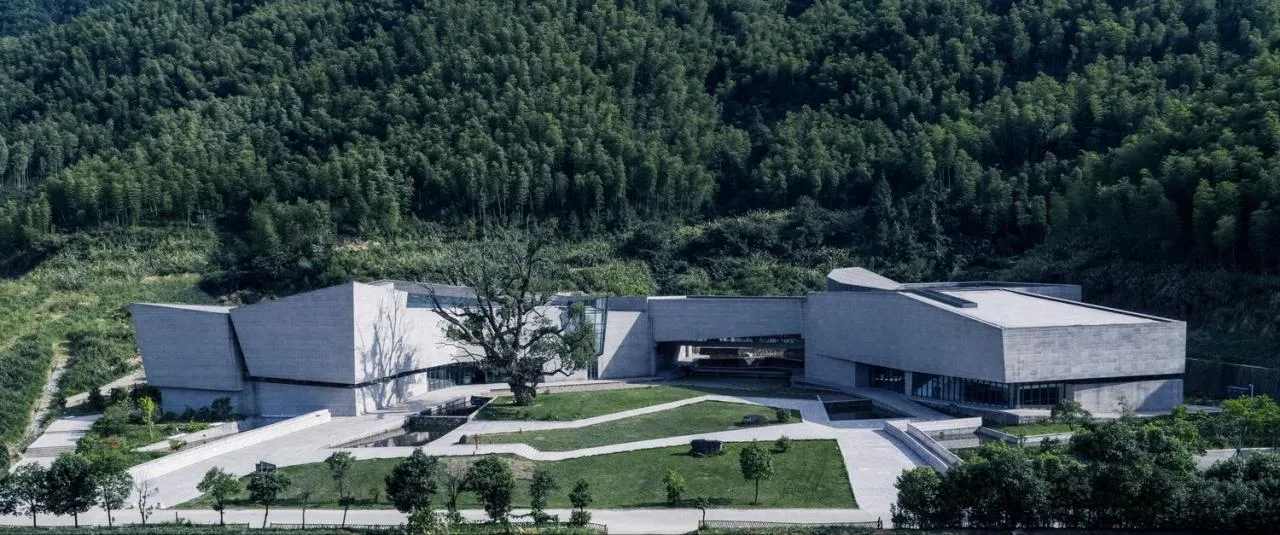
△ North-facing panoramic view © Janko
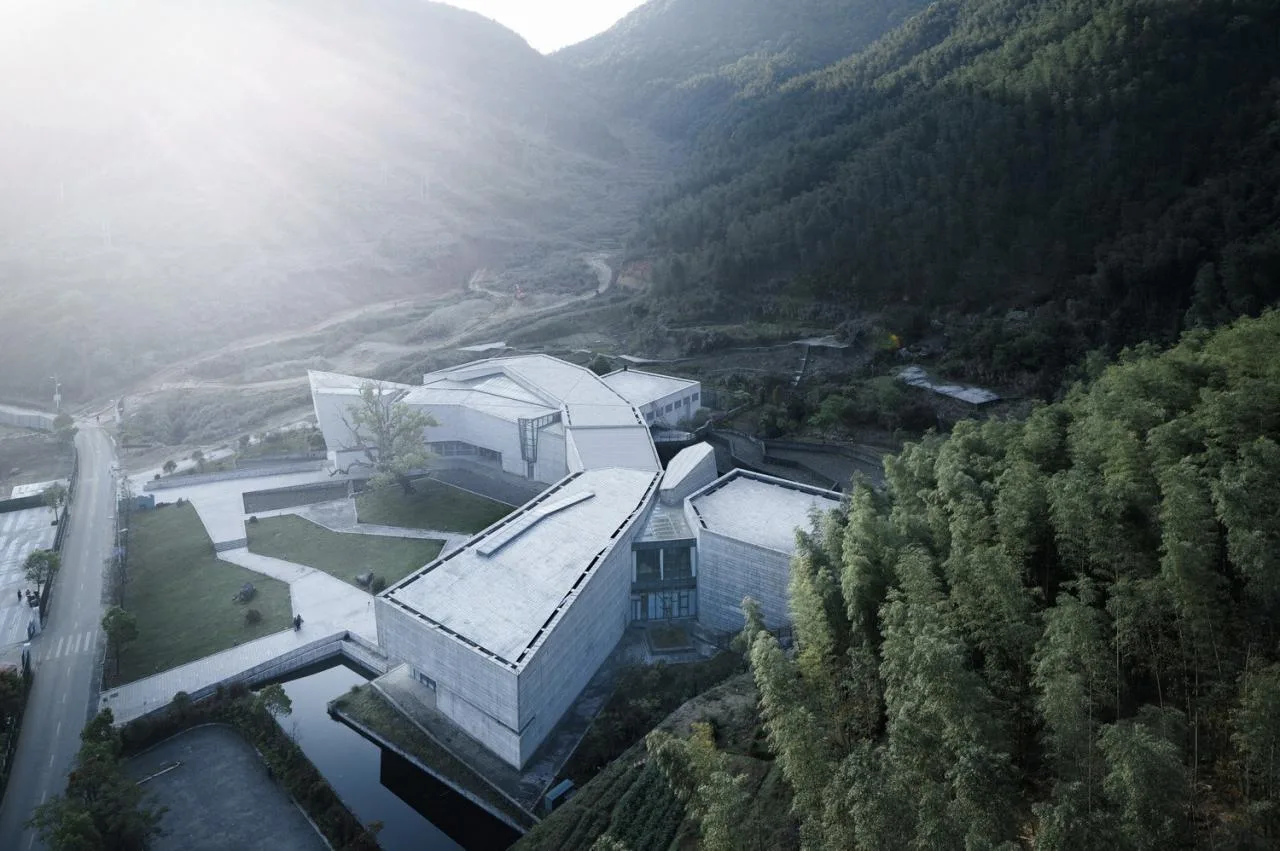
Northwest bird’s-eye view © Zhao Qiang
Project Drawings
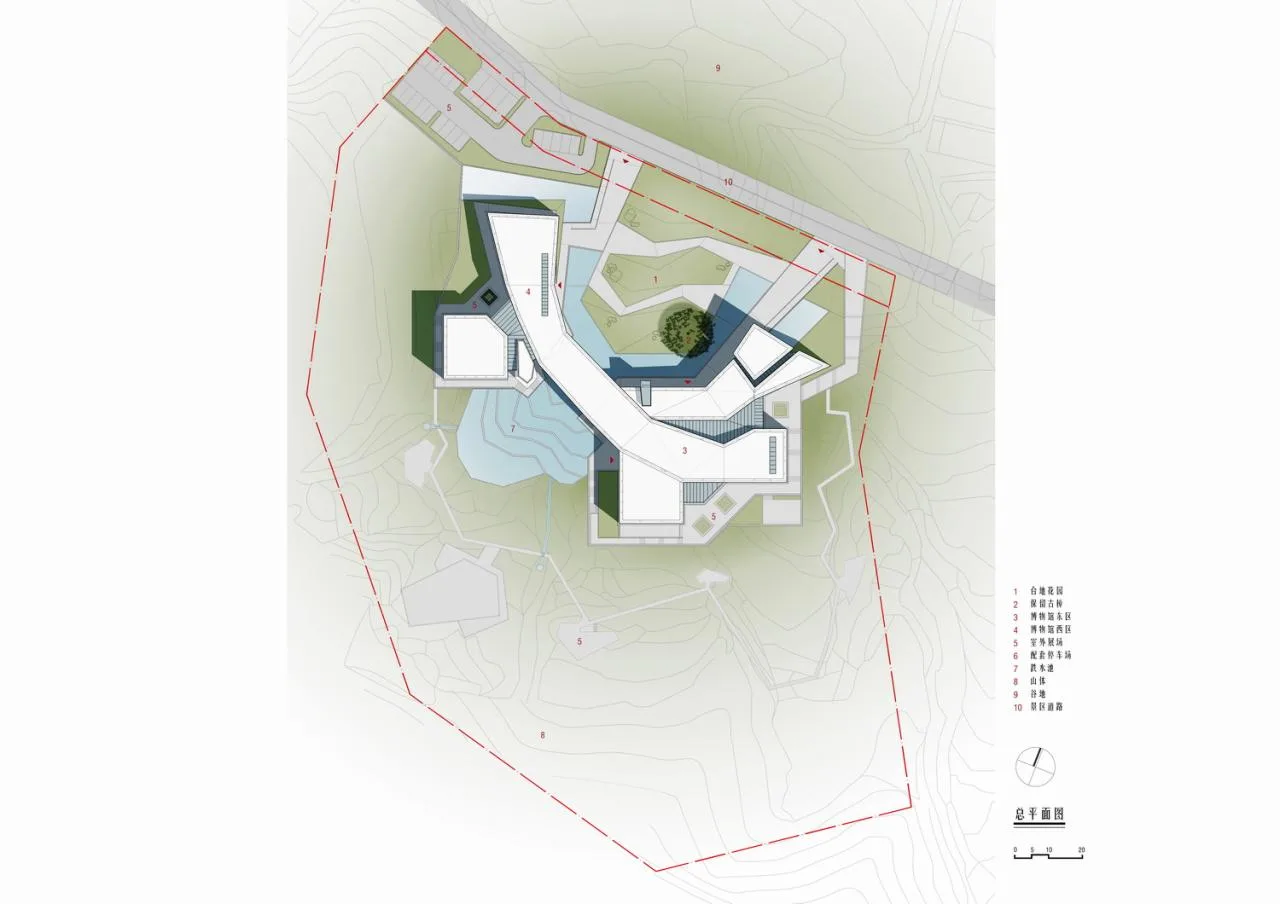
△ General layout plan
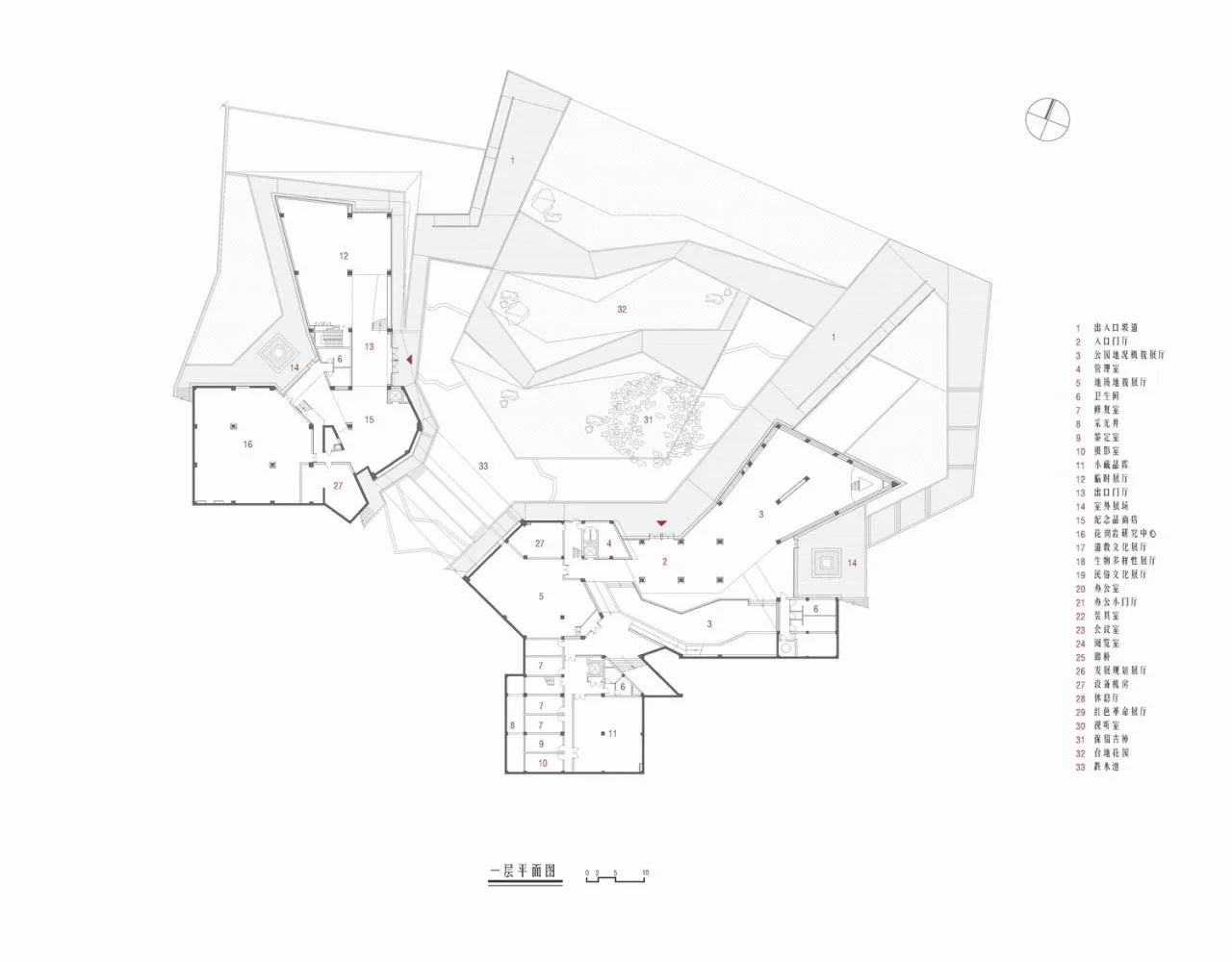
△ First floor plan
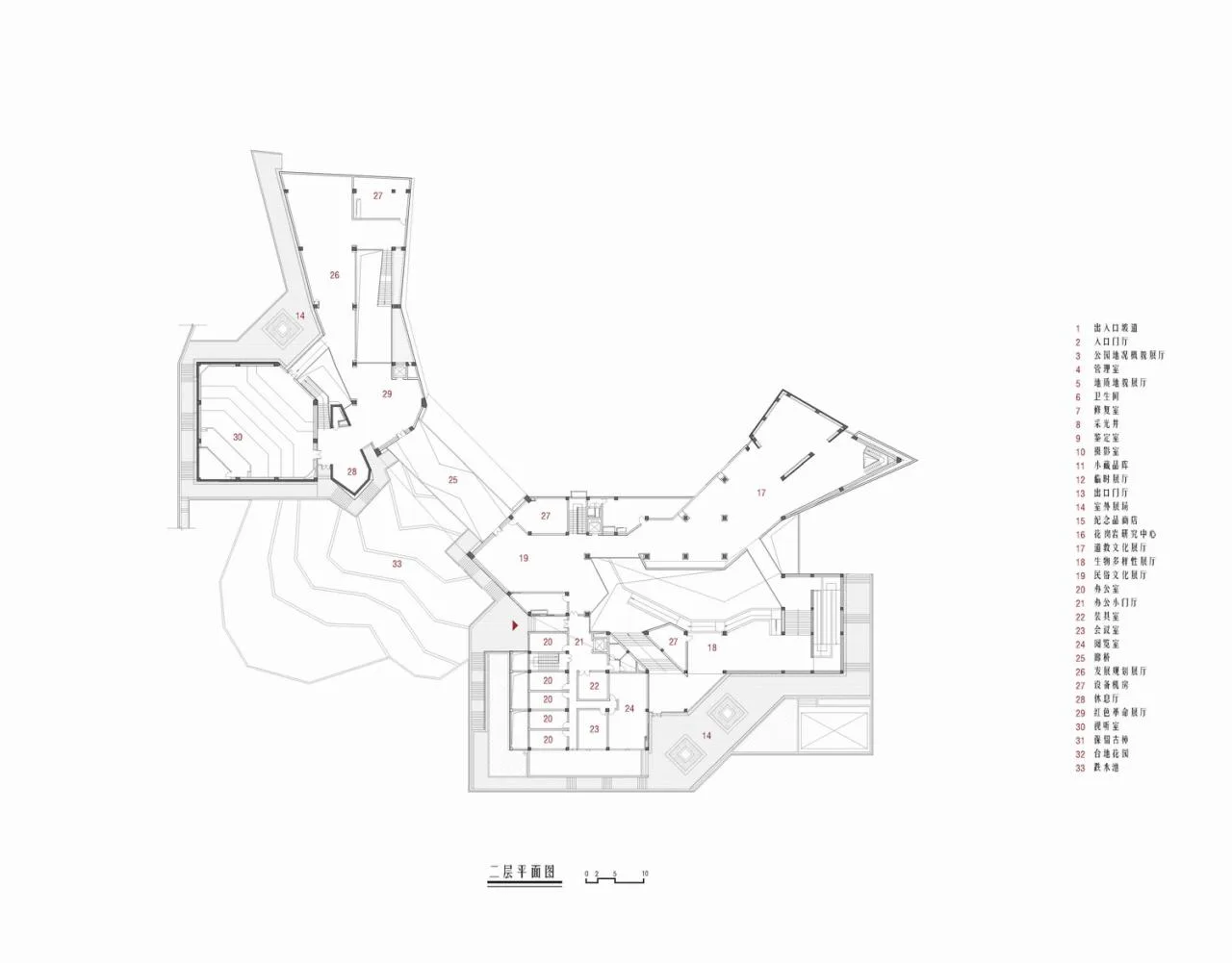
△ Second floor plan
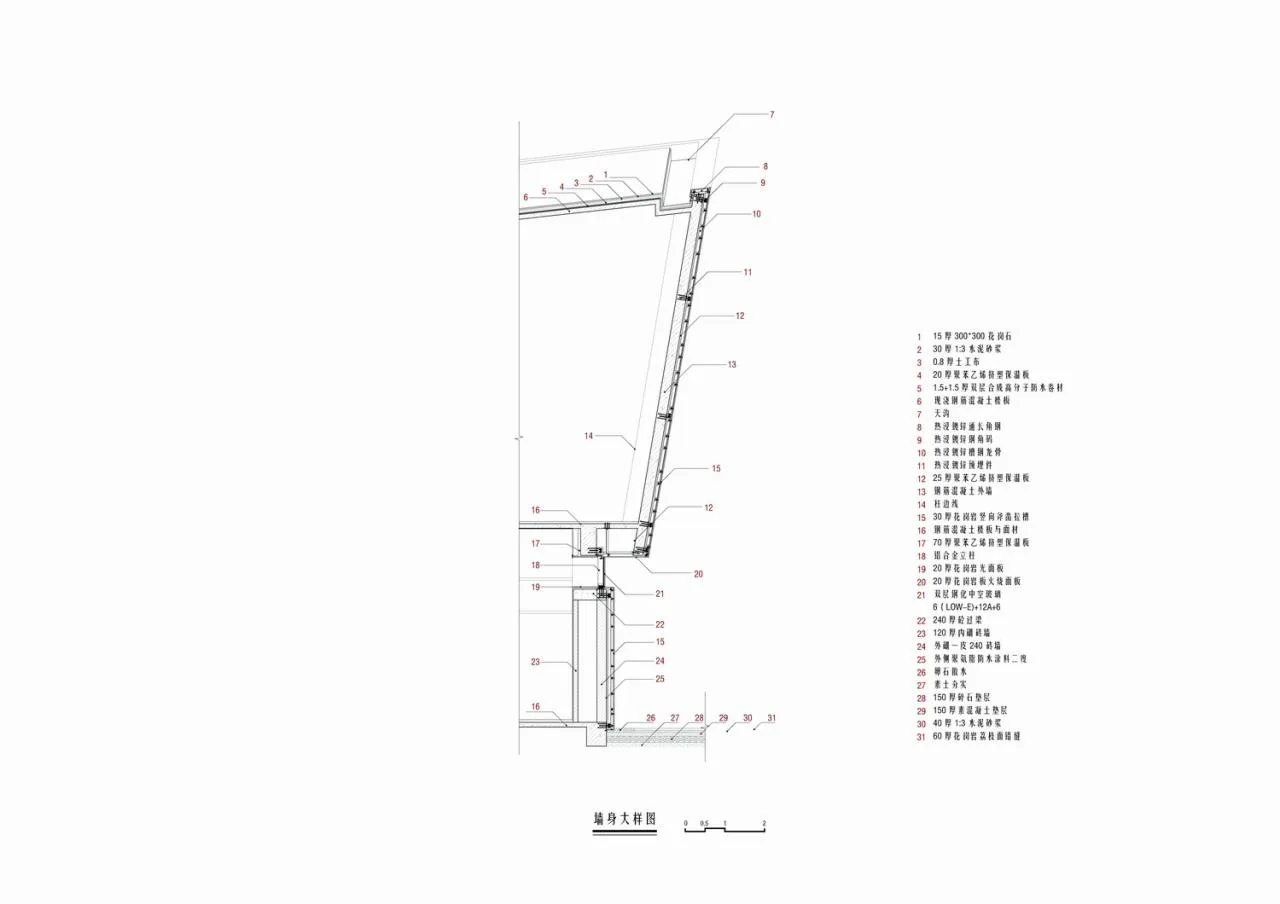
△ Wall detail drawing
Project Information
Project Name: Mount Sanqing Geological Museum
Project Type: Cultural Architecture
Owner: Mount Sanqing Management Committee
Architectural Design: Zhejiang University Architectural Design and Research Institute
Location: Mount Sanqing Scenic Area, Yushan County, Shangrao City, Jiangxi Province
Land Area: 35,525 square meters
Building Area: 6,425 square meters
Structural System: Reinforced concrete frame shear wall structure with local steel structures in large-span areas
Design Supervisor: Shen Jihuang
Design Directors: Ye Changqing
Architecture Team: Ye Changqing, Fang Hua
Structural Engineers: Wu Jie, Gao Zuoren
Water Supply and Drainage: Wang Bo
Electrical Engineering: Wu Xuhui
HVAC Engineering: Cao Zhigang
Intelligent Systems: Lu Qingxin
Construction Cost Management: Sun Wentong
Curtain Wall Specialist: Tao Shanjun
Architectural Photography: Zhao Qiang, Yang Ke















Must log in before commenting!
Sign Up