
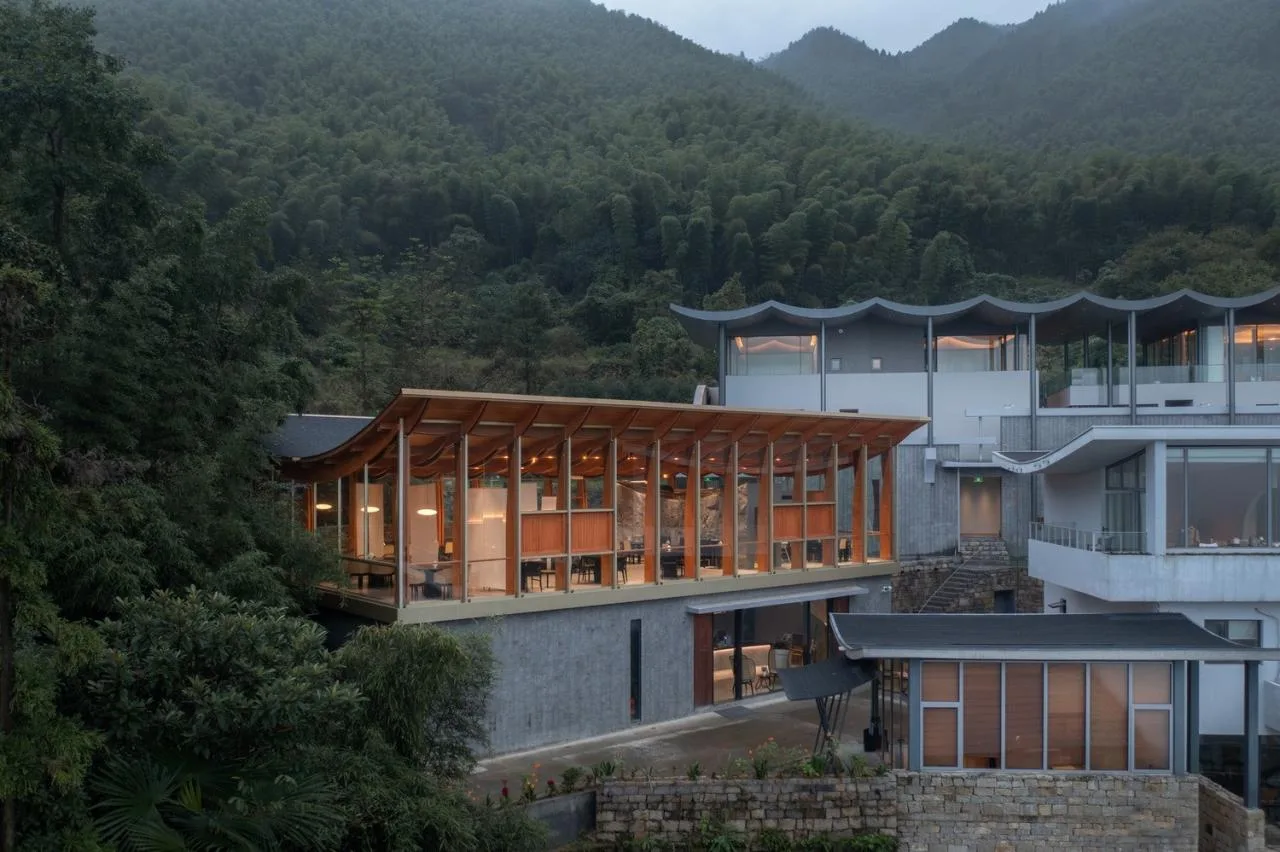
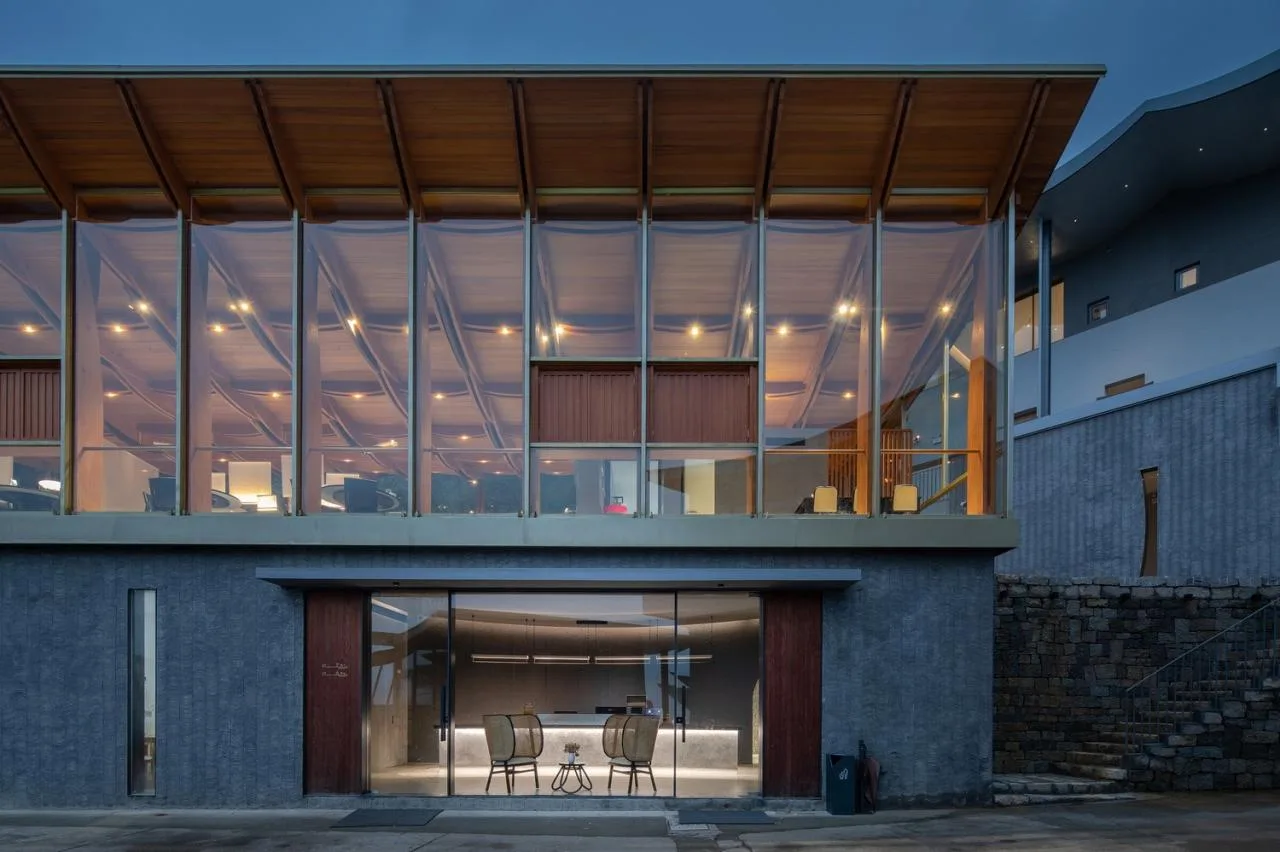
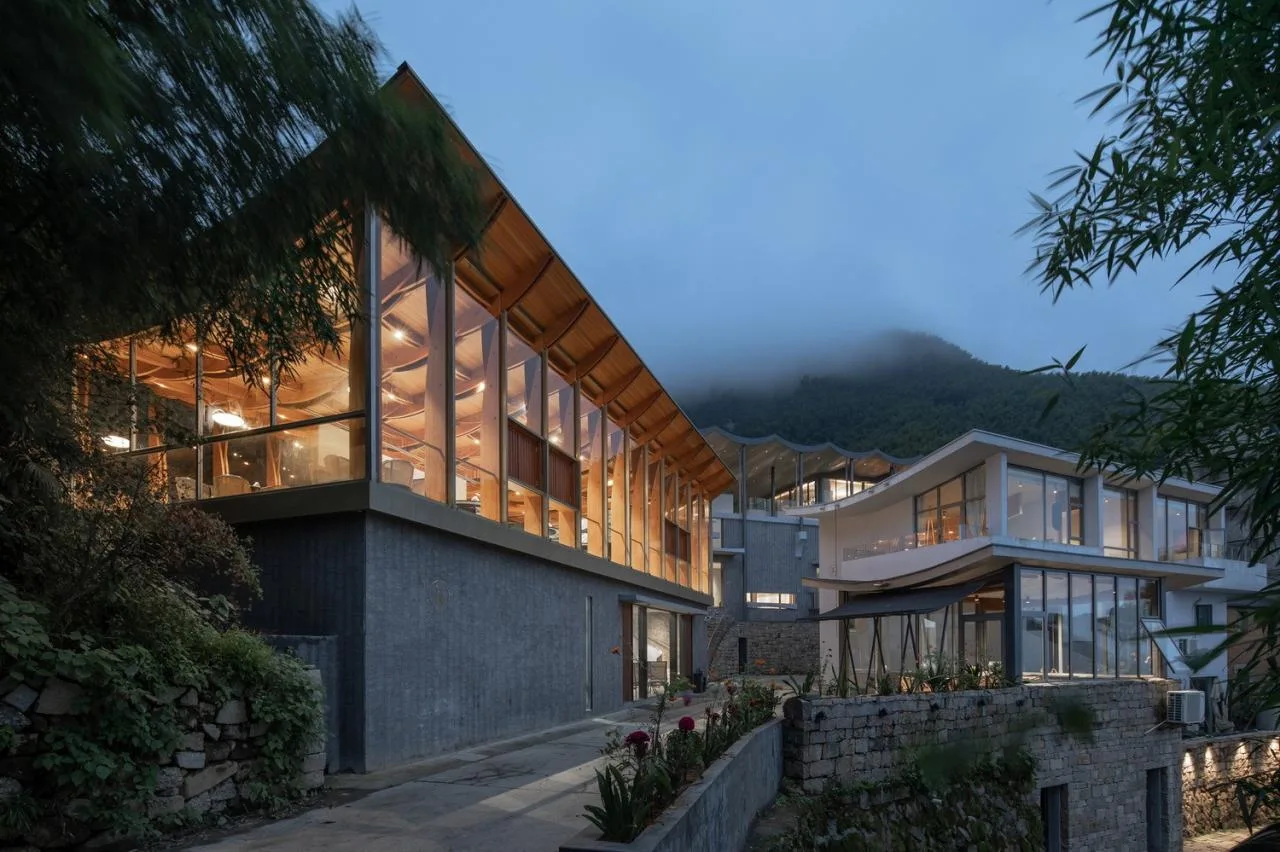
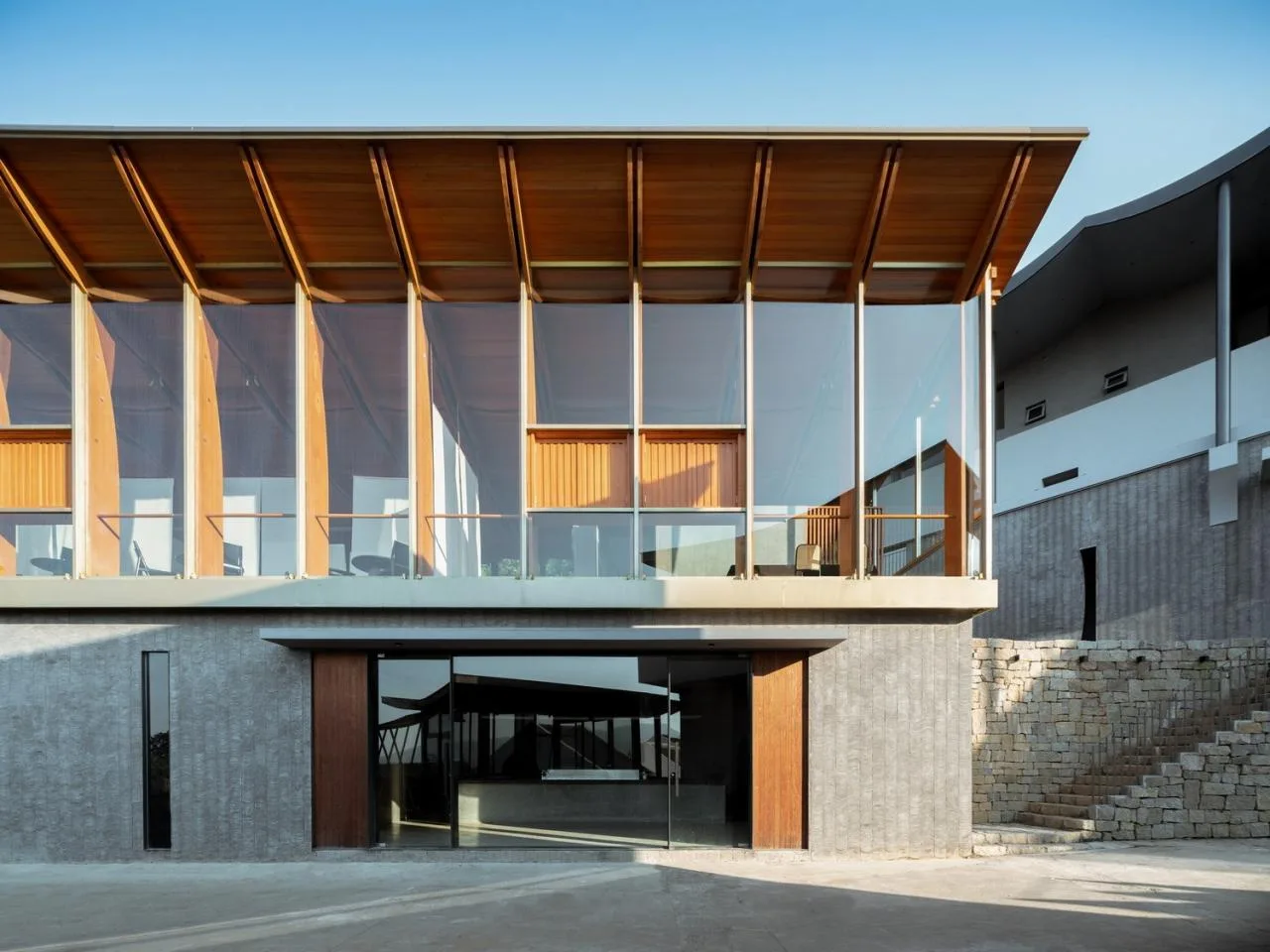
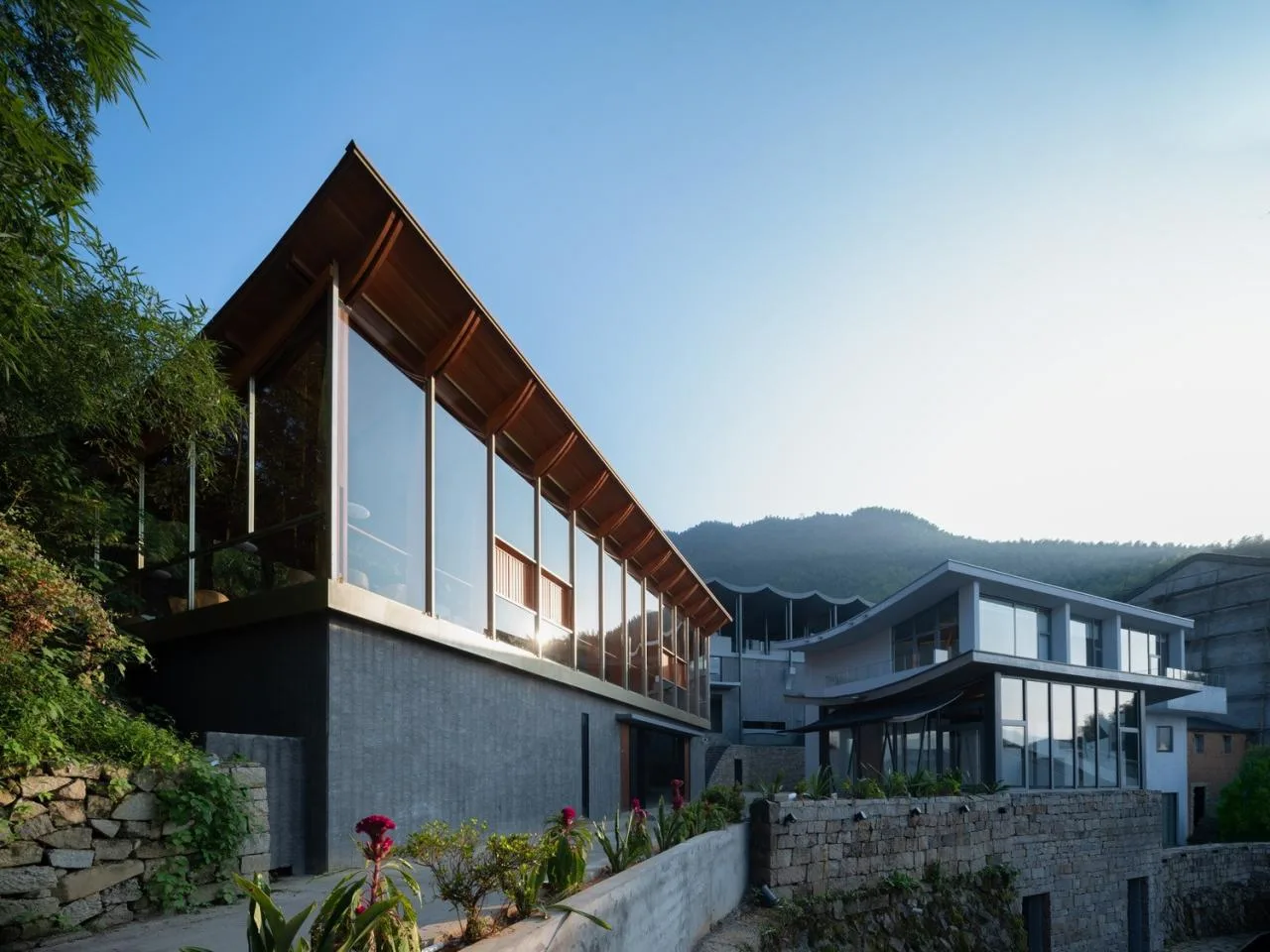
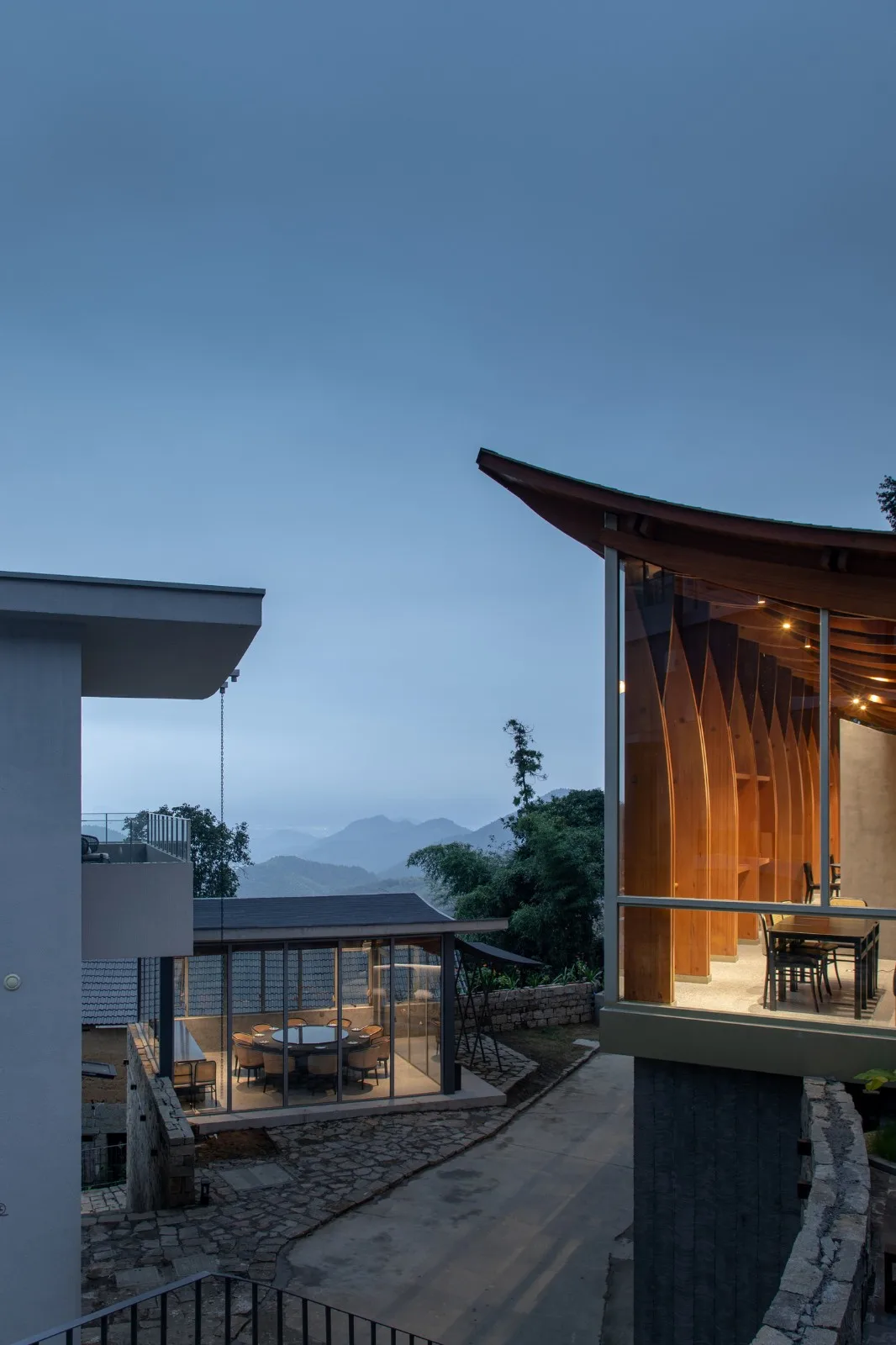
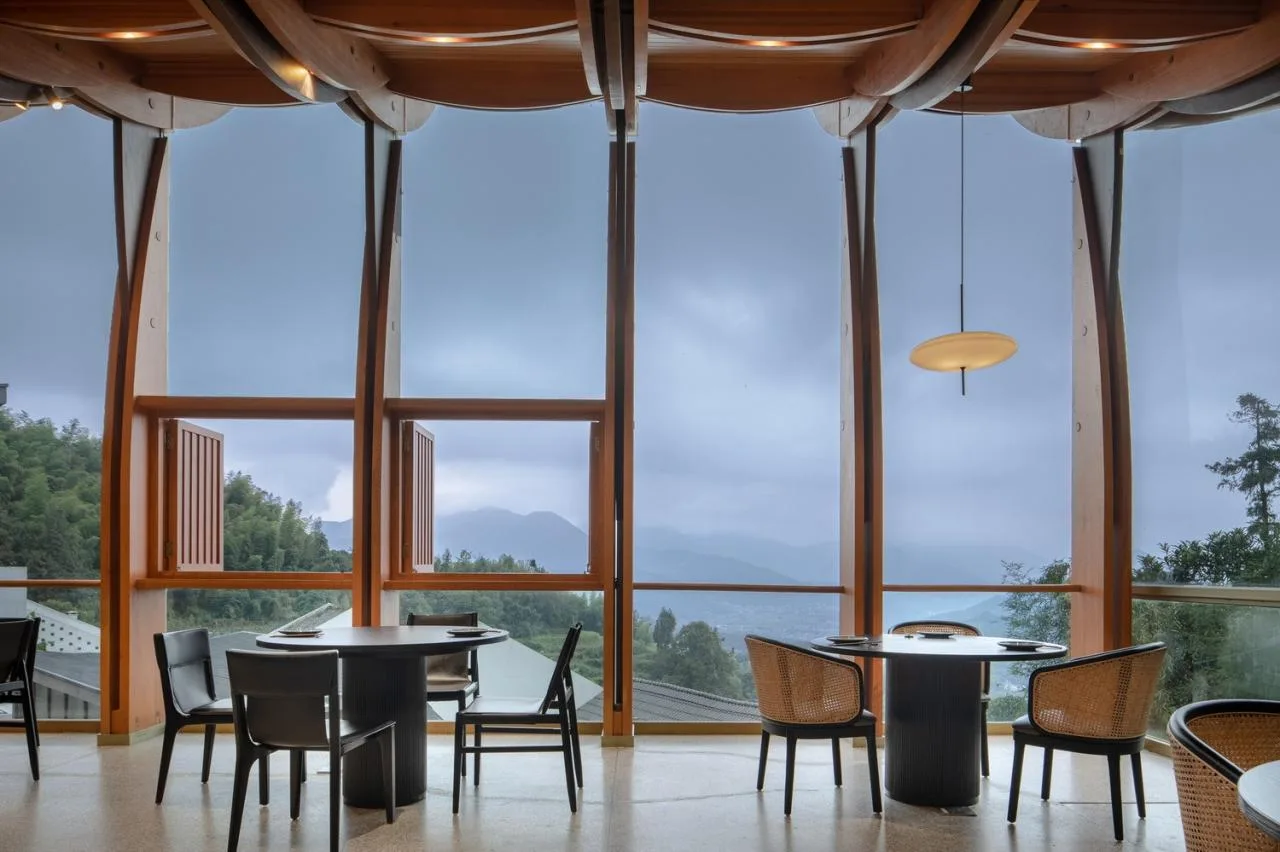
The Jiaoyue Pavilion is nestled in a village situated in the hilly region of western Zhejiang. Positioned halfway up the mountain, it is surrounded by picturesque landscapes on all sides. Most of the village’s residences have been converted into homestays, creating a need for a dedicated restaurant and reception area. The Jiaoyue Pavilion, the first building visitors encounter upon entering the village, was renovated from a former residential house. Its ground floor faces the road and functions as the village’s reception and kitchen logistics center, while the second floor offers expansive views and serves as a restaurant.
Behind the pavilion lies a bamboo forest, with an open mountain and water landscape stretching out before it. This setting raises an essential question for design: how should architecture integrate gracefully into the natural environment?
Choosing Wood: From “Small Materials for Large-Scale Production” to “Large Materials for Small-Scale Production”
Wood is a warm, inviting material that grows naturally—it embodies solidified vitality and represents a domesticated form of nature. It is accessible and easy to work with, making it one of the most primitive and rustic building materials. Human closeness to wood stems from a long history of companionship, crafting objects with simple tools from naturally sourced wood.
However, natural wood sizes are limited. To achieve larger structural spans, smaller wood pieces must be combined. Traditional Chinese wooden construction employs the technique of “small materials, big works,” where stacking small components is not only a test of craftsmanship but also a symbol of social hierarchy, as seen in the layering of wooden arches and caissons. Woodworking in traditional Chinese architecture represents a trinity of society, culture, and philosophy.
With the advent of modern laminated wood technology, wood lengths now surpass natural growth limits, enabling industry to produce large materials easily. Modern wood structures prioritize mechanical properties similar to steel and reinforced concrete, focusing on efficiency rather than exploring wood’s inherent qualities. As a result, wooden structures today often serve as “green packaging” in industrial construction.
For example, North American wooden construction systems feature massive components and heavy metal joints that feel crude, while the Japanese system, derived from the North American approach, emphasizes physical properties to an extreme, resulting in a superficial and rudimentary appearance.
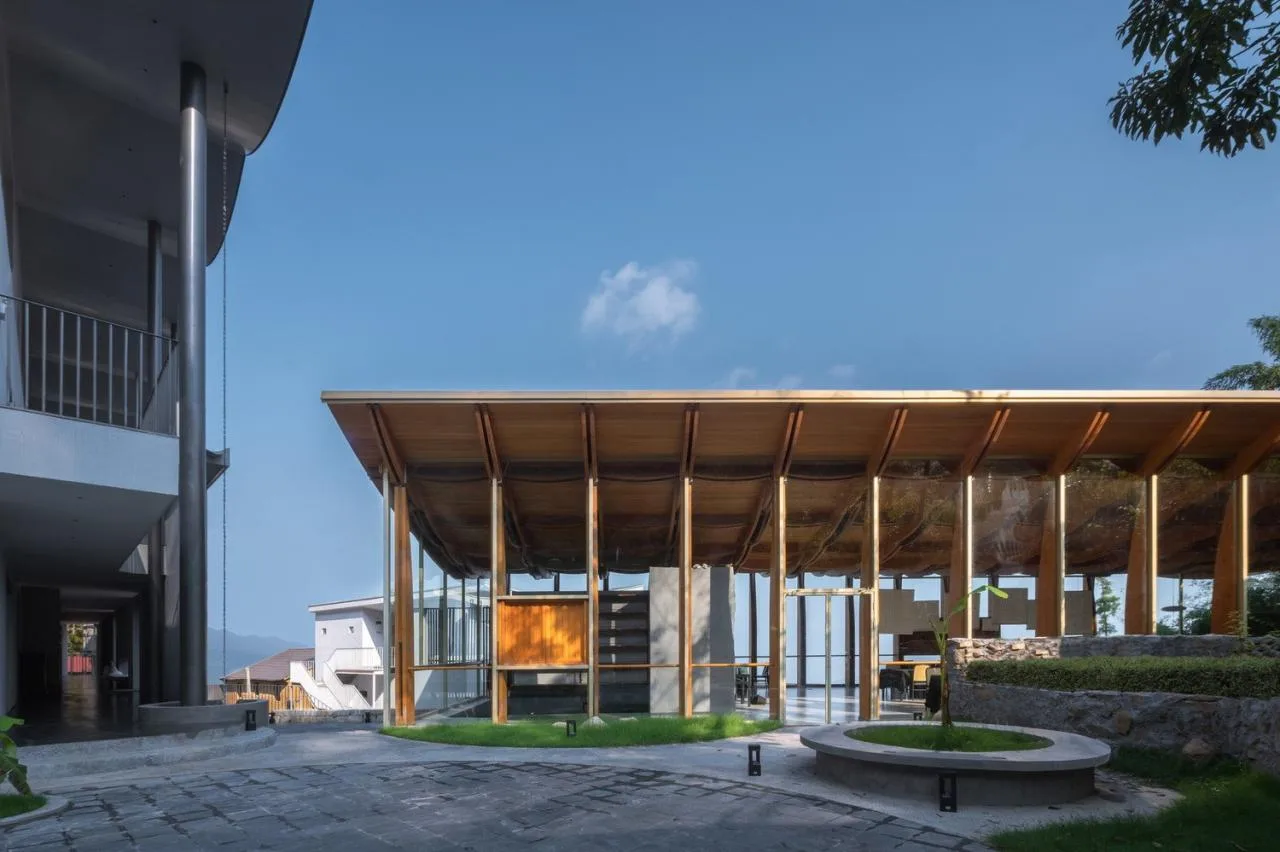
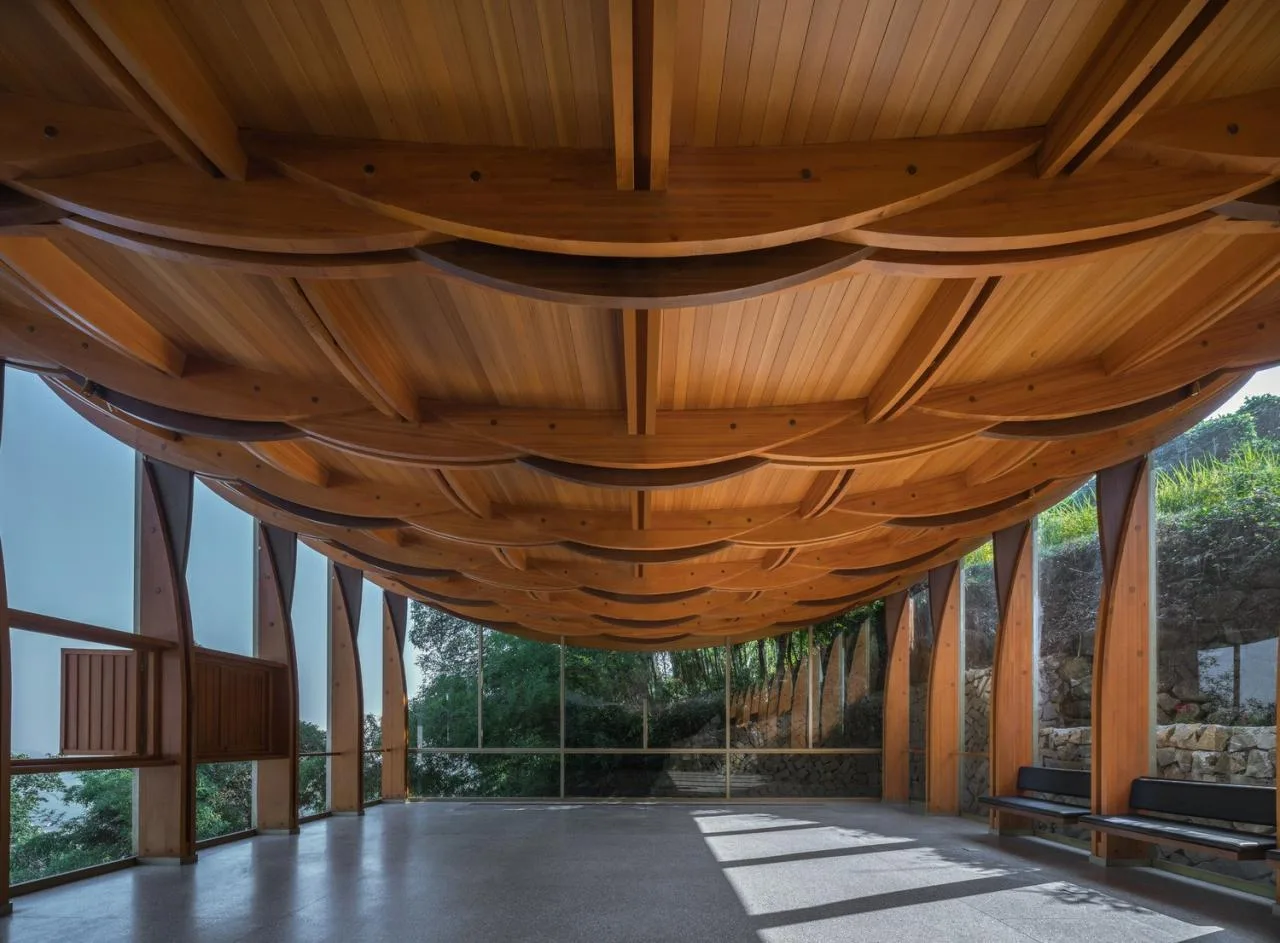
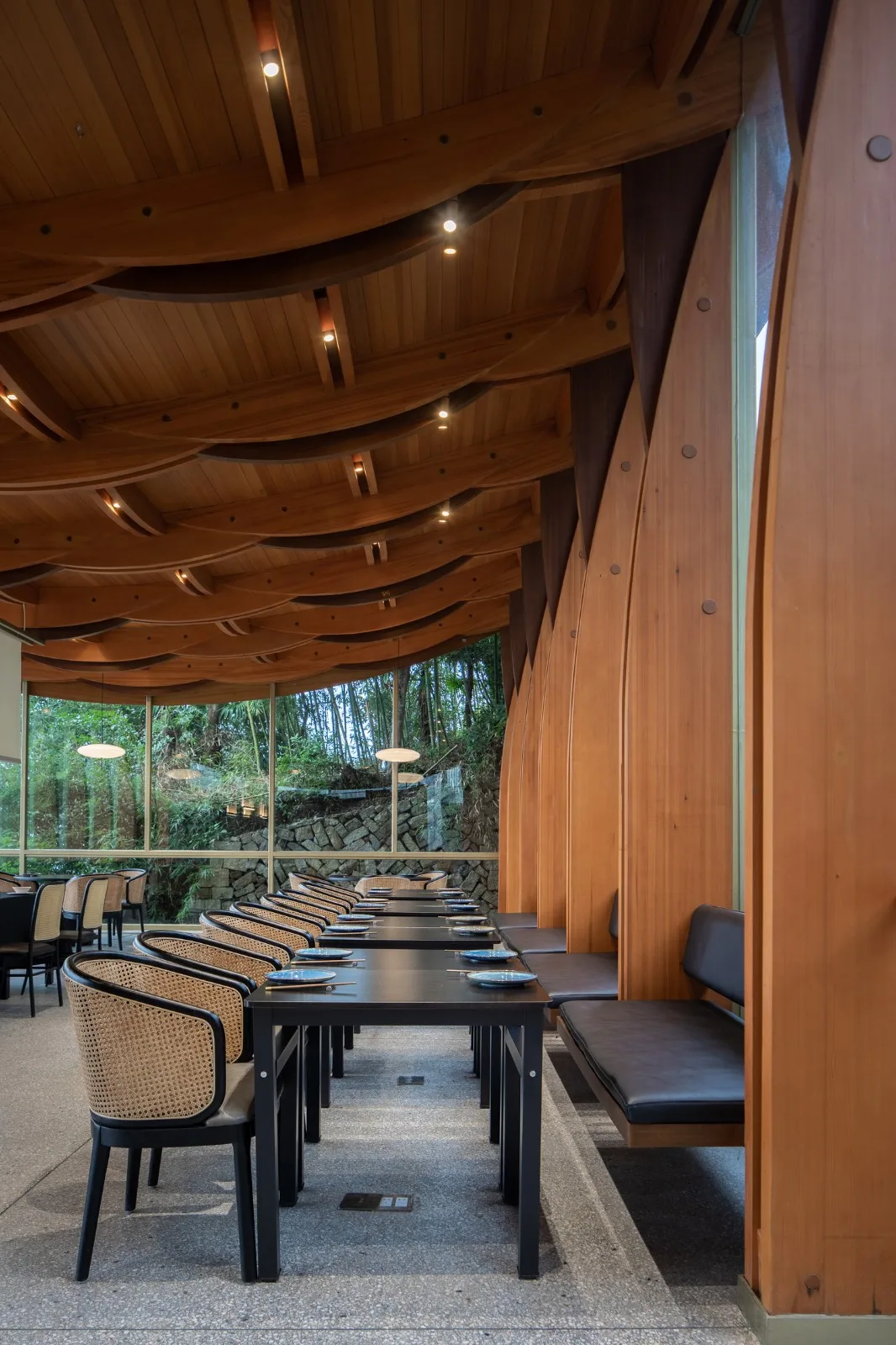
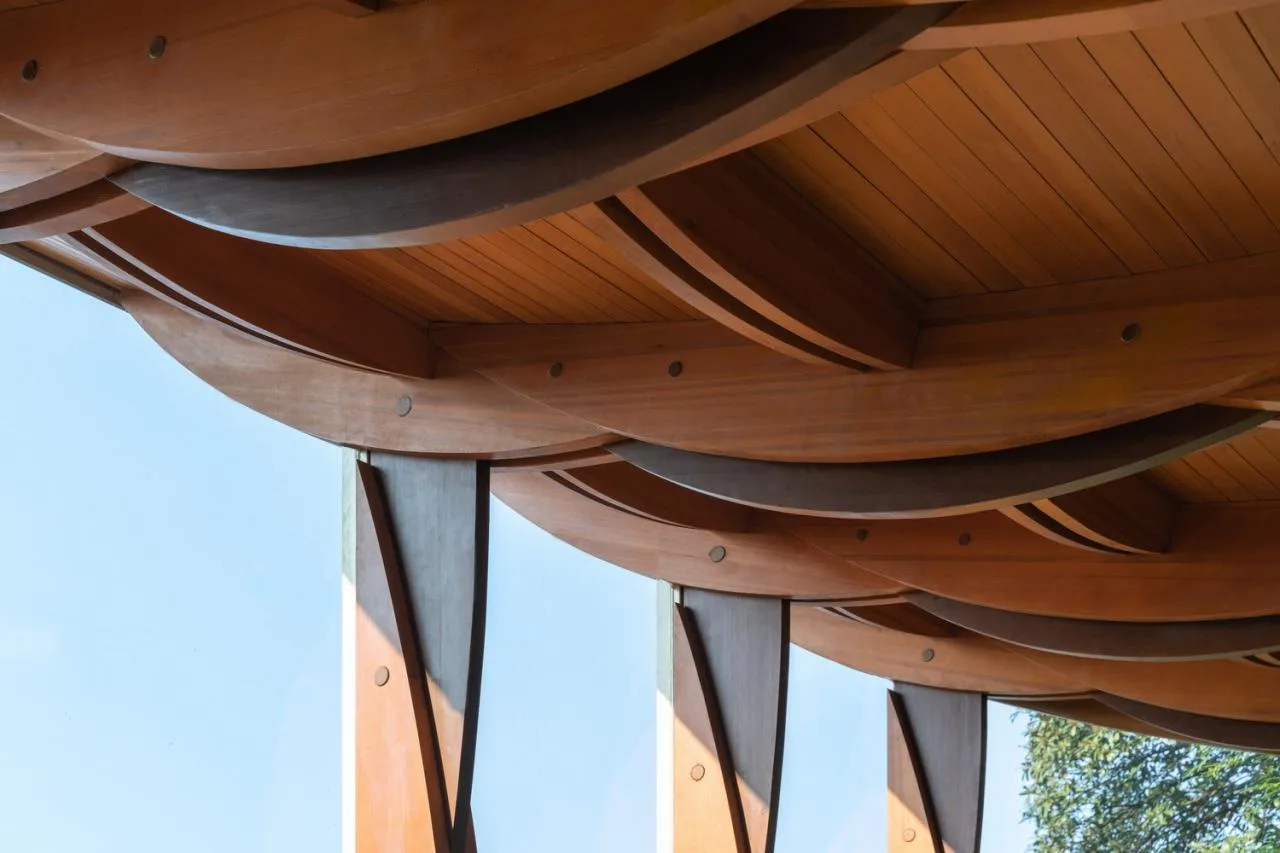
Traditional Chinese wooden structures boast a rich cultural legacy and do not prioritize efficiency above all. Reviving this tradition is a key direction for contemporary Chinese modern wood architecture. In the Jiaoyue Pavilion, structural spans were achieved not with single large pieces but by layering multiple small pieces to create redundancy. This approach challenges the notion of efficiency as the sole priority.
If shifting from “small-scale production” to “large-scale production” represents cultural loss after adopting foreign methods, then the current return to “large-scale production” is a distorted cultural revival.
Reverse Arch: From “Woven Wooden Arch” to “Woven Wooden Rope”
The Jiaoyue Pavilion’s structural inspiration comes from the traditional Chinese “woven wooden arch” bridges, a classic example of the “small materials, big works” technique. In the Northern Song Dynasty painting Along the River during Qingming Festival, the “Hongqiao” wooden arch bridge holds a central artistic role. Real-world examples, such as the corridor bridges in southern Zhejiang, demonstrate this structural prototype.
These wooden arch bridges are longitudinal arches made of many short wooden poles arranged horizontally to create stiffness and enable large spans. The intricate mortise and tenon joinery connects these small elements, allowing the structure to stand for centuries—an impressive feat of craftsmanship and design.
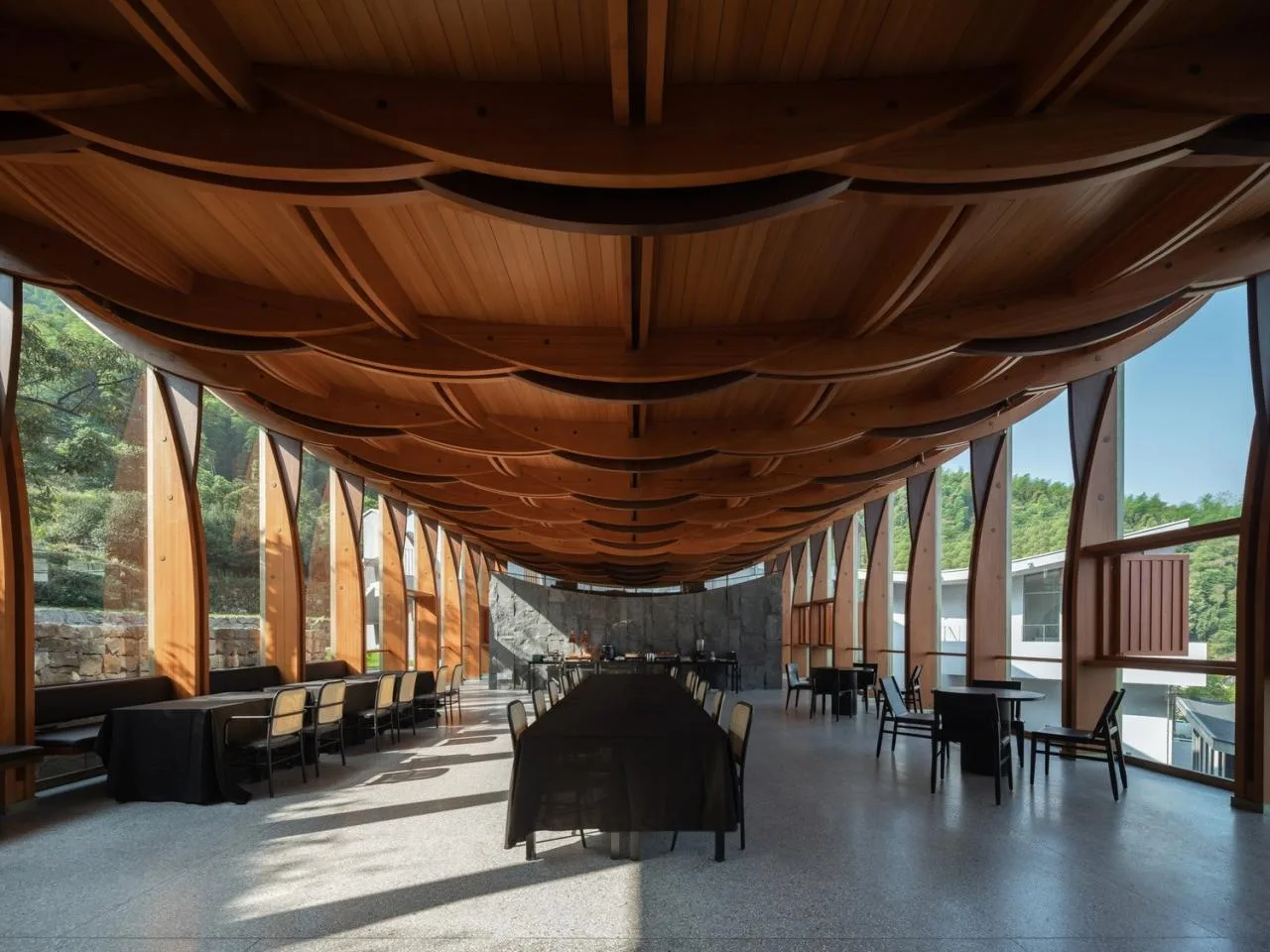
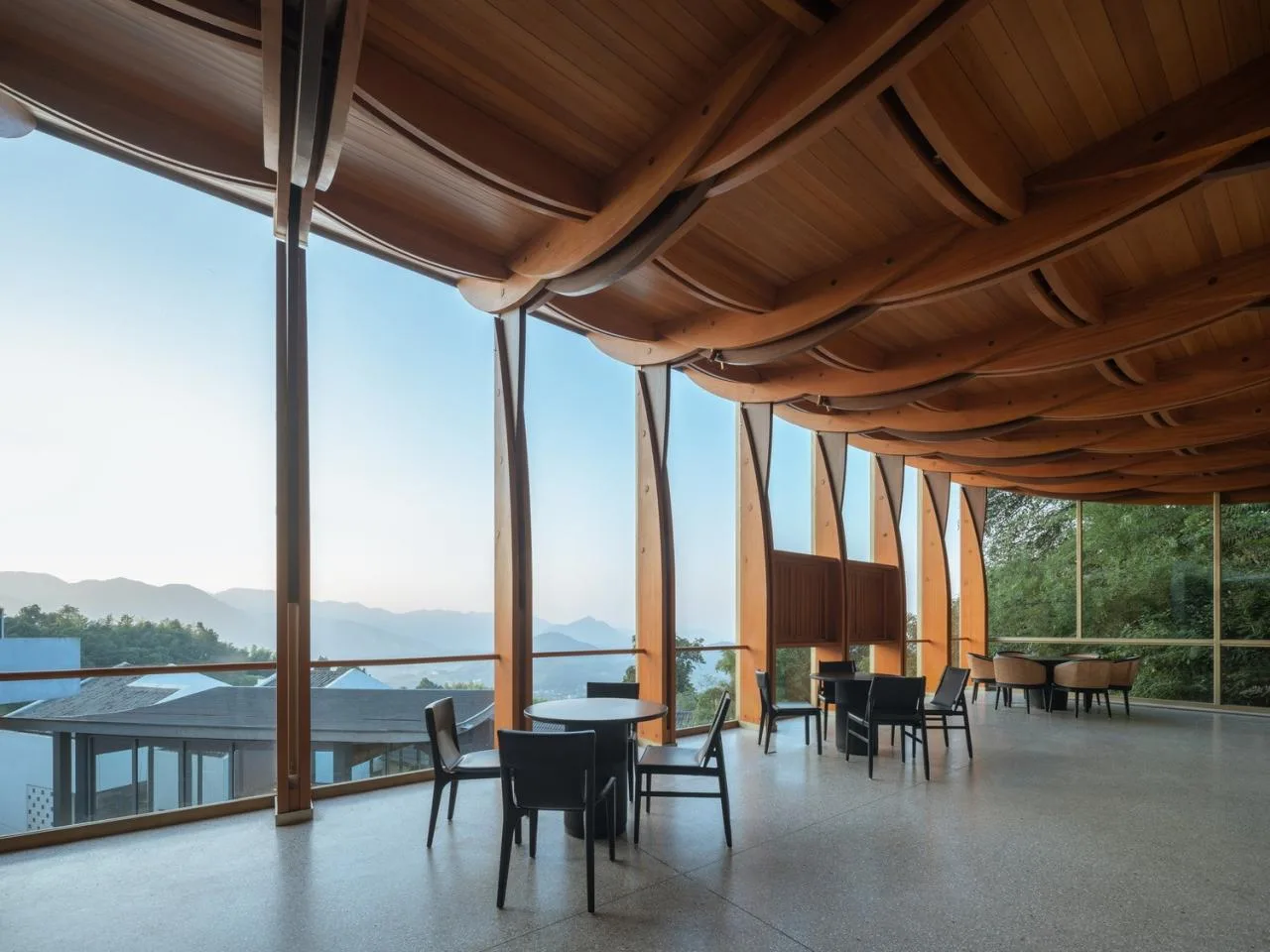
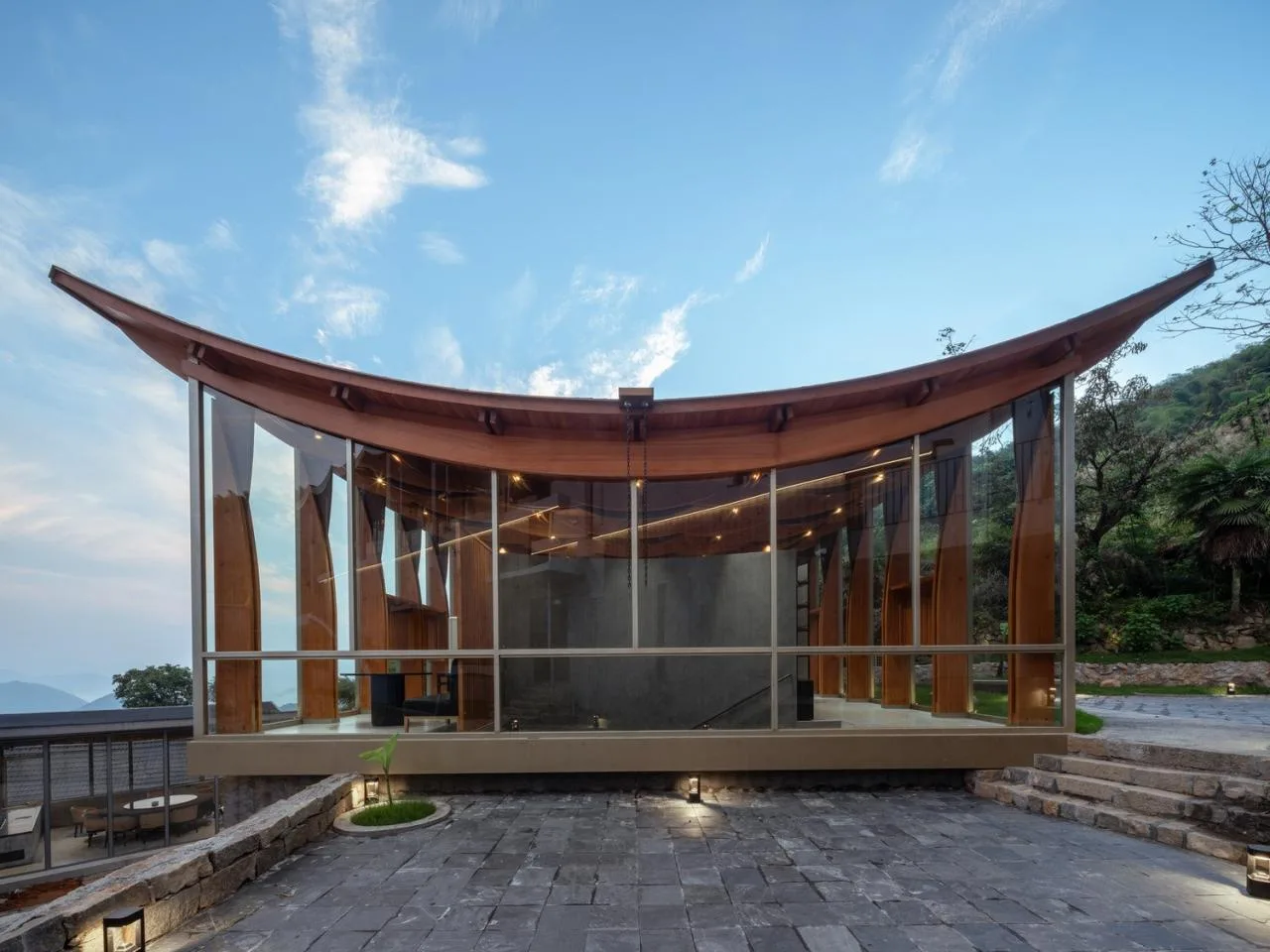
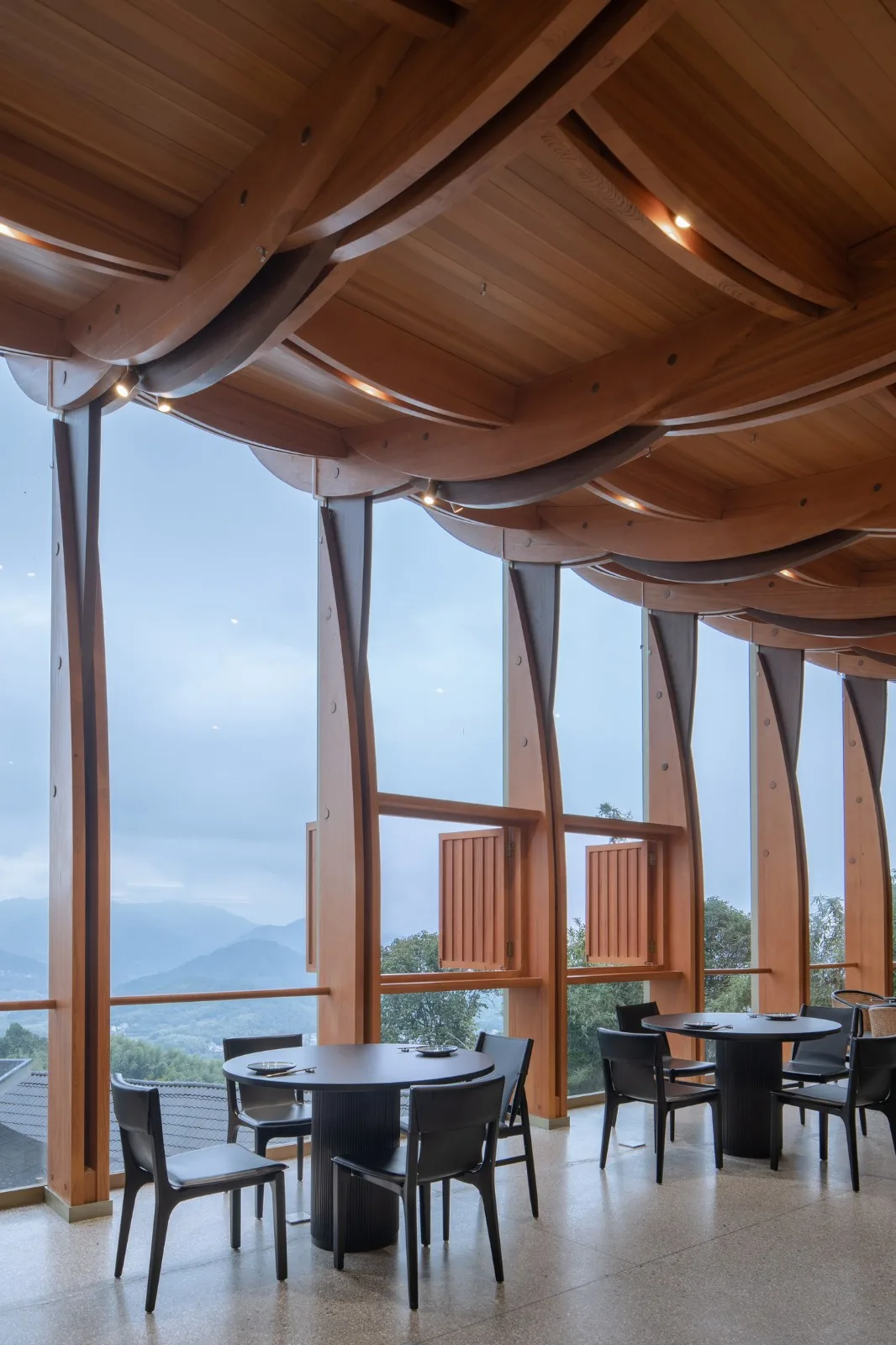
In the Jiaoyue Pavilion, this wooden arch form is flipped, transforming the “arch” into a “rope.” While the relationships between forces on each member remain unchanged, the force directions reverse: axial compression in the arch becomes axial tension, and lateral thrust transforms into lateral tension. This tension is counteracted by the outward widening of the columns, eliminating the need for a massive rigid foundation typical in arches.
This transformation—from weaving wooden arches to weaving wooden ropes—is both a reversal in form and force, cleverly adapting traditional wooden structures while encouraging the space to rise and expand outward.
Creating the Moon: From “Stacking the Moon” to “Water Waves”
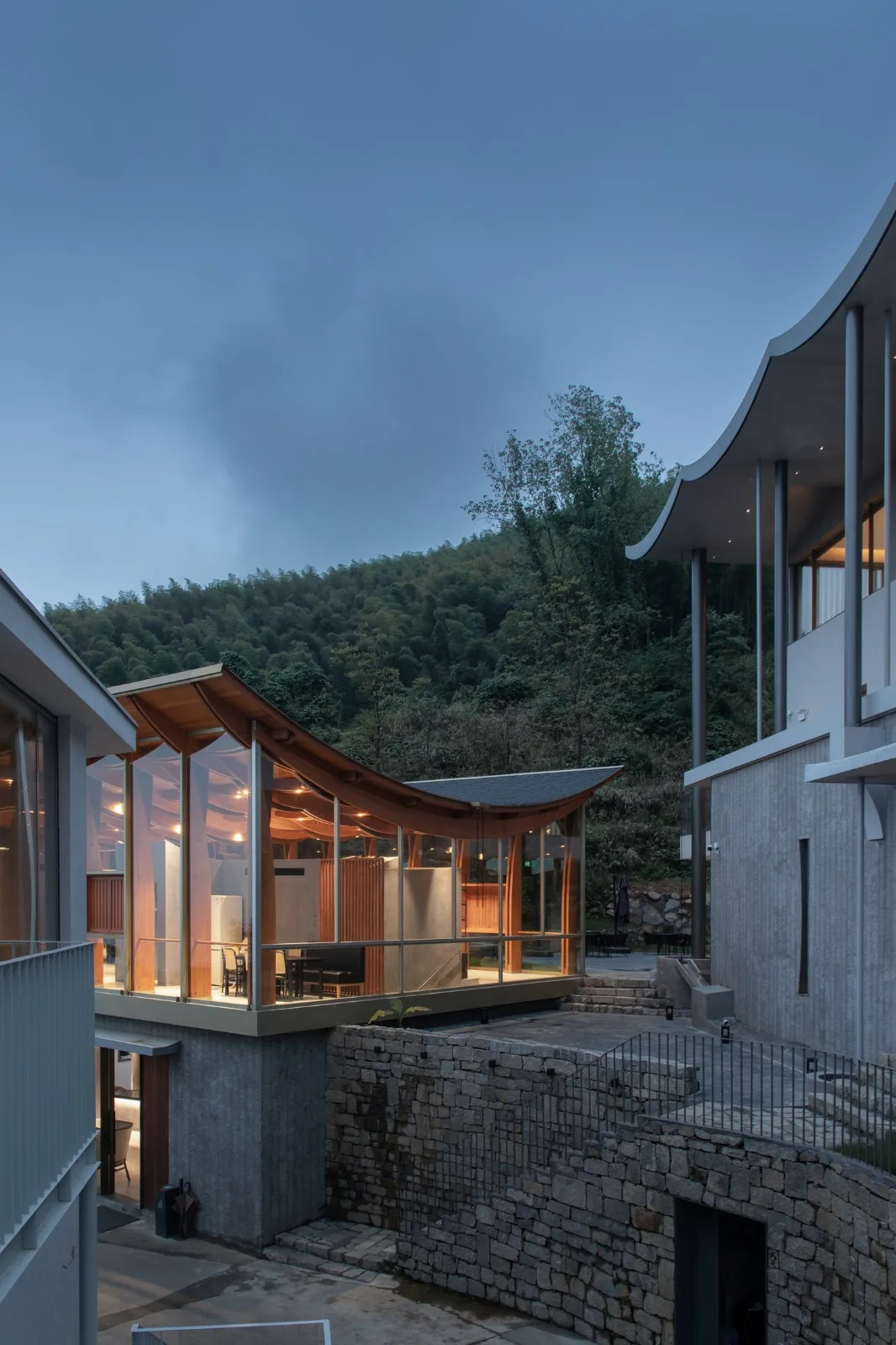
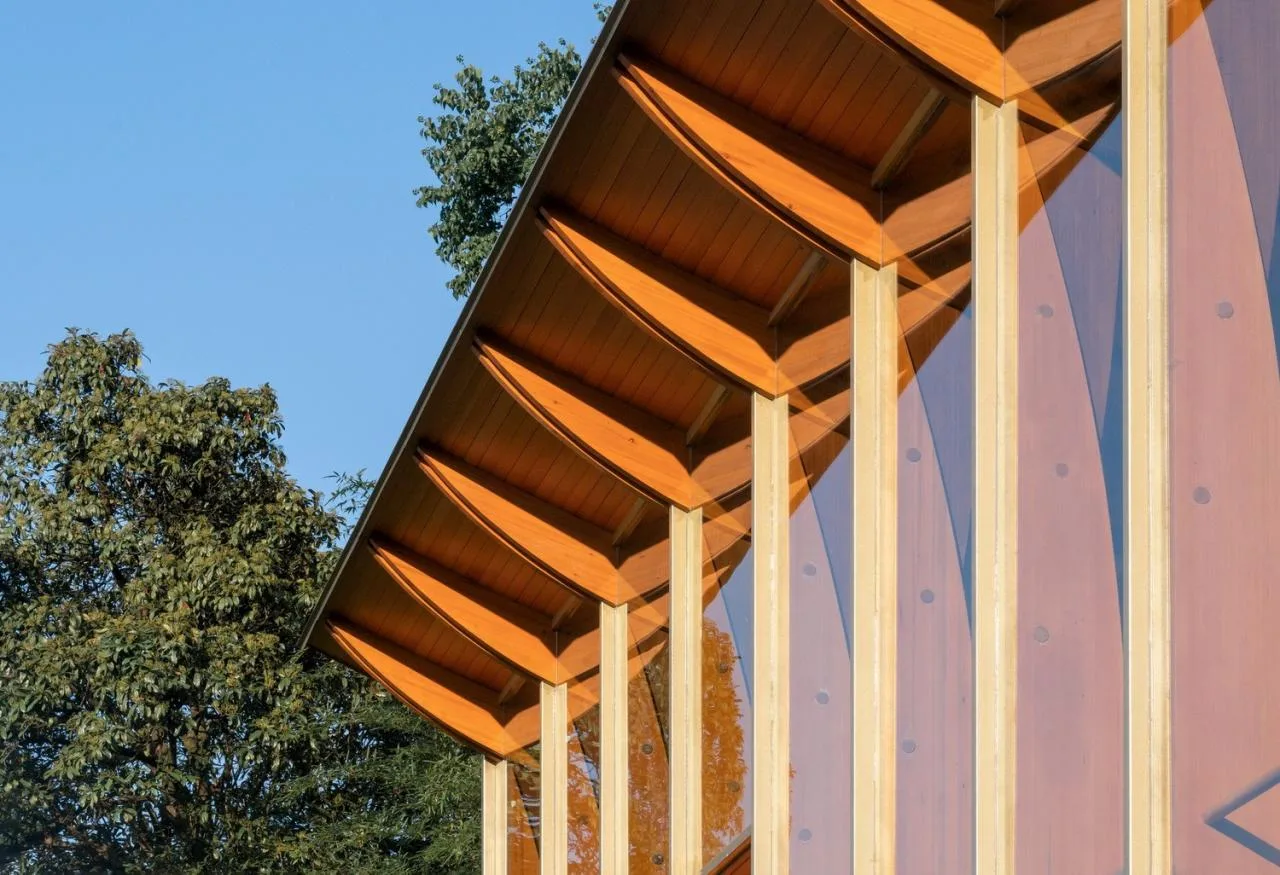
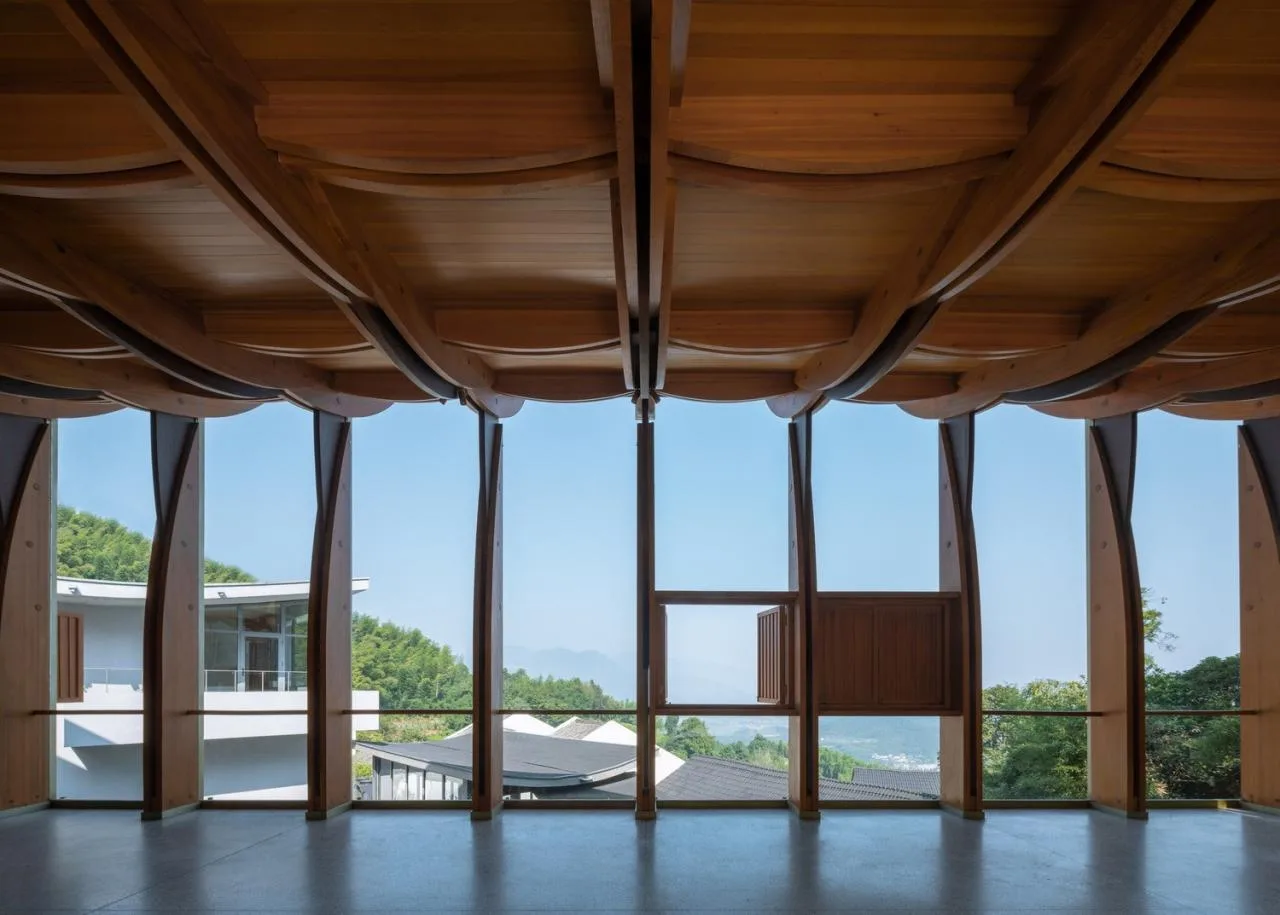
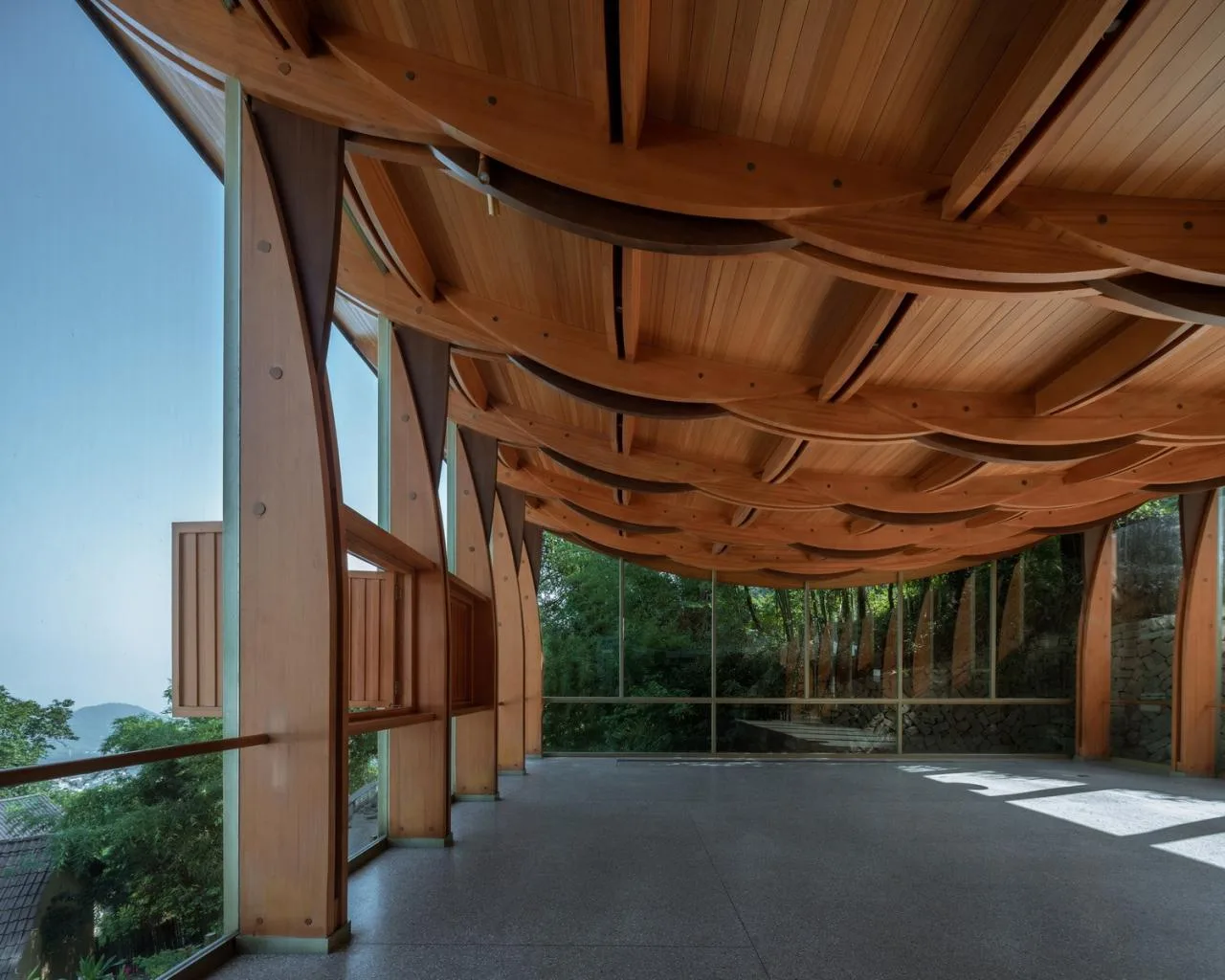
The poles of the Moon Pavilion do not use the traditional wooden round poles but instead feature curved, sheet-like poles. These poles taper at both ends and arc outward in the middle, reflecting the bending moment stress shape—also resembling the crescent shape of the moon.
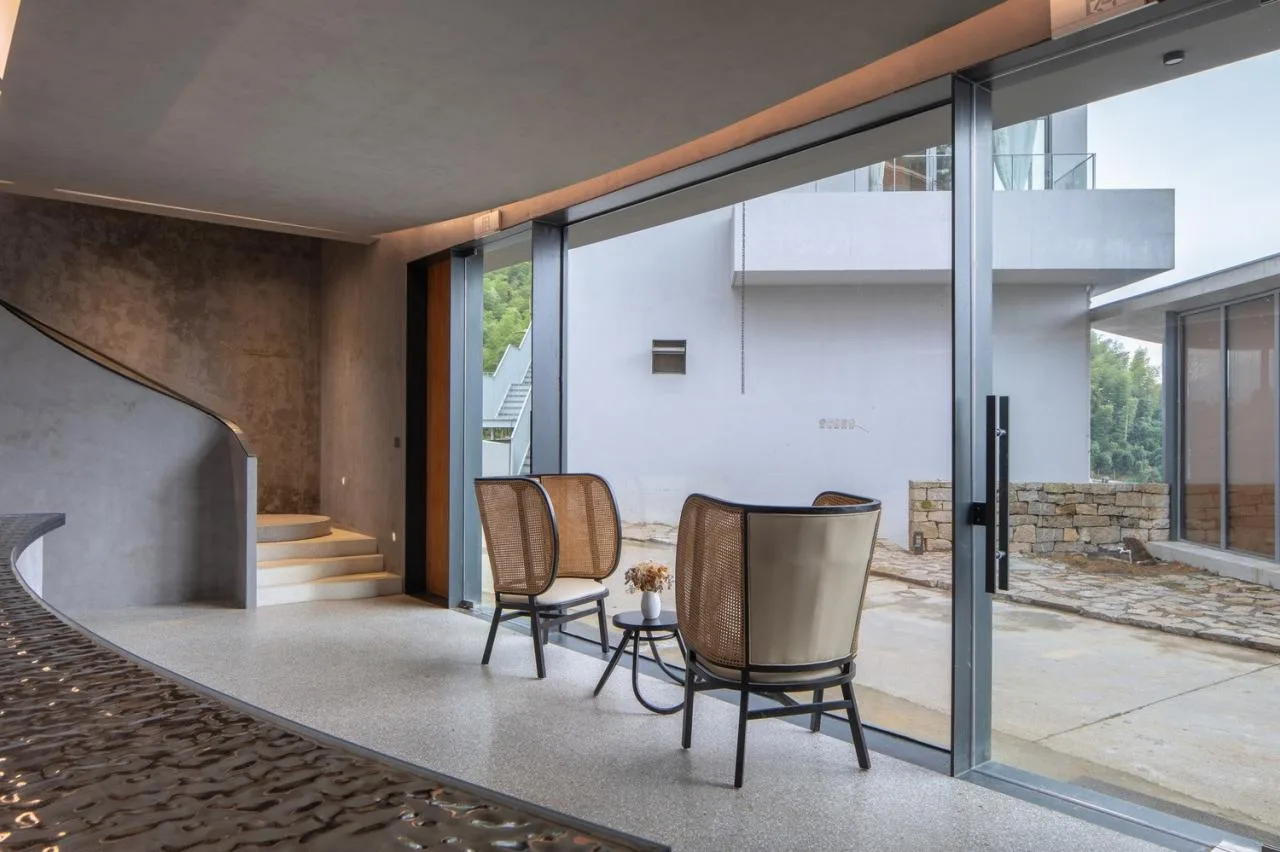
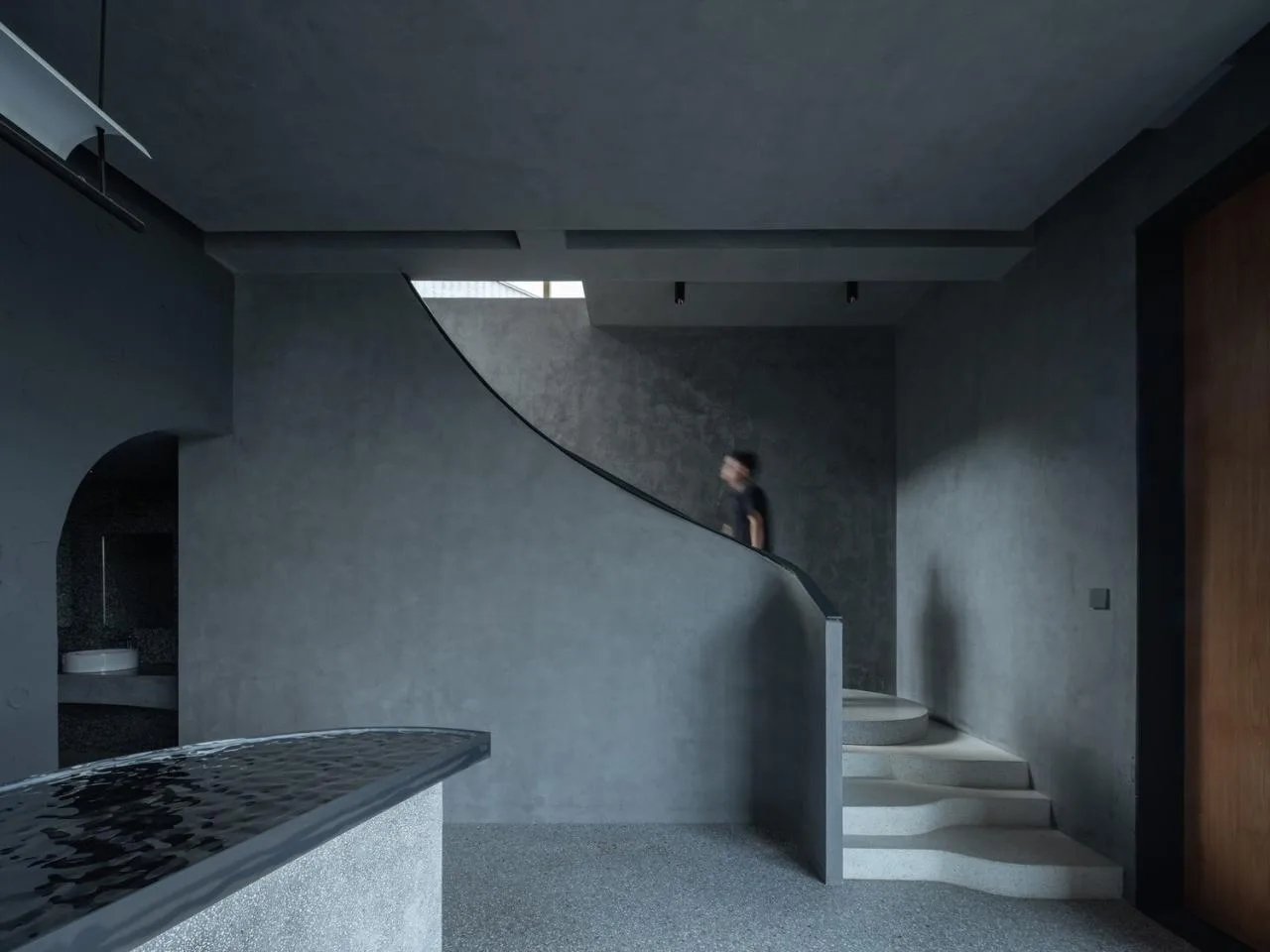
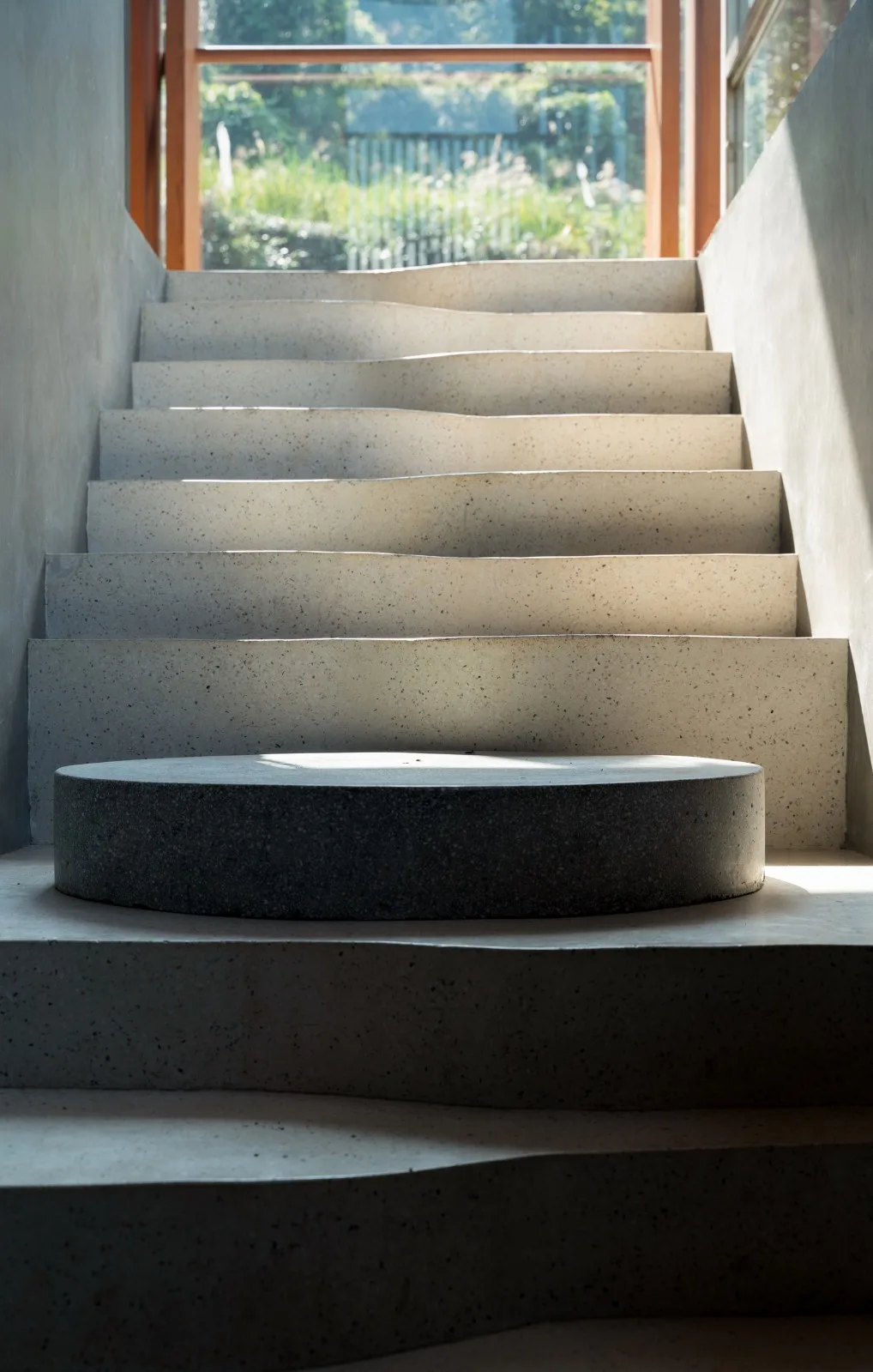
Multiple crescent-shaped rods are layered, evoking the “autumn water echoes” depicted in the “Water Map.” This progression from “moon layering” to “water waves” captures the poetic essence of Eastern aesthetics, influencing the design of walls, stairs, beams, columns, and joints—all treated with wave-like curves that simulate water ripples throughout the pavilion.
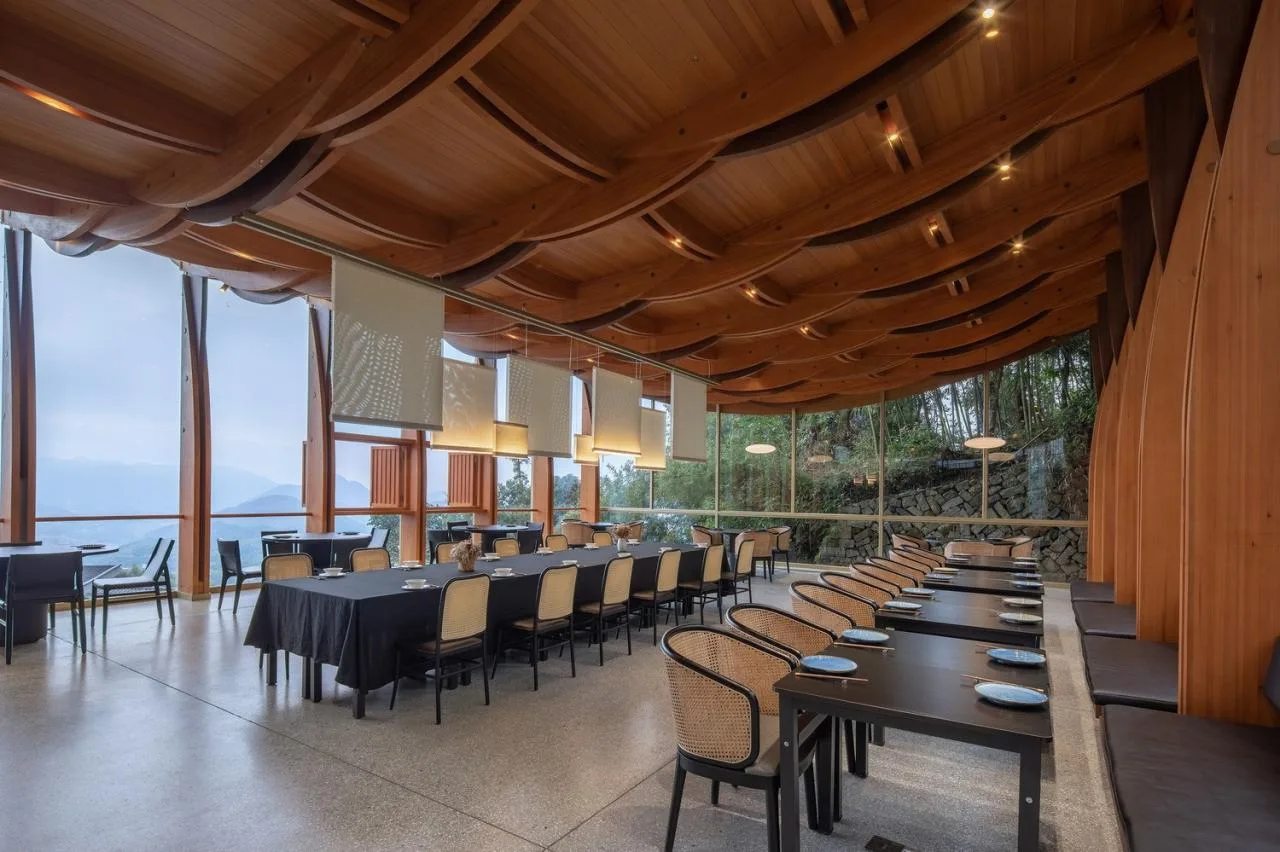
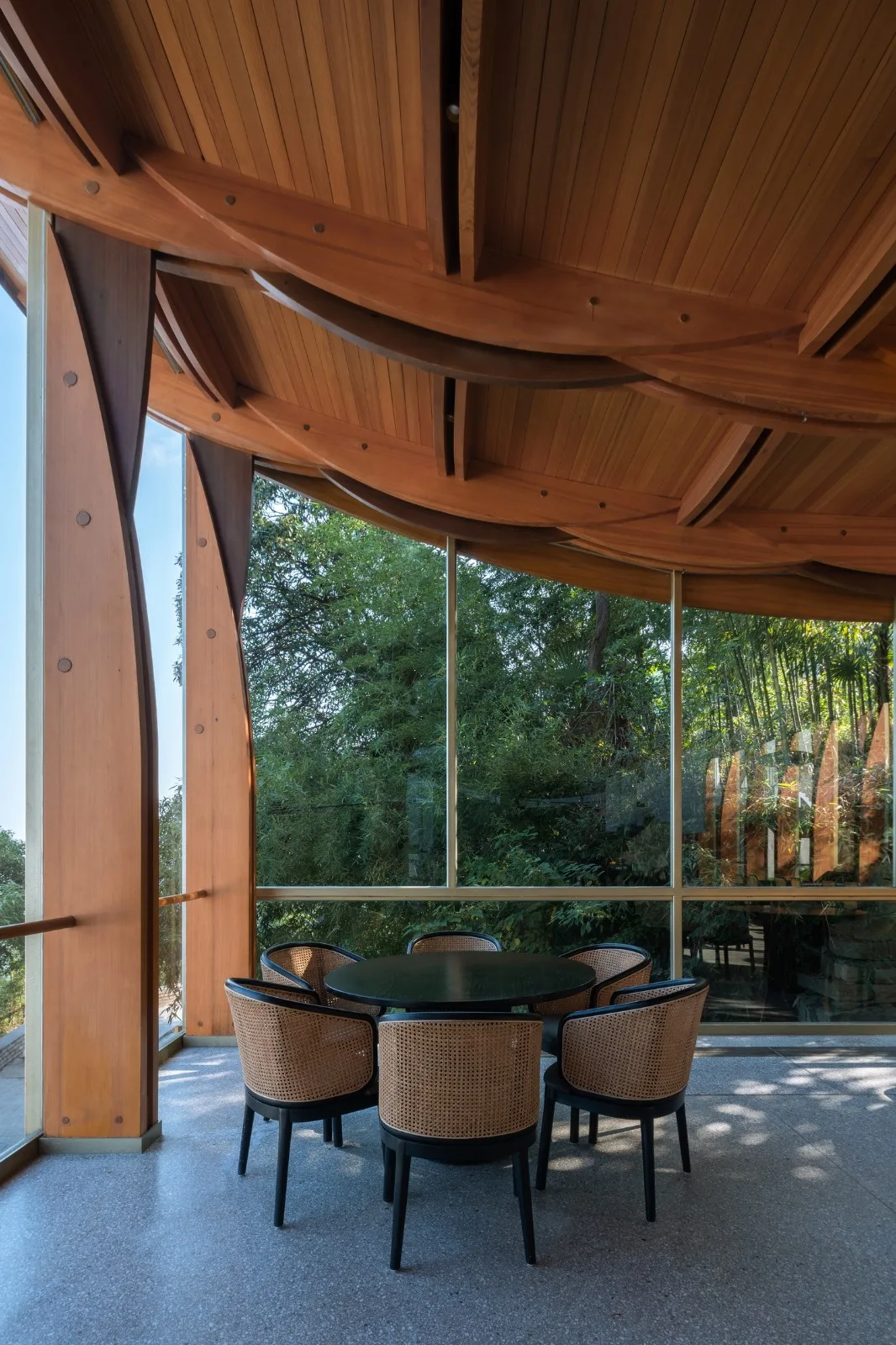
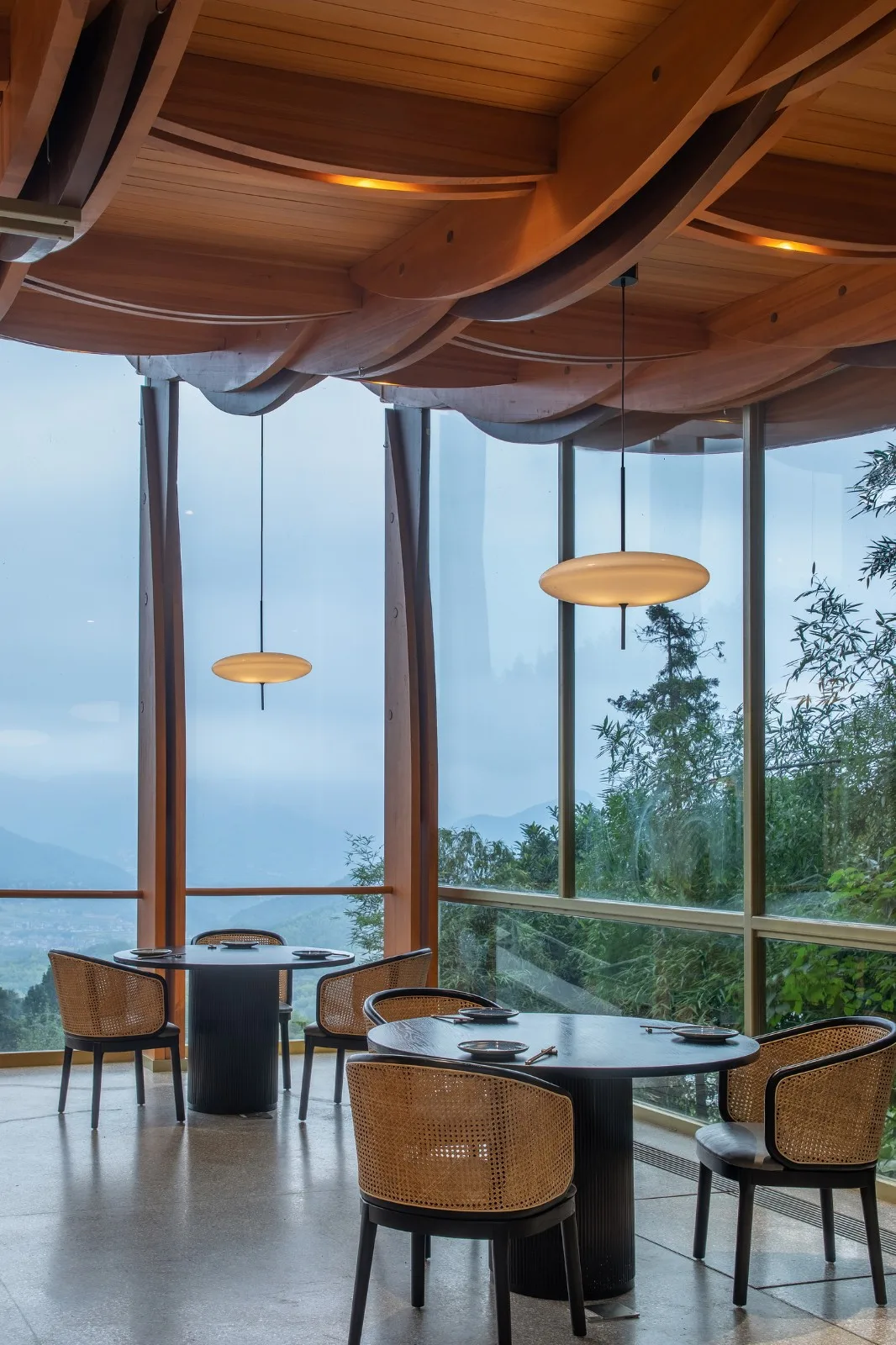
The Jieshan Jiaoyue Pavilion resembles a bone structure; aside from its load-bearing wooden framework, it remains transparent on all sides like a traditional pavilion, allowing the distant mountain scenery to become part of the experience. Here, the wooden structure steps back from the spotlight to serve as a protective shelter that frames nature, creating a unique spatial charm through its form.
Project Drawings
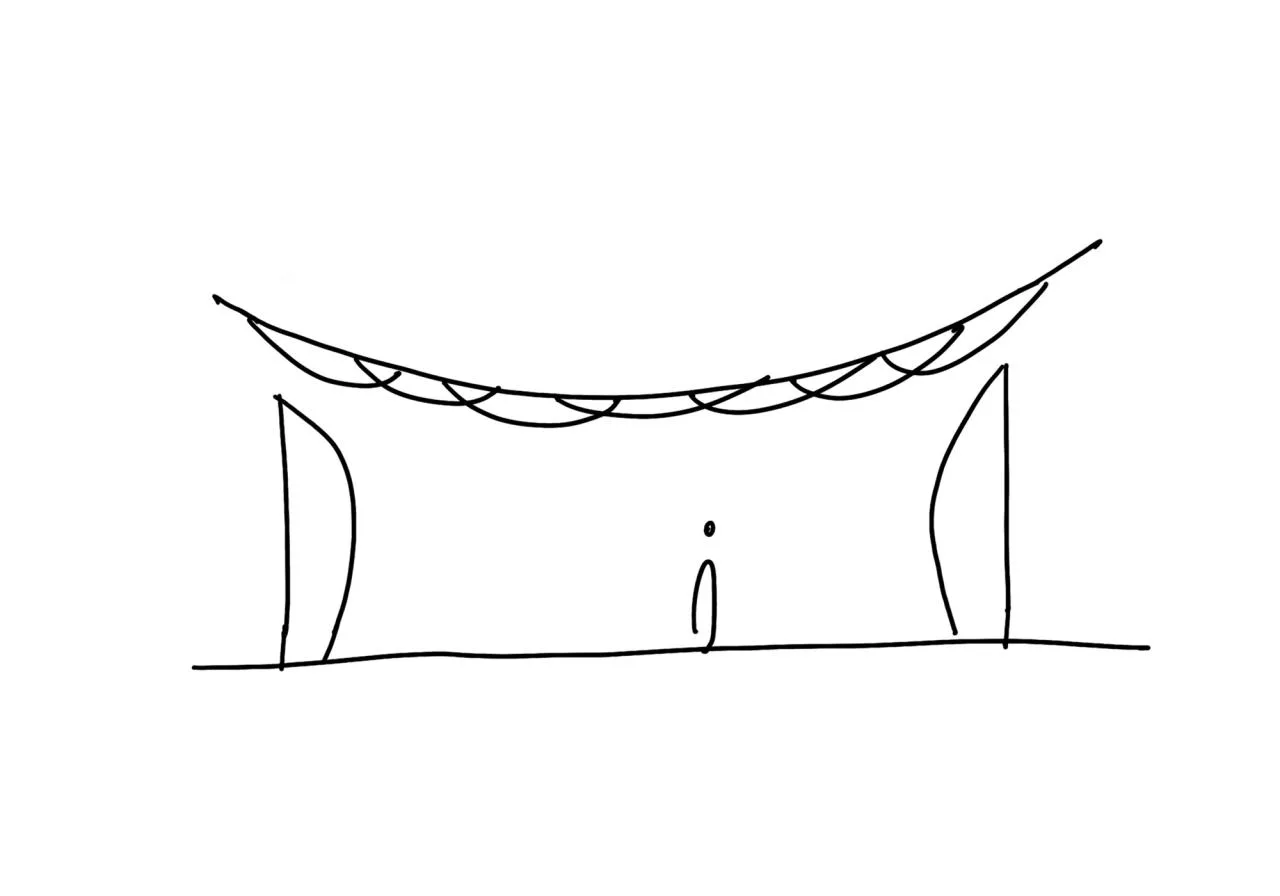
△ Hand-drawn sketch
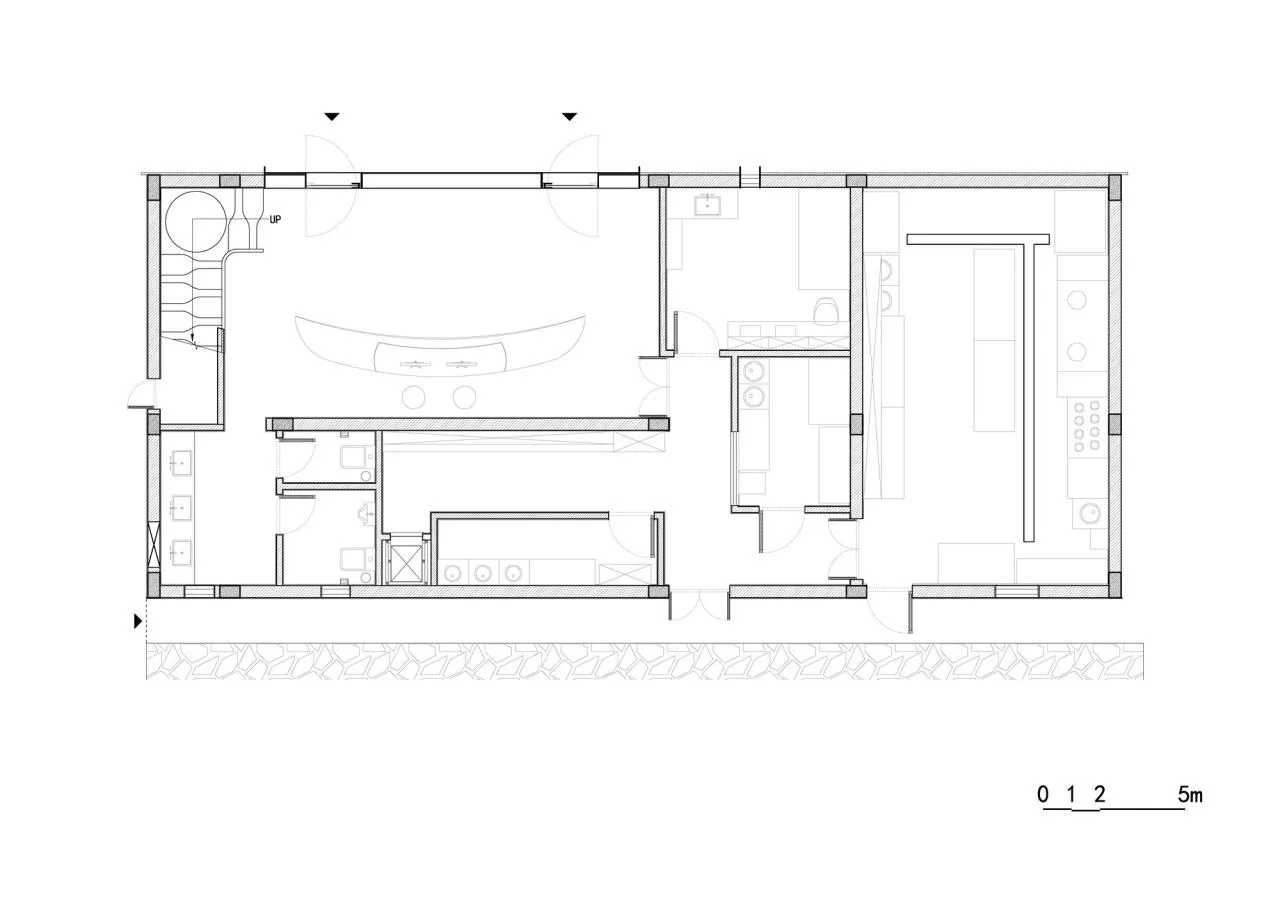
△ First floor plan
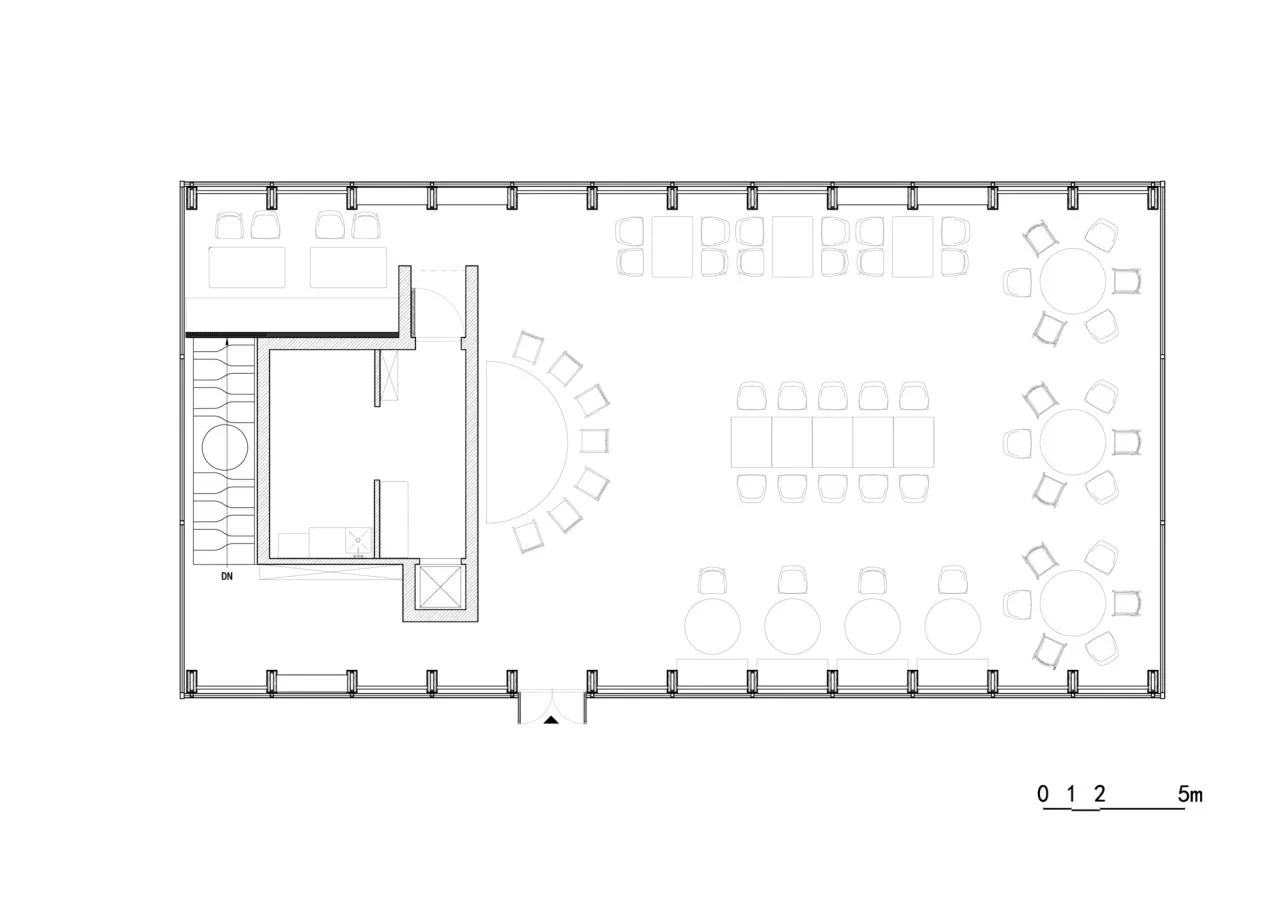
△ Second floor plan
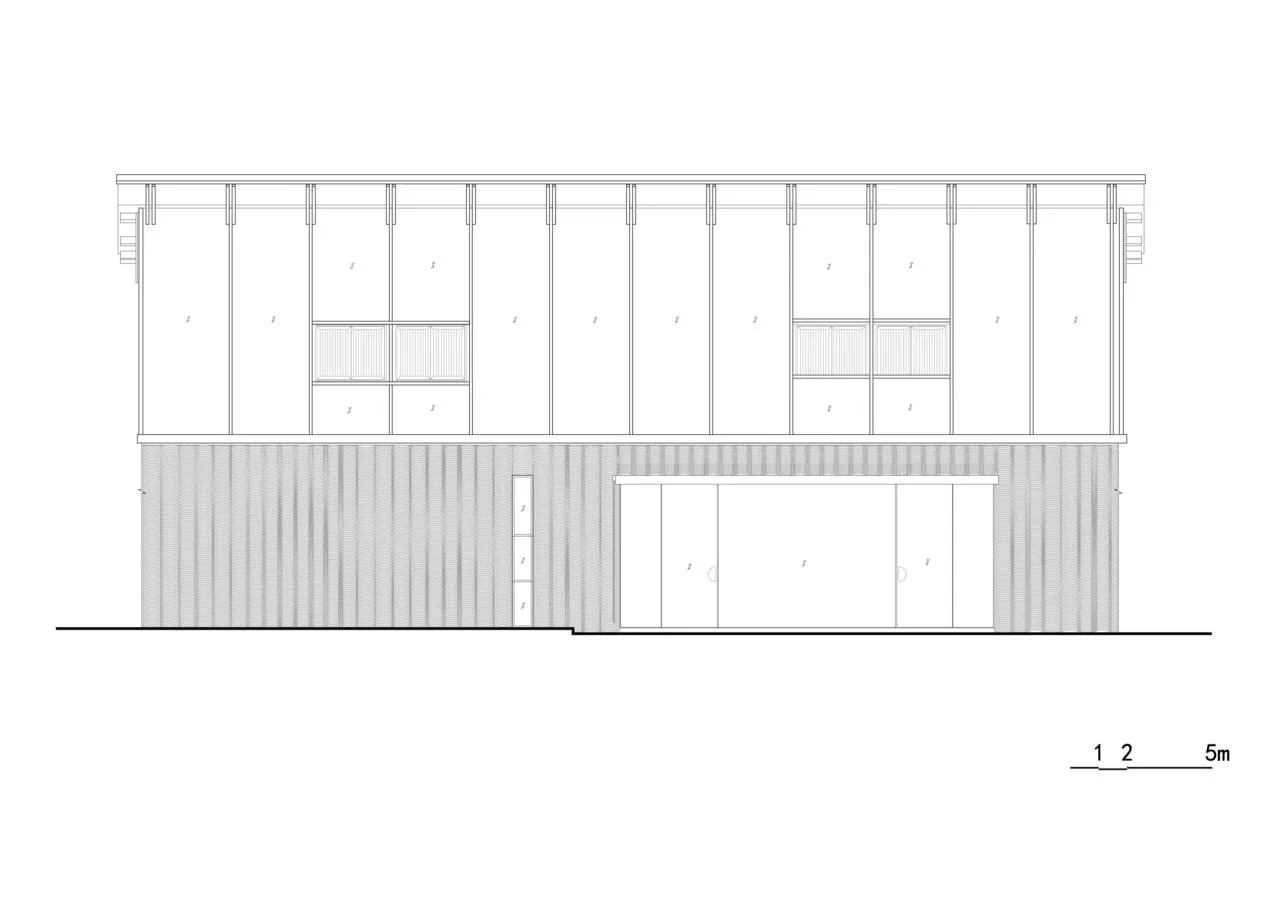
△ Elevation drawing
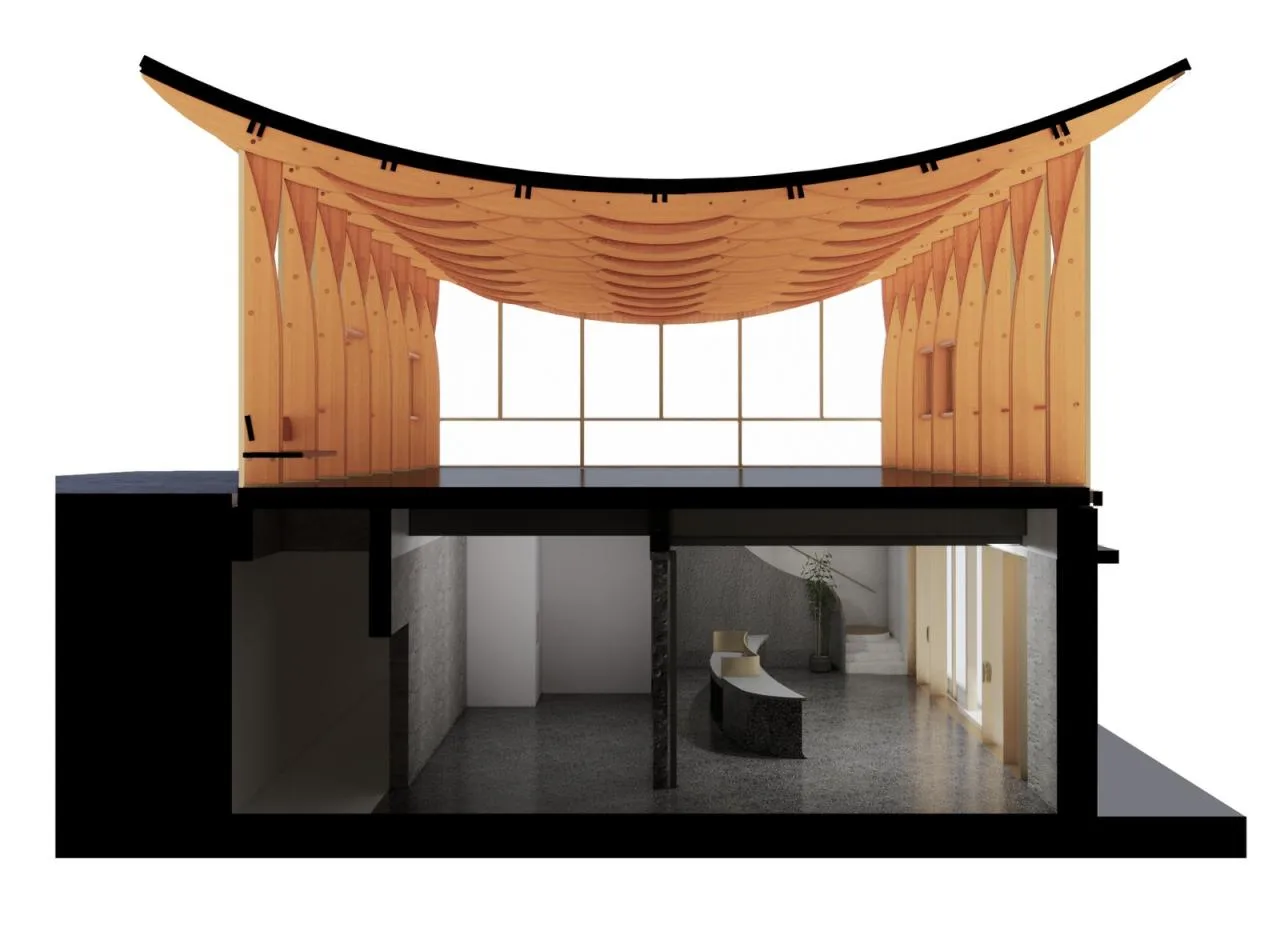
△ Sectional perspective
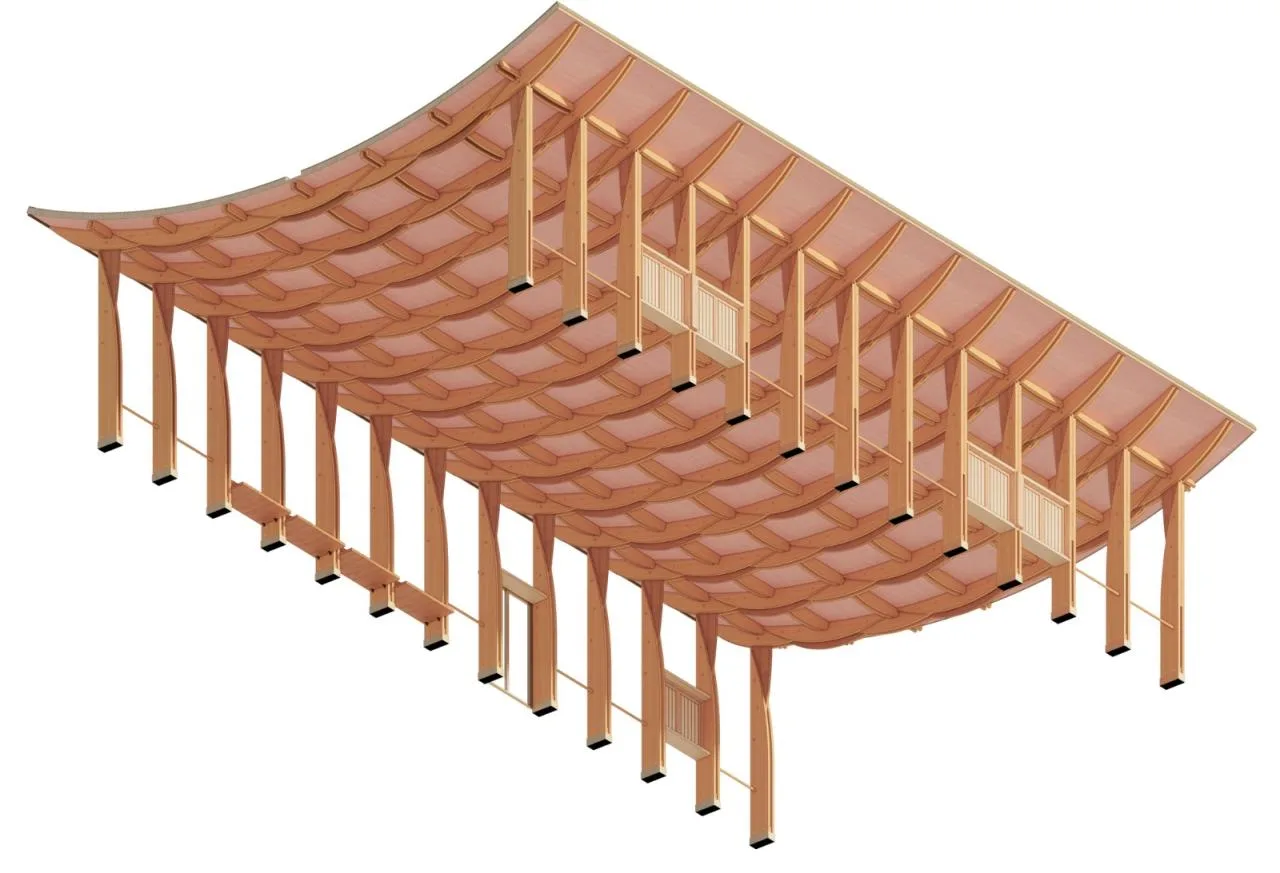
△ Structural schematic diagram
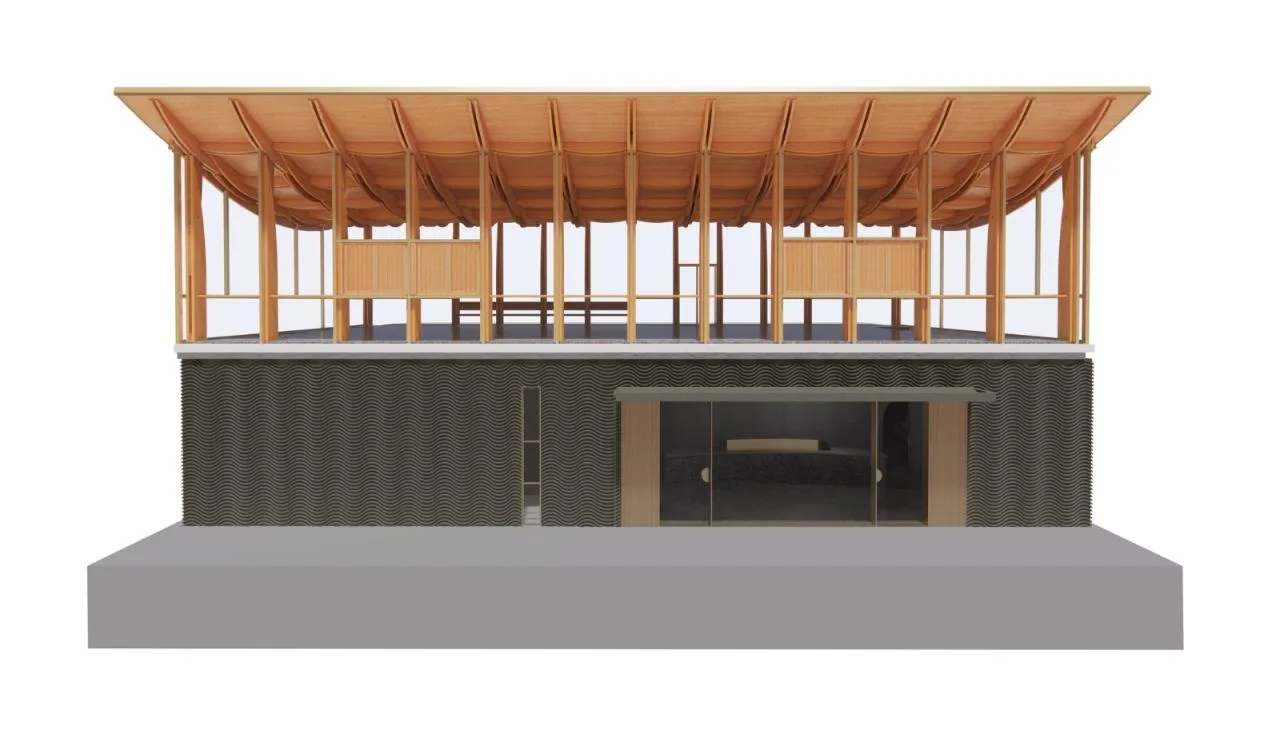
△ Perspective view
Project Information
Architect: Lai Architecture Design Studio
Area: 342 m²
Project Year: 2021
Photographers: Tang Xuguo, Zhao Yilong
Lead Architect: Ma Dao
Design Team: Yan An, Tang Ming, Li Fuying
Structural Consultant: Zhang Zhun
Wooden Structure Construction: Shanghai Mulekang Wooden Structure Engineering Co., Ltd.
Indoor Construction: Hangzhou Qilong Construction Co., Ltd.
Lighting Consultant: Shanghai Shanse Lighting Co., Ltd.
Project Type: Restaurant
Owner: Tonglu · Wuchi · Qianshan Boutique Homestay
Structure: Reinforced concrete frame structure & timber structure
Site Area: 200 m²
Location: Hangzhou















Must log in before commenting!
Sign Up