
Less than 100 days have passed since the opening of the Hangzhou Asian Games, and the Fuyang Yinhu Sports Center is now ready to welcome the event, ensure sustainable operations post-Games, and receive evaluations from various sectors of society. The design team from Zhejiang University Architectural Design and Research Institute embraced the concept of “achieving a green Asian Games economically and creating a cultural Asian Games through low-tech solutions.” Respecting professional sports technology requirements and incorporating Fuyang’s unique landscape, they designed the shooting, archery, and modern pentathlon venues using simple forms, a compact spatial layout, eco-friendly materials, low-tech construction methods, and sustainable facility use. This approach successfully embodies the theme of hosting the Asian Games in a green, intelligent, simple, and civilized manner.
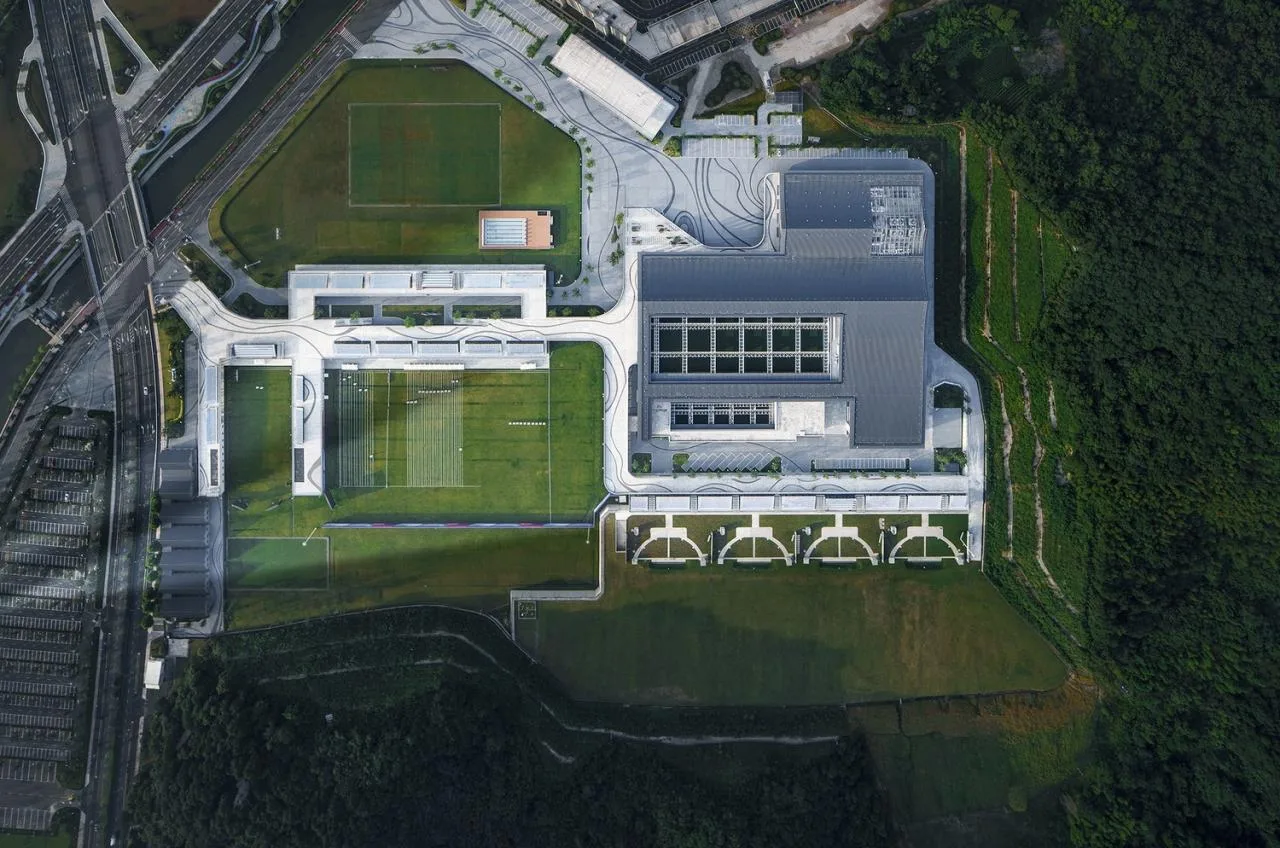
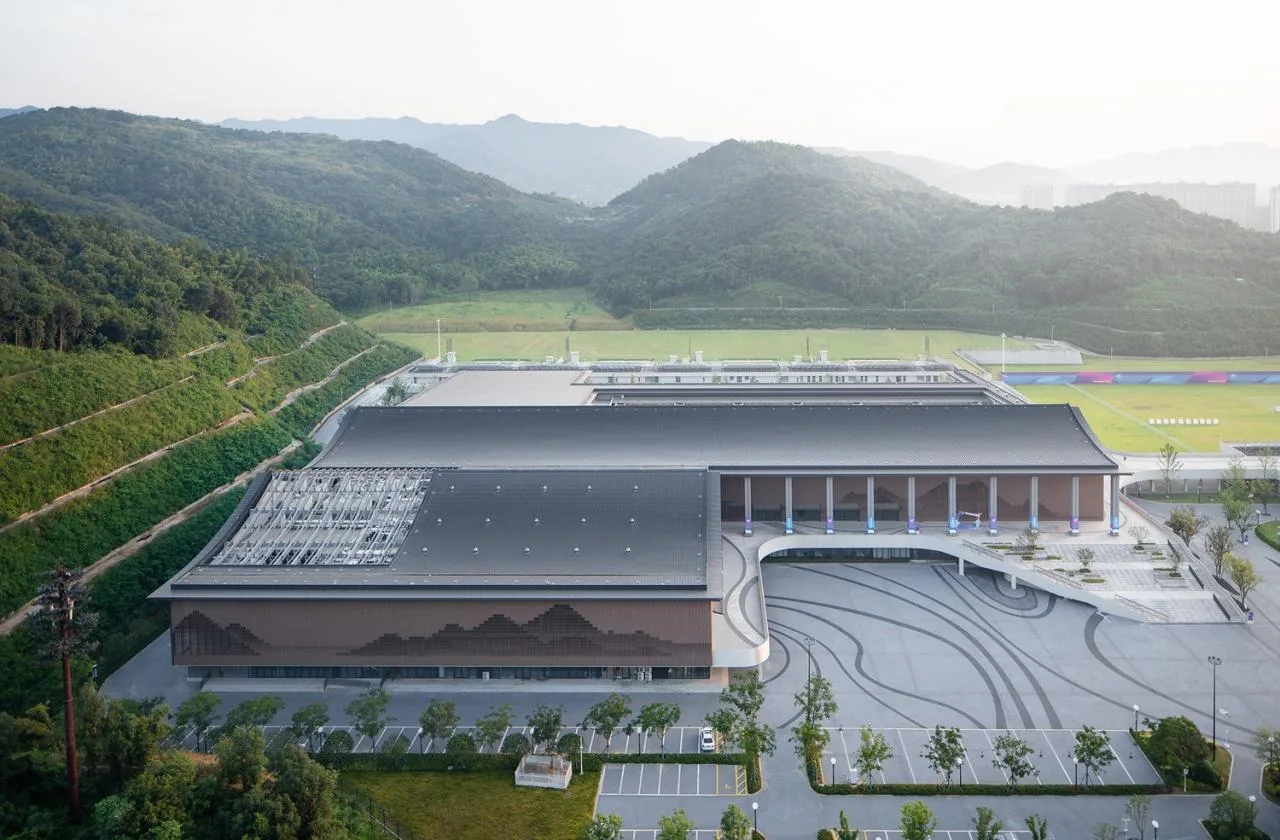
△ Surrounding environment of the venue © Zhao Qiang
The project covers a land area of 275,182 square meters with a building footprint of 82,360.35 square meters. It is one of the 12 newly constructed venues for the 19th Asian Games in 2023, hosting three major events: shooting, archery, and modern pentathlon.
Embracing Mountains and Waters
The site is surrounded by mountains to the west and north, water to the south, and connects to the city on the east side. Positioned at the center and embraced by mountains, the location evokes the distant mountains and waters along the Fuchun River. Inspired by Su Shi’s natural perception of “long mountains in the distance, chaotic mountains in the clouds, and green mountains in the morning,” and Huang Gongwang’s observation of the Fuchun Mountain Residence as an arrangement that evokes excitement wherever one looks, the design reflects a philosophy where life’s true essence lies not in career or wealth, but in self-cultivation and tranquility—a peaceful feeling of harmony with nature.
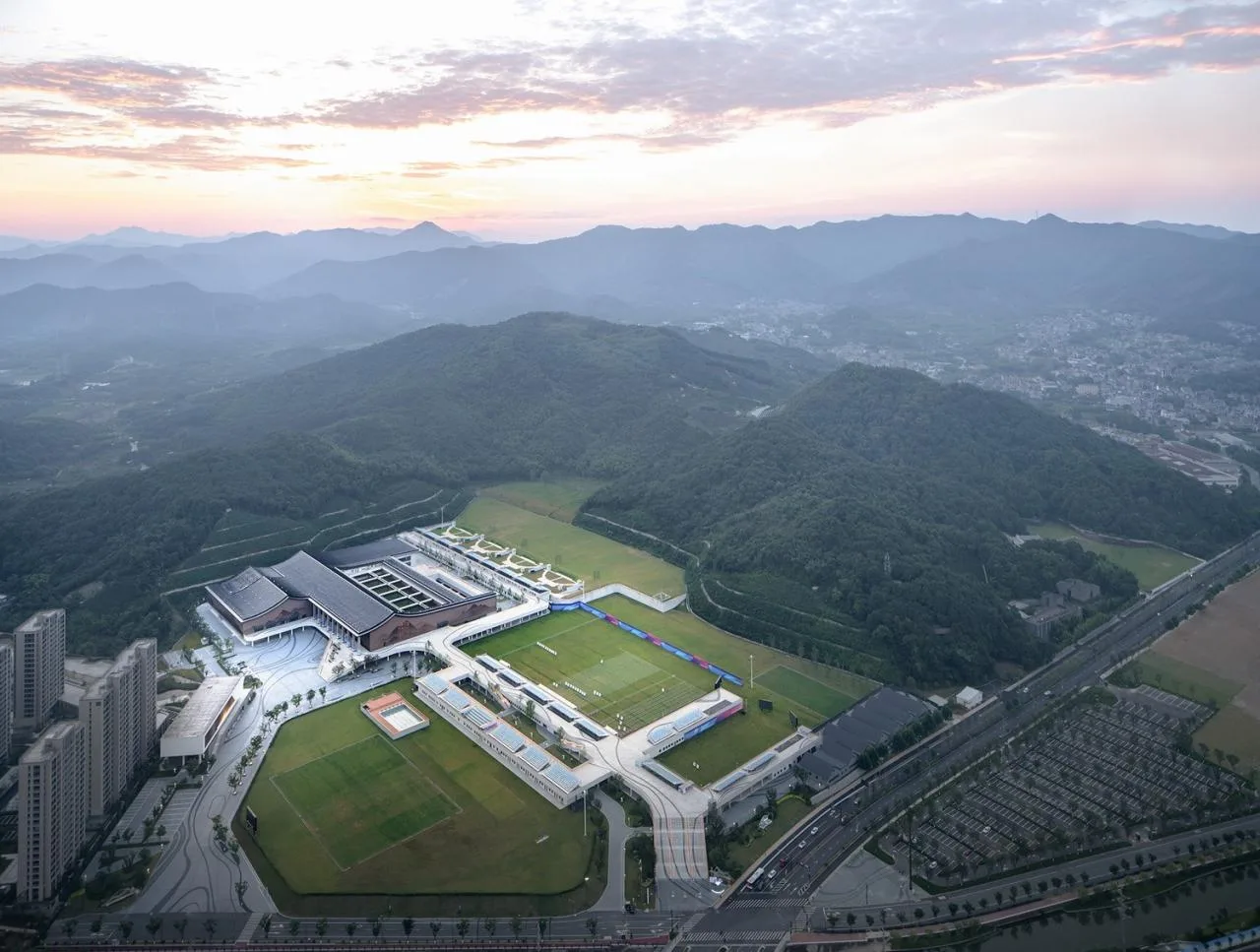
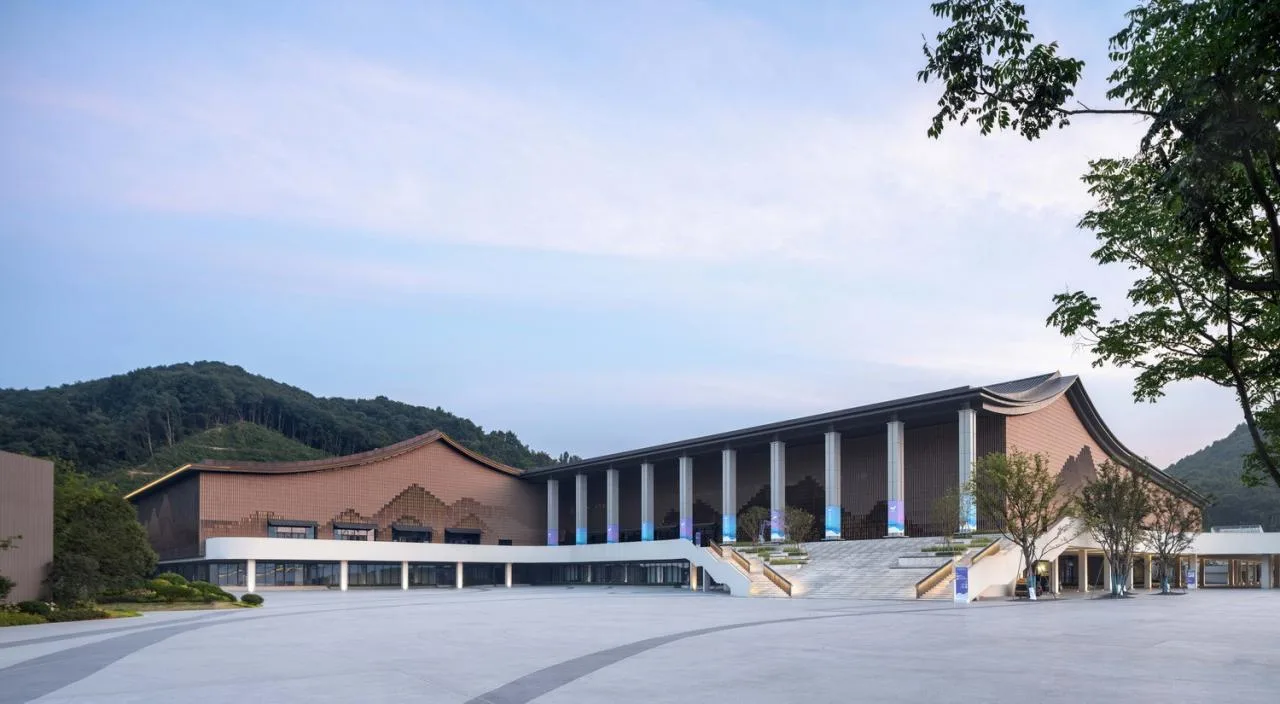
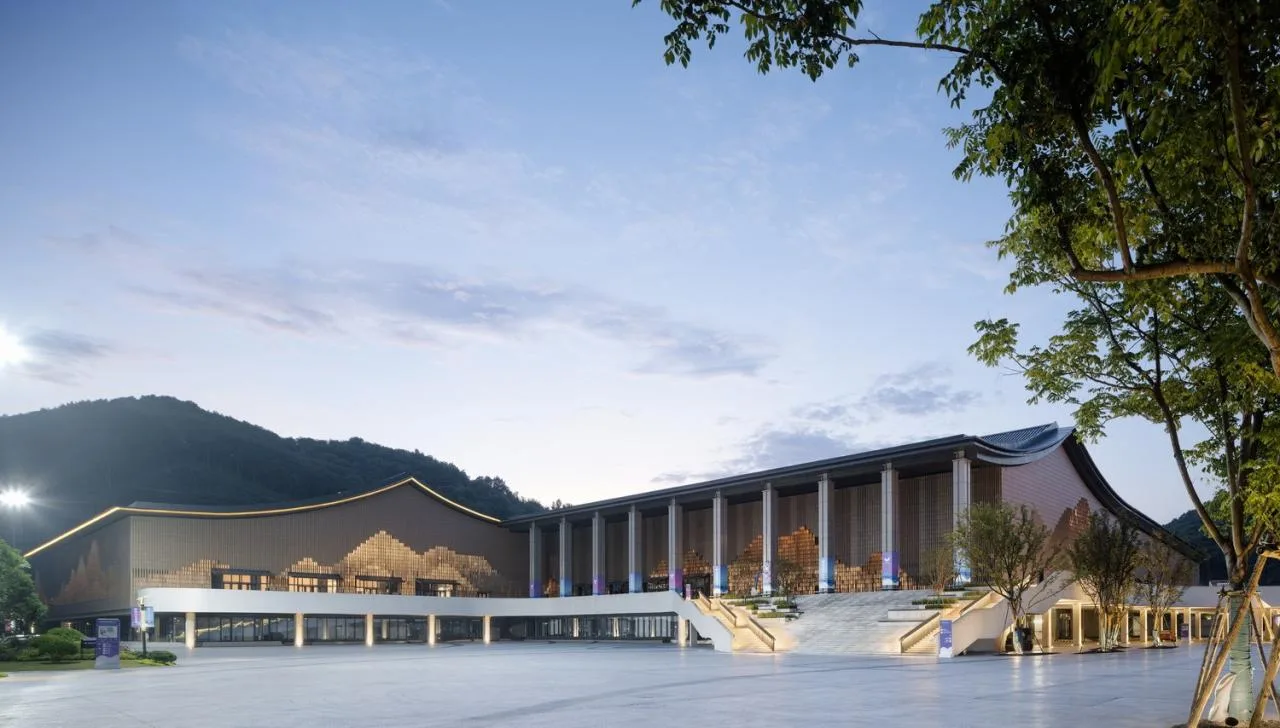
△ The Fuyang Shooting and Archery Modern Pentathlon Hall harmonizes with the natural surrounding mountains and waters © Zhao Qiang
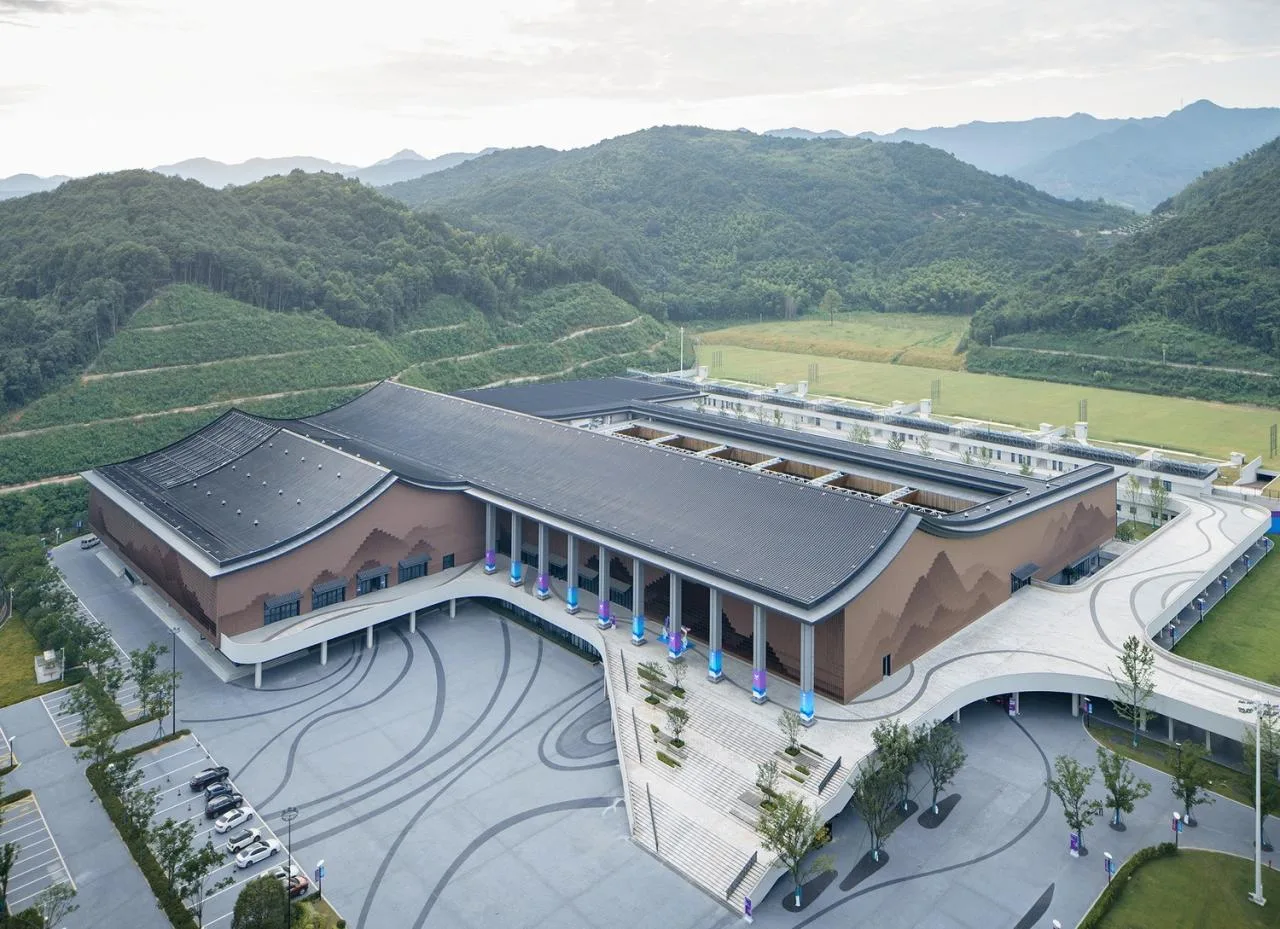
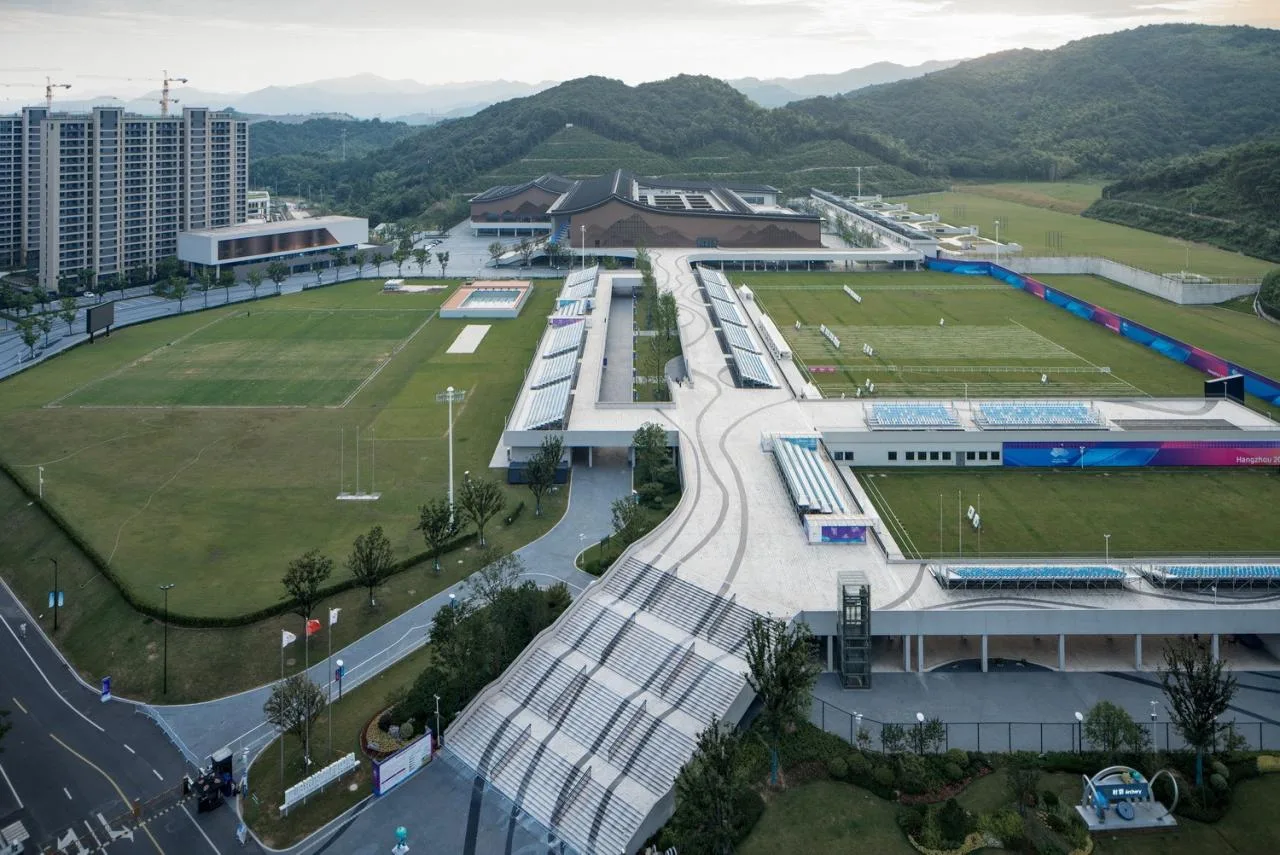
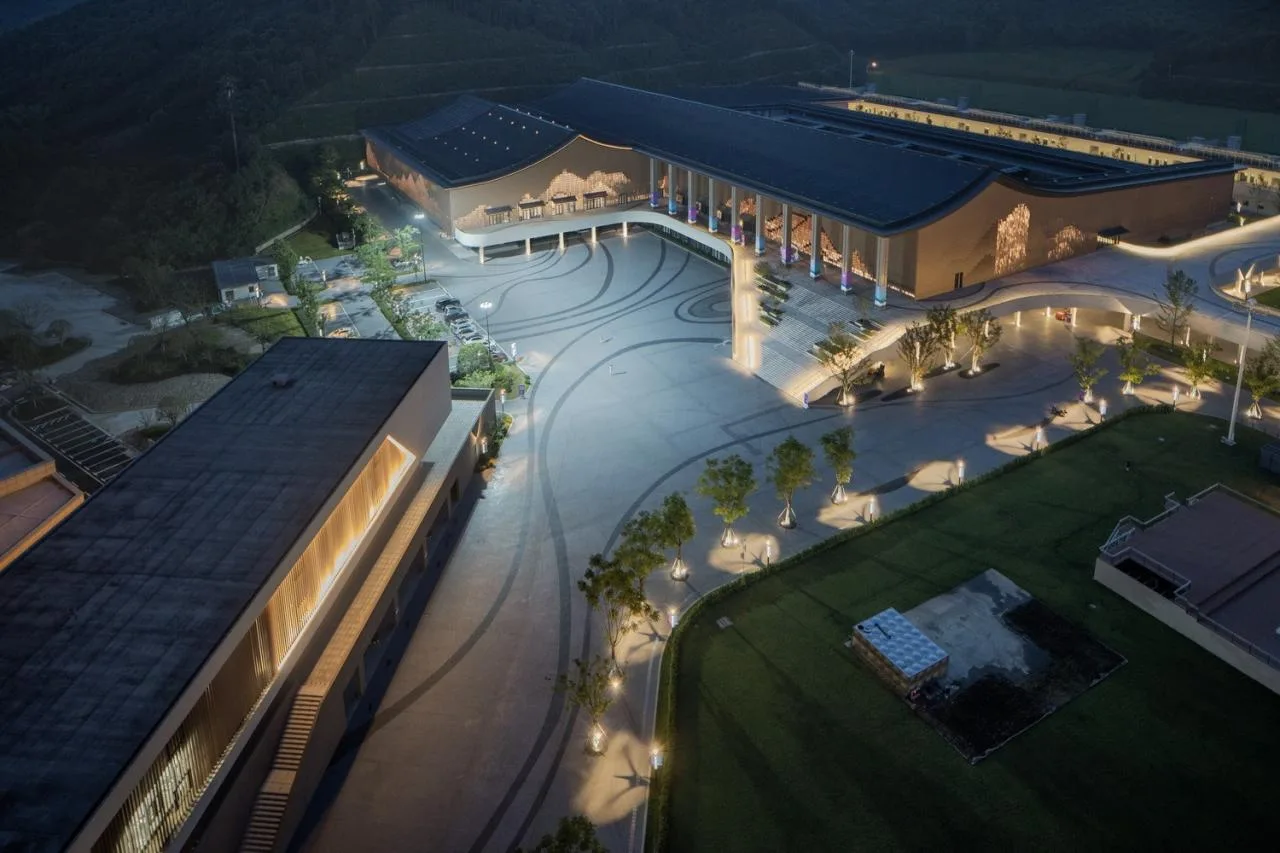
△ Aerial view of the main building complex © Zhao Qiang

△ Fuchun Mountain Residence Map Tail Section © Huang Gongwang (Yuan dynasty)
The design carefully considers how to utilize modern construction methods to create a diverse and integrated sports arena that returns to the venue’s origin while meeting competition functions. The architecture coexists harmoniously with the mountains and rivers, conveying the charm and distinctive features of Fuyang and Hangzhou to athletes and coaches from around the world.
A Modern Interpretation
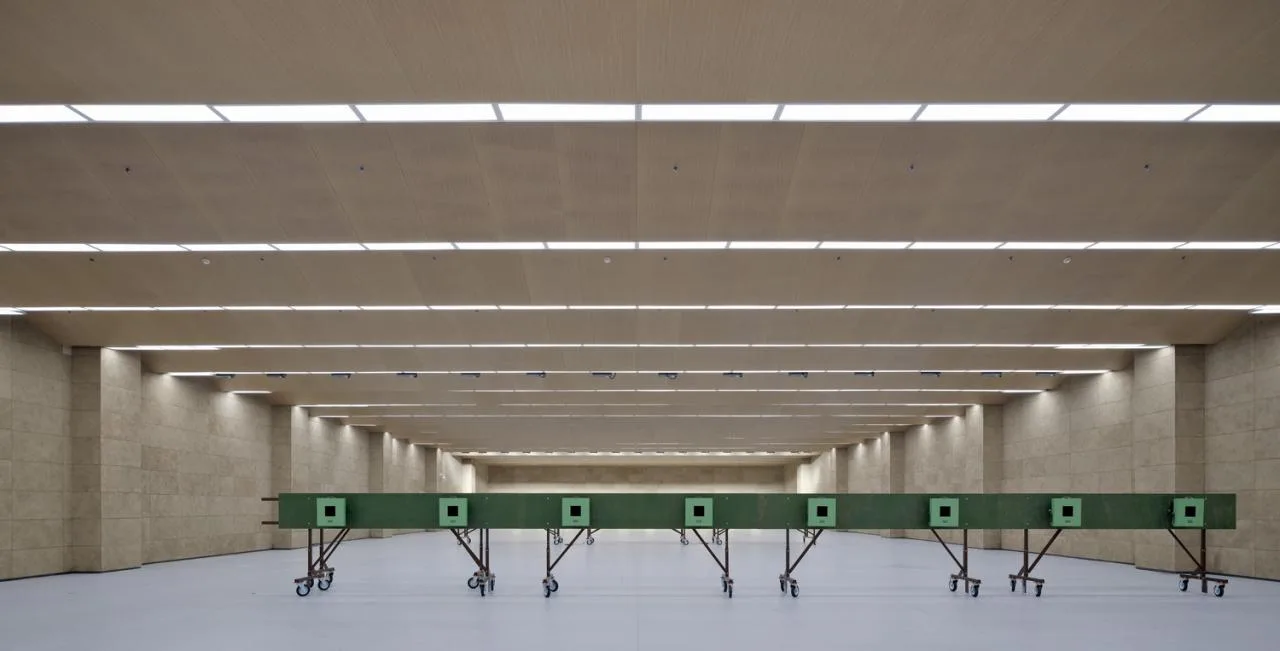
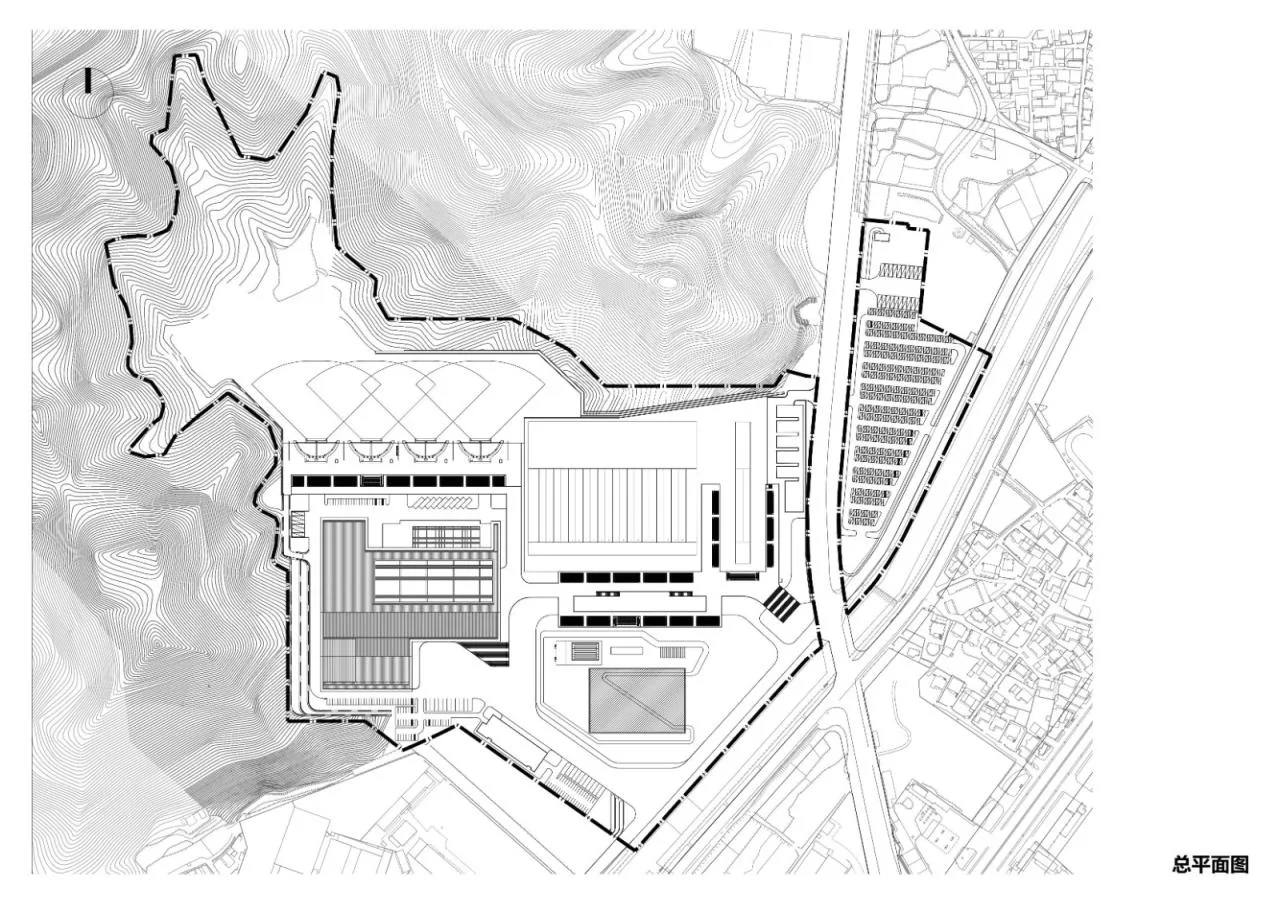
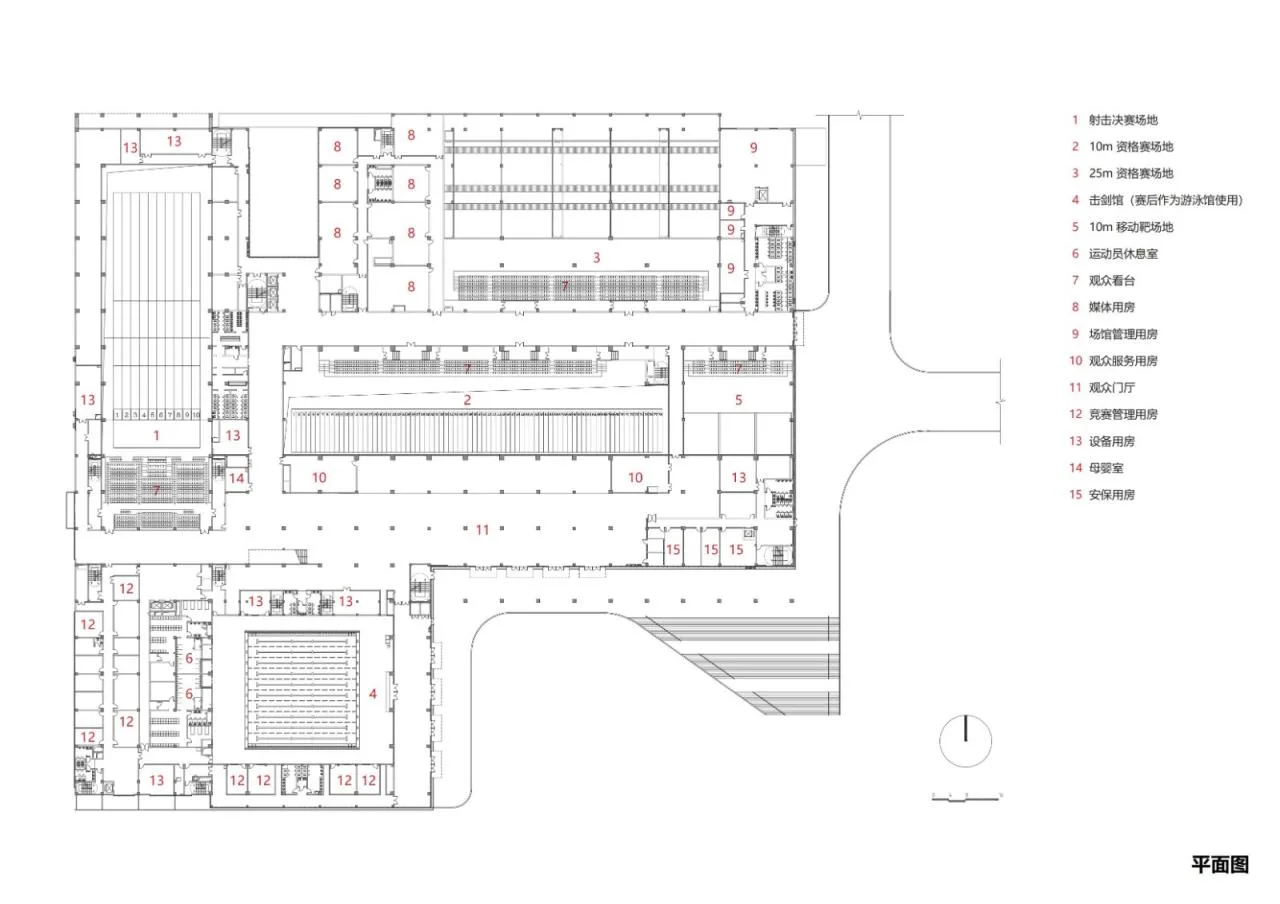
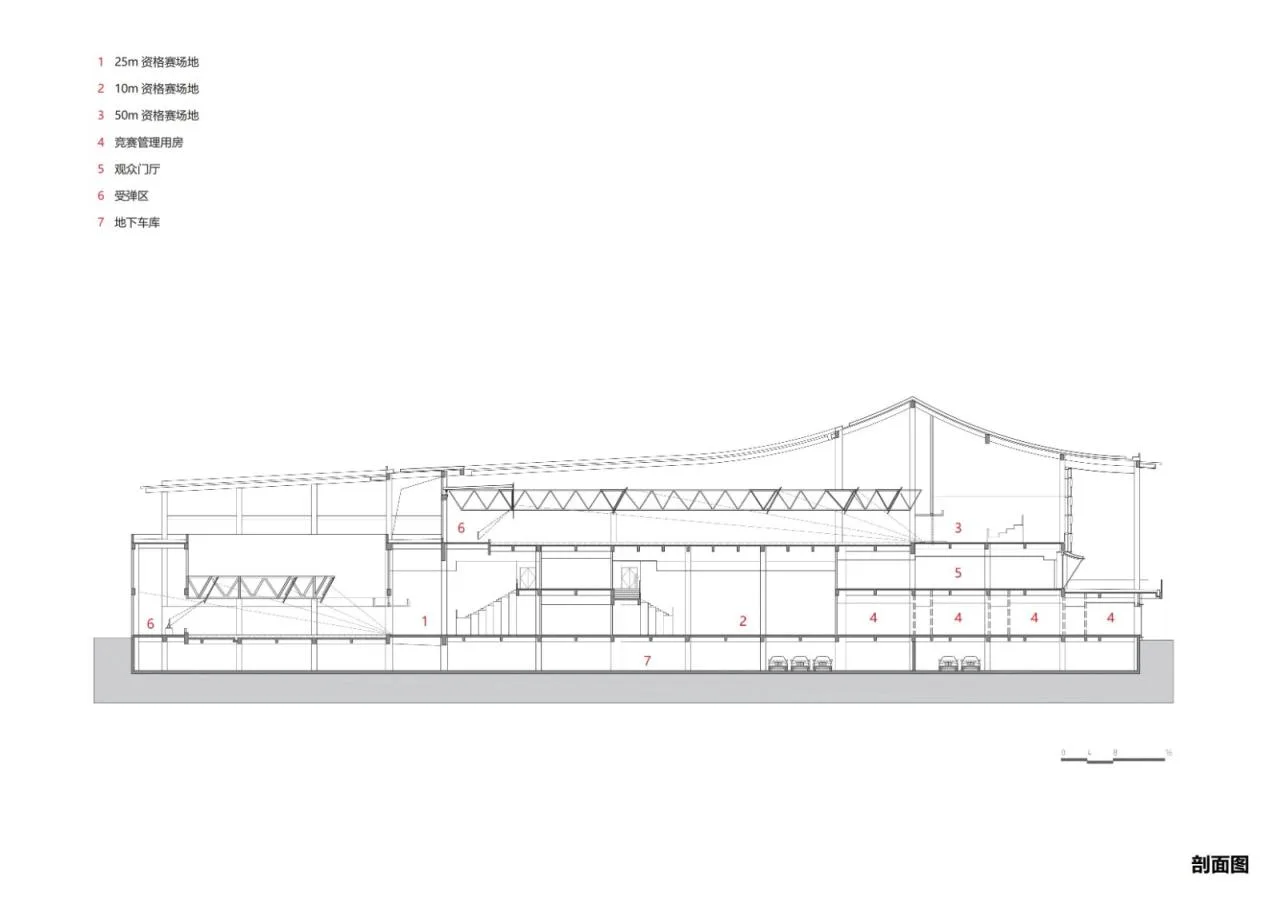
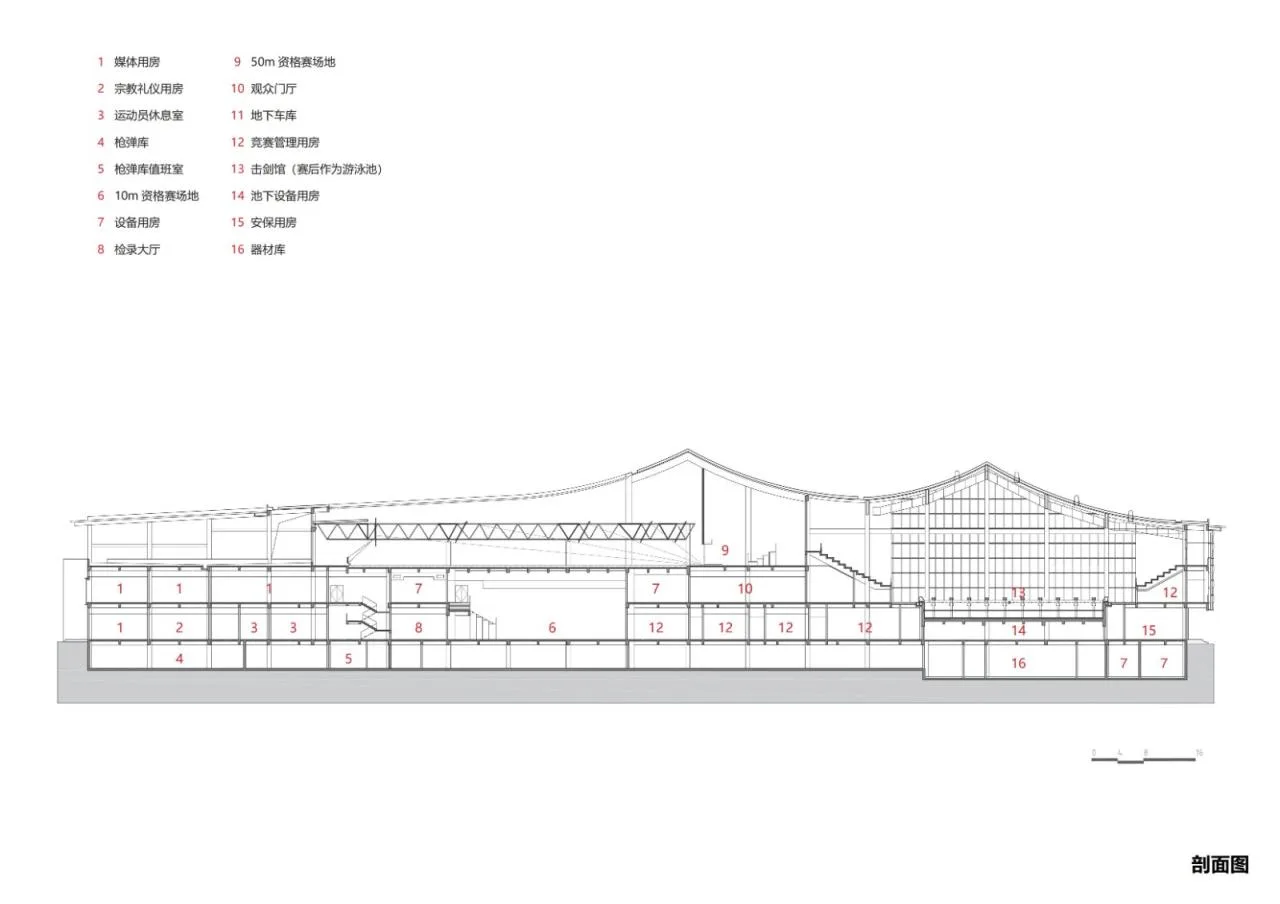
On-site, five terraced levels were established to correspond to the mountain’s elevation changes, minimizing environmental impact by reducing excavation and balancing earthwork internally. A two-tier platform efficiently connects the three competition events and organizes the flow of people. Vertically, the shooting competition’s 10-meter, 25-meter, and 50-meter qualification and final venues are distributed, while shared functions for all three events are centralized in the news security center to maximize efficiency.
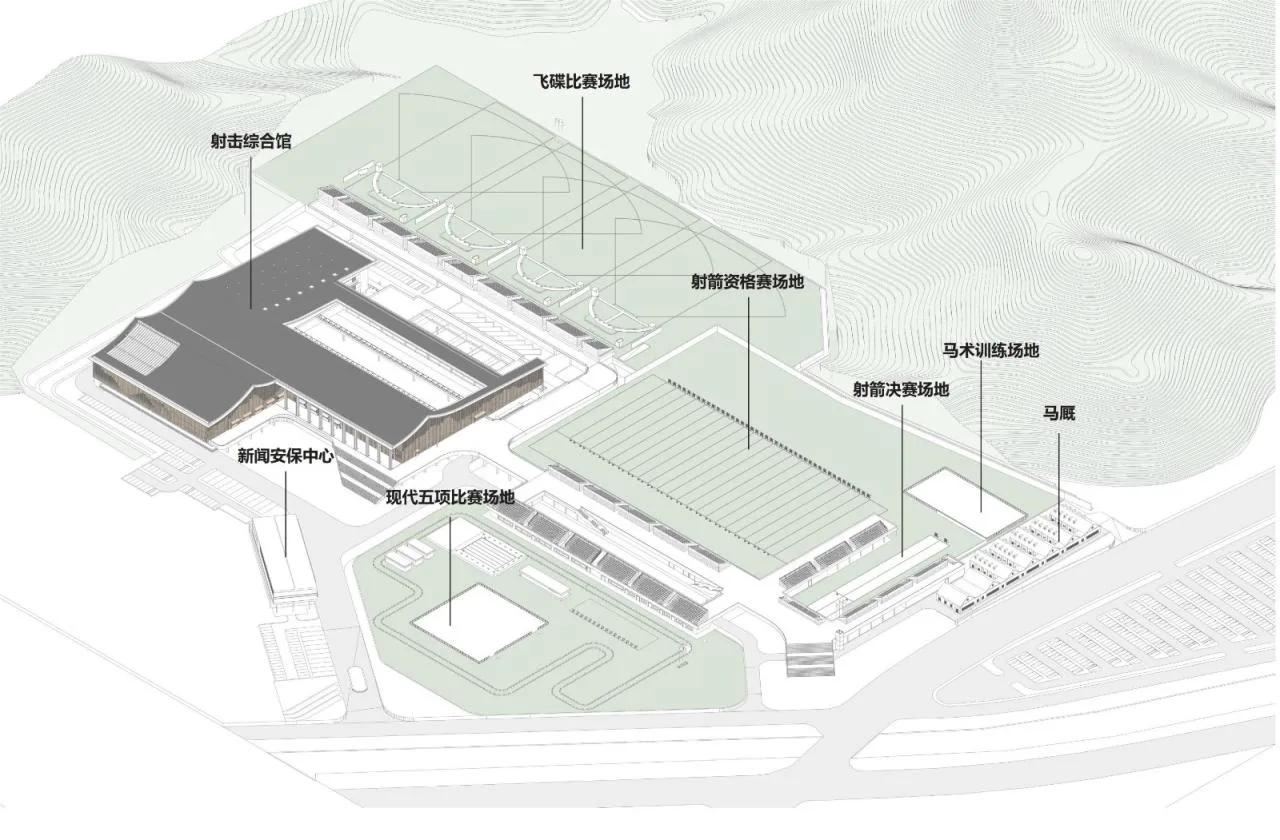
△ Functional zoning diagram
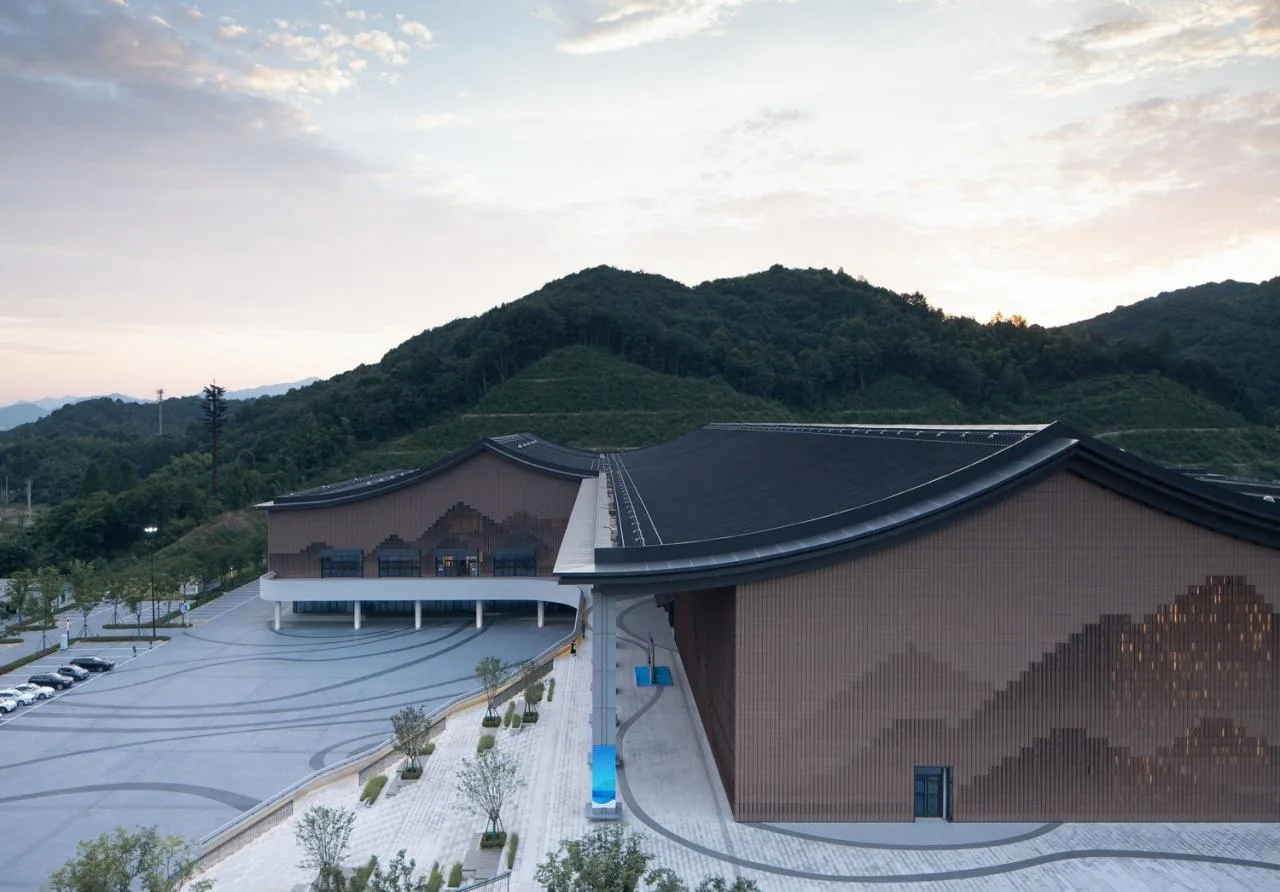
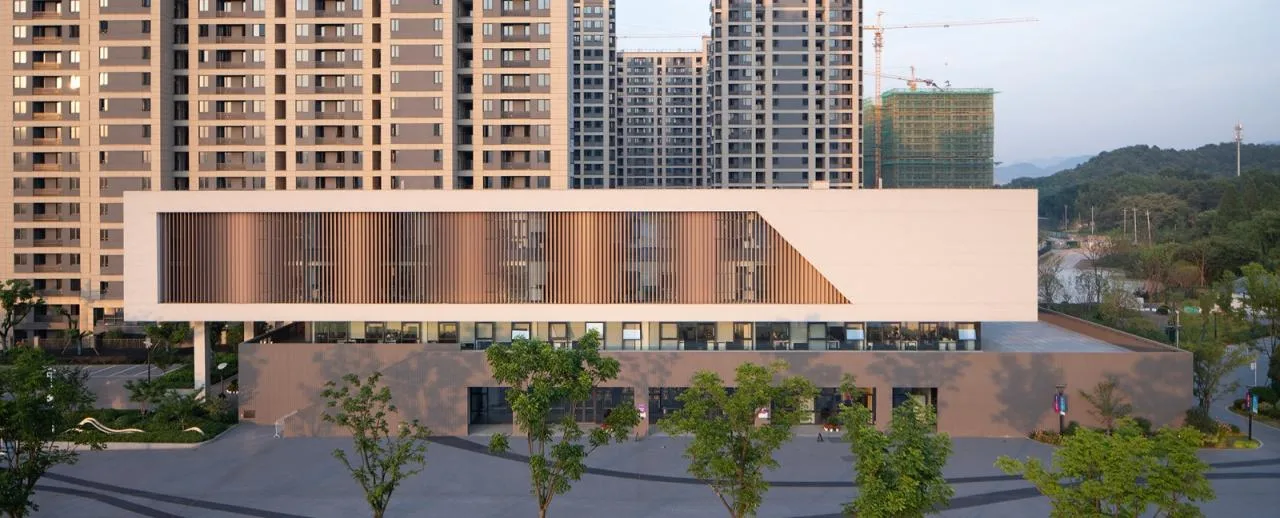
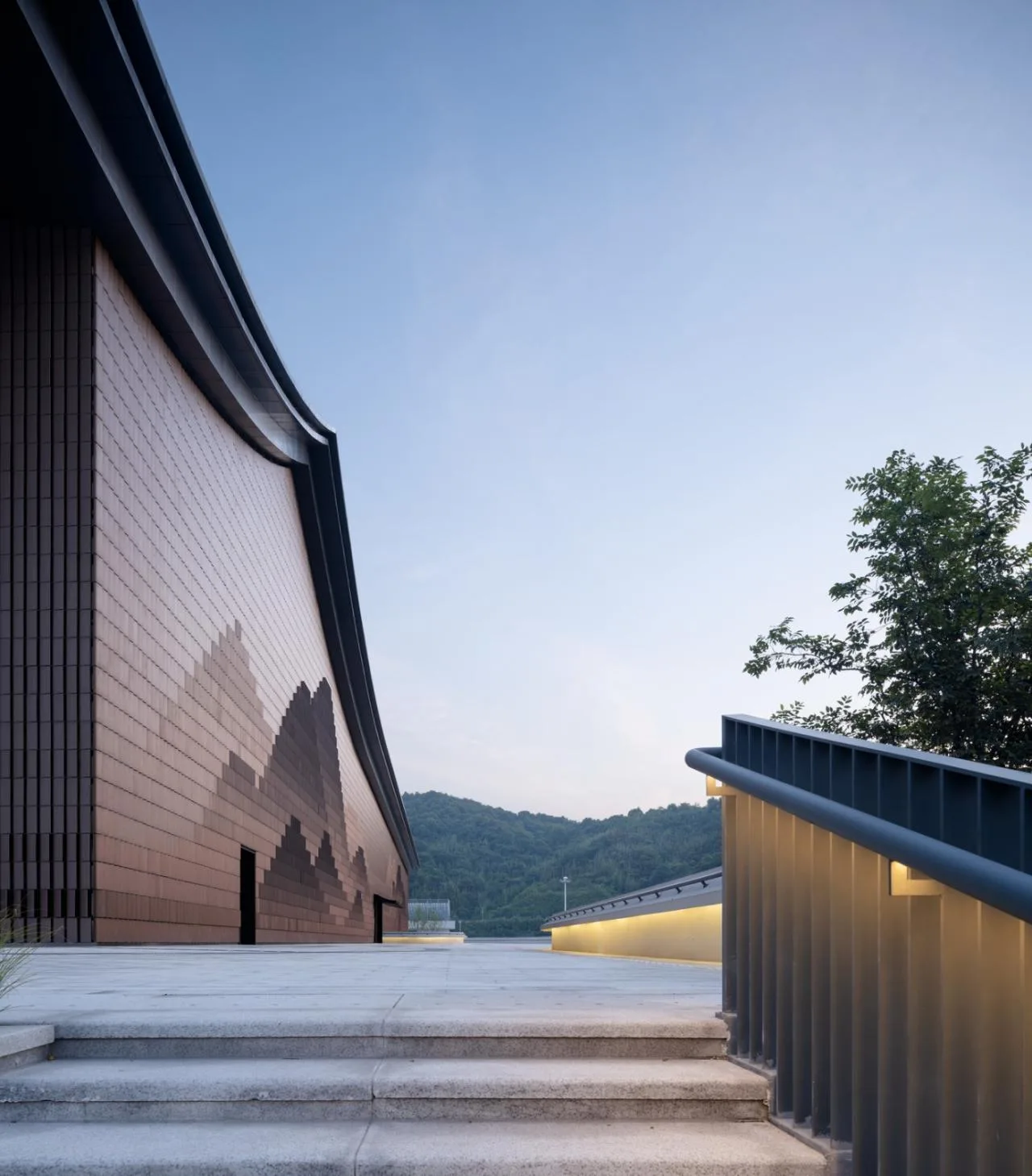
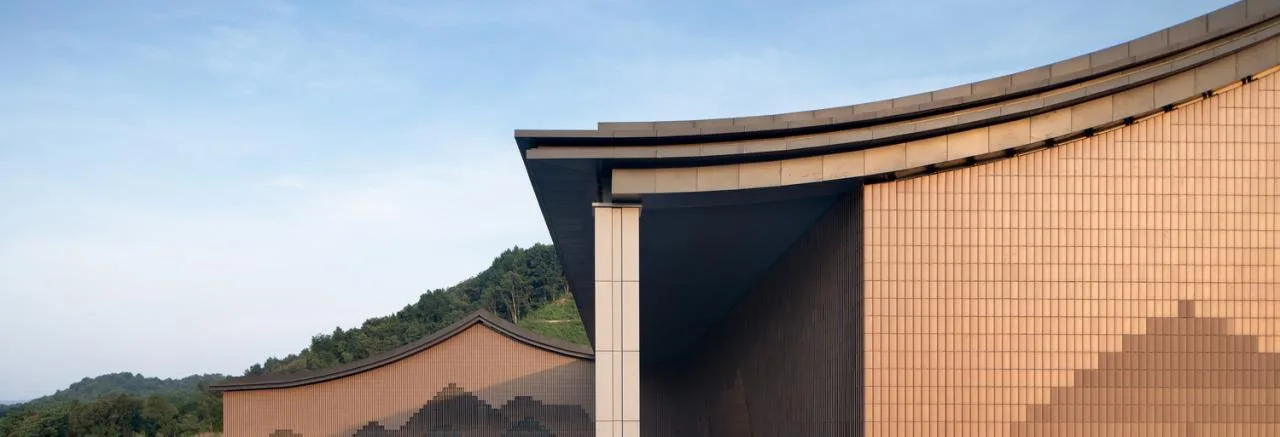
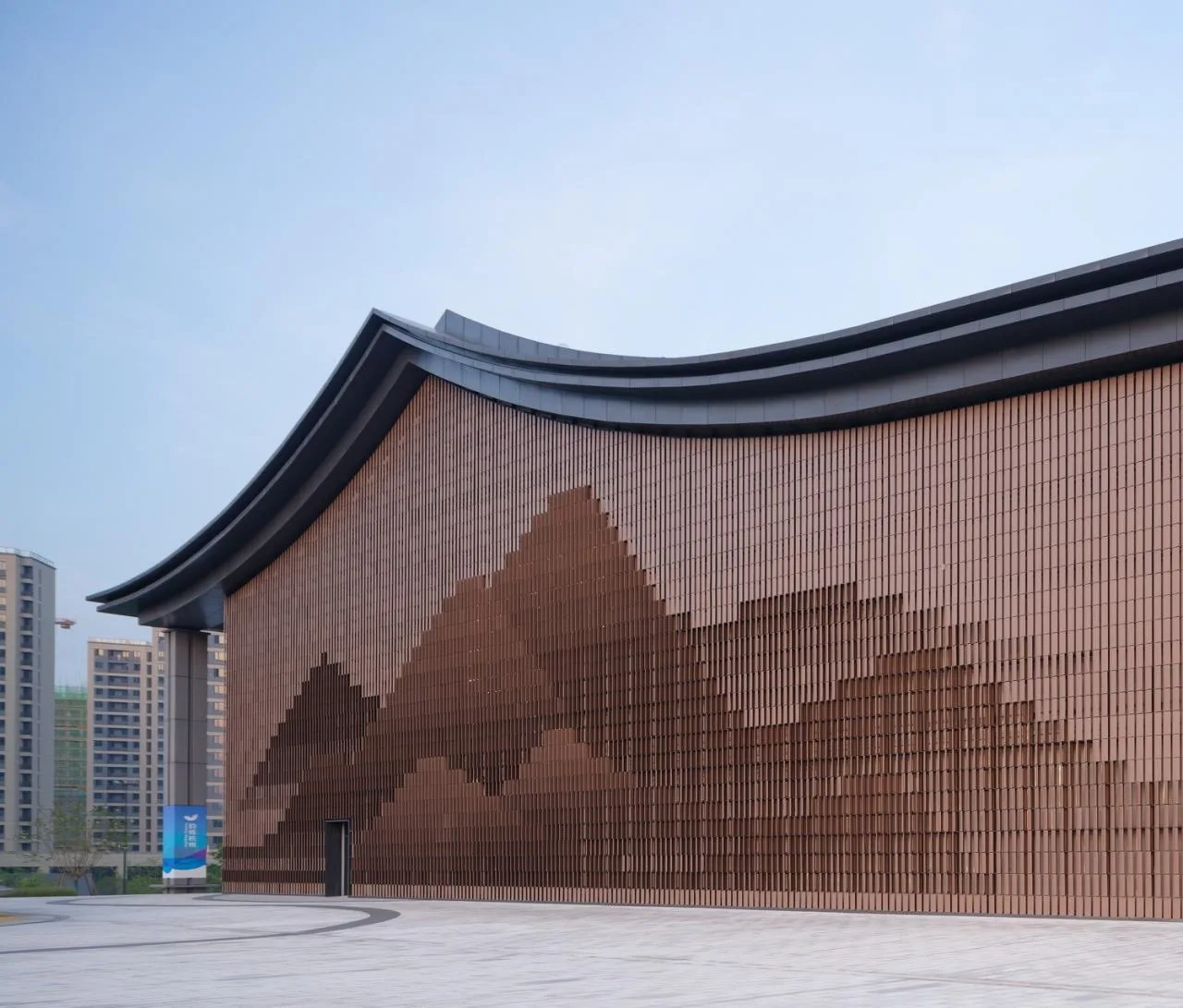
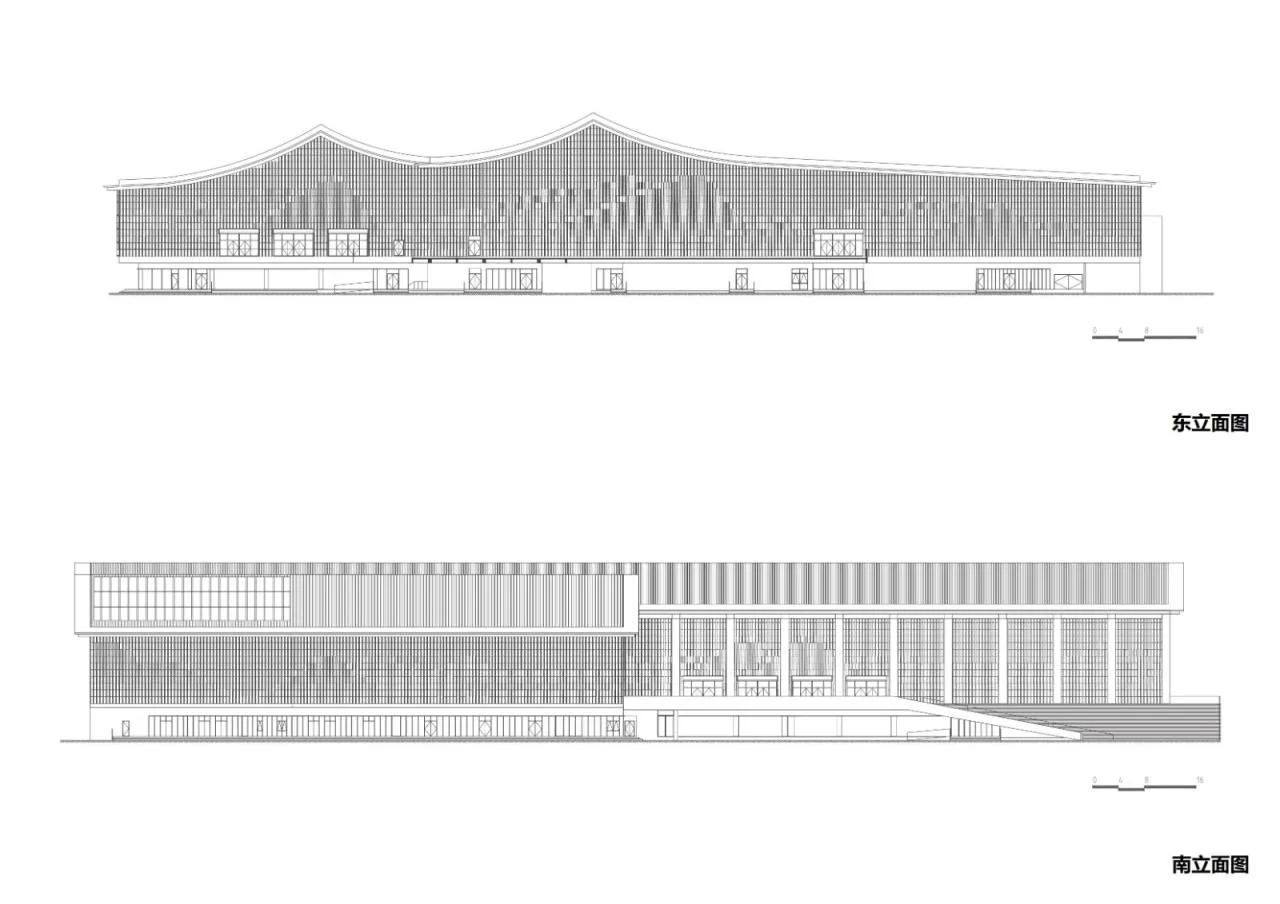
The shooting complex features a square plan with a large volume. The architectural design incorporates multiple connected sloping roofs that blend with the surrounding mountains, breaking down the building’s mass and integrating it seamlessly with nature. The facade employs parametric and pixelated techniques to reinterpret the Fuchun Mountain Residence, moving from abstraction to concreteness—expressing abstract concepts through tangible design.
The main hall dissolves its large volume through multiple sloping roof connections © Zhao Qiang
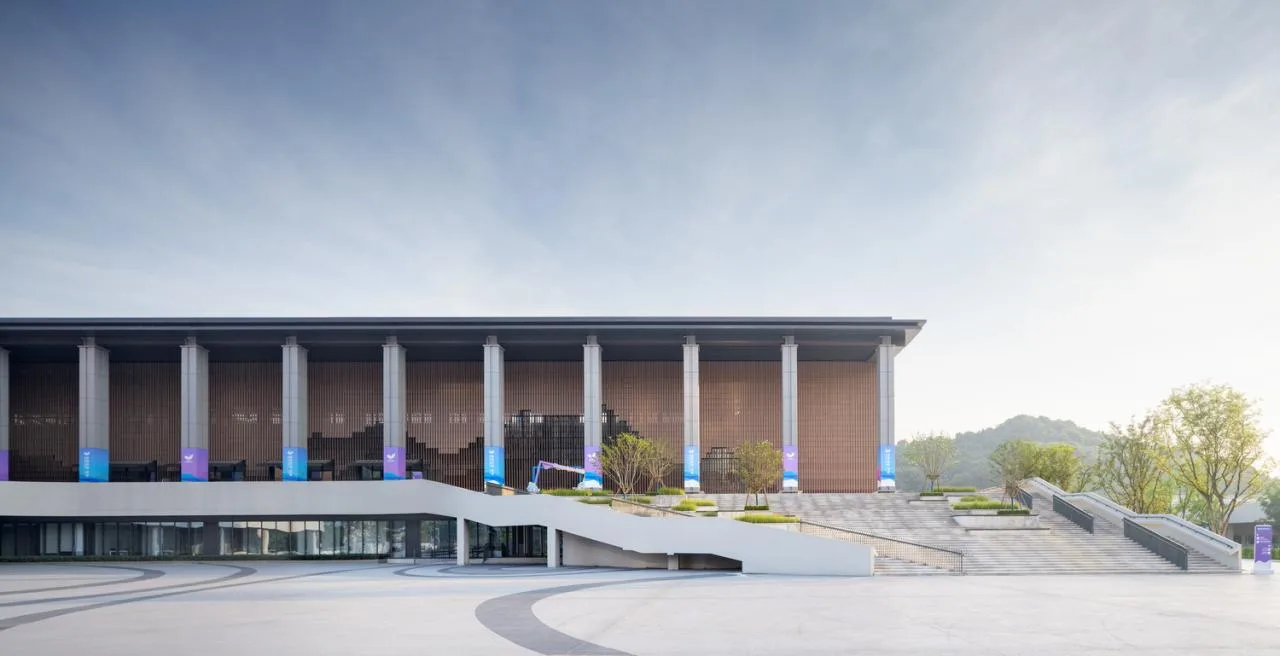
△ Fuchun Landscape Curtain Wall © Zhao Qiang
Parametric and pixelated design reinterpret the Fuchun Mountain Residence map © Zhao Qiang
The architecture intentionally avoids high-tech solutions such as mechanization, intelligence, and informatization, opting instead for modular, low-cost standard components to achieve a low-tech approach. The design uses 300mm by 520mm louvers as unit modules. By rotating over 37,000 of these units at different angles using a simple pivot mechanism, the facade “paints” the natural scenery of the Fuchun River—”using louvers as pens and sunlight as ink.”
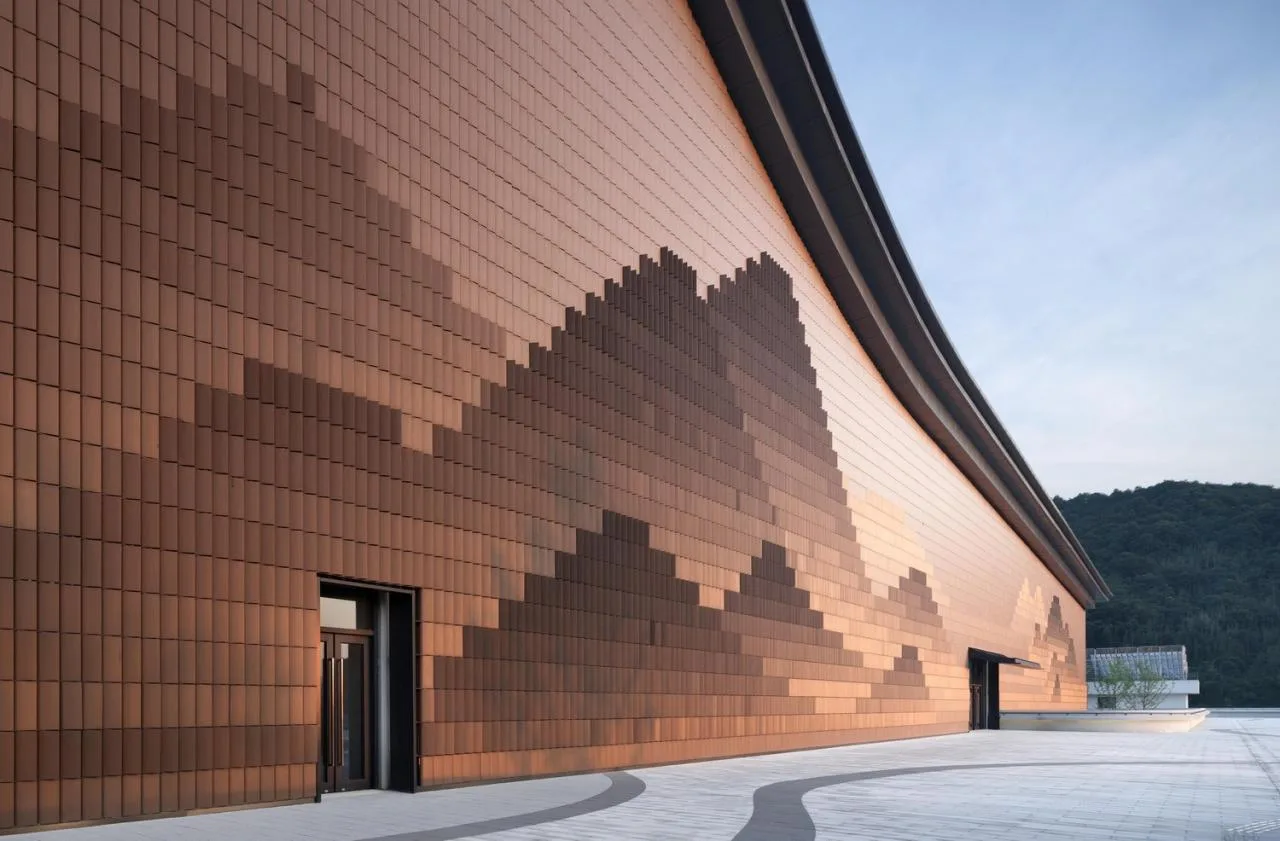
△ Over 37,000 louver units with varying rotation angles recreate the natural scenery along the Fuchun River © Zhao Qiang
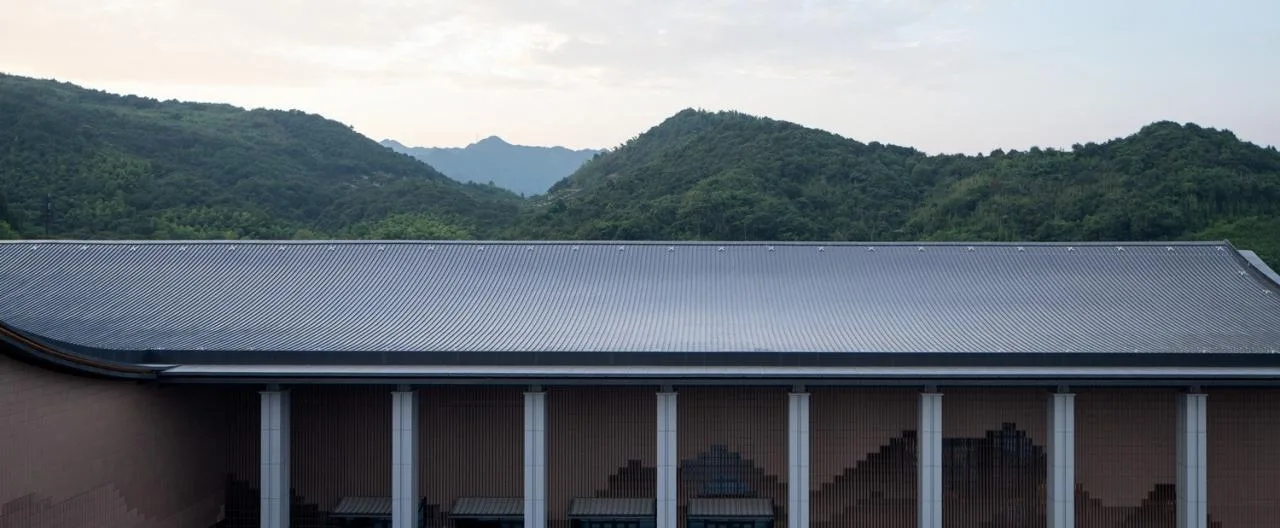
△ The louvered curtain wall reflects the distant mountain landscape
Construction Details
The rotation angle of each louver is controlled by a gear at its base. Each gear allows rotation increments of 5°, with angles ranging from 15° to 85° in 15 steps: 15°, 20°, 25°, 30°, 35°, 40°, 45°, 50°, 55°, 60°, 65°, 70°, 75°, 80°, and 85°. Smaller angle increments increase the number of units, enhancing pixel density and clarifying the landscape’s design intent. During construction, installers simply follow the angle diagram to accurately position each louver. These 15 louver angles, combined with sunlight, create complex and dynamic visual patterns.
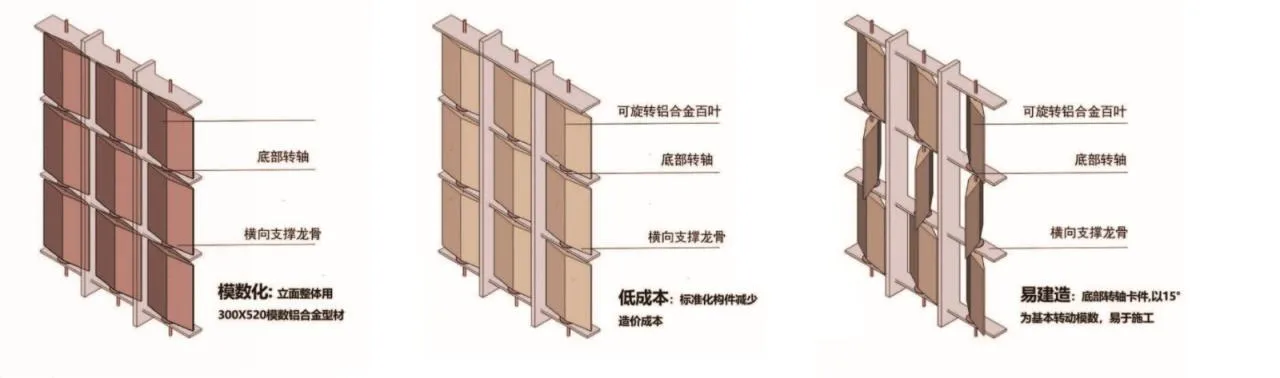
△ Unit louver structure
Natural Light as Inspiration
The principle of “light follows nature” stems from the idea of imitating nature—not only replicating natural forms but also learning from natural light’s behavior. By mimicking the nuances of light and shadow, the architecture reinterprets nature in a simple, organic manner.
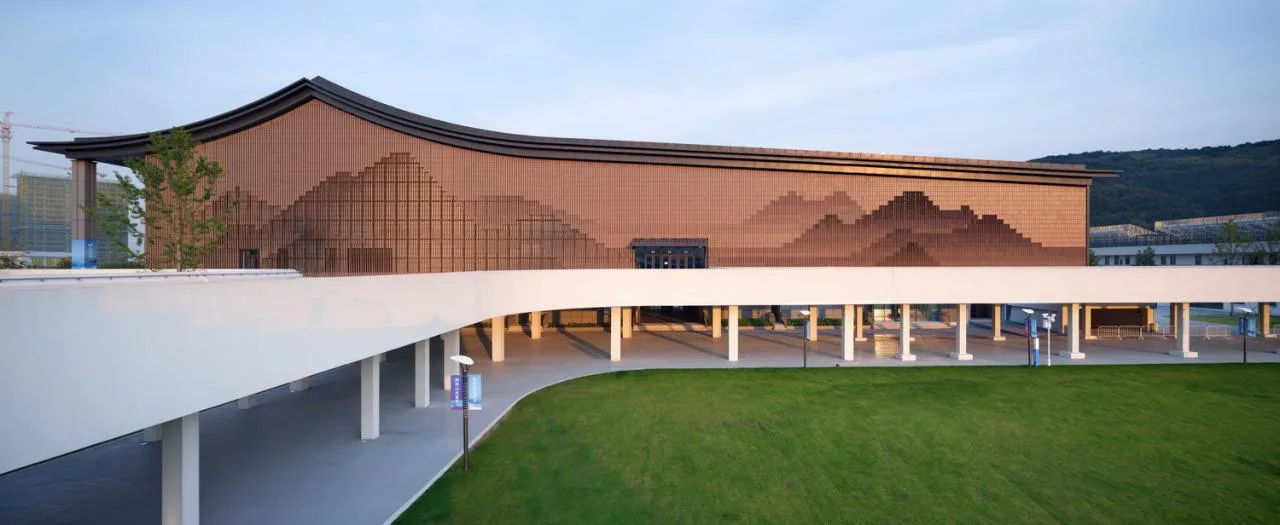
The changing light and shadows of the blinds narrate the story of light © Zhao Qiang
As sunlight shifts throughout the day, the building’s facade transforms. At dawn, the facade gradually reveals itself as shadows recede; at noon, direct sunlight highlights the contrast between louvers, clearly presenting the distant mountains and nearby waters. As the sun sets, the rich spring landscape—distant mountains, boats, and ancient trees—slowly fades into the building’s surface. At night, floodlights illuminate the facade, reawakening the scenery. The movement of light and shadow silently records the passage of time, breathing life into the architecture.
The design cleverly harnesses natural light and seasonal variations to recreate the vibrant spring scenery.
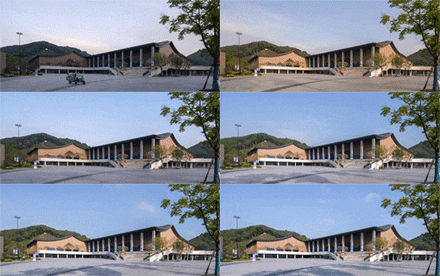
△ Facade skin that changes with light © Wu Qingshan
Sustainable Operation
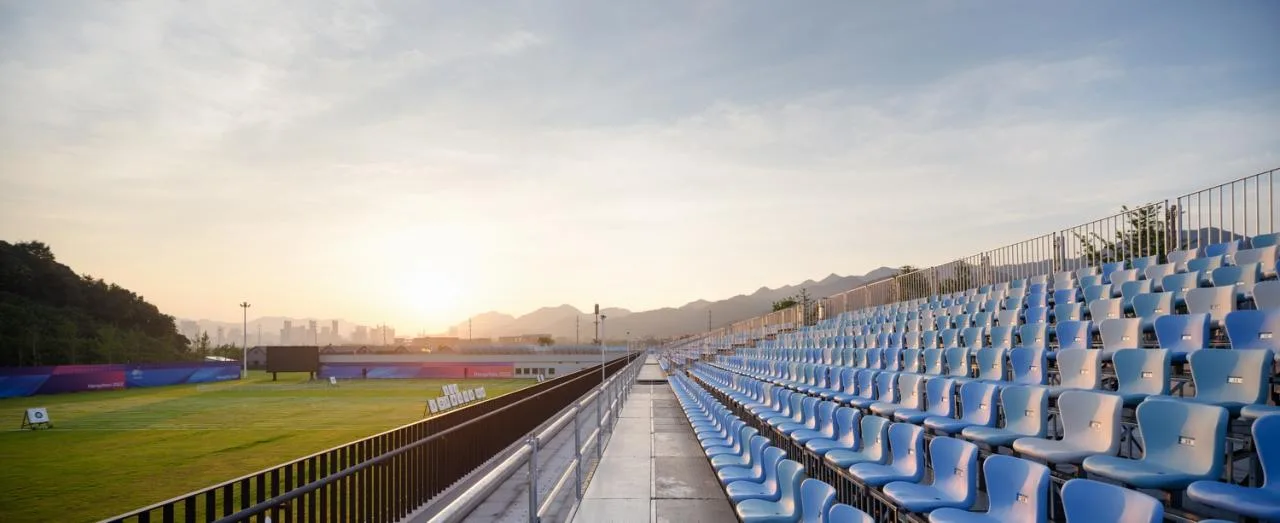
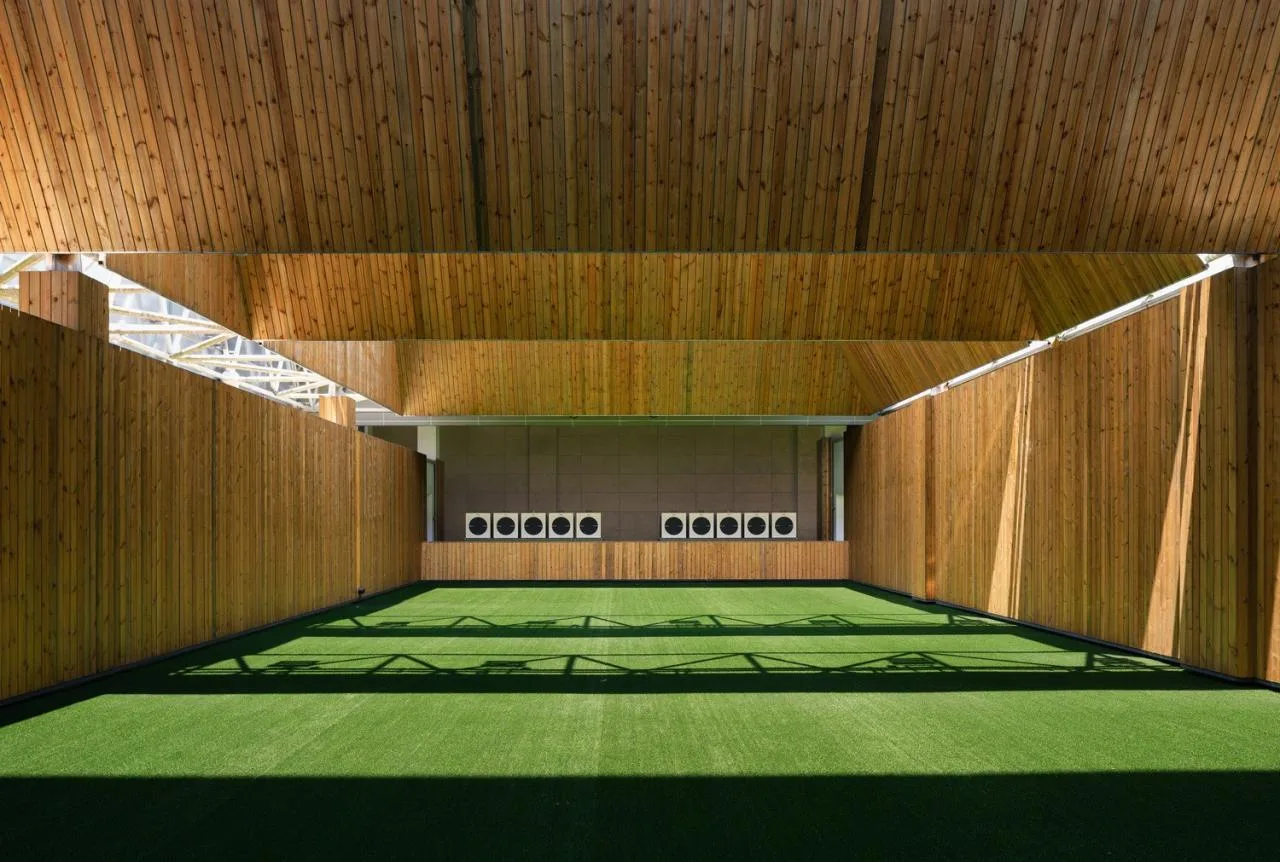
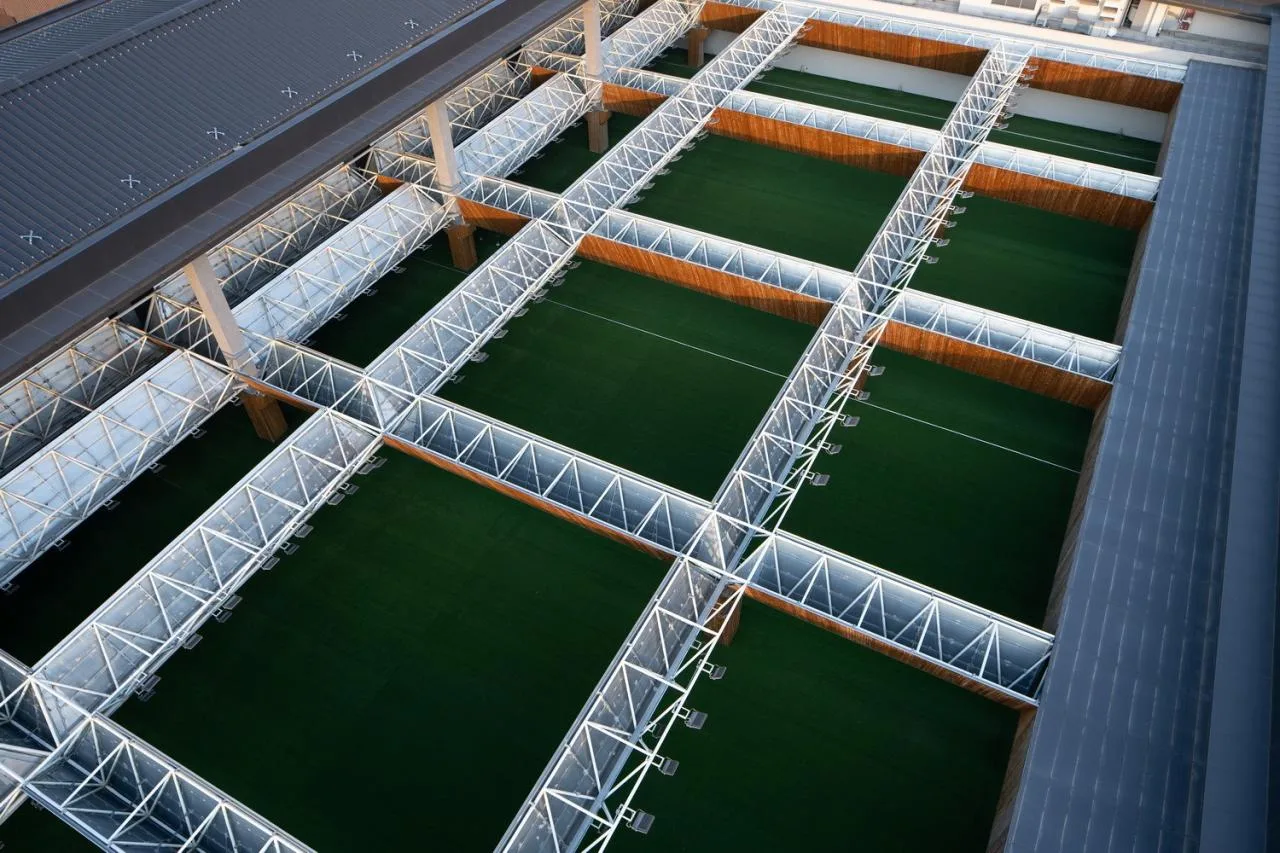
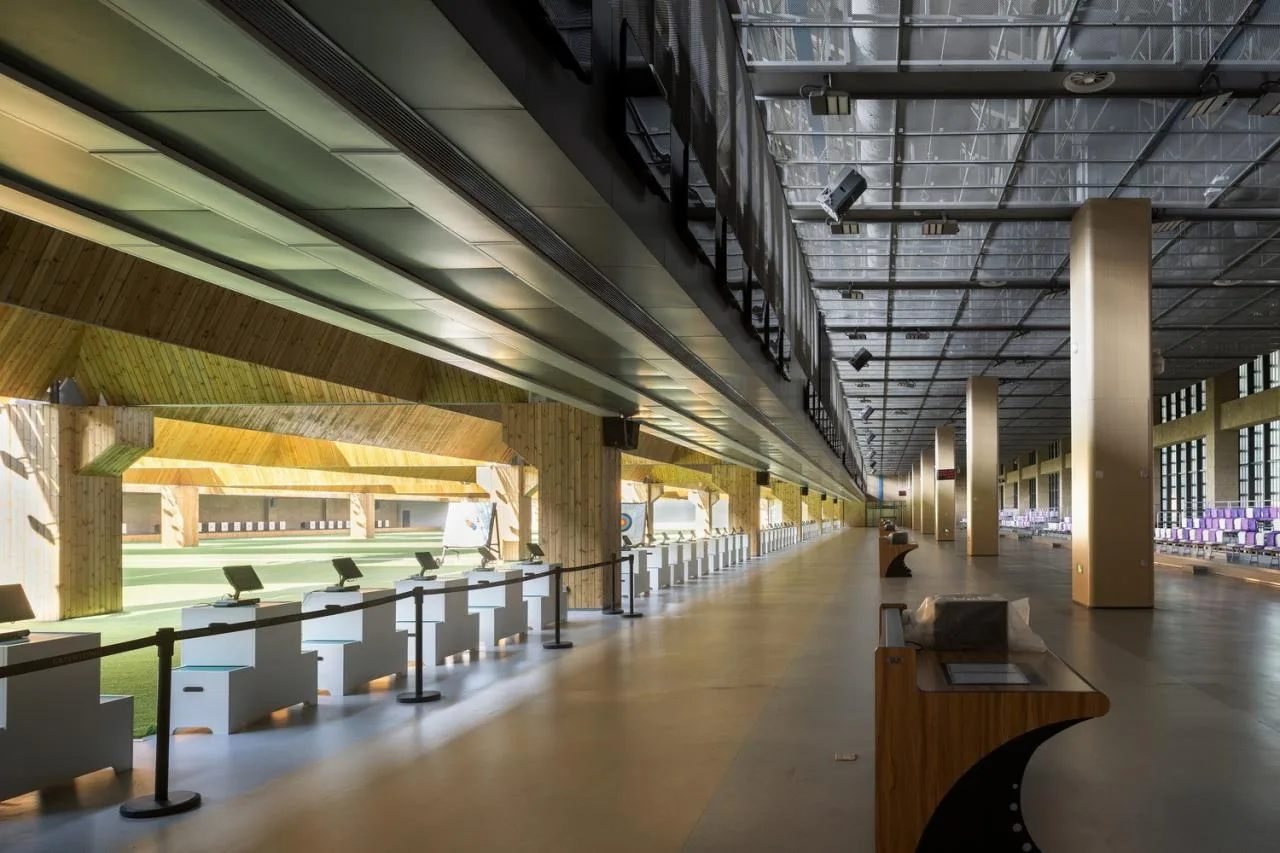
Competitive sports venues often face challenges of high investment with low usage, especially for specialized venues with small audiences, like the Silver Lake Sports Center. This project adopts a green, low-carbon design strategy focused on rapid construction, easy demolition, and component reuse. Structural choices and building facilities were planned to accommodate various post-competition scenarios: the news security center, auxiliary buildings, stables, and other facilities use recyclable steel structures; spectator stands are temporary steel structures that can be dismantled after the Games; competition venues will be converted into facilities for popular sports such as swimming, basketball, badminton, and table tennis to encourage public participation and sustain long-term use.
△ Temporary seating for archery, UFO, and modern pentathlon events © Zhao Qiang
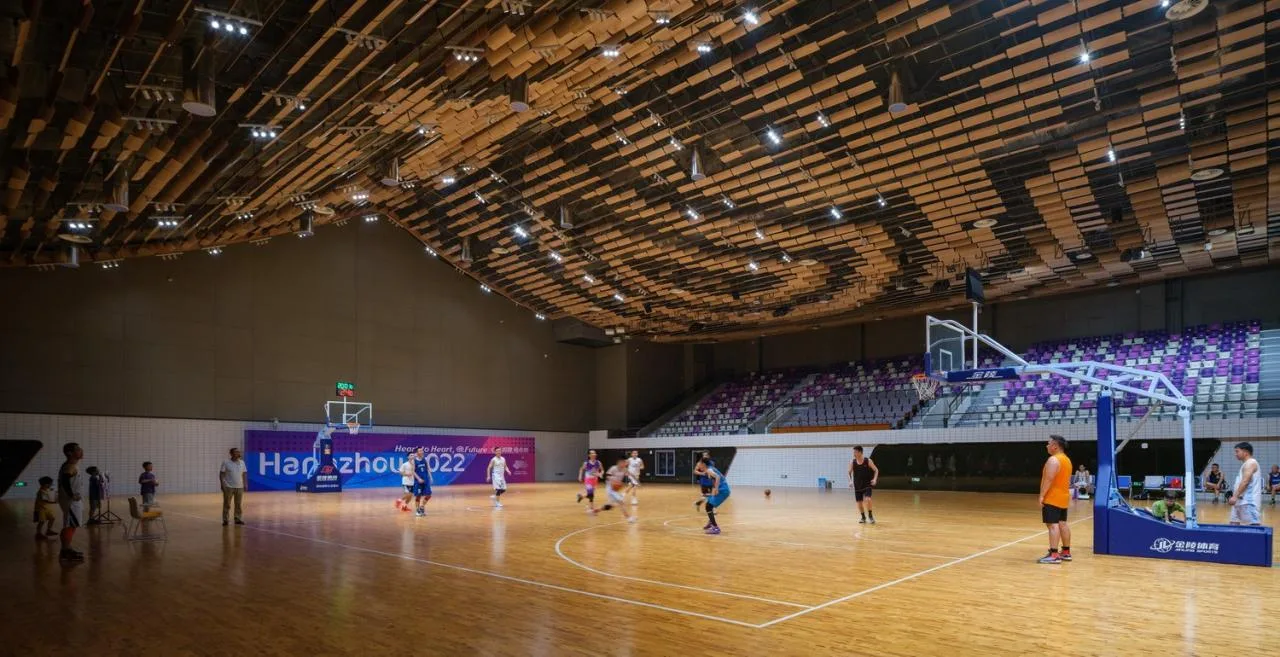
During competitions, the modern pentathlon’s fencing area can be converted into a 25-meter swimming pool afterward © Zhao Qiang
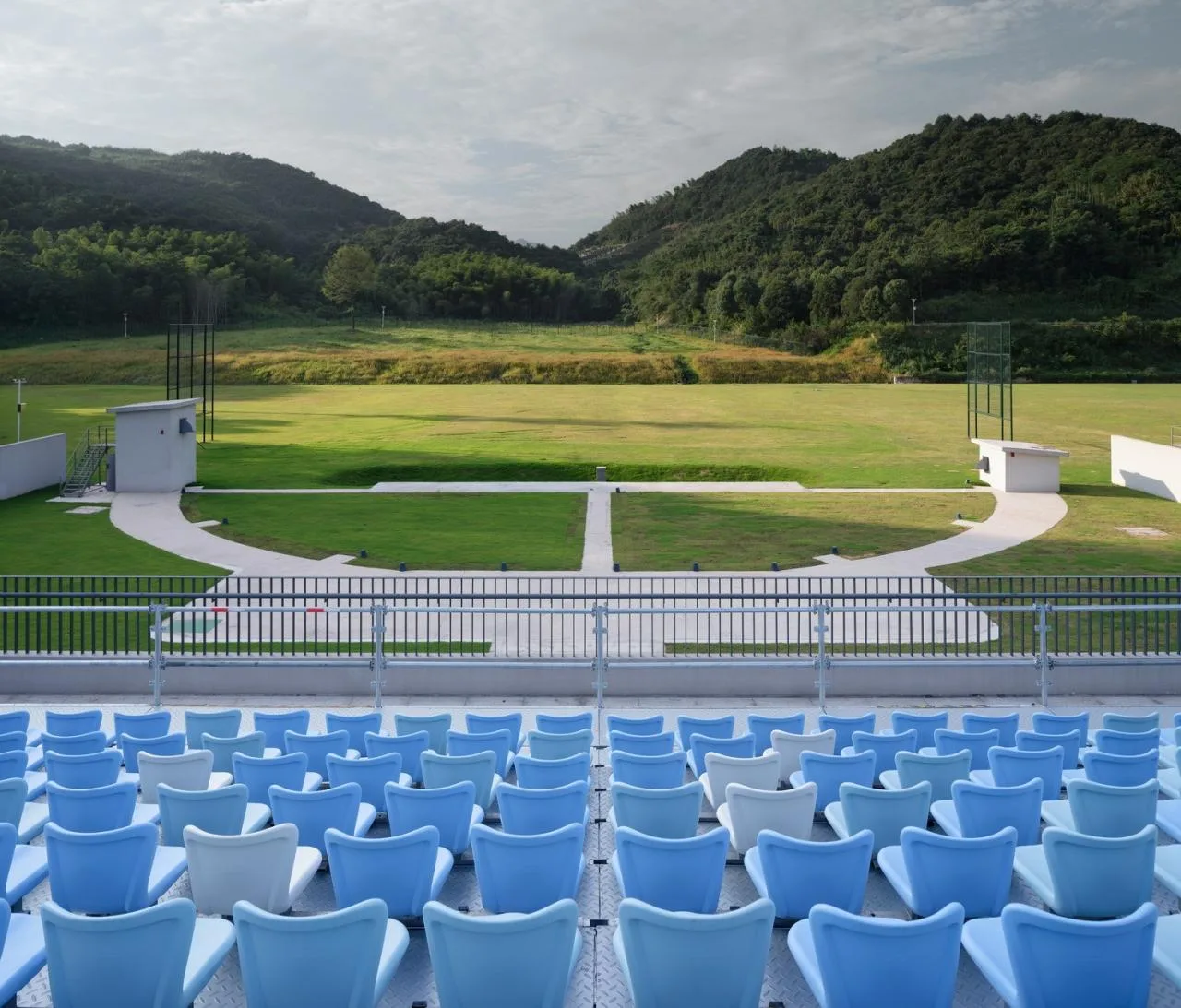
△ Outdoor UFO Field © Zhao Qiang
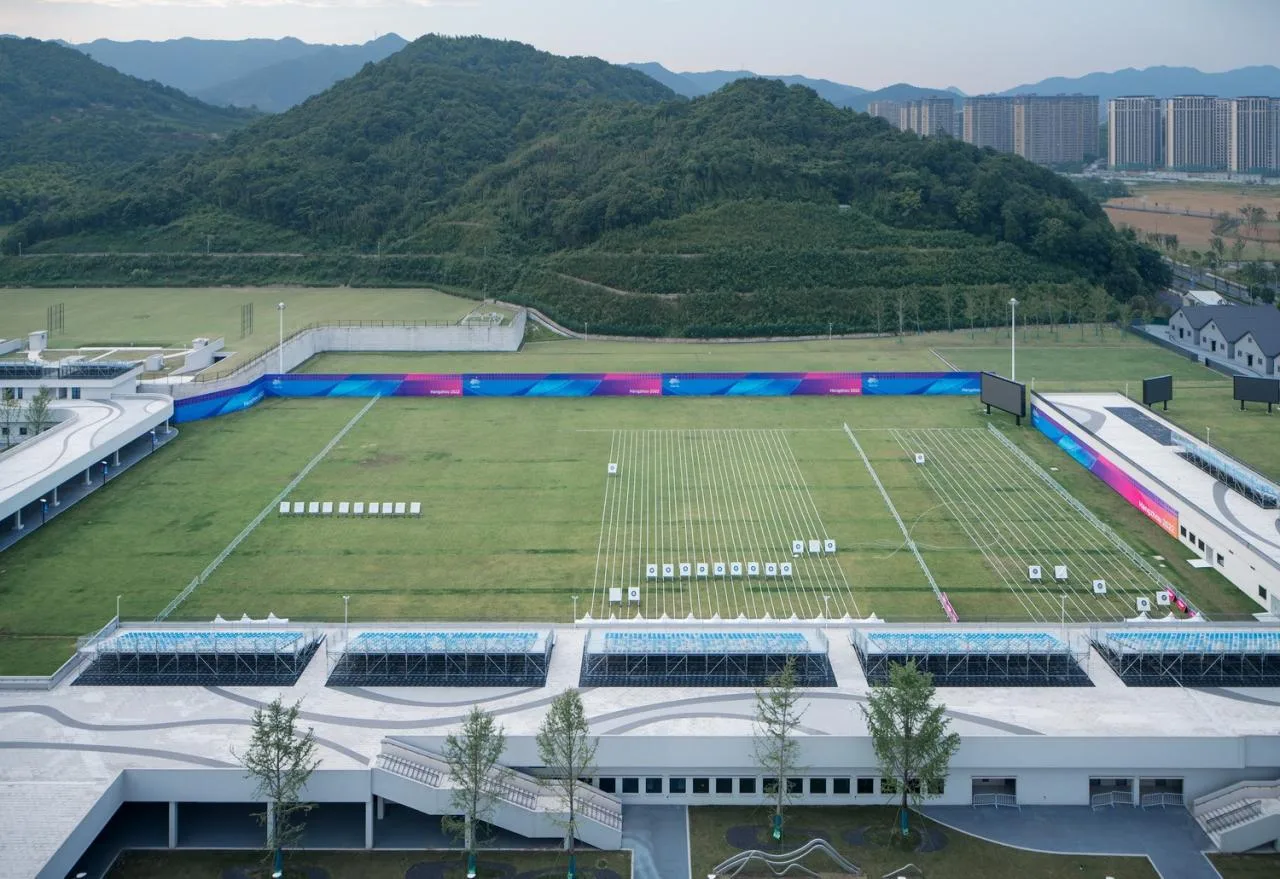
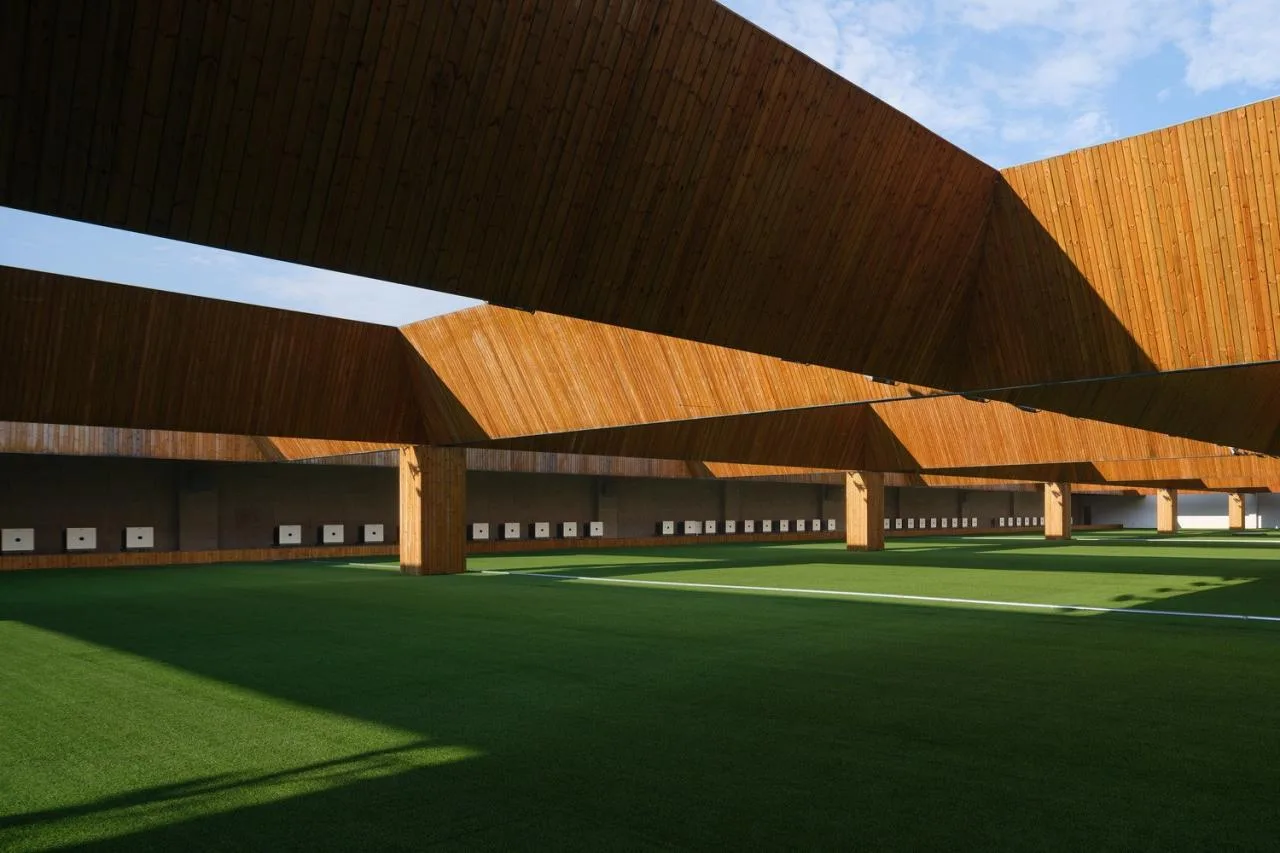
△ Outdoor venue integrated with natural environment © Zhao Qiang
The project draws inspiration from the natural mountains and rivers, using blinds as a pen and sunlight as ink to reinterpret nature. This approach expresses and interprets the Jiangnan landscape of the “Fuchun Mountain Residence” through brushstrokes, techniques, and construction methods. It serves as a cultural transmission, sharing Hangzhou’s charm and Fuyang’s landscape features with the world.
Project Drawings
Project Information
Project Name: Fuyang Yinhu Sports Center – Asian Games Shooting and Archery Modern Pentathlon Hall
Project Type: Sports Architecture
Architectural Design: ACRC, Zhejiang University Architectural Design and Research Institute
Location: Hangzhou, Zhejiang, China
Address: West Intersection of Jiulong Avenue and Longxi South Road, Yinhu New District, Fuyang, Hangzhou, Zhejiang Province
Status: Completed
Design Period: July 2018 – March 2019
Construction Period: March 2019 – June 2021
Land Area: 275,182 square meters
Building Area: 82,360.35 square meters
Photography: Zhao Qiang
Video Filming: Wu Qingshan
Design Director: Hu Huifeng
Project Managers: Zhang Chenfan, Li Bing
Architecture Team: Zhang Chenfan, Fang Hua, Lv Ning, Huang Diqi, Zhu Jinyun, Zhang Ziquan
Structural Engineers: Zhang Zhengyu, Jiang Fan
Water Supply & Drainage: Ouyang Hui, Wang Tiefeng
HVAC: Cao Zhigang, Zhu Shengwei, Li Xintong
Electrical: Yuan Songlin, Feng Shizhen, Zou Fan, Zheng Kai
Intelligence Systems: Lin Hua, Ye Agile, Yuan Xiaonan
Lighting: Wang Xiaodong, Wang Junjie, Liu Yihan, Feng Baile, Wu Xuhui
Decoration: Ye Jian, Huang Jiang, Hui Lin, Yun Hui
Electrical Decoration: Xiao Shuzheng, Yu Zicheng
Curtain Wall: Hang Feizhen, Lisa Luo Wenxin, Yuan Zengrong
Landscape: Feng Bin, Wu Jina, Shen Haitao, Zhang Beibei, Xu Hui, Wang Jue, Zhu Qunjian
Municipal Works: Chen Hao, Wu Lingling, Ling Jiayuan, Zhou Hua, Zhu Min, Wang Xueyan, Sun Zhe
Geotechnical: Chen Yun, Yang Qinfeng, Xin Lei, Gu Jiacheng
Client: Hangzhou Fuyang Yinhu New Area Construction Co., Ltd
Construction Contractor: Shanghai Baoye Group Co., Ltd
Roof: Aluminum-magnesium-manganese metal roof
Facade: Aluminum alloy louvered curtain wall
Interior Facade: Wood fiber sound-absorbing panels















Must log in before commenting!
Sign Up