
Architectural design has revealed numerous challenges, but the implementation of BIM technology can effectively address these issues, enhancing engineering quality and boosting productivity in the construction industry. This has garnered significant public attention, and to ensure the successful adoption of this technology, practical strategies must be put in place.
1. Government Support: Increase Funding and Encourage Enterprise Adoption
To promote and apply BIM technology effectively, government agencies must take a leading role in guiding the construction industry. Due to the high costs associated with BIM modeling, many small and medium-sized enterprises lack the capacity to develop and implement BIM solutions, often overlooking its potential benefits in construction projects. To incentivize adoption, governments should introduce policies offering financial rewards and economic assistance to construction companies that integrate BIM technology. Establishing dedicated government BIM funds can help alleviate the financial burden on private enterprises, fostering widespread use and advancement of BIM throughout the industry.
2. Enhancing Collaborative Design
With the rapid growth of construction projects in China, characterized by diversity and complexity, architectural design has become increasingly challenging. Employing scientific and efficient design methods is essential. BIM technology facilitates collaboration by accurately simulating building components within a unified technical platform. This improves data coordination and ensures that every building module integrates seamlessly, promoting more rational modern architectural designs. By minimizing design errors and enhancing interdepartmental cooperation, BIM supports optimal layout planning aligned with contemporary construction systems.
3. Visualizing Construction Projects
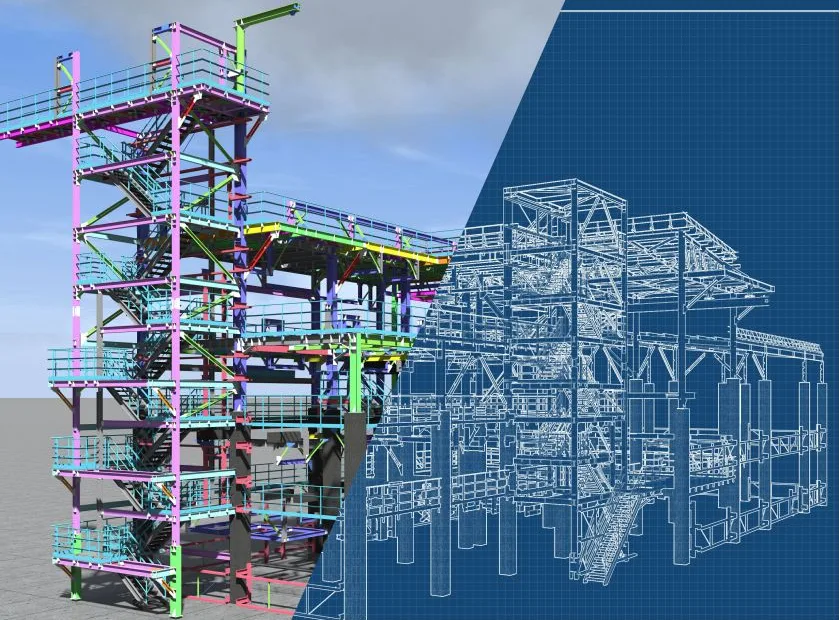
Visual design combined with 3D modeling significantly highlights the unique features of structural elements and helps prevent non-compliance during later construction phases. Traditional CAD software mainly produces two-dimensional models using geometric shapes to represent structural forms, but these cannot guarantee an accurate three-dimensional portrayal of the building. BIM technology enables the creation of detailed 3D models, allowing construction teams to fully understand the project’s overall characteristics. This visualization assists in making informed design and layout decisions based on real conditions. Consequently, BIM enhances project visualization by dynamically demonstrating construction effects, thereby optimizing design schemes and facilitating scientifically sound building processes.
4. Detailed Design of Project Components
BIM technology is applied not only to steel structure modeling but also to critical details such as connections between frame structures and equipment pipelines, and the compatibility of frame structures with elevator systems. Attention to these details is crucial for ensuring building quality. Therefore, designers must deepen their BIM expertise and master its technical applications. This proficiency allows for flexible integration of various architectural details, ultimately elevating the overall design quality of construction projects.
In conclusion, these strategies highlight key approaches to advancing BIM technology in architectural design. Perspectives may vary, but I hope this article offers valuable insights for everyone interested in this field.
















Must log in before commenting!
Sign Up