
The core value of BIM technology lies in constructing building models that link 3D model attributes with their components. This approach offers visualization, manageability, easy data analysis, and shareability. Today, BIM technology is widely applied in large-scale construction projects. With its many uses—such as virtual construction, clash detection, and detailed design—it has become a national standard and strategic tool. BIM brings significant benefits to construction projects by reducing rework, lowering owner costs, and improving collaboration efficiency.
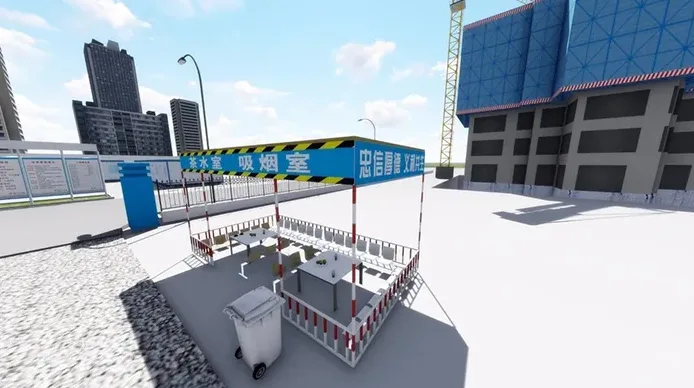
1. Construction Site Application Planning
In an engineering project’s long lifecycle, the construction phase is crucial as it brings the project into physical reality. No matter how sophisticated virtual simulations are, real-time and spatial details cannot be overlooked. Therefore, to realistically simulate construction processes and evaluate complex planning, BIM models must incorporate the sequence, timeline, and composition of model components from the point of 3D modeling—not necessarily only during design.
This phase focuses on using BIM models, including the current state of the construction site, to plan on-site operations and spatially simulate the placement of personnel, machinery, and materials. It generates temporary facility layouts and material staging plans for each construction stage, helping identify potential spatial and scheduling conflicts to select the most feasible construction approach.
2. 3D Control and Planning in BIM
The task of 3D control and planning involves using BIM’s 3D models to simulate the spatial arrangement of building components during construction, as well as to create construction drawings. These “lifting drawings” are made by importing existing 2D graphic data into the BIM model, linking relevant 2D information to the components, and producing combined 2D/3D construction documentation. These drawings serve as key references for on-site supervisors.
3. Construction System Design
The BIM execution team uses BIM models and specialized 3D software tools to design and analyze complex building systems—such as formwork, curtain walls, or retaining structures—to improve construction planning quality. This process enhances construction efficiency, boosts productivity, and increases awareness of safety considerations within complex systems.
4. Digital Construction
The BIM team integrates BIM 3D model data with automated mechanical manufacturing technologies to produce physical building components. This digital construction process parallels traditional CAD/CAM methods but is referred to as BIM/CAM. It involves breaking down the 3D model into manufacturable parts and feeding these into automated machinery for fabrication.
5. Coordination Work
Since the introduction of BIM, its concepts have been quickly embraced by the industry. However, despite the promise of BIM-capable software tools, effective implementation still requires robust engineering information management systems.
Nonetheless, BIM software tools—featuring parameter setting engines and 3D model visualization—have proven highly effective in improving traditional coordination meetings. When combined with proper version control of BIM models and data centers, the benefits multiply. Therefore, projects adopting BIM should prioritize “BIM 3D coordination operations.”
The BIM team bases their work on BIM models and uses automated clash detection software to identify conflicts between 3D components. This process of simulation, review, and correction during coordination meetings is known as “3D coordination work.” Utilizing BIM 3D coordination during the design phase is equally important.
6. Modeling the Current Construction Site Conditions
The BIM team develops 3D models that reflect the current conditions of the construction site, including geographic environment, surroundings, on-site facilities, and equipment. These models can be created in various ways depending on project needs and future value. Capturing the current state data helps document construction history, provide environmental records, improve accuracy in describing site conditions, and support subsequent project phases.
7. Construction Project Planning
Using 4D models—which add a time dimension to 3D models—the BIM team plans the sequencing of work segments during construction, renovations, or operational phases. This approach links construction schedules with BIM components and supports timeline-based planning. 4D modeling is a powerful visualization and communication tool that helps all project stakeholders, including owners, clearly understand project milestones and construction details. It provides better insight into scheduling and highlights critical paths.
In summary, these points highlight the critical significance of BIM technology in construction. We hope this article offers valuable insights to everyone interested in the field!
















Must log in before commenting!
Sign Up