
What is the accuracy of BIM models? When discussing LOD100, 200, 300, and so on, many industry professionals recognize that these levels indicate the model’s accuracy. Detailed explanations on this subject can be found on platforms like Baidu and other encyclopedias.
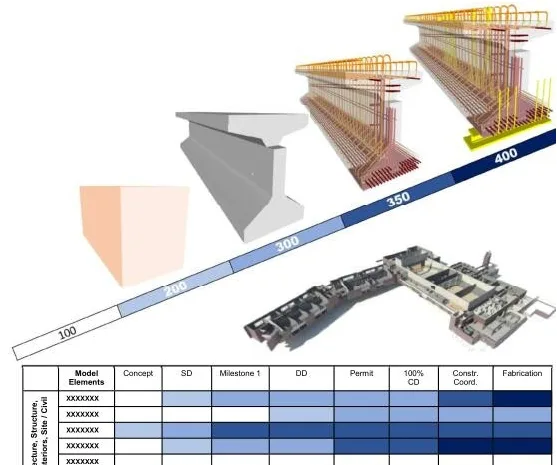
1. BIM Model Accuracy
BIM model accuracy, also referred to as the Level of Development (LOD), originates from the American Institute of Architects (AIA). While the specific role of AIA can be researched separately, the key point here is that AIA developed the LOD framework to clarify responsibilities regarding the integration of BIM component data into contractual agreements. In simple terms, it defines what level of BIM detail should be created at each stage of a construction project. Importantly, BIM models aren’t just about achieving maximum precision—they need only be accurate enough to meet the requirements of their particular project phase.
2. Levels of BIM Model Accuracy
The AIA specifies five LOD stages—LOD100, LOD200, LOD300, LOD400, and LOD500—that describe the information content and development level of BIM components throughout a project. Here’s an overview:
LOD100: Typically used during the planning and conceptual design phase. It includes basic volume data such as length, width, height, volume, and location. This level supports overall project analysis by stakeholders like designers and owners, covering aspects like capacity, orientation, and cost per unit area.
LOD200: Also part of the design phase, often for schematic or preliminary design. It involves approximate quantities, sizes, shapes, locations, and orientations of building elements. General performance analyses can also be performed at this stage.
LOD300: Refers to detailed design. BIM components at this level contain precise information on size, position, and orientation. This detail enables more thorough analyses and simulations, such as clash detection and construction sequencing. The related LOD350 level adds detailed interface information necessary for the assembly of building systems or components beyond LOD300.
LOD400: Covers construction, fabrication, manufacturing, and assembly phases. Models at this stage include all information required for complete manufacturing, assembly, and detailed construction tasks.
LOD500: Represents the as-built model after project completion. It contains accurate data on actual dimensions, quantities, locations, and orientations. This model serves as a reliable reference for operations and maintenance teams.
This summary provides a concise introduction to BIM model accuracy levels, aiming to assist everyone in understanding their purpose and application.
















Must log in before commenting!
Sign Up