
BIM technology significantly enhances the efficiency of collaborative building design by reducing design errors and optimizing the production process of prefabricated components. It also improves inventory management, simulates and refines construction workflows, and enables quality control and energy management during the building’s operation and maintenance phase. Overall, BIM effectively boosts the efficiency of building design, production, and construction.
1. Standardizing the Design of Prefabricated Components
BIM enables open and shared access to design information. Designers upload building design schemes to a project “cloud” server, integrating details such as dimensions and styles. This process creates a comprehensive “family” library of various prefabricated components. As this library grows, designers can compare and optimize similar components to establish standardized shapes and modular sizes for prefabricated buildings. This “family” library serves as the foundation for unified design specifications and standards.
2. Simulating Lifting Construction and Adjusting Schedule Plans
By breaking down prefabricated components and extracting relevant data, BIM provides precise information for their production. The BIM model links component manufacturing, transportation, and lifting processes with timelines, allowing 3D dynamic simulations of lifting plans. Integrating the BIM model with project schedules enables 5D project management, where planned versus actual progress can be analyzed to monitor and optimize workflow.
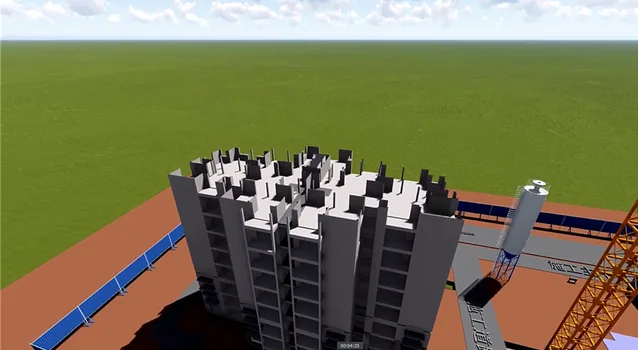
Furthermore, BIM can simulate the construction site environment, allowing planners to pre-determine crane directions and approaches. This enhances worker accuracy and construction equipment precision, ultimately delivering optimal construction plans.
3. Collaborative Work and Issue Tracking
The greatest strength of BIM lies in its informatization and collaborative capabilities. It provides a 3D information exchange platform for all construction stakeholders. Different professional models merge and interact within this shared environment, facilitating interdisciplinary collaboration.
Issue tracking supports multi-disciplinary planning throughout the building lifecycle. Each specialty imports the BIM model into issue-tracking software to simulate construction, review potential problems, and systematically analyze and document conflicts. This process resolves clashes caused by poor information exchange, optimizes engineering plans, and addresses issues before construction begins, reducing costly design changes and rework.
These are the key applications of BIM technology in architectural design. Opinions may vary, but I hope this overview proves helpful to everyone!
















Must log in before commenting!
Sign Up